
TRANSPORTATION ENGINEERING II (ENCE 353)
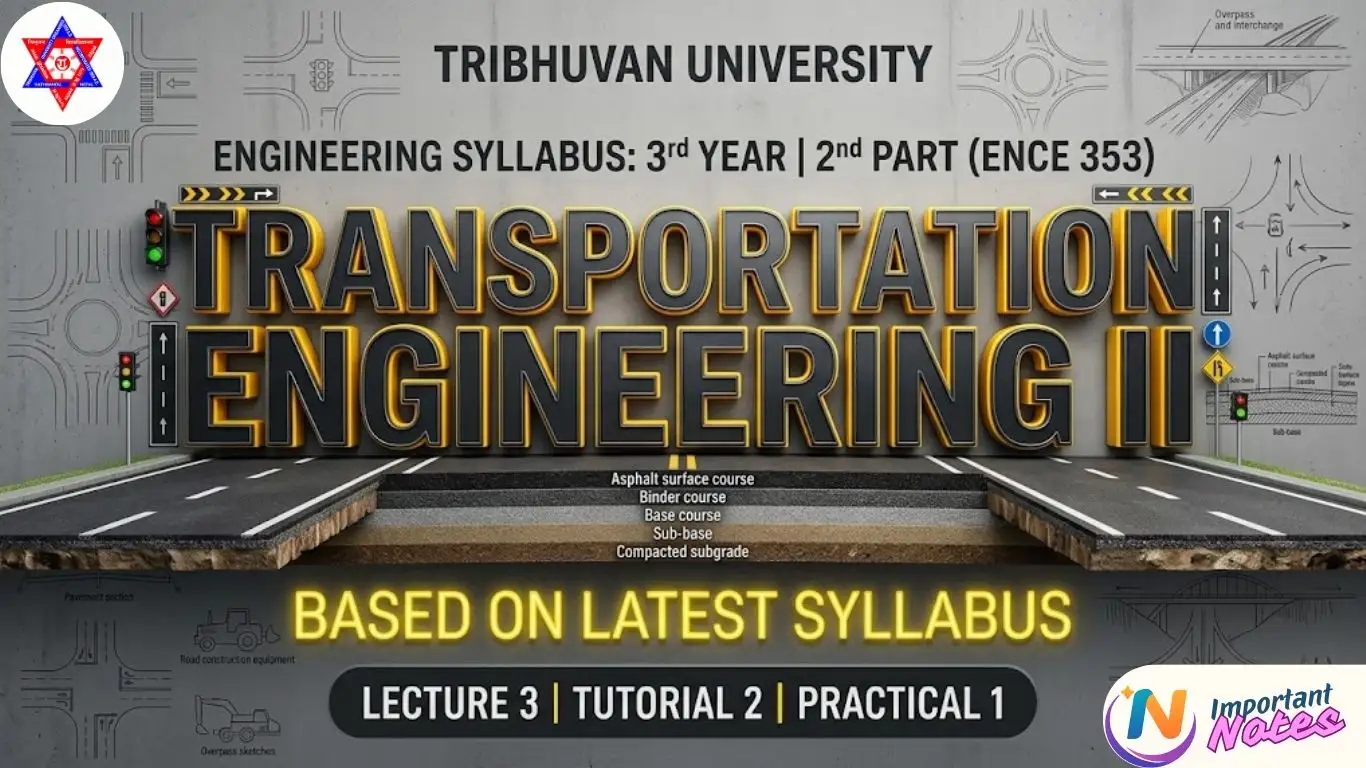
Course Objectives
The objective of this course is to provide students foundational knowledge in traffic engineering, traffic survey, traffic control and management, the basic principles of pavement design, the construction process of bituminous and cement concrete roads and the various problems in highway pavement and maintenance methods.
The comprehensive Transportation Engineering II ENCE 353 syllabus integrates advanced concepts from the Department of Roads (DoR) and international highway design standards to ensure students are equipped for real-world traffic and pavement challenges.
Detailed Syllabus
1.1 Traffic volume studies
1.2 Traffic speed and delay studies
1.3 Origin and destination study
1.4 Basic traffic flow parameters
1.5 Traffic capacity and level of service
1.6 Parking studies
1.7 Crash studies
2 Traffic Control Methods (7 hours)2.1 Types of intersections
2.2 Un-channelized and channelized intersections
2.3 Grade separated intersections (Overpass, underpass and interchanges)
2.4 Rotary intersection
2.5 Traffic control devices: Traffic sign, marking and islands
2.6 Traffic signal
2.7 Warrants for traffic signalization
2.8 Traffic signal design by Webster method
2.9 Traffic calming measures
2.10 Importance and design of street lighting
3 Pavement Design (14 hours)3.1 Introduction, types and structural components of pavement
3.2 Factors controlling pavement design
3.3 Historical development of pavement structures (Flexible pavement design): Theoretical (Bousinesq and Burmister approach); Semi empirical (Tri-axial approach); and empirical methods
3.4 Design of flexible pavement by IRC, DoR guidelines, Road Note 31, AASHTO method
3.5 Rigid pavement design (Westergaard theory)
3.6 Design of rigid pavement by latest IRC and AASHTO method
3.7 Pavement design (Surface dressing method) for low cost road, IRC method
4 Road Construction Technology (7 hours)4.1 Activities and techniques used in road construction
4.2 Road construction equipment and plants
4.3 Preparation of sub-grade: Excavation, fill and compaction
4.4 Mass Haul diagram
4.5 Granular, water bound macadam, soil stabilized sub base and base course
4.6 Prime coat and tack coat
4.7 Sand seal and slurry seal
4.8 Bituminous surface and base course: Surface dressing, grouted or penetration macadam
4.9 Bituminous premixes (Dense bituminous macadam; Bituminous concrete)
4.10 Cement concrete pavement and joints in cement concrete pavement
4.11 Concept on the construction of recycled pavement
5 Pavement Maintenance (4 hours)5.1 Difference between maintenance and rehabilitation
5.2 Classification of road maintenance
5.3 Causes of flexible and rigid pavement failure
5.4 Maintenance of low cost roads (Earthen, gravel and WBM roads)
5.5 Maintenance of flexible pavement and rigid pavement
5.6 Pavement evaluation method
5.7 Overlay and its types
5.8 IRC method of overlay design for flexible pavement
5.9 Concept of performance based maintenance
Tutorial (30 hours)
1. Data collection, analysis, report preparation and presentation on traffic data (Volume, speed, parking, crashes and other traffic data)
2. Design of road pavement (Rigid and flexible) and usage of DOR design sheet using traffic data from tutorial 1 and CBR from cone penetration test
3. Case study on pavement failures from field inspection and presentation
4. Case study on traffic control and management
Practical (15 hours)
1. Visual presentation/demonstration on related topics of traffic engineering
2. Cone penetration test on sub grade soil for CBR
3. Skid resistance test
4. Benkelman beam deflection test
5. Traffic volume and classification count at intersection
6. Spot speed study by manual and radar gun
7. Visual inspection of road construction, road material plant, road pavement failures and report preparation
Final Exam
The questions will cover all the chapters in the syllabus. The evaluation scheme will be as indicated in the table below:
| Chapter | Hours | Marks distribution* |
|---|---|---|
| 1 | 13 | 16 |
| 2 | 7 | 12 |
| 3 | 14 | 16 |
| 4 | 7 | 8 |
| 5 | 4 | 8 |
| Total | 45 | 60 |
* There may be minor deviation in marks distribution.
References
1. Rogers, M., Enright, B. (2016). Highway Engineering. Wiley-Blackwell.
2. Khisty, C. J., Lall, B. K. (2017). Transportation engineering: An introduction. Pearson India Education Services.
3. Shrestha, D. K., Marsani, A. (2020). Transportation Engineering II. Heritage Publishers & Distributors. Kathmandu.
4. Kadiyali, L. R., Lal, N. B. (2017). Principles and practices of highway engineering: Including expressways and airport engineering. Khanna Publishers.
5. Kadiyali, L. R. (2011). Traffic engineering and transport planning. Khanna Publishers.
6. Sharma, S. K. (2014). Principles, practice and design of highway engineering. S. Chand & Company Ltd.
7. Khanna, S. K., Justo, C. E. G. (2017). Highway engineering. Nem Chand & Bros.
8. O’Flaherty, C. A. (2002). Highways: Volume 2 – Highway engineering. Edward Arnold Publishers Ltd.
9. Khanna, S. K., Justo, C. E. G., Veeraragavan, A. (2013). Highway materials and pavement testing. Nem Chand & Bros.
10. Indian Roads Congress. (2001). IRC:37–2001: Guidelines for the design of flexible pavements.
11. Indian Roads Congress. (1998). IRC:58–1998: Guidelines for the design of rigid pavements for highways.
12. Department of Roads. (2021). Guidelines for the design of flexible pavement. Government of Nepal.
13. Department of Roads. (2021). Rigid pavement guideline 2021. Government of Nepal.
Chapter-wise Notes
Based on the latest syllabus of IoE (III/II)
| SN | Chapter | View / Download |
|---|---|---|
| 1 | Traffic Studies and Analysis | View / Download |
| 2 | Traffic Control Methods | View / Download |
| 3 | Pavement Design | View / Download |
| 4 | Road Construction Technology | View / Download |
| 5 | Pavement Maintenance | View / Download |
Practical Manuals & Reports
Complete lab manual logs and testing guides for Transportation Engineering II ENCE 353
| SN | Practical / Assignment Name | View / Download |
|---|---|---|
| 1 | Visual presentation/demonstration on related topics of traffic engineering | View / Download |
| 2 | Cone penetration test on sub grade soil for CBR | View / Download |
| 3 | Skid resistance test | View / Download |
| 4 | Benkelman beam deflection test | View / Download |
| 5 | Traffic volume and classification count at intersection | View / Download |
| 6 | Spot speed study by manual and radar gun | View / Download |
| 7 | Visual inspection of road construction, road material plant, road pavement failures and report preparation | View / Download |
Miscellaneous Items & Tutorials
| SN | Item | Description | Download |
|---|---|---|---|
| 1 | Traffic Survey Reports | Complete Traffic Volume, Speed, and Delay Study Reports | Download |
| 2 | Past Year Questions | Collection of previous exam papers for Transportation Engineering II ENCE 353 | Download |
| 3 | Tutorial Solutions Book | Full step-by-step solutions for Pavement Design and Traffic Management tutorials | Download |
Read Also:
Explore the complete collection of syllabi for all engineering disciplines and notes from the Institute of Engineering (IOE).
View All IOE Engineering Syllabi📄 Disclaimer: All Transportation Engineering II ENCE 353 notes, syllabus details, exam schedules, and guides shared here are based on the Latest curriculum of IoE and are primarily sourced from official structures.
If you are the original content creator of any material provided here and wish for removal or credit, kindly contact us. We respect intellectual property rights and will act promptly.