

ENCE 355 • Marks: 8
PROFESSIONAL AND SOCIAL ENGINEERING
Topic: Social Engineering
Syllabus Overview
6 Hours | Marks: 8
CHAPTER 5: SOCIAL ENGINEERING (6 hours)
5.1 Concept and Scope of Social Engineering
5.1.1 Definition of Social Engineering
Social engineering is fundamentally rooted in sociology and psychology but applies to various fields.
- ‘Social’: Refers to a group of individuals.
- ‘Engineering’: The application of science to resolve human problems or social issues.
- ‘Social Engineering’ (General): The use of applied science to resolve human-related problems within a social group.
Definitions across different disciplines:
- (a) In Sociology: Any intentional effort applied to influence or manipulate social structures, behaviors, or institutions to achieve specific goals. It involves interventions to shape social dynamics, societal reform, and manage social change. The intention may be negative or involve positive initiatives to improve societal well-being, promote social justice, and address inequalities.
- (b) In Political Sciences: The concept of manipulating people to change human attitudes or social behavior on a large scale. It attempts to influence people to achieve certain goals or take specific actions effectively and uninterruptedly.
- (c) In Jurisprudential Sense: Applied for the formulation of laws to control human behavior relatively for the welfare of the society. Any law or governance can be the output of social engineering.
- (d) In Civil Engineering: Refers to a thoughtful design/planning of physical infrastructure and environment to influence and shape human behavior and social outcomes. It acts as a multidisciplinary tool to bridge technical designs with human behavior to ensure useful, safe, and socially acceptable infrastructure.
- (e) In Cybersecurity: Currently used to describe the psychological manipulation of people to disclose confidential information for system breaching. It focuses on human hacking targeting the human mind.
Common Sense Definition: Social engineering refers to any act that influences a person to take an action that may or may not be in his or her best interests. It has both positive and negative aspects.
5.1.2 Concept of Social Engineering
Social engineering, knowingly or unknowingly, has been used from ancient times by rulers, governments, businessmen, and individuals to manipulate and exercise social behavior to achieve specific goals.
- In 1894 (Van Marken – Dutch Industrialist): Introduced the term ‘sociale ingenieurs’ (social engineers). He believed the world needed specialists to handle human problems like technical experts deal with machines. His goal was to improve people’s lives (building parks, libraries, etc., for employees) to bring positive change in attitudes and behavior.
- In 1945 (Karl Popper): Used the term referring to sociological and psychological elements for improving social structures, based on the assumption that people can be optimized like machinery.
- In 1970 (Popper’s successors): Expanded the theory to include psychological trickeries, aiming to guide people towards better interaction and health awareness (manipulation with a different aim).
- In 1995 (The Hacker Community): Defined it as the process of using social interactions to obtain information about a victim’s computer system. It is now a widely used, inexpensive cyberattack technique.
5.1.3 Scope of Social Engineering
- It is a powerful tool that can transform society when applied competently.
- It can be driven by unselfish goals or viewed as manipulative.
- Positive Motivations: Addressing social issues/inequalities, promoting social justice, improving public welfare, influencing cultural norms, stimulating economic development.
- Broad Scope: Governments, organizations, and professionals (including civil engineers) use it to address issues like social justice, public welfare, challenging harmful traditions, economic growth, and sustainable practices.
Application in Civil Engineering Sector:
- Manage human behavior to ensure successful infrastructure projects.
- Bridge the gap between technical design and public reality.
- Incorporate public behavior into design.
- Plan safety measures in high-risk sites to reduce human error.
- Protect critical infrastructure from manipulation.
- Gain community support for disruptive projects.
5.1.4 Examples of Uses of Social Engineering
- Enforcement of constitution/laws/regulations to reform society: Dynamic and transformable.
- Fundamental rights of people: Living with dignity, social justice, and human rights.
- Reservation: For scheduled castes, tribes, backward classes, etc.
- Social and economic transformation: Minimum wages, right to education.
- Evacuation/relocation of slums.
- Infrastructure development: Eco-friendly, culture-friendly, preservation of culture, elimination of improper customs or bad social practices.
- Cybersecurity: Exploiting human emotions (trust, fear, curiosity) to gain unauthorized access.
5.2 Elements of Society and Community and Their Difference
5.2.1 Society
A society is a stable institution and a formal association of people having similar interests. It involves sharing a common territory, common rules and regulations, and common beliefs and culture.
Elements of Society:
- Plurality (male/female/young/old)
- Differences (opinion/gender/interest)
- Dynamic (changeability/inherit quality)
- Interdependence (Like mother & baby)
- Cooperation (like in family, friendship)
- Likeness (Blood/nationality)
- Mutual understanding/interaction/awareness
- Social control/Stability
- Culture (traditions, activities, values)
Characteristics of Society:
- Consists of people.
- Mutual interaction and understanding.
- Coordination, cooperation, and division of labor.
- Interdependence.
- Likenesses and differences in society.
- Dynamics.
- Social control (through tradition or law).
- Uniqueness of culture.
Theories of Origin of Society
- 1. Divine Origin Theory: Society is the creation of God. The structure and activity of society represent the will of God. God is guiding, and human beings are merely acting.
- 2. Social Contract Theory: Society is planned by human beings. It is the end result of a mutual agreement among individuals. This theory assumes all human beings are born free and equal in dignity and rights.
- 3. Evolutionary Theory: Society is the result of gradual evolution through continuous development.
5.2.2 Community
When the members of a group live together and share no particular interest but the basic condition of common life. Man cannot live in isolation. Man is linked in many ways to his fellows in many ways who form a group. By living together for years in a definite part of territory, a sort of relation with people or social likeness is established. This fact of social living, likeness among these in specific area gives birth to community. Community is a cluster of people living with a narrow territorial radius, who share a common way of life.
According to Bogardus, community is “a social group with some degree of feeling and living in a given area”.
Blaire and Meeca said, “A human community is a functionally related aggregate of people who live in a particular geographic locality at a particular time, share a common culture, are arranged in a social structure, and exhibit an awareness of their uniqueness and separate identity as a group”.
According to Ginsberg, “Community is a group of social being living a common life including all the infinite variety and complexity of relations which result from that common life or constitute it”.
Elements of community
Followings are the elements of community:
- 1. Group of people: Having similar basic conditions of common life.
- 2. Locality: A definite territory for residing.
- 3. Common life: Equality without major ups and downs.
- 4. Community sentiments: Feeling of community sentiments is another important characteristic of a community. It means a feeling of belonging together. In cities and towns feeling of sentiments lacks drastically. In village one can still find feeling of community sentiments.
- 5. Particular name: Every community has some specific and particular name.
- 6. Naturality / no legal status: Natural emergence, not created by law.
- 7. Organized similarity: Like festivals, melas.
- 8. Permanency: Unlike crowd, community is of permanent nature.
- 9. Wider ends: Shared (common) interests rather than specific individual interests.
- 10. Likeness in language and customs is significant elements of community.
5.2.3 Differences Between Community and Society
| SN | Basis | Community | Society |
|---|---|---|---|
| 1 | Definition | Specific smaller group of individuals living in a particular area with some degree of “we-feeling”. | Larger group with a web of social relationships. |
| 2 | Identity | Has own specific name. | No specific name. |
| 3 | Member/size | Smaller, localized, limited group. A part of a society. | Larger wider group composed of more than one community. |
| 4 | Geographic limitations | Definite geographical boundaries. | No specific geographical boundaries. |
| 5 | Relationship | Personal, emotional, and direct. | Impersonal, role-based, and indirect web relationship. |
| 6 | Sentiment and social bond | Strong community sentiments of “we-feeling” are essential. Strong sense of belonging. | Community sentiments are not essential. Looser social bond. |
| 7 | Nature | Concrete. Can be seen as a group located at some place. | Abstract. Cannot be seen but can be felt. |
| 8 | Complexity | Less complex. | Highly complex. |
| 9 | Stability | Relatively more stable and permanent. | Ever-changing, may not be permanent. |
| 10 | Diversity and homogeneity | Share common interests. More likeness, less diverse, homogeneous. | Involves both likeness and difference. Diverse and heterogeneous. |
| 11 | Structure | Informal regulations (customs, traditions). No written rules. | Both formal/informal and organized/institutionalized regulation (laws). |
| 12 | Objectives and interest | Common, limited, local. Less extensive. | Not necessarily common, but more extensive and varied. |
| 13 | Examples | Villages, tribes, religious/caste/online communities. | Nation, states, metropolitan cities, global organizations. |
5.3 Social Inclusion and Decision Making
5.3.1 Definition of Social Inclusion
The process of ensuring participation of all people, especially disadvantaged/marginalized groups, in social, economic, cultural, political, and development activities.
- Marginalized groups: Women, elderly, disabled, low-income communities, indigenous groups, rural populations, ethnic minorities, etc.
- Promotes: Equality, participation, fairness, and access to resources and services.
5.3.2 Types of Social Inclusion
- 1. Gender inclusion: Equal participation of men/women (e.g., women in water supply committees).
- 2. Economic inclusion: Equal economic opportunities (e.g., affordable housing/transport for low-income groups).
- 3. Political inclusion: Participation in governance/planning (e.g., public participation in municipal planning).
- 4. Educational inclusion: Equal access to education/skill development (e.g., technical training for disadvantaged).
- 5. Cultural inclusion: Respecting cultural diversity and traditions (e.g., protecting heritage sites during development).
5.3.3 Advantages of Social Inclusion
- Promotes equality and reduces inequality.
- Promotes community participation in planning and development.
- Reduces conflict by minimizing disputes with social justice.
- Enhances project sustainability as communities support and maintain projects.
- Better decision quality due to different viewpoints.
- Builds social harmony and cooperation.
- Ensures fair access to infrastructure and services.
- Empowers disadvantaged communities.
5.3.4 Disadvantages/Challenges of Social Inclusion
- Time-consuming: Participation processes may delay projects.
- Increased cost: Meetings, surveys, and consultations require resources.
- Conflicting opinions: Different groups may have different interests.
- Political influence: Powerful groups may dominate discussions.
- Difficulty in consensus: Reaching agreement among stakeholders can be difficult.
- Lack of awareness: Some communities may lack technical knowledge.
5.3.5 Definitions of Decision Making
- George R. Terry: “Decision making is the selection based on some criteria from two or more possible alternatives.”
- Common Definition: Process of selecting the best course of action from multiple alternatives based on available information, constraints, objectives, and expected outcomes.
- In Civil Engineering: Systematic process of selecting the most suitable engineering solution by evaluating technical, economic, environmental, and social factors to ensure safe, economical, and sustainable infrastructure development.
5.3.6 Types of Decision Making
- 1. Programmed: Routine/repetitive decisions based on rules (e.g., selecting standard concrete mix design).
- 2. Non-programmed: Unique, complex decisions requiring judgment (e.g., emergency response after dam failure).
- 3. Strategic: Long-term decisions affecting overall development (e.g., Urban master planning).
- 4. Tactical: Medium-term decisions for project implementation (e.g., construction scheduling).
- 5. Operational: Day-to-day management decisions (e.g., labor allocation on site).
- 6. Participatory: Involving stakeholders, communities, consultants, etc. (e.g., public consultation for hydropower projects).
5.3.7 Decision Making Process
- Step 1: Problem identification (e.g., High traffic congestion).
- Step 2: Collect information (Technical/social data, site data, traffic studies).
- Step 3: Develop alternatives (e.g., Road widening, Flyover, Traffic management).
- Step 4: Evaluate alternatives (Based on safety, cost, environmental/social impacts).
- Step 5: Select best alternative (Using tools like B/C ratio).
- Step 6: Implement decision in the real field.
- Step 7: Monitor and review project performance.
5.3.8 Inclusive Decision Making in Civil Engineering
Civil engineering projects directly affect society. Therefore, engineers must consider social aspects alongside technical aspects through inclusive decision making.
Helps civil engineers to:
- 1. Select suitable project locations.
- 2. Plan projects better.
- 3. Choose appropriate materials and technology.
- 4. Manage budgets.
- 5. Ensure public safety.
- 6. Reduce environmental impacts.
- 7. Reduce conflict.
- 8. Achieve sustainable infrastructure.
- 9. Improve public trust and coordination.
Example: Road Construction Project
- Without Social Inclusion: Poor communities displaced, public protest, project delays.
- With Social Inclusion: Community consultation, fair compensation, better road alignment, public support.
5.4 Stakeholders: Identification, Mapping, Analysis, Engagement and Communication
5.4.1 Stakeholders
Any individual, group, or organization that can affect or be affected by a project, decision, or organization’s activities.
Examples in Civil Engineering: Investors, donors, engineers, consultants, clients, contractors, suppliers, local communities, government agencies, environmental NGOs, media, etc.
Stakeholders Management
The systematic process of identifying, mapping, analyzing, engaging, communicating, and planning of stakeholders throughout the project lifecycle to ensure their interests are understood and addressed.
5.4.2 Types of Stakeholders
| SN | Type | Definition | Examples (Road Project) |
|---|---|---|---|
| 1. | Internal | Directly involved in project execution; inside the project boundary. | Project manager, design engineers, contractors, client/owner, sponsor. |
| External | Affected by or have an interest in the project; outside the boundary. | ||
| a. Primary | Directly and significantly impacted (positive or negative). | Displaced residents, road users, local communities. | |
| b. Secondary | Indirectly affected; may influence project outcomes. | National environmental agencies, professional bodies, international donors, media. |
5.4.3 Advantages of Stakeholders Management
- 1. Builds trust and cooperation.
- 2. Reduces conflicts and minimizes project delays.
- 3. Improves decision-making from diverse perspectives.
- 4. Increases community support and project acceptance.
- 5. Helps identify social/regulatory risks.
- 6. Improves communication and reduces rumors.
- 7. Strengthens project reputation and sustainability.
- 8. Helps secure funding and regulatory approvals.
- 9. Ensures legal/environmental compliance.
- 10. Better resource management.
5.4.4 Disadvantages of Stakeholders Management
- 1. Time-consuming.
- 2. Increased costs (meetings, communication).
- 3. Slower decision-making due to extensive consultation.
- 4. Risk of conflicting, unsatisfiable demands.
- 5. Stakeholders may have hidden agendas or act in bad faith.
- 6. Over-engagement can raise unrealistic expectations.
- 7. Difficult to manage in politically sensitive/culturally complex environments.
5.4.5 Stakeholders Management Process
| Step | What you do? | Key Tool |
|---|---|---|
| 1. Identify (Who?) | Make a complete list of all stakeholders. | Brainstorming, document review, snowball method, social network analysis. Present in a Stakeholder Register. |
| 2. Map (Where do they Sit?) | Place them on a grid. | Influence (Power)-Interest Grid (Mendelow Matrix). |
| 3. Analyze (What do they want?) | Understand interests, concerns, impact, risks. | Stakeholder Analysis Table. |
| 4. Engage (How to involve them?) | Decide how to involve each group. | Engagement Strategy Table (Targeted, Briefing, Active, Passive based on grid position). |
| 5. Communicate (What, When, How?) | Send the right message to the right person at the right time through the right channel. | Stakeholder Communication Plan (SCP). |
Note: This process is cyclic/dynamic and must be revisited throughout the project lifecycle.
Details of the Process:
i. Identification (Stakeholder Register Example)
| ID | Name | Role | Interest | Influence (Power) |
|---|---|---|---|---|
| SH-01 | Ministry of Roads | Sponsor | Budget & timeline | Very High |
| SH-02 | Local Residents | Community | Noise, dust, access | Medium |
ii. Mapping (Influence-Interest Grid / Mendelow Matrix) A 2 × 2 grid determining engagement strategy:
- High Power, High Interest (Manage Closely): Maximum engagement, close collaboration (e.g., Client, Main Contractor).
- High Power, Low Interest (Keep Satisfied): Brief regularly, involve in key decisions (e.g., Ministry of Finance).
- Low Power, High Interest (Keep Informed): Send regular updates, address concerns (e.g., Local residents, Media).
- Low Power, Low Interest (Monitor): Minimal engagement, periodic updates (e.g., Academic researchers).
iii. Analysis Understanding dimensions such as: Interest, Expectations, Influence/Power, Impact on them, Knowledge, Risk appetite, Relationships, and Change potential.
iv. Engagement
- Manage Closely (High/High): Steering committees, co-design workshops.
- Keep Satisfied (High/Low): Executive summaries, milestone briefings.
- Keep Informed (Low/High): Community meetings, newsletters, helplines.
- Monitor (Low/Low): General bulletins, project website.
v. Communication (Stakeholder Communication Plan – SCP) Choosing the right channel (Face-to-face, written, email/social media, community meetings, helplines). Example:
| Element | Question to answer | Example |
|---|---|---|
| Who | Which stakeholder? | Local Residents’ Association |
| What | What key message? | Explain road closure & detour plan |
| Channel | How will you send it? | Community meeting + SMS alerts |
| When | How often? | Monthly meetings; weekly SMS during works |
5.5 Corporate Social Responsibility (CSR)
- Definition (Umbrella term): Business practices carried out for social/environmental purposes. The idea of “doing well while doing good” (earning with positive social outcomes, voluntarily or by law).
- European Commission: Commitment by business to behave ethically and contribute to economic development while improving the quality of life of the workforce, their families, the local community, and society.
- Common Definition: A business model in which companies integrate social and environmental concerns in their business operations and interactions with their stakeholders instead of only considering economic profits.
5.5.1 CSR Provisions in Nepal
Mandatory: It is a legal requirement rather than voluntary charity for specific industries to allocate at least 1% of annual net profit to a CSR fund.
- Industrial Enterprises Act (2020)/Rules (2022): Mandatory for medium/large industries and cottage/small industries with annual gross revenue above 150 million.
- Nepal Rastra Bank CSR Directives: Applicable for class A to D banks/financial institutions.
- Use of Funds: Education, health services, environmental protection, disaster relief, community development, rural infrastructure, pollution/waste management.
- Penalty: Failure to comply can result in fines up to 1.5% of yearly net profit.
5.5.2 CSR Examples in Nepal
- 1. Himal Power Limited: Rural electrification and medical facilities (‘Khimti Neighbourhood Development Project’).
- 2. NCELL: Plantation, landscaping, solar lights on Koteshwor-Kalanki road (‘Ring Road Green Belt Project’).
- 3. CG Group: Free artificial limb fittings (‘CG Sabal Center’).
- 4. Panchakanya Group: Renovation of local roads and temples in Fikkal, Ilam.
5.5.3 Scopes of CSR
- 1. Community development: Funding schools, healthcare, disaster relief.
- 2. Employee welfare: Safe working conditions, diversity/equity, training.
- 3. Supply chain management: Ensuring fair labor/ethical practices by suppliers.
- 4. Corporate governance: Transparency, accountability, ethical behavior.
- 5. Marketing.
- 6. Environmental concern areas.
5.5.4 Types of CSR (Carroll’s Pyramid Model)
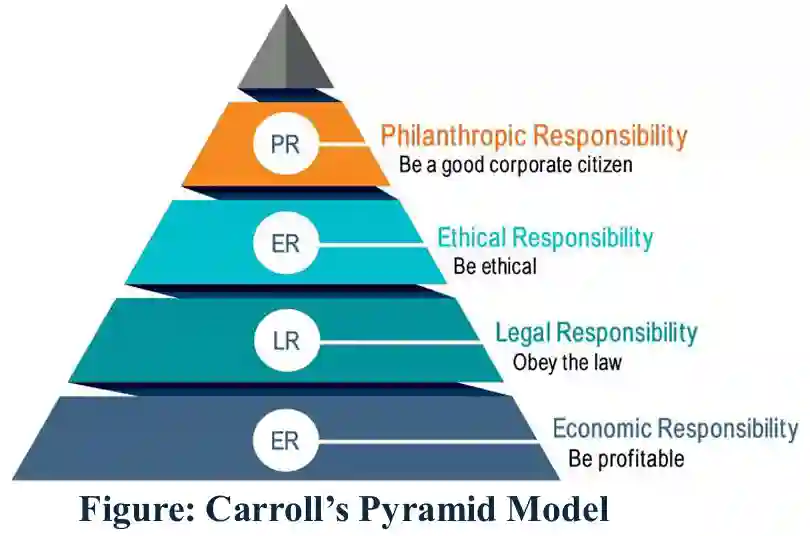
- 1. Economic Responsibility: Be profitable. The foundation of CSR; a business must survive to do good. Focus on producing goods/services and generating income.
- 2. Legal Responsibility: Obey the law. Play by the rules (labor, taxation, environmental laws).
- 3. Ethical Responsibility: Be ethical. Doing morally right things beyond legal requirements (fair treatment, honesty).
- 4. Philanthropic Responsibility: Be a good corporate citizen. Voluntary responsibility involving charity, donations, and community service.
5.5.5 Advantages of CSR
- 1. Improves brand image, reputation, and customer trust.
- 2. Increases sales and customer loyalty.
- 3. Retains employees, improves morale, and reduces turnover.
- 4. Attracts investors (viewed as stable/sustainable).
- 5. Reduces long-term operational expenses (energy saving/recycling).
- 6. Risk Management (avoids legal penalties and reputational damage).
- 7. Enhances community relations.
- 8. Promotes long-term sustainable development.
- 9. Gains government support/incentives.
- 10. Provides a competitive advantage in local/global markets.
5.5.6 Disadvantages of CSR
- 1. High Costs: Significant investment required.
- 2. Reduces Short-term Profit: Especially hard on small/starter companies.
- 3. Risk of Greenwashing: If used only as a marketing strategy without genuine commitment, exposure damages trust.
- 4. Diversion from Core Business Goals: May divert resources/attention from primary operations.
- 5. Increased Stakeholder Expectations: Stakeholders may demand continuous or increased CSR activities.
- 6. Misuse of CSR Funds: Poor planning can result in wasted funds without meaningful social impact.