
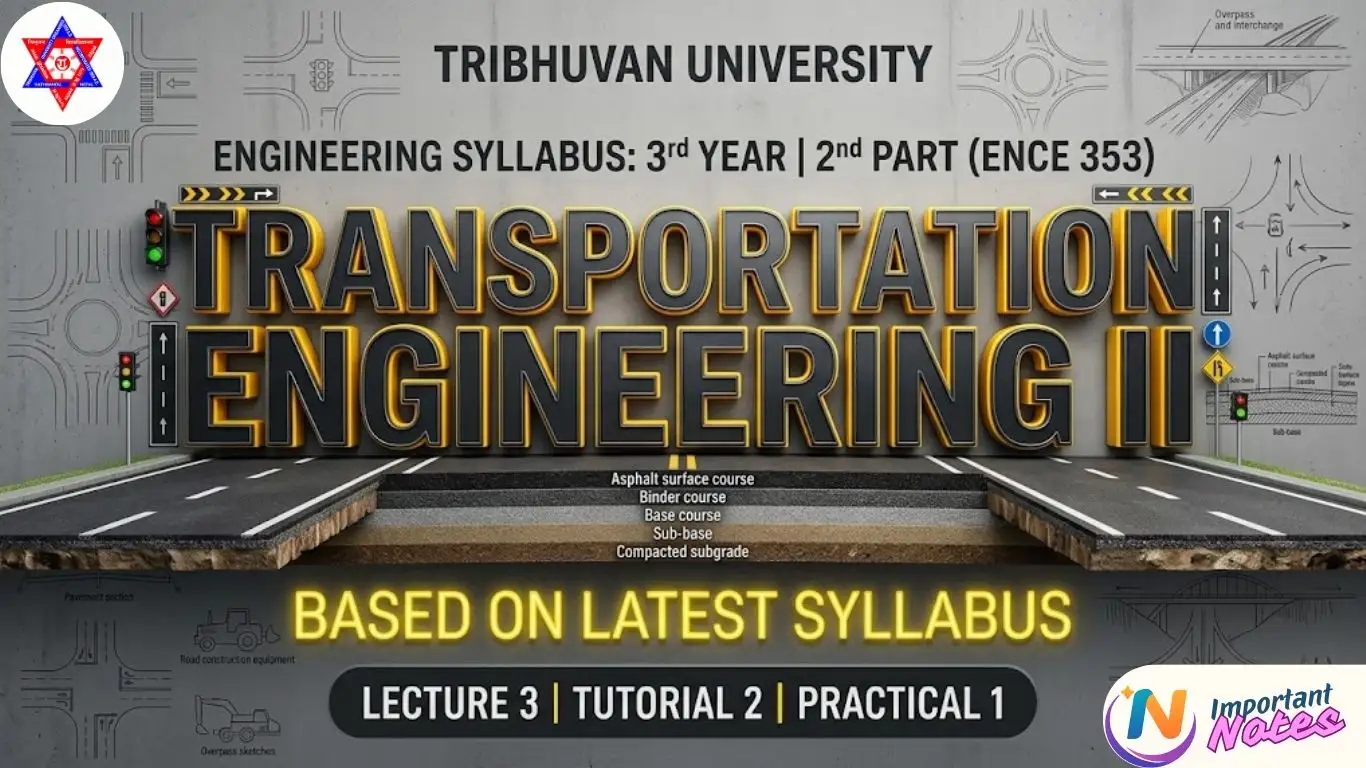
Road Construction Technology: Complete Guide
About this Chapter
Welcome to the comprehensive guide on Road Construction Technology. This chapter bridges the gap between pavement design and actual field execution, requiring 7 hours of study in the Transportation Engineering II (ENCE 353) syllabus.
In these notes, you will dive into the practical aspects of building highways. From the initial preparation of the sub-grade using heavy equipment to the precise application of bituminous and cement concrete layers, this section covers the critical techniques required to turn engineering designs into durable realities.
Execution of Highway Engineering
Road Construction Technology encompasses the diverse array of activities, equipment, and materials necessary to construct modern transportation networks. It begins long before the first layer of asphalt is laid, starting with the heavy earthwork required to establish the road’s foundation.
Earthwork and the Mass Haul Diagram
A crucial element of this chapter is the Mass Haul diagram. This graphical representation is an indispensable tool for civil engineers to plan the most economical movement of excavated materials. By balancing “cut” (excavation) and “fill” (embankment) volumes, engineers minimize transport costs. Accompanying this is the rigorous preparation of the sub-grade, involving proper excavation, filling, and achieving maximum dry density through mechanical compaction.
Base Courses and Bituminous Applications
Moving up the pavement structure, the curriculum covers various base materials, including Granular bases, Water Bound Macadam (WBM), and soil-stabilized layers. Crucially, students must understand the specific functions of bituminous binders. You will learn the difference between a Prime coat (applied to an untreated base to seal and promote adhesion) and a Tack coat (applied between existing bituminous layers). The notes also detail surface treatments like sand seals, slurry seals, and various bituminous premixes like Dense Bituminous Macadam (DBM) and Bituminous Concrete.
Rigid Pavements and Sustainability
Beyond flexible pavements, the chapter addresses the construction of Cement concrete pavements, placing special emphasis on the complex system of joints (expansion, contraction, and construction joints) required to manage thermal expansion and prevent uncontrolled cracking. Finally, reflecting modern engineering trends, the concept of recycled pavement construction is introduced, promoting sustainable practices in infrastructure development.
Disclaimer
The educational materials provided on this website are intended as supplementary resources to support your learning journey in Road Construction Technology and other civil engineering fields. These study materials are sample documents designed to help students understand complex concepts.
We have made every effort to ensure the accuracy of the content. However, we recommend students to refer to standard textbooks and consult with professors for authoritative explanations. These materials should be used as references only.
We respect intellectual property rights. If you believe any content should be credited differently or removed, or if you are the author and wish for these notes to be removed, please don’t hesitate to contact us. We are happy to make appropriate corrections or give proper attribution.