
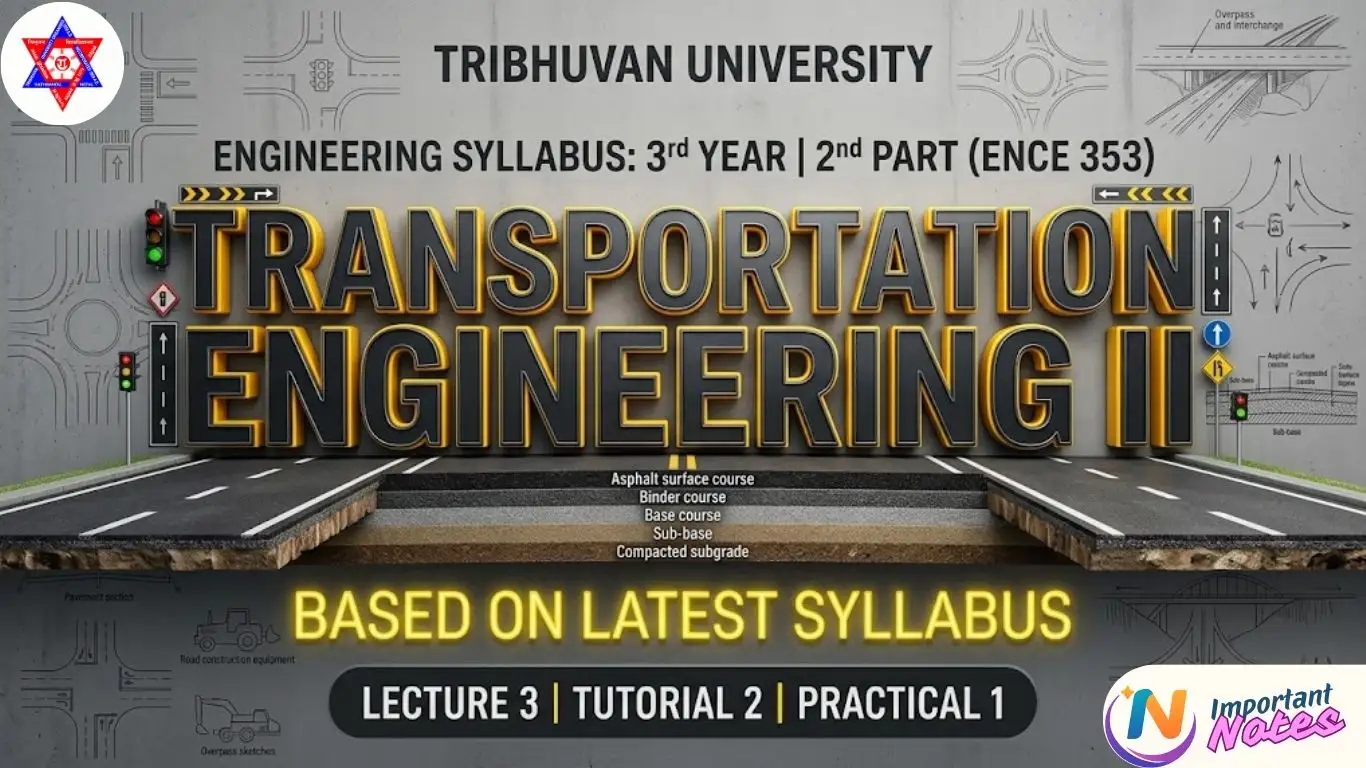
Pavement Maintenance & Rehabilitation
About this Chapter
Welcome to the guide on Pavement Maintenance. This concise but vital chapter accounts for 4 hours of lectures and carries a weightage of 8 marks in the Transportation Engineering II (ENCE 353) examination.
In this section, you will learn how to identify, evaluate, and repair various types of distress in road structures. From understanding the root causes of failure in flexible and rigid pavements to designing structural overlays, this chapter equips you with the knowledge to maintain and extend the lifespan of our transportation infrastructure.
Preserving Highway Infrastructure
Pavement Maintenance is the science and practice of preserving a road network to ensure safe, efficient, and comfortable travel while maximizing the return on the initial construction investment. A fundamental concept taught early in this chapter is distinguishing between routine maintenance (activities to preserve the existing condition) and rehabilitation (structural enhancements to restore or improve load-carrying capacity).
Diagnosing Pavement Failure
Before repairs can commence, engineers must understand why roads fail. The curriculum delves into the specific causes of distress in both flexible (asphalt) and rigid (concrete) pavements. Students will learn to identify common failures such as rutting, fatigue cracking (alligator cracking), potholes, and thermal cracking in flexible pavements, as well as joint spalling, faulting, and pumping in rigid pavements. Understanding these root causes is essential for prescribing the correct remedy.
Evaluation and Overlay Design
How do we measure a pavement’s health? The notes cover structural and functional pavement evaluation methods, which are critical for determining the remaining life of the road. When structural rehabilitation is necessary, adding an overlay is a common solution. A significant portion of this module focuses on the different types of overlays (flexible over flexible, rigid over flexible, etc.) and provides a deep dive into the IRC method of overlay design for flexible pavements, heavily relying on deflection data (e.g., from a Benkelman Beam test).
Modern Maintenance Paradigms
Finally, the chapter introduces students to contemporary approaches to infrastructure management, specifically the concept of performance-based maintenance. Unlike traditional methods that pay contractors for specific actions (like filling 10 potholes), performance-based contracts compensate based on the achieved condition of the road (e.g., maintaining a completely pothole-free surface), incentivizing innovation and efficiency in road preservation.
Disclaimer
The educational materials provided on this website are intended as supplementary resources to support your learning journey in Pavement Maintenance and other civil engineering fields. These study materials are sample documents designed to help students understand complex concepts.
We have made every effort to ensure the accuracy of the content. However, we recommend students to refer to standard textbooks and consult with professors for authoritative explanations. These materials should be used as references only.
We respect intellectual property rights. If you believe any content should be credited differently or removed, or if you are the author and wish for these notes to be removed, please don’t hesitate to contact us. We are happy to make appropriate corrections or give proper attribution.