
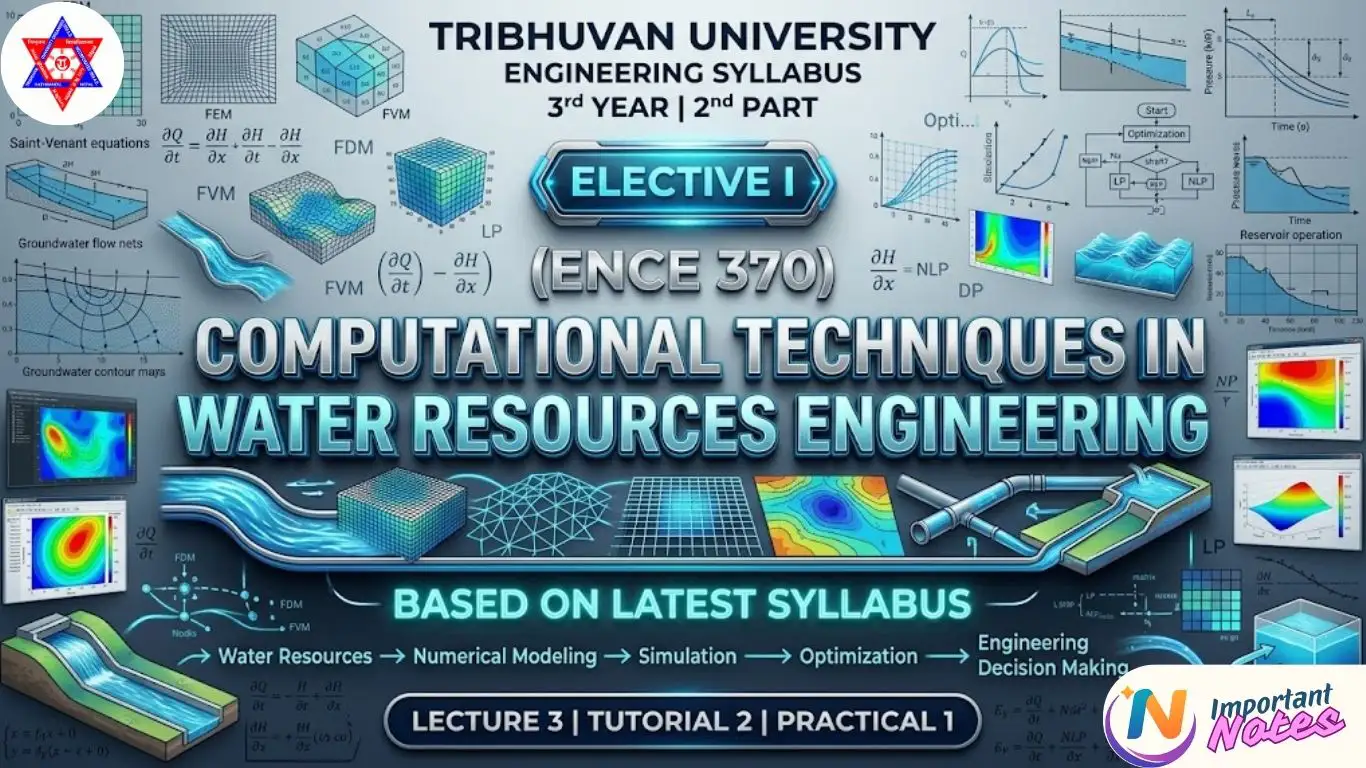
Comprehensive Notes on Chapter 2: Finite Difference Method
About this Chapter
Welcome to the detailed guide for Chapter 2: Finite Difference Method, a core component of the Computational Techniques in Water Resources Engineering (ENCE 370) syllabus. This chapter forms the mathematical backbone for solving complex hydraulic and hydrological problems computationally.
In this section, we delve deeply into the mathematical theory behind transforming continuous differential equations into discrete algebraic forms that computers can solve. Understanding the nuances of Chapter 2: Finite Difference Method is essential for applying concepts like the kinematic and dynamic wave models in practical engineering scenarios.
Deep Dive into Chapter 2: Finite Difference Method
The study of Chapter 2: Finite Difference Method is arguably the most critical technical hurdle in Computational Techniques for Water Resources Engineering. Because the governing equations of fluid flow (like the Saint-Venant equations introduced previously) rarely have exact analytical solutions in real-world river systems, engineers must rely on numerical approximations.
Understanding the Mathematical Theory
At its core, the Finite Difference Method (FDM) involves replacing the partial derivatives in governing equations with algebraic difference quotients. The notes provide thorough derivations of the Forward difference approximation, Backward difference approximation, and the Central difference approximation. Knowing which approximation to use is vital, as it directly impacts the Order of accuracy and the associated Truncation error introduced into the model.
Critical Concepts: Stability and Schemes
A significant portion of Chapter 2: Finite Difference Method focuses on model reliability. Engineers must grasp the concepts of consistency, convergence, and stability. A model that is unstable will produce wildly inaccurate, oscillating results that are useless for predicting flood routing or channel flow. To manage this, the curriculum explores both Explicit and implicit schemes. Explicit schemes calculate the state of the system at a future time from the state of the system at the current time, making them simpler but potentially unstable unless small time steps are used. Implicit schemes, while more computationally intensive to set up, often offer greater stability.
Application to Wave Models
Theoretical knowledge culminates in practical application. The notes guide students through the computation of Kinematic and dynamic wave celerity. You will learn the specific steps for the finite difference solution of the kinematic wave model (focusing on explicit methods) and the more complex dynamic wave model (covering both explicit and implicit methods). These skills are directly transferable to utilizing industry-standard software like HEC-RAS.
To fully master these numerical techniques and prepare for the 12 marks allocated to this section in the IOE exams, it is highly recommended to study the detailed PDF notes provided below. For further external reading on the fundamental mathematics of these methods, you can refer to resources like Wikipedia’s overview of the Finite Difference Method.
Disclaimer
The educational materials provided on this website are intended as supplementary resources to support your learning journey in Computational Techniques in Water Resources Engineering. These study materials are sample documents designed to help students understand complex concepts.
We have made every effort to ensure the accuracy of the content. However, we recommend students to refer to standard textbooks and consult with professors for authoritative explanations. These materials should be used as references only.
We respect intellectual property rights. If you believe any content should be credited differently or removed, or if you are the author and wish for these notes to be removed, please contact us. We are happy to make appropriate corrections or give proper attribution.