
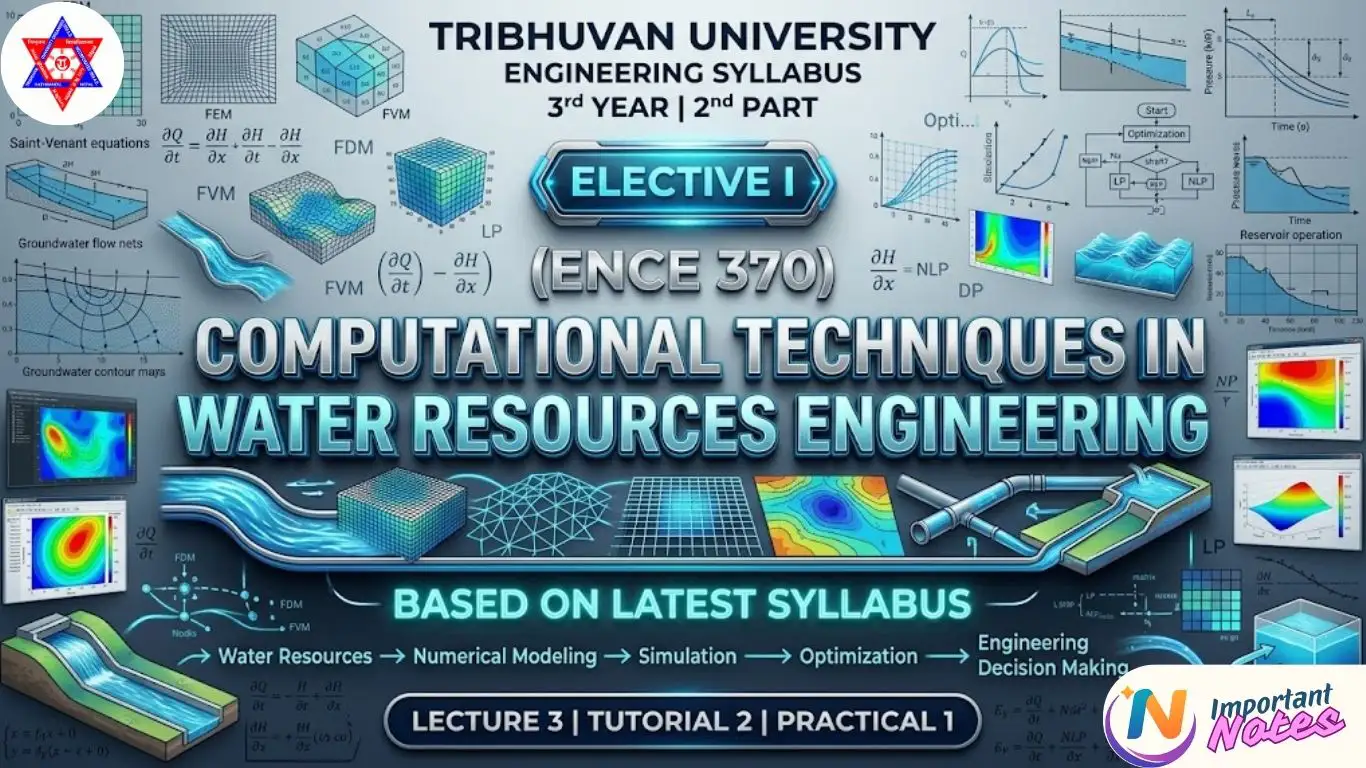
Optimization Techniques in Water Resources: Complete Guide & Solutions
About this Chapter
Welcome to the ultimate learning module for Optimization Techniques in Water Resources under Computational Techniques in Water Resources Engineering (ENCE 370). In modern civil and water resources engineering, optimal allocation of limited water supplies among competing demands—such as hydropower generation, agricultural irrigation, municipal supply, and environmental flow—is essential.
This chapter explores core system analysis frameworks, focusing on mathematical optimization models including Linear Programming (LP), Nonlinear Programming (NLP), and Dynamic Programming (DP). Mastering these algorithms equips engineers with the computational tools required for multi-period reservoir operation, canal scheduling, groundwater remediation, and conjunctive water management.
Detailed Guide: Optimization Techniques in Water Resources
The application of Optimization Techniques in Water Resources has revolutionized civil systems engineering. Water resource systems are inherently complex, multi-scale, and constrained by physical, environmental, and socio-economic limits. Systems engineering approaches translate physical river basins, reservoir networks, and distribution grids into rigorous mathematical objective functions and constraint sets.
1. Role and Types of Optimization Problems
Optimization refers to finding the best feasible solution from a set of alternatives under given operational constraints. In water resources engineering, the system goal may involve maximizing total economic benefit from irrigation and hydropower generation or minimizing capital costs, flood risks, and pollutant concentrations.
Classification of Water Resources Optimization Problems:
- Single-Objective vs. Multi-Objective Optimization: Single-objective problems maximize or minimize a solitary metric (e.g., maximizing annual hydropower revenue). Multi-objective problems seek a trade-off curve (Pareto optimal front) between competing targets, such as maximizing municipal supply while minimizing flood risk downstream.
- Deterministic vs. Stochastic Optimization: Deterministic models treat system inputs (hydrological inflows, crop water demands) as known parameters. Stochastic models account for climate variability, random river flow variations, and probabilistic rainfall using chance-constrained or scenario-tree formulations.
2. Linear Programming (LP) in Water Resources
Linear Programming (LP) is the most widely applied method in Optimization Techniques in Water Resources due to its efficient computational algorithms (e.g., Simplex algorithm) and capability to handle thousands of decision variables and linear inequality constraints.
$\text{Maximize or Minimize } Z = \sum_{j=1}^{n} c_j x_j$
$\text{Subject to constraints: } \sum_{j=1}^{n} a_{ij} x_j \le b_i \quad (i = 1, 2, \dots, m)$
$\text{Non-negativity conditions: } x_j \ge 0$
LP Application 1: Single and Multi-Period Reservoir Operation
Consider a reservoir with initial storage $S_t$, inflow $I_t$, release $R_t$, and evaporation losses $E_t$ during period $t$. The continuity equation forms a primary linear constraint:
Subject to storage constraints ($S_{\min} \le S_t \le S_{\max}$) and minimum downstream environmental release requirements ($R_t \ge R_{\text{env}}$), the linear objective function maximizes net economic return from released water across $T$ monthly or seasonal planning periods:
LP Application 2: Irrigation Canal Water Scheduling
Canal distribution networks require optimal allocation among various command areas ($A_k$) to maximize crop yields while adhering to total main canal flow capacity ($Q_{\max}$). Decision variables $x_k$ represent depth or volume allocated to crop type $k$, bounded by soil saturation limits and canal conveyance capacities.
3. Nonlinear Programming (NLP) in Water Management
Many physical processes in water resources exhibit non-linear physical behavior. Hydropower output depends non-linearly on the product of head and release ($P = \eta \gamma Q H(S)$), and groundwater head-drawdown relationships are non-linear governing functions. Nonlinear Programming (NLP) is used when objective functions or constraints contain non-linear terms.
Key NLP Applications:
- Hydropower Generation Scheduling: Because the effective hydraulic head $H(S)$ varies as a non-linear function of storage volume $S$, maximizing energy generation yields an NLP problem solved via sequential quadratic programming (SQP) or generalized reduced gradient (GRG) algorithms.
- Groundwater Remediation & Allocation: Optimization of pumping rates ($Q_w$) across a field of extraction wells to contain a contaminant plume while minimizing total pumping energy cost ($C \propto Q_w \cdot s_w$, where drawdown $s_w$ is non-linearly coupled with discharge).
- Water Allocation in Pipe Networks: Pipe flow pressure losses obey non-linear Darcy-Weisbach or Hazen-Williams equations ($\Delta h = k Q^{1.852}$).
4. Dynamic Programming (DP) for Multi-Period Operation
Sequential decision-making problems over time or space are ideally solved using Dynamic Programming (DP), developed by Richard Bellman. DP decomposes a complex multi-stage problem into a sequence of simpler single-stage sub-problems.
“An optimal policy has the property that whatever the initial state and initial decision are, the remaining decisions must constitute an optimal policy with regard to the state resulting from the first decision.”
Recursive Formulation for Reservoir Operation:
Let $t$ be the time stage index (month/season), $S_t$ be the state variable (reservoir storage at the beginning of stage $t$), and $R_t$ be the decision variable (release during stage $t$). The backward recursive dynamic programming equation is written as:
Where $B_t(S_t, R_t)$ is the immediate benefit earned during stage $t$, and $f_{t+1}^*(S_{t+1})$ is the maximum cumulative benefit obtainable from stage $t+1$ through the end of the planning horizon. By discretizing storage states into discrete levels, dynamic programming avoids local optima traps inherent in standard gradient non-linear techniques and easily incorporates stochastic inflow distributions (Stochastic Dynamic Programming – SDP).
Disclaimer
The educational materials provided on this website are intended as supplementary resources to support your learning journey in Optimization Techniques in Water Resources, Water Resources Engineering, and other IOE engineering courses. These study materials are reference documents created to assist civil engineering students in mastering complex computational concepts.
We have made every effort to ensure academic precision. However, we recommend students consult standard engineering textbooks and consult professors for authoritative guidance.
We respect intellectual property rights. If you believe any content should be credited differently or removed, please contact us for immediate resolution.