Syllabus: Analysis of Rate (6 Hours)
6. Analysis of Rates (6 hours)
6.1 Importance and purpose of rate analysis
6.2 Data required for rate analysis
6.3 Factors affecting rate analysis
6.4 Prevailing rate analysis norms and district rates in Nepal
6.5 Analysis of rate
6.5.1 Building works: Brickwork, concrete work, reinforcement work, woodwork, plasterwork, and flooring work
6.5.2 Road works: Earthwork in excavation/filling using equipment; Gabion, stone masonry, plum concrete, and pavement works
6.5.3 Sanitary and water supply works: Wash basin; commode and pan; pipes and fittings
Analysis of Rate Notes
1. What is Rate Analysis?
The method of determining the rate per unit of a particular item of work, considering the cost and quantities of materials, cost of labour (skilled and unskilled), hire of tools and plants, and contractor’s profit, etc., is known as Rate Analysis.
The rate of material is usually taken as the rate delivered at the site of work and includes the first cost (cost of origin), cost of transport, taxes, etc. If materials are to be carried from a distant place, more than 8 km, the cost of transportation is also added. The rate of materials and labour vary from place to place, and therefore the rate of a different item of work also varies from place to place.
2. Purpose of Rate Analysis
The purpose of rate analysis can be summarized as follows:
- To work out the actual cost per unit of an item.
- To work out the economical use of materials.
- To work out the cost of extra items which are not provided in the contract documents (Bill of Quantities – BOQ).
- To revise the schedule of rates due to changes in construction technique.
3. Requirement of Rate Analysis
- Correct information of the market rate of materials.
- Correct information of the rate of various categories of labour.
- Output of labour.
- Knowledge, rate, and outturn of various types of plant to be used in the construction work.
- Up-to-date knowledge of construction.
- Standards norms.
4. Factors Affecting Rate Analysis
- Specification of work and quality of materials.
- Proportion of mix (concrete or mortar).
- Construction facilities and availability of materials, tools, and plants.
- Location of site.
- Cost of labours and their availability.
- Facilities available for transportation of materials and labours to the site.
- Condition of road to the worksite.
- Overhead charges.
The rate of a particular item of work depends on the following:
- Specification of different items of work and materials to be used.
- Quantities of materials and their rates, number of different types of labours (skilled/unskilled).
- Location of work site, means of communication, distance of site from the sources of materials, rates of transportation, availability of workers.
- Availability of tools and plants, different types of equipment for different operations as per specification.
- Profit and overhead expenses of contractors.
5. Importance of Rate Analysis
- The process of doing analysis gives a clear picture of the various types of labours and materials required for completing the particular work.
- It can be used frequently to settle the disputes between contractor and client about the item not included in the original estimate.
- It can be used for the compensation by insurance.
Material Estimate
Note (Dry Mix / Wastage Norms)
- In concrete mix: To get dry mix (Cement + Sand + Aggregates), increase 50% to 55% of wet mix.
- In mortar mix: To get dry mix (Cement + Sand), increase 30% to 35% of wet mix.
- In plastering works: Firstly, increase 25% for filling in between joints and irregular surface. In case of ceiling and concrete surface (plain surface), only 10% – 15% increase of wet mix to get total wet mix. Then, to get dry mix (Cement + Sand), increase 30% to 35% of wet mix.
- In case of stone works: To get required stone, 15% – 20% increase of total works due to wastage and dressing. Volume of dry mortar mix = 30% to 40% of stone masonry.
- In RCC work: To get reinforcement: 1-3% of volume of RCC. Loss during cutting (but no lap and chair length included) = 5%. Binding wire: 10 Kg per quintal.
Calculate the Quantities of Materials Required for the Following Items of Work
Example 1: 48.5 m³ of brick work in (1:3) cement sand mortar.
Volume of brick work = 48.5 m³. Assume brick size = 230mm x 110mm x 55mm; mortar thickness = 10mm; so brick size with mortar = 240mm x 120mm x 65mm.
No. of bricks required $= \dfrac{\text{Vol. of brick work}}{\text{Vol. of one brick with mortar}} = \dfrac{48.5}{0.24 \times 0.120 \times 0.065} = 25908.11 \approx 25909$ Nos.
Add 5% wastage $\therefore$ Brick required $= 1.05 \times 25909 = 27205$ Nos.
Volume of wet mortar = Total brick work – Actual vol. of brick (without mortar) $= 48.5 – 25908.11 \times (0.23 \times 0.11 \times 0.055) = 12.45\text{ m}^3$
To get dry vol. of mortar, 30% increase: Dry vol. of mortar $= 1.3 \times 12.45 = 16.90\text{ m}^3$
Total part of mix proportion $= 1 + 3 = 4$
$\therefore$ Required cement $= \dfrac{16.90}{4} = 4.05\text{ m}^3$ {Unit wt. of cement = 1440 kg/m³, 1 bag cement = 50 kg} $= 4.05 \times 28.8 = 116.57$ bags
$\therefore$ Required sand $= 3 \times 4.05 = 12.15\text{ m}^3$
Let water cement ratio $= 0.8$; Water $= 0.8 \times 116.57 \times 50 = 4662.8$ lit
Hence, Required: Bricks = 27205 Nos, Cement = 116.57 bags, Sand = 12.15 m³, Water = 4662.8 lit.
Example 2:15 cm thick Foundation PCC (1:3:6), 0.95 m wide and 42 m long.
Total quantity of work (PCC) $= 42 \times 0.95 \times 0.15 = 5.99\text{ m}^3$
To get dry vol. of concrete mix, increase 50% to 55%: Vol. of dry mix $= 1.5 \times 5.99 = 8.99\text{ m}^3$
Total part of mix proportion $= 1 + 3 + 6 = 10$
Required: Cement $= 8.99 \times \dfrac{1}{10} = 0.899\text{ m}^3 = 0.899 \times 28.8 = 25.89$ bags
Sand $= 0.899 \times 3 = 2.697\text{ m}^3$; Aggregate $= 0.899 \times 6 = 5.394\text{ m}^3$
Water/Cement $= 0.5$; Water $= 0.5 \times 25.89 \times 50 = 647.25$ lit
Example 3: PCC – M20 for RCC roof 100mm thick, 20m wide and 25 m long.
PCC for RCC work $= 25 \times 20 \times 0.10 = 50\text{ m}^3$
Increase 50% for getting dry volume of mix: Vol. of dry mix $= 1.5 \times 50 = 75\text{ m}^3$
Total part of mix proportion $= 1 + 1.5 + 3 = 5.5$
Required: Cement $= 75 \times \dfrac{1}{5.5} = 13.636\text{ m}^3 = 13.63 \times 28.8 = 392.72$ bags
Sand $= 13.636 \times 1.5 = 20.45\text{ m}^3$; Aggregate $= 13.636 \times 3 = 40.91\text{ m}^3$
Water/Cement $= 0.5$; Water $= 0.5 \times 392.72 \times 50 = 9818$ lit
Mild Steel Bars (Steel Reinforcement): 1% of PCC for RCC work $= 1\%$ of $50\text{ m}^3 = 0.01 \times 50 = 0.5\text{ m}^3$ {Unit wt. of steel = 7850 kg/m³} $= 0.5 \times 7850 = 3925.00$ Kg
Binding wire $= 1$ kg per quintal $= 1 \times \dfrac{3925}{100} = 39.25$ kg
Example 4: 713 m² of 12.5 mm thick cement plaster (1:4).
Quantity of plastering work $= 713\text{ m}^2$. Therefore, Vol. of wet mortar $= 713 \times 0.0125 = 8.91\text{ m}^3$
Firstly, increase 25% for filling in between joints and irregular surface to get total wet mix $= 1.25 \times 8.91 = 11.14\text{ m}^3$
To get dry vol. of mortar, 30% increase: Vol. of dry mortar $= 1.30 \times 11.14 = 14.48\text{ m}^3$
Total part of mix proportion $= 1 + 4 = 5$
Required: Cement $= \dfrac{1}{5} \times 14.48 = 2.896\text{ m}^3 = 2.896 \times 28.8 = 83.42$ bags
Sand $= 2.896 \times 4 = 11.58\text{ m}^3$
Let water cement ratio $= 0.8$; Water $= 0.8 \times 83.42 \times 50 = 3336.8$ lit
Example 5: 110 m² half brick thick wall in (1:3) cement mortar.
Quantity of work $= 110\text{ m}^2$. Vol. of brick work $= 110 \times 0.11 = 12.10\text{ m}^3$
Assume brick size 230mm x 110mm x 55mm; brick size (with 10mm mortar) $= 240$mm x 110mm x 65mm.
No. of bricks required $= \dfrac{\text{Vol. of brick work}}{\text{Vol. of one brick with mortar}} = \dfrac{12.1}{0.24 \times 0.110 \times 0.065} = 7051.28 \approx 7052$ Nos.
Add 5% wastage $\therefore$ Brick required $= 1.05 \times 7052 = 7405$ Nos.
Volume of wet mortar = Total brick work – Actual vol. of brick (without mortar) $= 12.1 – 7052 \times (0.23 \times 0.11 \times 0.055) = 2.287\text{ m}^3$
To get dry vol. of mortar, 30% increase: Dry vol. of mortar $= 1.3 \times 2.287 = 2.97\text{ m}^3$
Total part of mix proportion $= 1 + 3 = 4$
$\therefore$ Required cement $= \dfrac{2.97}{4} = 0.74\text{ m}^3$ {Unit wt. of cement = 1440 kg/m³, 1 bag cement = 50 kg} $= 0.74 \times 28.8 = 21.41$ bags
$\therefore$ Required sand $= 3 \times 0.74 = 2.22\text{ m}^3$
Let water cement ratio $= 0.8$; Water $= 0.8 \times 21.41 \times 50 = 856.40$ lit
Example 7: 10 m³ of stone masonry in 1:6 mortar ratios.
Quantity of stone masonry $= 10\text{ m}^3$. Required: Vol. of stone $= 1.15 \times 10 = 11.5\text{ m}^3$
Vol. of dry mortar $= 40\%$ of work quantity $= 0.4 \times 10 = 4\text{ m}^3$
Total part of mix proportion $= 1 + 6 = 7$
Required cement $= \dfrac{1}{7} \times 4 = 0.57\text{ m}^3 = 0.57 \times 28.8 = 16.45$ bags
Required sand $= 6 \times 0.57 = 3.42\text{ m}^3$
W/C $= 0.6$; Required water $= 0.6 \times 16.45 \times 50 = 493.5$ lit
Solved Rate Analysis Examples
Example 7: Brick work in 1:3 cement mortar for first floor. Unit of analysis per m³.
Volume of brick work = 1.0 m³. Assume brick size = 230mm x 110mm x 55mm; mortar thickness = 10mm; brick size with mortar = 240mm x 120mm x 65mm.
No. of bricks required $= \dfrac{1.0}{0.24 \times 0.120 \times 0.065} = 534.18 \approx 535$ Nos. Add 5% wastage $\therefore$ Brick required $= 1.05 \times 535 = 562$ Nos.
Volume of wet mortar = Total brick work – Actual vol. of brick (without mortar) $= 1 – 534.18 \times (0.23 \times 0.11 \times 0.055) = 0.26\text{ m}^3$
Dry vol. of mortar $= 1.3 \times 0.26 = 0.338\text{ m}^3$. Total part of mix proportion $= 1+3 = 4$.
Required cement $= \dfrac{0.338}{4} = 0.0845\text{ m}^3 = 0.0845 \times 28.8 = 2.434$ bags. Required sand $= 3 \times 0.0845 = 0.2535\text{ m}^3$.
Water cement ratio $= 0.6$; Water $= 0.6 \times 2.434 \times 50 = 73.02$ lit.
Hence, Required: Bricks = 562 no, Cement = 2.434 bag, Sand = 0.2535 m³, Water = 73.02 lit.
| S.N. | Description | Unit | Quantity | Rate (Nrs) | Amount |
|---|
| i) | Cement | bag | 2.434 | 743 | 1808.462 |
| ii) | Sand | cum | 0.2535 | 2187.36 | 554.4958 |
| iii) | Bricks | no | 562 | 10 | 5620 |
| iv) | Water | lit | 73.02 | 0.25 | 18.255 |
| i) | Skilled | no | 1.5 | 650 | 975 |
| ii) | Unskilled | no | 2.2 | 475 | 1045 |
| iii) | Helper | no | 0.7 | 475 | 332.5 |
| Total (A+B) | 10353.71 |
| 3. Hire of tools and plants @ 3% of unskilled labor | 31.35 |
| Total | 10385.06 |
| 4. Contractors overhead and profit @ 15% of total | 1557.759 |
| Grand Total | 11942.82 |
Hence, Rate per cum = Nrs. 11942.82, excluding VAT
Example 8: 12.5 mm thick cement plaster (1:4) in wall. Unit of rate analysis 100 sqm.
Quantity of plastering work $= 100\text{ m}^2$. Vol. of wet mortar $= 100 \times 0.0125 = 1.25\text{ m}^3$.
Firstly, increase 25% for filling in between joints and irregular surface to get total wet mix $= 1.25 \times 1.25 = 1.5625\text{ m}^3$.
To get dry vol. of mortar, 30% increase: Vol. of dry mortar $= 1.30 \times 1.5625 = 2.031\text{ m}^3$. Total part of mix proportion $= 1+4 = 5$.
Required cement $= \dfrac{1}{5} \times 2.031 = 0.406\text{ m}^3 = 0.406 \times 28.8 = 11.69$ bags. Sand $= 0.406 \times 4 = 1.624\text{ m}^3$.
Water cement ratio $= 0.8$; Water $= 0.8 \times 11.69 \times 50 = 467.71$ lit.
Hence, Required: Cement = 11.69 bag, Sand = 1.624 m³, Water = 467.71 lit.
| S.N. | Description | Unit | Quantity | Rate (Nrs) | Amount |
|---|
| i) | Cement | bag | 11.69 | 743 | 8685.67 |
| ii) | Sand | cum | 1.624 | 2187.36 | 3552.273 |
| iii) | Water | lit | 467.71 | 0.25 | 116.9275 |
| i) | Skilled | no | 12 | 650 | 7800 |
| ii) | Unskilled | no | 16 | 475 | 7600 |
| Total (A+B) | 27754.87 |
| 3. Hire of tools and plants @ 3% of unskilled labor | 228 |
| Total | 27982.87 |
| 4. Contractors overhead and profit @ 15% of total | 4197.431 |
| Grand Total | 32180.3 |
Hence, Rate per 100 sqm = Nrs. 32180.3, excluding VAT.
Hence, Rate per sqm = Nrs. 321.8, excluding VAT.
Example 9: PCC (1:2:4). Unit of rate analysis 1 cum.
Total quantity of work (PCC) $= 1.0\text{ m}^3$. To get dry vol. of concrete mix, increase 50% to 55%: Vol. of dry mix $= 1.5 \times 1.0 = 1.5\text{ m}^3$.
Total part of mix proportion $= 1+2+4 = 7$.
Required: Cement $= 1.50 \times \dfrac{1}{7} = 0.214\text{ m}^3 = 0.214 \times 28.8 = 6.16$ bags. Sand $= 0.214 \times 2 = 0.428\text{ m}^3$. Aggregate $= 0.214 \times 4 = 0.856\text{ m}^3$.
Water/Cement $= 0.55$; Water $= 0.55 \times 6.16 \times 50 = 169.94$ lit.
Hence, Required: Cement = 6.16 bag, Sand = 0.428 m³, Aggregate = 0.856 m³, Water = 169.94 lit.
| S.N. | Description | Unit | Quantity | Rate (Nrs) | Amount |
|---|
| i) | Cement | bag | 6.16 | 743 | 4576.88 |
| ii) | Sand | cum | 0.428 | 2187.36 | 936.1901 |
| iii) | Aggregates | cum | 0.856 | 2399.04 | 2053.578 |
| iv) | Water | lit | 169.94 | 0.25 | 42.485 |
| i) | Skilled | no | 0.8 | 650 | 520 |
| ii) | Unskilled | no | 7 | 475 | 3325 |
| Total (A+B) | 11454.13 |
| 3. Hire of tools and plants @ 3% of unskilled labor | 99.75 |
| Total | 11553.88 |
| 4. Contractors overhead and profit @ 15% of total | 1733.082 |
| Grand Total | 13286.97 |
Hence, Rate per cum = Nrs. 13286.97, excluding VAT.
Example 10: 10 m³ of stone masonry in 1:6 mortar ratios
Volume of stone masonry $= 10\text{ m}^3$. To get volume of stone, increase by 15% to 20% due to wastage and dressing during placing: Volume of stone $= 10 \times 1.15 = 11.50\text{ m}^3$.
Take volume of dry mortar 30% – 40% of volume of stone masonry due to irregular shape and size of stone available: Vol. of dry mortar $= 40\%$ of work quantity $= 0.4 \times 10 = 4\text{ m}^3$.
Total part of mix proportion $= 1+6 = 7$. Required cement $= \dfrac{1}{7} \times 4 = 0.57\text{ m}^3 = 0.57 \times 28.8 = 16.45$ bags.
Required sand $= 6 \times 0.57 = 3.42\text{ m}^3$. W/C $= 0.6$; Required water $= 0.6 \times 16.45 \times 50 = 493.5$ lit.
| S.N. | Description | Unit | Quantity | Rate (Nrs) | Amount |
|---|
| i) | Cement | bag | 16.45 | 743 | 12222.35 |
| ii) | Sand | cum | 3.42 | 2187.36 | 7480.771 |
| iii) | Stone | cum | 11.5 | 1975.68 | 22720.32 |
| iv) | Water | lit | 493.5 | 0.25 | 123.375 |
| i) | Skilled | no | 15 | 650 | 9750 |
| ii) | Unskilled | no | 50 | 475 | 23750 |
| Total (A+B) | 76046.82 |
| 3. Hire of tools and plants @ 3% of unskilled labor | 712.5 |
| Total | 76759.32 |
| 4. Contractors overhead and profit @ 15% of total | 11513.9 |
| Grand Total | Nrs. 88273.21 |
Hence, Rate per 10 cum = Nrs. 88273.21, excluding VAT.
Example 11: Providing, laying & consolidation of 10 cm thick compacted gravel for sub-grade per sqm.
Volume of gravel sub-grade $= \dfrac{10}{100} \times 1 = 0.1\text{ m}^3$. Add 30% – 40% to get loose volume of gravel $= 1.35 \times 0.1 = 0.135\text{ m}^3$.
(A) Materials
i. Well graded gravel $= 0.135\text{ m}^3$ @ Rs 1700 = Rs 229.50
(B) Labors
i. Unskilled $= 0.14$ Nos. @ Rs 475 = Rs 66.50
(C) Equipment
i. Road roller $= 0.028$ hr. @ Rs 1000 = Rs 28.00
(D) Hire of tools and plants $= 3\%$ of unskilled labor cost = Rs 2.00
Total = Rs 326.00
(E) Contractor’s overhead and profit $= 15\%$ of Total $= 0.15 \times 326.00 =$ Rs 48.90
Grand total = Rs 326.00 + Rs 48.90 = Rs 374.90
Hence, Rate per sq. meter = Rs. 374.90
Example 12: Providing and laying 10 cm thick compacted semi grouting per 10 sq.m.
Volume $= 0.1 \times 10 = 1\text{ m}^3$. Loose volume $= 1.4 \times 1 = 1.40\text{ m}^3$.
Materials
i. Well graded Aggregates $= 1.40\text{ m}^3$ @ Rs 2100 = Rs 2940.00
ii. Bitumen $= 60$ kg @ Rs 99.00 = Rs 5940.00
iii. Wood (only boiler) $= 20$ kg @ Rs 17.00 = Rs 340.00
Labors
i. Unskilled $= 2$ Nos. @ Rs 475 = Rs 950.00
Equipment
i. Roller $= 0.07$ hr. @ Rs 1000 = Rs 70.00
ii. Boiler and sprayer $= 0.07$ hr. @ Rs 1000 = Rs 70.00
Hire of tools and plants $= 3\%$ of unskilled labor cost = Rs 28.50
Total = Rs 10310.00
Contractor’s overhead and profit $= 15\%$ of Total $= 0.15 \times 10310.00 =$ Rs 1546.50
Grand total = Rs 10310.00 + Rs 1546.50 = Rs 11856.50
Hence, Rate per 10 sq. meter = Rs. 11856.50
EXample 13:Providing and laying 15mm ɸ GI pipe per rm.
Materials
i. 15 mm dia. GI pipe $= 1$ m @ Rs 250 = Rs 250.00
ii. GI fittings (elbow, bend, tee etc.) = L.S (20-30%) = Rs 75.00
iii. Pipe tape, clamp, screws etc. = L.S (5-7%) = Rs 17.50
Labors
i. Skilled $= 0.18$ Nos. @ Rs 650 = Rs 117.00
ii. Unskilled $= 0.16$ Nos. @ Rs 475 = Rs 76.00
Hire of tools and plants $= 3\%$ of unskilled labor cost = Rs 2.28
Total = Rs 537.78
Contractor’s overhead and profit $= 15\%$ of Total $= 0.15 \times 537.78 =$ Rs 80.67
Grand total = Rs 537.78 + Rs 80.67 = Rs 618.45
Hence, Rate per running meter = Rs 618.45
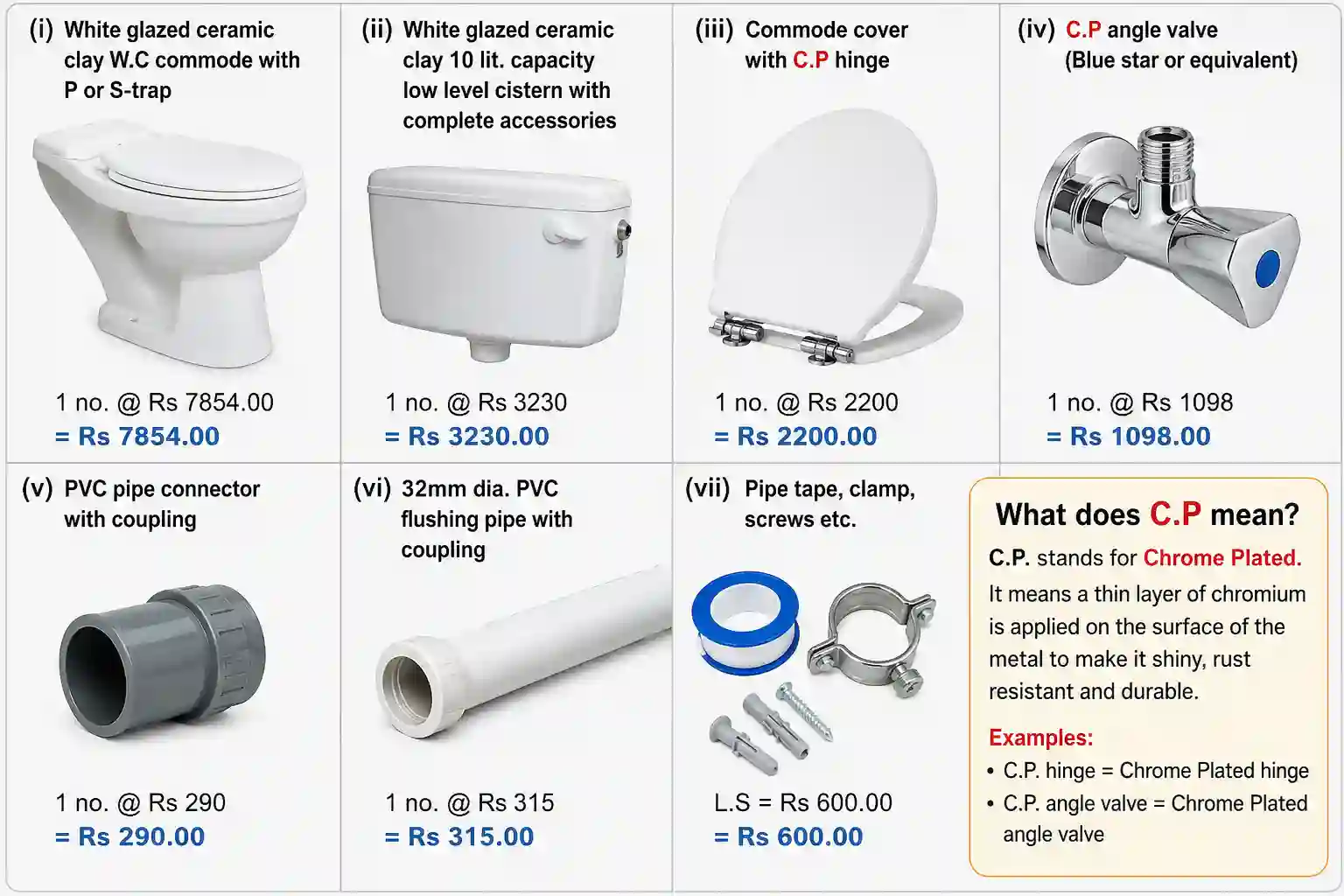
Example 14: Providing and fixing W.C. commode with low level cistern per no.
(A) MATERIALS
(i) White glazed ceramic clay W.C commode with P or S-trap = 1 no. @ Rs 7854.00 = Rs 7854.00
(ii) White glazed ceramic clay 10 lit. capacity low level cistern with complete accessories = 1 no. @ Rs 3230 = Rs 3230.00
(iii) Commode cover with C.P hinge = 1 no. @ Rs 2200 = Rs 2200.00
(iv) C.P angle valve (Blue star or equivalent) = 1 no. @ Rs 1098 = Rs 1098.00
(v) PVC pipe connector with coupling = 1 no. @ Rs 290 = Rs 290.00
(vi) 32mm dia. PVC flushing pipe with coupling = 1 no. @ Rs 315 = Rs 315.00
(vii) Pipe tape, clamp, screws etc. = L.S = Rs 600.00
Material cost = Rs 15587.00
(B) LABORS
(i) Skilled: 3 no. @ Rs 650 = Rs 1950
(ii) Unskilled: 3 no. @ Rs 475 = Rs 1425
Labor cost = Rs 3375
(C) Hire of tools and plants @ 3% of unskilled labor cost = Rs 42.75
Subtotal = Rs 19004.75
(D) Contractor overhead and profit @ 15% of subtotal = Rs 2850.71
Total = Rs 21855.46 / no
Example 15: Providing and fixing W.C. Pan with low level cistern per no.
(A) MATERIALS
White glazed ceramic clay W.C. Orisa pan with P or S-trap = 1 no. @ Rs 3090.00 = Rs 3090.00
White glazed ceramic clay 10 lit. capacity low level cistern with complete accessories = 1 no. @ Rs 3230 = Rs 3230.00
C.P angle valve (Blue star or equivalent) = 1 no. @ Rs 1098 = Rs 1098.00
PVC pipe connector with coupling = 1 no. @ Rs 290 = Rs 290.00
32mm dia. PVC flushing pipe with coupling = 1 no. @ Rs 315 = Rs 315.00
Pipe tape, clamp, screws etc. = L.S = Rs 600.00
Material cost = Rs 11998.00
(B) LABORS
Skilled: 3 no. @ Rs 650 = Rs 1950
Unskilled: 3 no. @ Rs 475 = Rs 1425
Labor cost = Rs 3375
(C) Hire of tools and plants @ 3% of unskilled labor cost = Rs 42.75
Subtotal = Rs 15415.75
(D) Contractor overhead and profit @ 15% of subtotal = Rs 2312.36
Total = Rs 17758.11 / no
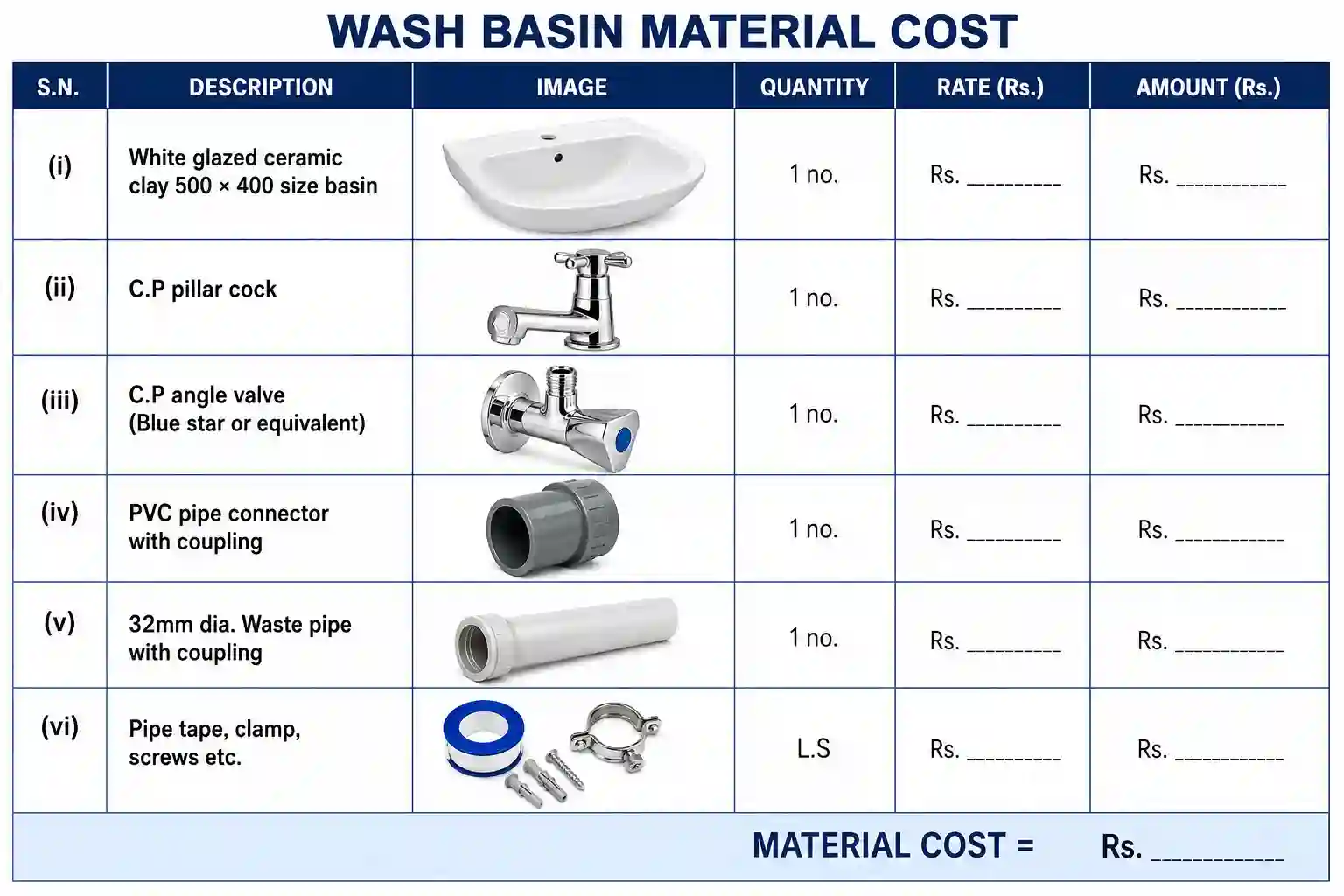
Example 16: Providing and fixing Wash basin per no.
(A) MATERIALS
White glazed ceramic clay 500 x 400 size basin = 1 no. @ Rs………….. = Rs…………….
C.P pillar cock = 1 no. @ Rs………….. = Rs…………….
C.P angle valve (Blue star or equivalent) = 1 no. @ Rs………… = Rs……………
PVC pipe connector with coupling = 1 no. @ Rs………….. = Rs…………..
32mm dia. Waste pipe with coupling = 1 no. @ Rs………… = Rs…………….
Pipe tape, clamp, screws etc. = L.S = Rs……………..
Material cost = Rs……………
(B) LABORS
Skilled: 2 no. @ Rs………… = Rs…………..
Unskilled: 2 no. @ Rs………… = Rs…………..
Labor cost = Rs…………….
(C) Hire of tools and plants @ 3% of unskilled labor cost = Rs…………
Subtotal = Rs……………………
(D) Contractor overhead and profit @ 15% of subtotal = Rs……………….
Total = Rs……………… / no
Road Works Rate Analysis Exercises
Rate for Equipments as per fiscal year 073-74 of Ktm:
- Loader = 1910/hr (use 1900/hr)
- Sprayer = 1655/hr (take 1700/hr)
- Boiler = 1757/hr (take 1800/hr)
- Grader = 1498/hr (take 1500/hr)
- Road Roller = 1034/hr (take 1035/hr)
- Bitumen = 77/kg (take 80/kg)
- Wood = 20/kg
(i) Providing and Spreading 10 cm Compacted Thickness Approved Sized Gravel in Subgrade (per 10 m²)
Volume of gravel sub-grade $= \dfrac{10}{100} \times 1\text{ m}^2$. Add 30-35% to get loose volume of gravel $= 0.1 + 0.1 \times 0.35 = 0.135\text{ m}^3$.
A) Materials
i) Approved size gravel = 0.135 m³ × Rs…………./m³
B) Labours
i) Unskilled = 0.14 nos. × Rs. 635 per head per day = Rs…………
C) Equipments
i) Road Roller = 0.028 hr × Rs…….. = Rs………..
D) Contractor’s overhead and profit = 15% of (A+B+C) = Rs…………
$\therefore$ Rate per m² = Rs…………..
(ii) Providing, Laying and 10 cm Compacted Thickness Base Course of Crushed Stone (per m²)
i) Vol. of base course $= \dfrac{10}{100} \times 1\text{ m}^2 = 0.1\text{ m}^3$
ii) Add 45-48% to get loose vol. of crushed stone $= 0.1 + \dfrac{48}{100} \times 0.1 = 0.148\text{ m}^3$
A) Materials
i) 75 mm size crushed stone = 0.148 m³ × Rs. ……… = Rs……………
B) Labours
i) Unskilled = 0.15 nos. × Rs. 635 per head per day = Rs………………..
C) Equipments
i) Road Roller = 0.04 hr × Rs…………….. per hour = Rs………………….
D) Contractor’s overhead and profit = 15% of (A+B+C) = Rs………………
$\therefore$ Rate per m² = Rs (A+B+C+D)
(iii) Providing, Laying and Compaction of 5 cm Thick Full Grouting (per 10 m²)
Vol. of 5 cm thick full grouting $= \dfrac{5}{100} \times 10 = 0.5\text{ m}^3$. Add 45-50% to get loose volume $= 0.5 + 0.5 \times 0.5 = 0.75\text{ m}^3$.
A) Materials
i) Bitumen = 50 kg × Rs……………../kg
ii) Kerosene (Lumpsum) = Rs. 100
iii) Wood (20 kg for boiler, 80 kg for open field, 120 kg for patch repairing) × Rs.20 = Rs. 400
B) Labours
i) Unskilled = 1.2 nos. × Rs. 635/head/day = Rs………….
C) Equipments
i) Roller = 0.07 hr × Rs 1035 per hour = Rs. ……………..
ii) Boiler = 0.07 hr × Rs. 1800 per hour = Rs………………
iii) Sprayer = 0.07 hr × Rs. 1700 per hour = Rs……………
Total = Rs…………………
D) Contractor’s overhead and profit = 15% of (A+B+C) = Rs…………
$\therefore$ Rate per 10 m² = Rs……………….