
TRANSPORTATION ENGINEERING I (ENCE 304)
LAB REPORTS: BITUMEN TESTS

TOC: Bitumen Tests
This document contains the complete laboratory reports for the Bitumen Tests conducted under the Transportation Engineering I (ENCE 304) curriculum. It covers the Softening Point, Penetration, and Ductility tests of bituminous binders used in highway construction.
EXPERIMENT 1: DETERMINATION OF SOFTENING POINT
Objective
To determine the softening point of the given sample of bitumen using the Ring and Ball apparatus as per IS: 1205-1978.
Apparatus
- Ring and Ball Apparatus: Two tapered brass rings and two steel balls (9.5 mm dia, 3.5g weight).
- Ball Guide: To center the balls.
- Support Frame: To hold the rings 50 mm below the liquid surface and 25 mm above the bottom plate.
- Bath: Heat-resistant glass beaker containing freshly boiled distilled water.
- Thermometer: Range -2°C to 80°C.
- Stirrer: To ensure uniform heat distribution.
- Hot Plate/Gas Stove.
Theory & Scope
The softening point is the temperature at which the substance attains a particular degree of softening under specified conditions of test. Bitumen does not melt at a specific point but gradually transitions from a semi-solid to a liquid state.
- Significance: This test helps to determine the temperature up to which a bituminous binder should be heated for various road applications. It indicates the temperature susceptibility of the bitumen; a higher softening point implies lower temperature susceptibility.
Procedure
- The material was heated to a temperature between 75°C and 100°C above its approximate softening point and stirred until completely fluid.
- The brass rings were preheated and placed on a metal plate coated with a mixture of glycerine and dextrin.
- The rings were filled with the molten bitumen to an excess and allowed to cool in air for 30 minutes.
- The excess material was removed with a warmed, sharp knife to level the surface.
- The apparatus was assembled with rings, thermometer, and ball guides in position, and the bath was filled with distilled water at 5°C.
- The bath was maintained at 5°C for 15 minutes, and the steel balls (cooled to 5°C) were placed in the guides.
- Heat was applied to the bath, stirring the liquid to raise the temperature at a uniform rate of 5.0 ± 0.5°C per minute.
- The temperature was recorded for each ring at the instant the sample surrounding the ball touched the bottom plate.
Observations and Calculations
| Trial No. | Temperature at which Ball touches bottom plate (°C) |
|---|---|
| Ball 1 | 48°C |
| Ball 2 | 54°C |
Calculation:
Average Softening Point =
Result
The Softening Point of the given bitumen sample is 51°C.
Discussion and Conclusion
The softening point obtained for the sample is 51°C. This value indicates the temperature at which the bitumen transitions from semi-solid to liquid state under the specified load. Generally, bitumen with a softening point between 35°C and 55°C is used for road construction in moderate climates. The variation between the two readings (48°C and 54°C) suggests some heterogeneity in the sample, but the average provides a reliable index for classification.
Precautions
- Maintain the heating rate strictly at 5°C per minute to ensure accuracy.
- Use freshly boiled distilled water to prevent air bubble formation on the specimen.
- Ensure air bubbles are carefully excluded when pouring the sample into the rings.
- Place the steel balls exactly at the center of the rings using the ball guides.
EXPERIMENT 2: DETERMINATION OF PENETRATION
Objective
To determine the penetration of bitumen as per IS: 1203-1978. This test measures the hardness or consistency of the bituminous material.
Apparatus
- Penetrometer: Apparatus accurately calibrated to yield results in tenths of a millimeter.
- Container: A flat-bottomed cylindrical metallic dish (55 mm diameter, 35 mm depth).
- Needle: Straight, highly polished, cylindrical stainless steel (SS 316) rod with a truncated cone tip.
- Water Bath: Thermostatically maintained at 25.0 ± 0.1°C.
- Transfer Dish: A small tray to ensure complete immersion of the container during the test.
- Thermometer: Range 0 to 44°C.
- Time Device: Stopwatch accurate to within ±0.1 s.
Theory & Scope
- Definition: Penetration is the distance in tenths of a millimeter that a standard needle penetrates vertically into a sample of the material under standard conditions of temperature, load, and time.
- Significance: It measures the consistency of bituminous materials and is used for grading bitumen (e.g., 60/70, 80/100). Higher values indicate softer bitumen, while lower values indicate harder bitumen.
Procedure
- The material was heated to a pouring consistency, stirred thoroughly, and poured into the container to a depth at least 10 mm in excess of the expected penetration.
- The sample was cooled in air for 1 to 1.5 hours and then conditioned in a water bath at 25.0 ± 0.1°C for another 1 to 1.5 hours.
- The transfer dish was filled with water from the water bath to cover the container completely.
- The sample was placed on the stand of the penetration apparatus.
- The needle (clean and dry) was adjusted to make contact with the surface of the sample (using the reflection method).
- The needle holder was loaded with a total moving weight of 100 ± 0.25 g.
- The needle was released for exactly 5 ± 0.1 seconds.
- The distance penetrated was measured in tenths of a millimeter.
- Three determinations were made at points at least 10 mm apart.
Observations and Calculations
Test Conditions: Load: 100 g, Time: 5 seconds, Temperature: Varied (as noted).
| Trial No. | Penetration Value (0.1 mm) |
|---|---|
| 1 | 78 |
| 2 | 64 |
| 3 | 56 |
Note: The observed values vary significantly (78, 64, 56) because different temperatures were maintained during the testing of each trial to demonstrate temperature sensitivity.
Average Penetration Calculation:
Result
The Average Penetration value of the bitumen sample is 66.
Discussion and Conclusion
The average value of 66 typically places this bitumen in the 60/70 grade category, which is commonly used for superior road pavement work. The variation in readings (from 78 to 56) highlights that bitumen is highly temperature-susceptible; it becomes softer (higher penetration) at higher temperatures and harder at lower temperatures. The sample is suitable for road construction where a medium-hardness bitumen is required.
Precautions
- Clean the needle with benzene and dry it before each penetration to ensure zero friction.
- Ensure the needle tip just touches the surface (using its reflection) without piercing it before release.
- Ensure there is no movement of the container or apparatus during the 5-second penetration period.
- Strictly maintain the temperature at 25.0°C, as demonstrated by the variance in observations when temperature fluctuates.
EXPERIMENT 3: DETERMINATION OF DUCTILITY
Objective
To determine the ductility of distillation residue of cutback bitumen, blown type bitumen, and other bituminous products as per IS: 1208-1978.
Apparatus
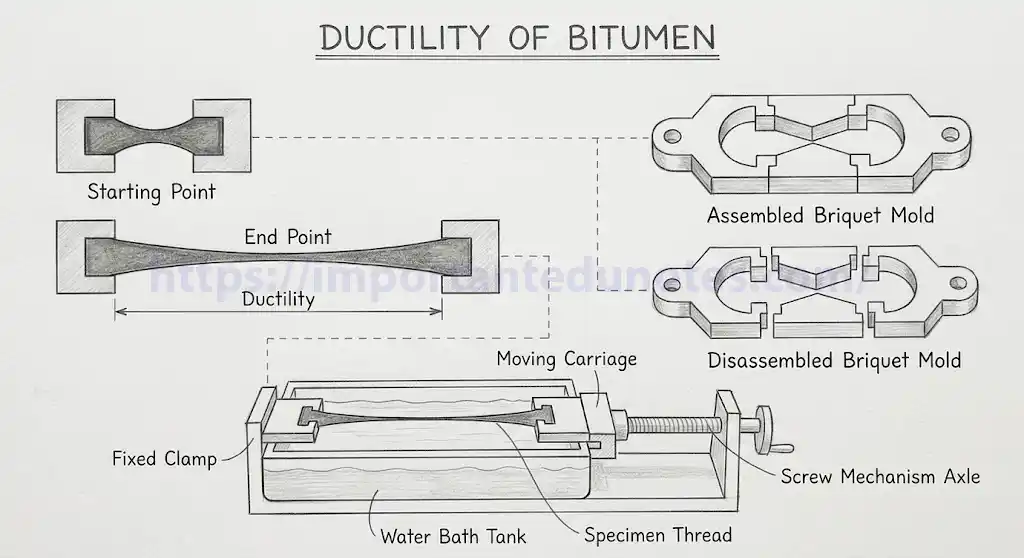
- Mould: Brass mould consisting of two clips and two side pieces (Total length: 75 mm, Minimum cross-section: 10 mm x 10 mm).
- Water Bath: Thermostatically maintained within ± 0.1°C of the specified temperature.
- Testing Machine: Apparatus capable of pulling the briquette apart horizontally at a uniform speed (typically 50 mm/min).
- Thermometer: Range 0 to 44°C.
Theory & Scope
- Definition: Ductility is the distance in centimeters to which a bituminous material will elongate before breaking when a briquette specimen is pulled apart at a specified speed and temperature.
- Significance: It measures the adhesive and cohesive properties of bitumen. High ductility is desirable for flexible pavements to prevent cracking under traffic loads and temperature changes.
Procedure
- The bituminous material was melted to a temperature of 75°C to 100°C above its softening point and poured into a mould assembled on a brass plate coated with a glycerine-dextrin mixture.
- The filled mould was cooled in air for 30-40 minutes, then placed in a water bath at 25°C for 30 minutes, after which excess bitumen was trimmed to level the surface.
- The mould was returned to the water bath for a further 85 to 95 minutes, after which the side pieces were removed.
- The clips were attached to the testing machine and pulled apart horizontally at a uniform speed of 50 ± 2.5 mm/min until rupture occurred, and the distance was recorded.
Observations and Calculations
Test Conditions: Temperature: 25.0°C, Pulling Speed: 50 mm/min.
| Parameter | Value |
|---|---|
| Initial Distance | 0 cm |
| Final Distance at Rupture | 60 cm |
| Ductility Value | 60 cm |
Result
The Ductility of the given bitumen sample is 60 cm.
Discussion and Conclusion
The obtained ductility value of 60 cm indicates that the bitumen possesses good adhesive and cohesive properties. For standard paving grade bitumen, the minimum ductility requirement typically ranges from 50 cm to 75 cm. Since the result meets the general requirement of exceeding 50 cm, the binder is considered sufficiently ductile and suitable for use in flexible pavement construction where it must withstand deformation without cracking.
Precautions
- Ensure the plate upon which the mould is placed is perfectly flat and level.
- Take care during filling not to disarrange the parts or trap air pockets.
- Adjust the specific gravity of the water (using methyl alcohol or sodium chloride) if the bitumen touches the surface or bottom.
- Ensure the water level covers the specimen both above and below by at least 25 mm.