
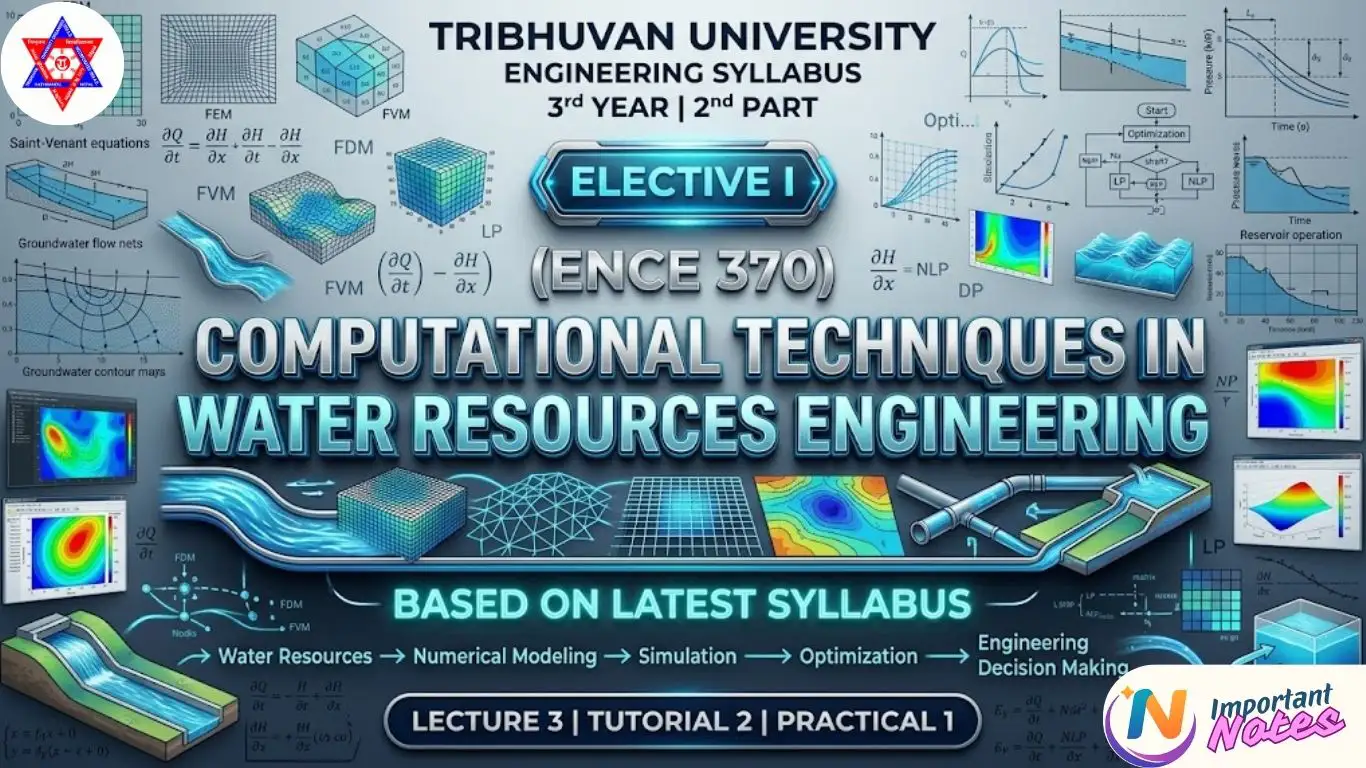
COMPUTATIONAL TECHNIQUES IN WATER RESOURCES ENGINEERING (ENCE 370)
Course Objectives
The objective of this course is to equip students with computational techniques for solving complex problems in water resources engineering. The course emphasizes the application of numerical methods to simulate and analyze open channel flow, groundwater seepage, and unsteady flow in pipe systems, alongside the use of optimization approaches for water resources management.
By the end of the course, students will be able to apply computational tools to effectively model, evaluate, and optimize water resources systems for practical engineering decision-making.
Detailed Syllabus
1.1 Role of computational techniques in water resources
1.2 Types of models: Deterministic, stochastic, data-driven
1.3 Methods of computation: Finite difference method (FDM); Finite element method (FEM); Finite volume method (FVM)
1.4 Initial and boundary conditions
1.5 Software overview related to water resources
1.6 Saint Venant equations: Assumptions, equations in conservative and non-conservative forms
2 Finite Difference Method (9 hours)2.1 Mathematical theory of FDM: Forward difference approximation; Backward difference approximation; Central difference approximation; Steps in FDM
2.2 Order of accuracy; Truncation error
2.3 Concept of consistency, convergence and stability
2.4 Explicit and implicit schemes
2.5 Kinematic and dynamic wave celerity
2.6 Finite difference solution of kinematic wave model (Explicit only)
2.7 Finite difference solution of dynamic wave model (Explicit and implicit)
3 Method of Characteristics (MOC) (12 Hours)3.1 Characteristics; Solution requirements; Advantages; Limitations
3.2 Characteristics equations to open channel and pipe flow
3.3 Finite difference solution of characteristics equations of unsteady pipe flow
3.4 Algorithm for solving water hammer problem using rectangular grid
3.5 Stability of MOC solution
3.6 Boundary conditions for unsteady pipe flow problem
3.7 MOC for 1D gradually varied unsteady open channel flow
3.8 Numerical (FDM) solution of MOC for 1D unsteady open channel flow
4 Simulation of Groundwater Flow (9 Hours)4.1 Basic equation of groundwater flow and flow-net analysis: Darcy’s Law; Steady continuity equation for incompressible flow; Equipotential line; Stream line; Flow potential; Flow-net; Rules for constructing flow-net in isotropic medium
4.2 Finite difference scheme for 2D groundwater simulation
4.3 Simulation of seepage under a dam based on steady state 2D model
4.4 1D implicit model for simulating river stage and groundwater table interaction
5 Optimization Techniques in Water Resources (9 Hours)5.1 Introduction: Role and importance of optimization in water resources planning and management; Types of optimization problems (single-objective, multi-objective, deterministic and stochastic)
5.2 Linear programming (LP): Formulation of LP problems (objective function, constraints, and decision variables); Application in reservoir operation and canal scheduling
5.3 Nonlinear programming (NLP): Overview of NLP problems and solution approaches; Applications in groundwater remediation, water allocation, and hydropower scheduling
5.4 Dynamic programming (DP): Principle of optimality; Recursive solution approach; Application to multi-period reservoir operation problems
Tutorial (30 hours)
1. Methods and techniques of computation
2. Solution of water resources problems by numerical methods
3. Finite difference method
4. Kinematic wave model
5. Dynamic wave model
6. Method of characteristics
7. Simulation of groundwater flow
8. Optimization techniques in water resources
Practical/Assignment (15 hours)
1. Simulation of rainfall-runoff process in a sloped channel using the kinematic wave approximation
2. Model an unsteady flow scenario (e.g., gate opening or dam break) using HEC-RAS
3. Solution of transient flow problem (e.g., sudden valve closure) in a pipeline using the Method of Characteristics (MOC) in MATLAB or Python
4. Development of MATLAB or Python program to solve 1D steady-state groundwater flow in a confined aquifer using the finite difference method (FDM) with Dirichlet boundary conditions
5. Creation of 2D steady-state groundwater model to simulate seepage under an earthen dam using MODFLOW and ModelMuse GUI
6. Formulation of linear programming model to optimize the monthly operation of a single reservoir for irrigation and hydropower using Excel Solver or Python
Final Exam
The questions will cover all the chapters in the syllabus. The evaluation scheme will be as indicated in the table below:
| Chapter | Hours | Marks distribution* |
|---|---|---|
| 1 | 6 | 8 |
| 2 | 9 | 12 |
| 3 | 12 | 16 |
| 4 | 9 | 12 |
| 5 | 9 | 12 |
| Total | 45 | 60 |
* There may be minor deviation in marks distribution.
References
1. Cheng, A. H.-D., Cheng, D. T. (2005). Applied Hydrology with Remote Sensing. Springer.
2. Anderson, M. P., Woessner, W. W. (1992). Applied Groundwater Modeling: Simulation of Flow and Advective Transport. Academic Press.
3. Chapra, S. C., Canale, R. P. (2015). Numerical Methods for Engineers. McGraw-Hill.
4. Loucks, D. P., van Beek, E. (2017). Water Resource Systems Planning and Management: An Introduction to Methods, Models, and Applications. Springer.
5. Wurbs, R. A., James, W. P. (2002). Water Resources Engineering. Prentice Hall.
6. Chaudhry, M. Hanif. (2008). Open-Channel Flow. Springer.
7. Chow, Ven Te. (1988). Applied Hydrology. McGraw-Hill.
Chapter-wise Notes
Based on the latest syllabus of IoE (III/II)
| SN | Chapter | View / Download |
|---|---|---|
| 1 | Computational Techniques | View / Download |
| 2 | Finite Difference Method | View / Download |
| 3 | Method of Characteristics (MOC) | View / Download |
| 4 | Simulation of Groundwater Flow | View / Download |
| 5 | Optimization Techniques in Water Resources | View / Download |
Practical Manuals & Reports
Lab manuals and software assignments for Computational Techniques in Water Resources Engineering ENCE 370
| SN | Practical Name | View / Download |
|---|---|---|
| 1 | Simulation of rainfall-runoff process in a sloped channel using the kinematic wave approximation | View / Download |
| 2 | Model an unsteady flow scenario (e.g., gate opening or dam break) using HEC-RAS | View / Download |
| 3 | Solution of transient flow problem in a pipeline using MOC in MATLAB/Python | View / Download |
| 4 | MATLAB/Python program to solve 1D steady-state groundwater flow using FDM | View / Download |
| 5 | Creation of 2D steady-state groundwater model to simulate seepage using MODFLOW | View / Download |
| 6 | Formulation of linear programming model to optimize reservoir operation using Excel Solver | View / Download |
Miscellaneous Items & Tutorials
| SN | Item | Description | Download |
|---|---|---|---|
| 1 | HEC-RAS and MODFLOW Software Guides | Step-by-step documentation for practical simulation and modelling | Download |
| 2 | Past Year Questions | Collection of previous exam papers for Computational Techniques in Water Resources Engineering ENCE 370 | Download |
| 3 | Tutorial Solutions Book | Full step-by-step numerical solutions for FDM, MOC, and Optimization problems | Download |
Read Also:
Explore the complete collection of syllabi for all engineering disciplines and notes from the Institute of Engineering (IOE).
View All IOE Engineering Syllabi📄 Disclaimer: All Computational Techniques in Water Resources Engineering ENCE 370 notes, syllabus details, exam schedules, and guides shared here are based on the Latest curriculum of IoE and are primarily sourced from official structures and computational texts.
If you are the original content creator of any material provided here and wish for removal or credit, kindly contact us. We respect intellectual property rights and will act promptly.