
Rotational Dynamics
Class 12 Physics Notes • NEB Syllabus 2083
Syllabus, 13 solved multiple choice questions, step-by-step numericals, handwritten and typed PDF notes and frequently asked questions on moment of inertia, torque, rotational energy and angular momentum.
1. Syllabus
Unit 1: Mechanics (24 hours)
Chapter 1: Rotational Dynamics (10 hours)
These notes follow the NEB Class 12 Physics syllabus (+2 Physics, Nepal). Practise the multiple choice questions first, then work through the numericals, and finish with the PDF notes for quick revision.
2. Multiple Choice Questions
Question 1. A disk and a ring, both with the same mass and radius, are released from the top of an inclined plane at the same time. Which one will reach the bottom first?
- a) Disk
- b) Ring
- c) Both will reach at the same time
- d) It depends on the inclination angle
Correct Answer: a) Disk
Reason: The moment of inertia of a disk (\(\tfrac12 MR^2\)) is less than that of a ring (\(MR^2\)). For rolling without slipping, \(a=\dfrac{g\sin\theta}{1+I/MR^2}\), so the disk has \(a=\tfrac23 g\sin\theta\) and the ring only \(a=\tfrac12 g\sin\theta\). The disk accelerates faster.
Question 2. Two bodies of masses \(m_1\) and \(m_2\) move in circles of radii \(r_1\) and \(r_2\) respectively. What will be the ratio of their linear velocities \(v_1\) and \(v_2\) if they complete the circles in equal time?
- a) \(\dfrac{m_1}{m_2}\)
- b) \(\dfrac{r_1}{r_2}\)
- c) 1
- d) \(\dfrac{m_1}{m_2}\cdot\dfrac{r_1}{r_2}\)
Correct Answer: b) \(\dfrac{r_1}{r_2}\)
Reason: Linear velocity \(v=\dfrac{2\pi r}{T}\). Since the time period \(T\) is the same for both, \(v\propto r\), hence \(\dfrac{v_1}{v_2}=\dfrac{r_1}{r_2}\).
Question 3. A figure skater pulls in her arms during a spin. What happens to her moment of inertia and angular velocity?
- a) Moment of inertia decreases, angular velocity increases
- b) Moment of inertia decreases, angular velocity decreases
- c) Moment of inertia increases, angular velocity increases
- d) Moment of inertia increases, angular velocity decreases
Correct Answer: a) Moment of inertia decreases, angular velocity increases
Reason: With no external torque, \(L=I\omega\) is constant. Pulling the arms in brings mass closer to the axis, so \(I\) decreases and \(\omega\) must increase.
Question 4. Which one has the highest moment of inertia: a ring, a solid sphere, a disc and a solid cylinder, all of the same mass and radius?
- a) Ring
- b) Solid sphere
- c) Disc
- d) Solid cylinder
Correct Answer: a) Ring
Reason: \(I_{\text{ring}}=MR^2\), \(I_{\text{disc}}=\tfrac12MR^2\), \(I_{\text{solid sphere}}=\tfrac25MR^2\). The ring has all its mass at the maximum distance from the axis.
Question 5. Which factor does not affect the moment of inertia of a rotating body?
- a) Mass of the body
- b) Distribution of mass around the axis
- c) Shape of the body
- d) Temperature of the body
Correct Answer: d) Temperature of the body
Reason: Moment of inertia depends on the mass, how it is distributed (shape and size) and the position of the axis of rotation, not on temperature.
Question 6. Why does a diver tuck in their body during a dive to increase their rotational speed?
- a) To increase moment of inertia
- b) To decrease moment of inertia
- c) To increase torque
- d) To decrease torque
Correct Answer: b) To decrease moment of inertia
Reason: Tucking brings mass closer to the axis, decreasing \(I\). By conservation of angular momentum, \(I_1\omega_1=I_2\omega_2\), so a smaller \(I\) gives a larger \(\omega\).
Question 7. Two wheels of different radii and the same mass roll without slipping on a horizontal surface. What happens to the rotational kinetic energy if their linear speeds are equal?
- a) Larger radius has more energy
- b) Smaller radius has more energy
- c) Remains the same
- d) The one with greater angular speed has more
Correct Answer: c) Remains the same
Reason: Taking both wheels as uniform solid discs:
The radius cancels, so for equal mass and speed the rotational kinetic energy is the same.
Question 8. What are the components of the total kinetic energy of a solid cylinder rolling down an incline without slipping?
- a) Only translational
- b) Only rotational
- c) Half translational, half rotational
- d) Two-thirds translational, one-third rotational
Correct Answer: d) Two-thirds translational, one-third rotational
Reason:
Translational share \(=\dfrac{1/2}{3/4}=\dfrac23\); rotational share \(=\dfrac{1/4}{3/4}=\dfrac13\).
Question 9. What happens to the torque if the angle between \(\vec r\) and \(\vec F\) is \(90^\circ\)?
- a) Torque is zero
- b) Torque is maximum
- c) Torque is minimum
- d) Torque is constant
Correct Answer: b) Torque is maximum
Reason: \(\tau=rF\sin\theta\). At \(\theta=90^\circ\), \(\sin 90^\circ=1\), the largest possible value, so the torque is maximum.
Question 10. Which one has the highest moment of inertia: a ring, a solid sphere, a disc and a hollow sphere, all of the same mass and radius?
- a) Ring
- b) Solid sphere
- c) Disc
- d) Hollow sphere
Correct Answer: a) Ring
Reason:
Question 11. Why does a gyroscope remain stable and resist changes in its orientation?
- a) Due to its moment of inertia
- b) Due to its angular velocity
- c) Due to conservation of angular momentum
- d) Due to its mass distribution
Correct Answer: c) Due to conservation of angular momentum
Reason: A spinning gyroscope has angular momentum. Unless an external torque acts, its magnitude and direction stay constant, so the gyroscope resists changes in orientation.
Question 12. What happens to the angular momentum of a rotating object if the radius is halved and the mass is kept constant (linear speed unchanged)?
- a) It remains the same
- b) It is doubled
- c) It is halved
- d) It is quadrupled
Correct Answer: c) It is halved
Reason: For a particle moving in a circle, \(L=mvr\). With \(m\) and \(v\) constant, halving \(r\) halves \(L\).
Note: if the angular velocity \(\omega\) were held constant instead, \(L=mr^2\omega\) would become one-fourth, which is not among the options, so the question intends constant linear speed.
Question 13. What is the angular velocity of a minute hand in \(\mathrm{rad\,s^{-1}}\)?
- a) \(\dfrac{\pi}{60}\)
- b) \(\dfrac{\pi}{180}\)
- c) \(\dfrac{\pi}{1800}\)
- d) \(\dfrac{\pi}{360}\)
Correct Answer: c) \(\dfrac{\pi}{1800}\)
Reason: One revolution (\(2\pi\) rad) takes \(60\times60=3600\ \mathrm{s}\).
3. Numerical and Subjective Questions
a) Define moment of inertia and explain how it depends on the distribution of mass.
Moment of inertia (\(I\)) is a measure of a body’s resistance to changes in its rotational motion; it is the rotational equivalent of mass. It depends not only on the total mass but also on how that mass is distributed about the axis of rotation. The farther the mass is from the axis, the greater the moment of inertia:
b) State the principle of conservation of angular momentum. Why does a gymnast spin faster when pulling in her arms?
If the net external torque on a system is zero, the total angular momentum stays constant: \(L=I\omega=\text{constant}\). Pulling the arms in brings mass closer to the axis and decreases \(I\). To keep \(L\) constant, \(\omega\) must increase, so she spins faster.
c) A dancer (mass 60 kg) spins on a frictionless turntable with arms outstretched: \(I_1=5\ \mathrm{kg\,m^2}\), \(\omega_1=2\ \mathrm{rad\,s^{-1}}\). She pulls her arms in, reducing her moment of inertia to \(I_2=2\ \mathrm{kg\,m^2}\) in 0.5 s.
(i) What is her new angular velocity after pulling in her arms?
(ii) What is the change in her rotational kinetic energy?
This extra energy comes from the work done by the dancer’s muscles in pulling her arms inward.
(iii) What average torque would be required if the change were produced by an external force (hypothetical)?
In the real situation angular momentum is conserved, so the net external torque is zero. Hypothetically, if \(I\) stayed \(5\ \mathrm{kg\,m^2}\) while \(\omega\) rose from 2 to 5 \(\mathrm{rad\,s^{-1}}\) in 0.5 s:
a) Define rolling motion and explain the condition for pure rolling.
Rolling motion is the combination of translational motion of the centre of mass and rotational motion about the centre of mass. In pure rolling (rolling without slipping) the point of contact is momentarily at rest relative to the surface, which gives
b) Derive the relation between linear velocity and angular velocity for a body undergoing pure rolling.
In one complete revolution (time \(T\)) the centre of mass moves a distance \(s=2\pi R\). So
c) A uniform rod of length 1.2 m and mass 2.4 kg is placed on a smooth horizontal surface. A force of 12 N is applied perpendicularly at one end of the rod.
(i) What is the torque produced about the centre of mass of the rod?
(ii) What is the angular acceleration of the rod about its centre of mass?
(iii) What is the linear acceleration of the centre of mass?
a) Define radius of gyration. How is it related to the moment of inertia?
The radius of gyration (\(k\)) of a body about an axis is the perpendicular distance from the axis at which the entire mass could be concentrated so that the moment of inertia stays the same. It is related to \(I\) by
b) Explain how moment of inertia varies for different geometrical bodies such as a ring, disc and sphere (mention any two with reasoning).
| Body (mass \(M\), radius \(R\)) | Moment of inertia |
|---|---|
| Ring (axis through centre, perpendicular to plane) | \(MR^2\) |
| Disc or solid cylinder (axis through centre) | \(\tfrac12MR^2\) |
| Hollow sphere (about a diameter) | \(\tfrac23MR^2\) |
| Solid sphere (about a diameter) | \(\tfrac25MR^2\) |
Ring versus disc: in a ring all the mass is at the maximum distance \(R\). In a disc of the same mass and radius the mass is spread from the centre out to \(R\); mass closer to the axis contributes less to \(I\), so the disc has the smaller moment of inertia.
Hollow sphere versus solid sphere: a hollow sphere has all its mass on the surface, farthest from the axis, whereas a solid sphere has mass throughout its volume, closer to the axis. Hence \(\tfrac23MR^2>\tfrac25MR^2\).
c) A uniform rod of mass 2 kg and length 1 m lies on a smooth inclined plane making \(30^\circ\) with the horizontal. The rod is hinged at its upper end to the incline and released from rest, rotating downwards in the plane of the incline.
Take \(g=9.8\ \mathrm{m\,s^{-2}}\). The rod starts across the slope, so the component of its weight along the incline, \(mg\sin30^\circ\), acts at the centre of mass (distance \(L/2\) from the hinge) perpendicular to the rod.
(i) Calculate the torque acting on the rod about the hinge just after it is released.
(ii) Determine the angular acceleration of the rod at that instant.
i) Define torque and give its SI unit. Write the vector formula and explain each term.
Torque (\(\tau\)) is the turning effect of a force; it is the rotational equivalent of force. Its SI unit is the newton-metre (N m).
ii) State the relation between torque and angular acceleration. What is the rotational analogue of Newton’s second law?
The relation is
where \(\tau\) is the net torque, \(I\) the moment of inertia and \(\alpha\) the angular acceleration. It is the rotational analogue of Newton’s second law, \(F=ma\).
iii) A constant torque of 1000 N m turns a wheel of moment of inertia \(200\ \mathrm{kg\,m^2}\) about an axis through its centre. Calculate its angular velocity after 3 seconds.
Starting from rest (\(\omega_0=0\)):
a) Define angular acceleration. Write down the kinematic equations of rotational motion for constant angular acceleration.
Angular acceleration (\(\alpha\)) is the rate of change of angular velocity with respect to time. For constant \(\alpha\):
b) Differentiate between angular displacement, angular velocity and angular acceleration.
c) A disc starts from rest and accelerates uniformly to \(20\ \mathrm{rad\,s^{-1}}\) in 5 seconds. Find (i) the angular acceleration and (ii) the angle turned during this time.
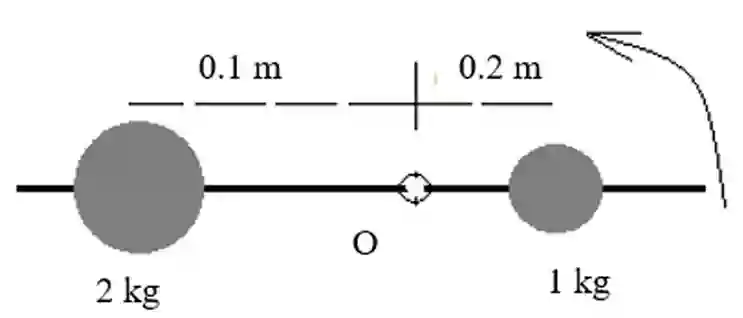
Figure: Two masses on a rod about the centre of rotation
a) Define centre of mass. How does its position affect the rotational stability?
The centre of mass is the point where the whole mass of a body can be considered to act; it is the mass-weighted average position of the body. For stable rotation the centre of mass should lie on the axis of rotation. If it is off the axis, the rotating body exerts an unbalanced, continuously changing force on the axle, causing vibration and wobbling.
b) Explain the concept of rotational kinetic energy. How is it different from translational kinetic energy?
Rotational kinetic energy is the energy a body has due to its rotation:
Translational kinetic energy, \(K_{\text{trans}}=\tfrac12mv^2\), depends on mass and linear velocity, whereas rotational kinetic energy depends on the moment of inertia and angular velocity.
c) Referring to the figure, two masses of 1 kg and 2 kg are placed at 0.2 m and 0.1 m respectively from the centre of a massless rod. Find the total moment of inertia of the system about the centre.
a) Why is moment of inertia considered the rotational analogue of mass?
It plays the same role in rotation that mass plays in translation. Mass decides the linear acceleration for a given force (\(F=ma\)); moment of inertia decides the angular acceleration for a given torque (\(\tau=I\alpha\)). It measures a body’s resistance to angular acceleration.
b) Derive the expression for the moment of inertia of a uniform rod about an axis through its centre and perpendicular to its length.
Let the rod have mass \(M\) and length \(L\), extending from \(x=-L/2\) to \(x=+L/2\) about the axis at \(x=0\). Linear mass density is \(\lambda=\dfrac{M}{L}\).
Take a small element of length \(dx\) at distance \(x\) from the axis. Its mass is \(dm=\dfrac{M}{L}\,dx\) and its moment of inertia is
Integrating over the whole rod:
About an axis through one end (parallel axis theorem): \(I=\tfrac1{12}ML^2+M\left(\tfrac L2\right)^2=\tfrac13ML^2\).
c) A rod of mass 5 kg and length 1 m rotates about its centre. Calculate its moment of inertia and its rotational kinetic energy when spinning at \(12\ \mathrm{rad\,s^{-1}}\).
Figure: Rod pivoted at its centre with two point masses
a) Write the expression for the total moment of inertia of the system about the central pivot. Mention each contributing term.
The total is the sum of the moment of inertia of the rod and that of the two point masses:
where \(M\) and \(L\) are the mass and length of the rod, and \(m_1, m_2\) are the attached masses at distances \(r_1, r_2\) from the pivot.
b) How will the moment of inertia change if one mass is moved closer to the centre? Justify your answer conceptually.
It decreases. Each point mass contributes \(mr^2\), which depends on the square of its distance from the axis. Moving a mass closer reduces its \(r\) and therefore its contribution to the total moment of inertia.
c) Given: rod mass \(M=3\ \mathrm{kg}\), length \(L=1.2\ \mathrm{m}\); point masses \(m_1=m_2=1\ \mathrm{kg}\), each at a distance of 0.6 m from the centre. Calculate the total moment of inertia of the system about the centre.
a) Define angular momentum for a rotating body. State its SI unit.
Angular momentum is the product of the moment of inertia and the angular velocity of the body:
SI unit: \(\mathrm{kg\,m^2\,s^{-1}}\) (equivalently joule-second).
b) State and explain the principle of conservation of angular momentum. Give one real-life example other than a skater.
If no net external torque acts on a system, its total angular momentum remains constant, that is, \(I_1\omega_1=I_2\omega_2\).
Example: a diver leaving a board tucks into a ball to spin faster (smaller \(I\), larger \(\omega\)) and straightens just before entering the water to slow the spin (larger \(I\), smaller \(\omega\)).
c) A skater of moment of inertia \(3\ \mathrm{kg\,m^2}\) spins at \(4\ \mathrm{rad\,s^{-1}}\). She pulls in her arms and reduces her moment of inertia to \(1.5\ \mathrm{kg\,m^2}\). Find her new angular velocity. What does this tell us about angular momentum?
The moment of inertia halved and the angular velocity doubled, so the product \(I\omega\) stayed the same: angular momentum is conserved.
a) Derive the formula for the work done by a torque in producing angular displacement.
Let a force \(F\) act at a distance \(r\) from the axis and turn the body through a small angle \(d\theta\). The point of application moves \(ds=r\,d\theta\), so
Total work: \(W=\int\tau\,d\theta\), which for a constant torque gives
Power is the rate of doing work:
b) A constant torque of 8 N m is applied to a wheel. If it turns through an angle of 5 radians in 2 seconds, calculate the work done and the average power delivered.
a) Name and state the physical principle that explains why her angular velocity increases when she pulls her arms in.
Principle of conservation of angular momentum: if the net external torque on a system is zero, its total angular momentum \(L=I\omega\) remains constant.
b) Derive the relation between angular momentum and moment of inertia for a rotating body.
Consider a rigid body as \(n\) particles of masses \(m_1,m_2,\dots,m_n\) at perpendicular distances \(r_1,r_2,\dots,r_n\) from the axis, rotating with uniform angular velocity \(\omega\).
For the \(i\)-th particle: \(v_i=r_i\omega\), linear momentum \(p_i=m_ir_i\omega\), and angular momentum
Since \(I=\sum m_ir_i^2\), we get
c) If the dancer’s initial moment of inertia is \(4\ \mathrm{kg\,m^2}\) and angular velocity is \(2\ \mathrm{rad\,s^{-1}}\), and she reduces her moment of inertia to \(2\ \mathrm{kg\,m^2}\), calculate her new angular velocity.
a) Give the significance of moment of inertia in rotational motion.
Moment of inertia represents a body’s resistance to changes in its rotational speed. A larger moment of inertia needs a larger torque to produce the same angular acceleration.
b) Write the formula for the moment of inertia of the uniform rod about the given axis.
c) State the principle of conservation of angular momentum with a real-life example.
If no net external torque acts on a system, its total angular momentum is conserved. Example: a spinning ice skater pulls her arms in and spins faster.
d) Given \(M=6\ \mathrm{kg}\), \(L=2\ \mathrm{m}\), \(m_1=2\ \mathrm{kg}\) at \(d_1=0.5\ \mathrm{m}\), \(m_2=3\ \mathrm{kg}\) at \(d_2=0.8\ \mathrm{m}\), \(\tau=12\ \mathrm{N\,m}\) and \(\theta=\pi\ \mathrm{rad}\), calculate the total moment of inertia of the system (rod and masses) about the axis of rotation. If the system is released from rest and rotates under the constant torque \(\tau\), find (i) the angular acceleration \(\alpha\) and (ii) the angular velocity after rotating through the angle \(\theta\).
(i) Angular acceleration
(ii) Angular velocity after turning through \(\theta\) (using \(\omega^2=\omega_0^2+2\alpha\theta\) with \(\omega_0=0\)):
a) Define angular momentum and state its SI unit.
Angular momentum is the product of moment of inertia and angular velocity, \(L=I\omega\). SI unit: \(\mathrm{kg\,m^2\,s^{-1}}\).
b) State the principle of conservation of angular momentum.
If the net external torque on a closed system is zero, the total angular momentum of the system remains constant.
c) Explain why the skater spins faster after pulling her arms inward.
Pulling the arms in moves mass closer to the axis and decreases her moment of inertia. No external torque acts, so \(L=I\omega\) stays constant; \(\omega\) therefore increases to compensate for the smaller \(I\).
d) Given \(I_1=5\ \mathrm{kg\,m^2}\), \(\omega_1=2\ \mathrm{rad\,s^{-1}}\) and \(I_2=2\ \mathrm{kg\,m^2}\), calculate (i) the new angular velocity \(\omega_2\) and (ii) the change in rotational kinetic energy of the skater (take \(K=\tfrac12I\omega^2\)).
4. View PDF Notes
i. Handwritten Notes
ii. Typed PDF Notes
5. Frequently Asked Questions
What is rotational dynamics in Class 12 Physics?
What topics are included in Chapter 1 Rotational Dynamics of NEB Class 12 Physics?
What is moment of inertia and what is its SI unit?
What is the radius of gyration?
What is the moment of inertia of a uniform rod?
What is the relation between torque and angular acceleration?
What are the equations of rotational motion for constant angular acceleration?
What is the formula for rotational kinetic energy?
How do you calculate work and power in rotational motion?
What is the law of conservation of angular momentum?
Why does a disc reach the bottom of an incline before a ring?
What are the moments of inertia of a ring, disc, solid sphere and hollow sphere?
Where can I get Class 12 Physics Chapter 1 Rotational Dynamics notes in PDF?
Students also search for: