
Fluid Statics
Class 12 Physics Notes • NEB Syllabus 2083
Syllabus, 12 solved multiple choice questions, step-by-step numericals, handwritten and typed PDF notes and frequently asked questions on pressure, buoyancy, surface tension, viscosity, continuity and Bernoulli’s equation.
1. Syllabus
Unit 1: Mechanics (24 hours)
Chapter 3: Fluid Statics (6 hours)
These notes follow the NEB Class 12 Physics syllabus (+2 Physics, Nepal). Practise the multiple choice questions first, then work through the numericals, and finish with the PDF notes for quick revision.
2. Multiple Choice Questions
Question 1. Which of the following liquids is likely to have the highest surface tension?
- a) Alcohol
- b) Water
- c) Mercury
- d) Oil
Correct Answer: c) Mercury
Reason: Mercury has strong metallic cohesive bonds between its atoms, so its surface tension (\(\approx0.485\ \mathrm{N\,m^{-1}}\)) is much higher than that of water (\(\approx0.072\ \mathrm{N\,m^{-1}}\)), alcohol or oil.
Question 2. Which phenomenon is not influenced by surface tension?
- a) Capillary action
- b) Floating of a small insect on water
- c) Expansion of liquid volume
- d) Formation of droplets
Correct Answer: c) Expansion of liquid volume
Reason: Thermal expansion depends on temperature and the expansion coefficient of the liquid. Capillary action, a floating insect and droplet formation are direct effects of surface tension.
Question 3. Which part of the liquid has the highest value of surface tension?
- a) Free surface
- b) Middle region
- c) In contact with wall
- d) Near the bottom
Correct Answer: a) Free surface
Reason: Surface tension is a surface phenomenon. It acts at the free surface of a liquid, where the unbalanced cohesive forces pull the surface molecules inward.
Question 4. What will be the height of a liquid column in a capillary tube on the Moon’s surface if its height is \(h\) on Earth?
- a) \(h\)
- b) \(\dfrac{h}{6}\)
- c) \(6h\)
- d) \(1.6h\)
Correct Answer: c) \(6h\)
Reason: The capillary rise is
On the Moon \(g_{\text{Moon}}=\dfrac g6\), so the column height becomes \(6h\).
Question 5. What is the height of a liquid column in a capillary of radius \(1\ \mathrm{mm}\) if the liquid rises to a height of \(7.5\ \mathrm{cm}\) in a capillary of radius \(2\ \mathrm{mm}\)?
- a) \(7.5\ \mathrm{cm}\)
- b) \(15\ \mathrm{cm}\)
- c) \(10\ \mathrm{cm}\)
- d) \(5\ \mathrm{cm}\)
Correct Answer: b) \(15\ \mathrm{cm}\)
Reason: By Jurin’s law, \(h\,r=\text{constant}\) (since \(h=\dfrac{2T\cos\theta}{r\rho g}\)).
Question 6. A body is floating on water in a beaker, and the entire system is falling freely under gravity. What will be the upthrust on the body?
- a) Equal to the weight of the water displaced
- b) Equal to the weight of the body
- c) Equal to the loss in weight of the body
- d) Zero
Correct Answer: d) Zero
Reason: The upthrust is \(U=V\rho g_{\text{eff}}\). In free fall the effective gravity is \(g_{\text{eff}}=0\), so there is no pressure difference in the water and the buoyant force is zero.
Question 7. What is the initial flow rate of water from a \(1\ \mathrm{cm^2}\) hole at the bottom of a tank with a \(5\)-metre water level?
- a) \(10^{-3}\ \mathrm{m^3\,s^{-1}}\)
- b) \(10^{-4}\ \mathrm{m^3\,s^{-1}}\)
- c) \(10\ \mathrm{m^3\,s^{-1}}\)
- d) \(10^{-2}\ \mathrm{m^3\,s^{-1}}\)
Correct Answer: a) \(10^{-3}\ \mathrm{m^3\,s^{-1}}\)
Reason: Using Torricelli’s law with \(g=10\ \mathrm{m\,s^{-2}}\):
Question 8. Two solids are immersed in water. One is submerged to \(\tfrac23\) of its volume, while the other is submerged to \(\tfrac12\) of its volume. What is the ratio of their densities?
- a) \(1:2\)
- b) \(2:3\)
- c) \(3:4\)
- d) \(4:3\)
Correct Answer: d) \(4:3\)
Reason: For a floating body, \(\rho=\dfrac{V_{\text{sub}}}{V}\,\rho_w\). Hence
Question 9. Water flows at \(4\ \mathrm{m\,s^{-1}}\) through a horizontal pipe. If the pipe’s diameter doubles, what will be the flow speed?
- a) \(1\ \mathrm{m\,s^{-1}}\)
- b) \(2\ \mathrm{m\,s^{-1}}\)
- c) \(4\ \mathrm{m\,s^{-1}}\)
- d) \(8\ \mathrm{m\,s^{-1}}\)
Correct Answer: a) \(1\ \mathrm{m\,s^{-1}}\)
Reason: By the equation of continuity, \(A_1v_1=A_2v_2\), that is \(d_1^2v_1=d_2^2v_2\). Doubling \(d\) makes the area four times larger, so the speed becomes \(\dfrac{4}{4}=1\ \mathrm{m\,s^{-1}}\).
Question 10. Water flows at \(2\ \mathrm{m\,s^{-1}}\) through a \(1\ \mathrm{mm^2}\) hole at the bottom of a beaker. What is the instantaneous height of the water in the vessel? (Hint: \(v=\sqrt{2gh}\))
- a) \(20\ \mathrm{cm}\)
- b) \(10\ \mathrm{cm}\)
- c) \(12\ \mathrm{cm}\)
- d) \(15\ \mathrm{cm}\)
Correct Answer: a) \(20\ \mathrm{cm}\)
Reason:
Question 11. Which factor has the greatest impact on the volume of liquid flowing through a pipe according to Poiseuille’s law?
- a) Pressure difference
- b) Length of the pipe
- c) Radius of the pipe
- d) Viscosity of the liquid
Correct Answer: c) Radius of the pipe
Reason: Poiseuille’s law gives
The flow rate is proportional to \(r^4\), so the radius is by far the most dominant factor.
Question 12. Which of the following best explains aerodynamic lift?
- a) The pressure is higher above the wing
- b) Air moves faster above the wing
- c) Air moves slower above the wing
- d) Gravity pulls the wing upward
Correct Answer: b) Air moves faster above the wing
Reason: Air travels faster over the curved upper surface of an aerofoil. By Bernoulli’s principle the pressure above the wing is lower than below it, which produces a net upward force (lift).
3. Numerical and Subjective Questions
a) Define pressure in a fluid. State its variation with depth.
Pressure in a fluid is the normal force exerted by the fluid per unit surface area:
In a static, incompressible fluid the pressure increases linearly with depth \(h\):
b) Derive the expression for pressure at a depth \(h\) below the surface of a liquid.
Consider an imaginary vertical liquid column of depth \(h\) and cross-sectional area \(A\).
Downward force on the top surface: \(F_{\text{top}}=P_0A\)
Weight of the liquid column: \(W=mg=(\rho Ah)g\)
Upward force at the bottom: \(F_{\text{bottom}}=PA\)
For equilibrium, \(F_{\text{bottom}}=F_{\text{top}}+W\):
Dividing by \(A\):
c) A hole is made at a depth of \(20\ \mathrm{cm}\) below the surface of water. Calculate the speed of water emerging from the hole. (Take \(g=9.8\ \mathrm{m\,s^{-2}}\))
Using Torricelli’s law:
a) The bottom of a ship is made heavier. Why?
The bottom of a ship is made heavy (often with ballast) to lower the centre of gravity of the ship well below its metacentre. This keeps the ship in stable equilibrium and produces a strong restoring (righting) torque, which prevents it from capsizing in rough water.
b) Does Archimedes’ principle apply in a satellite moving in a circular orbit around the Earth? Explain.
No. Inside an orbiting satellite everything is weightless, so the effective gravity is \(g_{\text{eff}}=0\). Since the buoyant force is \(U=\rho Vg_{\text{eff}}\), no upthrust acts on an object placed in a fluid inside the satellite.
c) A string supports a solid iron object of mass \(200\ \mathrm{g}\) which is totally immersed in a liquid of density \(900\ \mathrm{kg\,m^{-3}}\). If the density of iron is \(8000\ \mathrm{kg\,m^{-3}}\), calculate the tension in the string.
(With \(g=10\ \mathrm{m\,s^{-2}}\) the tension is \(1.775\ \mathrm{N}\).)
a) State Archimedes’ principle.
When a body is immersed partly or fully in a fluid, it experiences an upward buoyant force (upthrust) equal to the weight of the fluid displaced by the body.
b) Explain the condition for floating and sinking of a body in a liquid.
c) A block of volume \(0.02\ \mathrm{m^3}\) is floating in water with \(75\%\) of its volume submerged. Find its density.
By the law of floatation, weight of block = weight of water displaced:
a) How can you treat Archimedes’ principle in an artificial satellite?
In an artificial satellite the effective gravity is \(g_{\text{eff}}=0\). The hydrostatic pressure gradient needs gravity (\(\dfrac{dP}{dh}=\rho g\)), so no pressure gradient exists in a fluid there. The buoyant force vanishes (\(U=0\)) and Archimedes’ principle does not work.
b) The specific gravity of sea water is \(1.03\) and that of ice is \(0.92\). What fraction of an iceberg is above the surface of the water?
About \(10.7\%\) of the iceberg is above the water.
c) A \(25\ \mathrm{cm}\) thick block of ice floating on fresh water can support an \(80\ \mathrm{kg}\) man standing on it. What is the smallest area of the ice block? (Specific gravity of ice \(=0.917\))
For the minimum area, the block is just fully submerged:
a) Define surface energy.
Surface energy is the potential energy per unit area stored in the surface layer of a liquid. It is the work done against the cohesive forces to create that unit area of surface.
b) Derive the relation between surface energy and surface tension.
Consider a rectangular wire frame with a sliding wire of length \(L\) supporting a liquid film. The film has two free surfaces, so the pulling force on the sliding wire is
Work done when the wire is displaced by \(\Delta x\):
The total increase in area is \(\Delta A=2L\,\Delta x\). Hence
Surface energy per unit area is numerically equal to the surface tension.
c) A rectangular plate with dimensions \(6\ \mathrm{cm}\times4\ \mathrm{cm}\times2\ \mathrm{mm}\) is placed with its largest face resting on the surface of water. Calculate the downward force exerted on the plate due to surface tension, assuming a zero angle of contact. Also find the downward force if the plate is placed vertically so that only its longest side just touches the water. (Surface tension of water \(=7\times10^{-2}\ \mathrm{N\,m^{-1}}\))
Flat position (the whole perimeter is in contact):
Vertical position (along the longest side):
a) Define surface tension. What is its SI unit?
Surface tension is the cohesive force per unit length acting along an imaginary line drawn on the liquid surface:
SI unit: \(\mathrm{N\,m^{-1}}\).
b) What is capillarity? Derive the expression for capillary rise.
Capillarity is the rise or fall of a liquid in a narrow tube dipped in it.
Let the liquid rise to a height \(h\) in a tube of radius \(r\) with angle of contact \(\theta\). The upward force due to surface tension acts along the circumference:
Weight of the liquid column:
Balancing the forces:
c) A capillary tube of radius \(0.25\ \mathrm{mm}\) is dipped in water. If the surface tension is \(0.072\ \mathrm{N\,m^{-1}}\) and the angle of contact is zero, calculate the height of water rise. (Take \(g=9.8\ \mathrm{m\,s^{-2}}\), \(\rho=1000\ \mathrm{kg\,m^{-3}}\))
a) What is the angle of contact? Explain how it affects capillary action.
The angle of contact (\(\theta\)) is the angle between the tangent to the liquid surface at the point of contact and the solid wall, measured inside the liquid.
b) Derive the relation between surface tension, capillary rise and the radius of the tube.
Rearranging the capillary rise formula \(h=\dfrac{2T\cos\theta}{r\rho g}\):
c) Two small drops of mercury, each of radius \(r\), coalesce to form a single large drop. Calculate the ratio of the total surface energies before and after the change.
Conservation of volume:
Initial surface energy:
Final surface energy:
a) Define viscosity and give its SI unit.
Viscosity is the property of a fluid by which it offers internal frictional resistance to the relative motion of its layers. SI unit: \(\mathrm{Pa\,s}\) (or \(\mathrm{N\,s\,m^{-2}}\)).
b) State and explain Newton’s law of viscosity.
The viscous force \(F\) between two layers of a fluid is directly proportional to the area \(A\) of the layers and to the velocity gradient \(\dfrac{dv}{dx}\) between them:
The negative sign shows that the force opposes the relative motion; \(\eta\) is the coefficient of viscosity.
c) A fluid of viscosity \(0.01\ \mathrm{N\,s\,m^{-2}}\) flows through a tube of radius \(2\ \mathrm{mm}\). If the velocity gradient is \(400\ \mathrm{s^{-1}}\), find the shear stress.
a) Explain why small liquid drops are spherical.
Surface tension makes a liquid surface contract so that its area and surface energy are as small as possible. For a given volume a sphere has the minimum surface area. In small drops the surface tension forces dominate over gravity, so the drops become spherical.
b) Discuss the effect of adhesive and cohesive forces on the shape of drops.
a) i) Define surface energy.
Surface energy is the potential energy per unit area possessed by the molecules at the liquid surface relative to those in the interior.
a) ii) Derive an expression for surface energy in terms of surface tension and area.
The work done to increase the surface area by \(\Delta A\) against the surface tension \(T\) is
Hence the surface energy per unit area is
b) Calculate the work done in breaking a drop of water of \(2\ \mathrm{mm}\) diameter into a million droplets of the same size. The surface tension of water is \(72\times10^{-3}\ \mathrm{N\,m^{-1}}\).
Radius of each droplet (volume is conserved):
Increase in surface area:
a) Define viscosity and coefficient of viscosity.
Viscosity is the internal friction of a fluid. The coefficient of viscosity (\(\eta\)) is the tangential viscous force per unit area per unit velocity gradient:
b) Derive an expression for the force required to move one layer of fluid over another.
By Newton’s law of viscosity, the viscous drag force is proportional to the area \(A\) of the layer and the velocity gradient \(\dfrac{dv}{dx}\). Introducing the constant \(\eta\):
An equal external force must be applied to keep the layer moving at a steady speed.
c) A plate of area \(0.2\ \mathrm{m^2}\) is moving at a velocity of \(0.1\ \mathrm{m\,s^{-1}}\) over a thin layer of liquid of thickness \(0.5\ \mathrm{mm}\). If the viscosity of the liquid is \(0.5\ \mathrm{N\,s\,m^{-2}}\), find the force required to maintain the motion of the plate.
a) State and explain Stokes’ law.
The viscous drag force \(F_v\) on a spherical object of radius \(r\) moving with velocity \(v\) through a fluid of viscosity \(\eta\) is
b) Derive an expression for the terminal velocity of a spherical object falling through a viscous medium.
At terminal velocity \(v_t\) the net force is zero. The weight balances the upthrust plus the viscous force. Let \(\rho\) be the density of the sphere and \(\sigma\) that of the fluid:
c) A spherical ball of radius \(0.002\ \mathrm{m}\) falls through oil of viscosity \(0.1\ \mathrm{N\,s\,m^{-2}}\). If the density of the ball is \(900\ \mathrm{kg\,m^{-3}}\) and that of the oil is \(700\ \mathrm{kg\,m^{-3}}\), calculate the terminal velocity of the ball.
a) State Poiseuille’s formula for the flow of a liquid through a capillary.
The volume flow rate \(Q\) of a liquid through a horizontal capillary tube of radius \(r\) and length \(L\), with a pressure difference \(\Delta P\) across its ends, is
b) Explain the significance of Poiseuille’s equation in fluid dynamics.
It shows that the flow is extremely sensitive to the radius of the tube (\(Q\propto r^4\)). This explains blood flow in blood vessels, where a small narrowing greatly reduces the flow, and it is used to find the pressure needed for flow in industrial pipelines.
c) A liquid of viscosity \(0.6\ \mathrm{N\,s\,m^{-2}}\) flows through a tube of radius \(2\ \mathrm{mm}\). If the pressure difference across \(10\ \mathrm{cm}\) of the tube is \(500\ \mathrm{Pa}\), calculate the volume flow rate using Poiseuille’s equation.
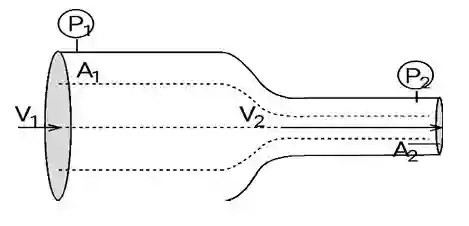
Figure: Water flowing through a pipe of changing cross-section
a) What is the cause of surface tension? Hot soup is tastier than cold soup. Why?
Surface tension is caused by the net inward cohesive attraction on the molecules of the surface layer. Hot soup has a lower surface tension, so it spreads easily over the tongue and reaches more taste buds.
b) In the figure, water is flowing through a pipe having \(A_1=0.02\ \mathrm{m^2}\), \(A_2=0.01\ \mathrm{m^2}\), \(P_1=4\times10^4\ \mathrm{Pa}\) and \(V_1=2\ \mathrm{m\,s^{-1}}\). Find (i) the velocity at end \(A_2\) and (ii) the pressure at end \(A_2\).
(i) Velocity at end \(A_2\) (equation of continuity):
(ii) Pressure at end \(A_2\) (Bernoulli’s equation, \(\rho=1000\ \mathrm{kg\,m^{-3}}\)):
a) State Bernoulli’s theorem.
For an ideal (incompressible, non-viscous) fluid in streamline flow, the total energy per unit volume remains constant along a streamline:
b) Write any two applications of Bernoulli’s principle in real life.
c) Water is flowing through a horizontal pipe of radius \(0.02\ \mathrm{m}\) and length \(1\ \mathrm{m}\) with a velocity of \(0.5\ \mathrm{m\,s^{-1}}\). The viscosity of water is \(0.001\ \mathrm{N\,s\,m^{-2}}\) and the pressure difference across the pipe is \(500\ \mathrm{Pa}\). Calculate the power loss due to viscosity over the length of the pipe.
Volume flow rate from Poiseuille’s formula:
Power loss:
a) What type of fluid does Bernoulli’s principle apply to?
It applies to an ideal fluid: one that is non-viscous, incompressible and irrotational, in steady streamline flow.
b) Derive Bernoulli’s equation for a streamline flow of an incompressible and non-viscous fluid.
The work done by the pressure difference on a fluid of mass \(m\) (volume \(m/\rho\)) equals the change in its mechanical energy.
Equating the two and dividing by \(\dfrac m\rho\):
c) Water is flowing through a horizontal pipe. At one point the velocity of water is \(2\ \mathrm{m\,s^{-1}}\) and the pressure is \(3000\ \mathrm{Pa}\). At another point the velocity increases to \(4\ \mathrm{m\,s^{-1}}\). Find the pressure at this second point, assuming steady flow.
For horizontal flow (\(\rho=1000\ \mathrm{kg\,m^{-3}}\)):
Taking the given pressures as gauge pressures, the negative sign means that the pressure at the second point is \(3000\ \mathrm{Pa}\) below atmospheric pressure. The kinetic energy per unit mass increases by \(\tfrac12(v_2^2-v_1^2)=\tfrac12(16-4)=6\ \mathrm{J\,kg^{-1}}\).
Figure: Steady flow of water in a pipe of varying cross-section
a) State and derive the equation of continuity for incompressible flow.
Statement: for steady streamline flow of an incompressible fluid, the product of the cross-sectional area and the fluid speed is constant:
Derivation: in a time \(\Delta t\), the mass of fluid entering section 1 is \(m_1=\rho_1A_1v_1\Delta t\) and the mass leaving section 2 is \(m_2=\rho_2A_2v_2\Delta t\). By conservation of mass, \(m_1=m_2\):
For an incompressible fluid \(\rho_1=\rho_2\), so
b) State Bernoulli’s principle and write its mathematical form.
Statement: along a streamline in a steady, non-viscous, incompressible flow, the total mechanical energy per unit volume remains constant.
c) Why is the fluid pressure lower at higher speed according to Bernoulli’s principle?
Bernoulli’s equation expresses conservation of mechanical energy. For horizontal flow the energy per unit volume is
When the speed rises, the kinetic energy per unit volume rises. To keep the total constant, the static pressure \(P\) must fall.
d) A pipe tapers from a diameter of \(10\ \mathrm{cm}\) to \(5\ \mathrm{cm}\). Water flows at \(2\ \mathrm{m\,s^{-1}}\) in the wider section. Find (i) the speed at the narrow section and (ii) the pressure difference between the two ends.
(i) Speed at the narrow section
(ii) Pressure difference (\(\rho=1000\ \mathrm{kg\,m^{-3}}\)):
4. View PDF Notes
i. Handwritten Notes
ii. Typed PDF Notes
5. Frequently Asked Questions
What is fluid statics in Class 12 Physics?
What topics are included in Chapter 3 Fluid Statics of NEB Class 12 Physics?
What is pressure in a fluid and how does it vary with depth?
What is Archimedes’ principle and what are the conditions for floating and sinking?
What is surface tension and what is its SI unit?
What is surface energy and how is it related to surface tension?
What is angle of contact and capillarity?
Why are small liquid drops spherical?
What is Newton’s law of viscosity and the coefficient of viscosity?
What is Stokes’ law and terminal velocity?
What is Poiseuille’s formula?
What is the equation of continuity?
What is Bernoulli’s equation and what are its applications?
Why is the upthrust zero in a freely falling system or in a satellite?
Where can I get Class 12 Physics Chapter 3 Fluid Statics notes in PDF?
Students also search for: