
Chemical Kinetics
Class 12 Chemistry Notes • NEB Syllabus 2083
Syllabus, 25 solved multiple choice questions, step-by-step numerical solutions, formulas, handwritten and typed PDF notes and frequently asked questions on rate law, order, half-life, activation energy and catalysis.
1. Syllabus
Unit 3: Chemical Kinetics
These notes follow the NEB Class 12 Chemistry syllabus (+2 Chemistry, Nepal). Practise the multiple choice questions first, then work through the solved numerical and subjective questions, and finish with the PDF notes for quick revision.
2. Multiple Choice Questions
Question 1. Which of the following statements is correct about the rate of reaction?
- a) The rate of a reaction decreases with passage of time as the concentration of reactants decreases.
- b) The rate of a reaction is same at any time during the reaction.
- c) The rate of a reaction is independent of temperature change.
- d) The rate of a reaction decreases with increase in concentration of reactant(s).
Correct Answer: a) The rate of a reaction decreases with passage of time as the concentration of reactants decreases.
Reason: The rate is proportional to the concentration of the reactants (for zero order reactions it stays constant). As the reactants are used up, their concentration falls and the rate falls with time. The rate also depends on temperature and increases with concentration.
Question 2. Rate law for the reaction \(\mathrm{A+2B\rightarrow C}\) is found to be \(rate=k[A][B]\). The concentration of reactant B is doubled, keeping the concentration of A constant. What will be the value of rate of the reaction?
- a) same
- b) doubled
- c) quadrupled
- d) halved
Correct Answer: b) doubled
Reason: The reaction is first order in B. New rate \(=k[A](2[B])=2\,k[A][B]\), which is twice the original rate.
Question 3. According to collision theory, which of the given statements is true?
- a) all collisions are sufficiently violent
- b) all collisions are responsible for product formation
- c) all collisions are effective
- d) only a fraction of collisions is effective which have enough energy to form products
Correct Answer: d) only a fraction of collisions is effective which have enough energy to form products
Reason: Only the collisions in which molecules have the correct orientation and a total energy at least equal to the activation energy are effective. Most collisions are not effective.
Question 4. According to the collision theory of reaction rates, which of the following causes the increased rate with temperature?
- a) greater number of collisions
- b) higher velocity of reacting molecules
- c) greater number of molecules having the activation energy
- d) decrease in the activation energy
Correct Answer: c) greater number of molecules having the activation energy
Reason: A rise in temperature increases the fraction of molecules whose energy equals or exceeds the activation energy. This effect is far larger than the small increase in collision frequency, and the activation energy itself does not change.
Question 5. The rate of the first order reaction \(A\rightarrow\text{product}\) is \(7.5\times10^{-4}\ \mathrm{mol\,L^{-1}\,s^{-1}}\) when the concentration of A is \(0.2\ \mathrm{mol\,L^{-1}}\). What is the rate constant of the reaction?
- a) \(2.5\times10^{-5}\ \mathrm{s^{-1}}\)
- b) \(8.0\times10^{-4}\ \mathrm{s^{-1}}\)
- c) \(6.0\times10^{-4}\ \mathrm{s^{-1}}\)
- d) \(3.75\times10^{-3}\ \mathrm{s^{-1}}\)
Correct Answer: d) \(3.75\times10^{-3}\ \mathrm{s^{-1}}\)
Reason: For a first order reaction, \(rate=k[A]\), so \(k=\dfrac{7.5\times10^{-4}}{0.2}=3.75\times10^{-3}\ \mathrm{s^{-1}}\).
Question 6. For the reaction \(\mathrm{H_2(g)+Br_2(g)\rightarrow 2HBr(g)}\), the rate is \(\mathrm{rate}=k[\mathrm{H_2}][\mathrm{Br_2}]^{1/2}\). Which one of the following statements is true for the reaction?
- a) The reaction is of second order
- b) The molecularity of the reaction is 3/2
- c) The unit of k is \(\mathrm{s^{-1}}\)
- d) The molecularity of the reaction is two
Correct Answer: d) The molecularity of the reaction is two
Reason: The order is \(1+\tfrac12=\tfrac32\), so (a) is wrong, and the unit of k is \(\mathrm{L^{1/2}\,mol^{-1/2}\,s^{-1}}\), so (c) is wrong. Molecularity can never be a fraction, so (b) is wrong. The balanced equation shows one molecule of \(\mathrm{H_2}\) and one of \(\mathrm{Br_2}\) reacting, so the molecularity read from the equation is two (the textbook answer).
Question 7. Half-life period for a first order reaction is 20 min. How much time is required to change the concentration of the reactant from 0.08 M to 0.01 M?
- a) 20 min
- b) 60 min
- c) 40 min
- d) 50 min
Correct Answer: b) 60 min
Reason: Each half-life halves the concentration: \(0.08\rightarrow0.04\rightarrow0.02\rightarrow0.01\) takes 3 half-lives. Time \(=3\times20=60\ \mathrm{min}\).
Question 8. What is the primary difference between average rate and instantaneous rate of a reaction?
- a) Average rate is time-independent, while instantaneous rate is time-dependent
- b) Average rate is determined over a time interval, while instantaneous rate is determined at a specific time
- c) Average rate applies only to fast reactions, while instantaneous rate applies only to slow reactions
- d) There is no significant difference between the two
Correct Answer: b) Average rate is determined over a time interval, while instantaneous rate is determined at a specific time
Reason: Average rate is the change in concentration divided by the time interval. Instantaneous rate is the rate at one moment, equal to the slope of the tangent to the concentration-time curve at that time.
Question 9. Given the reaction \(A\rightarrow B\), if the concentration of A decreases from 0.8 M to 0.6 M in 20 seconds, what is the average rate of the reaction?
- a) 0.01 M/s
- b) 0.02 M/s
- c) 0.04 M/s
- d) 0.10 M/s
Correct Answer: a) 0.01 M/s
Reason: Average rate \(=-\dfrac{\Delta[A]}{\Delta t}=\dfrac{0.8-0.6}{20}=0.01\ \mathrm{M/s}\).
Question 10. Which of the following is true about the rate constant (k) in a rate law?
- a) It changes with the concentration of reactants
- b) It depends on the order of the reaction
- c) It is constant at a given temperature
- d) It varies with the catalyst used but not with temperature
Correct Answer: c) It is constant at a given temperature
Reason: The rate constant does not depend on concentration. It depends only on the reaction, the temperature and the catalyst, so for a given reaction at a fixed temperature it has one fixed value.
Question 11. Molecularity is the number of species involved in the rate determining collision. Which of the following reactions can have a molecularity greater than 3?
- a) Elementary reaction
- b) Complex reaction
- c) Zero-order reaction
- d) Pseudo-first-order reaction
Correct Answer: b) Complex reaction
Reason: The molecularity of an elementary reaction cannot exceed 3, because the simultaneous collision of more than three molecules is extremely unlikely. A complex (multi-step) reaction has an overall equation with many reacting molecules, so the number of molecules in its balanced equation can exceed 3.
Question 12. For the reaction \(2A+B\rightarrow C+D\), the experimentally determined rate law is \(R=k[A]^2\). What is the identity of this reaction?
- a) Second-order and bimolecular
- b) Second-order and trimolecular
- c) Second-order overall but unimolecular in B
- d) First-order in A and B
Correct Answer: b) Second-order and trimolecular
Reason: The power of [A] is 2, and B does not appear, so the order is 2. The balanced equation has \(2+1=3\) molecules reacting, so the molecularity read from the equation is three (trimolecular).
Question 13. Which of the following plots corresponds to a zero-order reaction?
- a) A straight line with a negative slope for [A] vs. time
- b) A straight line for [A] vs. time
- c) A curved line for [A] vs. time
- d) A straight line for 1/[A] vs. time
Correct Answer: a) A straight line with a negative slope for [A] vs. time
Reason: For a zero order reaction \([A]=[A]_0-kt\), so the plot of [A] against time is a straight line with slope \(-k\). A plot of 1/[A] against time is a straight line for a second order reaction.
Question 14. Half-life gives the idea about the rate of reaction. Which of the following affect the half-life of a first-order reaction?
- a) Initial concentration of the reactant
- b) Rate constant only
- c) Temperature and pressure
- d) Both a and b
Correct Answer: b) Rate constant only
Reason: For a first order reaction \(t_{1/2}=0.693/k\), which does not depend on the initial concentration. (Temperature changes the half-life only through k.)
Question 15. According to collision theory, which of the following factors does NOT directly affect reaction rates?
- a) Number of collisions per second
- b) Activation energy
- c) Orientation of colliding molecules
- d) Molecular weight of the reactants
Correct Answer: d) Molecular weight of the reactants
Reason: The collision frequency, the activation energy and the orientation of the colliding molecules decide how many collisions are effective. The molecular weight does not appear directly as a factor.
Question 16. What is the role of an activated complex in a chemical reaction?
- a) It is a stable intermediate
- b) It is a short-lived, high-energy species that forms before products
- c) It is a low-energy state that slows the reaction
- d) It is the final product
Correct Answer: b) It is a short-lived, high-energy species that forms before products
Reason: The activated complex (transition state) is the unstable arrangement at the top of the energy barrier. It either falls back to the reactants or goes forward to give the products.
Question 17. Which of the following can be calculated using Arrhenius equation?
- a) Order of reaction
- b) Activation energy
- c) Half-life
- d) Molecularity
Correct Answer: b) Activation energy
Reason: From the rate constants at two temperatures, \(\log\dfrac{k_2}{k_1}=\dfrac{E_a}{2.303R}\left(\dfrac{T_2-T_1}{T_1T_2}\right)\) gives the activation energy.
Question 18. Catalyst alters the rate of chemical reaction so are useful in many industrial and chemical processes. How does a catalyst affect the rate of a chemical reaction?
- a) Lowering the activation energy
- b) Increasing the concentration of reactants
- c) Shifting the equilibrium constant
- d) Increasing the temperature
Correct Answer: a) Lowering the activation energy
Reason: A catalyst provides an alternative reaction path with a lower activation energy, so more collisions are effective. It does not change the concentration, the temperature or the equilibrium constant.
Question 19. Which of the following factors increases the rate of reaction but does not alter the equilibrium constant?
- a) Catalyst
- b) Pressure
- c) Temperature
- d) Reactant concentration
Correct Answer: a) Catalyst
Reason: A catalyst speeds up the forward and backward reactions equally, so the equilibrium constant is unchanged. Temperature changes the value of the equilibrium constant.
Question 20. Catalysis may be homogeneous or heterogeneous. Which of the following is an example of heterogeneous catalysis?
- a) Enzyme action on glucose
- b) Decomposition of hydrogen peroxide by manganese dioxide
- c) Acid-catalyzed ester hydrolysis
- d) Ozone depletion by chlorine radicals
Correct Answer: b) Decomposition of hydrogen peroxide by manganese dioxide
Reason: Solid \(\mathrm{MnO_2}\) catalyses the decomposition of liquid \(\mathrm{H_2O_2}\). The catalyst and the reactant are in different phases, so it is heterogeneous catalysis.
Question 21. Enzyme catalysis involves the role of biological catalyst in the living body. How does it differ and is unique from other chemical catalysts?
- a) It works only at high temperatures
- b) It is highly specific and efficient
- c) It increases activation energy
- d) It works only in gaseous reactions
Correct Answer: b) It is highly specific and efficient
Reason: An enzyme acts on one particular substrate (lock and key model) and can speed up the reaction by a very large factor at body temperature and near neutral pH.
Question 22. Substrate concentration affects the rate of reaction in enzyme catalysis. Which of the following causes the reaction rate to reach a maximum at high substrate concentration?
- a) All enzyme molecules are saturated with substrate
- b) Activation energy becomes zero
- c) The temperature becomes constant
- d) Enzymes are consumed
Correct Answer: a) All enzyme molecules are saturated with substrate
Reason: At high substrate concentration every active site is occupied. Adding more substrate cannot increase the rate, so the rate levels off at its maximum.
Question 23. If the rate of a reaction doubles when the temperature is increased from 300 K to 310 K, what is the activation energy? (Take \(R=8.314\ \mathrm{J\,mol^{-1}K^{-1}}\))
- a) \(57.9\ \mathrm{kJ/mol}\)
- b) \(48.2\ \mathrm{kJ/mol}\)
- c) \(34.7\ \mathrm{kJ/mol}\)
- d) \(23.5\ \mathrm{kJ/mol}\)
Correct Answer: a) \(57.9\ \mathrm{kJ/mol}\)
Reason: Using \(\log\dfrac{k_2}{k_1}=\dfrac{E_a}{2.303R}\cdot\dfrac{T_2-T_1}{T_1T_2}\) with \(k_2/k_1=2\): \(E_a=\dfrac{2.303\times8.314\times0.3010\times300\times310}{10}\approx53.6\ \mathrm{kJ/mol}\). Of the given options, 57.9 kJ/mol is the nearest and is the textbook answer.
Question 24. Hydrochloric acid is reacted with large pieces of calcium carbonate; the reaction is then repeated using calcium carbonate powder. How does this change affect the activation energy and the collision frequency?
- a) Activation energy increases; collision frequency increases
- b) Activation energy stays constant; collision frequency increases
- c) Activation energy increases; collision frequency stays constant
- d) Activation energy stays constant; collision frequency stays constant
Correct Answer: b) Activation energy stays constant; collision frequency increases
Reason: Powdering the solid increases its surface area, so more particles are exposed to the acid and the collision frequency increases. The activation energy depends on the reaction itself and does not change.
Question 25. The following data were measured for the reaction of nitric oxide with hydrogen: \(2NO(g)+2H_2(g)\rightarrow N_2(g)+2H_2O(g)\)
| Experiment | [NO] (M) | [H2] (M) | Initial rate (M/s) |
|---|---|---|---|
| 1 | 0.10 | 0.10 | \(1.23\times10^{-3}\) |
| 2 | 0.10 | 0.20 | \(2.46\times10^{-3}\) |
| 3 | 0.20 | 0.10 | \(4.92\times10^{-3}\) |
- a) 0
- b) 1
- c) 2
- d) 3
Correct Answer: d) 3
Reason: Experiments 1 and 2: \(\mathrm{[H_2]}\) doubles and the rate doubles, so the order in \(\mathrm{H_2}\) is 1. Experiments 1 and 3: [NO] doubles and the rate becomes four times, so the order in NO is 2. Overall order \(=2+1=3\).
3. Numerical and Subjective Questions
Short Answer Questions
a. Rate of reaction and rate constant
Rate of reaction: the change in the concentration of a reactant or a product per unit time. Its unit is \(\mathrm{mol\,L^{-1}\,s^{-1}}\).
Rate constant (k): the proportionality constant in the rate law. It is equal to the rate of the reaction when the concentration of every reactant is 1 mol/L, and it depends on temperature and catalyst but not on concentration.
b. Activation energy and activated complex
Activation energy (\(E_a\)): the minimum energy that the colliding molecules must have for the collision to be effective and give products.
Activated complex: the unstable, short-lived, high-energy arrangement of atoms formed at the top of the energy barrier when reactant molecules collide with enough energy. It is also called the transition state, and it can either form the products or fall back to the reactants.
a. Average and instantaneous rate
| Average rate | Instantaneous rate |
|---|---|
| Change in concentration over a finite time interval, \(\Delta[R]/\Delta t\). | Rate at one particular moment, \(d[R]/dt\). |
| Equal to the slope of the chord joining two points on the concentration-time curve. | Equal to the slope of the tangent at a point on the curve. |
| Gives only a mean value over the interval. | Gives the exact rate at that time. |
b. Order and molecularity
| Order | Molecularity |
|---|---|
| Sum of the powers of concentration terms in the rate law. | Number of molecules colliding in an elementary step. |
| Found by experiment. | Found from the mechanism of the reaction. |
| Can be zero, fractional, negative or whole. | Always a positive whole number, usually 1, 2 or 3. |
| Applies to simple and complex reactions. | Applies only to elementary reactions or the rate-determining step. |
c. \(1^{\mathrm{st}}\) order and \(2^{\mathrm{nd}}\) order reaction
| First order | Second order |
|---|---|
| Rate \(=k[A]\). | Rate \(=k[A]^2\) or \(k[A][B]\). |
| Unit of k: \(\mathrm{s^{-1}}\). | Unit of k: \(\mathrm{L\,mol^{-1}\,s^{-1}}\). |
| Half-life \(0.693/k\), independent of initial concentration. | Half-life \(1/(ka)\), inversely proportional to initial concentration. |
| Plot of \(\ln[A]\) against t is a straight line. | Plot of \(1/[A]\) against t is a straight line. |
d. Homogeneous and heterogeneous catalysis
| Homogeneous catalysis | Heterogeneous catalysis |
|---|---|
| Catalyst and reactants are in the same phase. | Catalyst and reactants are in different phases. |
| Example: \(\mathrm{H^+}\) catalysing the esterification of ethanol with acetic acid. | Example: solid Fe catalysing \(\mathrm{N_2+3H_2\rightleftharpoons2NH_3}\). |
| Catalyst is difficult to separate from the products. | Catalyst is easily separated and reused. |
The rate of a chemical reaction is the change in the concentration of a reactant or product per unit time:
Unit: \(\mathrm{mol\,L^{-1}\,s^{-1}}\) (also written M/s; for slow reactions mol L-1 min-1 or mol L-1 h-1). For gaseous reactions it may also be written in atm s-1.
Very slow reactions: rusting of iron (days to months) and the conversion of petroleum from organic matter (millions of years). Another example is the fermentation of sugar to alcohol.
Very fast reactions: the precipitation of yellow \(\mathrm{PbI_2}\) on mixing \(\mathrm{Pb(NO_3)_2}\) and \(\mathrm{KI}\) solutions, and the neutralisation \(\mathrm{HCl+NaOH\rightarrow NaCl+H_2O}\) (over in a fraction of a second). Explosions are also very fast.
Average rate is the change in concentration over a finite time interval, \(-\Delta[R]/\Delta t\). It is the slope of the chord joining two points on the concentration-time curve. Instantaneous rate is the rate at a particular time, \(-d[R]/dt\). It is the slope of the tangent drawn to the curve at that time.
The instantaneous rate is the precise measurement. The rate keeps changing as the reactant is used up, so an average over an interval only gives a mean value that hides this change. The instantaneous rate is the limit of the average rate as the time interval \(\Delta t\rightarrow0\) and gives the exact rate at that moment.
The initial rate is the instantaneous rate at the start of the reaction (at \(t=0\)), when the reactants are present at their starting concentrations.
Advantages:
The rate law is the experimentally determined equation that expresses the rate of a reaction as the product of the rate constant and the concentrations of the reactants, each raised to a power: \(\mathrm{rate}=k[A]^x[B]^y\). The powers \(x\) and \(y\) need not be equal to the stoichiometric coefficients.
a. \(\mathrm{H_2(g)+I_2(g)\rightarrow 2HI(g)}\)
b. \(\mathrm{N_2+3H_2\rightleftharpoons 2NH_3}\)
The rate constant (k) is the proportionality constant in the rate law. It is numerically equal to the rate of reaction when all the reactant concentrations are unity, and it is constant at a given temperature. For a reaction of order \(n\), \(k=\dfrac{\mathrm{rate}}{[A]^n}\), so the unit is \((\mathrm{mol\,L^{-1}})^{1-n}\,\mathrm{s^{-1}}\).
a. \(\mathrm{rate}=k[\mathrm{NO}]^2\)
Second order (\(n=2\)).
b. \(\mathrm{rate}=k[\mathrm{NH_3}]^0\)
Zero order (\(n=0\)).
c. \(\mathrm{rate}=k[\mathrm{BrO_3^-}][\mathrm{Br^-}][\mathrm{H^+}]^2\)
Order \(n=1+1+2=4\).
a. Write the rate law expression of this reaction.
In terms of the rate of disappearance of the reactants and appearance of the product:
b. Calculate the rate of formation of \(\mathrm{NO_2}\).
NO and \(\mathrm{NO_2}\) have the same coefficient (2), so \(\mathrm{NO_2}\) forms at the same rate at which NO disappears.
The rate of formation of \(\mathrm{NO_2}\) is 0.066 mol L-1 s-1, and the rate of the reaction is \(\tfrac12\times0.066=0.033\ \mathrm{mol\,L^{-1}\,s^{-1}}\).
a. What is the order of this reaction and how do you know it?
The reaction is of first order. The unit of the rate constant is \(\mathrm{min^{-1}}\), and only the first order reaction has the unit of time-1 (for order \(n\) the unit is \((\mathrm{mol\,L^{-1}})^{1-n}\mathrm{min^{-1}}\), which equals \(\mathrm{min^{-1}}\) only when \(n=1\)).
b. What is the molecularity of this reaction?
The balanced equation shows two molecules of \(\mathrm{N_2O_5}\) reacting, so the molecularity read from the equation is 2 (textbook answer). Note that the order is 1, so order and molecularity are not the same here, which shows that the reaction is not a single-step process: its slow step involves one molecule.
c. What is the rate of the reaction when \([\mathrm{N_2O_5}]=0.40\ \mathrm{M}\)?
| [Q]initial (M) | 0.170 | 0.212 | 0.357 |
|---|---|---|---|
| Rate (mol/L/s) | \(6.68\times10^{-3}\) | \(1.04\times10^{-2}\) | \(2.94\times10^{-2}\) |
a. What is the order of the reaction with respect to [Q], and what is the rate equation?
Compare the experiments with [Q] = 0.170 M and 0.212 M:
Since \(1.247^2=1.56\), \(n=2\). The check with the third experiment: \((0.357/0.170)^2=4.41\) and \(2.94\times10^{-2}/6.68\times10^{-3}=4.40\). The reaction is of second order in Q.
b. What is the value of the rate constant?
The other experiments give the same value: \(1.04\times10^{-2}/0.212^2=0.231\) and \(2.94\times10^{-2}/0.357^2=0.231\).
c. Write the rate law equation.
The rate law of a reaction is the experimental expression that relates the rate to the concentrations of the reactants: \(\mathrm{rate}=k[A]^x[B]^y\). The sum \(x+y\) is the order of the reaction. It cannot be written from the balanced equation and must be found by experiment.
| Order | Rate law | Unit of k |
|---|---|---|
| Zero | \(\mathrm{rate}=k\) | \(\mathrm{mol\,L^{-1}\,s^{-1}}\) |
| First | \(\mathrm{rate}=k[A]\) | \(\mathrm{s^{-1}}\) |
| Second | \(\mathrm{rate}=k[A]^2\) | \(\mathrm{L\,mol^{-1}\,s^{-1}}\) |
General unit: \((\mathrm{mol\,L^{-1}})^{1-n}\,\mathrm{s^{-1}}\).
| Initial rate of disappearance (mol L-1 s-1) | A (mol/L) | B (mol/L) |
|---|---|---|
| 0.053 | 0.10 | 0.50 |
| 0.127 | 0.20 | 0.30 |
| 1.02 | 0.40 | 0.60 |
| 0.254 | 0.20 | 0.60 |
| 0.509 | 0.40 | 0.30 |
a. Calculate the order of reaction with respect to A and B.
Order in B (A fixed at 0.20 M): compare Experiments 2 and 4. B changes from 0.30 to 0.60 (doubled) and the rate changes from 0.127 to 0.254 (doubled). So the order in B is 1.
Order in A (B fixed at 0.30 M): compare Experiments 2 and 5. A changes from 0.20 to 0.40 (doubled) and the rate changes from 0.127 to 0.509 (four times). So the order in A is 2.
b. Calculate the rate of reaction when A = 0.5 mol/L and B = 0.3 mol/L.
The same value comes from the other experiments (for Experiment 3, \(1.02/(0.40^2\times0.60)=10.6\)).
One-eighth means \(a\rightarrow\tfrac a2\rightarrow\tfrac a4\rightarrow\tfrac a8\), which is three half-lives:
Using the first order equation with \([A]=a/8\):
Check: \(3t_{1/2}=3\times\dfrac{0.693}{k}=\dfrac{2.079}{k}\). So \(t=3\,t_{1/2}=\dfrac{2.079}{k}\).
With a constant frequency factor, the Arrhenius equation gives:
Number of half-lives: \(0.08\rightarrow0.04\rightarrow0.02\rightarrow0.01\) is 3 half-lives. Alternatively, using the rate constant:
The time required is 60 minutes.
a. Difference
| Homogeneous catalysis | Heterogeneous catalysis |
|---|---|
| Reactants and catalyst are in the same phase. | Reactants and catalyst are in different phases. |
| Example: \(\mathrm{2SO_2(g)+O_2(g)\xrightarrow{NO(g)}2SO_3(g)}\) (lead chamber process). | Example: \(\mathrm{2SO_2(g)+O_2(g)\xrightarrow{V_2O_5(s)}2SO_3(g)}\). |
| The reaction occurs throughout the mixture. | The reaction occurs on the surface of the catalyst. |
b. Three industrial processes using heterogeneous catalysis
| Process | Reaction | Catalyst |
|---|---|---|
| Haber process for ammonia | \(\mathrm{N_2(g)+3H_2(g)\rightleftharpoons2NH_3(g)}\) | Finely divided iron (with \(\mathrm{Mo}\) as promoter) |
| Contact process for sulphuric acid | \(\mathrm{2SO_2(g)+O_2(g)\rightleftharpoons2SO_3(g)}\) | \(\mathrm{V_2O_5}\) |
| Ostwald process for nitric acid | \(\mathrm{4NH_3+5O_2\rightarrow4NO+6H_2O}\) | Platinum-rhodium gauze |
| Hydrogenation of vegetable oil | \(\mathrm{\text{unsaturated oil}+H_2\rightarrow\text{saturated fat}}\) | Nickel |
The half-life is related to the initial concentration \(a\) by \(t_{1/2}\propto\dfrac{1}{a^{\,n-1}}\). So
\(2=2^{n-1}\), so \(n=2\). The reaction is of second order.
For a second order reaction \(t_{1/2}=\dfrac{1}{ka}\):
Check with the second pair: \(1/(4.0\times0.60)=0.417\).
| Experiment | Initial [NH4+] (M) | Initial [NO2–] (M) | Observed initial rate (M/s) |
|---|---|---|---|
| 1 | 0.0100 | 0.200 | \(5.4\times10^{-7}\) |
| 2 | 0.0200 | 0.200 | \(10.8\times10^{-7}\) |
| 3 | 0.0400 | 0.200 | \(21.5\times10^{-7}\) |
| 4 | 0.200 | 0.0202 | \(10.8\times10^{-7}\) |
| 5 | 0.200 | 0.0404 | \(21.6\times10^{-7}\) |
| 6 | 0.200 | 0.0808 | \(43.3\times10^{-7}\) |
a. Compare the initial concentration of \(\mathrm{NH_4^+}\) and initial observed rate in experiment number 1 and 2 and make a relation with concentration and rate of reaction.
In Experiments 1 and 2, \(\mathrm{[NO_2^-]}\) is the same. \(\mathrm{[NH_4^+]}\) doubles (0.0100 M to 0.0200 M) and the rate doubles (\(5.4\times10^{-7}\) to \(10.8\times10^{-7}\)). So the rate is directly proportional to \(\mathrm{[NH_4^+]}\).
b. Find the order of reaction with respect to each reactant and determine the value of rate constant.
\(\mathrm{NH_4^+}\): first order (Experiments 1, 2, 3: doubling the concentration doubles the rate, and quadrupling it gives four times the rate).
\(\mathrm{NO_2^-}\): first order (Experiments 4, 5, 6: \(\mathrm{[NO_2^-]}\) doubles from 0.0202 to 0.0404 and the rate doubles; it doubles again at 0.0808 and the rate doubles again).
The other experiments give \(2.7\times10^{-4}\) as well (mean \(2.7\times10^{-4}\ \mathrm{L\,mol^{-1}\,s^{-1}}\)).
| [NO] (M) | [H2] (M) | Rate (mol/L/s) |
|---|---|---|
| 0.30 | 0.35 | \(2.835\times10^{-3}\) |
| 0.60 | 0.35 | \(1.134\times10^{-2}\) |
| 0.60 | 0.70 | \(2.268\times10^{-2}\) |
Order in NO (\(\mathrm{[H_2]}\) constant, rows 1 and 2): [NO] doubles and the rate becomes \(1.134\times10^{-2}/2.835\times10^{-3}=4\) times, so \(2^x=4\) and the order in NO is 2.
Order in \(\mathrm{H_2}\) ([NO] constant, rows 2 and 3): \(\mathrm{[H_2]}\) doubles and the rate doubles, so the order in \(\mathrm{H_2}\) is 1.
Rows 2 and 3 give the same value: \(1.134\times10^{-2}/(0.60^2\times0.35)=0.090\).
a. Decreasing the pressure of \(\mathrm{NO_2}\) from 0.50 atm to 0.250 atm.
The concentration of a gas is proportional to its pressure, so \(\mathrm{[NO_2]}\) is halved.
The rate decreases to one-fourth of its original value.
b. Increasing the concentration of CO from 0.01 M to 0.03 M.
The rate law does not contain [CO], so the reaction is of zero order in CO. The rate is unchanged.
| Experiment | [H2O2] (mol dm-3) | [I–] (mol dm-3) | [H+] (mol dm-3) | Initial rate (mol dm-3 s-1) |
|---|---|---|---|---|
| 1 | 0.0200 | 0.0100 | 0.0100 | \(3.50\times10^{-6}\) |
| 2 | 0.0300 | 0.0100 | 0.0100 | \(5.30\times10^{-6}\) |
| 3 | 0.0050 | 0.0200 | 0.0200 | \(1.75\times10^{-6}\) |
a. Find out the order of reaction with respect to each reactant.
\(\mathrm{H_2O_2}\) (Experiments 1 and 2, the other concentrations fixed): [H2O2] increases 1.5 times and the rate increases \(5.30/3.50=1.51\) times, so the order is 1.
\(\mathrm{I^-}\) and \(\mathrm{H^+}\) (Experiment 3 against Experiment 1): [H2O2] falls to one-fourth, which alone would make the rate one-fourth. The observed rate is one-half, so the changes in [I–] and [H+] (both doubled) together must double the rate: \(2^{b}\times2^{c}=2\), so \(b+c=1\). The experimental result for this reaction is that the rate depends on \(\mathrm{I^-}\) and does not depend on \(\mathrm{H^+}\), so the order in \(\mathrm{I^-}\) is 1 and in \(\mathrm{H^+}\) is 0.
b. Write the rate law equation.
c. Calculate the value of k.
Experiment 3 gives \(1.75\times10^{-6}/(0.0050\times0.0200)=1.75\times10^{-2}\), the same value.
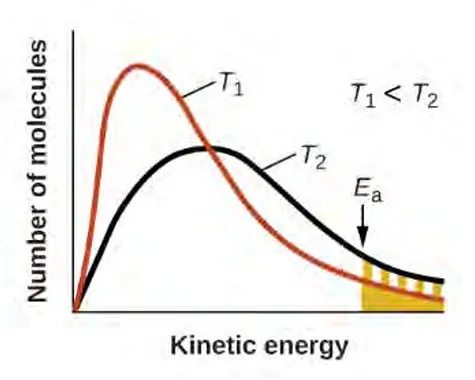
Figure: Maxwell distribution of molecular energies at two temperatures
a. Name the variables in the x and y-axis.
The x-axis shows the kinetic energy of the molecules, and the y-axis shows the number (fraction) of molecules having that energy.
b. Is there any change in the activation energy at higher temperature?
No. The activation energy is a property of the reaction and its path. It does not change with temperature, so the position of \(E_a\) on the energy axis is the same for both curves.
c. Using the graph how can you explain the effect of temperature at higher temperature?
At the higher temperature \(T_2\) the curve flattens and shifts to the right, so more molecules have high kinetic energy. The area under the curve to the right of \(E_a\) (the fraction of molecules able to react) is larger at \(T_2\) than at \(T_1\). More collisions are therefore effective, and the rate of reaction increases. The rate roughly doubles for every 10 degrees rise in temperature.
Long Answer Questions
| [NO] (mol/L) | [Cl2] (mol/L) | Rate (mol/L/h) |
|---|---|---|
| 0.50 | 0.50 | 1.14 |
| 1.00 | 0.50 | 4.56 |
| 1.00 | 1.00 | 9.12 |
a. What is the rate equation that describes the rate’s dependence on the concentrations of NO and \(\mathrm{Cl_2}\)?
Let rate \(=k[\mathrm{NO}]^x[\mathrm{Cl_2}]^y\).
Rows 1 and 2 (\(\mathrm{[Cl_2]}\) fixed): [NO] doubles and the rate becomes \(4.56/1.14=4\) times, so \(x=2\). Rows 2 and 3 ([NO] fixed): \(\mathrm{[Cl_2]}\) doubles and the rate becomes \(9.12/4.56=2\) times, so \(y=1\).
b. What are the orders with respect to each reactant?
Order with respect to NO is 2, with respect to \(\mathrm{Cl_2}\) is 1, and the overall order is 3.
c. What is the value of rate constant?
Row 3 gives the same value: \(9.12/(1.00^2\times1.00)=9.12\).
d. Find the rate of reaction when the reactant concentrations are 2.0 mol/L each.
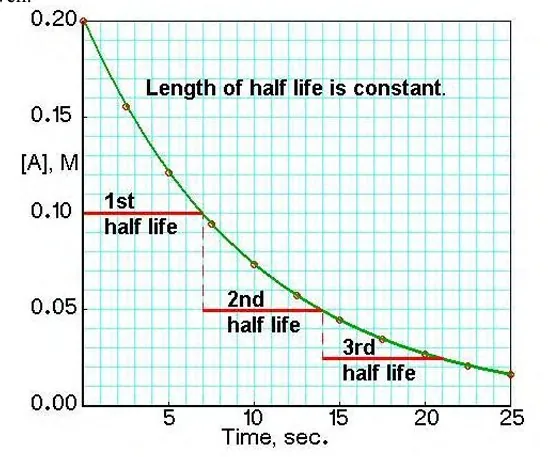
Figure: Concentration of the reactant against time
a. Define the term half-life. Why is it important to know the half-life of a reaction or process?
Half-life (\(t_{1/2}\)) is the time required for the concentration of a reactant to fall to half of its initial value.
Importance: it tells how fast a reaction proceeds (a short half-life means a fast reaction), it helps to find the order of the reaction (constant for first order), and it is used to predict how long a drug stays in the body, the dating of fossils and rocks (radioactive decay) and the storage life of chemicals.
b. Identify the order of reaction given using the information in the plot and give reason for your choice.
From the plot, the concentration falls from 0.20 M to 0.10 M in about 7 s, from 0.10 M to 0.05 M in the next 7 s (14 s in total), and from 0.05 M to 0.025 M in a further 7 s. The half-life is constant (about 7 s) and independent of the concentration of the reactant. This is the characteristic of a first order reaction.
c. Calculate the rate of reaction for the change in concentration from 0.15 mol per liter to 0.05 mol per liter.
From the plot, the concentration is 0.15 M at about 3 s and 0.05 M at about 14 s, so \(\Delta t\approx11\ \mathrm{s}\).
d. What is the rate constant of the given reaction assuming it as a first-order reaction?
Check: \(\dfrac{2.303}{k}\log\dfrac{0.15}{0.05}=\dfrac{2.303\times0.477}{0.099}=11\ \mathrm{s}\), which agrees with part c.
e. Predict the time for the completion of the reaction.
For a first order reaction \([A]=[A]_0e^{-kt}\), and the concentration approaches zero only asymptotically (\([A]=0\) only when \(t\rightarrow\infty\)). So the reaction never completes in a finite time. Practically it is regarded as complete after about 7 to 10 half-lives (about 50 to 70 s here), when less than 1% of the reactant remains.
a. Define the term catalyst. How does a catalyst alter the rate of reaction?
A catalyst is a substance that changes the rate of a chemical reaction without being consumed in the reaction (and without changing its overall products).
It provides an alternative path with lower activation energy. Since the activation energy is lower, a larger fraction of the colliding molecules has enough energy to react, so the rate increases (see the rate constant in the equation \(k=Ae^{-E_a/RT}\)).
b. What type of catalysis is this? Define this catalysis.
This is heterogeneous catalysis: the catalyst is solid iron, while the reactants and products are gases. In heterogeneous catalysis the catalyst and the reactants are in different phases, and the reaction takes place on the surface of the catalyst.
c. Give reason behind low temperature and high pressure required to increase the yield of ammonia.
Low temperature: the forward reaction is exothermic. By Le Chatelier’s principle, lowering the temperature shifts the equilibrium to the forward direction and the yield of ammonia increases. (In practice about 450 to 500 degrees Celsius is used, as a compromise, because the rate is too slow at very low temperature.)
High pressure: 4 moles of gas (\(1N_2+3H_2\)) form 2 moles of gas (\(2NH_3\)). Increasing the pressure shifts the equilibrium towards the side with fewer moles of gas, the forward direction, so the yield increases (about 200 atm is used).
d. Is there any effect of a catalyst on the position of equilibrium? Why?
No. A catalyst lowers the activation energy of the forward and the backward reactions equally, so both rates increase by the same factor. The equilibrium constant and the position of equilibrium remain unchanged. The catalyst only helps the equilibrium to be reached sooner.
| Experiment | [A] (M) | [B] (M) | Initial rate (M/s) |
|---|---|---|---|
| 1 | 0.100 | 0.100 | \(4.0\times10^{-5}\) |
| 2 | 0.100 | 0.200 | \(4.0\times10^{-5}\) |
| 3 | 0.200 | 0.100 | \(16.0\times10^{-5}\) |
a. the rate law for the reaction
Experiments 1 and 2: [B] doubles, the rate does not change, so the order in B is 0.
Experiments 1 and 3: [A] doubles and the rate becomes \(16.0/4.0=4\) times, so the order in A is 2.
b. the rate constant
c. the rate of the reaction when [A] = 0.5 M and [B] = 0.05 M
[B] does not appear in the rate law, so its value has no effect.
a. Write the rate law equation for this reaction.
b. Determine the overall order of the reaction.
Overall order \(=0+2=2\).
c. If the rate constant of this reaction is \(2.0\times10^{-2}\ \mathrm{L\,mol^{-1}\,s^{-1}}\), determine the initial rate of disappearance of X when the concentration of X is 0.30 M and that of Y is 0.40 M.
[X] does not appear in the rate law (zero order), so the initial rate of disappearance of X is \(3.2\times10^{-3}\ \mathrm{mol\,L^{-1}\,s^{-1}}\) (X and Y react in a 1:1 ratio).
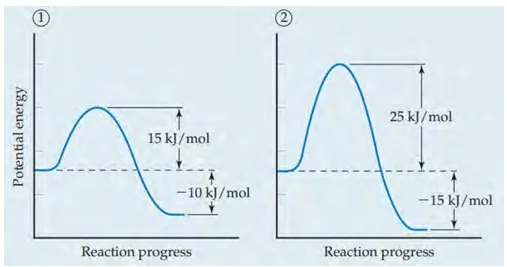
Figure: Energy profile diagrams 1 and 2
a. What do you mean by an energy profile diagram?
An energy profile diagram is a graph of the potential energy of the system against the progress (reaction coordinate) of the reaction. It shows the energy of the reactants, the activated complex at the peak and the products, so it shows the activation energy and the enthalpy change of the reaction.
b. Identify the figure whether it is endothermic or exothermic and why?
Both are exothermic: the products have lower energy than the reactants, so energy is released and \(\Delta H\) is negative (\(-10\ \mathrm{kJ/mol}\) in diagram 1 and \(-15\ \mathrm{kJ/mol}\) in diagram 2).
c. What is the value of activation energy in each diagram?
Diagram 1: \(E_a=15\ \mathrm{kJ/mol}\). Diagram 2: \(E_a=25\ \mathrm{kJ/mol}\).
d. Which one proceeds faster and why?
Process 1 proceeds faster, since its activation energy (15 kJ/mol) is lower than that of process 2 (25 kJ/mol). A lower energy barrier lets a larger fraction of molecules react.
e. Which of the processes (1 or 2) gives the more stable product and why?
Process 2 gives the more stable product. It releases more energy (\(\Delta H=-15\ \mathrm{kJ/mol}\) against \(-10\ \mathrm{kJ/mol}\)), so its product has lower energy, and lower energy means greater stability.
4. View PDF Notes
i. Handwritten Notes
ii. Typed PDF Notes
5. Frequently Asked Questions
What is chemical kinetics? (Class 12 Chemistry)
What topics are included in Unit 3 Chemical Kinetics of NEB Class 12 Chemistry?
What is the rate of a reaction and what are its units?
What is the rate law and the rate constant?
What is the difference between order and molecularity of a reaction?
What are the integrated rate equations for zero and first order reactions?
What is half-life and what are its formulas?
What is the collision theory and what is activation energy?
What is the Arrhenius equation? How is the activation energy calculated?
How do concentration, temperature and a catalyst affect the rate of reaction?
What are the types of catalysis? Give examples.
Where can I find the Chemical Kinetics formula sheet for Class 12?
Where can I find Chemical Kinetics Class 12 numericals with solutions?
Where can I get Class 12 Chemistry Chemical Kinetics notes in PDF? Is there a book?
Where can I get Class 12 Chemistry notes of NEB (handwritten, PDF, Nepal)?
Students also search for: