
Class 10 Optional Mathematics Miscellaneous Exercise
Functions, polynomials, linear programming, parabola, surds, matrices and determinants
9 solved questions with English and Nepali questions, textbook-style step by step solutions, textbook figures and frequently asked questions for the Nepal Grade 10 SEE.
1. Miscellaneous Exercise Solutions: Class 10 Optional Mathematics
This Miscellaneous Exercise comes at the end of Unit 6 (Matrix and Determinant) and revises earlier units: functions, polynomials, linear inequalities, surd equations, the parabola, matrices and determinants. Every question is written as in the textbook, with its parts listed under it and the Nepali question in brackets. The solutions follow the textbook style (Here, … Thus, …).
Miscellaneous Exercise: Written Questions (लेख्ने प्रश्न)
Q.1 In the given mapping diagram, the function \(g(x)\) is defined from set \(A\) to \(B\), and the function \(h(x)\) is defined from set \(B\) to \(C\). Observe the two mapping diagrams and answer the following questions.
- a. Write the composite function from \(A\) to \(C\) in symbolic form.
- b. Write the composite function from \(A\) to \(C\) in ordered pair form.
- c. Is the inverse function of the composite function from \(A\) to \(C\) defined? If defined, write it in ordered pair form.
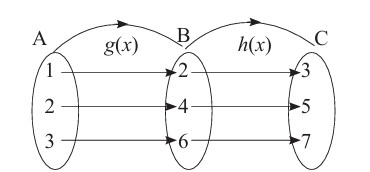
(दिइएको मिलानचित्रमा समूह \(A\) देखि \(B\) सम्म फलन \(g(x)\) र समूह \(B\) देखि \(C\) सम्म फलन \(h(x)\) परिभाषित छन् । (क) \(A\) देखि \(C\) सम्मको संयुक्त फलनलाई सङ्केतमा लेख्नुहोस् । (ख) संयुक्त फलनलाई क्रमजोडाका रूपमा लेख्नुहोस् । (ग) के संयुक्त फलनको विपरीत फलन परिभाषित हुन्छ ? हुन्छ भने क्रमजोडाका रूपमा लेख्नुहोस् ।)
Here, \(A=\{1,2,3\}\), \(B=\{2,4,6\}\), \(C=\{3,5,7\}\).
- \(g: A\to B=\{(1,2),(2,4),(3,6)\}\)
- \(h: B\to C=\{(2,3),(4,5),(6,7)\}\)
a. Symbolic form
The composite function from \(A\) to \(C\) is \((h\circ g)(x)\) or \(hg(x)\).
b. Ordered pair form
- \(x=1\): \(g(1)=2\), \(h(2)=3\), giving \((1,3)\).
- \(x=2\): \(g(2)=4\), \(h(4)=5\), giving \((2,5)\).
- \(x=3\): \(g(3)=6\), \(h(6)=7\), giving \((3,7)\).
c. Inverse function
The function \(hg: A\to C\) is one-to-one and onto, because every element of \(A\) has a unique image and every element of \(C\) has a pre-image. So its inverse exists. Reverse the ordered pairs:
\[(hg)^{-1}=\{(3,1),(5,2),(7,3)\}\]Q.2 If the functions are \(f(x)=2x+3\) and \(g(x)=x-2\).
- a. Find \(f(g(x))\) and \(g^{-1}(f(x))\).
- b. Find the quotient and remainder when \(f(x)\) is divided by \(g(x)\).
- c. Show the linear inequality \(2x+3y>6\) on a graph.
- d. What is a surd equation? Solve \(\sqrt{2x+3}=1\) and check it.
(यदि \(f(x)=2x+3\) र \(g(x)=x-2\) भए, (क) \(f(g(x))\) र \(g^{-1}(f(x))\) पत्ता लगाउनुहोस् । (ख) \(f(x)\) लाई \(g(x)\) ले भाग गर्दा भागफल र शेष पत्ता लगाउनुहोस् । (ग) रेखीय असमानता \(2x+3y>6\) लाई लेखाचित्रमा देखाउनुहोस् । (घ) सर्डयुक्त समीकरण भनेको के हो ? \(\sqrt{2x+3}=1\) लाई हल गरी जाँच गर्नुहोस् ।)
a. Composite functions
\[f(g(x))=f(x-2)=2(x-2)+3=2x-4+3=2x-1\]For \(g^{-1}\), let \(y=x-2\) and interchange \(x\) and \(y\):
\[x=y-2 \implies y=x+2\]So \(g^{-1}(x)=x+2\). Then
\[g^{-1}(f(x))=(2x+3)+2=2x+5\]b. Division
\[\begin{aligned}\frac{2x+3}{x-2} &= \frac{2(x-2)+7}{x-2} \\ &= 2+\frac{7}{x-2}\end{aligned}\]The quotient is \(2\) and the remainder is \(7\).
c. Graph of \(2x+3y>6\)
The boundary line is \(2x+3y=6\), passing through \((0,2)\) and \((3,0)\). It is dashed because the inequality is strict. Test \((0,0)\):
\[2(0)+3(0)=0>6 \quad (\text{false})\]So shade the side away from the origin.
Figure: Graph of 2x + 3y > 6: dashed boundary line, shaded away from the origin.
d. Surd equation
An equation in which the variable appears under a radical sign is called a surd equation. Solve \(\sqrt{2x+3}=1\):
\[2x+3=1 \implies 2x=-2 \implies x=-1\]Verification:
\[\begin{aligned}\text{L.H.S.} &= \sqrt{2(-1)+3} \\ &= \sqrt{1} \\ &= 1 \\ &= \text{R.H.S.}\end{aligned}\]Q.3 The polynomials are \(f(x)=x^3-2x^2-4x+8\) and \(d(x)=x+2\).
- a. Write the remainder when \(f(x)\) is divided by \(d(x)\).
- b. Is \(d(x)\) a factor of \(f(x)\)? Give reason.
- c. Find the factors of \(f(x)\).
- d. If \(d(x)\) is a function, find \(d^{-1}(x)\).
(बहुपदीय \(f(x)=x^3-2x^2-4x+8\) र \(d(x)=x+2\) छन् । (क) \(f(x)\) लाई \(d(x)\) ले भाग गर्दा शेष कति आउँछ ? (ख) के \(d(x)\) बहुपदीय \(f(x)\) को गुणनखण्ड हो, कारण दिनुहोस् । (ग) \(f(x)\) का गुणनखण्डहरू पत्ता लगाउनुहोस् । (घ) \(d(x)\) फलन हुँदा \(d^{-1}(x)\) पत्ता लगाउनुहोस् ।)
a. Remainder
\(d(x)=x+2\) gives \(a=-2\). By the Remainder Theorem:
\[\begin{aligned}R &= f(-2) \\ &= (-2)^3-2(-2)^2-4(-2)+8 \\ &= -8-8+8+8 \\ &= 0\end{aligned}\]b. Is \(d(x)\) a factor?
Yes, because the remainder \(R=f(-2)=0\) (Factor Theorem).
c. Factors of \(f(x)\)
\[\begin{aligned}f(x) &= x^2(x-2)-4(x-2) \\ &= (x-2)(x^2-4) \\ &= (x-2)(x-2)(x+2)\end{aligned}\]d. Inverse function
Let \(y=x+2\) and interchange \(x\) and \(y\):
\[x=y+2 \implies y=x-2\]Q.4 Observe the graph of the given system and answer to the following questions:
- a. Write the coordinates of the points \(O\), \(A\), \(B\) and \(C\).
- b. From the feasible values, find the maximum and minimum value of \(f(x,y)=20x+15y\).
- c. Write the four inequalities represented by the shaded region.
- d. Taking the equation of line \(AB\) as \(f(x)\) and the equation of line \(BC\) as \(g(x)\), find \(f(g(x))\).
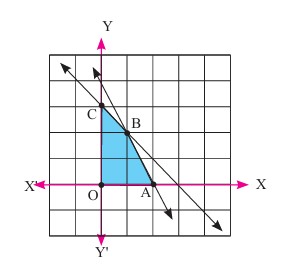
(दिइएको लेखाचित्र हेरी प्रश्नको उत्तर दिनुहोस् । (क) बिन्दुहरू \(O\), \(A\), \(B\) र \(C\) का निर्देशाङ्क लेख्नुहोस् । (ख) उद्देश्य फलन \(f(x,y)=20x+15y\) को अधिकतम र न्यूनतम मान निकाल्नुहोस् । (ग) छाया पारिएको भागले जनाउने चारओटा असमानता पत्ता लगाउनुहोस् । (घ) रेखा \(AB\) को समीकरणलाई \(f(x)\) र \(BC\) लाई \(g(x)\) मानी \(f(g(x))\) पत्ता लगाउनुहोस् ।)
a. Coordinates
\(O=(0,0)\), \(A=(2,0)\), \(B=(1,2)\), \(C=(0,3)\).
b. Optimization
Evaluate \(f(x,y)=20x+15y\) at each corner point:
- At \(O(0,0)\): \(20(0)+15(0)=0\)
- At \(A(2,0)\): \(20(2)+15(0)=40\)
- At \(B(1,2)\): \(20(1)+15(2)=20+30=50\)
- At \(C(0,3)\): \(20(0)+15(3)=45\)
The maximum value is \(50\) at \(B(1,2)\) and the minimum value is \(0\) at \(O(0,0)\).
c. Four inequalities
Line \(AB\) passes through \((2,0)\) and \((1,2)\):
\[\begin{aligned}& m=\frac{2-0}{1-2}=-2 \\ &\implies y-0=-2(x-2) \\ &\implies 2x+y=4\end{aligned}\]The shaded region contains \((0,0)\), so \(2x+y\le 4\).
Line \(BC\) passes through \((0,3)\) and \((1,2)\):
\[\begin{aligned}& m=\frac{2-3}{1-0}=-1 \\ &\implies y-3=-1(x-0) \\ &\implies x+y=3\end{aligned}\]The shaded region contains \((0,0)\), so \(x+y\le 3\). Also \(x\ge 0\) and \(y\ge 0\).
d. Composite function
From \(AB\): \(f(x)=4-2x\). From \(BC\): \(g(x)=3-x\).
\[f(g(x))=f(3-x)=4-2(3-x)=4-6+2x=2x-2\]Q.5 Observe the graph of the given system and answer to the following questions:
- a. What is the name of the curve shown in the graph?
- b. Write the coordinates of the vertex of the curve.
- c. Find the equation of the axis of symmetry.
- d. Find the equation of the curve.
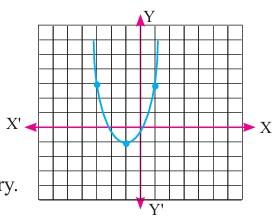
(दिइएको लेखाचित्र हेरी उत्तर दिनुहोस् । (क) लेखाचित्रमा देखाइएको वक्रको नाम के हो ? (ख) वक्रको शीर्षबिन्दुको निर्देशाङ्क लेख्नुहोस् । (ग) सममितीय अक्षको समीकरण पत्ता लगाउनुहोस् । (घ) वक्रको समीकरण निकाल्नुहोस् ।)
The U-shaped curve has its lowest turning point at \((-1,-1)\) and passes through \((0,0)\).
a. Name of the curve
The curve is a parabola.
b. Vertex
The vertex is \((h,k)=(-1,-1)\).
c. Axis of symmetry
The vertical line through the vertex is \(x=h\), so \(x=-1\).
d. Equation of the curve
Use the vertex form \(y=a(x-h)^2+k=a(x+1)^2-1\). The curve passes through \((0,0)\):
\[0=a(0+1)^2-1 \implies a=1\]\[y=(x+1)^2-1=x^2+2x\]Q.6 If \(A=\begin{bmatrix}2 & -3 \\ -4 & 7\end{bmatrix}\), then,
- a. State whether \(A^{-1}\) is defined, with reason.
- b. If defined, find \(A^{-1}\).
- c. Which of the matrices \(\begin{bmatrix}4 & 9 \\ 16 & 49\end{bmatrix}\) and \(\begin{bmatrix}16 & -27 \\ -36 & 61\end{bmatrix}\) is \(A^2\)?
(यदि \(A=\begin{bmatrix}2 & -3 \\ -4 & 7\end{bmatrix}\) भए, (क) \(A^{-1}\) परिभाषित हुन्छ वा हुँदैन, कारणसहित लेख्नुहोस् । (ख) परिभाषित हुन्छ भने \(A^{-1}\) पत्ता लगाउनुहोस् । (ग) \(A^2\) का लागि \(\begin{bmatrix}4 & 9 \\ 16 & 49\end{bmatrix}\) र \(\begin{bmatrix}16 & -27 \\ -36 & 61\end{bmatrix}\) मध्ये कुन हो ?)
Here, \(A=\begin{bmatrix}2 & -3 \\ -4 & 7\end{bmatrix}\).
a. Is \(A^{-1}\) defined?
\[\begin{aligned}|A| &= \begin{vmatrix}2 & -3 \\ -4 & 7\end{vmatrix} \\ &= (2\times 7)-((-3)\times (-4)) \\ &= 14-12 \\ &= 2\end{aligned}\]Since \(|A|=2\neq 0\), \(A\) is a non-singular matrix, so \(A^{-1}\) is defined.
b. Find \(A^{-1}\)
\[\begin{aligned}A^{-1} &= \frac{1}{|A|}\mathrm{adj}(A) \\ &= \frac{1}{2}\begin{bmatrix}7 & 3 \\ 4 & 2\end{bmatrix} \\ &= \begin{bmatrix}\frac{7}{2} & \frac{3}{2} \\ 2 & 1\end{bmatrix}\end{aligned}\]c. Find \(A^2\)
\[\begin{aligned}A^2 &= \begin{bmatrix}2 & -3 \\ -4 & 7\end{bmatrix}\begin{bmatrix}2 & -3 \\ -4 & 7\end{bmatrix} \\ &= \begin{bmatrix}2(2)+(-3)(-4) & 2(-3)+(-3)(7) \\ (-4)(2)+7(-4) & (-4)(-3)+7(7)\end{bmatrix} \\ &= \begin{bmatrix}4+12 & -6-21 \\ -8-28 & 12+49\end{bmatrix} \\ &= \begin{bmatrix}16 & -27 \\ -36 & 61\end{bmatrix}\end{aligned}\]So \(A^2\) is the second matrix.
Q.7 If \(A=\begin{bmatrix}1 & 2 \\ 3 & 5\end{bmatrix}\) and \(B=\begin{bmatrix}4 & 1 \\ 7 & 2\end{bmatrix}\), then,
- a. What is a transpose matrix? Write it.
- b. Verify that \((A+B)^T=B^T+A^T\).
- c. Is it possible to find \(AB\)? Give reason. If possible, find it.
- d. Verify that \((AB)^{-1}=B^{-1}A^{-1}\).
(यदि \(A=\begin{bmatrix}1 & 2 \\ 3 & 5\end{bmatrix}\) र \(B=\begin{bmatrix}4 & 1 \\ 7 & 2\end{bmatrix}\) भए, (क) क्रम परिवर्तन मेट्रिक्स भनेको के हो ? लेख्नुहोस् । (ख) \((A+B)^T=B^T+A^T\) परीक्षण गर्नुहोस् । (ग) \(AB\) पत्ता लगाउन सम्भव छ कि छैन, कारण दिनुहोस् । सम्भव छ भने पत्ता लगाउनुहोस् । (घ) \((AB)^{-1}=B^{-1}A^{-1}\) परीक्षण गर्नुहोस् ।)
Here, \(A=\begin{bmatrix}1 & 2 \\ 3 & 5\end{bmatrix}\) and \(B=\begin{bmatrix}4 & 1 \\ 7 & 2\end{bmatrix}\).
a. Transpose matrix
The matrix obtained by interchanging the rows and columns of \(A\) is called its transpose, written \(A^T\) or \(A’\).
\[A^T=\begin{bmatrix}1 & 3 \\ 2 & 5\end{bmatrix}\]b. Verify \((A+B)^T=B^T+A^T\)
L.H.S.:
\[\begin{aligned}A+B &= \begin{bmatrix}1 & 2 \\ 3 & 5\end{bmatrix}+\begin{bmatrix}4 & 1 \\ 7 & 2\end{bmatrix} \\ &= \begin{bmatrix}1+4 & 2+1 \\ 3+7 & 5+2\end{bmatrix} \\ &= \begin{bmatrix}5 & 3 \\ 10 & 7\end{bmatrix}\end{aligned}\]\[(A+B)^T=\begin{bmatrix}5 & 10 \\ 3 & 7\end{bmatrix}\]R.H.S.: \(B^T=\begin{bmatrix}4 & 7 \\ 1 & 2\end{bmatrix}\) and \(A^T=\begin{bmatrix}1 & 3 \\ 2 & 5\end{bmatrix}\).
\[\begin{aligned}B^T+A^T &= \begin{bmatrix}4 & 7 \\ 1 & 2\end{bmatrix}+\begin{bmatrix}1 & 3 \\ 2 & 5\end{bmatrix} \\ &= \begin{bmatrix}4+1 & 7+3 \\ 1+2 & 2+5\end{bmatrix} \\ &= \begin{bmatrix}5 & 10 \\ 3 & 7\end{bmatrix}\end{aligned}\]L.H.S. = R.H.S., so it is verified.
c. Product \(AB\)
Yes, \(AB\) is possible because the number of columns of \(A\) (\(2\)) equals the number of rows of \(B\) (\(2\)).
\[\begin{aligned}AB &= \begin{bmatrix}1 & 2 \\ 3 & 5\end{bmatrix}\begin{bmatrix}4 & 1 \\ 7 & 2\end{bmatrix} \\ &= \begin{bmatrix}1(4)+2(7) & 1(1)+2(2) \\ 3(4)+5(7) & 3(1)+5(2)\end{bmatrix} \\ &= \begin{bmatrix}4+14 & 1+4 \\ 12+35 & 3+10\end{bmatrix} \\ &= \begin{bmatrix}18 & 5 \\ 47 & 13\end{bmatrix}\end{aligned}\]d. Verify \((AB)^{-1}=B^{-1}A^{-1}\)
L.H.S.:
\[\begin{aligned}|AB| &= \begin{vmatrix}18 & 5 \\ 47 & 13\end{vmatrix} \\ &= (18\times 13)-(5\times 47) \\ &= 234-235 \\ &= -1\end{aligned}\]\[\begin{aligned}(AB)^{-1} &= \frac{1}{-1}\begin{bmatrix}13 & -5 \\ -47 & 18\end{bmatrix} \\ &= \begin{bmatrix}-13 & 5 \\ 47 & -18\end{bmatrix}\end{aligned}\]R.H.S.:
\[\begin{aligned}|A| &= \begin{vmatrix}1 & 2 \\ 3 & 5\end{vmatrix} \\ &= (1\times 5)-(2\times 3) \\ &= 5-6 \\ &= -1\end{aligned}\]\[\begin{aligned}|B| &= \begin{vmatrix}4 & 1 \\ 7 & 2\end{vmatrix} \\ &= (4\times 2)-(1\times 7) \\ &= 8-7 \\ &= 1\end{aligned}\]\[\begin{aligned}A^{-1} &= \frac{1}{-1}\begin{bmatrix}5 & -2 \\ -3 & 1\end{bmatrix} \\ &= \begin{bmatrix}-5 & 2 \\ 3 & -1\end{bmatrix}\end{aligned}\]\[\begin{aligned}B^{-1} &= \frac{1}{1}\begin{bmatrix}2 & -1 \\ -7 & 4\end{bmatrix} \\ &= \begin{bmatrix}2 & -1 \\ -7 & 4\end{bmatrix}\end{aligned}\]\[\begin{aligned}B^{-1}A^{-1} &= \begin{bmatrix}2 & -1 \\ -7 & 4\end{bmatrix}\begin{bmatrix}-5 & 2 \\ 3 & -1\end{bmatrix} \\ &= \begin{bmatrix}2(-5)+(-1)(3) & 2(2)+(-1)(-1) \\ (-7)(-5)+4(3) & (-7)(2)+4(-1)\end{bmatrix} \\ &= \begin{bmatrix}-10-3 & 4+1 \\ 35+12 & -14-4\end{bmatrix} \\ &= \begin{bmatrix}-13 & 5 \\ 47 & -18\end{bmatrix}\end{aligned}\]Q.8 If \(P=\begin{bmatrix}2m&7\\5&9\end{bmatrix}\) and its inverse matrix is \(Q=\begin{bmatrix}9&n\\-5&4\end{bmatrix}\), then,
- a. Write the determinant of an identity matrix.
- b. Find the values of \(m\) and \(n\).
- c. Find the determinant of \(P\).
- d. Find \(Q^T\).
(यदि \(P=\begin{bmatrix}2m&7\\5&9\end{bmatrix}\) को विपरीत मेट्रिक्स \(Q=\begin{bmatrix}9&n\\-5&4\end{bmatrix}\) भए, (क) एकात्मक मेट्रिक्सको डिटरमिनान्ट कति हुन्छ ? (ख) \(m\) र \(n\) को मान पत्ता लगाउनुहोस् । (ग) \(P\) को डिटरमिनान्ट पत्ता लगाउनुहोस् । (घ) \(Q^T\) पत्ता लगाउनुहोस् ।)
a. Determinant of an identity matrix
The determinant of any identity matrix \(I\) is \(1\).
b. Values of \(m\) and \(n\)
Since \(Q=P^{-1}\), we have \(PQ=I\).
\[\begin{aligned}\begin{bmatrix}2m&7\\5&9\end{bmatrix}\begin{bmatrix}9&n\\-5&4\end{bmatrix} &= \begin{bmatrix}18m-35&2mn+28\\45-45&5n+36\end{bmatrix} \\ &= \begin{bmatrix}1&0\\0&1\end{bmatrix}\end{aligned}\]\[18m-35=1 \implies 18m=36 \implies m=2\]\[5n+36=1 \implies 5n=-35 \implies n=-7\]Check: \(2mn+28=2(2)(-7)+28=0\) ✓.
c. Determinant of \(P\)
Since \(m=2\), \(P=\begin{bmatrix}4&7\\5&9\end{bmatrix}\).
\[|P|=(4\times 9)-(7\times 5)=36-35=1\]d. \(Q^T\)
Since \(n=-7\), \(Q=\begin{bmatrix}9&-7\\-5&4\end{bmatrix}\).
\[Q^T=\begin{bmatrix}9&-5\\-7&4\end{bmatrix}\]Q.9 If \(A=\begin{bmatrix}4 & -2 \\ -3 & 2\end{bmatrix}\) and \(B=\begin{bmatrix}-1 & 1 \\ -5 & 4\end{bmatrix}\), then,
- a. Define an inverse matrix.
- b. Determine whether \([(A+B)^T]^T\) is equal to \(A+B\), with calculation.
- c. Find the determinant of \(BA\).
(यदि \(A=\begin{bmatrix}4 & -2 \\ -3 & 2\end{bmatrix}\) र \(B=\begin{bmatrix}-1 & 1 \\ -5 & 4\end{bmatrix}\) भए, (क) विपरीत मेट्रिक्स परिभाषित गर्नुहोस् । (ख) \([(A+B)^T]^T\) र \(A+B\) बराबर हुन्छन् कि हुँदैनन्, गणना गरी कारण लेख्नुहोस् । (ग) \(BA\) को डिटरमिनान्ट पत्ता लगाउनुहोस् ।)
Here, \(A=\begin{bmatrix}4 & -2 \\ -3 & 2\end{bmatrix}\) and \(B=\begin{bmatrix}-1 & 1 \\ -5 & 4\end{bmatrix}\).
a. Definition
If \(A\) and \(B\) are square matrices of the same order such that \(AB=BA=I\), then \(B\) is called the inverse matrix of \(A\), written \(A^{-1}\).
b. Verification
\[\begin{aligned}A+B &= \begin{bmatrix}4 & -2 \\ -3 & 2\end{bmatrix}+\begin{bmatrix}-1 & 1 \\ -5 & 4\end{bmatrix} \\ &= \begin{bmatrix}4+(-1) & (-2)+1 \\ (-3)+(-5) & 2+4\end{bmatrix} \\ &= \begin{bmatrix}3 & -1 \\ -8 & 6\end{bmatrix}\end{aligned}\]\[(A+B)^T=\begin{bmatrix}3 & -8 \\ -1 & 6\end{bmatrix}\]\[[(A+B)^T]^T=\begin{bmatrix}3 & -1 \\ -8 & 6\end{bmatrix}\]Since \([(A+B)^T]^T=\begin{bmatrix}3 & -1 \\ -8 & 6\end{bmatrix}=A+B\), they are equal.
c. Determinant of \(BA\)
\[\begin{aligned}|A| &= \begin{vmatrix}4 & -2 \\ -3 & 2\end{vmatrix} \\ &= (4\times 2)-((-2)\times (-3)) \\ &= 8-6 \\ &= 2\end{aligned}\]\[\begin{aligned}|B| &= \begin{vmatrix}-1 & 1 \\ -5 & 4\end{vmatrix} \\ &= ((-1)\times 4)-(1\times (-5)) \\ &= (-4)-(-5) \\ &= 1\end{aligned}\]Using \(|BA|=|B|\cdot|A|=1\times 2=2\). Direct check:
\[\begin{aligned}BA &= \begin{bmatrix}-1 & 1 \\ -5 & 4\end{bmatrix}\begin{bmatrix}4 & -2 \\ -3 & 2\end{bmatrix} \\ &= \begin{bmatrix}(-1)(4)+1(-3) & (-1)(-2)+1(2) \\ (-5)(4)+4(-3) & (-5)(-2)+4(2)\end{bmatrix} \\ &= \begin{bmatrix}-4-3 & 2+2 \\ -20-12 & 10+8\end{bmatrix} \\ &= \begin{bmatrix}-7 & 4 \\ -32 & 18\end{bmatrix}\end{aligned}\]\[\begin{aligned}|BA| &= \begin{vmatrix}-7 & 4 \\ -32 & 18\end{vmatrix} \\ &= ((-7)\times 18)-(4\times (-32)) \\ &= (-126)-(-128) \\ &= 2\end{aligned}\]1. \(hg=\{(1,3),(2,5),(3,7)\}\), \((hg)^{-1}=\{(3,1),(5,2),(7,3)\}\) 2. a. \(2x-1\), \(2x+5\) b. \(2\), \(7\) d. \(x=-1\)
3. a. \(0\) c. \((x+2)(x-2)^2\) d. \(x-2\) 4. a. \(O(0,0),A(2,0),B(1,2),C(0,3)\) b. \(50\) at \(B\), \(0\) at \(O\) d. \(2x-2\)
5. Parabola, \((-1,-1)\), \(x=-1\), \(y=x^2+2x\) 6. \(A^{-1}=\frac{1}{2}\begin{bmatrix}7&3\\4&2\end{bmatrix}\), \(A^2=\begin{bmatrix}16&-27\\-36&61\end{bmatrix}\)
7. \(AB=\begin{bmatrix}18&5\\47&13\end{bmatrix}\), \((AB)^{-1}=\begin{bmatrix}-13&5\\47&-18\end{bmatrix}\) 8. \(m=2,\ n=-7,\ |P|=1\) 9. \(|BA|=2\)
2. Frequently Asked Questions on Class 10 Optional Mathematics Miscellaneous Exercise
What is covered in the Class 10 Optional Mathematics Miscellaneous Exercise? (कक्षा १० ऐच्छिक गणितको मिश्रित अभ्यासमा के के समावेश छ ?)
The Miscellaneous Exercise at the end of Unit 6 has 9 questions that revise composite and inverse functions, the remainder and factor theorems, linear programming with a feasible region, the parabola, surd equations, and matrices, determinants and inverse matrices. This page solves all 9 questions.
How do I find the inverse of a composite function? (संयुक्त फलनको विपरीत फलन कसरी पत्ता लगाउने ?)
If the composite function is one-one and onto, its inverse is defined. Interchange the elements of each ordered pair of the composite function to write the inverse.
How do I find the maximum and minimum value from a graph? (लेखाचित्रबाट अधिकतम र न्यूनतम मान कसरी निकाल्ने ?)
Read the coordinates of the corner points of the shaded feasible region, substitute each point in the objective function, and compare the values. The largest value is the maximum and the smallest value is the minimum.
How do I find the equation of a parabola from its graph? (लेखाचित्रबाट पाराबोलाको समीकरण कसरी निकाल्ने ?)
Read the vertex \((h,k)\) from the graph and write \(y=a(x-h)^2+k\). Put one more point of the graph in this equation to find \(a\).
Are these questions useful for SEE preparation in Nepal? (के यी प्रश्नहरू SEE को तयारीका लागि उपयोगी छन् ?)
Yes. The Miscellaneous Exercise mixes topics from several units, so it is good practice for SEE-style questions of Class 10 Optional Mathematics.
Students also search for:
Also Read
- SEE Class 10 Optional Mathematics Notes (all chapters)
- SEE Class 10 Compulsory Mathematics Notes
- SEE Class 10 Science Notes
- Class 10 English Notes (SEE Nepal)
- Nepali Class 10 Vyakaran SEE Notes
- SEE Class 10 Social Studies Notes
- SEE Class 10 Computer Science Notes
- Class 10 Account SEE Notes
- Class 10 Education Notes
- Class 10 Economics Guide