
Chemical Thermodynamics
Class 12 Chemistry Notes • NEB Syllabus 2083
Syllabus, 25 solved multiple choice questions, 20 short and 8 long answer questions with step-by-step numerical solutions, handwritten and typed PDF notes and frequently asked questions on the first law, enthalpy, Hess’s law, entropy and Gibbs free energy.
1. Syllabus
Unit 4: Chemical Thermodynamics
These notes follow the NEB Class 12 Chemistry syllabus (+2 Chemistry, Nepal). Practise the multiple choice questions first, then work through the solved numerical and subjective questions, and finish with the PDF notes for quick revision.
2. Multiple Choice Questions
- a) Study of energy changes during chemical reactions
- b) Study of chemical properties of elements
- c) Study of nuclear reactions
- d) Study of motion of particles
Correct Answer: a) Study of energy changes during chemical reactions
Reason: Thermodynamics is the study of energy and how it is interconverted between a system and its surroundings. In chemistry it deals with the energy changes that accompany chemical reactions and physical changes, and it tells us whether a process can occur (spontaneity) and how far it can go. The study of properties of elements belongs to inorganic chemistry, nuclear reactions to nuclear chemistry and the motion of particles to mechanics.
- a) Room heated
- b) Room cooled
- c) More heat is passed out
- d) No effect in the room
Correct Answer: a) Room heated
Reason: A refrigerator takes heat from its inside and gives it out at the back, using electrical work. When the door is open, the heat it takes comes from the same room, so the room is not cooled. The heat given out at the back equals the heat taken in plus the electrical work supplied to the compressor (first law, \(Q_{out}=Q_{in}+W\)). The extra work appears as heat in the room, so the room becomes slightly warmer.
- a) \(\Delta H > \Delta E\) (always)
- b) \(\Delta H > \Delta E\) (change in no. of moles of gaseous product and reactant is less than zero)
- c) \(\Delta H > \Delta E\) (change in no. of moles of gaseous product and reactant is more than zero)
- d) \(\Delta H = \Delta E\) (always)
Correct Answer: c) \(\Delta H > \Delta E\) (change in no. of moles of gaseous product and reactant is more than zero)
Reason: From \(H=E+PV\), at constant temperature and pressure
where \(\Delta n_g\) is the moles of gaseous products minus the moles of gaseous reactants. If \(\Delta n_g>0\), the term \(\Delta n_gRT\) is positive and \(\Delta H>\Delta E\). If \(\Delta n_g<0\), then \(\Delta H<\Delta E\), and if \(\Delta n_g=0\), then \(\Delta H=\Delta E\).
- a) \(\Delta H\) +ve
- b) \(\Delta S\) +ve
- c) \(\Delta G\) +ve
- d) \(\Delta S\) -ve
Correct Answer: d) \(\Delta S\) -ve
Reason: When a gas is adsorbed, its molecules lose their freedom of movement and are held on the surface, so the disorder falls and \(\Delta S\) is negative. The process is exothermic (\(\Delta H\) negative) and spontaneous (\(\Delta G\) negative). In \(\Delta G=\Delta H-T\Delta S\) the term \(-T\Delta S\) is positive, so the negative \(\Delta H\) must be large enough to overcome it. Therefore a negative \(\Delta S\) is the feature that agrees with the adsorption of a gas.
\(CO_{(g)}+\frac12O_{2(g)}\rightarrow CO_{2(g)}\); \(\Delta H=-67.4\) kcal/mol
\(O_{2(g)}\rightarrow 2O_{(g)}\); \(\Delta H=117.4\) kcal/mol
\(CO_{(g)}\rightarrow C_{(g)}+O_{(g)}\); \(\Delta H=230.6\) kcal/mol
- a) 117
- b) 145
- c) 154
- d) None of the above
Correct Answer: b) 145
Reason: Use Hess’s law. Keep equation 1, reverse equation 2, keep equation 4, and reverse half of equation 3 (\(O\rightarrow\frac12O_2\)):
The data are given in kcal/mol, so the value is 145.0 kcal/mol, which matches option b (the unit written in the question, kJ/mol, is a misprint; 145.0 kcal is 606.7 kJ).
- a) Diamond is chemically different from graphite
- b) Graphite is more stable than diamond
- c) Diamond is more stable than graphite
- d) Diamond is as stable as graphite
Correct Answer: b) Graphite is more stable than diamond
Reason: The conversion of diamond into graphite is exothermic, so graphite has lower enthalpy than diamond. The lower the energy, the greater the stability, so graphite is the more stable allotrope. Both are pure carbon, so they are chemically the same. Diamond does not change to graphite in practice because the activation energy is very high.
- a) Energy is always absorbed
- b) Energy is always released
- c) Energy is conserved but can change forms
- d) Energy is created during the reaction
Correct Answer: c) Energy is conserved but can change forms
Reason: The first law of thermodynamics (conservation of energy) says that energy can neither be created nor destroyed, it can only change from one form to another. Some reactions absorb energy (endothermic) and some release it (exothermic), so a and b are not true for all reactions.
- a) It determines the feasibility of the reaction
- b) It affects only exothermic reactions
- c) It is required only for reversible reactions
- d) It decreases with increasing temperature
Correct Answer: a) It determines the feasibility of the reaction
Reason: Activation energy is the energy barrier that the reactants must cross to form products. A reaction with a very high activation energy does not proceed at a measurable rate at that temperature, so the activation energy decides whether the reaction actually takes place. Every reaction, endothermic or exothermic, reversible or not, has an activation energy, and its value does not decrease with temperature (only the fraction of molecules crossing the barrier increases). Whether the reaction is possible thermodynamically is decided by \(\Delta G\).
- a) 70 J
- b) 30 J
- c) 50 J
- d) 20 J
Correct Answer: b) 30 J
Reason: By the first law, \(\Delta U=q+w\). Here \(\Delta U=+50\) J and work done on the system is \(w=+20\) J.
The system absorbs 30 J of heat.
- a) A machine that creates energy from nothing
- b) A refrigerator using external energy
- c) A compressed gas heating up
- d) A car engine burning fuel
Correct Answer: a) A machine that creates energy from nothing
Reason: The first law is the law of conservation of energy, so a machine that produces energy from nothing (a perpetual motion machine of the first kind) is impossible. A refrigerator works on external energy, compressing a gas converts work into heat, and an engine converts the chemical energy of the fuel into heat and work, so none of these breaks the law.
- a) Enthalpy of formation of carbon and enthalpy of combustion of carbon dioxide
- b) Enthalpy of combustion of carbon and enthalpy of formation of carbon monoxide
- c) Enthalpy of neutralization
- d) Enthalpy of sublimation of carbon
Correct Answer: b) Enthalpy of combustion of carbon and enthalpy of formation of carbon monoxide
Reason: The reaction \(C_{(graphite)}+O_{2(g)}\rightarrow CO_{2(g)}\), \(\Delta H=-393.5\) kJ/mol, is the enthalpy of combustion of carbon (1 mole of carbon burns completely in oxygen), and because graphite and oxygen are elements in their standard states, it is also the enthalpy of formation of carbon dioxide. Option b is the only one that names the combustion of carbon correctly. Its second part should read carbon dioxide, since the formation of carbon monoxide has \(\Delta H_f^\circ=-110.5\) kJ/mol. Carbon is not neutralised or sublimed in this reaction.
- a) Low temperature
- b) High temperature
- c) All temperatures
- d) No effect of temperature
Correct Answer: a) Low temperature
Reason: A negative enthalpy of solution means that heat is released when the solute dissolves (exothermic). By Le Chatelier’s principle, lowering the temperature favours the exothermic direction, so the dissolution is favoured at low temperature, and the solubility of such a substance decreases when the temperature is raised.
- a) The nature of reactants only
- b) The nature of products only
- c) The initial and final states, not the pathway
- d) The temperature and pressure conditions only
Correct Answer: c) The initial and final states, not the pathway
Reason: Hess’s law states that the total enthalpy change of a reaction is the same whether it takes place in one step or in several steps. Enthalpy is a state function, so \(\Delta H\) depends only on the initial state (reactants) and the final state (products), not on the path or the number of steps.
- a) Enthalpy of combustion is equal and opposite to enthalpy of formation
- b) Enthalpy of reaction is independent of path
- c) Heat capacity remains constant in all conditions
- d) Enthalpy of solution is always negative
Correct Answer: a) Enthalpy of combustion is equal and opposite to enthalpy of formation
Reason: The law of Lavoisier and Laplace (first law of thermochemistry) says that the heat required to decompose a compound into its elements is equal in magnitude and opposite in sign to the heat evolved when the compound is formed from its elements: \(\Delta H_{decomposition}=-\Delta H_{formation}\). Option a is the closest statement of this law, since it states the equal and opposite relation (the word combustion in it stands for the reverse process, decomposition). Option b is Hess’s law, and c and d are not laws of thermochemistry.
- a) Freezing of water
- b) Crystallization of salt
- c) Evaporation of alcohol
- d) Formation of ice
Correct Answer: c) Evaporation of alcohol
Reason: Of the four processes, only evaporation increases the entropy, because a liquid changes to a vapour and the disorder rises (\(\Delta S>0\)). Freezing of water, crystallization of a salt and formation of ice all change a disordered state to an ordered one, so their entropy decreases. Evaporation absorbs heat, so its enthalpy change is positive, which means that no process in the list has both an increase in entropy and a decrease in enthalpy at the same time; evaporation is the option that fits the entropy part of the question.
- a) A refrigerator transferring heat from cold to hot region
- b) Heat flowing from a hot cup of tea to air
- c) Water freezing at \(0^\circ\mathrm{C}\)
- d) Conservation of mechanical energy
Correct Answer: b) Heat flowing from a hot cup of tea to air
Reason: The second law says that the entropy of the universe increases in a spontaneous process, and heat flows spontaneously from a hot body to a cold body. The tea loses heat and its entropy falls, but the air gains the same heat at a lower temperature, so its entropy rises by more, and \(\Delta S_{univ}>0\). A refrigerator moves heat from cold to hot only with the help of work, so it is not a spontaneous process.
- a) Positive
- b) Negative
- c) Zero
- d) Unchanged
Correct Answer: b) Negative
Reason: At constant temperature and pressure, \(\Delta G=\Delta H-T\Delta S=-T\Delta S_{univ}\). A spontaneous process has \(\Delta S_{univ}>0\), so \(\Delta G<0\). \(\Delta G=0\) means equilibrium and \(\Delta G>0\) means the forward reaction is non-spontaneous.
- a) 200 K
- b) 300 K
- c) 400 K
- d) 500 K
Correct Answer: c) 400 K
Reason: Both \(\Delta H\) and \(\Delta S\) are negative, so the reaction is spontaneous at low temperature and becomes non-spontaneous above the temperature at which \(\Delta G=0\):
With \(\Delta S=-500\) J/mol\(\cdot\)K (\(-0.5\) kJ/mol\(\cdot\)K), \(T=\dfrac{-200}{-0.5}=400\) K, which is option c. With the value printed in the question (\(-50\) J/mol\(\cdot\)K) the same formula gives 4000 K, which is not among the options, so the entropy in the question is a misprint of \(-500\) J/mol\(\cdot\)K.
- a) Positive
- b) Negative
- c) Zero
- d) Undefined
Correct Answer: b) Negative
Reason: If \(K>1\), then \(\ln K\) is positive, so \(\Delta G^\circ=-RT\ln K\) is negative. A negative \(\Delta G^\circ\) means the reaction is spontaneous and the products are favoured at equilibrium. If \(K=1\), \(\Delta G^\circ=0\), and if \(K<1\), \(\Delta G^\circ\) is positive.
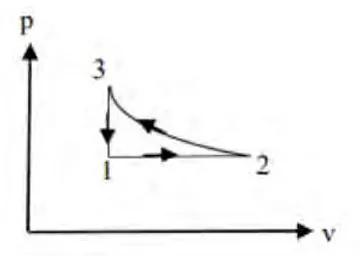
Figure: P-V graph for the isobaric process question
- a) 1 to 2
- b) 3 to 1
- c) 3 to 2
- d) Cannot be predicted from the figure given
Correct Answer: a) 1 to 2
Reason: In a pressure-volume graph an isobaric process (constant pressure) is a horizontal line. In the figure, the path 3 to 1 is a vertical line (constant volume, isochoric), the path 1 to 2 is a horizontal line (constant pressure, isobaric), and the path 3 to 2 is a curve (pressure and volume both change, as in an isothermal or adiabatic process). So the isobaric process is 1 to 2.
- a) 200 K
- b) 500 K
- c) 800 K
- d) 1000 K
Correct Answer: a) 200 K (b) 500 K is also correct)
Reason: Both \(\Delta H\) and \(\Delta S\) are negative, so the reaction is spontaneous only below the temperature at which \(\Delta G=0\):
For \(T<750\) K, \(\Delta G=\Delta H-T\Delta S<0\). Check at 200 K: \(\Delta G=-150-200(-0.2)=-110\) kJ. At 500 K: \(\Delta G=-150+100=-50\) kJ. At 800 K: \(\Delta G=-150+160=+10\) kJ (non-spontaneous), and at 1000 K: \(+50\) kJ. So 200 K and 500 K both give a spontaneous reaction, and the lowest value, 200 K, is option a.
- a) High enthalpy of graphite
- b) Increase in entropy
- c) Decrease in pressure
- d) Lower energy of diamond
Correct Answer: b) Increase in entropy
Reason: The conversion of diamond into graphite is exothermic (\(\Delta H=-1.9\) kJ/mol), and the entropy increases because graphite is a less rigidly ordered layered structure than diamond (\(S^\circ\) of graphite is greater than that of diamond). Both factors make \(\Delta G\) negative. Graphite has lower, not higher, enthalpy, and diamond has higher, not lower, energy, so options a and d are the reverse of the facts.
- a) -300 J
- b) -100 J
- c) +100 J
- d) +300 J
Correct Answer: a) -300 J
Reason: Heat released by the system is \(q=-200\) J and work done by the system is \(w=-100\) J.
The internal energy of the system decreases by 300 J.
- a) Only enthalpy
- b) Only entropy
- c) Both enthalpy and entropy
- d) Volume of reactants
Correct Answer: c) Both enthalpy and entropy
Reason: Spontaneity is decided by the Gibbs free energy change, \(\Delta G=\Delta H-T\Delta S\), which contains both the enthalpy change (tendency to lower energy) and the entropy change (tendency to increase disorder). Many reactions are spontaneous in spite of a positive \(\Delta H\) (melting of ice above 0 degrees Celsius) or a negative \(\Delta S\) (freezing below 0 degrees Celsius), so neither factor alone decides it.
- a) Physical states of reactants
- b) Temperature
- c) Catalyst
- d) Bond energies
Correct Answer: c) Catalyst
Reason: A catalyst provides a path of lower activation energy, but the enthalpies of the reactants and the products stay the same, and \(\Delta H\) is a state function. The physical states change \(\Delta H\) (\(H_2O_{(l)}\) and \(H_2O_{(g)}\) differ by 44 kJ/mol), the temperature slightly changes it, and the bond energies of the bonds broken and formed give it directly.
3. Numerical and Subjective Questions
Short Answer Questions
a. Internal energy
Internal energy (\(U\) or \(E\)) is the sum of all forms of energy of a system: the kinetic energy (translational, rotational and vibrational motion) and the potential energy (attractions between the particles) of all its particles. It is a state function and it depends on the amount of substance (an extensive property).
Unit: joule (J) or kilojoule (kJ); for one mole, kJ mol-1.
b. Enthalpy
Enthalpy (\(H\)) is the total heat content of a system, defined as the internal energy plus the product of pressure and volume:
The change in enthalpy is equal to the heat gained or lost at constant pressure, \(\Delta H=q_p\). Unit: J or kJ (kJ mol-1 for molar enthalpy change).
c. Entropy
Entropy (\(S\)) is the measure of the disorder or randomness of a system. For a reversible isothermal process \(\Delta S=\dfrac{q_{rev}}{T}\). A highly ordered system has low entropy and a disordered system has high entropy.
Unit: J K-1 (J K-1 mol-1 for one mole), or cal K-1.
d. Gibbs free energy
Gibbs free energy (\(G\)) is the part of the energy of a system that is available to do useful work. It combines enthalpy and entropy:
The decrease in free energy in a spontaneous process at constant temperature and pressure is equal to the maximum useful work, \(\Delta G=-W_{max}\). Unit: J or kJ (kJ mol-1).
a. Exothermic and endothermic process
| Exothermic process | Endothermic process |
|---|---|
| Releases heat to the surroundings. | Absorbs heat from the surroundings. |
| \(\Delta H\) is negative (\(H_{products}<H_{reactants}\)). | \(\Delta H\) is positive (\(H_{products}>H_{reactants}\)). |
| The surroundings become warmer. | The surroundings become cooler. |
| Examples: combustion of firewood or methane, freezing of water, neutralisation. | Examples: melting of ice, photosynthesis, decomposition of \(CaCO_3\), dissolving \(NH_4NO_3\) (cold pack). |
b. Extensive and intensive properties
| Extensive property | Intensive property |
|---|---|
| Depends on the amount (size) of matter in the system. | Does not depend on the amount of matter. |
| Examples: mass, volume, internal energy, enthalpy, entropy, Gibbs free energy. | Examples: temperature, pressure, density, boiling point, refractive index, specific heat capacity. |
| Values add up when systems are combined. | Values do not add up (two glasses of water at 30 degrees Celsius give a mixture at 30 degrees Celsius). |
c. Enthalpy of formation and enthalpy of combustion
| Enthalpy of formation | Enthalpy of combustion |
|---|---|
| Enthalpy change when 1 mole of a compound is formed from its elements in their standard states. | Enthalpy change when 1 mole of a substance burns completely in oxygen. |
| May be negative or positive (\(H_2O_{(l)}\): \(-285.8\); \(NO\): \(+90.3\) kJ/mol). | Always negative, as combustion is exothermic. |
| \(C_{(graphite)}+O_2\rightarrow CO_2\): \(-393.5\) kJ/mol (formation of \(CO_2\)). | \(CH_4+2O_2\rightarrow CO_2+2H_2O_{(l)}\): \(-890\) kJ/mol. |
| Zero for an element in its standard state. | Used to find the calorific value of fuels. |
d. State function and path function
| State function | Path function |
|---|---|
| Depends only on the initial and final states of the system. | Depends on the path (way) by which the change is carried out. |
| Examples: \(P, V, T, U, H, S, G\). | Examples: heat \(q\) and work \(w\). |
| Change is \(\Delta X=X_{final}-X_{initial}\), the same by every path. | Different for different paths between the same two states (slow or fast, isothermal or adiabatic). |
e. Isobaric and isochoric process
| Isobaric process | Isochoric process |
|---|---|
| Pressure remains constant (\(\Delta P=0\)). | Volume remains constant (\(\Delta V=0\)). |
| Work \(w=-P\Delta V\) is done by or on the system. | No pressure-volume work, \(w=0\). |
| Heat exchanged is \(q_p=\Delta H\). | Heat exchanged is \(q_v=\Delta U\). |
| Example: boiling of water in an open vessel at atmospheric pressure. | Example: heating a gas in a closed rigid container. |
a. First law of thermodynamics
Statement: Energy can neither be created nor destroyed, but it can be changed from one form to another (the energy of the universe is constant). When heat is added to a system, it appears as some other form of energy in the same amount.
where \(\Delta U\) is the change in internal energy, \(q\) is the heat absorbed by the system and \(w\) is the work done on the system. Sign convention: \(q\) is positive when heat is absorbed and negative when heat is released; \(w\) is positive when work is done on the system and negative when the system does work. (If the work done by the system is written as \(W\), the law reads \(\Delta E=Q-W\), which is the same statement.) For a gas at constant pressure \(w=-P\Delta V\).
b. Second law of thermodynamics
Statement: The total entropy of the universe always increases in a spontaneous (natural) process.
For a reversible process \(\Delta S_{univ}=0\) (equilibrium), and for a non-spontaneous process \(\Delta S_{univ}<0\). It explains why heat flows from a hot body to a cold body, why no engine is 100% efficient, and why a gas spreads into an empty flask but never collects back by itself.
c. Laplace and Lavoisier law
Statement: The heat required to decompose a compound into its elements is equal in magnitude but opposite in sign to the heat evolved when the compound is formed from its elements.
Example: \(H_{2(g)}+\frac12O_{2(g)}\rightarrow H_2O_{(l)}\), \(\Delta H=-285.8\) kJ/mol, and \(H_2O_{(l)}\rightarrow H_{2(g)}+\frac12O_{2(g)}\), \(\Delta H=+285.8\) kJ/mol. This is the first law of thermochemistry.
d. Hess’s law of constant heat summation
Statement: The total enthalpy change of a chemical reaction is the same whether the reaction takes place in one step or in several steps, provided the initial and the final conditions are the same.
Example: \(C_{(s)}+\frac12O_2\rightarrow CO\), \(\Delta H_1=-110.5\) kJ and \(CO+\frac12O_2\rightarrow CO_2\), \(\Delta H_2=-283.0\) kJ. Then for \(C_{(s)}+O_2\rightarrow CO_2\), \(\Delta H=-110.5-283.0=-393.5\) kJ, the same as the direct burning of carbon. This is the second law of thermochemistry and it follows from the fact that enthalpy is a state function.
A state function is a property of a system whose value depends only on the present state of the system (given by \(P, V, T\) and the amount), and not on the path by which that state was reached. Its change is \(\Delta X=X_{final}-X_{initial}\).
Enthalpy is a state function because \(H=E+PV\), and \(E\), \(P\) and \(V\) are all state functions, so \(H\) is fixed by the state of the system. The change \(\Delta H=H_{products}-H_{reactants}\) is the same by whatever route the reaction takes. Hess’s law is the direct proof: the enthalpy change of \(C_{(s)}\rightarrow CO_2\) is \(-393.5\) kJ whether it takes place in one step or through \(CO\).
Entropy is a state function because it measures the disorder of the system, which depends on its present condition (temperature, pressure, volume and amount of substance). The change \(\Delta S=S_{final}-S_{initial}\) depends only on the two end states, for example \(\Delta S_{fusion}\) of ice at 273 K is the same, \(S_{liquid}-S_{solid}\), however the melting is carried out. Heat and work, in contrast, are path functions.
Internal energy is the sum of all the energies of the particles of a system (kinetic energy of translation, rotation and vibration, and potential energy due to intermolecular forces).
Relationship: \(H=E+PV\), so for a change at constant pressure
For gases, \(P\Delta V=\Delta n_gRT\) (ideal gas, \(PV=nRT\)), so
where \(\Delta n_g\) is the moles of gaseous products minus the moles of gaseous reactants.
Formation of HCl:
\(\Delta n_g=2-(1+1)=0\). Therefore \(\Delta n_gRT=0\) and
So the change in enthalpy equals the change in internal energy (both are \(-184.6\) kJ for 2 mol of HCl, as \(\Delta H_f\) of \(HCl\) is \(-92.3\) kJ/mol). The same is true for every reaction in which the number of moles of gas does not change.
a. What do you mean by enthalpy of reaction?
The enthalpy of reaction is the heat absorbed or released when the number of moles of reactants shown in the balanced equation react completely to form products at constant pressure. \(\Delta H_{rxn}=H_{products}-H_{reactants}\), and under standard conditions (298 K and 1 atm) it is the standard enthalpy of reaction \(\Delta H^\circ_{rxn}=\sum\Delta H_f^\circ(\text{products})-\sum\Delta H_f^\circ(\text{reactants})\).
b. What is the meaning of \(\Delta H=+180\) kJ?
The sign is positive, so the reaction is endothermic: 180 kJ of heat is absorbed from the surroundings when 1 mole of \(N_2\) reacts with 1 mole of \(O_2\) to give 2 moles of \(NO\). The enthalpy of the product is 180 kJ higher than that of the reactants.
c. Find the enthalpy change of the given reaction: \(2NO_{(g)}\rightarrow N_{2(g)}+O_{2(g)}\)
This is the reverse reaction. By the Laplace and Lavoisier law the sign changes:
The decomposition of 2 moles of \(NO\) is exothermic and releases 180 kJ.
d. Calculate the enthalpy of formation of \(NO\).
The enthalpy of formation refers to 1 mole of the compound. The equation gives 2 moles of \(NO\) for 180 kJ:
(The tabulated value is \(+90.3\) kJ/mol.) \(NO\) is formed with absorption of energy, so it is an endothermic and relatively unstable compound.
Laplace and Lavoisier law (first law of thermochemistry, 1780): The heat required to decompose a compound into its elements is equal in magnitude but opposite in sign to the heat evolved when the compound is formed from its elements. In general, \(\Delta H_{forward}=-\Delta H_{reverse}\).
Applications:
1. The enthalpy of decomposition of a compound is found from its enthalpy of formation: \(S_{(s)}+O_{2(g)}\rightarrow SO_{2(g)}\), \(\Delta H=-296.9\) kJ, so \(SO_{2(g)}\rightarrow S_{(s)}+O_{2(g)}\), \(\Delta H=+296.9\) kJ.
2. The enthalpy of a reverse reaction (which may be difficult to measure) is known when the forward value is known, e.g. \(H_2O_{(l)}\rightarrow H_2+\frac12O_2\), \(+285.8\) kJ/mol.
3. When reactions are added in Hess’s law calculations, an equation may be reversed and the sign of its \(\Delta H\) changed.
4. It follows from the law of conservation of energy: if the forward and reverse values were not equal and opposite, a cycle could create or destroy energy.
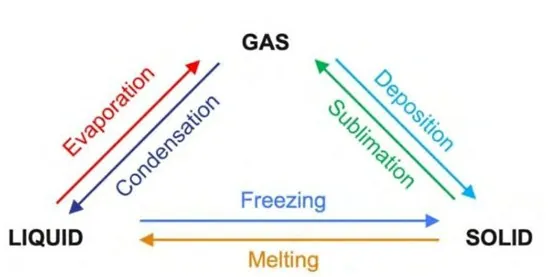
Figure: Evaporation, condensation, freezing, melting, sublimation and deposition
a. Identify the processes that are endothermic and the processes that are exothermic.
A process in which the particles move apart absorbs energy, and a process in which they come closer releases energy.
| Endothermic (\(\Delta H>0\)) | Exothermic (\(\Delta H<0\)) |
|---|---|
| Melting (solid to liquid) | Freezing (liquid to solid) |
| Evaporation (liquid to gas) | Condensation (gas to liquid) |
| Sublimation (solid to gas) | Deposition (gas to solid) |
b. Name the process that proceeds with an increase in entropy of the system.
Melting, evaporation and sublimation proceed with an increase in entropy (\(\Delta S>0\)), since the particles become more free and more disordered. Sublimation has the largest increase because the solid changes directly to a gas. Freezing, condensation and deposition decrease the entropy.
c. Using the information of enthalpy change and entropy change, identify the processes that are spontaneous at low temperature with suitable explanation.
In \(\Delta G=\Delta H-T\Delta S\), a process is spontaneous at low temperature when \(\Delta H\) is negative and \(\Delta S\) is also negative. At low temperature the term \(T\Delta S\) is small, so \(\Delta H\) controls the sign and \(\Delta G\) is negative. At high temperature the term \(-T\Delta S\) becomes large and positive, so \(\Delta G\) becomes positive.
The processes spontaneous at low temperature are therefore freezing, condensation and deposition (exothermic with decrease in entropy). The reverse processes, melting, evaporation and sublimation (\(\Delta H>0\), \(\Delta S>0\)), are spontaneous at high temperature.
| Process | \(\Delta H\) | \(\Delta S\) | Spontaneous at |
|---|---|---|---|
| Freezing, condensation, deposition | \(-\) | \(-\) | Low temperature |
| Melting, evaporation, sublimation | \(+\) | \(+\) | High temperature |
\(4C_{(s)}+4H_{2(g)}\rightarrow C_4H_{8(g)}\); \(\Delta H=-17\) kJ mol-1
\(H_{2(g)}+\frac12O_{2(g)}\rightarrow H_2O_{(g)}\); \(\Delta H=-242\) kJ mol-1
Use Hess’s law. Reverse the first equation (sign changes), and keep the other two:
On adding, \(C\), \(H_2\) and \(O_2\) cancel and the result is \(C_4H_{10}O_{(l)}\rightarrow C_4H_{8(g)}+H_2O_{(g)}\):
The reaction is endothermic (absorbs 76 kJ per mole). The same answer comes from \(\Delta H=\sum\Delta H_f(\text{products})-\sum\Delta H_f(\text{reactants})=[-17+(-242)]-(-335)=+76\) kJ.
Note: the formation of \(C_4H_{10}O_{(l)}\) from its elements, \(4C+5H_2+\frac12O_2\rightarrow C_4H_{10}O_{(l)}\), is the first given equation itself, \(\Delta H=-335\) kJ mol-1.
(2) \(H_{2(g)}+O_{2(g)}\rightarrow H_2O_{2(aq)}\); \(\Delta H=-191.2\) kJ mol-1
(3) \(H_{2(g)}+\frac12O_{2(g)}\rightarrow H_2O_{(g)}\); \(\Delta H=-241.8\) kJ mol-1
(4) \(H_2O_{(g)}\rightarrow H_2O_{(l)}\); \(\Delta H=-43.8\) kJ mol-1
Arrange the equations so that they add up to the target equation:
| Step | Equation | \(\Delta H\) (kJ) |
|---|---|---|
| Keep (1) | \(C_6H_4(OH)_{2}\rightarrow C_6H_4O_{2}+H_{2}\) | +177.4 |
| Reverse (2) | \(H_2O_{2(aq)}\rightarrow H_{2}+O_{2}\) | +191.2 |
| (3) × 2 | \(2H_{2}+O_{2}\rightarrow 2H_2O_{(g)}\) | \(2\times(-241.8)=-483.6\) |
| (4) × 2 | \(2H_2O_{(g)}\rightarrow 2H_2O_{(l)}\) | \(2\times(-43.8)=-87.6\) |
Adding: \(2H_2\) and \(O_2\) on the right cancel the same amounts on the left, and \(2H_2O_{(g)}\) cancels, leaving the required equation.
\(K_{(s)}+\frac12Cl_{2(g)}\rightarrow KCl_{(s)}\); \(\Delta H=-437\) kJ mol-1
\(Mg_{(s)}+\frac12O_{2(g)}\rightarrow MgO_{(s)}\); \(\Delta H=-602\) kJ mol-1
| Step | Equation | \(\Delta H\) (kJ) |
|---|---|---|
| Reverse (1) | \(KCl_{(s)}+3MgO_{(s)}\rightarrow KClO_{3(s)}+3Mg_{(s)}\) | +1852 |
| Keep (2) | \(K_{(s)}+\frac12Cl_{2(g)}\rightarrow KCl_{(s)}\) | \(-437\) |
| (3) × 3 | \(3Mg_{(s)}+\frac32O_{2(g)}\rightarrow 3MgO_{(s)}\) | \(3\times(-602)=-1806\) |
Adding, \(KCl\), \(3MgO\) and \(3Mg\) cancel and the required equation is obtained:
This is the enthalpy of formation of \(KClO_3\) (exothermic).
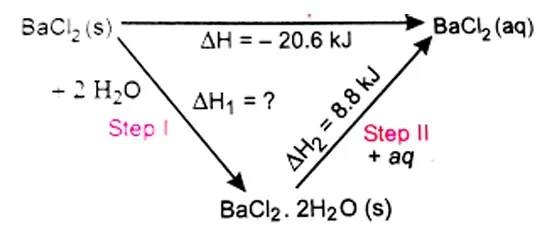
Figure: Enthalpy cycle of barium chloride (Hess’s law)
a. How does this explain Hess’s law?
\(BaCl_{2(aq)}\) can be obtained from \(BaCl_{2(s)}\) by two routes: directly (\(\Delta H=-20.6\) kJ), or in two steps, first forming the dihydrate (\(\Delta H_1\)) and then dissolving it (\(\Delta H_2=+8.8\) kJ). Hess’s law says that the enthalpy change is the same by both routes because it depends only on the initial and final states:
b. What is the enthalpy of solution of barium chloride?
The enthalpy of solution is the enthalpy change when 1 mole of the solute dissolves in water, so it is the direct step: \(\Delta H_{sol}=-20.6\) kJ mol-1 (exothermic).
c. Calculate the enthalpy of hydration of \(BaCl_{2(s)}\) from the cycle.
The enthalpy of hydration of \(BaCl_{2(s)}\) to \(BaCl_2\cdot2H_2O_{(s)}\) is \(-29.4\) kJ mol-1. The hydration is exothermic, and the dissolution of the hydrate is endothermic.
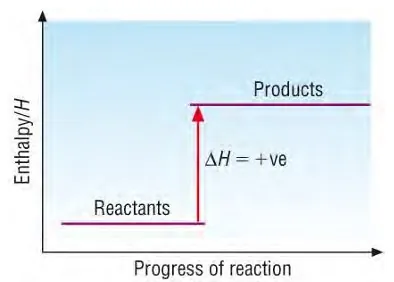
Figure: Products at higher enthalpy than reactants, \(\Delta H=+ve\)
a. Identify the reaction as endothermic or exothermic and why?
The reaction is endothermic. In the graph the products lie at a higher enthalpy level than the reactants, so \(\Delta H=H_{products}-H_{reactants}\) is positive. The system absorbs heat from the surroundings, and the surroundings become cooler.
b. Give any two common examples of such reactions.
1. Thermal decomposition of calcium carbonate: \(CaCO_3\rightarrow CaO+CO_2\), \(\Delta H=+178\) kJ/mol.
2. Photosynthesis: \(6CO_2+6H_2O\rightarrow C_6H_{12}O_6+6O_2\) (energy of sunlight absorbed). Other examples are the formation of \(NO\) from \(N_2\) and \(O_2\) (\(+180\) kJ), the dissolution of \(NH_4NO_3\) in water (\(+25.7\) kJ/mol) and the melting of ice.
a. Write such mathematical relationship with its meaning.
The change in the internal energy of a system is equal to the heat absorbed by the system plus the work done on the system. (Written with work done by the system, \(\Delta E=Q-W\).) For example, a gas absorbs 600 J of heat and does 200 J of work in expanding: \(\Delta U=600-200=+400\) J.
b. How can such an equation be varied for isothermal and adiabatic processes?
Isothermal process (\(\Delta T=0\)): the internal energy of an ideal gas depends on temperature only, so \(\Delta U=0\) and \(q=-w\). All the heat absorbed is changed into work.
Adiabatic process (\(q=0\)): there is no heat exchange, so \(\Delta U=w\). Work done on the system raises its internal energy and the temperature, and work done by the system lowers it.
c. By what means can the internal energy of a closed system increase?
The internal energy of a closed system (no exchange of matter) increases (i) when heat is absorbed from the surroundings (\(q>0\)), and (ii) when work is done on the system by the surroundings, as in compression (\(w>0\)).
d. Under what conditions will the quantities \(q\) and \(w\) be negative?
\(q\) is negative when the system releases heat to the surroundings (exothermic process). \(w\) is negative when the system does work on the surroundings, for example when a gas expands against external pressure.
a. What do you mean by allotropes?
Allotropes are the different forms of the same element in the same physical state, which have different arrangements of atoms and therefore different physical properties. Graphite, diamond and fullerene are allotropes of carbon.
b. Which of the allotropes is most stable and why?
Graphite is the more stable allotrope. Diamond releases more heat on burning (\(-395.4\) kJ against \(-393.5\) kJ), so diamond starts at a higher enthalpy than graphite, and the one with the lower enthalpy is more stable. This is why graphite is the standard state of carbon (\(\Delta H_f^\circ=0\)).
c. Calculate enthalpy change for the conversion of graphite to diamond and diamond to graphite.
Keep the first equation and reverse the second:
By the Laplace and Lavoisier law, \(C_{(diamond)}\rightarrow C_{(graphite)}\) has \(\Delta H=-1.9\) kJ. Although this conversion is spontaneous, diamond does not change to graphite in practice since the activation energy is very high.
(2) \(O_{3(g)}\rightarrow\frac32O_{2(g)}\); \(\Delta H=-142.3\) kJ
(3) \(O_{2(g)}\rightarrow2O_{(g)}\); \(\Delta H=495.0\) kJ
a. Which one is an easier process among the reactions (2) and (3) and why?
Reaction (2) is easier. It is exothermic (\(\Delta H=-142.3\) kJ), so it releases energy and goes to the more stable \(O_2\), whereas reaction (3) is strongly endothermic (\(\Delta H=+495.0\) kJ) because the strong \(O=O\) double bond has to be broken, which needs a large amount of energy.
b. Calculate the change in enthalpy for the reaction: \(NO_{(g)}+O_{(g)}\rightarrow NO_{2(g)}\)
| Step | Equation | \(\Delta H\) (kJ) |
|---|---|---|
| Keep (1) | \(NO+O_3\rightarrow NO_2+O_2\) | \(-198.9\) |
| Reverse (2) | \(\frac32O_2\rightarrow O_3\) | \(+142.3\) |
| Reverse (3) × ½ | \(O\rightarrow\frac12O_2\) | \(-247.5\) |
Adding the three equations: \(O_3\) appears on both sides and cancels. The left side has \(\frac32O_2\) and the right side has \(1+\frac12=\frac32O_2\), so \(O_2\) cancels as well. What remains is \(NO+O\rightarrow NO_2\).
a. \(NaNO_{3(s)}\rightarrow Na^{+}{}_{(aq)}+NO_3^{-}{}_{(aq)}\)
\(\Delta S\) is positive. The ordered crystal lattice breaks up into free, mobile ions in solution, so the disorder increases.
b. The freezing of liquid water
\(\Delta S\) is negative. The molecules of liquid water, which move randomly, become fixed in the regular hydrogen-bonded lattice of ice, so the disorder decreases.
c. \(CO_{2(s)}\rightarrow CO_{2(g)}\)
\(\Delta S\) is positive. Dry ice sublimes to a gas whose molecules move freely and occupy a large volume, which is a large increase in randomness.
d. \(CaCO_{3(s)}\rightarrow CaO_{(s)}+CO_{2(g)}\)
\(\Delta S\) is positive. One solid forms a solid and a gas, and the gaseous product has far greater entropy than any solid (the number of moles of gas increases from 0 to 1).
| Substance | \(\Delta H_f^\circ\) (kJ/mol) | \(S^\circ\) (J/K\(\cdot\)mol) |
|---|---|---|
| \(H_2O_{(l)}\) | -285.83 | 70.0 |
| \(H_2O_{(g)}\) | -241.82 | 188.8 |
Step 1: enthalpy change
Step 2: entropy change
Step 3: at equilibrium \(\Delta G=0\), so \(\Delta H=T\Delta S\):
Above 370.5 K, \(\Delta G<0\) and the evaporation is spontaneous; below it the process is non-spontaneous. The value is close to the boiling point of water (373 K), the small difference being due to the use of \(\Delta H\) and \(S^\circ\) at 298 K.
| Bond | Bond Enthalpy (kJ mol-1) |
|---|---|
| C-C | +347 |
| C-H | +413 |
| O=O | +498 |
| O-H | +464 |
| C=O (in \(CO_2\)) | +805 |
| C-O | +358 |
| H-H | +436 |
| C=C | +612 |
a. Which of the bonds is difficult to break among the bonds given?
The \(C=O\) bond in \(CO_2\) (+805 kJ mol-1) is the most difficult to break because it has the highest bond enthalpy. It is a double bond between the small, strongly attracting \(C\) and \(O\) atoms.
b. What is the meaning of bond enthalpy of C-H bond \(413\) kJ mol-1?
It means that 413 kJ of energy is required to break 1 mole of \(C-H\) bonds in gaseous molecules to give gaseous atoms (the average value of \(C-H\) bonds in different compounds). The same amount of energy is released when 1 mole of \(C-H\) bonds is formed.
c. Calculate the enthalpy of combustion of methane using the bond energy in the table.
\(CH_{4(g)}+2O_{2(g)}\rightarrow CO_{2(g)}+2H_2O_{(g)}\). Bonds broken: 4 \(C-H\) and 2 \(O=O\). Bonds formed: 2 \(C=O\) and 4 \(O-H\).
| Bonds broken (energy absorbed) | Bonds formed (energy released) |
|---|---|
| \(4\times413=1652\) | \(2\times805=1610\) |
| \(2\times498=996\) | \(4\times464=1856\) |
| Total \(=2648\) kJ | Total \(=3466\) kJ |
The negative sign shows that the combustion is exothermic. The value is for water as a gas; it is close to the value \(-802\) kJ obtained from enthalpies of formation, because bond enthalpies are average values.
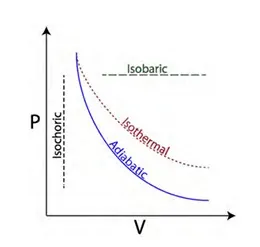
Figure: P-V graph of isobaric, isochoric, isothermal and adiabatic processes
| Process | Definition | Line on P-V graph | Example |
|---|---|---|---|
| Isochoric | Volume remains constant (\(\Delta V=0\)). No work is done, \(w=0\), so \(\Delta U=q_v\). | Vertical line | Heating a gas in a closed rigid container. |
| Isobaric | Pressure remains constant (\(\Delta P=0\)). Heat absorbed changes the volume and the temperature, \(w=-P\Delta V\), \(q_p=\Delta H\). | Horizontal line | Boiling of water at atmospheric pressure. |
| Isothermal | Temperature remains constant (\(\Delta T=0\)), heat is exchanged with the surroundings; for an ideal gas \(\Delta U=0\), \(q=-w\) and \(PV=\) constant. | Hyperbola (curve) | Slow expansion or compression of a gas in a heat bath; melting of ice at 0 degrees Celsius. |
| Adiabatic | No heat is exchanged with the surroundings (\(q=0\)), so \(\Delta U=w\); \(PV^\gamma=\) constant. | Curve steeper than the isotherm | Rapid compression or expansion of a gas in an insulated cylinder. |
Long Answer Questions
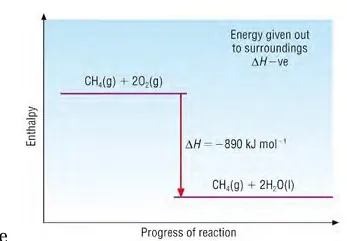
Figure: Enthalpy of methane and oxygen (reactants) and carbon dioxide and water (products), \(\Delta H=-890\) kJ mol-1
a. Define the term enthalpy.
Enthalpy (\(H\)) is the total heat content of a system, equal to its internal energy plus the pressure-volume term, \(H=E+PV\). The change in enthalpy \(\Delta H=H_{products}-H_{reactants}\) is equal to the heat absorbed or released at constant pressure.
b. Write the balanced chemical equation for the given reaction.
This is the complete combustion of methane (the products in the figure are \(CO_2\) and liquid water; the carbon atom of methane must appear as \(CO_2\) to balance the equation).
c. What is the meaning of \(-890\) kJ mol-1?
The reaction is exothermic. When 1 mole of methane (16 g) burns completely in oxygen to form carbon dioxide and liquid water, 890 kJ of heat is given out to the surroundings. The enthalpy of the products is 890 kJ per mole lower than that of the reactants, and this value is the enthalpy of combustion of methane.
d. Calculate the calorific value of methane in kJ g-1.
The calorific value is the heat released when 1 g of the fuel burns completely. Molar mass of \(CH_4=12+4=16\) g/mol.
That is about 55,600 kJ/kg, in agreement with the table of fuels in the notes (methane, 55,500 kJ/kg).
e. How does this reaction increase the entropy of the universe?
In the reaction 3 moles of gas become 1 mole of gas and 2 moles of liquid, so the entropy of the system decreases (about \(-243\) J K-1 per mole of methane). But the 890 kJ of heat released goes into the surroundings and increases the random motion of their particles:
The gain in entropy of the surroundings is much larger than the loss in the system, so \(\Delta S_{univ}=\Delta S_{sys}+\Delta S_{surr}\approx-243+2987>0\). By the second law the reaction is spontaneous (once it is started).
Entropy (\(S\)) is the thermodynamic quantity that measures the disorder or randomness of a system. A more ordered system has lower entropy. For a reversible process \(\Delta S=q_{rev}/T\). Unit: J K-1 (J K-1 mol-1 per mole). Entropy increases in the order solid < liquid < gas, and when the number of moles of gas increases.
a. Molten gold solidifies.
\(\Delta S\) is negative: the liquid (random) changes to an ordered crystalline solid.
b. Gaseous \(Cl_2\) dissociates in the stratosphere to form gaseous \(Cl\) atoms.
\(Cl_{2(g)}\rightarrow2Cl_{(g)}\): \(\Delta S\) is positive, as one mole of gas gives two moles of gas (more particles and more ways of arrangement).
c. Gaseous \(CO\) reacts with gaseous \(H_2\) to form liquid methanol, \(CH_3OH\).
\(CO_{(g)}+2H_{2(g)}\rightarrow CH_3OH_{(l)}\): \(\Delta S\) is negative, since 3 moles of gas change to 1 mole of liquid, so the disorder decreases greatly.
d. Precipitation reaction between \(Ca(NO_3)_{2(aq)}\) and \((NH_4)_3PO_{4(aq)}\).
\(3Ca(NO_3)_{2(aq)}+2(NH_4)_3PO_{4(aq)}\rightarrow Ca_3(PO_4)_{2(s)}+6NH_4NO_{3(aq)}\): \(\Delta S\) is negative. Free ions \(Ca^{2+}\) and \(PO_4^{3-}\) leave the solution and settle as an ordered solid, so the disorder of the system decreases.
| Reaction | \(\Delta H_c\) (kJ mol-1) |
|---|---|
| \(C_{(graphite)}+O_{2(g)}\rightarrow CO_{2(g)}\) | -393.5 |
| \(H_{2(g)}+\frac12O_{2(g)}\rightarrow H_2O_{(l)}\) | -285.8 |
| \(C_2H_{6(g)}+\frac72O_{2(g)}\rightarrow2CO_{2(g)}+3H_2O_{(l)}\) | -1559.7 |
a. Define the term enthalpy of combustion.
The enthalpy of combustion (\(\Delta H_c\)) is the enthalpy change when 1 mole of a substance burns completely in oxygen under standard conditions. It is always negative because combustion is exothermic.
b. Calculate the calorific value of ethane.
Molar mass of \(C_2H_6=2(12)+6(1)=30\) g/mol.
c. Using Hess’s law calculate the enthalpy of formation of ethane.
Required: \(2C_{(graphite)}+3H_{2(g)}\rightarrow C_2H_{6(g)}\), \(\Delta H_f=?\)
| Step | Equation | \(\Delta H\) (kJ) |
|---|---|---|
| (1) × 2 | \(2C+2O_2\rightarrow2CO_2\) | \(2(-393.5)=-787.0\) |
| (2) × 3 | \(3H_2+\frac32O_2\rightarrow3H_2O_{(l)}\) | \(3(-285.8)=-857.4\) |
| Reverse (3) | \(2CO_2+3H_2O_{(l)}\rightarrow C_2H_6+\frac72O_2\) | +1559.7 |
Adding, \(2CO_2\), \(3H_2O\) and the \(O_2\) (\(2+\frac32=\frac72\)) cancel:
a. Define the term standard enthalpy and entropy change.
The standard enthalpy change (\(\Delta H^\circ\)) and standard entropy change (\(\Delta S^\circ\)) are the enthalpy and entropy changes of a reaction when all the reactants and products are in their standard states (pressure 1 atm, temperature 298 K, and 1 mol/L for solutions), the amounts being those of the balanced equation.
b. What is the enthalpy of formation of carbon dioxide in the given process? Justify.
\(\Delta H_f^\circ(CO_2)=-393\) kJ mol-1. The reaction forms 1 mole of \(CO_2\) from carbon (graphite, the standard state) and oxygen gas, both elements in their standard states, so the reaction is the formation of \(CO_2\) itself. Hence the enthalpy of combustion of graphite and the enthalpy of formation of \(CO_2\) are the same (the tabulated value is \(-393.5\) kJ/mol).
c. In which condition is the above process spontaneous?
\(\Delta G^\circ=\Delta H^\circ-T\Delta S^\circ\). Here \(\Delta H^\circ\) is negative and \(\Delta S^\circ\) is positive, so \(-T\Delta S^\circ\) is also negative and \(\Delta G^\circ\) is negative at every temperature. The process is spontaneous at all temperatures.
d. Calculate the temperature at which the standard free energy change (\(\Delta G^\circ\)) = \(-394\) kJ.
So \(\Delta G^\circ=-394\) kJ at about 345 K. (At 298 K, \(\Delta G^\circ=-393-298(0.0029)=-393.9\) kJ, which is about \(-394\) kJ as well.)
e. Melting and freezing are reverse processes but are spontaneous in nature. Explain the spontaneity of these processes at different temperatures.
For \(H_2O_{(s)}\rightleftharpoons H_2O_{(l)}\) the melting has \(\Delta H>0\) (heat absorbed) and \(\Delta S>0\) (more disorder); freezing has \(\Delta H<0\) and \(\Delta S<0\). In \(\Delta G=\Delta H-T\Delta S\):
| Process | \(\Delta H\) | \(\Delta S\) | \(\Delta G\) and spontaneity |
|---|---|---|---|
| Melting | + | + | \(\Delta G<0\) at high temperature (\(T>T_m\)), when \(T\Delta S>\Delta H\); non-spontaneous at low temperature. |
| Freezing | \(-\) | \(-\) | \(\Delta G<0\) at low temperature (\(T<T_m\)), when \(\Delta H\) dominates; non-spontaneous at high temperature. |
At the melting point \(T_m\) (273 K for ice), \(\Delta G=0\) and the two phases are in equilibrium: \(T_m=\Delta H_{fusion}/\Delta S_{fusion}=6010/22.0=273\) K. So ice melts spontaneously above 0 degrees Celsius and water freezes spontaneously below it.
| Substances | \(\Delta H_f^\circ\) (kJ/mol) |
|---|---|
| \(NH_{3(g)}\) | -45.9 |
| \(O_{2(g)}\) | 0.0 |
| \(NO_{(g)}\) | +90.3 |
| \(H_2O_{(g)}\) | -241.8 |
| \(H_2O_{(l)}\) | -285.8 |
a. What do you mean by standard enthalpy of formation?
The standard enthalpy of formation (\(\Delta H_f^\circ\)) is the enthalpy change when 1 mole of a compound is formed from its elements in their standard states under standard conditions (1 atm and 298 K). For example \(H_2+\frac12O_2\rightarrow H_2O_{(l)}\), \(\Delta H_f^\circ=-285.8\) kJ/mol. The more negative the value, the more stable the compound.
b. Why is the value zero for oxygen?
Oxygen gas, \(O_2\), is the element in its most stable (standard) form. No change is needed to form it from itself, so no energy is absorbed or released, and by convention \(\Delta H_f^\circ\) of every element in its standard state (\(O_2, N_2, H_2\), graphite) is zero.
c. Which of the substances is difficult to form and why?
\(NO\) is the difficult one to form, since its \(\Delta H_f^\circ=+90.3\) kJ/mol is positive: energy has to be supplied to form it from \(N_2\) and \(O_2\), because the strong \(N\equiv N\) and \(O=O\) bonds must be broken (it forms only at very high temperature, such as in a lightning flash or an engine). The others release energy when they form.
d. Identify the substance that is most stable and the one that is unstable.
The most stable is \(H_2O_{(l)}\) with the most negative value (\(-285.8\) kJ/mol), as it releases the most energy on formation. The unstable one is \(NO_{(g)}\) with a positive value (\(+90.3\) kJ/mol), its energy is higher than that of its elements.
e. Calculate the calorific value of ammonia and nitric oxide.
Ammonia. Complete combustion: \(4NH_{3(g)}+3O_{2(g)}\rightarrow2N_{2(g)}+6H_2O_{(l)}\)
Nitric oxide. \(NO\) is already an oxide and no data for \(NO_2\) are given, so its combustion cannot be calculated from the table. The energy it can release is that of its decomposition into elements, \(2NO\rightarrow N_2+O_2\), \(\Delta H=-180.6\) kJ, that is \(90.3\) kJ per mole:
The value is very small compared with ammonia and with methane (55.6 kJ/g). When ammonia is oxidised to \(NO\) (Ostwald process, \(4NH_3+5O_2\rightarrow4NO+6H_2O_{(g)}\)), \(\Delta H=4(90.3)+6(-241.8)-4(-45.9)=-906\) kJ.
a. What do you mean by standard enthalpy of formation?
It is the enthalpy change when 1 mole of a compound is formed from its elements in their standard states under standard conditions (1 atm, 298 K), for example \(2C_{(s)}+3H_{2(g)}\rightarrow C_2H_{6(g)}\), \(\Delta H_f^\circ=-84.7\) kJ/mol.
b. How can you use these values to compare the stability and reactivity of given substances?
A compound with a more negative \(\Delta H_f^\circ\) has released more energy when it formed, lies lower in energy, and is more stable and less reactive. Ethane (\(-84.7\) kJ/mol) is stable and unreactive. Acetylene (\(+226.7\) kJ/mol) is formed by absorption of energy, so it is at a high energy level, unstable and very reactive; it burns with a very hot flame and can decompose explosively into its elements.
c. Calculate the enthalpy change of the given reaction using Hess’s law: \(H_2C=CH_2+H_2\xrightarrow{Ni,\ 300^\circ\mathrm{C}}H_3C-CH_3\)
The reaction is the hydrogenation of ethene to ethane. The standard enthalpy of formation of ethene, \(+52.5\) kJ/mol, is given in the table of the notes, and \(\Delta H_f^\circ(H_2)=0\):
By Hess’s law this is the sum of the decomposition of ethene into elements (\(-52.5\)), which is the Laplace and Lavoisier reverse of its formation (\(+52.5\)), and the formation of ethane (\(-84.7\)). The reaction is exothermic.
With the acetylene value given in the question, the hydrogenation of acetylene, \(C_2H_2+2H_2\rightarrow C_2H_6\), has \(\Delta H=-84.7-226.7=-311.4\) kJ/mol.
| Bond | Enthalpy (kJ/mol) |
|---|---|
| C-H | 413 |
| C-C | 347 |
| Cl-Cl | 239 |
| H-Cl | 427 |
| C-Cl | 339 |
a. Define the term bond enthalpy.
Bond enthalpy (bond energy) is the amount of energy required to break 1 mole of a particular bond in gaseous molecules to form gaseous atoms (the same energy is released when 1 mole of the bond is formed). Unit: kJ mol-1.
b. What are the factors that affect the value of bond enthalpy?
Bond order: the higher the bond order, the stronger the bond (\(C-C\) 347 < \(C=C\) 612 < \(C\equiv C\) 837 kJ/mol).
Bond length: the shorter the bond, the stronger it is (\(F-F\) 158 kJ/mol is weak and long, \(N\equiv N\) 945 kJ/mol is short and strong).
Electronegativity (polarity): the higher the electronegativity of the bonded atom, the stronger the bond (\(C-F\) 485 kJ/mol is stronger than \(C-I\) 240 kJ/mol). The size of the bonded atoms also matters, since larger atoms form longer and weaker bonds.
c. Which of the given bonds is difficult to dissociate and why?
The \(H-Cl\) bond (427 kJ/mol) is the most difficult to break because it has the highest bond enthalpy. It is a short, polar bond, as chlorine is much more electronegative than hydrogen. The \(Cl-Cl\) bond (239 kJ/mol) is the weakest, since it is long and non-polar.
d. Calculate the enthalpy change of the given reaction: \(CH_3-CH_3+Cl_2\rightarrow CH_3-CH_2-Cl+HCl\)
One \(C-H\) bond and the \(Cl-Cl\) bond are broken, and one \(C-Cl\) bond and one \(H-Cl\) bond are formed (the other bonds are unchanged).
| Bonds broken (absorbed) | Bonds formed (released) |
|---|---|
| \(C-H=413\) | \(C-Cl=339\) |
| \(Cl-Cl=239\) | \(H-Cl=427\) |
| Total \(=652\) kJ | Total \(=766\) kJ |
The chlorination of ethane is exothermic.
a. Define the term spontaneity and Gibbs free energy?
Spontaneity: a process is spontaneous when it takes place by itself, in the given conditions, without continuous help from outside (water flowing downhill, melting of ice at room temperature, rusting of iron). A non-spontaneous process occurs only if energy is supplied (electrolysis of water).
Gibbs free energy (\(G\)): the part of the total energy of the system that is available (free) to do useful work, \(G=H-TS\). The change in free energy equals the maximum useful work, \(\Delta G=-W_{max}\).
b. How is free energy change related with enthalpy change and entropy change?
It follows from \(\Delta S_{univ}=\Delta S_{sys}-\dfrac{\Delta H_{sys}}{T}\), that is, \(-T\Delta S_{univ}=\Delta H-T\Delta S_{sys}=\Delta G\).
c. In which conditions of free energy change are the processes spontaneous?
| \(\Delta G\) | Meaning |
|---|---|
| \(\Delta G<0\) (negative) | Forward process is spontaneous |
| \(\Delta G=0\) | System is at equilibrium |
| \(\Delta G>0\) (positive) | Forward process is non-spontaneous (the reverse process is spontaneous) |
A process is spontaneous when \(\Delta G\) is negative. In any spontaneous process at constant temperature and pressure the free energy decreases.
d. Identify whether the following processes are spontaneous or non-spontaneous and mention the condition of temperature for the spontaneity:
| Process | \(\Delta H\) | \(\Delta S\) | Spontaneity and temperature |
|---|---|---|---|
| i. Evaporation of liquid | + | + | Spontaneous at high temperature (above the boiling point); non-spontaneous at low temperature. |
| ii. Dissolving NaCl in water | slightly + (about +4 kJ/mol) | + (large) | Spontaneous at ordinary and higher temperatures, as the entropy gain from the free ions makes \(\Delta G\) negative; it is favoured at higher temperature. |
| iii. Crystallization of copper sulphate | \(-\) | \(-\) | Spontaneous at low temperature (cooling a saturated solution); non-spontaneous at high temperature. |
Summary of the sign rules: \(\Delta H<0,\ \Delta S>0\): spontaneous at all temperatures; \(\Delta H>0,\ \Delta S<0\): non-spontaneous at all temperatures; \(\Delta H<0,\ \Delta S<0\): spontaneous at low temperature; \(\Delta H>0,\ \Delta S>0\): spontaneous at high temperature.
4. View PDF Notes
i. Handwritten Notes
ii. Typed PDF Notes
5. Frequently Asked Questions
What is chemical thermodynamics? (Class 12 Chemistry)
What topics are included in Unit 4 Chemical Thermodynamics of NEB Class 12 Chemistry?
What are system, surroundings and the types of system?
What is the first law of thermodynamics and what is its formula?
What is the relation between enthalpy change and internal energy change?
What is the difference between exothermic and endothermic reactions?
What are the standard enthalpies of formation, combustion and solution?
What is the calorific value of a fuel and how is it calculated?
State Laplace-Lavoisier law and Hess's law with examples.
How do you calculate the enthalpy of a reaction from bond enthalpies?
What is entropy and how can you predict the sign of the entropy change?
What is the second law of thermodynamics?
What is Gibbs free energy and how does it predict spontaneity?
What is the relationship between ΔG and the equilibrium constant?
What are isothermal, adiabatic, isobaric and isochoric processes?
Which is more stable, graphite or diamond?
What is a state function and what is a path function?
Where can I find the Chemical Thermodynamics formula sheet for Class 12?
Where can I find Chemical Thermodynamics Class 12 numericals with solutions?
Where can I get Class 12 Chemistry Chemical Thermodynamics notes in PDF? Is there a book?
Where can I get Class 12 Chemistry notes of NEB (handwritten, PDF, Nepal)?
Students also search for: