
Genetic Materials Notes
Class 12 Biology Notes • NEB Syllabus 2083
Genetic materials notes for Class 12 Biology Unit 3 Genetics chapter 3.1: syllabus, micro syllabus, 10 solved multiple choice questions, all short and long answer questions with diagrams on DNA, RNA, DNA replication and the genetic code, and two PDF notes for the NEB syllabus.
1. Genetic Materials Syllabus
Unit 3: Genetic Materials Notes
These genetic materials notes follow the NEB Class 12 Biology syllabus (+2 Biology, Nepal), chapter 3.1 of Unit 3 Genetics. Practise the multiple choice questions first, then work through the solved short and long answer questions with their diagrams, and finish with the PDF notes for quick revision.
Micro syllabus: 3. Genetics
Read more about genetics, DNA, RNA and the genetic code on Wikipedia. More notes: Class 12 Biology notes, Class 12 Chemistry notes and Class 12 Physics notes.
2. Genetic Materials Notes: Multiple Choice Questions
Question 1. Name the nitrogenous base that is found in RNA but not in DNA?
- a) Adenine
- b) Guanine
- c) Cytosine
- d) Uracil
Correct Answer: d) Uracil
Reason: Uracil replaces thymine in RNA and pairs with adenine. DNA has thymine.
Question 2. What type of bond connects the sugar and phosphate in the RNA backbone?
- a) Hydrogen bond
- b) Ionic bond
- c) Peptide bond
- d) Phosphodiester bond
Correct Answer: d) Phosphodiester bond
Reason: The phosphate joins the 3′ carbon of one sugar to the 5′ carbon of the next sugar by a phosphodiester bond. Hydrogen bonds join the base pairs.
Question 3. Which of the following correctly pairs nitrogenous bases in DNA?
- a) Adenine-Guanine and Cytosine-Thymine
- b) Adenine-Thymine and Cytosine-Guanine
- c) Adenine-Cytosine and Guanine-Thymine
- d) Adenine-Uracil and Cytosine-Guanine
Correct Answer: b) Adenine-Thymine and Cytosine-Guanine
Reason: A pairs with T by two hydrogen bonds and C pairs with G by three. Uracil is not found in DNA.
Question 4. How many nucleotide bases form one codon in the genetic code?
- a) 1
- b) 2
- c) 3
- d) 4
Correct Answer: c) 3
Reason: The genetic code is a triplet code. Three bases make one codon, which codes for one amino acid.
Question 5. Which of the following statements about the genetic code is true?
- a) It overlaps in codons
- b) It is universal for all organisms
- c) One codon specifies multiple amino acids
- d) It has punctuation marks
Correct Answer: b) It is universal for all organisms
Reason: The same codon gives the same amino acid in almost all organisms, from bacteria to humans. The code is non-overlapping, unambiguous and punctuationless.
Question 6. Which of the following enzyme unwinds the DNA helix during replication?
- a) DNA polymerase
- b) Ligase
- c) Helicase
- d) Primase
Correct Answer: c) Helicase
Reason: Helicase breaks the hydrogen bonds between the bases and opens the helix into a replication fork.
Question 7. Which of the following best explains why one strand is synthesized continuously and the other discontinuously during replication?
- a) Helicase works only one direction
- b) DNA polymerase can only add nucleotides in the 5’ to 3’ direction
- c) One strand has more A-T content
- d) The lagging strand is longer
Correct Answer: b) DNA polymerase can only add nucleotides in the 5’ to 3’ direction
Reason: The two strands are antiparallel and polymerase works only in the 5′→3′ direction. So one strand is made in one stretch and the other in Okazaki fragments.
Question 8. Study the given figure of types of DNA replication. Identify the types A, B and C.
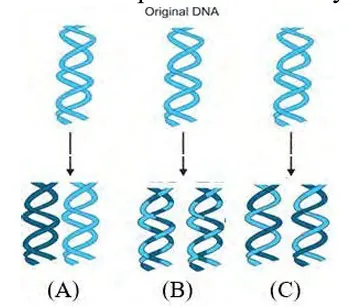
Figure for Question 8
- a) A – Conservative, B – Semi conservative, C- Dispersive
- b) A – Semi conservative, B – Conservative, C – Dispersive
- c) A – Consevative, B – Dispersive, C – Semi conservative
- d) A – Dispersive, B – Semi conservative, C – Dispersive
Correct Answer: a) A – Conservative, B – Semi conservative, C- Dispersive
Reason: A gives one fully old and one fully new helix, B gives two hybrid helices (one old and one new strand each), and C gives mixed patches of old and new DNA.
Question 9. If a DNA molecule has 2000 base pairs, how long will the molecule be approximately?
- a) 680 nm
- b) 340 nm
- c) 2000 nm
- d) 34 nm
Correct Answer: a) 680 nm
Reason: Adjacent base pairs are 0.34 nm apart. So the length is 2000 × 0.34 nm = 680 nm.
Question 10. If a drug is developed that strengthens the hydrogen bonds between DNA base pairs, what cellular process would be most directly affected?
- a) Formation of the sugar-phosphate backbone
- b) Transcription and DNA replication
- c) Transport of mRNA
- d) Digestion of nucleotides in the cytoplasm
Correct Answer: b) Transcription and DNA replication
Reason: Both processes need the two strands to separate by breaking hydrogen bonds. The backbone is held by phosphodiester bonds, which the drug does not change.
3. Genetic Materials Notes: Short and Long Answer Questions
Short Answer Questions
Heredity is the transmission of characters from one generation to the next generation, for example from parents to offspring. A dog always gives birth to a dog, and a watermelon seed always grows into a watermelon plant.
Variation is the difference shown by the individuals of a species, and also by the offspring of the same parents. Brothers and sisters look alike, but they are never exactly the same. Variations arise from mutation and from the recombination of genes in sexual reproduction.
The branch of biology that deals with the study of heredity and variation is called genetics.
A nucleotide is the basic unit of the nucleic acids DNA and RNA. It has three components.
A sugar joined to a base is called a nucleoside. When a phosphate group is added, it becomes a nucleotide.
| Purine | Pyrimidine |
|---|---|
| Has two rings in its structure (a 6-membered ring fused with a 5-membered ring). | Has one ring in its structure (a 6-membered ring). |
| Larger in size. | Smaller in size. |
| Adenine (A) and guanine (G). | Cytosine (C), thymine (T) and uracil (U). |
| Both bases are present in DNA and RNA. | Cytosine is present in both. Thymine is present in DNA only and uracil in RNA only. |
| Always pairs with a pyrimidine: A with T (or U), two hydrogen bonds. | Always pairs with a purine: C with G, three hydrogen bonds. |
| Leading strand | Lagging strand |
|---|---|
| Made continuously in one stretch. | Made discontinuously, as short pieces called Okazaki fragments. |
| Synthesized in the 5′→3′ direction, towards the replication fork. | Synthesized in the 5′→3′ direction, away from the replication fork. |
| Its template runs in the 3′→5′ direction. | Its template runs in the 5′→3′ direction. |
| Needs only one RNA primer. | Needs many RNA primers, one for each fragment. |
| DNA ligase is not needed to join pieces. | DNA ligase joins the fragments after the primers are replaced by DNA. |
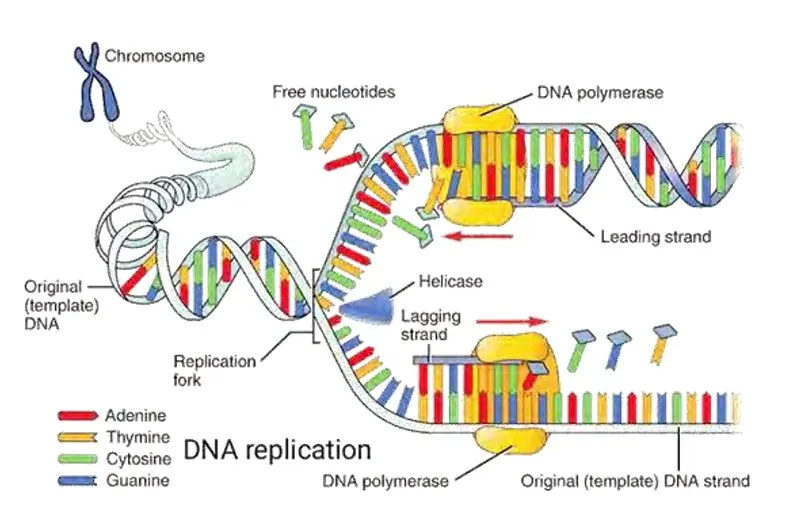
Figure: Genetic materials notes: semi-conservative mode of DNA replication
During transcription, RNA polymerase makes an RNA strand complementary to the DNA template strand. Adenine pairs with uracil (not thymine), and guanine pairs with cytosine.
| DNA template | T | A | C | G | G | A |
|---|---|---|---|---|---|---|
| RNA formed | A | U | G | C | C | U |
Answer: the RNA sequence is AUGCCU. The textbook gives the same rule: a DNA template CAATGA makes the RNA GUUACU.
Identification: the nucleic acid is RNA (ribonucleic acid). Uracil and ribose are found in RNA only, and DNA has thymine and deoxyribose.
Organisms: DNA is the genetic material of all organisms except RNA viruses. RNA serves as the genetic material in some viruses, for example the tobacco mosaic virus (TMV), influenza virus, SARS-CoV-2 and the retrovirus HIV.
It is a component of RNA.
Justification: adenine and phosphate are present in both DNA and RNA, so the sugar decides. RNA has ribose, which has an OH group on the 2′ carbon. DNA has deoxyribose, which has only H at that place (Figure 3.1.1 of the textbook). A nucleotide of ribose, adenine and phosphate is adenosine monophosphate (AMP), a ribonucleotide.
a) What is shown in the figure?
The figure shows DNA replication at a replication fork. The parental duplex is opened, the fork moves forward, and one new strand is made continuously while the other is made in pieces.
b) Label A, B and C.
c) Name the enzymes that add DNA nucleotide to the template.
DNA polymerase (DNA polymerase III in bacteria). It adds nucleotides to the 3′ end of the growing strand, so it works only in the 5′→3′ direction.
d) What is okazaki fragment?
Okazaki fragments are the short pieces of DNA made discontinuously on the lagging strand. Each one starts from an RNA primer. The primers are later replaced by DNA, and DNA ligase joins the pieces into one continuous strand.
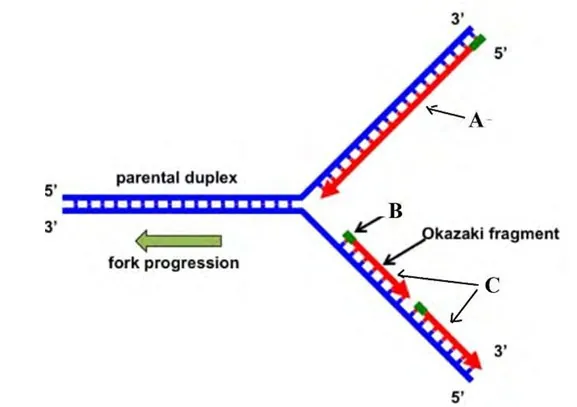
Figure for Q.8
Long Answer Questions
DNA (deoxyribonucleic acid) is the genetic material in all organisms except RNA viruses. In prokaryotic cells it is found in the cytoplasm. In eukaryotic cells it is found mainly in the nucleus, and in small amounts in mitochondria and plastids. It is a big molecule made of many deoxyribonucleotides joined by phosphodiester bonds.
Structure of DNA. J. D. Watson (American biologist) and F. H. C. Crick (English chemist) designed the double helix model of DNA in 1953. The main characteristics are:
Functions of DNA
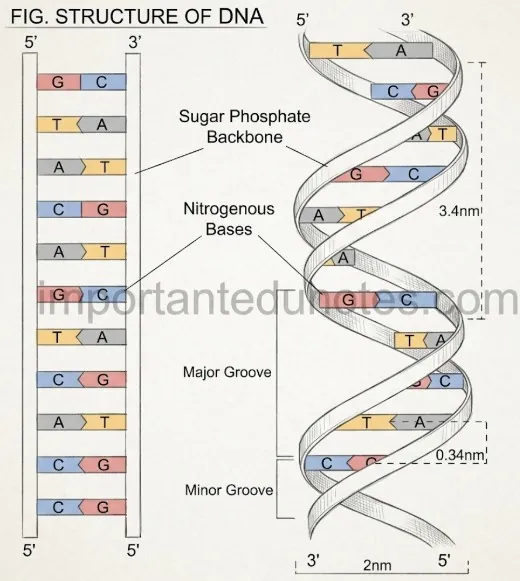
Figure: Genetic materials notes: structure of DNA (Watson and Crick double helix)
RNA (ribonucleic acid) is present in all living cells. It is made in the nucleus but is found in the nucleolus, cytoplasm, mitochondria, plastids and ribosomes. It is a polymer of ribonucleotides.
Structure of RNA
Functions of RNA
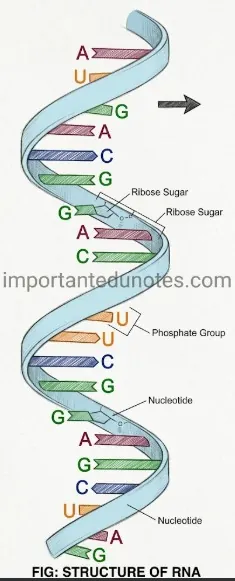
Figure: Structure of RNA
The three types of RNA are messenger RNA, ribosomal RNA and transfer RNA. All three are made from DNA by transcription and work together in protein synthesis.
| mRNA | rRNA | tRNA |
|---|---|---|
| Carries the genetic message from DNA. | Part of the ribosome. | Carries amino acids. |
| Has codons. | Gives the site for protein synthesis. | Has an anticodon. |
| About 5 %. | About 80 %. | About 15 %. |
The DNA carries genetic information from cell to cell and from generation to generation, and this information is expressed as protein. Proteins are made of 20 kinds of amino acids. A sequence of three bases codes for one amino acid, and it is called a codon.
Definition: the specific order of the nitrogenous bases in RNA that translates the message of DNA into amino acids is called the genetic code. It is a set of instructions that cells use to make proteins.
Characteristics of the genetic code
DNA replication is the process by which a double stranded DNA makes two identical copies of itself. It is needed in cell division, so that each new cell receives an exact copy of the genetic material.
Types of DNA replication
Figure: Genetic materials notes: types of DNA replication (conservative, semi-conservative, dispersive)
The semi-conservative mode is the correct one, proved by Meselson and Stahl (1958). Each daughter DNA is a hybrid, which keeps one parental chain and one new chain. The steps are as follows.
1. Initiation
2. Elongation
3. Termination. The replication ends when it reaches the end of the DNA molecule. Two DNA molecules are formed, each with one old and one new chain, and the new DNA coils into a double helix automatically.
Figure: Genetic materials notes: semi-conservative mode of DNA replication
4. Genetic Materials Notes PDF
PDF Notes 1: Genetics (Unit 3)
PDF Notes 2: Genetic Materials (Chapter 3.1)
5. Genetic Materials: Frequently Asked Questions
What are genetic materials? (Genetic materials notes in simple words)
Is genetic material DNA?
What are genetic materials examples and genetic materials list?
What is the genetic material structure?
Where are the genetic materials in humans and in the cell?
What are genetic materials pdf and genetic materials ppt?
What is genetics in biology (genetics biology) and what are genetics traits?
What is the importance of genetics and genetics in medicine?
Where can I get genetics pdf, genetics ppt and a genetics website?
What is the difference between DNA and RNA?
What is the genetic code and how is DNA replicated?
Where can I get Class 12 Biology Book PDF Nepal and Class 12 Biology Book PDF Asmita Publication?
Where can I get Class 12 biology notes, Class 12 biology pdf and Class 12 Biology Notes NEB for this chapter?
Where can I get Class 12 Biology notes in the style of Note Mandir?
Students also search for: