
Health Disorders | NEB class 12 Biology Notes | Zoology
Class 12 Biology Notes • NEB Syllabus 2083
Medical conditions list a-z and health disorders notes for Class 12 Biology Unit 9 chapter 9.2: syllabus, micro syllabus, 30 solved multiple choice questions, short and long answers on cardiovascular, respiratory and renal disorders and drug, alcohol and smoking abuse, and two PDF notes.
1.Syllabus
Unit 9: Human Population and Health Disorders (this page: chapter 9.2 Health disorders)
This medical conditions list a-z page follows the NEB Class 12 Biology syllabus (+2 Biology, Nepal), chapter 9.2 of Unit 9. Use the alphabetical list below for quick revision, practise the multiple choice questions, work through the solved short and long answers, and finish with the PDF notes.

Figure: Medical conditions list a-z, Class 12 Biology (NEB)
Micro syllabus: 9. Human Population and Health Disorders
Medical Conditions List A-Z
| Condition | Type | Meaning |
|---|---|---|
| Aortic aneurysm | Cardiovascular | Dilation of the aorta |
| Arrhythmia | Cardiovascular | Abnormal heart rate or rhythm |
| Arteriosclerosis | Cardiovascular | Thickening of artery wall by plaque |
| Asthma | Respiratory | Inflammation and spasm of bronchi |
| Atherosclerosis | Cardiovascular | Narrowing of artery lumen by lipid |
| Bronchiectasis | Respiratory | Widening and damage of bronchi |
| Bronchitis | Respiratory | Inflammation and swelling of bronchi |
| Calculi (kidney stone) | Renal | Stone in urinary tract |
| Chronic obstructive pulmonary disease (COPD) | Respiratory | Trouble in breathing, especially exhalation |
| Coronary artery disease | Cardiovascular | Blocked coronary artery |
| Cystitis | Renal | Inflammation of bladder lining |
| Emphysema | Respiratory | Damage of lungs |
| End stage renal disease | Renal | Final stage of chronic kidney disease |
| Glomerulonephritis | Renal | Inflammation of glomeruli |
| Heart failure | Cardiovascular | Heart cannot pump enough blood |
| Hypertension | Cardiovascular | High blood pressure (silent killer) |
| Hypotension | Cardiovascular | Low blood pressure |
| Lung cancer | Respiratory | Abnormal growth of cells in alveoli |
| Myocardial infarction | Cardiovascular | Heart attack |
| Nephritis | Renal | Inflammation of kidney |
| Pneumonia | Respiratory | Inflammation of alveoli with fluid |
| Polycystic kidney disease | Renal | Fluid-filled cysts on kidneys |
| Pulmonary edema | Respiratory | Fluid leaking into alveoli |
| Pyelonephritis | Renal | Infection from bladder up to kidneys |
| Renal failure | Renal | Kidneys non-functional |
| Rheumatic heart disease | Cardiovascular | Valve and muscle damage by rheumatic fever |
| Stroke | Cardiovascular | Stoppage of blood flow to the brain |
| Tuberculosis | Respiratory | Alveoli inflamed by Mycobacterium |
| Uremia | Renal | Urea retained in blood |
| Urinary tract infection | Renal | Infection of urethra and bladder |
Read more about the list of diseases, cardiovascular disease, respiratory disease and substance use disorder on Wikipedia. More notes: Class 12 Biology notes, Class 12 Chemistry notes and Class 12 Physics notes.
2.Multiple Choice Questions on Health Disorders
Question 1. Which one of the following is a collection of symptoms that disrupt normal bodily functions?
- a) Disease
- b) Disorder
- c) Syndrome
- d) Condition
Correct Answer: b) Disorder
Reason: A disorder is a collection of symptoms that disrupts normal bodily functions. A disease has a known cause; a syndrome has no clear cause or course.
Question 2. Which of the following disorders refers to the disorder of the heart and related organs?
- a) Cardiovascular disorders
- b) Respiratory disorders
- c) Renal disorders
- d) Substance abuse disorders
Correct Answer: a) Cardiovascular disorders
Reason: Cardiovascular disorders (CVDs) affect the heart and blood vessels.
Question 3. Which one of the following is a cardiovascular disorder affecting the heart?
- a) Myocardial infarction
- b) Arteriosclerosis
- c) Atherosclerosis
- d) Hypertension
Correct Answer: a) Myocardial infarction
Reason: Myocardial infarction (heart attack) damages heart muscle. The others affect blood vessels or blood flow.
Question 4. A condition in which the heart cannot pump enough blood to meet the body's needs is known as:
- a) Heart attack
- b) Heart failure
- c) Cardiomyopathy
- d) Aortic aneurysms
Correct Answer: b) Heart failure
Reason: Heart failure is improper pumping or relaxing of the heart, with fluid build-up and shortness of breath.
Question 5. How can most cardiovascular diseases be prevented?
- a) By addressing obesity
- b) By addressing alcohol abuse
- c) By addressing tobacco abuse
- d) All of these
Correct Answer: d) All of these
Reason: Obesity, alcohol and tobacco are all risk factors, so addressing all of them prevents CVDs.
Question 6. Stroke is a:
- a) Heart attack
- b) Lungs attack
- c) Kidney attack
- d) Brain attack
Correct Answer: d) Brain attack
Reason: Stroke (cerebro-vascular accident) is stoppage of blood flow to the brain.
Question 7. Asthma is a:
- a) Cardiovascular disorder
- b) Respiratory disorder
- c) Nervous disorder
- d) Renal disorder
Correct Answer: b) Respiratory disorder
Reason: Asthma is inflammation and spasm of bronchi and bronchioles, a respiratory disorder.
Question 8. What is the full form of COPD?
- a) Congenital Obstructive Pulmonary Disease
- b) Cancer Obstructive Pulmonary Data
- c) Chronic Obstructive Pulmonary Disease
- d) Conventional Obtaining Disease
Correct Answer: c) Chronic Obstructive Pulmonary Disease
Reason: COPD is chronic obstructive pulmonary disease: trouble in breathing, especially exhalation.
Question 9. A person is suffering from a respiratory disorder. What would be the possible cause of chronic obstructive pulmonary disease (COPD)?
- a) Using caffeine
- b) Exposure to pollutants
- c) Inhalation of tranquilizers
- d) Exposure to narcotics
Correct Answer: b) Exposure to pollutants
Reason: Air pollution and smoking are the environmental causes of respiratory disorders.
Question 10. Low oxygen supply to tissues is scientifically known as:
- a) Asphyxia
- b) Hypoxia
- c) Emphysema
- d) Asthma
Correct Answer: b) Hypoxia
Reason: Hypoxia means a low oxygen supply to tissues. Emphysema and asthma are lung diseases.
Question 11. Renal calculi is:
- a) Urinary tract infection
- b) Kidney stone
- c) Inflammation of renal pelvis
- d) Inflammation of urethra
Correct Answer: b) Kidney stone
Reason: Renal calculi (nephrolithiasis) are stones formed in the urinary tract by crystallization of calcium oxalate and uric acid.
Question 12. Which of the following minerals is not involved in the formation of renal calculi?
- a) Urea
- b) Uric acid
- c) Calcium carbonate
- d) Calcium oxalate
Correct Answer: a) Urea
Reason: Urea stays dissolved and is excreted. Stones form from calcium salts and uric acid.
Question 13. What is glucosuria (glaucosauria)?
- a) Low amount of sugar in urine
- b) High amount of sugar in urine
- c) Average amount of sugar in urine
- d) Low amount of fat in urine
Correct Answer: b) High amount of sugar in urine
Reason: Glucosuria is the presence of a high amount of sugar (glucose) in urine.
Question 14. Haemodialysis is the treatment for renal disorders. It is the process of removal of ______ in the blood by artificial means.
- a) Sodium ions
- b) Potassium ions
- c) Urea
- d) Ammonia
Correct Answer: c) Urea
Reason: Dialysis removes urea, the main nitrogenous waste retained in kidney failure (uremia).
Question 15. What is the inflammation of the glomeruli of the kidney referred to?
- a) Cystitis
- b) Nephritis
- c) Glomerulonephritis
- d) Pyelonephritis
Correct Answer: c) Glomerulonephritis
Reason: Glomerulonephritis (Bright's disease) is inflammation of glomeruli. Nephritis is inflammation of the kidney in general.
Question 16. Substance abuse shows:
- a) Rhinorrhoea
- b) Diarrhoea
- c) Lacrimation
- d) Withdrawal symptoms
Correct Answer: d) Withdrawal symptoms
Reason: If the substance is not taken, the person shows withdrawal effects and withdrawal symptoms.
Question 17. Which one of the following is referred to as narcotics?
- a) Diazepam
- b) Caffeine
- c) Opium
- d) Cocaine
Correct Answer: c) Opium
Reason: Narcotics include opium and its derivatives (morphine, codeine, heroin). Diazepam is a tranquilizer; caffeine and cocaine are stimulants.
Question 18. The dependency of the mind and body on a drug is known as:
- a) Drug use
- b) Drug abuse
- c) Drug addict
- d) Drug addiction
Correct Answer: d) Drug addiction
Reason: Regular abuse of a drug for its psychic effect is drug addiction, a neurological dependence.
Question 19. The most dangerous hallucinogens are:
- a) Cocaine
- b) Heroin
- c) Caffeine
- d) Lysergic acid diethylamide (LSD)
Correct Answer: d) Lysergic acid diethylamide (LSD)
Reason: LSD, obtained from the ergot fungus, is the most powerful hallucinogen.
Question 20. Performance-enhancing drugs used by athletes are:
- a) Amphetamines
- b) Sedatives
- c) Tranquilizers
- d) Nicotine
Correct Answer: a) Amphetamines
Reason: Amphetamines are CNS stimulants largely used by athletes to increase physical strength.
Question 21. Which one of the following is an undistilled alcoholic beverage?
- a) Beer
- b) Whiskey
- c) Rum
- d) Brandy
Correct Answer: a) Beer
Reason: Beer (and wine) are made by fermentation only. Whiskey, rum and brandy are distilled.
Question 22. Drinking and driving do not go together. What could happen if a driver drinks?
- a) It could affect judgment
- b) It could affect the liver
- c) It could affect sugar level
- d) It could affect body weight
Correct Answer: a) It could affect judgment
Reason: Alcohol depresses the CNS, slowing reaction and impairing judgment and coordination.
Question 23. The most severely affected organ due to alcoholism is the:
- a) Mouth
- b) Stomach
- c) Liver
- d) Kidney
Correct Answer: c) Liver
Reason: About 90% of alcohol is metabolized in the liver; chronic intake causes fatty liver, hepatitis and cirrhosis.
Question 24. The modern way of tobacco addiction is:
- a) Smoking tobacco
- b) Chewing tobacco
- c) Aerosol inhalation of heated tobacco
- d) Sniffing tobacco
Correct Answer: c) Aerosol inhalation of heated tobacco
Reason: Heating tobacco and inhaling the aerosol, without smoke, is the modern way.
Question 25. The main drug found in tobacco is:
- a) Opium
- b) Caffeine
- c) Nicotine
- d) LSD
Correct Answer: c) Nicotine
Reason: Nicotine is the highly addictive drug for which smoking is done.
Question 26. Cigarette smoking causes:
- a) Emphysema
- b) Asthma
- c) Fibrosis
- d) Bronchitis
Correct Answer: a) Emphysema
Reason: Smoking causes COPD, bronchitis, lung cancer and emphysema. Emphysema, damage of lungs, is the classic answer.
Question 27. Pneumonia is one of the harmful respiratory diseases, especially in children. All of the following are correct for a person during pneumonia, but what happens first? I. Alveoli are damaged II. Alveoli are filled with liquid III. Lung tissues are thickened IV. Shortness of breathing
- a) I, II, III, and IV
- b) II, III, IV, and I
- c) II, IV, I, and III
- d) I, III, II, and IV
Correct Answer: b) II, III, IV, and I
Reason: Pneumonia begins with inflammation and fluid in the alveoli (II); tissue thickening and breathlessness follow, and alveoli are damaged in acute cases.
Question 28. A person suddenly falls down and becomes unconscious. A doctor checked and said that it is due to inadequate blood supply to the brain. What would be the type of disorder?
- a) Asthma
- b) Heart attack
- c) Oedema
- d) Syncope
Correct Answer: d) Syncope
Reason: Syncope is fainting due to a temporary fall of blood supply to the brain.
Question 29. Which one of the following statements is correct in terms of a drunkard?
- a) The reaction time increases
- b) The reaction time decreases
- c) The reaction time equals
- d) The reaction time becomes fastest
Correct Answer: a) The reaction time increases
Reason: Alcohol is a CNS depressant, so the response is slower and reaction time increases.
Question 30. Most of the alcohol drunk is absorbed in the:
- a) Buccal cavity
- b) Oesophagus
- c) Stomach
- d) Intestine
Correct Answer: d) Intestine
Reason: Absorption starts in the stomach, but most alcohol is absorbed in the small intestine.
3.Short and Long Answer Questions
Short Answer Questions
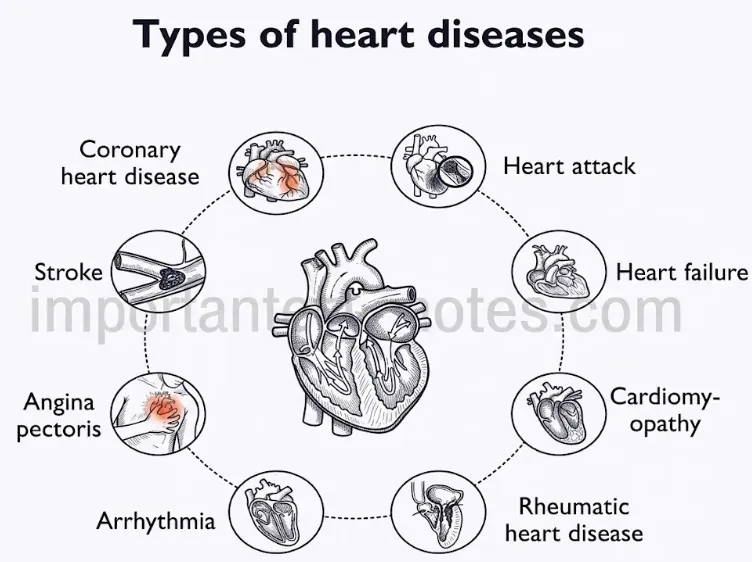
Figure: Types of heart diseases
| Disorder | Comment |
|---|---|
| Coronary heart disease (CAD/CHD) | Blood flow obstruction due to blockage of the coronary artery by atherosclerosis; primary cause of heart attack. |
| Stroke | Stoppage of blood flow to the brain (brain attack, cerebro-vascular accident). |
| Angina pectoris | Chest pain, a symptom of reduced blood supply to heart muscle. |
| Arrhythmia | Abnormal heart rate or rhythm due to improper impulse conduction. |
| Heart attack (myocardial infarction) | Blood flow to the heart is reduced or stopped, which can damage or kill heart muscle. |
| Heart failure | Improper pumping or relaxing of the heart, with fluid build-up and shortness of breath. |
| Cardiomyopathy | Disease of the heart muscle itself, which weakens the pumping. |
| Rheumatic heart disease | Damage of heart muscles and valves due to rheumatic fever. |
CVDs cause about 18 million deaths every year.
Early warnings: shortness of breath, cough and fatigue; later wheezing, chest pain and repeated lung or chest infections. These may become life threatening if left untreated.
Elderly: chronic obstructive pulmonary disease (COPD), pneumonia, lung cancer and tuberculosis are more concerned, because of long exposure to smoking and pollution and weaker immunity.
Infants: pneumonia (alveoli inflamed and filled with fluid) and asthma are more concerned, because their airways are narrow and immunity is not yet developed.
Drug (WHO) is any substance used to modify or explore physiological systems or pathological states for the benefit of the recipient. Use under a doctor for treatment is drug use.
Drug abuse is self-administration of a drug for a non-medical reason, in quantity and frequency that impair a person’s ability to function and cause social, physical, physiological or emotional harm.
Description: Regular abuse for its psychic effect is drug addiction (the person is a drug addict); the compulsion to take it is drug dependence; this leads to drug use disorder, and missing the drug causes withdrawal symptoms. Drugs are swallowed, smoked, snorted, taken as suppositories or injected. Reasons include curiosity, peer pressure, escape from pain and stress, availability and lack of awareness.
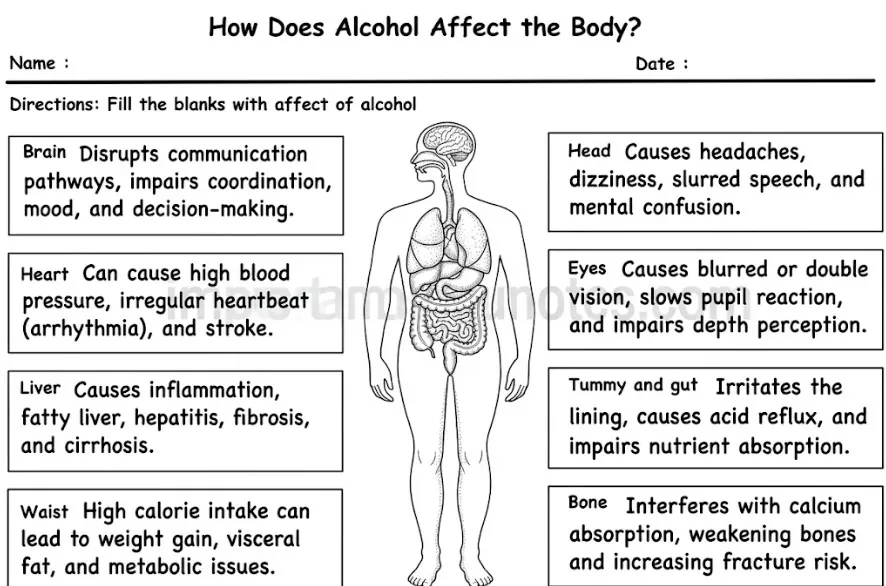
Figure: Effects of alcohol on the body
| Part | Effect of alcohol |
|---|---|
| Brain | Depresses the CNS; ataxia (uncoordinated movement) from the cerebellum; Wernicke’s encephalopathy and Korsakoff psychosis from thiamine (vitamin B1) deficiency. |
| Heart | Raises blood pressure and risk of heart disease; alcohol-induced cardiomyopathy. |
| Liver | Fatty change, alcohol-induced hepatitis and cirrhosis; raised GGT enzyme. |
| Waist | Alcohol gives 7 kcal per g, so heavy drinking adds calories and body weight. |
| Head | Hangover and headache; dependence and withdrawal symptoms. |
| Eyes | Blurred vision and slow response (impaired judgment and reaction time). |
| Tummy and gut | Oral, oesophageal and gastric cancer risk; stomach irritation. |
| Bone | Heavy long-term use weakens bone (loss of calcium). |
Smoking is the inhalation of smoke of fired tobacco from cigarette, cigar, pipe, or locally bidi, churot, chilam and hookah. Tobacco comes from dried leaves of Nicotiana tabacum (and N. rustica).
Chemicals: tobacco smoke contains thousands of chemicals: carbon monoxide (toxic), benzene, more than 70 carcinogens (tar, hydrogen cyanide, formaldehyde, arsenic, cadmium, lead, nickel) and nicotine, the addictive drug. Inhaled smoke delivers nicotine to the brain within 20 seconds and releases dopamine.
Addiction: regular use gives tobacco (nicotine) addiction and dependence, with withdrawal symptoms (shaky hands, sweating, irritability, fast heartbeat, anxiety, insomnia). Tobacco causes about 6 million deaths a year. World No Tobacco Day is 31 May.
Smoking harms nearly every system:
1. Cardiovascular: coronary artery disease, Burger’s disease and stroke. 2. Respiratory: COPD, bronchitis, lung cancer and emphysema. 3. Gastro-intestinal: oral, throat and gastric cancer, and peptic ulcers. 4. Carcinogens: more than 70 cancer-causing chemicals. 5. Carbon monoxide reduces oxygen supply. 6. Nicotine addiction makes quitting hard. 7. Foetus: chemicals can damage the developing foetus of a pregnant woman.
Tobacco is the leading cause of preventable disease, with 6 million deaths per year, so smoking is injurious to health.
Long Answer Questions
Introduction: Any abnormal change that causes distress and discomfort to the concerned person and to the people around is a socially significant disease. A disease may be physical, mental, physiological or social.
Substance use disorder (brain or mental health disorder due to substance abuse) is a socially significant disease, though it is equally psychological, physiological and physical.
Figure: Cardiovascular disorders are leading socially significant diseases
| Disease group | Social significance |
|---|---|
| Cardiovascular disorders | About 18 million deaths a year; caused by unhealthy diet, smoking, drinking, inactivity and stress; heart attack and stroke. |
| Respiratory disorders | About 3.5 million deaths a year; air pollution and smoking; asthma, COPD, pneumonia, tuberculosis. |
| Renal disorders | About 0.25 million deaths a year; diabetes and high blood pressure; kidney failure needs dialysis or transplant. |
| Drug abuse | In Nepal in 2024 about 157,000 drug addicts (93% male, 70% aged 20–29); loss of job and school, family and social crime. |
| Alcohol abuse | In Nepal 24% people drink; liver cirrhosis, accidents, broken families. |
| Tobacco abuse | Most commonly abused substance in Nepal; 6 million deaths a year worldwide. |
Conclusion: These diseases burden the family, the economy and the nation, so they are controlled through awareness, healthy lifestyle, law and rehabilitation.
Abused drugs are two major types: psychotropic (change mood, consciousness, perception and behaviour) and psychedelic (cause hallucination).
| Category | Examples and source | Biological effects |
|---|---|---|
| Narcotics (opiates, analgesics) | Opium, from latex of unripe boll of poppy Papaver somniferum; semi-synthetic morphine, codeine, heroin; synthetic oxycodone. | Dull senses, relieve pain, induce profound sleep; excess causes stupor, coma or convulsions. CNS depressants. |
| Tranquilizers (anxiolytics) | Diazepam (Valium), chlordiazepoxide (Librium), alprazolam (Xanax). | Mental calmness by relieving anxiety and tension, without affecting consciousness. |
| Sedatives | Barbiturates, benzodiazepines, lorazepam, zolpidem. | Calming; reduce mental activity and finally suppress consciousness (CNS depressants). |
| Hypnotics | Luminal, saconal (sleeping pills). | Induce sleep to treat insomnia. |
| Stimulants | Caffeine from tea, coffee, cocoa; cocaine from coca (Erythroxylum coca); synthetic amphetamines. | Increase alertness, mood and physical performance by raising sympathetic activity; amphetamines are anti-sleep drugs used by athletes. |
| Hallucinogens (psychedelics) | Cannabis (bhang, ganja, marijuana, hashish, charas); LSD from ergot fungus Claviceps purpurea. | Alter perception, mood and thought; auditory and optical illusion or hallucination. LSD is the most powerful. |
Effects of abuse on the addict include nausea, liver damage, seizures, stroke, brain damage, lung disease, hepatitis, HIV-AIDS, depression, suicide, neurosis and psychosis.
Figure: Effects of alcohol on the body
Addiction: regular abuse of a substance to get its psychic effect is addiction, which is neurological. For alcohol it is alcohol addiction (alcoholism); the compulsion to take it is alcohol dependence, which leads to alcohol use disorder (AUD), a chronic relapsing brain disorder. If alcohol is not taken, withdrawal symptoms appear. Severity is mild (2–3 criteria), moderate (4–5) or severe (6 or more).
a) Symptoms
Withdrawal symptoms; craving; high tolerance; drinking more or longer than intended; spending much time drinking or recovering from hangovers; failing family and work duties; continuing despite health or relationship problems; drinking to overcome withdrawal.
b) Effects
Acts as CNS depressant (cerebellum affected, ataxia); lowers ADH secretion; raises blood pressure and heart disease risk; fatty liver, hepatitis and cirrhosis; raised GGT; vitamin B1 deficiency (Wernicke’s encephalopathy, Korsakoff psychosis); hangovers; oral, oesophageal and gastric cancer; cardiomyopathy, alcohol poisoning and cerebellar degeneration.
c) Control measures
| Prevention | Treatment |
|---|---|
| Avoid high-risk drinking (not more than 2 drinks a day or 8 a week for women, 3 a day or 12 a week for men); avoid stress; awareness. | Inpatient or residential rehabilitation for severe cases; behavioural counselling; support groups; medicines naltrexone and acamprosate (topiramate and gabapentin reduce craving). |
4.PDF Notes (Health Disorders)
PDF Notes 1: Human Population and Health Disorder (Unit 9)
PDF Notes 2: Health Disorders (Chapter 2)
5.Frequently Asked Questions
What is a medical conditions list a-z for Class 12 Biology?
What is the difference between disease, syndrome and disorder?
What are the most common health problems in Nepal?
What are cardiovascular disorders and how are they prevented?
What are common respiratory disorders?
What are common renal disorders?
What are mental health disorders and substance use disorders?
What are the types of abused drugs?
Which days are observed against substance abuse?
Where can I download Health disorders PDF for Class 12?
Is this Class 12 Biology book PDF for Nepal NEB?
Students also search for: