
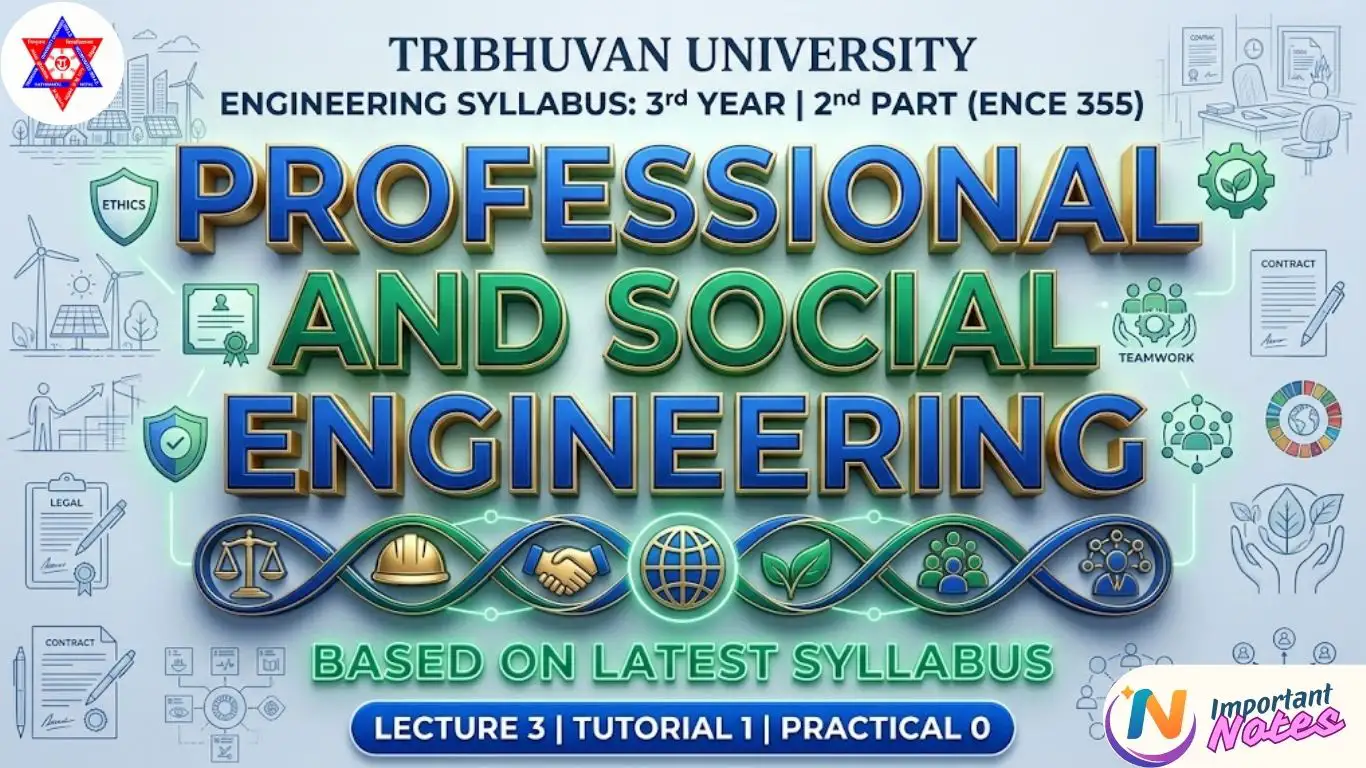
PROFESSIONAL AND SOCIAL ENGINEERING (ENCE 355)
Course Objectives
The objective of this course is to introduce the interrelationship among technology, environment, and society, emphasizing the ethical, professional, and legal responsibilities of engineers. It aims to develop the ability to apply professional ethics, comply with institutional and legal provisions, communicate effectively, and engage responsibly with stakeholders and communities while recognizing the broader societal role of engineering practice.
Detailed Syllabus
1.1 Early civilization and engineering practices
1.2 Cultural and social influence of technology
1.3 Environment and society; Role and impact of technology
1.4 Environmental conservation
1.4.1 Ecosystem and conservation of environment
1.4.2 Conservation of natural resources and wildlife in infrastructure development (Impact on natural resources; Significance; Ecology and behavior; Conservation)
1.4.3 Global and regional environmental issues
1.5 Resource efficiency and sustainable technologies
1.5.1 Renewable and non-renewable resources
1.5.2 Waste management and recycling technologies
1.5.3 Green engineering and design practices
1.6 Natural resources safeguards: Principle and practices
2 Ethics and Professionalism (8 hours)2.1 Ethics, morality, and professionalism
2.2 Ethical responsibilities toward sustainability and safety
2.3 Code of conduct and professional behavior
2.4 Responsibility, liability, and negligence
2.5 Conflict of interest, corruption, and whistleblowing
2.6 Ethical decision-making and case studies
3 Engineering Practice and Legal Framework (10 hours)3.1 Engineering Council and professional associations
3.2 Professional regulations
3.3 Engineering enterprises
3.4 Licensing and disciplinary procedures
3.5 Contract types and Public Procurement Act
3.6 Labor law and occupational safety
3.7 Intellectual property and arbitration
3.8 Conflict resolution techniques
4 Professional Skill and Career Development (5 hours)4.1 Proposal writing and reporting
4.2 Professional correspondence
4.3 Communication, teamwork, and leadership
4.4 Continuing Professional Development (CPD)
5 Social Engineering (6 hours)5.1 Concept and scope of social engineering
5.2 Elements of society and community and their difference
5.3 Social inclusion and decision making
5.4 Stakeholders: Identification, mapping, analysis, engagement and communication
5.5 Corporate social responsibility (CSR)
6 Engineers in Society (6 hours)6.1 Engineer as an agent of change
6.2 Public accountability and ethical citizenship
6.3 Balancing technical and social expectations
6.4 Contribution to Sustainable Development Goals (SDGs)
Tutorial (15 hours)
1. Debate to apply ethical principles in practical engineering situations.
2. Group discussion to analyze interactions among technology, environment, and society.
3. Case critique to evaluate professional conduct and legal obligations.
4. Class room workshop to demonstrate proposal writing and professional communication skills.
5. Stakeholder mapping exercise to identify and analyze interests and influence in infrastructure projects.
6. Discussion to explore social inclusion and corporate social responsibility (CSR) practices.
7. Reflective session to assess teamwork, leadership, and continuing professional development (CPD).
8. Case presentation to synthesize ethical, legal, and social dimensions of engineering practice.
Final Exam
The questions will cover all the chapters in the syllabus. The evaluation scheme will be as indicated in the table below:
| Chapter | Hours | Marks distribution* |
|---|---|---|
| 1 | 10 | 12 |
| 2 | 8 | 10 |
| 3 | 10 | 14 |
| 4 | 5 | 6 |
| 5 | 6 | 8 |
| 6 | 6 | 10 |
| Total | 45 | 60 |
* There may be minor deviation in marks distribution.
References
1. Whitbeck, C. (2012), Ethics in Engineering Practice and Research, Cambridge University Press.
2. Martin, M. W., Schinzinger, R. (2004). Ethics in engineering. New York, NY: McGraw-Hill.
3. Environmental and Construction Engineering: Reality and the Future: Selected Papers. (2021). Germany: Springer International Publishing.
4. Nepal Engineering Council. Act, Regulations, and Code of Conduct.
5. Government of Nepal. Public Procurement Act (2063) and Regulations (2064).
6. World Federation of Engineering Organizations. (2016). Model Code of Ethics for Engineers.
Chapter-wise Notes
Based on the latest syllabus of IoE (III/II)
| SN | Chapter | View / Download |
|---|---|---|
| 1 | Technology, Environment and Society | View / Download |
| 2 | Ethics and Professionalism | View / Download |
| 3 | Engineering Practice and Legal Framework | View / Download |
| 4 | Professional Skill and Career Development | View / Download |
| 5 | Social Engineering | View / Download |
| 6 | Engineers in Society | View / Download |
Miscellaneous Items & Tutorials
| SN | Item | Description | Download |
|---|---|---|---|
| 1 | Past Year Questions | Collection of previous exam papers for Professional and Social Engineering ENCE 355 | Download |
| 2 | Model Questions Solution | Date: 2083 | Download |
| 3 | Case Studies Solutions Book | Solved professional negligence, liabilities, and intellectual property case studies | Download |
Read Also:
Explore the complete collection of syllabi for all engineering disciplines and notes from the Institute of Engineering (IOE).
View All IOE Engineering Syllabi📄 Disclaimer: All Professional and Social Engineering ENCE 355 notes, syllabus details, exam schedules, and guides shared here are based on the Latest curriculum of IoE and are primarily sourced from official structures.
If you are the original content creator of any material provided here and wish for removal or credit, kindly contact us. We respect intellectual property rights and will act promptly.