
Periodic Motion
Class 12 Physics Notes • NEB Syllabus 2083
Syllabus, 12 solved multiple choice questions, step-by-step numericals, handwritten and typed PDF notes and frequently asked questions on SHM, pendulum, spring-mass system, damping and resonance.
1. Syllabus
Unit 1: Mechanics
Chapter 2: Periodic Motion
These notes follow the NEB Class 12 Physics syllabus (+2 Physics, Nepal). Practise the multiple choice questions first, then work through the numericals, and finish with the PDF notes for quick revision.
2. Multiple Choice Questions
Question 1. A particle undergoing SHM has its displacement given as \(y=3\sin\omega t+4\cos\omega t\). What will be its amplitude of vibration?
- a) 3 cm
- b) 4 cm
- c) 5 cm
- d) 7 cm
Correct Answer: c) 5 cm
Reason: The equation combines into a single sine wave \(y=A\sin(\omega t+\phi)\), where the resultant amplitude is \(A=\sqrt{a^2+b^2}\).
Question 2. What is the angle between the instantaneous velocity and acceleration of a particle undergoing SHM?
- a) Zero
- b) \(\dfrac{\pi}{2}\)
- c) \(\pi\)
- d) Zero or \(\pi\)
Correct Answer: b) \(\dfrac{\pi}{2}\)
Reason: For \(x=A\sin\omega t\):
The phase difference between velocity and acceleration is \(\pi-\tfrac{\pi}{2}=\tfrac{\pi}{2}\), that is, 90°.
Question 3. A particle undergoing SHM has amplitude \(r\) and period \(T\). What is the time taken by it to travel from \(x=r\) to \(x=\dfrac r2\)?
- a) \(\dfrac T2\)
- b) \(\dfrac T3\)
- c) \(\dfrac T6\)
- d) \(\dfrac T{12}\)
Correct Answer: c) \(\dfrac T6\)
Reason: Starting from the extreme position, \(x=r\cos\omega t\). Putting \(x=\tfrac r2\):
Question 4. What happens to the period of a simple pendulum if its length is tripled?
- a) The period doubles
- b) The period triples
- c) The period increases by a factor of \(\sqrt3\)
- d) The period increases by a factor of 3
Correct Answer: c) The period increases by a factor of \(\sqrt3\)
Reason: \(T=2\pi\sqrt{L/g}\), so \(T\propto\sqrt L\). For a new length \(3L\):
Question 5. A simple pendulum is suspended on the moon, where the acceleration due to gravity is \(\tfrac16\) of that on earth. If the period of the same pendulum is 2 seconds on earth, what will the period be on the moon?
- a) 5 seconds
- b) 2 seconds
- c) 6 seconds
- d) 12 seconds
Correct Answer: a) 5 seconds
Reason: \(T\propto\dfrac1{\sqrt g}\), so
Question 6. A girl sitting on a swing is swinging with a period \(T\). What will be the period if another girl sits together with her and goes for a swing?
- a) Is halved
- b) Is doubled
- c) Remains the same
- d) Is quadrupled
Correct Answer: c) Remains the same
Reason: The swing acts as a simple pendulum. Its period \(T=2\pi\sqrt{L/g}\) depends only on the effective length and on \(g\), and is independent of the mass of the swingers.
Question 7. What is the natural frequency of a longitudinal vibration of a spring if the mass of the system is made half and the spring stiffness is doubled?
- a) Is halved
- b) Is doubled
- c) Is quadrupled
- d) Remains unaffected
Correct Answer: b) Is doubled
Reason: \(f=\dfrac1{2\pi}\sqrt{\dfrac km}\). With mass \(\tfrac m2\) and stiffness \(2k\):
Question 8. What will happen to the frequency of a mass-spring system if the mass is doubled?
- a) The frequency will double
- b) The frequency will remain the same
- c) The frequency will decrease by a factor of \(\sqrt2\)
- d) The frequency will decrease by a factor of 2
Correct Answer: c) The frequency will decrease by a factor of \(\sqrt2\)
Reason: Since \(f=\dfrac1{2\pi}\sqrt{\dfrac km}\), we have \(f\propto\dfrac1{\sqrt m}\). If the mass becomes \(2m\), the new frequency is \(f’=\dfrac{f}{\sqrt2}\).
Question 9. If the natural frequency of Fig. I is \(f\), what will be the frequency of Fig. II upon adding two similar springs of the same spring constant?
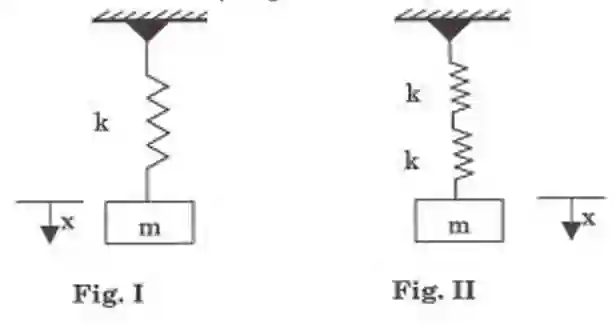
Figure: Spring-mass system (Fig. I) and the modified arrangement (Fig. II)
- a) \(f\)
- b) \(\dfrac{f}{\sqrt2}\)
- c) \(\dfrac{\sqrt2}{f}\)
- d) \(\sqrt2\,f\)
Correct Answer: d) \(\sqrt2\,f\)
Reason: Adding an identical spring in parallel makes the effective spring constant \(k_{\text{eff}}=2k\). Since \(f\propto\sqrt{k_{\text{eff}}}\),
Question 10. Why does resonance occur in simple harmonic motion?
- a) The system is disturbed by a random force
- b) The driving frequency matches the natural frequency of the system
- c) The amplitude is reduced
- d) The system loses energy
Correct Answer: b) The driving frequency matches the natural frequency of the system
Reason: Resonance occurs when an external force drives an oscillating system at a frequency equal to its natural frequency. Energy transfer is then maximum, causing a large increase in amplitude.
Question 11. Where would you observe resonance in everyday life?
- a) In a swinging pendulum with no external force
- b) When a car suspension system absorbs shocks
- c) In musical instruments like a guitar or violin
- d) When a spring stretches under a constant weight
Correct Answer: c) In musical instruments like a guitar or violin
Reason: Musical instruments use resonance to amplify sound. The hollow body of a guitar resonates at the frequencies of the vibrating strings, producing a louder and sustained note.
Question 12. In an angular simple harmonic oscillator, the restoring torque \(\tau\) is given by \(\tau=-k\theta\), where \(\theta\) is the angular displacement and \(k\) is the torsional constant. What is the angular frequency \(\omega\) of the oscillation?
- a) \(\omega=\sqrt k\)
- b) \(\omega=\sqrt{\dfrac kI}\)
- c) \(\omega=\dfrac kI\)
- d) \(\omega=\dfrac1k\)
Correct Answer: b) \(\omega=\sqrt{\dfrac kI}\)
Reason: From \(\tau=I\alpha\) and \(\tau=-k\theta\):
Comparing with \(\alpha=-\omega^2\theta\) gives \(\omega^2=\dfrac kI\), so \(\omega=\sqrt{k/I}\).
3. Numerical and Subjective Questions
a) Define simple harmonic motion. What are its essential characteristics?
Simple harmonic motion is a special type of periodic motion in which the restoring force on the body is directly proportional to its displacement from the equilibrium position and is always directed toward that position.
Essential characteristics:
b) Derive the expression for acceleration in SHM.
Let the displacement be \(x=A\sin(\omega t+\phi)\), where \(A\) is the amplitude and \(\omega\) the angular frequency. Velocity is the first derivative of displacement:
Acceleration is the derivative of velocity:
Substituting \(x\) back:
c) A particle of mass 0.1 kg is executing SHM with a period of 2 s and an amplitude of 0.5 m.
(i) Find its total mechanical energy.
(ii) Determine the kinetic energy when the displacement is 0.3 m.
(iii) At what displacement is the speed half of its maximum value?
Maximum speed is \(v_{\max}=A\omega\), and the speed at displacement \(x\) is \(v=\omega\sqrt{A^2-x^2}\). Setting \(v=\dfrac{A\omega}{2}\):
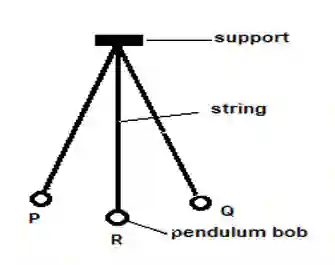
Figure: Simple pendulum swinging between the extreme positions P and Q
a) The time taken for the pendulum to swing from P to Q is approximately 0.5 s. Estimate the length of the pendulum.
P and Q are the extreme positions, so the time from P to Q is half the period:
Taking \(g=9.8\ \mathrm{m\,s^{-2}}\) and \(T=2\pi\sqrt{L/g}\):
b) (i) Draw a free body diagram showing all necessary forces.
Represent the bob by a dot. Draw the weight \(mg\) as an arrow pointing straight down, and the tension \(T\) as an arrow along the string toward the pivot, making an angle \(\theta\) with the vertical. Resolve the weight into two components:
(ii) Use the free body diagram to find the frequency of oscillation.
The restoring force is the tangential component of the weight:
For small angles \(\sin\theta\approx\theta=\dfrac xL\), where \(x\) is the arc length:
Comparing with \(a=-\omega^2x\) gives \(\omega=\sqrt{g/L}\), so
Using \(T=1.0\ \mathrm{s}\) from part (a): \(f=\dfrac1T=1.0\ \mathrm{Hz}\).
a) Define the equilibrium position in vertical SHM.
The equilibrium position is the rest point of the suspended mass where the downward weight \(mg\) is exactly balanced by the upward spring force \(ke\), where \(e\) is the extension of the spring. The net force there is zero.
b) How does the restoring force act in vertical SHM? Explain using Hooke’s law.
Suppose the mass is displaced further downward by \(x\) from equilibrium. The total stretch is \((e+x)\), so the upward spring force is \(F_s=k(e+x)\) and the weight acts downward. The net force is
Since \(mg=ke\) at equilibrium,
The gravity term cancels, leaving a restoring force \(-kx\) strictly proportional to the displacement from equilibrium.
c) A 5 kg block is suspended from a vertical spring, causing it to stretch by 0.25 m.
(i) Calculate the spring constant of the spring.
(ii) If the block is displaced further and set into oscillation, find its period.
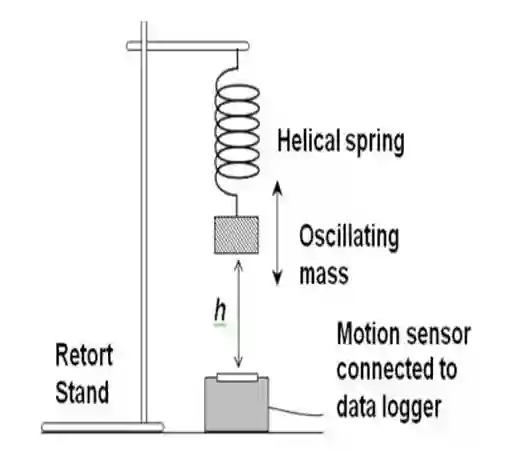
Figure: Mass oscillating vertically on a helical spring with a motion sensor
a) Name the type of oscillation shown in the diagram.
Vertical simple harmonic motion (free, undamped vertical oscillation).
b) Write the expression for the period \(T\) of vertical oscillation in terms of mass \(m\) and spring constant \(k\).
c) If the extension of the spring at equilibrium is \(h\), derive a relation between \(h\), \(g\) and \(T\).
At equilibrium the weight balances the spring force: \(mg=kh\), so \(\dfrac mk=\dfrac hg\). Substituting into the period formula:
a) What is angular simple harmonic motion? Give one example.
Angular SHM is a periodic rotational motion in which the restoring torque is directly proportional to the angular displacement from the equilibrium position and directed opposite to it: \(\tau\propto-\theta\).
Example: the balance wheel of a mechanical watch, or a torsional pendulum (a disc suspended by a twisted wire).
b) Derive the expression for the period of angular SHM in a torsional pendulum.
The restoring torque is \(\tau=-k\theta\), where \(k\) is the torsional constant. By the rotational form of Newton’s second law, \(\tau=I\alpha\). Equating:
The standard equation of angular SHM is \(\alpha=-\omega^2\theta\), so \(\omega=\sqrt{k/I}\). Since \(T=\dfrac{2\pi}{\omega}\):
c) A disc of moment of inertia \(0.05\ \mathrm{kg\,m^2}\) is suspended by a wire with a torsional constant of \(0.10\ \mathrm{N\,m\,rad^{-1}}\). Find the period of angular oscillation.
a) What is damping in oscillation? Name the types of damping.
Damping is the gradual loss of mechanical energy, and hence the reduction in amplitude, of an oscillating system due to non-conservative forces such as air resistance or internal friction.
Types: underdamping (light damping), critical damping and overdamping (heavy damping).
b) Explain what happens to the amplitude of oscillations when the frequency of a periodic driving force matches the natural frequency of the system.
This phenomenon is called resonance. When the driving frequency equals the natural frequency, the force is applied in step with the motion and keeps adding energy to the system. The amplitude increases dramatically to a maximum value, limited only by the amount of damping present.
c) A metal pendulum bob oscillates in still air. An investigator records the successive peak displacements: 1 (8.0 cm), 2 (6.0 cm), 3 (4.5 cm), 4 (3.4 cm).
(i) Describe in words how you would sketch a displacement-time graph for this pendulum.
Draw a sinusoidal wave oscillating above and below a central horizontal time axis. The peaks shrink steadily with each cycle. An exponential-decay envelope can be drawn through the peaks (8.0, 6.0, 4.5, 3.4 cm) to show that the amplitude decreases progressively, which reveals that the bob is damped.
(ii) If the undamped period is 1.6 s, will the actual period in air be exactly 1.6 s, slightly greater or slightly less? Give a reason.
The actual period will be slightly greater than 1.6 s. The resistive force opposes the motion throughout the swing and slows the bob slightly, so each cycle takes a little longer.
(iii) The pendulum now swings in thin oil instead of air. State two qualitative changes in the displacement-time graph.
a) What is resonance? Under what condition does it occur?
Resonance is the phenomenon in forced oscillations in which the amplitude of vibration becomes maximum. It occurs when the frequency of the external driving force is exactly equal to the natural frequency of the oscillating body.
b) What is the phase relation between displacement and driving force at resonance?
At resonance the velocity is in phase with the driving force, so the displacement lags behind the driving force by a phase angle of \(\dfrac{\pi}{2}\) (90°).
c) A forced oscillator has a natural frequency \(\omega_0=5\ \mathrm{rad\,s^{-1}}\). When driven by an external force of frequency \(\omega=5\ \mathrm{rad\,s^{-1}}\), the amplitude is maximum. Explain this behaviour using a graph and state the resonance condition.
Here \(\omega=\omega_0=5\ \mathrm{rad\,s^{-1}}\), so the resonance condition \(\omega_{\text{driving}}=\omega_{\text{natural}}\) is satisfied. A graph of amplitude against angular frequency \(\omega\) is a bell-like curve that peaks sharply at \(\omega=5\ \mathrm{rad\,s^{-1}}\). The amplitude is maximum there because the system absorbs maximum power from the driver when the two frequencies match.
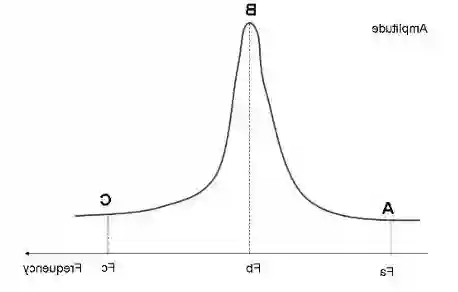
Figure: Amplitude versus driving frequency (resonance curve)
a) Name the physical phenomenon represented by the graph.
Resonance in forced oscillations.
b) Identify the frequency \(F_b\) and explain what happens to the amplitude at this frequency.
\(F_b\) is the natural frequency of the system. At this resonant frequency the driving force is in step with the natural motion of the system, so maximum energy is transferred and the amplitude reaches its peak value.
c) Compare the amplitudes at points A and C and explain why they are lower than at B.
At \(F_a\) (below resonance) and \(F_c\) (above resonance) the driving force is out of step with the natural rhythm of the system. The force sometimes works against the motion, so the average energy transfer is much smaller and the amplitudes are lower than at B.
a) Define SHM and derive the equation of motion using Hooke’s law.
SHM is oscillatory motion in which the restoring force is proportional to the displacement. By Hooke’s law \(F=-kx\), and by Newton’s second law \(F=ma=m\dfrac{d^2x}{dt^2}\). Equating:
This differential equation describes the motion, with \(\omega^2=\dfrac km\).
b) What is total mechanical energy in SHM? Derive the expression and discuss how energy varies with time.
The total mechanical energy \(E\) is the sum of kinetic energy \(K\) and potential energy \(U\). For \(x=A\sin\omega t\):
The total energy is constant. Kinetic and potential energies keep converting into each other (varying as \(\cos^2\) and \(\sin^2\) of \(\omega t\)), but their sum never changes in a frictionless system.
c) Explain why the restoring force in vertical SHM is independent of gravity.
Gravity only stretches the spring initially to create a new equilibrium point (\(mg=ke\)). When the mass is displaced further by \(x\), the net force is \(F=mg-k(e+x)\). Substituting \(mg=ke\) leaves \(F=-kx\). The constant gravitational pull is cancelled by the constant initial spring tension, so it does not appear in the restoring force that drives the oscillation.
d) Two springs with spring constants \(k_1=200\ \mathrm{N\,m^{-1}}\) and \(k_2=300\ \mathrm{N\,m^{-1}}\) are connected in parallel to a mass of 2 kg.
(i) Find the effective spring constant of the system.
(ii) Calculate the period of oscillation.
(iii) If the amplitude of motion is 0.15 m, find the maximum energy stored in the system.
(i) Find its angular velocity.
(ii) Calculate the displacement after 0.1 s from the mean position.
Taking the motion to start from the mean position, \(x=A\sin\omega t\):
The particle is back at the mean position after half a cycle.
(iii) Find its velocity and acceleration at that point.
The speed is maximum and the acceleration is zero at the mean position.
(i) Find the amplitude after 10 oscillations.
The amplitude retained per cycle is 95%, that is 0.95, so \(A_n=A_0(0.95)^n\):
(ii) How much energy remains after 10 oscillations if the initial energy is 40 J?
Energy is proportional to the square of the amplitude, \(E\propto A^2\):
4. View PDF Notes
i. Handwritten Notes
ii. Typed PDF Notes
5. Frequently Asked Questions
What is periodic motion in Class 12 Physics?
What topics are included in Chapter 2 Periodic Motion of NEB Class 12 Physics?
What is simple harmonic motion (SHM) and what are its characteristics?
What are the equations for displacement, velocity and acceleration in SHM?
What is the total energy of a particle in SHM?
What is the time period of a simple pendulum?
What is the time period of a spring-mass system?
Why is the restoring force in vertical SHM independent of gravity?
What is angular SHM and what is the period of a torsional pendulum?
What is damping in oscillations and what are its types?
What is resonance and when does it occur?
What happens to the period of a pendulum on the moon?
Where can I get Class 12 Physics Chapter 2 Periodic Motion notes in PDF?
Students also search for: