
Class 10 Optional Mathematics Trigonometry
Exercise 7.1 Compound Angles, Exercise 7.2 Multiple Angles, Exercise 7.3 Submultiple Angles, Exercise 7.4 Transformation of Products and Sums, Exercise 7.5 Conditional Identities, Exercise 7.6 Heights and Distances
257 solved questions with English and Nepali questions, step by step solutions, figures and frequently asked questions for the Nepal Grade 10 SEE.
1. Class 10 Optional Mathematics Trigonometry: Unit Overview and Key Formulas
Unit 7: Trigonometry (Optional Mathematics, Grade 10, SEE, Nepal) • Exercise 7.1 Compound Angles, Exercise 7.2 Multiple Angles, Exercise 7.3 Submultiple Angles, Exercise 7.4 Transformation of Products and Sums, Exercise 7.5 Conditional Identities, Exercise 7.6 Heights and Distances
Class 10 Optional Mathematics Trigonometry is the seventh unit of the course prescribed by the Curriculum Development Centre (CDC), Nepal. This page solves every question of Exercises 7.1 to 7.6. Every question is written as in the textbook: the main question first (Q.1, Q.2, Q.3 …) with its parts (a, b, c …) listed under it and the Nepali question in brackets. Multiple choice solutions also have Nepali in brackets, and the other solutions are in English because the steps and symbols are the same in both languages.
- Compound angles: formulas for the sine, cosine and tangent of \(A+B\) and \(A-B\).
- Exact values: write \(15^\circ=45^\circ-30^\circ\), \(75^\circ=45^\circ+30^\circ\), \(105^\circ=60^\circ+45^\circ\) and use standard values.
- Multiple angles (Exercise 7.2): put \(B=A\) to get the double angle formulas, then expand \(A+2A\) for the triple angle formulas.
- Submultiple angles (Exercise 7.3): replace \(A\) by \(\frac A2\) in the double angle formulas (or by \(\frac\theta3\) in the triple angle formulas) to express \(\sin A\), \(\cos A\), \(\tan A\) through \(\frac A2\), and use \(\cos A=1-2\sin^2\frac A2=2\cos^2\frac A2-1\) to find \(\sin\frac A2\) or \(\cos\frac A2\).
- Transformation of products and sums (Exercise 7.4): add or subtract the compound angle formulas to turn a product such as \(2\sin A\cos B\) into a sum, and put \(A=\frac{C+D}{2}\), \(B=\frac{C-D}{2}\) to turn a sum such as \(\sin C+\sin D\) into a product.
- Conditional identities (Exercise 7.5): an identity such as \(\sin2A+\sin2B+\sin2C=4\sin A\sin B\sin C\) is true only when a condition such as \(A+B+C=180^\circ\) holds. Use \(A+B=180^\circ-C\), so \(\sin(A+B)=\sin C\) and \(\cos(A+B)=-\cos C\).
- Heights and distances (Exercise 7.6): draw a right-angled triangle for each observation, mark the angle of elevation or depression from the horizontal, and use \(\tan\theta=\dfrac{\text{height}}{\text{distance}}\). With two observations, write both distances in terms of the height and use the difference or sum.
- Identities: use \(A+B=45^\circ\) (then \(\tan(A+B)=1\)), divide by \(\cos\), and expand \(A+B+C\) step by step.
Key formulas to remember
For more chapters, visit the complete SEE Class 10 Optional Mathematics notes. You can also read about trigonometric identities for extra understanding.
2. Exercise 7.1 Compound Angles: Class 10 Optional Mathematics Trigonometry
Exercise 7.1 Compound Angles: Multiple Choice Questions (बहुवैकल्पिक प्रश्न)
Q.1 Tick (✓) the correct option for the given questions:
(दिइएका प्रश्नहरूको उपयुक्त विकल्पमा ठिक चिह्न (✓) लगाउनुहोस् : )
A. Which one is equal to \(\sin(A+B)\)? (तलका मध्ये कुन \(\sin(A+B)\) सँग बराबर हुन्छ ?)
- a) \(\sin A\cos B-\cos A\sin B\)
- b) \(\sin A\cos B+\cos A\sin B\)
- c) \(\cos A\cos B-\sin A\sin B\)
- d) \(\sin A\cos A+\cos B\sin B\)
Correct Answer: b) \(\sin A\cos B+\cos A\sin B\)
Solution:
- By the compound angle formula for the sine of a sum:
(योगफलको साइनको सूत्र अनुसार \(\sin(A+B)=\sin A\cos B+\cos A\sin B\) हुन्छ ।)
B. Which is equal to \(\cos(A-B)\)? (तलका मध्ये कुन \(\cos(A-B)\) सँग बराबर हुन्छ ?)
- a) \(\sin A\cos B-\cos A\sin B\)
- b) \(\sin A\cos B+\cos A\sin B\)
- c) \(\cos A\cos B+\sin A\sin B\)
- d) \(\sin A\cos A+\cos B\sin B\)
Correct Answer: c) \(\cos A\cos B+\sin A\sin B\)
Solution:
- By the compound angle formula for the cosine of a difference:
(अन्तरको कोसाइनको सूत्र अनुसार \(\cos(A-B)=\cos A\cos B+\sin A\sin B\) हुन्छ ।)
C. If \(A=30^\circ\) and \(B=60^\circ\), what is the value of \(\sin(A+B)\)? (यदि \(A=30^\circ\) र \(B=60^\circ\) भए \(\sin(A+B)\) को मान कति हुन्छ ?)
- a) \(0\)
- b) \(1\)
- c) \(\frac12\)
- d) \(\frac{\sqrt3}{2}\)
Correct Answer: b) \(1\)
Solution:
- Here, \(A+B=30^\circ+60^\circ=90^\circ\).
(\(A+B=90^\circ\) भएकाले \(\sin90^\circ=1\) हुन्छ ।)
D. If \(\sin(A+B)=\frac12\) and \(B=30^\circ\), what is the value of \(A\)? (यदि \(\sin(A+B)=\frac12\) र \(B=30^\circ\) भए \(A\) को मान कति हुन्छ ?)
- a) \(0^\circ\)
- b) \(30^\circ\)
- c) \(45^\circ\)
- d) \(60^\circ\)
Correct Answer: a) \(0^\circ\)
Solution:
- Since \(\sin30^\circ=\frac12\), we get \(A+B=30^\circ\).
(\(\sin(A+B)=\sin30^\circ\) भएकाले \(A+B=30^\circ\) र \(A=0^\circ\) हुन्छ ।)
E. Which of the following relations is correct? (तलका सम्बन्धहरू मध्ये कुन सही छ ?)
- a) \(\tan(A+B)=\tan A+\tan B\)
- b) \(\tan(A+B)=\frac{\tan A-\tan B}{1+\tan A\tan B}\)
- c) \(\tan(A+B)=\frac{\tan A+\tan B}{1+\tan A\tan B}\)
- d) \(\tan(A+B)=\frac{\tan A+\tan B}{1-\tan A\tan B}\)
Correct Answer: d) \(\tan(A+B)=\frac{\tan A+\tan B}{1-\tan A\tan B}\)
Solution:
- The tangent of a sum is
(\(\tan(A+B)=\frac{\tan A+\tan B}{1-\tan A\tan B}\) हुन्छ ।)
Exercise 7.1 Compound Angles: Written Questions (लेख्ने प्रश्न)
Q.2 Prove that: (Without using calculator or table)
- a. \(\cos15^\circ=\frac{\sqrt3+1}{2\sqrt2}\)
- b. \(\sin75^\circ=\frac{\sqrt3+1}{2\sqrt2}\)
- c. \(\tan75^\circ=2+\sqrt3\)
- d. \(\cos105^\circ=\frac{1-\sqrt3}{2\sqrt2}\)
- e. \(\tan105^\circ=-(2+\sqrt3)\)
- f. \(\cot15^\circ=2+\sqrt3\)
(क्याल्कुलेटर वा तालिका प्रयोग नगरी सिद्ध गर्नुहोस् : )
Here, \(15^\circ=45^\circ-30^\circ\) and \(\cos(A-B)=\cos A\cos B+\sin A\sin B\).
\[\begin{aligned}\text{L.H.S.} &= \cos(45^\circ-30^\circ) \\ &= \cos45^\circ\cos30^\circ+\sin45^\circ\sin30^\circ \\ &= \frac{1}{\sqrt2}\cdot\frac{\sqrt3}{2}+\frac{1}{\sqrt2}\cdot\frac12 \\ &= \frac{\sqrt3+1}{2\sqrt2} \\ &= \text{R.H.S.}\end{aligned}\]Here, \(75^\circ=45^\circ+30^\circ\) and \(\sin(A+B)=\sin A\cos B+\cos A\sin B\).
\[\begin{aligned}\text{L.H.S.} &= \sin(45^\circ+30^\circ) \\ &= \sin45^\circ\cos30^\circ+\cos45^\circ\sin30^\circ \\ &= \frac{1}{\sqrt2}\cdot\frac{\sqrt3}{2}+\frac{1}{\sqrt2}\cdot\frac12 \\ &= \frac{\sqrt3+1}{2\sqrt2} \\ &= \text{R.H.S.}\end{aligned}\]Here, \(75^\circ=45^\circ+30^\circ\).
\[\begin{aligned}\text{L.H.S.} &= \frac{\tan45^\circ+\tan30^\circ}{1-\tan45^\circ\tan30^\circ} \\ &= \frac{1+\frac{1}{\sqrt3}}{1-\frac{1}{\sqrt3}} \\ &= \frac{\sqrt3+1}{\sqrt3-1} \\ &= \frac{(\sqrt3+1)^2}{(\sqrt3-1)(\sqrt3+1)} \\ &= \frac{4+2\sqrt3}{2} \\ &= 2+\sqrt3 \\ &= \text{R.H.S.}\end{aligned}\]Here, \(105^\circ=60^\circ+45^\circ\) and \(\cos(A+B)=\cos A\cos B-\sin A\sin B\).
\[\begin{aligned}\text{L.H.S.} &= \cos60^\circ\cos45^\circ-\sin60^\circ\sin45^\circ \\ &= \frac12\cdot\frac{1}{\sqrt2}-\frac{\sqrt3}{2}\cdot\frac{1}{\sqrt2} \\ &= \frac{1-\sqrt3}{2\sqrt2} \\ &= \text{R.H.S.}\end{aligned}\]Here, \(105^\circ=60^\circ+45^\circ\).
\[\begin{aligned}\text{L.H.S.} &= \frac{\tan60^\circ+\tan45^\circ}{1-\tan60^\circ\tan45^\circ} \\ &= \frac{\sqrt3+1}{1-\sqrt3} \\ &= \frac{(\sqrt3+1)(1+\sqrt3)}{(1-\sqrt3)(1+\sqrt3)} \\ &= \frac{4+2\sqrt3}{-2} \\ &= -(2+\sqrt3) \\ &= \text{R.H.S.}\end{aligned}\]Here, \(\cot15^\circ=\dfrac{1}{\tan15^\circ}\) and \(15^\circ=45^\circ-30^\circ\).
\[\begin{aligned}\tan15^\circ &= \frac{1-\frac{1}{\sqrt3}}{1+\frac{1}{\sqrt3}} \\ &= \frac{\sqrt3-1}{\sqrt3+1}\end{aligned}\]\[\begin{aligned}\text{L.H.S.} &= \cot15^\circ \\ &= \frac{\sqrt3+1}{\sqrt3-1} \\ &= \frac{(\sqrt3+1)^2}{3-1} \\ &= 2+\sqrt3 \\ &= \text{R.H.S.}\end{aligned}\]Q.3 If \(\sin A=\frac35\) and \(\cos B=\frac{12}{13}\), find the value of:
- a. \(\sin(A+B)\)
- b. \(\cos(A+B)\)
- c. \(\sin(A-B)\)
- d. \(\cos(A-B)\)
- e. \(\tan(A+B)\)
- f. \(\cot(A-B)\)
(यदि \(\sin A=\frac35\) र \(\cos B=\frac{12}{13}\) भए मान पत्ता लगाउनुहोस् : )
Here, \(\sin A=\frac35\) and \(\cos B=\frac{12}{13}\) (taking \(A\) and \(B\) acute).
\[\begin{aligned}\cos A &= \sqrt{1-\sin^2A} \\ &= \sqrt{1-\frac{9}{25}} \\ &= \frac45,\qquad \sin B \\ &= \sqrt{1-\cos^2B} \\ &= \sqrt{1-\frac{144}{169}} \\ &= \frac{5}{13}\end{aligned}\]\[\begin{aligned}\sin(A+B) &= \sin A\cos B+\cos A\sin B \\ &= \frac35\cdot\frac{12}{13}+\frac45\cdot\frac{5}{13} \\ &= \frac{36}{65}+\frac{20}{65} \\ &= \frac{56}{65}\end{aligned}\]Here, \(\sin A=\frac35,\ \cos A=\frac45,\ \cos B=\frac{12}{13},\ \sin B=\frac{5}{13}\) (found in part (a)).
\[\begin{aligned}\cos(A+B) &= \cos A\cos B-\sin A\sin B \\ &= \frac45\cdot\frac{12}{13}-\frac35\cdot\frac{5}{13} \\ &= \frac{48}{65}-\frac{15}{65} \\ &= \frac{33}{65}\end{aligned}\]Here, \(\sin A=\frac35,\ \cos A=\frac45,\ \cos B=\frac{12}{13},\ \sin B=\frac{5}{13}\) (found in part (a)).
\[\begin{aligned}\sin(A-B) &= \sin A\cos B-\cos A\sin B \\ &= \frac35\cdot\frac{12}{13}-\frac45\cdot\frac{5}{13} \\ &= \frac{36}{65}-\frac{20}{65} \\ &= \frac{16}{65}\end{aligned}\]Here, \(\sin A=\frac35,\ \cos A=\frac45,\ \cos B=\frac{12}{13},\ \sin B=\frac{5}{13}\) (found in part (a)).
\[\begin{aligned}\cos(A-B) &= \cos A\cos B+\sin A\sin B \\ &= \frac45\cdot\frac{12}{13}+\frac35\cdot\frac{5}{13} \\ &= \frac{48}{65}+\frac{15}{65} \\ &= \frac{63}{65}\end{aligned}\]Here, \(\sin A=\frac35,\ \cos A=\frac45,\ \cos B=\frac{12}{13},\ \sin B=\frac{5}{13}\) (found in part (a)).
Using parts (a) and (b):
\[\begin{aligned}\tan(A+B) &= \frac{\sin(A+B)}{\cos(A+B)} \\ &= \frac{56/65}{33/65} \\ &= \frac{56}{33}\end{aligned}\]Here, \(\sin A=\frac35,\ \cos A=\frac45,\ \cos B=\frac{12}{13},\ \sin B=\frac{5}{13}\) (found in part (a)).
Using parts (c) and (d):
\[\begin{aligned}\cot(A-B) &= \frac{\cos(A-B)}{\sin(A-B)} \\ &= \frac{63/65}{16/65} \\ &= \frac{63}{16}\end{aligned}\]Q.4 Prove that:
- a. \(\sin(A+B)+\sin(A-B)=2\sin A\cos B\)
- b. \(\sin(A+B)-\sin(A-B)=2\cos A\sin B\)
- c. \(\cos(A+B)+\cos(A-B)=2\cos A\cos B\)
- d. \(\cos(A-B)-\cos(A+B)=2\sin A\sin B\)
(प्रमाणित गर्नुहोस् : )
Q.5 Prove that: (Without using calculator or table)
- a. \(\sin75^\circ-\sin15^\circ=\frac{1}{\sqrt2}\)
- b. \(\cos15^\circ-\sin75^\circ=0\)
- c. \(\sin105^\circ-\cos75^\circ=\frac{1}{\sqrt2}\)
- d. \(\cos105^\circ+\cos15^\circ=\frac{1}{\sqrt2}\)
- e. \(\tan15^\circ+\cot15^\circ=4\)
- f. \(\cos18^\circ-\sin18^\circ=\sqrt2\sin27^\circ\)
- g. \(\sin35^\circ+\cos35^\circ=\sqrt2\cos10^\circ\)
- h. \(\sqrt3\cos20^\circ+\sin20^\circ=2\sin80^\circ\)
(क्याल्कुलेटर वा तालिका प्रयोग नगरी सिद्ध गर्नुहोस् : )
From Question 2, \(\sin75^\circ=\cos15^\circ=\frac{\sqrt3+1}{2\sqrt2}\) and \(\sin15^\circ=\cos75^\circ=\frac{\sqrt3-1}{2\sqrt2}\).
\[\begin{aligned}\text{L.H.S.} &= \frac{\sqrt3+1}{2\sqrt2}-\frac{\sqrt3-1}{2\sqrt2} \\ &= \frac{2}{2\sqrt2} \\ &= \frac{1}{\sqrt2} \\ &= \text{R.H.S.}\end{aligned}\]Here, \(\sin105^\circ=\sin(60^\circ+45^\circ)=\frac{\sqrt3+1}{2\sqrt2}\) and \(\cos75^\circ=\cos(45^\circ+30^\circ)=\frac{\sqrt3-1}{2\sqrt2}\).
\[\begin{aligned}\text{L.H.S.} &= \frac{\sqrt3+1}{2\sqrt2}-\frac{\sqrt3-1}{2\sqrt2} \\ &= \frac{2}{2\sqrt2} \\ &= \frac{1}{\sqrt2} \\ &= \text{R.H.S.}\end{aligned}\]From Question 2, \(\cos105^\circ=\frac{1-\sqrt3}{2\sqrt2}\) and \(\cos15^\circ=\frac{\sqrt3+1}{2\sqrt2}\).
\[\begin{aligned}\text{L.H.S.} &= \frac{1-\sqrt3}{2\sqrt2}+\frac{\sqrt3+1}{2\sqrt2} \\ &= \frac{2}{2\sqrt2} \\ &= \frac{1}{\sqrt2} \\ &= \text{R.H.S.}\end{aligned}\]Here, \(\cot15^\circ=2+\sqrt3\) (Question 2f) and \(\tan15^\circ=\dfrac{1}{2+\sqrt3}=\dfrac{2-\sqrt3}{(2+\sqrt3)(2-\sqrt3)}=2-\sqrt3\).
\[\begin{aligned}\text{L.H.S.} &= (2-\sqrt3)+(2+\sqrt3) \\ &= 4 \\ &= \text{R.H.S.}\end{aligned}\]Q.6 Prove that:
- a. \(\sin(25^\circ+\alpha)\cos(65^\circ-\alpha)+\cos(25^\circ+\alpha)\sin(65^\circ-\alpha)=1\)
- b. \(\cos(25^\circ+\alpha)\cos(65^\circ+\alpha)-\sin(25^\circ+\alpha)\sin(65^\circ+\alpha)=-\sin2\alpha\)
- c. \(\cos(60^\circ+\beta)-\cos\beta+\cos(60^\circ-\beta)=0\)
- d. \(\frac{\tan(45^\circ+\phi)-\tan\phi}{1+\tan(45^\circ+\phi)\tan\phi}=1\)
(प्रमाणित गर्नुहोस् : )
Let \(A=25^\circ+\alpha\) and \(B=65^\circ-\alpha\).
\[\begin{aligned}\text{L.H.S.} &= \sin A\cos B+\cos A\sin B \\ &= \sin(A+B) \\ &= \sin(25^\circ+\alpha+65^\circ-\alpha) \\ &= \sin90^\circ \\ &= 1 \\ &= \text{R.H.S.}\end{aligned}\]Let \(A=25^\circ+\alpha\) and \(B=65^\circ+\alpha\).
\[\begin{aligned}\text{L.H.S.} &= \cos A\cos B-\sin A\sin B \\ &= \cos(A+B) \\ &= \cos(90^\circ+2\alpha) \\ &= -\sin2\alpha \\ &= \text{R.H.S.}\end{aligned}\]Using \(\cos(A+B)+\cos(A-B)=2\cos A\cos B\):
\[\begin{aligned}\text{L.H.S.} &= \cos(60^\circ+\beta)+\cos(60^\circ-\beta)-\cos\beta \\ &= 2\cos60^\circ\cos\beta-\cos\beta \\ &= 2\left(\frac12\right)\cos\beta-\cos\beta \\ &= 0 \\ &= \text{R.H.S.}\end{aligned}\]Using \(\dfrac{\tan A-\tan B}{1+\tan A\tan B}=\tan(A-B)\) with \(A=45^\circ+\phi\) and \(B=\phi\):
\[\begin{aligned}\text{L.H.S.} &= \tan((45^\circ+\phi)-\phi) \\ &= \tan45^\circ \\ &= 1 \\ &= \text{R.H.S.}\end{aligned}\]Q.7 If \(A+B=\frac{\pi}{4}^c\), prove that:
- a. \(\tan A+\tan B+\tan A\tan B=1\)
- b. \((1+\tan A)(1+\tan B)=2\)
(यदि \(A+B=\frac{\pi}{4}^c\) भए प्रमाणित गर्नुहोस् : )
Here, \(A+B=45^\circ\). Taking \(\tan\) on both sides:
\[\begin{aligned}& \tan(A+B)=\tan45^\circ \\ &\implies \frac{\tan A+\tan B}{1-\tan A\tan B}=1 \\ &\implies \tan A+\tan B=1-\tan A\tan B\end{aligned}\]That is, \(\tan A+\tan B+\tan A\tan B=1\).
From part (a), \(\tan A+\tan B+\tan A\tan B=1\). Add \(1\) to both sides:
\[\begin{aligned}& 1+\tan A+\tan B+\tan A\tan B=2 \\ &\implies (1+\tan A)+\tan B(1+\tan A)=2 \\ &\implies (1+\tan A)(1+\tan B)=2\end{aligned}\]Here,
\[\begin{aligned}\tan(X+Y) &= \frac{\tan X+\tan Y}{1-\tan X\tan Y} \\ &= \frac{\frac23+\frac15}{1-\frac23\cdot\frac15} \\ &= \frac{13/15}{13/15} \\ &= 1\end{aligned}\]Since \(\tan(X+Y)=1=\tan45^\circ\), we get \(X+Y=45^\circ\).
Here, \(\tan B=\frac1m\) gives \(\cot B=m\). So
\[\begin{aligned}& \tan A=m=\cot B=\tan\left(\frac{\pi}{2}-B\right) \\ &\implies A=\frac{\pi}{2}-B \\ &\implies A+B=\frac{\pi}{2}\end{aligned}\]Q.9 Prove that:
- a. \(\frac{\cos35^\circ-\sin35^\circ}{\cos35^\circ+\sin35^\circ}=\tan10^\circ\)
- b. \(\frac{\cos17^\circ+\sin17^\circ}{\cos17^\circ-\sin17^\circ}=\tan62^\circ\)
- c. \(\frac{\cos8^\circ+\sin8^\circ}{\cos8^\circ-\sin8^\circ}=\cot37^\circ\)
- d. \(\frac{\cos10^\circ-\sin10^\circ}{\cos10^\circ+\sin10^\circ}=\tan35^\circ\)
(प्रमाणित गर्नुहोस् : )
Divide the numerator and denominator by \(\cos35^\circ\):
\[\begin{aligned}\text{L.H.S.} &= \frac{1-\tan35^\circ}{1+\tan35^\circ} \\ &= \frac{\tan45^\circ-\tan35^\circ}{1+\tan45^\circ\tan35^\circ} \\ &= \tan(45^\circ-35^\circ) \\ &= \tan10^\circ \\ &= \text{R.H.S.}\end{aligned}\]Divide the numerator and denominator by \(\cos17^\circ\):
\[\begin{aligned}\text{L.H.S.} &= \frac{1+\tan17^\circ}{1-\tan17^\circ} \\ &= \frac{\tan45^\circ+\tan17^\circ}{1-\tan45^\circ\tan17^\circ} \\ &= \tan(45^\circ+17^\circ) \\ &= \tan62^\circ \\ &= \text{R.H.S.}\end{aligned}\]Divide the numerator and denominator by \(\cos8^\circ\):
\[\begin{aligned}\text{L.H.S.} &= \frac{1+\tan8^\circ}{1-\tan8^\circ} \\ &= \tan(45^\circ+8^\circ) \\ &= \tan53^\circ \\ &= \tan(90^\circ-37^\circ) \\ &= \cot37^\circ \\ &= \text{R.H.S.}\end{aligned}\]Divide the numerator and denominator by \(\cos10^\circ\):
\[\begin{aligned}\text{L.H.S.} &= \frac{1-\tan10^\circ}{1+\tan10^\circ} \\ &= \tan(45^\circ-10^\circ) \\ &= \tan35^\circ \\ &= \text{R.H.S.}\end{aligned}\]Q.10 Prove that:
- a. \(\frac{\tan5A-\tan4A}{1+\tan5A\tan4A}=\tan A\)
- b. \(\frac{\tan7A-\tan4A}{1+\tan7A\tan4A}=\tan3A\)
- c. \(\frac{\tan(A+B)-\tan B}{1+\tan(A+B)\tan B}=\tan A\)
- d. \(\tan(A+B)\tan(A-B)=\frac{\tan^2A-\tan^2B}{1-\tan^2A\tan^2B}\)
- e. \(\frac{\sin(A+B)}{\sin A\sin B}=\cot B+\cot A\)
- f. \(\frac{\cos(A+B)}{\sin A\sin B}=\cot A\cot B-1\)
(प्रमाणित गर्नुहोस् : )
Q.11 Prove that:
- a. \(\tan25^\circ+\tan20^\circ+\tan25^\circ\tan20^\circ=1\)
- b. \(1-\tan27^\circ-\tan18^\circ=\tan27^\circ\tan18^\circ\)
- c. \(\tan65^\circ-\tan20^\circ=1+\tan65^\circ\tan20^\circ\)
- d. \(1+\cot18^\circ+\cot27^\circ=\cot18^\circ\cot27^\circ\)
(प्रमाणित गर्नुहोस् : )
Since \(25^\circ+20^\circ=45^\circ\), take \(\tan\) on both sides:
\[\frac{\tan25^\circ+\tan20^\circ}{1-\tan25^\circ\tan20^\circ}=\tan45^\circ=1 \implies \tan25^\circ+\tan20^\circ=1-\tan25^\circ\tan20^\circ\]Hence \(\tan25^\circ+\tan20^\circ+\tan25^\circ\tan20^\circ=1\).
Since \(27^\circ+18^\circ=45^\circ\):
\[\begin{aligned}& \tan(27^\circ+18^\circ)=1 \\ &\implies \tan27^\circ+\tan18^\circ=1-\tan27^\circ\tan18^\circ \\ &\implies 1-\tan27^\circ-\tan18^\circ=\tan27^\circ\tan18^\circ\end{aligned}\]Since \(65^\circ-20^\circ=45^\circ\):
\[\begin{aligned}& \tan(65^\circ-20^\circ)=1 \\ &\implies \frac{\tan65^\circ-\tan20^\circ}{1+\tan65^\circ\tan20^\circ}=1 \\ &\implies \tan65^\circ-\tan20^\circ=1+\tan65^\circ\tan20^\circ\end{aligned}\]Since \(18^\circ+27^\circ=45^\circ\), \(\cot(18^\circ+27^\circ)=1\):
\[\begin{aligned}& \frac{\cot18^\circ\cot27^\circ-1}{\cot18^\circ+\cot27^\circ}=1 \\ &\implies \cot18^\circ\cot27^\circ-1=\cot18^\circ+\cot27^\circ \\ &\implies 1+\cot18^\circ+\cot27^\circ=\cot18^\circ\cot27^\circ\end{aligned}\]Q.12 Prove that:
- a. \(\tan50^\circ+\tan60^\circ+\tan70^\circ=\tan50^\circ\tan60^\circ\tan70^\circ\)
- b. \(\tan10A-\tan6A-\tan4A=\tan10A\tan6A\tan4A\)
- c. \(\tan20^\circ\tan30^\circ+\tan30^\circ\tan40^\circ+\tan40^\circ\tan20^\circ=1\)
- d. \(\cot5A\cot4A-\cot9A\cot5A-\cot9A\cot4A=1\)
(प्रमाणित गर्नुहोस् : )
Since \(50^\circ+60^\circ+70^\circ=180^\circ\), we have \(50^\circ+60^\circ=180^\circ-70^\circ\).
\[\tan(50^\circ+60^\circ)=-\tan70^\circ \implies \frac{\tan50^\circ+\tan60^\circ}{1-\tan50^\circ\tan60^\circ}=-\tan70^\circ\]\[\tan50^\circ+\tan60^\circ=-\tan70^\circ+\tan50^\circ\tan60^\circ\tan70^\circ \implies \tan50^\circ+\tan60^\circ+\tan70^\circ=\tan50^\circ\tan60^\circ\tan70^\circ\]Since \(10A=6A+4A\):
\[\tan10A=\frac{\tan6A+\tan4A}{1-\tan6A\tan4A} \implies \tan10A-\tan10A\tan6A\tan4A=\tan6A+\tan4A\]\[\tan10A-\tan6A-\tan4A=\tan10A\tan6A\tan4A\]Since \(20^\circ+40^\circ=90^\circ-30^\circ\):
\[\tan(20^\circ+40^\circ)=\cot30^\circ=\frac{1}{\tan30^\circ} \implies \frac{\tan20^\circ+\tan40^\circ}{1-\tan20^\circ\tan40^\circ}=\frac{1}{\tan30^\circ}\]\[\tan20^\circ\tan30^\circ+\tan30^\circ\tan40^\circ=1-\tan20^\circ\tan40^\circ\]Hence \(\tan20^\circ\tan30^\circ+\tan30^\circ\tan40^\circ+\tan40^\circ\tan20^\circ=1\).
Since \(9A=5A+4A\):
\[\cot9A=\frac{\cot5A\cot4A-1}{\cot5A+\cot4A} \implies \cot9A\cot5A+\cot9A\cot4A=\cot5A\cot4A-1\]Hence \(\cot5A\cot4A-\cot9A\cot5A-\cot9A\cot4A=1\).
Q.13 Prove that:
- a. \(\tan50^\circ-\tan40^\circ=2\tan10^\circ\)
- b. \(\tan50^\circ=2\tan30^\circ+\tan20^\circ\)
(प्रमाणित गर्नुहोस् : )
Here \(\cos40^\circ=\sin50^\circ\) and \(\sin100^\circ=\sin(90^\circ+10^\circ)=\cos10^\circ\).
Note on the printed question
As printed this relation is not true: \(\tan50^\circ\approx1.1918\) but \(2\tan30^\circ+\tan20^\circ\approx1.5187\). The relation that follows from part (a) is \(\tan50^\circ=\tan40^\circ+2\tan10^\circ\), which is probably what the textbook intends.
Proof of the corrected relation
From part (a), \(\tan50^\circ-\tan40^\circ=2\tan10^\circ\), so
\[\tan50^\circ=\tan40^\circ+2\tan10^\circ\]Q.14 Prove that:
- a. \(\frac{\sin(\beta+\gamma)}{\sin(\beta-\gamma)}=\frac{\tan\beta+\tan\gamma}{\tan\beta-\tan\gamma}\)
- b. \(\frac{\sin(A+B)\sin(A-B)}{\cos^2A\cos^2B}=\tan^2A-\tan^2B\)
- c. \(\frac{\sin(A+B)+\sin(A-B)}{\cos(A+B)+\cos(A-B)}=\tan A\)
(प्रमाणित गर्नुहोस् : )
Divide the numerator and denominator by \(\cos\beta\cos\gamma\):
\[\begin{aligned}\text{L.H.S.} &= \frac{\sin\beta\cos\gamma+\cos\beta\sin\gamma}{\sin\beta\cos\gamma-\cos\beta\sin\gamma} \\ &= \frac{\tan\beta+\tan\gamma}{\tan\beta-\tan\gamma} \\ &= \text{R.H.S.}\end{aligned}\]Here \(\sin(A+B)\sin(A-B)=\sin^2A\cos^2B-\cos^2A\sin^2B=\sin^2A-\sin^2B\).
Using Question 4(a) and 4(c):
\[\begin{aligned}\text{L.H.S.} &= \frac{2\sin A\cos B}{2\cos A\cos B} \\ &= \frac{\sin A}{\cos A} \\ &= \tan A \\ &= \text{R.H.S.}\end{aligned}\]Q.15 Prove that:
- a. \(\frac{\sin(A-B)}{\cos A\cos B}+\frac{\sin(B-C)}{\cos B\cos C}+\frac{\sin(C-A)}{\cos C\cos A}=0\)
- b. \(\sin(A+B+C)=\cos A\cos B\cos C(\tan A+\tan B+\tan C-\tan A\tan B\tan C)\)
- c. \(\cos(A+B+C)=\cos A\cos B\cos C(1-\tan A\tan B-\tan B\tan C-\tan C\tan A)\)
- d. \(\tan(A+B+C)=\frac{\tan A+\tan B+\tan C-\tan A\tan B\tan C}{1-\tan A\tan B-\tan B\tan C-\tan C\tan A}\)
(प्रमाणित गर्नुहोस् : )
Here, \(\dfrac{\sin(A-B)}{\cos A\cos B}=\dfrac{\sin A\cos B-\cos A\sin B}{\cos A\cos B}=\tan A-\tan B\). Similarly the other two terms are \(\tan B-\tan C\) and \(\tan C-\tan A\).
\[\begin{aligned}\text{L.H.S.} &= (\tan A-\tan B)+(\tan B-\tan C)+(\tan C-\tan A) \\ &= 0 \\ &= \text{R.H.S.}\end{aligned}\]Here,
\[\begin{aligned}\sin(A+B+C) &= \sin(A+B)\cos C+\cos(A+B)\sin C \\ &= (\sin A\cos B+\cos A\sin B)\cos C+(\cos A\cos B-\sin A\sin B)\sin C \\ &= \sin A\cos B\cos C+\cos A\sin B\cos C+\cos A\cos B\sin C-\sin A\sin B\sin C \\ &= \cos A\cos B\cos C\left(\tan A+\tan B+\tan C-\tan A\tan B\tan C\right)\end{aligned}\](taking \(\cos A\cos B\cos C\) common).
Here,
\[\begin{aligned}\cos(A+B+C) &= \cos(A+B)\cos C-\sin(A+B)\sin C \\ &= (\cos A\cos B-\sin A\sin B)\cos C-(\sin A\cos B+\cos A\sin B)\sin C \\ &= \cos A\cos B\cos C-\sin A\sin B\cos C-\sin A\cos B\sin C-\cos A\sin B\sin C \\ &= \cos A\cos B\cos C(1-\tan A\tan B-\tan C\tan A-\tan B\tan C)\end{aligned}\](taking \(\cos A\cos B\cos C\) common).
Using parts (b) and (c):
\[\begin{aligned}\text{L.H.S.} &= \tan(A+B+C) \\ &= \frac{\sin(A+B+C)}{\cos(A+B+C)} \\ &= \frac{\cos A\cos B\cos C(\tan A+\tan B+\tan C-\tan A\tan B\tan C)}{\cos A\cos B\cos C(1-\tan A\tan B-\tan B\tan C-\tan C\tan A)} \\ &= \frac{\tan A+\tan B+\tan C-\tan A\tan B\tan C}{1-\tan A\tan B-\tan B\tan C-\tan C\tan A} \\ &= \text{R.H.S.}\end{aligned}\]1. A. b B. c C. b D. a E. d
3. \(\sin(A+B)=\frac{56}{65}\), \(\cos(A+B)=\frac{33}{65}\), \(\sin(A-B)=\frac{16}{65}\), \(\cos(A-B)=\frac{63}{65}\), \(\tan(A+B)=\frac{56}{33}\), \(\cot(A-B)=\frac{63}{16}\)
2, 4–15. Proved (see the note for Question 13b)
3. Exercise 7.2 Multiple Angles: Class 10 Optional Mathematics Trigonometry
Exercise 7.2 Multiple Angles: Multiple Choice Questions (बहुवैकल्पिक प्रश्न)
Q.1 Tick (✓) the correct option for the given questions:
(दिइएका प्रश्नहरूको उपयुक्त विकल्पमा ठिक चिह्न (✓) लगाउनुहोस् : )
A. Which of the following trigonometric expressions is equal to \(\cos2A\)? (तलका मध्ये कुन \(\cos2A\) सँग बराबर हुन्छ ?)
- a) \(\cos^2A+\sin^2A\)
- b) \(\cos^2A-\sin^2A\)
- c) \(1-2\cos^2A\)
- d) \(2\sin^2A-1\)
Correct Answer: b) \(\cos^2A-\sin^2A\)
Solution:
- Put \(B=A\) in \(\cos(A+B)=\cos A\cos B-\sin A\sin B\).
(\(\cos(A+B)\) मा \(B=A\) राख्दा \(\cos2A=\cos^2A-\sin^2A\) हुन्छ ।)
B. Which of the following trigonometric expressions is equal to \(\sin3\theta\)? (तलका मध्ये कुन \(\sin3\theta\) सँग बराबर हुन्छ ?)
- a) \(4\sin\theta-3\sin^3\theta\)
- b) \(4\sin^3\theta-3\sin\theta\)
- c) \(3\sin\theta-4\sin^3\theta\)
- d) \(3\sin\theta-4\sin^4\theta\)
Correct Answer: c) \(3\sin\theta-4\sin^3\theta\)
Solution:
- Expand \(\sin(\theta+2\theta)\).
(\(\sin3\theta=3\sin\theta-4\sin^3\theta\) हुन्छ ।)
C. If \(A=30^\circ\), what is the value of \(\sin2A\)? (यदि \(A=30^\circ\) भए \(\sin2A\) को मान कति हुन्छ ?)
- a) \(0\)
- b) \(1\)
- c) \(\frac12\)
- d) \(\frac{\sqrt3}{2}\)
Correct Answer: d) \(\frac{\sqrt3}{2}\)
Solution:
- Here, \(\sin2A=\sin(2\times30^\circ)=\sin60^\circ=\frac{\sqrt3}{2}\).
(\(\sin2A=\sin60^\circ=\frac{\sqrt3}{2}\) हुन्छ ।)
D. What should be the value of \(A\) when \(\cos3A=-1\)? (\(\cos3A=-1\) हुँदा \(A\) को मान कति हुनुपर्छ ?)
- a) \(0^\circ\)
- b) \(30^\circ\)
- c) \(15^\circ\)
- d) \(60^\circ\)
Correct Answer: d) \(60^\circ\)
Solution:
- Since \(\cos180^\circ=-1\), we get \(3A=180^\circ\).
(\(3A=180^\circ\) भएकाले \(A=60^\circ\) हुन्छ ।)
E. Which of the following trigonometric expressions is equal to \(\tan2A\)? (तलका मध्ये कुन \(\tan2A\) सँग बराबर हुन्छ ?)
- a) \(\frac{2\tan A}{1-\tan^2A}\)
- b) \(\frac{2\tan A}{1+\tan^2A}\)
- c) \(\frac{1+\tan^2A}{1-\tan^2A}\)
- d) \(\frac{1-\tan^2A}{1+\tan^2A}\)
Correct Answer: a) \(\frac{2\tan A}{1-\tan^2A}\)
Solution:
- Put \(B=A\) in \(\tan(A+B)=\frac{\tan A+\tan B}{1-\tan A\tan B}\).
(\(\tan2A=\frac{2\tan A}{1-\tan^2A}\) हुन्छ ।)
Exercise 7.2 Multiple Angles: Written Questions (लेख्ने प्रश्न)
Here, \(\sin A=\frac45\) (taking \(A\) acute).
\[\begin{aligned}\cos A &= \sqrt{1-\sin^2A} \\ &= \sqrt{1-\frac{16}{25}} \\ &= \frac35\end{aligned}\]\[\begin{aligned}\sin2A &= 2\sin A\cos A \\ &= 2\cdot\frac45\cdot\frac35 \\ &= \frac{24}{25}\end{aligned}\]\[\begin{aligned}\cos2A &= 1-2\sin^2A \\ &= 1-2\cdot\frac{16}{25} \\ &= -\frac{7}{25}\end{aligned}\]\[\begin{aligned}\tan2A &= \frac{\sin2A}{\cos2A} \\ &= \frac{24/25}{-7/25} \\ &= -\frac{24}{7}\end{aligned}\]Here, \(\cos A=\frac{12}{13}\) (taking \(A\) acute).
\[\begin{aligned}\sin A &= \sqrt{1-\cos^2A} \\ &= \sqrt{1-\frac{144}{169}} \\ &= \frac{5}{13}\end{aligned}\]\[\begin{aligned}\sin2A &= 2\sin A\cos A \\ &= 2\cdot\frac{5}{13}\cdot\frac{12}{13} \\ &= \frac{120}{169}\end{aligned}\]\[\begin{aligned}\cos2A &= 2\cos^2A-1 \\ &= 2\cdot\frac{144}{169}-1 \\ &= \frac{119}{169}\end{aligned}\]\[\begin{aligned}\tan2A &= \frac{120/169}{119/169} \\ &= \frac{120}{119}\end{aligned}\]Here, \(\cos\theta=\frac45\) (taking \(\theta\) acute), so \(\sin\theta=\sqrt{1-\frac{16}{25}}=\frac35\).
\[\begin{aligned}\sin3\theta &= 3\sin\theta-4\sin^3\theta \\ &= \frac95-4\cdot\frac{27}{125} \\ &= \frac{225-108}{125} \\ &= \frac{117}{125}\end{aligned}\]\[\begin{aligned}\cos3\theta &= 4\cos^3\theta-3\cos\theta \\ &= 4\cdot\frac{64}{125}-\frac{12}{5} \\ &= \frac{256-300}{125} \\ &= -\frac{44}{125}\end{aligned}\]\[\begin{aligned}\tan3\theta &= \frac{117/125}{-44/125} \\ &= -\frac{117}{44}\end{aligned}\]Use \(\tan3y=\dfrac{3\tan y-\tan^3y}{1-3\tan^2y}\).
\[\begin{aligned}\tan3y &= \frac{\frac32-\frac18}{1-\frac34} \\ &= \frac{11/8}{1/4} \\ &= \frac{11}{2}\end{aligned}\]Use \(\cos2A=1-2\sin^2A\) (taking \(A\) acute).
\[\begin{aligned}& \frac{7}{25}=1-2\sin^2A \\ &\implies 2\sin^2A=\frac{18}{25} \\ &\implies \sin^2A=\frac{9}{25} \\ &\implies \sin A=\frac35\end{aligned}\]Use \(\cos2A=2\cos^2A-1\) (taking \(A\) acute).
\[\begin{aligned}& \frac{13}{36}=2\cos^2A-1 \\ &\implies 2\cos^2A=\frac{49}{36} \\ &\implies \cos^2A=\frac{49}{72} \\ &\implies \cos A=\frac{7}{6\sqrt2}\end{aligned}\]Let \(t=\tan A\). Use \(\tan2A=\dfrac{2t}{1-t^2}\).
\[\begin{aligned}& \frac{120}{119}=\frac{2t}{1-t^2} \\ &\implies 120-120t^2=238t \\ &\implies 60t^2+119t-60=0\end{aligned}\]Factorize:
\[\begin{aligned}& 60t^2+144t-25t-60=0 \\ &\implies 12t(5t+12)-5(5t+12)=0 \\ &\implies (12t-5)(5t+12)=0\end{aligned}\]Q.4 Prove that:
- a. \(\frac{1+\cos2A}{\sin2A}=\cot A\)
- b. \(\frac{1-\cos2A}{\sin2A}=\tan A\)
- c. \(\frac{1-\cos2A}{1+\cos2A}=\tan^2A\)
- d. \(\frac{1-\tan\theta}{1+\tan\theta}=\frac{1-\sin2\theta}{\cos2\theta}\)
- e. \(\frac{\cos2\alpha}{1+\sin2\alpha}=\frac{1-\tan\alpha}{1+\tan\alpha}\)
- f. \(\frac{1+\sin2\theta-\cos2\theta}{1+\sin2\theta+\cos2\theta}=\tan\theta\)
- g. \(\frac{\sin\theta+\sin2\theta}{1+\cos\theta+\cos2\theta}=\tan\theta\)
- h. \(\tan A+\cot A=2\csc2A\)
- i. \(\cot A-\tan A=2\cot2A\)
(प्रमाणित गर्नुहोस् : )
Q.5 Prove that:
- a. \(\tan(45^\circ+A)=\frac{\cos2A}{1-\sin2A}\)
- b. \(\frac{1-\sin2\theta}{\cos2\theta}=\frac{\cos\theta-\sin\theta}{\cos\theta+\sin\theta}\)
- c. \(2\sin^2(45^\circ-A)=1-\sin2A\)
- d. \(\tan(45^\circ+A)=\sec2A+\tan2A\)
- e. \(2\cos^2(45^\circ-A)=1+\sin2A\)
- f. \(\cos^2(45^\circ-\theta)-\sin^2(45^\circ-\theta)=\sin2\theta\)
- g. \(\frac{\sin5A}{\sin A}-\frac{\cos5A}{\cos A}=4\cos2A\)
- h. \(\frac{1-\tan^2(45^\circ-A)}{1+\tan^2(45^\circ-A)}=\sin2A\)
(प्रमाणित गर्नुहोस् : )
Using \(2\sin^2X=1-\cos2X\):
\[\begin{aligned}\text{L.H.S.} &= 1-\cos2(45^\circ-A) \\ &= 1-\cos(90^\circ-2A) \\ &= 1-\sin2A \\ &= \text{R.H.S.}\end{aligned}\]Using \(2\cos^2X=1+\cos2X\):
\[\begin{aligned}\text{L.H.S.} &= 1+\cos2(45^\circ-A) \\ &= 1+\cos(90^\circ-2A) \\ &= 1+\sin2A \\ &= \text{R.H.S.}\end{aligned}\]Using \(\cos^2X-\sin^2X=\cos2X\):
\[\begin{aligned}\text{L.H.S.} &= \cos2(45^\circ-\theta) \\ &= \cos(90^\circ-2\theta) \\ &= \sin2\theta \\ &= \text{R.H.S.}\end{aligned}\]Using \(\dfrac{1-\tan^2X}{1+\tan^2X}=\cos2X\):
\[\begin{aligned}\text{L.H.S.} &= \cos2(45^\circ-A) \\ &= \cos(90^\circ-2A) \\ &= \sin2A \\ &= \text{R.H.S.}\end{aligned}\]Given \(\cos\theta=\frac12\left(a+\frac1a\right)\).
\[\begin{aligned}\cos2\theta &= 2\cos^2\theta-1 \\ &= 2\cdot\frac14\left(a+\frac1a\right)^2-1 \\ &= \frac12\left(a^2+2+\frac{1}{a^2}\right)-1 \\ &= \frac12\left(a^2+\frac{1}{a^2}\right)\end{aligned}\]Given \(\sin A=\frac12\left(a+\frac1a\right)\).
\[\begin{aligned}\cos2A &= 1-2\sin^2A \\ &= 1-2\cdot\frac14\left(a+\frac1a\right)^2 \\ &= 1-\frac12\left(a^2+2+\frac{1}{a^2}\right) \\ &= -\frac12\left(a^2+\frac{1}{a^2}\right)\end{aligned}\]Given \(\sin\beta=\frac12\left(a+\frac1a\right)\), so \(\sin^3\beta=\frac18\left(a^3+3a+\frac3a+\frac{1}{a^3}\right)\).
\[\begin{aligned}\sin3\beta &= 3\sin\beta-4\sin^3\beta \\ &= \frac32\left(a+\frac1a\right)-\frac12\left(a^3+3a+\frac3a+\frac{1}{a^3}\right) \\ &= \frac32\left(a+\frac1a\right)-\frac12\left(a^3+\frac{1}{a^3}\right)-\frac32\left(a+\frac1a\right) \\ &= -\frac12\left(a^3+\frac{1}{a^3}\right)\end{aligned}\]Given \(\cos\beta=\frac12\left(a+\frac1a\right)\), so \(\cos^3\beta=\frac18\left(a^3+3a+\frac3a+\frac{1}{a^3}\right)\).
\[\begin{aligned}\cos3\beta &= 4\cos^3\beta-3\cos\beta \\ &= \frac12\left(a^3+3a+\frac3a+\frac{1}{a^3}\right)-\frac32\left(a+\frac1a\right) \\ &= \frac12\left(a^3+\frac{1}{a^3}\right)+\frac32\left(a+\frac1a\right)-\frac32\left(a+\frac1a\right) \\ &= \frac12\left(a^3+\frac{1}{a^3}\right)\end{aligned}\]Q.7 Prove that:
- a. \((\sin2A+\sin2B)^2+(\cos2A-\cos2B)^2=4\sin^2(A+B)\)
- b. \((\sin2A-\sin2B)^2+(\cos2A+\cos2B)^2=4\cos^2(A+B)\)
- c. \((1+\sin2A+\cos2A)^2=4\cos^2A(1+\sin2A)\)
(प्रमाणित गर्नुहोस् : )
Q.8 Prove that:
- a. \(\sin^2A-\cos^2A\cos2B=\sin^2B-\cos^2B\cos2A\)
- b. \(\cos^2\alpha+\sin^2\alpha\cos2\beta=\cos^2\beta+\sin^2\beta\cos2\alpha\)
(प्रमाणित गर्नुहोस् : )
Let \(s=\sin^2A\) and \(t=\sin^2B\). Using \(\cos2B=1-2t\) and \(\cos^2A=1-s\):
\[\begin{aligned}\text{L.H.S.} &= s-(1-s)(1-2t) \\ &= s-(1-2t-s+2st) \\ &= 2s+2t-2st-1\end{aligned}\]Using \(\cos2A=1-2s\) and \(\cos^2B=1-t\):
\[\begin{aligned}\text{R.H.S.} &= t-(1-t)(1-2s) \\ &= t-(1-2s-t+2st) \\ &= 2s+2t-2st-1\end{aligned}\]Both sides are equal to \(2\sin^2A+2\sin^2B-2\sin^2A\sin^2B-1\).
Let \(c=\cos^2\alpha\) and \(d=\cos^2\beta\). Using \(\sin^2\alpha=1-c\) and \(\cos2\beta=2d-1\):
\[\begin{aligned}\text{L.H.S.} &= c+(1-c)(2d-1) \\ &= c+2d-1-2cd+c \\ &= 2c+2d-2cd-1\end{aligned}\]Using \(\sin^2\beta=1-d\) and \(\cos2\alpha=2c-1\):
\[\begin{aligned}\text{R.H.S.} &= d+(1-d)(2c-1) \\ &= d+2c-1-2cd+d \\ &= 2c+2d-2cd-1\end{aligned}\]Both sides are equal.
Q.9 Prove that:
- a. \((2\cos\theta+1)(2\cos\theta-1)=2\cos2\theta+1\)
- b. \((2\cos\theta+1)(2\cos\theta-1)(2\cos2\theta-1)=2\cos4\theta+1\)
(प्रमाणित गर्नुहोस् : )
Using part (a), \((2\cos\theta+1)(2\cos\theta-1)=2\cos2\theta+1\).
\[\begin{aligned}\text{L.H.S.} &= (2\cos2\theta+1)(2\cos2\theta-1) \\ &= 4\cos^22\theta-1 \\ &= 2(1+\cos4\theta)-1 \\ &= 2\cos4\theta+1 \\ &= \text{R.H.S.}\end{aligned}\]Q.10 Prove that:
- a. \(\frac{\cos^3A+\sin^3A}{\cos A+\sin A}=1-\frac12\sin2A\)
- b. \(\cos^6\theta-\sin^6\theta=\cos2\theta\left(1-\frac14\sin^22\theta\right)\)
- c. \(4(\sin^6\theta+\cos^6\theta)=4-3\sin^22\theta\)
- d. \(\cos^6\theta-\sin^6\theta=\frac14(\cos^32\theta+3\cos2\theta)\)
- e. \(\cos^6\phi+\sin^6\phi=\frac18(5+3\cos4\phi)\)
- f. \(\sin^8\theta+\cos^8\theta=\frac18(8-8\sin^22\theta+\sin^42\theta)\)
(प्रमाणित गर्नुहोस् : )
Using \(a^3+b^3=(a+b)^3-3ab(a+b)\) with \(a=\sin^2\theta\) and \(b=\cos^2\theta\):
\[\begin{aligned}\text{L.H.S.} &= 4[1-3\sin^2\theta\cos^2\theta] \\ &= 4-3(2\sin\theta\cos\theta)^2 \\ &= 4-3\sin^22\theta \\ &= \text{R.H.S.}\end{aligned}\]From part (b) and \(\sin^22\theta=1-\cos^22\theta\):
\[\begin{aligned}\text{L.H.S.} &= \cos2\theta\left(1-\frac14\sin^22\theta\right) \\ &= \cos2\theta\left(1-\frac14+\frac14\cos^22\theta\right) \\ &= \frac14\cos2\theta(3+\cos^22\theta) \\ &= \frac14(\cos^32\theta+3\cos2\theta) \\ &= \text{R.H.S.}\end{aligned}\]From part (c), \(\cos^6\phi+\sin^6\phi=1-\frac34\sin^22\phi\) and \(\sin^22\phi=\dfrac{1-\cos4\phi}{2}\).
\[\begin{aligned}\text{L.H.S.} &= 1-\frac34\cdot\frac{1-\cos4\phi}{2} \\ &= \frac{8-3+3\cos4\phi}{8} \\ &= \frac18(5+3\cos4\phi) \\ &= \text{R.H.S.}\end{aligned}\]Let \(x=\sin^22\theta\). Then \(\sin^4\theta+\cos^4\theta=1-2\sin^2\theta\cos^2\theta=1-\frac{x}{2}\) and \(\sin^4\theta\cos^4\theta=\frac{x^2}{16}\).
\[\begin{aligned}\text{L.H.S.} &= (\sin^4\theta+\cos^4\theta)^2-2\sin^4\theta\cos^4\theta \\ &= \left(1-\frac x2\right)^2-\frac{x^2}{8} \\ &= 1-x+\frac{x^2}{4}-\frac{x^2}{8} \\ &= \frac{8-8x+x^2}{8} \\ &= \frac18(8-8\sin^22\theta+\sin^42\theta) \\ &= \text{R.H.S.}\end{aligned}\]Q.11 Prove that:
- a. \(\csc10^\circ-\sqrt3\sec10^\circ=4\)
- b. \(\sqrt3\csc20^\circ-\sec20^\circ=4\)
- c. \(\sec40^\circ+\sqrt3\csc40^\circ=4\)
(प्रमाणित गर्नुहोस् : )
Here \(\sin100^\circ=\sin(180^\circ-80^\circ)=\sin80^\circ\).
Q.12 Prove that:
- a. \(\csc2A+\cot4A=\cot A-\csc4A\)
- b. \(\cot8A+\csc4A=\cot2A-\csc8A\)
- c. \(\frac{\sec4A-1}{\sec2A-1}=\tan4A\cot A\)
- d. \(\frac{\sec8A-1}{\sec4A-1}=\tan8A\cot2A\)
(प्रमाणित गर्नुहोस् : )
Using \(\csc X+\cot X=\dfrac{1+\cos X}{\sin X}=\cot\dfrac X2\):
\[\csc4A+\cot4A=\cot2A \implies \csc2A+\cot4A+\csc4A=\csc2A+\cot2A=\cot A\]Hence \(\csc2A+\cot4A=\cot A-\csc4A\).
Using \(\csc X+\cot X=\cot\dfrac X2\):
\[\cot8A+\csc8A=\cot4A \implies \cot8A+\csc8A+\csc4A=\cot4A+\csc4A=\cot2A\]Hence \(\cot8A+\csc4A=\cot2A-\csc8A\).
Q.13 Prove that:
- a. \(\frac{1}{\tan3\theta+\tan\theta}-\frac{1}{\cot3\theta+\cot\theta}=\cot4\theta\)
- b. \(\frac{\cot\theta}{\cot\theta-\cot3\theta}-\frac{\tan\theta}{\tan3\theta-\tan\theta}=1\)
(प्रमाणित गर्नुहोस् : )
First, \(\dfrac{\cot\theta}{\cot\theta-\cot3\theta}=\dfrac{\frac{1}{\tan\theta}}{\frac{\tan3\theta-\tan\theta}{\tan\theta\tan3\theta}}=\dfrac{\tan3\theta}{\tan3\theta-\tan\theta}\).
\[\begin{aligned}\text{L.H.S.} &= \frac{\tan3\theta}{\tan3\theta-\tan\theta}-\frac{\tan\theta}{\tan3\theta-\tan\theta} \\ &= \frac{\tan3\theta-\tan\theta}{\tan3\theta-\tan\theta} \\ &= 1 \\ &= \text{R.H.S.}\end{aligned}\]Q.14 Prove that:
- a. \(4(\cos^310^\circ+\sin^320^\circ)=3(\cos10^\circ+\sin20^\circ)\)
- b. \(4(\cos^320^\circ+\sin^350^\circ)=3(\cos20^\circ+\sin50^\circ)\)
- c. \(\cos^3A\cos3A+\sin^3A\sin3A=\cos^32A\)
(प्रमाणित गर्नुहोस् : )
Using \(4\cos^3A=\cos3A+3\cos A\) and \(4\sin^3A=3\sin A-\sin3A\):
\[\begin{aligned}\text{L.H.S.} &= \cos30^\circ+3\cos10^\circ+3\sin20^\circ-\sin60^\circ \\ &= \frac{\sqrt3}{2}+3(\cos10^\circ+\sin20^\circ)-\frac{\sqrt3}{2} \\ &= 3(\cos10^\circ+\sin20^\circ) \\ &= \text{R.H.S.}\end{aligned}\]Using \(4\cos^3A=\cos3A+3\cos A\) and \(4\sin^3A=3\sin A-\sin3A\):
\[\begin{aligned}\text{L.H.S.} &= \cos60^\circ+3\cos20^\circ+3\sin50^\circ-\sin150^\circ \\ &= \frac12+3(\cos20^\circ+\sin50^\circ)-\frac12 \\ &= 3(\cos20^\circ+\sin50^\circ) \\ &= \text{R.H.S.}\end{aligned}\]Here \(\sin150^\circ=\sin(180^\circ-30^\circ)=\frac12\).
Here \(\cos^4A-\sin^4A=\cos2A\) and \(\cos^6A-\sin^6A=\cos2A(1-\sin^2A\cos^2A)\).
Q.15 Prove that:
- a. \(\tan\theta+\tan(60^\circ+\theta)-\tan(60^\circ-\theta)=3\tan3\theta\)
- b. \(\cot\theta+\cot(60^\circ+\theta)-\cot(60^\circ-\theta)=3\cot3\theta\)
- c. \(\tan\theta+2\tan2\theta+4\tan4\theta+8\cot8\theta=\cot\theta\)
(प्रमाणित गर्नुहोस् : )
Let \(t=\tan\theta\). Then
\[\begin{aligned}\tan(60^\circ+\theta)-\tan(60^\circ-\theta) &= \frac{\sqrt3+t}{1-\sqrt3t}-\frac{\sqrt3-t}{1+\sqrt3t} \\ &= \frac{(\sqrt3+t)(1+\sqrt3t)-(\sqrt3-t)(1-\sqrt3t)}{1-3t^2} \\ &= \frac{8t}{1-3t^2}\end{aligned}\]\[\begin{aligned}\text{L.H.S.} &= t+\frac{8t}{1-3t^2} \\ &= \frac{t(1-3t^2)+8t}{1-3t^2} \\ &= 3\cdot\frac{3t-t^3}{1-3t^2} \\ &= 3\tan3\theta \\ &= \text{R.H.S.}\end{aligned}\]Let \(t=\tan\theta\). Then
\[\begin{aligned}\cot(60^\circ+\theta)-\cot(60^\circ-\theta) &= \frac{1-\sqrt3t}{\sqrt3+t}-\frac{1+\sqrt3t}{\sqrt3-t} \\ &= \frac{(1-\sqrt3t)(\sqrt3-t)-(1+\sqrt3t)(\sqrt3+t)}{3-t^2} \\ &= \frac{-8t}{3-t^2}\end{aligned}\]\[\begin{aligned}\text{L.H.S.} &= \frac1t-\frac{8t}{3-t^2} \\ &= \frac{3-t^2-8t^2}{t(3-t^2)} \\ &= 3\cdot\frac{1-3t^2}{3t-t^3} \\ &= 3\cot3\theta \\ &= \text{R.H.S.}\end{aligned}\]Using \(\cot X-\tan X=2\cot2X\), that is \(\tan X+2\cot2X=\cot X\):
\[\begin{aligned}8\cot8\theta+4\tan4\theta &= 4(2\cot8\theta+\tan4\theta) \\ &= 4\cot4\theta\end{aligned}\]\[\begin{aligned}4\cot4\theta+2\tan2\theta &= 2(2\cot4\theta+\tan2\theta) \\ &= 2\cot2\theta\end{aligned}\]\[2\cot2\theta+\tan\theta=\cot\theta\]Hence the sum \(\tan\theta+2\tan2\theta+4\tan4\theta+8\cot8\theta=\cot\theta\).
Here,
\[\begin{aligned}\cos4\theta &= 1-2\sin^22\theta \\ &= 1-2(2\sin\theta\cos\theta)^2 \\ &= 1-8\sin^2\theta(1-\sin^2\theta) \\ &= 1-8\sin^2\theta+8\sin^4\theta\end{aligned}\]Let \(c=\cos\theta\). Here \(\cos5\theta=\cos3\theta\cos2\theta-\sin3\theta\sin2\theta\).
\[\begin{aligned}\cos3\theta\cos2\theta &= (4c^3-3c)(2c^2-1) \\ &= 8c^5-10c^3+3c\end{aligned}\]\[\begin{aligned}\sin3\theta\sin2\theta &= (3\sin\theta-4\sin^3\theta)(2\sin\theta\cos\theta) \\ &= 2c\,\sin^2\theta(3-4\sin^2\theta) \\ &= 2c(1-c^2)(4c^2-1) \\ &= 10c^3-8c^5-2c\end{aligned}\]Subtract:
\[\begin{aligned}\cos5\theta &= (8c^5-10c^3+3c)-(10c^3-8c^5-2c) \\ &= 16c^5-20c^3+5c\end{aligned}\]Q.17 Prove that:
- a. \(\frac{\cos A}{\cos A-\sin A}-\frac{\cos A}{\cos A+\sin A}=\tan2A\)
- b. \(\tan2\theta+\sec2\theta=\frac{\cos\theta+\sin\theta}{\cos\theta-\sin\theta}\)
- c. \(\frac{\cot2\theta+\tan2\theta}{\cot2\theta-\tan2\theta}=\sec4\theta\)
- d. \(\frac{\cos2A}{1+\sin2A}=\tan(45^\circ-A)=\frac{1-\tan A}{1+\tan A}\)
(प्रमाणित गर्नुहोस् : )
First part:
\[\begin{aligned}\frac{\cos2A}{1+\sin2A} &= \frac{(\cos A-\sin A)(\cos A+\sin A)}{(\cos A+\sin A)^2} \\ &= \frac{\cos A-\sin A}{\cos A+\sin A} \\ &= \frac{1-\tan A}{1+\tan A}\end{aligned}\]Second part:
\[\begin{aligned}\tan(45^\circ-A) &= \frac{\tan45^\circ-\tan A}{1+\tan45^\circ\tan A} \\ &= \frac{1-\tan A}{1+\tan A}\end{aligned}\]So all three expressions are equal.
Q.18 If \(2\tan\alpha=3\tan\beta\), prove that:
- a. \(\tan(\alpha+\beta)=\dfrac{5\sin2\beta}{5\cos2\beta-1}\)
- b. \(\tan(\alpha-\beta)=\dfrac{\sin2\beta}{5-\cos2\beta}\)
(यदि \(2\tan\alpha=3\tan\beta\) भए प्रमाणित गर्नुहोस् : )
Let \(t=\tan\beta\), so \(\tan\alpha=\frac32t\).
\[\begin{aligned}\tan(\alpha+\beta) &= \frac{\tan\alpha+\tan\beta}{1-\tan\alpha\tan\beta} \\ &= \frac{\frac52t}{1-\frac32t^2} \\ &= \frac{5t}{2-3t^2}\end{aligned}\]Now use \(t=\dfrac{\sin2\beta}{1+\cos2\beta}\) and \(t^2=\dfrac{1-\cos2\beta}{1+\cos2\beta}\):
\[\begin{aligned}\frac{5t}{2-3t^2} &= \frac{5\sin2\beta}{2(1+\cos2\beta)-3(1-\cos2\beta)} \\ &= \frac{5\sin2\beta}{5\cos2\beta-1}\end{aligned}\]Let \(t=\tan\beta\), so \(\tan\alpha=\frac32t\).
\[\begin{aligned}\tan(\alpha-\beta) &= \frac{\tan\alpha-\tan\beta}{1+\tan\alpha\tan\beta} \\ &= \frac{\frac12t}{1+\frac32t^2} \\ &= \frac{t}{2+3t^2}\end{aligned}\]Using \(t=\dfrac{\sin2\beta}{1+\cos2\beta}\) and \(t^2=\dfrac{1-\cos2\beta}{1+\cos2\beta}\):
\[\begin{aligned}\frac{t}{2+3t^2} &= \frac{\sin2\beta}{2(1+\cos2\beta)+3(1-\cos2\beta)} \\ &= \frac{\sin2\beta}{5-\cos2\beta}\end{aligned}\]Q.19 If \(\tan A=\frac ba\), prove that: \(a\cos2A+b\sin2A=a\).
(यदि \(\tan A=\frac ba\) भए प्रमाणित गर्नुहोस् : \(a\cos2A+b\sin2A=a\) ।)
Here, \(\tan A=\frac ba\).
\[\begin{aligned}\cos2A &= \frac{1-\tan^2A}{1+\tan^2A} \\ &= \frac{a^2-b^2}{a^2+b^2},\qquad \sin2A \\ &= \frac{2\tan A}{1+\tan^2A} \\ &= \frac{2ab}{a^2+b^2}\end{aligned}\]\[\begin{aligned}\text{L.H.S.} &= a\cdot\frac{a^2-b^2}{a^2+b^2}+b\cdot\frac{2ab}{a^2+b^2} \\ &= \frac{a^3-ab^2+2ab^2}{a^2+b^2} \\ &= \frac{a(a^2+b^2)}{a^2+b^2} \\ &= a \\ &= \text{R.H.S.}\end{aligned}\]Q.20 Prove that: \(\dfrac{\sin A-\sqrt{1-\sin2A}}{\cos A-\sqrt{1-\sin2A}}=\cot A\).
(प्रमाणित गर्नुहोस् : \(\dfrac{\sin A-\sqrt{1-\sin2A}}{\cos A-\sqrt{1-\sin2A}}=\cot A\) ।)
Simplifying the surd
\[1-\sin2A=\sin^2A+\cos^2A-2\sin A\cos A=(\cos A-\sin A)^2 \implies \sqrt{1-\sin2A}=|\cos A-\sin A|\]Case 1: \(0<A<45^\circ\), so \(\sqrt{1-\sin2A}=\cos A-\sin A\)
\[\begin{aligned}\frac{\sin A-(\cos A-\sin A)}{\cos A-(\cos A-\sin A)} &= \frac{2\sin A-\cos A}{\sin A} \\ &= 2-\cot A\end{aligned}\]Case 2: \(45^\circ<A<90^\circ\), so \(\sqrt{1-\sin2A}=\sin A-\cos A\)
\[\begin{aligned}\frac{\sin A-(\sin A-\cos A)}{\cos A-(\sin A-\cos A)} &= \frac{\cos A}{2\cos A-\sin A} \\ &= \frac{1}{2-\tan A}\end{aligned}\]Note on the printed question
Neither case gives \(\cot A\). For \(A=30^\circ\) the left side is \(\dfrac{0.5-0.366}{0.866-0.366}\approx0.268=2-\sqrt3\), while \(\cot30^\circ=\sqrt3\approx1.732\). So the identity cannot be proved as printed; there appears to be a misprint in the question.
Q.21 Prove that: \(\sin^4A=\frac38-\frac12\cos2A+\frac18\cos4A\)
(प्रमाणित गर्नुहोस् : \(\sin^4A=\frac38-\frac12\cos2A+\frac18\cos4A\))
Q.22 Prove that: \(\sin^4\frac{\pi}{8}+\sin^4\frac{3\pi}{8}+\sin^4\frac{5\pi}{8}+\sin^4\frac{7\pi}{8}=\frac32\)
(प्रमाणित गर्नुहोस् : \(\sin^4\frac{\pi}{8}+\sin^4\frac{3\pi}{8}+\sin^4\frac{5\pi}{8}+\sin^4\frac{7\pi}{8}=\frac32\))
Since \(\sin\frac{7\pi}{8}=\sin\frac{\pi}{8}\), \(\sin\frac{5\pi}{8}=\sin\frac{3\pi}{8}\) and \(\sin\frac{3\pi}{8}=\cos\frac{\pi}{8}\):
\[\begin{aligned}\text{L.H.S.} &= 2\left[\sin^4\frac{\pi}{8}+\cos^4\frac{\pi}{8}\right] \\ &= 2\left[1-2\sin^2\frac{\pi}{8}\cos^2\frac{\pi}{8}\right] \\ &= 2\left[1-\frac12\sin^2\frac{\pi}{4}\right] \\ &= 2\left[1-\frac14\right] \\ &= \frac32 \\ &= \text{R.H.S.}\end{aligned}\]1. A. b B. c C. d D. d E. a
2. a. \(\frac{24}{25},-\frac{7}{25},-\frac{24}{7}\) b. \(\frac{120}{169},\frac{119}{169},\frac{120}{119}\) c. \(\frac{117}{125},-\frac{44}{125},-\frac{117}{44}\) d. \(\frac{11}{2}\)
3. a. \(\frac35\) b. \(\frac{7}{6\sqrt2}\) c. \(\frac{5}{12}\) or \(-\frac{12}{5}\) 16. a. \(8\sin^4\theta-8\sin^2\theta+1\) b. \(16\cos^5\theta-20\cos^3\theta+5\cos\theta\)
4–15, 17–19, 21, 22. Proved 20. See the note (printed identity does not hold)
4. Exercise 7.3 Submultiple Angles: Class 10 Optional Mathematics Trigonometry
Exercise 7.3 Submultiple Angles: Multiple Choice Questions (बहुवैकल्पिक प्रश्न)
Q.1 Tick (✓) the correct option for the given questions:
(दिइएका प्रश्नहरूको उपयुक्त विकल्पमा ठिक चिह्न (✓) लगाउनुहोस् : )
A. Which of the following is equal to \(\sin A\)? (तलका मध्ये \(\sin A\) कुनसँग बराबर हुन्छ ?)
- a) \(\cos^2\frac A2+\sin^2\frac A2\)
- b) \(\cos^2\frac A2-\sin^2\frac A2\)
- c) \(1-2\cos^2\frac A2\)
- d) \(2\sin\frac A2\cos\frac A2\)
Correct Answer: d) \(2\sin\frac A2\cos\frac A2\)
Solution:
- Put \(X=\frac A2\) in the double angle formula \(\sin2X=2\sin X\cos X\).
(\(\sin2X=2\sin X\cos X\) मा \(X=\frac A2\) राख्दा \(\sin A=2\sin\frac A2\cos\frac A2\) हुन्छ ।)
B. Which of the following is equal to \(\cos\theta\)? (तलका मध्ये कुन चाहिँ \(\cos\theta\) सँग बराबर हुन्छ ?)
- a) \(4\sin\frac\theta3-3\sin^3\frac\theta3\)
- b) \(4\cos^3\frac\theta3-3\cos\frac\theta3\)
- c) \(3\cos\frac\theta3-4\cos^3\frac\theta3\)
- d) \(3\sin\frac\theta3-4\sin^4\frac\theta3\)
Correct Answer: b) \(4\cos^3\frac\theta3-3\cos\frac\theta3\)
Solution:
- Put \(X=\frac\theta3\) in the triple angle formula \(\cos3X=4\cos^3X-3\cos X\).
(\(\cos3X=4\cos^3X-3\cos X\) मा \(X=\frac\theta3\) राख्दा \(\cos\theta=4\cos^3\frac\theta3-3\cos\frac\theta3\) हुन्छ ।)
C. If \(A=60^\circ\), what is the value of \(\sin\frac A2\)? (यदि \(A=60^\circ\) भए \(\sin\frac A2\) को मान कति हुन्छ ?)
- a) \(0\)
- b) \(1\)
- c) \(\frac12\)
- d) \(\frac{\sqrt3}{2}\)
Correct Answer: c) \(\frac12\)
Solution:
- Here, \(\dfrac A2=\dfrac{60^\circ}{2}=30^\circ\).
(\(\frac A2=30^\circ\) भएकाले \(\sin30^\circ=\frac12\) हुन्छ ।)
D. Which is a submultiple angle of \(60^\circ\)? (\(60^\circ\) को अपवर्तक कोण कुन हो ?)
- a) \(15^\circ\)
- b) \(25^\circ\)
- c) \(35^\circ\)
- d) \(45^\circ\)
Correct Answer: a) \(15^\circ\)
Solution:
- A submultiple angle of \(A\) is \(\frac An\) where \(n=2,3,4,\dots\)
- \(\frac{60^\circ}{2}=30^\circ\), \(\frac{60^\circ}{3}=20^\circ\), \(\frac{60^\circ}{4}=15^\circ\).
(\(60^\circ\) लाई \(4\) ले भाग गर्दा \(15^\circ\) आउँछ, त्यसैले \(15^\circ\) अपवर्तक कोण हो ।)
E. Which is equal to \(\tan A\)? (\(\tan A\) सँग बराबर कुन हुन्छ ?)
- a) \(\dfrac{2\tan\frac A2}{1+\tan^2\frac A2}\)
- b) \(\dfrac{1-\tan^2\frac A2}{1+\tan^2\frac A2}\)
- c) \(\dfrac{2\tan\frac A2}{1-\tan^2\frac A2}\)
- d) \(\dfrac{1+\tan^2\frac A2}{1-\tan^2\frac A2}\)
Correct Answer: c) \(\dfrac{2\tan\frac A2}{1-\tan^2\frac A2}\)
Solution:
- Put \(X=\frac A2\) in \(\tan2X=\dfrac{2\tan X}{1-\tan^2X}\).
(\(\tan2X\) को सूत्रमा \(X=\frac A2\) राख्दा \(\tan A=\frac{2\tan\frac A2}{1-\tan^2\frac A2}\) हुन्छ ।)
Exercise 7.3 Submultiple Angles: Written Questions (लेख्ने प्रश्न)
An angle obtained by dividing a given angle \(A\) by the integers \(2,3,4,\dots\) is called a submultiple angle of \(A\). Its submultiple angles are \(\dfrac A2,\ \dfrac A3,\ \dfrac A4,\dots\)
Example: if \(A=60^\circ\), then
\[\begin{aligned}\frac{60^\circ}{2}&=30^\circ \\ \frac{60^\circ}{3}&=20^\circ \\ \frac{60^\circ}{4}&=15^\circ\end{aligned}\]Use \(\sin2X=\dfrac{2\tan X}{1+\tan^2X}\) with \(X=\dfrac\theta2\).
\[\begin{aligned}\sin\theta&=\sin\left(2\cdot\frac\theta2\right) \\ &=\frac{2\tan\frac\theta2}{1+\tan^2\frac\theta2}\end{aligned}\]Use \(\cos2X=2\cos^2X-1\) with \(X=\dfrac\theta2\).
\[\begin{aligned}\cos\theta&=\cos\left(2\cdot\frac\theta2\right) \\ &=2\cos^2\frac\theta2-1\end{aligned}\]Use \(\cos2X=\dfrac{1-\tan^2X}{1+\tan^2X}\) with \(X=\dfrac\theta2\).
\[\begin{aligned}\cos\theta&=\cos\left(2\cdot\frac\theta2\right) \\ &=\frac{1-\tan^2\frac\theta2}{1+\tan^2\frac\theta2}\end{aligned}\]Use \(\sin3X=3\sin X-4\sin^3X\) with \(X=\dfrac\theta3\).
\[\begin{aligned}\sin\theta&=\sin\left(3\cdot\frac\theta3\right) \\ &=3\sin\frac\theta3-4\sin^3\frac\theta3\end{aligned}\]Here, \(\sin\frac A2=\frac45\) (taking \(\frac A2\) acute).
\[\begin{aligned}\cos\frac A2&=\sqrt{1-\sin^2\frac A2} \\ &=\sqrt{1-\frac{16}{25}} \\ &=\frac35\end{aligned}\]\[\begin{aligned}\sin A&=2\sin\frac A2\cos\frac A2 \\ &=2\cdot\frac45\cdot\frac35 \\ &=\frac{24}{25}\end{aligned}\]\[\begin{aligned}\cos A&=\cos^2\frac A2-\sin^2\frac A2 \\ &=\frac{9}{25}-\frac{16}{25} \\ &=-\frac{7}{25}\end{aligned}\]\[\begin{aligned}\tan A&=\frac{\sin A}{\cos A} \\ &=\frac{24/25}{-7/25} \\ &=-\frac{24}{7}\end{aligned}\]Here, \(\tan\frac A2=\frac34\), so \(\tan^2\frac A2=\frac9{16}\).
\[\begin{aligned}\sin A&=\frac{2\tan\frac A2}{1+\tan^2\frac A2} \\ &=\frac{2\cdot\frac34}{1+\frac9{16}} \\ &=\frac{3/2}{25/16} \\ &=\frac{24}{25}\end{aligned}\]\[\begin{aligned}\cos A&=\frac{1-\tan^2\frac A2}{1+\tan^2\frac A2} \\ &=\frac{1-\frac9{16}}{1+\frac9{16}} \\ &=\frac{7/16}{25/16} \\ &=\frac{7}{25}\end{aligned}\]\[\begin{aligned}\tan A&=\frac{2\tan\frac A2}{1-\tan^2\frac A2} \\ &=\frac{3/2}{7/16} \\ &=\frac{24}{7}\end{aligned}\]Here, \(\cos\frac A2=\frac5{13}\) (taking \(\frac A2\) acute).
\[\begin{aligned}\sin\frac A2&=\sqrt{1-\cos^2\frac A2} \\ &=\sqrt{1-\frac{25}{169}} \\ &=\frac{12}{13}\end{aligned}\]\[\begin{aligned}\sin A&=2\sin\frac A2\cos\frac A2 \\ &=2\cdot\frac{12}{13}\cdot\frac5{13} \\ &=\frac{120}{169}\end{aligned}\]\[\begin{aligned}\cos A&=2\cos^2\frac A2-1 \\ &=2\cdot\frac{25}{169}-1 \\ &=-\frac{119}{169}\end{aligned}\]\[\begin{aligned}\tan A&=\frac{120/169}{-119/169} \\ &=-\frac{120}{119}\end{aligned}\]Here, \(\sin\frac\theta3=\frac12\) (taking \(\frac\theta3\) acute).
\[\begin{aligned}\cos\frac\theta3&=\sqrt{1-\frac14} \\ &=\frac{\sqrt3}{2}\end{aligned}\]\[\begin{aligned}\sin\theta&=3\sin\frac\theta3-4\sin^3\frac\theta3 \\ &=\frac32-4\cdot\frac18 \\ &=1\end{aligned}\]\[\begin{aligned}\cos\theta&=4\cos^3\frac\theta3-3\cos\frac\theta3 \\ &=4\cdot\frac{3\sqrt3}{8}-\frac{3\sqrt3}{2} \\ &=0\end{aligned}\]Since \(\tan\theta=\dfrac{\sin\theta}{\cos\theta}=\dfrac10\), \(\tan\theta\) is not defined (\(\theta=90^\circ\)).
Here, \(\cos\frac\theta3=\frac45\) (taking \(\frac\theta3\) acute).
\[\begin{aligned}\sin\frac\theta3&=\sqrt{1-\frac{16}{25}} \\ &=\frac35\end{aligned}\]\[\begin{aligned}\sin\theta&=3\sin\frac\theta3-4\sin^3\frac\theta3 \\ &=\frac95-4\cdot\frac{27}{125} \\ &=\frac{225-108}{125} \\ &=\frac{117}{125}\end{aligned}\]\[\begin{aligned}\cos\theta&=4\cos^3\frac\theta3-3\cos\frac\theta3 \\ &=4\cdot\frac{64}{125}-\frac{12}{5} \\ &=\frac{256-300}{125} \\ &=-\frac{44}{125}\end{aligned}\]\[\begin{aligned}\tan\theta&=\frac{117/125}{-44/125} \\ &=-\frac{117}{44}\end{aligned}\]Use \(\tan3X=\dfrac{3\tan X-\tan^3X}{1-3\tan^2X}\) with \(X=\dfrac\theta3\).
\[\begin{aligned}\tan\theta&=\frac{3\cdot\frac12-\left(\frac12\right)^3}{1-3\left(\frac12\right)^2} \\ &=\frac{\frac32-\frac18}{1-\frac34} \\ &=\frac{11/8}{1/4} \\ &=\frac{11}{2}\end{aligned}\]Use \(\cos A=1-2\sin^2\frac A2\) (taking \(\frac A2\) acute).
\[\begin{aligned}&\frac7{25}=1-2\sin^2\frac A2 \\ &\implies 2\sin^2\frac A2=\frac{18}{25} \\ &\implies \sin^2\frac A2=\frac9{25} \\ &\implies \sin\frac A2=\frac35\end{aligned}\]Use \(\cos A=2\cos^2\frac A2-1\) (taking \(\frac A2\) acute).
\[\begin{aligned}&\frac{13}{36}=2\cos^2\frac A2-1 \\ &\implies 2\cos^2\frac A2=\frac{49}{36} \\ &\implies \cos^2\frac A2=\frac{49}{72} \\ &\implies \cos\frac A2=\frac{7}{6\sqrt2}\end{aligned}\]Let \(t=\tan\frac A2\). Use \(\tan A=\dfrac{2t}{1-t^2}\).
\[\begin{aligned}&\frac43=\frac{2t}{1-t^2} \\ &\implies 4-4t^2=6t \\ &\implies 2t^2+3t-2=0 \\ &\implies 2t^2+4t-t-2=0 \\ &\implies (2t-1)(t+2)=0\end{aligned}\]So \(t=\frac12\) or \(t=-2\).
Q.5 If \(\cos30^\circ=\frac{\sqrt3}{2}\), prove that:
- i. \(\sin15^\circ=\dfrac{\sqrt3-1}{2\sqrt2}\)
- ii. \(\cos15^\circ=\dfrac{\sqrt3+1}{2\sqrt2}\)
- iii. \(\tan15^\circ=2-\sqrt3\)
(यदि \(\cos30^\circ=\frac{\sqrt3}{2}\) भए प्रमाणित गर्नुहोस् : )
Given \(\cos30^\circ=\dfrac{\sqrt3}{2}\).
Use \(\cos2X=1-2\sin^2X\) with \(X=15^\circ\).
\[\begin{aligned}\cos30^\circ&=1-2\sin^215^\circ \\ \frac{\sqrt3}{2}&=1-2\sin^215^\circ \\ 2\sin^215^\circ&=\frac{2-\sqrt3}{2} \\ \sin^215^\circ&=\frac{2-\sqrt3}{4}=\frac{4-2\sqrt3}{8} \\ &=\frac{(\sqrt3-1)^2}{(2\sqrt2)^2}\end{aligned}\]Since \(15^\circ\) is acute, \(\sin15^\circ>0\). Hence
\[\begin{aligned}\sin15^\circ&=\frac{\sqrt3-1}{2\sqrt2}\end{aligned}\]Given \(\cos30^\circ=\dfrac{\sqrt3}{2}\).
Use \(\cos2X=2\cos^2X-1\) with \(X=15^\circ\).
\[\begin{aligned}\cos30^\circ&=2\cos^215^\circ-1 \\ \frac{\sqrt3}{2}&=2\cos^215^\circ-1 \\ 2\cos^215^\circ&=\frac{2+\sqrt3}{2} \\ \cos^215^\circ&=\frac{2+\sqrt3}{4}=\frac{4+2\sqrt3}{8} \\ &=\frac{(\sqrt3+1)^2}{(2\sqrt2)^2}\end{aligned}\]Since \(15^\circ\) is acute, \(\cos15^\circ>0\). Hence
\[\begin{aligned}\cos15^\circ&=\frac{\sqrt3+1}{2\sqrt2}\end{aligned}\]Using parts (i) and (ii):
\[\begin{aligned}\tan15^\circ&=\frac{\sin15^\circ}{\cos15^\circ} \\ &=\frac{\sqrt3-1}{\sqrt3+1} \\ &=\frac{(\sqrt3-1)^2}{(\sqrt3+1)(\sqrt3-1)} \\ &=\frac{4-2\sqrt3}{2} \\ &=2-\sqrt3\end{aligned}\]1. A. d B. b C. c D. a E. c
3. a. \(\frac{24}{25},-\frac{7}{25},-\frac{24}{7}\) b. \(\frac{24}{25},\frac{7}{25},\frac{24}{7}\) c. \(\frac{120}{169},-\frac{119}{169},-\frac{120}{119}\) d. \(1,0,\) undefined e. \(\frac{117}{125},-\frac{44}{125},-\frac{117}{44}\) f. \(\frac{11}{2}\)
4. a. \(\frac35\) b. \(\frac{7}{6\sqrt2}\) c. \(\frac12\) or \(-2\)
2, 5. Proved or expressed as shown
5. Exercise 7.4 Transformation of Products and Sums: Class 10 Optional Mathematics Trigonometry
Exercise 7.4 Transformation of Products and Sums: Multiple Choice Questions (बहुवैकल्पिक प्रश्न)
Q.1 Tick (✓) the correct option for the given questions:
(दिइएका प्रश्नहरूको उपयुक्त विकल्पमा ठिक चिह्न (✓) लगाउनुहोस् : )
A. Which of the trigonometric expressions is equal to \(2\sin A\cos B\)? (तलका मध्ये \(2\sin A\cos B\) सँग बराबर हुने त्रिकोणमितीय अभिव्यञ्जक कुन हो ?)
- a) \(\sin(A+B)-\sin(A-B)\)
- b) \(\sin(A+B)+\sin(A-B)\)
- c) \(\cos(A+B)+\cos(A-B)\)
- d) \(\cos(A+B)-\sin(A-B)\)
Correct Answer: b) \(\sin(A+B)+\sin(A-B)\)
Solution:
- Add \(\sin(A+B)=\sin A\cos B+\cos A\sin B\) and \(\sin(A-B)=\sin A\cos B-\cos A\sin B\).
(दुवै सूत्र जोड्दा \(\sin(A+B)+\sin(A-B)=2\sin A\cos B\) हुन्छ ।)
B. Which of the trigonometric expressions is equal to \(\sin A-\sin B\)? (तलका मध्ये \(\sin A-\sin B\) सँग बराबर हुने त्रिकोणमितीय अभिव्यञ्जक कुन हो ?)
- a) \(2\sin\frac{A+B}{2}\cos\frac{A-B}{2}\)
- b) \(-2\sin\frac{A+B}{2}\sin\frac{A-B}{2}\)
- c) \(2\cos\frac{A+B}{2}\sin\frac{A-B}{2}\)
- d) \(2\cos\frac{A+B}{2}\cos\frac{A-B}{2}\)
Correct Answer: c) \(2\cos\frac{A+B}{2}\sin\frac{A-B}{2}\)
Solution:
- Use the formula \(\sin C-\sin D=2\cos\dfrac{C+D}{2}\sin\dfrac{C-D}{2}\).
(\(\sin C-\sin D\) को सूत्र अनुसार \(\sin A-\sin B=2\cos\frac{A+B}{2}\sin\frac{A-B}{2}\) हुन्छ ।)
C. Which of the following trigonometric expressions is equal to \(\cos C-\cos D\)? (तलका मध्ये \(\cos C-\cos D\) सँग बराबर हुने त्रिकोणमितीय अभिव्यञ्जक कुन हो ?)
- a) \(2\sin\frac{C+D}{2}\cos\frac{C-D}{2}\)
- b) \(2\cos\frac{C+D}{2}\cos\frac{C-D}{2}\)
- c) \(-2\sin\frac{C+D}{2}\sin\frac{D-C}{2}\)
- d) \(-2\sin\frac{C+D}{2}\sin\frac{C-D}{2}\)
Correct Answer: d) \(-2\sin\frac{C+D}{2}\sin\frac{C-D}{2}\)
Solution:
- Use the formula \(\cos C-\cos D=-2\sin\dfrac{C+D}{2}\sin\dfrac{C-D}{2}\).
- Option (c) is not equal to it: \(\sin\frac{D-C}{2}=-\sin\frac{C-D}{2}\), so option (c) equals \(+2\sin\frac{C+D}{2}\sin\frac{C-D}{2}\).
(\(\cos C-\cos D=-2\sin\frac{C+D}{2}\sin\frac{C-D}{2}\) हुन्छ, जुन विकल्प (घ) हो ।)
D. What is obtained when \(\cos6A+\cos4A\) is transformed into product form? (\(\cos6A+\cos4A\) लाई गुणनफलमा रूपान्तरण गर्दा के हुन्छ ?)
- a) \(2\sin6A\cos4A\)
- b) \(2\sin5A\cos A\)
- c) \(2\cos5A\sin A\)
- d) \(2\cos5A\cos A\)
Correct Answer: d) \(2\cos5A\cos A\)
Solution:
- Use \(\cos C+\cos D=2\cos\dfrac{C+D}{2}\cos\dfrac{C-D}{2}\) with \(C=6A\), \(D=4A\).
(\(\cos C+\cos D\) को सूत्रमा \(C=6A,\ D=4A\) राख्दा \(2\cos5A\cos A\) हुन्छ ।)
E. Which of the following is equal to \(\sin60^\circ+\sin40^\circ\)? (\(\sin60^\circ+\sin40^\circ\) कुनसँग बराबर हुन्छ ?)
- a) \(2\sin50^\circ\cos10^\circ\)
- b) \(2\sin50^\circ\sin10^\circ\)
- c) \(2\cos50^\circ\sin10^\circ\)
- d) \(2\cos50^\circ\cos5^\circ\)
Correct Answer: a) \(2\sin50^\circ\cos10^\circ\)
Solution:
- Use \(\sin C+\sin D=2\sin\dfrac{C+D}{2}\cos\dfrac{C-D}{2}\) with \(C=60^\circ\), \(D=40^\circ\).
(\(\sin C+\sin D\) को सूत्र प्रयोग गर्दा \(2\sin50^\circ\cos10^\circ\) हुन्छ ।)
Exercise 7.4 Transformation of Products and Sums: Written Questions (लेख्ने प्रश्न)
Q.2 Transform the following trigonometric expressions in product form into sum or difference form:
- a. \(\sin50^\circ\cos30^\circ\)
- b. \(\cos25^\circ\cos15^\circ\)
- c. \(\cos10A\sin6A\)
- d. \(\sin27^\circ\sin32^\circ\)
(दिइएका गुणनफल रूपका त्रिकोणमितीय व्यञ्जकहरूलाई योग वा अन्तरको रूपमा रूपान्तरण गर्नुहोस् : )
Use \(2\sin A\cos B=\sin(A+B)+\sin(A-B)\).
\[\begin{aligned}\sin50^\circ\cos30^\circ&=\frac12\left[2\sin50^\circ\cos30^\circ\right] \\ &=\frac12\left[\sin80^\circ+\sin20^\circ\right]\end{aligned}\]Use \(2\cos A\cos B=\cos(A+B)+\cos(A-B)\).
\[\begin{aligned}\cos25^\circ\cos15^\circ&=\frac12\left[2\cos25^\circ\cos15^\circ\right] \\ &=\frac12\left[\cos40^\circ+\cos10^\circ\right]\end{aligned}\]Use \(2\cos A\sin B=\sin(A+B)-\sin(A-B)\).
\[\begin{aligned}\cos10A\sin6A&=\frac12\left[2\cos10A\sin6A\right] \\ &=\frac12\left[\sin16A-\sin4A\right]\end{aligned}\]Use \(2\sin A\sin B=\cos(A-B)-\cos(A+B)\) with \(A=32^\circ\), \(B=27^\circ\).
\[\begin{aligned}\sin27^\circ\sin32^\circ&=\frac12\left[2\sin32^\circ\sin27^\circ\right] \\ &=\frac12\left[\cos5^\circ-\cos59^\circ\right]\end{aligned}\]Q.3 Transform the following trigonometric expressions in sum or difference form into product form:
- a. \(\sin50^\circ+\sin30^\circ\)
- b. \(\cos25^\circ+\cos15^\circ\)
- c. \(\cos7A-\cos5A\)
- d. \(\sin67^\circ-\sin43^\circ\)
(दिइएका योग वा अन्तर रूपका त्रिकोणमितीय व्यञ्जकहरूलाई गुणनफल रूपमा रूपान्तरण गर्नुहोस् : )
Use \(\sin C+\sin D=2\sin\dfrac{C+D}{2}\cos\dfrac{C-D}{2}\).
\[\begin{aligned}\sin50^\circ+\sin30^\circ&=2\sin\frac{80^\circ}{2}\cos\frac{20^\circ}{2} \\ &=2\sin40^\circ\cos10^\circ\end{aligned}\]Use \(\cos C+\cos D=2\cos\dfrac{C+D}{2}\cos\dfrac{C-D}{2}\).
\[\begin{aligned}\cos25^\circ+\cos15^\circ&=2\cos\frac{40^\circ}{2}\cos\frac{10^\circ}{2} \\ &=2\cos20^\circ\cos5^\circ\end{aligned}\]Use \(\cos C-\cos D=-2\sin\dfrac{C+D}{2}\sin\dfrac{C-D}{2}\).
\[\begin{aligned}\cos7A-\cos5A&=-2\sin\frac{12A}{2}\sin\frac{2A}{2} \\ &=-2\sin6A\sin A\end{aligned}\]Use \(\sin C-\sin D=2\cos\dfrac{C+D}{2}\sin\dfrac{C-D}{2}\).
\[\begin{aligned}\sin67^\circ-\sin43^\circ&=2\cos\frac{110^\circ}{2}\sin\frac{24^\circ}{2} \\ &=2\cos55^\circ\sin12^\circ\end{aligned}\]Q.4 Prove that:
- a. \(\cos50^\circ+\cos40^\circ=\sqrt2\cos5^\circ\)
- b. \(\sin50^\circ-\sin70^\circ=-\sin10^\circ\)
- c. \(\sin10^\circ+\sin70^\circ=\sqrt3\sin40^\circ\)
- d. \(\cos10^\circ+\cos70^\circ=\sqrt3\cos40^\circ\)
- e. \(\cos40^\circ-\sin40^\circ=\sqrt2\sin5^\circ\)
- f. \(\sin37^\circ-\cos67^\circ=\sqrt3\sin7^\circ\)
(प्रमाणित गर्नुहोस् : )
Here \(\cos40^\circ=\sin(90^\circ-40^\circ)=\sin50^\circ\).
\[\begin{aligned}\text{L.H.S.}&=\sin50^\circ-\sin40^\circ \\ &=2\cos\frac{50^\circ+40^\circ}{2}\sin\frac{50^\circ-40^\circ}{2} \\ &=2\cos45^\circ\sin5^\circ \\ &=\sqrt2\sin5^\circ \\ &=\text{R.H.S.}\end{aligned}\]Here \(\cos67^\circ=\sin(90^\circ-67^\circ)=\sin23^\circ\).
\[\begin{aligned}\text{L.H.S.}&=\sin37^\circ-\sin23^\circ \\ &=2\cos\frac{37^\circ+23^\circ}{2}\sin\frac{37^\circ-23^\circ}{2} \\ &=2\cos30^\circ\sin7^\circ \\ &=\sqrt3\sin7^\circ \\ &=\text{R.H.S.}\end{aligned}\]Q.5 Prove that:
- a. \(\dfrac{\cos10^\circ-\sin10^\circ}{\cos10^\circ+\sin10^\circ}=\tan35^\circ\)
- b. \(\dfrac{\cos9^\circ-\sin9^\circ}{\cos9^\circ+\sin9^\circ}=\cot54^\circ\)
- c. \(\dfrac{\cos12^\circ-\sin12^\circ}{\cos12^\circ+\sin12^\circ}=\tan33^\circ\)
- d. \(\dfrac{\sin A-\sin B}{\sin A+\sin B}=\cot\dfrac{A+B}{2}\tan\dfrac{A-B}{2}\)
- e. \(\dfrac{\cos B-\cos A}{\sin A+\sin B}=\tan\dfrac{A-B}{2}\)
- f. \(\dfrac{\sin(60^\circ+A)+\sin(60^\circ-A)}{\cos(60^\circ+A)+\cos(60^\circ-A)}=\sqrt3\)
- g. \(2\sin(45^\circ+\phi)\cos(45^\circ-\phi)=1+\sin2\phi\)
- h. \(2\cos(45^\circ+\theta)\cos(45^\circ-\theta)=\cos2\theta\)
(प्रमाणित गर्नुहोस् : )
Here \(\cos10^\circ=\sin80^\circ\).
\[\begin{aligned}\text{L.H.S.}&=\frac{\sin80^\circ-\sin10^\circ}{\sin80^\circ+\sin10^\circ} \\ &=\frac{2\cos45^\circ\sin35^\circ}{2\sin45^\circ\cos35^\circ} \\ &=\frac{\sin35^\circ}{\cos35^\circ}\quad(\because\sin45^\circ=\cos45^\circ) \\ &=\tan35^\circ \\ &=\text{R.H.S.}\end{aligned}\]Divide the numerator and denominator by \(\cos9^\circ\):
\[\begin{aligned}\text{L.H.S.}&=\frac{1-\tan9^\circ}{1+\tan9^\circ} \\ &=\frac{\tan45^\circ-\tan9^\circ}{1+\tan45^\circ\tan9^\circ} \\ &=\tan(45^\circ-9^\circ) \\ &=\tan36^\circ \\ &=\cot(90^\circ-36^\circ) \\ &=\cot54^\circ \\ &=\text{R.H.S.}\end{aligned}\]Divide the numerator and denominator by \(\cos12^\circ\):
\[\begin{aligned}\text{L.H.S.}&=\frac{1-\tan12^\circ}{1+\tan12^\circ} \\ &=\frac{\tan45^\circ-\tan12^\circ}{1+\tan45^\circ\tan12^\circ} \\ &=\tan(45^\circ-12^\circ) \\ &=\tan33^\circ \\ &=\text{R.H.S.}\end{aligned}\]Here \(\cos B-\cos A=2\sin\frac{A+B}{2}\sin\frac{A-B}{2}\).
\[\begin{aligned}\text{L.H.S.}&=\frac{2\sin\frac{A+B}{2}\sin\frac{A-B}{2}}{2\sin\frac{A+B}{2}\cos\frac{A-B}{2}} \\ &=\frac{\sin\frac{A-B}{2}}{\cos\frac{A-B}{2}} \\ &=\tan\frac{A-B}{2} \\ &=\text{R.H.S.}\end{aligned}\]Use \(\sin(X+Y)+\sin(X-Y)=2\sin X\cos Y\) and \(\cos(X+Y)+\cos(X-Y)=2\cos X\cos Y\).
\[\begin{aligned}\text{L.H.S.}&=\frac{2\sin60^\circ\cos A}{2\cos60^\circ\cos A} \\ &=\tan60^\circ \\ &=\sqrt3 \\ &=\text{R.H.S.}\end{aligned}\]Use \(2\sin A\cos B=\sin(A+B)+\sin(A-B)\).
\[\begin{aligned}\text{L.H.S.}&=\sin\left[(45^\circ+\phi)+(45^\circ-\phi)\right]+\sin\left[(45^\circ+\phi)-(45^\circ-\phi)\right] \\ &=\sin90^\circ+\sin2\phi \\ &=1+\sin2\phi \\ &=\text{R.H.S.}\end{aligned}\]Use \(2\cos A\cos B=\cos(A+B)+\cos(A-B)\).
\[\begin{aligned}\text{L.H.S.}&=\cos90^\circ+\cos2\theta \\ &=0+\cos2\theta \\ &=\cos2\theta \\ &=\text{R.H.S.}\end{aligned}\]Q.6 Prove that:
- a. \(\dfrac{\sin\theta+\sin3\theta-\sin2\theta}{\cos\theta-\cos2\theta+\cos3\theta}=\tan2\theta\)
- b. \(\dfrac{\sin2A+\sin3A+\sin5A+\sin6A}{\cos2A+\cos3A+\cos5A+\cos6A}=\tan4A\)
- c. \(\dfrac{\sin A-\sin3A+\sin5A-\sin7A}{\cos A-\cos3A-\cos5A+\cos7A}=\cot3A\)
- d. \(\dfrac{\cos3A\cos2A-\sin5A\sin7A}{\sin4A\sin3A-\sin2A\sin5A}=\cot A\)
(प्रमाणित गर्नुहोस् : )
Group \(\sin3\theta+\sin\theta=2\sin2\theta\cos\theta\) and \(\cos3\theta+\cos\theta=2\cos2\theta\cos\theta\).
\[\begin{aligned}\text{L.H.S.}&=\frac{(\sin3\theta+\sin\theta)-\sin2\theta}{(\cos3\theta+\cos\theta)-\cos2\theta} \\ &=\frac{2\sin2\theta\cos\theta-\sin2\theta}{2\cos2\theta\cos\theta-\cos2\theta} \\ &=\frac{\sin2\theta(2\cos\theta-1)}{\cos2\theta(2\cos\theta-1)} \\ &=\tan2\theta \\ &=\text{R.H.S.}\end{aligned}\]Pair the angles whose sum is \(8A\): \(6A,2A\) and \(5A,3A\).
\[\begin{aligned}\text{L.H.S.}&=\frac{(\sin6A+\sin2A)+(\sin5A+\sin3A)}{(\cos6A+\cos2A)+(\cos5A+\cos3A)} \\ &=\frac{2\sin4A\cos2A+2\sin4A\cos A}{2\cos4A\cos2A+2\cos4A\cos A} \\ &=\frac{2\sin4A(\cos2A+\cos A)}{2\cos4A(\cos2A+\cos A)} \\ &=\tan4A \\ &=\text{R.H.S.}\end{aligned}\]Note on the printed question
As printed, the right side should be \(\cot2A\), not \(\cot3A\). For \(A=10^\circ\) the left side is \(\approx2.7475=\cot20^\circ\), while \(\cot30^\circ\approx1.7321\). We therefore prove the corrected relation.
Proof of the corrected relation
\[\begin{aligned}\text{Numerator}&=(\sin A-\sin7A)+(\sin5A-\sin3A) \\ &=-2\cos4A\sin3A+2\cos4A\sin A \\ &=-2\cos4A(\sin3A-\sin A) \\ &=-4\cos4A\cos2A\sin A\end{aligned}\]\[\begin{aligned}\text{Denominator}&=(\cos A-\cos3A)+(\cos7A-\cos5A) \\ &=2\sin2A\sin A-2\sin6A\sin A \\ &=2\sin A(\sin2A-\sin6A) \\ &=-4\sin A\cos4A\sin2A\end{aligned}\]\[\begin{aligned}\text{L.H.S.}&=\frac{-4\cos4A\cos2A\sin A}{-4\sin A\cos4A\sin2A} \\ &=\frac{\cos2A}{\sin2A} \\ &=\cot2A\end{aligned}\]Note on the printed question
As printed, this relation is not true. For \(A=10^\circ\), the left side is \(\approx1.582\) but \(\cot10^\circ\approx5.671\). The simplification below shows why: the numerator does not reduce to a multiple of the denominator, so there appears to be a misprint in the question.
What the expression simplifies to
\[\begin{aligned}2\times\text{Numerator}&=2\cos3A\cos2A-2\sin7A\sin5A \\ &=(\cos5A+\cos A)-(\cos2A-\cos12A)\end{aligned}\]\[\begin{aligned}2\times\text{Denominator}&=2\sin4A\sin3A-2\sin5A\sin2A \\ &=(\cos A-\cos7A)-(\cos3A-\cos7A) \\ &=\cos A-\cos3A=2\sin2A\sin A\end{aligned}\]So the denominator is \(\sin2A\sin A\), and the numerator is \(\tfrac12(\cos12A-\cos2A+\cos5A+\cos A)\), which does not simplify to \(\cos A\sin2A\).
Q.7 Prove that:
- a. \(4\cos\theta\cos(60^\circ+\theta)\cos(60^\circ-\theta)=\cos3\theta\)
- b. \(4\cot\theta\cot(60^\circ+\theta)\cot(60^\circ-\theta)=\cot3\theta\)
- c. \(\sec\left(45^\circ+\dfrac\theta2\right)\sec\left(45^\circ-\dfrac\theta2\right)=2\sec\theta\)
- d. \(\tan\left(\dfrac{\pi^c}{4}+\theta\right)-\tan\left(\dfrac{\pi^c}{4}-\theta\right)=2\tan2\theta\)
(प्रमाणित गर्नुहोस् : )
First prove \(4\sin\theta\sin(60^\circ+\theta)\sin(60^\circ-\theta)=\sin3\theta\):
\[\begin{aligned}4\sin\theta\sin(60^\circ+\theta)\sin(60^\circ-\theta)&=2\sin\theta\left[\cos2\theta-\cos120^\circ\right] \\ &=2\sin\theta\cos2\theta+\sin\theta \\ &=(\sin3\theta-\sin\theta)+\sin\theta \\ &=\sin3\theta\end{aligned}\]By part (a), \(4\cos\theta\cos(60^\circ+\theta)\cos(60^\circ-\theta)=\cos3\theta\). Hence
\[\begin{aligned}\text{L.H.S.}&=\frac{4\cos\theta\cos(60^\circ+\theta)\cos(60^\circ-\theta)}{4\sin\theta\sin(60^\circ+\theta)\sin(60^\circ-\theta)} \\ &=\frac{\cos3\theta}{\sin3\theta} \\ &=\cot3\theta \\ &=\text{R.H.S.}\end{aligned}\]Here \(\dfrac{\pi^c}{4}=45^\circ\), \(\tan(45^\circ+\theta)=\dfrac{1+\tan\theta}{1-\tan\theta}\) and \(\tan(45^\circ-\theta)=\dfrac{1-\tan\theta}{1+\tan\theta}\).
\[\begin{aligned}\text{L.H.S.}&=\frac{(1+\tan\theta)^2-(1-\tan\theta)^2}{1-\tan^2\theta} \\ &=\frac{4\tan\theta}{1-\tan^2\theta} \\ &=2\cdot\frac{2\tan\theta}{1-\tan^2\theta} \\ &=2\tan2\theta \\ &=\text{R.H.S.}\end{aligned}\]Q.8 Prove that:
- a. \(\sin10^\circ\sin50^\circ\sin70^\circ=\dfrac18\)
- b. \(\cos10^\circ\cos50^\circ\cos70^\circ=\dfrac{\sqrt3}{8}\)
- c. \(\sin10^\circ\sin30^\circ\sin50^\circ\sin70^\circ=\dfrac1{16}\)
- d. \(\sin10^\circ\sin50^\circ\sin60^\circ\sin70^\circ=\dfrac{\sqrt3}{16}\)
- e. \(\cos20^\circ\cos30^\circ\cos40^\circ\cos80^\circ=\dfrac{\sqrt3}{16}\)
- f. \(\cos20^\circ\cos40^\circ\cos80^\circ=\dfrac18\)
(प्रमाणित गर्नुहोस् : )
Using \(\sin\theta\sin(60^\circ-\theta)\sin(60^\circ+\theta)=\frac14\sin3\theta\) (Question 7b) with \(\theta=10^\circ\):
\[\begin{aligned}\text{L.H.S.}&=\sin10^\circ\sin(60^\circ-10^\circ)\sin(60^\circ+10^\circ) \\ &=\frac14\sin30^\circ \\ &=\frac14\cdot\frac12 \\ &=\frac18 \\ &=\text{R.H.S.}\end{aligned}\]Using \(\cos\theta\cos(60^\circ-\theta)\cos(60^\circ+\theta)=\frac14\cos3\theta\) (Question 7a) with \(\theta=10^\circ\):
\[\begin{aligned}\text{L.H.S.}&=\frac14\cos30^\circ \\ &=\frac14\cdot\frac{\sqrt3}{2} \\ &=\frac{\sqrt3}{8} \\ &=\text{R.H.S.}\end{aligned}\]Using part (a), \(\sin10^\circ\sin50^\circ\sin70^\circ=\frac18\):
\[\begin{aligned}\text{L.H.S.}&=\sin30^\circ\left(\sin10^\circ\sin50^\circ\sin70^\circ\right) \\ &=\frac12\cdot\frac18 \\ &=\frac1{16} \\ &=\text{R.H.S.}\end{aligned}\]Using part (a):
\[\begin{aligned}\text{L.H.S.}&=\sin60^\circ\left(\sin10^\circ\sin50^\circ\sin70^\circ\right) \\ &=\frac{\sqrt3}{2}\cdot\frac18 \\ &=\frac{\sqrt3}{16} \\ &=\text{R.H.S.}\end{aligned}\]Here \(40^\circ=60^\circ-20^\circ\) and \(80^\circ=60^\circ+20^\circ\). Using \(\cos\theta\cos(60^\circ-\theta)\cos(60^\circ+\theta)=\frac14\cos3\theta\) with \(\theta=20^\circ\):
\[\begin{aligned}\cos20^\circ\cos40^\circ\cos80^\circ&=\frac14\cos60^\circ \\ &=\frac18\end{aligned}\]\[\begin{aligned}\text{L.H.S.}&=\cos30^\circ\cdot\frac18 \\ &=\frac{\sqrt3}{2}\cdot\frac18 \\ &=\frac{\sqrt3}{16} \\ &=\text{R.H.S.}\end{aligned}\]Multiply and divide by \(2\sin20^\circ\), using \(2\sin x\cos x=\sin2x\) repeatedly:
\[\begin{aligned}\text{L.H.S.}&=\frac{2\sin20^\circ\cos20^\circ\cos40^\circ\cos80^\circ}{2\sin20^\circ} \\ &=\frac{\sin40^\circ\cos40^\circ\cos80^\circ}{2\sin20^\circ} \\ &=\frac{2\sin40^\circ\cos40^\circ\cos80^\circ}{4\sin20^\circ} \\ &=\frac{\sin80^\circ\cos80^\circ}{4\sin20^\circ} \\ &=\frac{2\sin80^\circ\cos80^\circ}{8\sin20^\circ} \\ &=\frac{\sin160^\circ}{8\sin20^\circ} \\ &=\frac{\sin20^\circ}{8\sin20^\circ}\quad(\because\sin160^\circ=\sin20^\circ) \\ &=\frac18 \\ &=\text{R.H.S.}\end{aligned}\]1. A. b B. c C. d D. d E. a
2. a. \(\frac{\sin80^\circ+\sin20^\circ}{2}\) b. \(\frac{\cos40^\circ+\cos10^\circ}{2}\) c. \(\frac{\sin16A-\sin4A}{2}\) d. \(\frac{\cos5^\circ-\cos59^\circ}{2}\)
3. a. \(2\sin40^\circ\cos10^\circ\) b. \(2\cos20^\circ\cos5^\circ\) c. \(-2\sin6A\sin A\) d. \(2\cos55^\circ\sin12^\circ\)
4–8. Proved (see the notes for Questions 6c and 6d)
6. Exercise 7.5 Conditional Identities: Class 10 Optional Mathematics Trigonometry
Exercise 7.5 Conditional Identities: Multiple Choice Questions (बहुवैकल्पिक प्रश्न)
Q.1 Tick (✓) the correct option for the given questions:
(दिइएका प्रश्नहरूको उपयुक्त विकल्पमा ठिक चिह्न (✓) लगाउनुहोस् : )
A. Which of the following statements is correct? (तलका मध्ये कुन कथन सही छ ?)
- a) Conditions are necessary in identities.
- b) Conditional identities are true in all situations.
- c) Identities are always true.
- d) Conditional identities do not need to be verified.
Correct Answer: c) Identities are always true.
Solution:
- An identity is true for all values of the angles for which both sides are defined.
- A conditional identity is true only when the given condition holds, for example \(A+B+C=180^\circ\).
(सर्वसमिका सधैं सत्य हुन्छ । अनुबन्धित सर्वसमिका दिइएको सर्त पूरा हुँदा मात्र सत्य हुन्छ ।)
B. If \(\tan A=1\), what is the value of \(A\)? (\(\tan A=1\) भएमा \(A\) को मान कति हुन्छ ?)
- a) \(0^\circ\)
- b) \(30^\circ\)
- c) \(45^\circ\)
- d) \(60^\circ\)
Correct Answer: c) \(45^\circ\)
Solution:
- Since \(\tan45^\circ=1\), we get \(A=45^\circ\).
(\(\tan45^\circ=1\) भएकाले \(A=45^\circ\) हुन्छ ।)
C. Under what condition is \(\sin A=\cos B\) true? (\(\sin A=\cos B\) कुन अवस्थामा सही हुन्छ ?)
- a) \(A=B\)
- b) \(A+B=90^\circ\)
- c) \(A-B=90^\circ\)
- d) \(A+B=180^\circ\)
Correct Answer: b) \(A+B=90^\circ\)
Solution:
- Since \(\cos B=\sin(90^\circ-B)\), the relation \(\sin A=\sin(90^\circ-B)\) gives \(A=90^\circ-B\).
(\(\cos B=\sin(90^\circ-B)\) भएकाले \(A+B=90^\circ\) हुन्छ ।)
D. Which of the following is a conditional identity? (तलका मध्ये कुन अनुबन्धित सर्वसमिका हो ?)
- a) \(\sin^2A+\cos^2A=1\)
- b) \(1+\tan^2A=\sec^2A\)
- c) If \(A+B=90^\circ\) then \(\cot A=\tan B\)
- d) \(\sin2A=2\sin A\cos A\)
Correct Answer: c) If \(A+B=90^\circ\) then \(\cot A=\tan B\)
Solution:
- Options (a), (b) and (d) are true for all angles for which they are defined.
- Option (c) is true only under the condition \(A+B=90^\circ\), so it is a conditional identity.
(विकल्प (ग) \(A+B=90^\circ\) सर्त पूरा हुँदा मात्र सत्य हुन्छ, त्यसैले यो अनुबन्धित सर्वसमिका हो ।)
E. If \(A+B+C=180^\circ\), which one is correct? (यदि \(A+B+C=180^\circ\) हुँदा कुन सही हुन्छ ?)
- a) \(\sin(A+B)=\cos C\)
- b) \(\sin(A+B)=\sin C\)
- c) \(\sin(A+B)=-\sin C\)
- d) \(\sin(A+B)=-\cos C\)
Correct Answer: b) \(\sin(A+B)=\sin C\)
Solution:
- Here \(A+B=180^\circ-C\).
(\(A+B=180^\circ-C\) भएकाले \(\sin(A+B)=\sin C\) हुन्छ ।)
Exercise 7.5 Conditional Identities: Written Questions (लेख्ने प्रश्न)
Q.2 The three angles of a triangle are \(\alpha=30^\circ\), \(\beta=90^\circ\) and \(\gamma=60^\circ\). Verify that:
- a. \(\sin(\alpha+\beta)=\sin\gamma\)
- b. \(\cos(\beta+\gamma)=-\cos\alpha\)
- c. \(\tan(\alpha+\beta)=-\tan\gamma\)
- d. \(\cot(\alpha+\gamma)=-\cot\beta\)
- e. \(\sin\left(\dfrac\alpha2+\dfrac\beta2\right)=\cos\dfrac\gamma2\)
- f. \(\cos\left(\dfrac\alpha2+\dfrac\beta2\right)=\sin\dfrac\gamma2\)
(त्रिभुजका तीनओटा कोण \(\alpha=30^\circ\), \(\beta=90^\circ\) र \(\gamma=60^\circ\) भए परीक्षण गर्नुहोस् : )
Given \(\alpha=30^\circ\), \(\beta=90^\circ\) and \(\gamma=60^\circ\), so \(\alpha+\beta+\gamma=180^\circ\).
\[\begin{aligned}\text{L.H.S.}&=\sin(30^\circ+90^\circ)=\sin120^\circ=\frac{\sqrt3}{2} \\ \text{R.H.S.}&=\sin60^\circ=\frac{\sqrt3}{2} \\ \text{L.H.S.}&=\text{R.H.S.}\end{aligned}\]Given \(\alpha=30^\circ\), \(\beta=90^\circ\) and \(\gamma=60^\circ\), so \(\alpha+\beta+\gamma=180^\circ\).
\[\begin{aligned}\text{L.H.S.}&=\cos(90^\circ+60^\circ)=\cos150^\circ=-\frac{\sqrt3}{2} \\ \text{R.H.S.}&=-\cos30^\circ=-\frac{\sqrt3}{2} \\ \text{L.H.S.}&=\text{R.H.S.}\end{aligned}\]Given \(\alpha=30^\circ\), \(\beta=90^\circ\) and \(\gamma=60^\circ\), so \(\alpha+\beta+\gamma=180^\circ\).
\[\begin{aligned}\text{L.H.S.}&=\tan(30^\circ+90^\circ)=\tan120^\circ=-\sqrt3 \\ \text{R.H.S.}&=-\tan60^\circ=-\sqrt3 \\ \text{L.H.S.}&=\text{R.H.S.}\end{aligned}\]Given \(\alpha=30^\circ\), \(\beta=90^\circ\) and \(\gamma=60^\circ\), so \(\alpha+\beta+\gamma=180^\circ\).
\[\begin{aligned}\text{L.H.S.}&=\cot(30^\circ+60^\circ)=\cot90^\circ=0 \\ \text{R.H.S.}&=-\cot90^\circ=0 \\ \text{L.H.S.}&=\text{R.H.S.}\end{aligned}\]Given \(\alpha=30^\circ\), \(\beta=90^\circ\) and \(\gamma=60^\circ\), so \(\alpha+\beta+\gamma=180^\circ\).
\[\begin{aligned}\text{L.H.S.}&=\sin(15^\circ+45^\circ)=\sin60^\circ=\frac{\sqrt3}{2} \\ \text{R.H.S.}&=\cos30^\circ=\frac{\sqrt3}{2} \\ \text{L.H.S.}&=\text{R.H.S.}\end{aligned}\]Given \(\alpha=30^\circ\), \(\beta=90^\circ\) and \(\gamma=60^\circ\), so \(\alpha+\beta+\gamma=180^\circ\).
\[\begin{aligned}\text{L.H.S.}&=\cos(15^\circ+45^\circ)=\cos60^\circ=\frac12 \\ \text{R.H.S.}&=\sin30^\circ=\frac12 \\ \text{L.H.S.}&=\text{R.H.S.}\end{aligned}\]Q.3 If \(A=30^\circ\), \(B=120^\circ\) and \(C=30^\circ\), verify that:
- a. \(\tan A+\tan B+\tan C=\tan A\tan B\tan C\)
- b. \(\tan2A+\tan2B+\tan2C=\tan2A\tan2B\tan2C\)
- c. \(\cot A\cot B+\cot B\cot C+\cot C\cot A=1\)
- d. \(\cot2A\cot2B+\cot2B\cot2C+\cot2C\cot2A=1\)
- e. \(\cot3A\cot3B+\cot3B\cot3C+\cot3C\cot3A=0\)
(यदि \(A=30^\circ\), \(B=120^\circ\) र \(C=30^\circ\) भए परीक्षण गर्नुहोस् : )
Given \(A=30^\circ\), \(B=120^\circ\) and \(C=30^\circ\), so \(A+B+C=180^\circ\).
\[\begin{aligned}\text{L.H.S.}&=\frac1{\sqrt3}-\sqrt3+\frac1{\sqrt3}=\frac{2-3}{\sqrt3}=-\frac1{\sqrt3} \\ \text{R.H.S.}&=\frac1{\sqrt3}\cdot(-\sqrt3)\cdot\frac1{\sqrt3}=-\frac1{\sqrt3} \\ \text{L.H.S.}&=\text{R.H.S.}\end{aligned}\]Given \(A=30^\circ\), \(B=120^\circ\) and \(C=30^\circ\), so \(A+B+C=180^\circ\).
Here \(2A=60^\circ\), \(2B=240^\circ\), \(2C=60^\circ\) and \(\tan240^\circ=\tan(180^\circ+60^\circ)=\sqrt3\).
\[\begin{aligned}\text{L.H.S.}&=\tan60^\circ+\tan240^\circ+\tan60^\circ=\sqrt3+\sqrt3+\sqrt3=3\sqrt3 \\ \text{R.H.S.}&=\sqrt3\cdot\sqrt3\cdot\sqrt3=3\sqrt3 \\ \text{L.H.S.}&=\text{R.H.S.}\end{aligned}\]Given \(A=30^\circ\), \(B=120^\circ\) and \(C=30^\circ\), so \(A+B+C=180^\circ\).
Here \(\cot30^\circ=\sqrt3\) and \(\cot120^\circ=-\frac1{\sqrt3}\).
\[\begin{aligned}\text{L.H.S.}&=\sqrt3\left(-\frac1{\sqrt3}\right)+\left(-\frac1{\sqrt3}\right)\sqrt3+\sqrt3\cdot\sqrt3 \\ &=-1-1+3=1 \\ &=\text{R.H.S.}\end{aligned}\]Given \(A=30^\circ\), \(B=120^\circ\) and \(C=30^\circ\), so \(A+B+C=180^\circ\).
Here \(2A=60^\circ\), \(2B=240^\circ\), \(2C=60^\circ\) and \(\cot60^\circ=\cot240^\circ=\frac1{\sqrt3}\).
\[\begin{aligned}\text{L.H.S.}&=\frac13+\frac13+\frac13=1 \\ &=\text{R.H.S.}\end{aligned}\]Given \(A=30^\circ\), \(B=120^\circ\) and \(C=30^\circ\), so \(A+B+C=180^\circ\).
Note on the printed question
Here \(3A=90^\circ\), \(3B=360^\circ\) and \(3C=90^\circ\). But \(\cot360^\circ=\dfrac{\cos360^\circ}{\sin360^\circ}\) is not defined, so the expression cannot be evaluated for these values, and the relation cannot be verified as printed.
Where it is defined, this expression equals \(1\), not \(0\). Put \(X=3A\), \(Y=3B\), \(Z=3C\), so \(X+Y+Z=540^\circ\):
\[\begin{aligned}\cot(X+Y)&=\cot(540^\circ-Z)=\cot(180^\circ-Z)=-\cot Z \\ \frac{\cot X\cot Y-1}{\cot X+\cot Y}&=-\cot Z \\ \cot X\cot Y+\cot Y\cot Z+\cot Z\cot X&=1\end{aligned}\]Check with \(A=B=45^\circ\), \(C=90^\circ\): \(\cot135^\circ=-1\), \(\cot135^\circ=-1\), \(\cot270^\circ=0\), so the sum is \((-1)(-1)+(-1)(0)+(0)(-1)=1\).
Q.4 If the three angles of \(\Delta ABC\) are \(A=30^\circ\), \(B=90^\circ\) and \(C=60^\circ\), verify that:
- a. \(\sin2A-\sin2B+\sin2C=4\cos A\sin B\cos C\)
- b. \(\sin2A-\sin2B-\sin2C=-4\sin A\cos B\cos C\)
- c. \(\cos2A+\cos2B+\cos2C=-1-4\cos A\cos B\cos C\)
- d. \(\cos2A-\cos2B+\cos2C=1-4\sin A\cos B\sin C\)
(यदि \(\Delta ABC\) का तीनओटा कोण \(A=30^\circ\), \(B=90^\circ\) र \(C=60^\circ\) भए परीक्षण गर्नुहोस् : )
Given \(A=30^\circ\), \(B=90^\circ\) and \(C=60^\circ\), so \(A+B+C=180^\circ\). Then \(2A=60^\circ\), \(2B=180^\circ\), \(2C=120^\circ\).
\[\begin{aligned}\text{L.H.S.}&=\sin60^\circ-\sin180^\circ+\sin120^\circ=\frac{\sqrt3}{2}-0+\frac{\sqrt3}{2}=\sqrt3 \\ \text{R.H.S.}&=4\cos30^\circ\sin90^\circ\cos60^\circ=4\cdot\frac{\sqrt3}{2}\cdot1\cdot\frac12=\sqrt3 \\ \text{L.H.S.}&=\text{R.H.S.}\end{aligned}\]Given \(A=30^\circ\), \(B=90^\circ\) and \(C=60^\circ\), so \(A+B+C=180^\circ\). Then \(2A=60^\circ\), \(2B=180^\circ\), \(2C=120^\circ\).
\[\begin{aligned}\text{L.H.S.}&=\frac{\sqrt3}{2}-0-\frac{\sqrt3}{2}=0 \\ \text{R.H.S.}&=-4\sin30^\circ\cos90^\circ\cos60^\circ=-4\cdot\frac12\cdot0\cdot\frac12=0 \\ \text{L.H.S.}&=\text{R.H.S.}\end{aligned}\]Given \(A=30^\circ\), \(B=90^\circ\) and \(C=60^\circ\), so \(A+B+C=180^\circ\). Then \(2A=60^\circ\), \(2B=180^\circ\), \(2C=120^\circ\).
\[\begin{aligned}\text{L.H.S.}&=\cos60^\circ+\cos180^\circ+\cos120^\circ=\frac12-1-\frac12=-1 \\ \text{R.H.S.}&=-1-4\cos30^\circ\cos90^\circ\cos60^\circ=-1-0=-1 \\ \text{L.H.S.}&=\text{R.H.S.}\end{aligned}\]Given \(A=30^\circ\), \(B=90^\circ\) and \(C=60^\circ\), so \(A+B+C=180^\circ\). Then \(2A=60^\circ\), \(2B=180^\circ\), \(2C=120^\circ\).
\[\begin{aligned}\text{L.H.S.}&=\cos60^\circ-\cos180^\circ+\cos120^\circ=\frac12+1-\frac12=1 \\ \text{R.H.S.}&=1-4\sin30^\circ\cos90^\circ\sin60^\circ=1-0=1 \\ \text{L.H.S.}&=\text{R.H.S.}\end{aligned}\]Q.5 The three angles of a triangle are \(\alpha=45^\circ\), \(\beta=45^\circ\) and \(\gamma=90^\circ\). Verify that:
- a. \(\sin^2\alpha+\sin^2\beta+\sin^2\gamma=4\sin\alpha\sin\beta\sin\gamma\)
- b. \(\sin^2\alpha+\sin^2\beta-\sin^2\gamma=1-2\cos\alpha\cos\beta\sin\gamma\)
- c. \(\cos^2\alpha-\cos^2\beta+\cos^2\gamma=1-2\sin\alpha\cos\beta\sin\gamma\)
- d. \(\cos^2\alpha-\cos^2\beta-\cos^2\gamma=2\cos\alpha\sin\beta\sin\gamma-1\)
(त्रिभुजका तीनओटा कोण \(\alpha=45^\circ\), \(\beta=45^\circ\) र \(\gamma=90^\circ\) भए परीक्षण गर्नुहोस् : )
Given \(\alpha=45^\circ\), \(\beta=45^\circ\) and \(\gamma=90^\circ\), so \(\alpha+\beta+\gamma=180^\circ\).
\[\begin{aligned}\text{L.H.S.}&=\sin^245^\circ+\sin^245^\circ+\sin^290^\circ=\frac12+\frac12+1=2 \\ \text{R.H.S.}&=4\sin45^\circ\sin45^\circ\sin90^\circ=4\cdot\frac1{\sqrt2}\cdot\frac1{\sqrt2}\cdot1=2 \\ \text{L.H.S.}&=\text{R.H.S.}\end{aligned}\]Note on the printed question
The two sides agree for these particular angles only because \(\cos\gamma=\cos90^\circ=0\). The relation is not an identity: the identity for \(\alpha+\beta+\gamma=180^\circ\) is \(\sin^2\alpha+\sin^2\beta+\sin^2\gamma=2+2\cos\alpha\cos\beta\cos\gamma\). For \(30^\circ,60^\circ,90^\circ\) the printed form gives \(2\) on the left and \(4\cdot\frac12\cdot\frac{\sqrt3}{2}\cdot1=\sqrt3\) on the right.
Given \(\alpha=45^\circ\), \(\beta=45^\circ\) and \(\gamma=90^\circ\), so \(\alpha+\beta+\gamma=180^\circ\).
\[\begin{aligned}\text{L.H.S.}&=\frac12+\frac12-1=0 \\ \text{R.H.S.}&=1-2\cos45^\circ\cos45^\circ\sin90^\circ=1-2\cdot\frac12\cdot1=0 \\ \text{L.H.S.}&=\text{R.H.S.}\end{aligned}\]Note on the printed question
This holds for these angles, but it is not an identity. The identity for \(\alpha+\beta+\gamma=180^\circ\) is \(\sin^2\alpha+\sin^2\beta-\sin^2\gamma=2\sin\alpha\sin\beta\cos\gamma\). For \(30^\circ,60^\circ,90^\circ\) the left side is \(0\) but \(1-2\cos30^\circ\cos60^\circ\sin90^\circ\approx0.134\).
Given \(\alpha=45^\circ\), \(\beta=45^\circ\) and \(\gamma=90^\circ\), so \(\alpha+\beta+\gamma=180^\circ\).
\[\begin{aligned}\text{L.H.S.}&=\frac12-\frac12+0=0 \\ \text{R.H.S.}&=1-2\sin45^\circ\cos45^\circ\sin90^\circ=1-2\cdot\frac12\cdot1=0 \\ \text{L.H.S.}&=\text{R.H.S.}\end{aligned}\]Given \(\alpha=45^\circ\), \(\beta=45^\circ\) and \(\gamma=90^\circ\), so \(\alpha+\beta+\gamma=180^\circ\).
\[\begin{aligned}\text{L.H.S.}&=\frac12-\frac12-0=0 \\ \text{R.H.S.}&=2\cos45^\circ\sin45^\circ\sin90^\circ-1=2\cdot\frac12\cdot1-1=0 \\ \text{L.H.S.}&=\text{R.H.S.}\end{aligned}\]Q.6 Find out for which of the following conditions the identity \(\sin2A+\sin2B+\sin2C=4\sin A\sin B\sin C\) is valid.
(सर्वसमिका \(\sin2A+\sin2B+\sin2C=4\sin A\sin B\sin C\) तल दिइएका मध्ये कुन अवस्थामा मात्र मान्य हुन्छ, पत्ता लगाउनुहोस् ।)
- a) \(A+B=90^\circ\) and \(C=90^\circ\)
- b) \(A+B+C=180^\circ\)
- c) \(A+B+C=360^\circ\)
- d) \(A+B+C=90^\circ\)
Let \(A+B+C=180^\circ\), so \(A+B=180^\circ-C\). Then \(\sin(A+B)=\sin C\) and \(\cos C=-\cos(A+B)\).
\[\begin{aligned}\text{L.H.S.}&=2\sin(A+B)\cos(A-B)+\sin2C \\ &=2\sin C\cos(A-B)+2\sin C\cos C \\ &=2\sin C\left[\cos(A-B)+\cos C\right] \\ &=2\sin C\left[\cos(A-B)-\cos(A+B)\right] \\ &=2\sin C\cdot2\sin A\sin B \\ &=4\sin A\sin B\sin C \\ &=\text{R.H.S.}\end{aligned}\]So the identity is valid when \(A+B+C=180^\circ\). (Option (a) is a special case of this condition, since \(A+B=90^\circ\) and \(C=90^\circ\) also give \(A+B+C=180^\circ\).)
1. A. c B. c C. b D. c E. b
2, 3(a)–(d), 4, 5. Verified (see the notes for Questions 5a and 5b)
3(e). Not defined at \(B=120^\circ\) (see the note); the sum equals \(1\) where defined
6. b. \(A+B+C=180^\circ\)
7. Exercise 7.6 Heights and Distances: Class 10 Optional Mathematics Trigonometry
Exercise 7.6 Heights and Distances: Multiple Choice Questions (बहुवैकल्पिक प्रश्न)
Q.1 Tick (✓) the correct option for the given questions:
(दिइएका प्रश्नहरूको उपयुक्त विकल्पमा ठिक चिह्न (✓) लगाउनुहोस् : )
A. What is the angle called which is formed by the line of sight with the horizontal when looking at an object below the eye level? (तलतिर रहेको वस्तु हेर्दा दृष्टि रेखा र क्षितिज रेखाबिच बन्ने कोणलाई के भनिन्छ ?)
- a) Angle of depression
- b) Acute angle
- c) Angle of elevation
- d) Right angle
Correct Answer: a) Angle of depression
Solution:
- The angle between the line of sight and the horizontal, when the object is below eye level, is the angle of depression.
(आँखाको स्तरभन्दा तलको वस्तु हेर्दा बन्ने कोणलाई अवनति कोण भनिन्छ ।)
B. What is the angle called that is formed by the line of sight with the horizontal when looking at an object above the eye level? (माथितिर रहेको वस्तु हेर्दा दृष्टि रेखा र क्षितिज रेखाबिच बन्ने कोणलाई के भनिन्छ ?)
- a) Angle of depression
- b) Acute angle
- c) Angle of elevation
- d) Right angle
Correct Answer: c) Angle of elevation
Solution:
- The angle between the line of sight and the horizontal, when the object is above eye level, is the angle of elevation.
(आँखाको स्तरभन्दा माथिको वस्तु हेर्दा बन्ने कोणलाई उन्नतांश कोण भनिन्छ ।)
C. If the angle of elevation of an object observed from a place is \(0^\circ\), where is that object? (कुनै स्थानबाट एउटा वस्तुको अवलोकन गर्दा बन्ने उन्नतांश कोण \(0^\circ\) भयो भने सो वस्तु कहाँ हुन्छ ?)
- a) Above
- b) Below
- c) At eye level
- d) Not visible
Correct Answer: c) At eye level
Solution:
- The angle of elevation is measured upward from the horizontal through the eye. If it is \(0^\circ\), the line of sight is the horizontal itself, so the object is at eye level.
(उन्नतांश कोण \(0^\circ\) हुँदा दृष्टि रेखा क्षितिज रेखासँग मिल्छ, त्यसैले वस्तु आँखाकै स्तरमा हुन्छ ।)
D. When the angle of elevation of the top of a pole observed from a place is \(45^\circ\), what is the relationship between the height of the pole and the distance from that place to the pole? (कुनै स्थानबाट खम्बाको टुप्पाको उन्नतांश कोण \(45^\circ\) हुँदा खम्बाको उचाइ र सो स्थानबाट खम्बासम्मको दुरीको सम्बन्ध के हुन्छ ?)
- a) Height > Distance
- b) Height < Distance
- c) Equal
- d) No relation
Correct Answer: c) Equal
Solution:
- Let the height be \(h\) and the distance \(d\).
(\(\tan45^\circ=\frac hd=1\) भएकाले \(h=d\) हुन्छ ।)
E. As the angle of elevation of the top of a tower observed from a place increases, what happens to the distance? (कुनै स्थानबाट टावरको टुप्पाको उन्नतांश कोण बढ्दै जाँदा दुरी कस्तो हुन्छ ?)
- a) Increases
- b) Decreases
- c) Remains the same
- d) No relation
Correct Answer: b) Decreases
Solution:
- The height \(h\) of the tower is fixed, and \(d=\dfrac{h}{\tan\theta}\).
- As \(\theta\) increases from \(0^\circ\) to \(90^\circ\), \(\tan\theta\) increases, so \(d\) decreases.
(\(\theta\) बढ्दा \(\tan\theta\) बढ्छ र \(d=\frac h{\tan\theta}\) घट्छ ।)
F. What is the angle of elevation when observing the top of a tree of height \(10\sqrt3\) m from a point \(10\) m away? (कुनै स्थानबाट \(10\) m टाढा रहेको \(10\sqrt3\) m अग्लो रुखको टुप्पामा हेर्दा कति डिग्रीको उन्नतांश कोण बन्छ ?)
- a) \(30^\circ\)
- b) \(45^\circ\)
- c) \(60^\circ\)
- d) \(120^\circ\)
Correct Answer: c) \(60^\circ\)
Solution:
- Here, perpendicular \(=10\sqrt3\) m and base \(=10\) m.
(\(\tan\theta=\sqrt3\) भएकाले \(\theta=60^\circ\) हुन्छ ।)
Exercise 7.6 Heights and Distances: Written Questions (लेख्ने प्रश्न)
Q.2 Find the values of \(x\), \(y\) and \(\theta\) in the given figures:
- a. Figure (a)
- b. Figure (b)
- c. Figure (c)
- d. Figure (d)
- e. Figure (e)
- f. Figure (f)
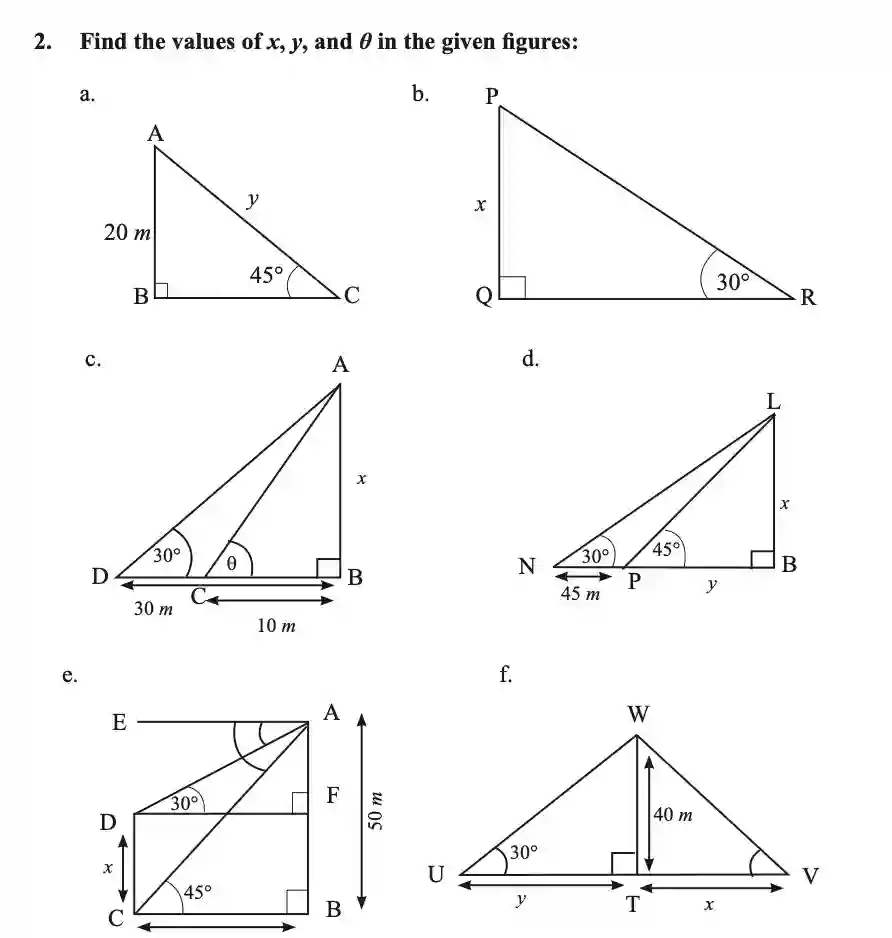
(दिइएका चित्रहरूबाट \(x\), \(y\) र \(\theta\) का मान पत्ता लगाउनुहोस् : )
The data given for the figure are \(AB=20\) m, \(\angle B=90^\circ\), \(\angle C=45^\circ\) and \(AC=y\). The side \(x\) is not described, so we take \(x=BC\).
\[\begin{aligned}\sin45^\circ&=\frac{AB}{AC}=\frac{20}{y} \\ \frac1{\sqrt2}&=\frac{20}{y} \\ y&=20\sqrt2\approx28.28\text{ m}\end{aligned}\]\[\begin{aligned}\tan45^\circ&=\frac{AB}{BC}=\frac{20}{x} \\ x&=20\text{ m}\end{aligned}\]In \(\triangle ABD\):
\[\begin{aligned}\tan30^\circ&=\frac{AB}{BD} \\ \frac1{\sqrt3}&=\frac{x}{30} \\ x&=\frac{30}{\sqrt3}=10\sqrt3\approx17.32\text{ m}\end{aligned}\]In \(\triangle ABC\):
\[\begin{aligned}\tan\theta&=\frac{AB}{BC}=\frac{10\sqrt3}{10}=\sqrt3 \\ \theta&=60^\circ\end{aligned}\]Here \(N,P,B\) lie on a line, so \(NB=NP+PB=45+y\). In \(\triangle LPB\):
\[\begin{aligned}\tan45^\circ&=\frac{LB}{PB}=\frac xy \\ x&=y\end{aligned}\]In \(\triangle LNB\):
\[\begin{aligned}\tan30^\circ&=\frac{LB}{NB}=\frac{x}{45+y}=\frac{x}{45+x} \\ 45+x&=\sqrt3x \\ x(\sqrt3-1)&=45 \\ x&=\frac{45}{\sqrt3-1}=\frac{45(\sqrt3+1)}{2}\approx61.47\text{ m}\end{aligned}\]Since \(y=x\), \(y\approx61.47\) m.
\(AB\) is the vertical height \(50\) m, \(E\) is on the horizontal through \(A\), and \(D\), \(C\) are points seen from \(A\) at depressions \(30^\circ\) and \(45^\circ\). Draw \(DF\perp AB\), so \(DF=BC=y\) and \(BF=DC=x\). By alternate angles, \(\angle ACB=45^\circ\) and \(\angle ADF=30^\circ\).
In \(\triangle ABC\):
\[\begin{aligned}\tan45^\circ&=\frac{AB}{BC}=\frac{50}{y} \\ y&=50\text{ m}\end{aligned}\]In \(\triangle ADF\):
\[\begin{aligned}\tan30^\circ&=\frac{AF}{DF}=\frac{AF}{50} \\ AF&=\frac{50}{\sqrt3}\approx28.87\text{ m}\end{aligned}\]\[\begin{aligned}x&=BF=AB-AF=50-28.87 \\ &=21.13\text{ m}\end{aligned}\]In \(\triangle WVT\):
\[\begin{aligned}\tan45^\circ&=\frac{WT}{VT}=\frac{40}{x} \\ x&=40\text{ m}\end{aligned}\]In \(\triangle WUT\):
\[\begin{aligned}\tan30^\circ&=\frac{WT}{UT}=\frac{40}{y} \\ y&=40\sqrt3\approx69.28\text{ m}\end{aligned}\]Let \(AB=h\) be the height of the house and \(C,D\) the two observation points, with \(CD=50\) m, \(\angle ACB=60^\circ\), \(\angle ADB=30^\circ\).
\[\begin{aligned}\tan60^\circ&=\frac{h}{BC}\implies BC=\frac h{\sqrt3} \\ \tan30^\circ&=\frac{h}{BD}=\frac{h}{BC+50} \\ \frac1{\sqrt3}&=\frac{h}{\frac h{\sqrt3}+50} \\ \frac h{\sqrt3}+50&=\sqrt3h \\ 50&=h\left(\sqrt3-\frac1{\sqrt3}\right)=\frac{2h}{\sqrt3} \\ h&=25\sqrt3\approx43.30\text{ m}\end{aligned}\]Let \(AB=30\) ft be the pole, with \(\angle ACB=60^\circ\) and \(\angle ADB=45^\circ\).
\[\begin{aligned}BC&=\frac{30}{\tan60^\circ}=\frac{30}{\sqrt3}=10\sqrt3\approx17.32\text{ ft} \\ BD&=\frac{30}{\tan45^\circ}=30\text{ ft} \\ CD&=BD-BC=30-17.32=12.68\text{ ft}\end{aligned}\]Let \(AB=500\) m be the hill. By alternate angles, \(\angle ACB=60^\circ\) and \(\angle ADB=30^\circ\).
\[\begin{aligned}BC&=\frac{500}{\tan60^\circ}=\frac{500}{\sqrt3}\approx288.68\text{ m} \\ BD&=\frac{500}{\tan30^\circ}=500\sqrt3\approx866.03\text{ m} \\ CD&=BD-BC=866.03-288.68=577.35\text{ m}\end{aligned}\]Let \(AB=h\) be the house, \(CD=10\) ft, \(\angle ACB=60^\circ\) and \(\angle ADB=45^\circ\).
\[\begin{aligned}BC&=\frac h{\sqrt3},\qquad BD=\frac h{\tan45^\circ}=h \\ BD-BC&=10 \\ h-\frac h{\sqrt3}&=10 \\ h&=\frac{10\sqrt3}{\sqrt3-1}=\frac{10\sqrt3(\sqrt3+1)}{2}=5(3+\sqrt3) \\ &\approx23.66\text{ ft}\end{aligned}\]Note on the wording
Two angles of elevation of the same pole are both acute, so they cannot add up to \(180^\circ\). The intended meaning is that they add up to \(90^\circ\) (complementary), which is how the solution below proceeds.
Let \(AB=h\) be the pole, \(BC=36\) m, \(BD=40\) m, \(\angle ACB=\theta\) and \(\angle ADB=90^\circ-\theta\).
\[\begin{aligned}\tan\theta&=\frac h{36} \\ \tan(90^\circ-\theta)&=\cot\theta=\frac h{40}\implies\tan\theta=\frac{40}{h} \\ \frac h{36}&=\frac{40}{h} \\ h^2&=1440 \\ h&=\sqrt{1440}=12\sqrt{10}\approx37.95\text{ m}\end{aligned}\]As in Question 5(a), the two acute angles must add up to \(90^\circ\). The midpoint is \(25\) m from each pole. Let the shorter pole be \(h\) and the taller \(2h\), with angles \(\theta\) and \(90^\circ-\theta\).
\[\begin{aligned}\tan\theta&=\frac h{25} \\ \cot\theta&=\frac{2h}{25}\implies\tan\theta=\frac{25}{2h} \\ \frac h{25}&=\frac{25}{2h} \\ 2h^2&=625 \\ h&=\frac{25}{\sqrt2}\approx17.68\text{ m} \\ 2h&\approx35.36\text{ m}\end{aligned}\]Let \(AB=h\) be the pole. The shadow is \(BC\) at \(60^\circ\) and \(BD\) at \(30^\circ\), with \(BD-BC=50\).
\[\begin{aligned}BC&=\frac h{\tan60^\circ}=\frac h{\sqrt3},\qquad BD=\frac h{\tan30^\circ}=\sqrt3h \\ \sqrt3h-\frac h{\sqrt3}&=50 \\ \frac{2h}{\sqrt3}&=50 \\ h&=25\sqrt3\approx43.30\text{ m}\end{aligned}\]Let \(AB=30\) m be the building and \(CD\) the column (\(C\) its bottom, \(D\) its top). Draw \(DF\perp AB\), so \(DF=BC\) and \(CD=BF\). By alternate angles, \(\angle ACB=60^\circ\) and \(\angle ADF=45^\circ\).
\[\begin{aligned}BC&=\frac{30}{\tan60^\circ}=10\sqrt3\approx17.32\text{ m} \\ AF&=DF\tan45^\circ=17.32\text{ m} \\ CD&=BF=AB-AF=30-17.32=12.68\text{ m}\end{aligned}\]Let the building be \(AB=20\) m, the temple \(CD=h\), and the horizontal distance \(BC=d\). From \(B\) the pinnacle \(D\) is at elevation \(30^\circ\); from \(A\) it is at depression \(60^\circ\), so \(\angle ADF=60^\circ\) where \(F\) is the foot of the perpendicular from \(D\) to \(AB\).
\[\begin{aligned}\tan30^\circ&=\frac hd\implies d=\sqrt3h \\ \tan60^\circ&=\frac{AF}{DF}=\frac{20-h}{d} \\ \sqrt3&=\frac{20-h}{\sqrt3h} \\ 3h&=20-h \\ h&=5\text{ m}\end{aligned}\]The window top is \(20-1.8=18.2\) m above the man\u2019s eye level. Let \(d\) be his distance from the house.
\[\begin{aligned}\tan30^\circ&=\frac{18.2}{d}\implies d=18.2\sqrt3\approx31.52\text{ m} \\ \text{Roof above eye level}&=d\tan45^\circ=31.52\text{ m} \\ \text{Height of house}&=31.52+1.8=33.32\text{ m}\end{aligned}\]Let the column have height \(H\) and let \(d\) be its distance from the house.
\[\begin{aligned}\tan60^\circ&=\frac Hd\implies d=\frac H{\sqrt3} \\ \tan45^\circ&=\frac{H-15}{d}\implies H-15=d=\frac H{\sqrt3} \\ H\left(1-\frac1{\sqrt3}\right)&=15 \\ H&=\frac{15\sqrt3}{\sqrt3-1}=\frac{15(3+\sqrt3)}{2}\approx35.49\text{ m}\end{aligned}\]We take the aeroplane to be flying towards the observer, so it covers the difference of the two horizontal distances.
\[\begin{aligned}d_1&=\frac{6000}{\tan30^\circ}=6000\sqrt3\approx10392.30\text{ m} \\ d_2&=\frac{6000}{\tan45^\circ}=6000\text{ m} \\ \text{Distance covered}&=d_1-d_2\approx4392.30\text{ m in }10\text{ s} \\ \text{Speed}&=\frac{4392.30}{10}=439.23\text{ m/s} \\ &=439.23\times\frac{18}{5}\approx1581.23\text{ km/hr}\end{aligned}\]Let the point be \(x\) m from the first pole and \((30-x)\) m from the second, and let each pole have height \(h\).
\[\begin{aligned}\tan60^\circ&=\frac hx\implies h=\sqrt3x \\ \tan30^\circ&=\frac{h}{30-x}\implies h=\frac{30-x}{\sqrt3} \\ \sqrt3x&=\frac{30-x}{\sqrt3} \\ 3x&=30-x\implies x=7.5\text{ m} \\ 30-x&=22.5\text{ m} \\ h&=7.5\sqrt3\approx12.99\text{ m}\end{aligned}\]Assumption
The data fix the answer only if the man is at the middle (\u201cबिचबाट\u201d), at equal distance \(d\) from both poles; we take that. With equal distances the larger angle belongs to the taller pole, so the \(45^\circ\) pole is the shorter one, which agrees with the given data.
\[\begin{aligned}\text{Shorter pole above eye level}&=41.6-1.6=40\text{ m} \\ \tan45^\circ&=\frac{40}{d}\implies d=40\text{ m} \\ \text{Taller pole above eye level}&=d\tan60^\circ=40\sqrt3\approx69.28\text{ m} \\ \text{Height of taller pole}&=69.28+1.6=70.88\text{ m} \\ \text{Distance between poles}&=2d=80\text{ m}\end{aligned}\]Let the lower part be \(4k\) and the upper part \(5k\), so the height is \(9k\). Each part subtends \(\theta\), so the whole pole subtends \(2\theta\).
\[\begin{aligned}\tan\theta&=\frac{4k}{20}=\frac k5 \\ \tan2\theta&=\frac{9k}{20} \\ \frac{2\cdot\frac k5}{1-\frac{k^2}{25}}&=\frac{9k}{20} \\ \frac{10k}{25-k^2}&=\frac{9k}{20} \\ 200&=9(25-k^2) \\ 9k^2&=25\implies k=\frac53 \\ \text{Height}&=9k=15\text{ m}\end{aligned}\]Let the tower be \(h\) and the distance to the point \(d\). The tower top is at elevation \(45^\circ\), so the flag top is at \(45^\circ+15^\circ=60^\circ\).
\[\begin{aligned}\tan45^\circ&=\frac hd\implies d=h \\ \tan60^\circ&=\frac{h+5}{d}=\frac{h+5}{h} \\ \sqrt3h&=h+5 \\ h&=\frac5{\sqrt3-1}=\frac{5(\sqrt3+1)}{2}\approx6.83\text{ m}\end{aligned}\]Q.12 Two poles of equal height are given. Standing at a point between the two poles, a person observes the top of each pole and finds the angle of elevation to be \(45^\circ\). Moving \(20\) m closer to one pole, the angle of elevation becomes \(60^\circ\).
- a. Represent the given context in a diagram.
- b. Find the height of the poles.
- c. Find the distance between the two poles.
- d. As the observer moves closer to the pole, the angle of elevation increases. Explain with reason.
(बराबर उचाइका दुईओटा खम्बाहरू छन् । दुवै खम्बाका बिचमा उभिएर एक जना मानिसले प्रत्येक खम्बाको टुप्पो अवलोकन गर्दा \(45^\circ\) को उन्नतांश कोण पाउँछ । एउटा खम्बातिर \(20\) m नजिक गएर फेरि अवलोकन गर्दा \(60^\circ\) को उन्नतांश कोण पाउँछ । (क) चित्र बनाउनुहोस् । (ख) खम्बाहरूको उचाइ पत्ता लगाउनुहोस् । (ग) खम्बाहरूबिचको दुरी पत्ता लगाउनुहोस् । (घ) खम्बाहरू नजिक गएर अवलोकन गर्दा उन्नतांश कोण किन बढ्दै जान्छ, कारणसहित पुष्टि गर्नुहोस् ।)
a. Diagram
Diagram: poles AP and BQ of equal height h; M is the midpoint (45° to both tops); N is 20 m closer to BQ (60°).
b. Height of the poles
Let each pole have height \(h\). At \(M\) the angle to the top of \(BQ\) is \(45^\circ\), so \(MQ=h\) (since \(\tan45^\circ=1\)). After moving \(20\) m towards \(Q\), \(NQ=h-20\).
\[\begin{aligned}\tan60^\circ&=\frac{h}{h-20} \\ \sqrt3(h-20)&=h \\ h(\sqrt3-1)&=20\sqrt3 \\ h&=\frac{20\sqrt3}{\sqrt3-1}=10(3+\sqrt3)\approx47.32\text{ m}\end{aligned}\]c. Distance between the poles
From \(M\) both tops are seen at \(45^\circ\), so \(PM=MQ=h\). Hence
\[\begin{aligned}PQ&=2h\approx2\times47.32=94.64\text{ m}\end{aligned}\]d. Why the angle increases
For a pole of fixed height \(h\) at distance \(d\), \(\tan\theta=\dfrac hd\). As the observer moves closer, \(d\) decreases while \(h\) stays the same, so \(\tan\theta\) increases. Since \(\tan\theta\) increases with \(\theta\) for \(0^\circ<\theta<90^\circ\), the angle of elevation \(\theta\) increases.
Q.13 Outside a building, a ladder \(10\) m long is placed so that its top rests at a point \(4\) m below the roof. From the foot of the ladder, the angle of elevation of the roof is \(60^\circ\).
- a. Draw a diagram representing the given context.
- b. Find the height of the building at which the top of the ladder touches.
- c. Find the distance between the foot of the ladder and the building.
- d. Find the angle of elevation, from the foot of the ladder, of a point \(20\) m below the roof.
(एउटा भवनको बाहिर भित्तामा भवनको छतबाट \(4\) m तल एउटा \(10\) m लामो भर्याङ तेर्साएर राखिएको छ । भर्याङको फेदबाट भवनको छतसम्मको उन्नतांश कोण \(60^\circ\) बनेको छ भने (क) चित्र निर्माण गर्नुहोस् । (ख) भर्याङको टुप्पाले घरको कुन उचाइमा छोएको छ, पत्ता लगाउनुहोस् । (ग) भर्याङको फेदबाट घर कति दुरीमा छ, पत्ता लगाउनुहोस् । (घ) भर्याङको फेदबाट भवनको छतबाट \(20\) m तलको विन्दुको उन्नतांश कोण पत्ता लगाउनुहोस् ।)
a. Diagram
Diagram: ladder FT of length 10 m rests on the wall at T, 4 m below the roof R; the angle of elevation of R from F is 60°.
b. Height at which the ladder touches the wall
Let \(BT=h\) and \(BF=d\). Then the roof is at height \(h+4\), and \(FT=10\) m.
\[\begin{aligned}\tan60^\circ&=\frac{h+4}{d}\implies d=\frac{h+4}{\sqrt3} \\ h^2+d^2&=10^2\ (\text{right triangle }FBT) \\ h^2+\frac{(h+4)^2}{3}&=100 \\ 3h^2+h^2+8h+16&=300 \\ h^2+2h-71&=0 \\ h&=\frac{-2+\sqrt{4+284}}{2}=-1+6\sqrt2\approx7.49\text{ m}\end{aligned}\]c. Distance of the foot of the ladder from the building
\[\begin{aligned}d&=\frac{h+4}{\sqrt3}=\frac{11.49}{1.732}\approx6.63\text{ m}\end{aligned}\]Check: \(h^2+d^2=7.49^2+6.63^2\approx100\).
d. Note on the printed question
The roof is only \(h+4\approx11.49\) m above the ground, so a point \(20\) m below the roof would lie below the ground. The question cannot be answered as printed (the number \(20\) is probably a misprint).
The method is: for a point \(k\) m below the roof (\(k<11.49\)), its height is \(11.49-k\) and \(\tan\theta=\dfrac{11.49-k}{6.63}\). For example, the point \(4\) m below the roof is the top of the ladder:
\[\begin{aligned}\tan\theta&=\frac{7.49}{6.63}\approx1.129 \\ \theta&\approx48.5^\circ\end{aligned}\]1. A. a B. c C. c D. c E. b F. c
2. a. \(y=20\sqrt2\) m b. \(\frac{10}{\sqrt3}\) m c. \(10\sqrt3\) m, \(60^\circ\) d. \(61.47\) m, \(61.47\) m e. \(21.13\) m, \(50\) m f. \(40\) m, \(40\sqrt3\) m
3. a. \(43.30\) m b. \(12.68\) ft
4. a. \(577.35\) m b. \(23.66\) ft
5. a. \(37.95\) m b. \(17.68\) m and \(35.36\) m
6. a. \(43.30\) m b. \(25.62\) ft
7. a. \(12.68\) m b. \(5\) m
8. a. \(73.21\) m b. \(33.32\) m
9. a. \(35.49\) m b. \(1581.23\) km/hr
10. a. \(12.99\) m; \(7.5\) m and \(22.5\) m b. \(70.88\) m; \(80\) m
11. a. \(15\) m b. \(6.83\) m
12. b. \(47.32\) m c. \(94.64\) m
13. b. \(7.49\) m c. \(6.63\) m d. see the note (cannot be answered as printed)
8. Frequently Asked Questions on Class 10 Optional Mathematics Trigonometry
What is covered in Class 10 Optional Mathematics Trigonometry Exercise 7.1 to 7.6? (कक्षा १० ऐच्छिक गणित त्रिकोणमिति अभ्यास ७.१ र ७.२ मा के के समावेश छ ?)
Exercise 7.1 covers compound angles: the formulas for \(\sin(A\pm B)\), \(\cos(A\pm B)\) and \(\tan(A\pm B)\), exact values such as \(15^\circ\) and \(75^\circ\), and proofs of identities. Exercise 7.2 covers multiple angles: double and triple angle formulas, finding values from a given ratio, and long identities. Exercise 7.3 covers submultiple angles: expressing a ratio of an angle through its half or one-third angle, and finding values from a given submultiple ratio. Exercise 7.4 covers the transformation of products into sums or differences and of sums or differences into products. Exercise 7.5 covers conditional identities, which hold only under a given condition such as A+B+C=180 degrees: verifying them for given angles and proving them. Exercise 7.6 covers heights and distances: problems on angles of elevation and depression solved with the tangent ratio. The Miscellaneous Exercise (on a separate page) mixes compound angle, submultiple angle and heights and distances questions. This page solves 257 questions.
What are the double angle formulas? (दोब्बर कोणका सूत्रहरू के के हुन् ?)
- \(\sin2A=2\sin A\cos A\)
- \(\cos2A=\cos^2A-\sin^2A=2\cos^2A-1=1-2\sin^2A\)
- \(\tan2A=\dfrac{2\tan A}{1-\tan^2A}\)
They come from the compound angle formulas by putting \(B=A\) (Exercise 7.2, Question 1).
What are the triple angle formulas? (तेब्बर कोणका सूत्रहरू के के हुन् ?)
- \(\sin3A=3\sin A-4\sin^3A\)
- \(\cos3A=4\cos^3A-3\cos A\)
- \(\tan3A=\dfrac{3\tan A-\tan^3A}{1-3\tan^2A}\)
How do I find \(\sin A\) when \(\cos2A\) is given? (\(\cos2A\) दिइएको छ भने \(\sin A\) कसरी निकाल्ने ?)
Use \(\cos2A=1-2\sin^2A\) and solve for \(\sin A\). For \(\cos2A=\frac{7}{25}\), \(\sin^2A=\frac{9}{25}\), so \(\sin A=\frac35\) (Exercise 7.2, Question 3a).
How do I prove identities that contain \(1\pm\cos2A\)? (\(1\pm\cos2A\) भएका सर्वसमिका कसरी प्रमाणित गर्ने ?)
Use \(1+\cos2A=2\cos^2A\) and \(1-\cos2A=2\sin^2A\), together with \(\sin2A=2\sin A\cos A\). Example: \(\dfrac{1+\cos2A}{\sin2A}=\cot A\) (Exercise 7.2, Question 4a).
What are the compound angle formulas for sine and cosine? (साइन र कोसाइनका संयुक्त कोणका सूत्रहरू के के हुन् ?)
- \(\sin(A+B)=\sin A\cos B+\cos A\sin B\)
- \(\sin(A-B)=\sin A\cos B-\cos A\sin B\)
- \(\cos(A+B)=\cos A\cos B-\sin A\sin B\)
- \(\cos(A-B)=\cos A\cos B+\sin A\sin B\)
What is the compound angle formula for tangent? (ट्यान्जेन्टको संयुक्त कोणको सूत्र के हो ?)
\(\tan(A+B)=\dfrac{\tan A+\tan B}{1-\tan A\tan B}\) and \(\tan(A-B)=\dfrac{\tan A-\tan B}{1+\tan A\tan B}\).
How do I find the exact value of \(\sin75^\circ\) or \(\cos15^\circ\)? (\(\sin75^\circ\) वा \(\cos15^\circ\) को ठ्याक्कै मान कसरी निकाल्ने ?)
Write the angle as a sum or difference of standard angles, such as \(75^\circ=45^\circ+30^\circ\), then use the formula. For example \(\sin75^\circ=\dfrac{\sqrt3+1}{2\sqrt2}\) (Exercise 7.1, Question 2b).
How do I find \(\sin(A+B)\) when only \(\sin A\) and \(\cos B\) are given? (केवल \(\sin A\) र \(\cos B\) दिइएको छ भने \(\sin(A+B)\) कसरी निकाल्ने ?)
Find \(\cos A=\sqrt{1-\sin^2A}\) and \(\sin B=\sqrt{1-\cos^2B}\), then substitute in the formula. See Exercise 7.1, Question 3, where \(\sin(A+B)=\dfrac{56}{65}\).
How do I prove identities like \(\tan A+\tan B+\tan A\tan B=1\)? (\(\tan A+\tan B+\tan A\tan B=1\) जस्ता सर्वसमिका कसरी प्रमाणित गर्ने ?)
If \(A+B=45^\circ\), take \(\tan\) of both sides: \(\dfrac{\tan A+\tan B}{1-\tan A\tan B}=1\), then rearrange (Exercise 7.1, Question 7).
How do I use \(45^\circ\) to simplify \(\dfrac{\cos35^\circ-\sin35^\circ}{\cos35^\circ+\sin35^\circ}\)? (\(45^\circ\) प्रयोग गरी यस्ता भिन्न कसरी सरल गर्ने ?)
Divide the numerator and denominator by \(\cos35^\circ\) to get \(\dfrac{1-\tan35^\circ}{1+\tan35^\circ}\). Since \(\tan45^\circ=1\), this is \(\tan(45^\circ-35^\circ)=\tan10^\circ\) (Exercise 7.1, Question 9).
What is the identity for \(\tan(A+B+C)\)? (\(\tan(A+B+C)\) को सर्वसमिका के हो ?)
\(\tan(A+B+C)=\dfrac{\tan A+\tan B+\tan C-\tan A\tan B\tan C}{1-\tan A\tan B-\tan B\tan C-\tan C\tan A}\). It follows by dividing the sine and cosine expansions of Exercise 7.1, Question 15.
Is every printed identity in the exercise true? (के अभ्यासमा छापिएका सबै सर्वसमिका सही छन् ?)
Not always. In Exercise 7.1, Question 13(b) as printed, \(\tan50^\circ=2\tan30^\circ+\tan20^\circ\) is false (the relation that follows from part (a) is \(\tan50^\circ=\tan40^\circ+2\tan10^\circ\)), and Exercise 7.2, Question 20 as printed does not give \(\cot A\). A quick numerical check with a calculator is a good habit.
Are these questions useful for SEE preparation in Nepal? (के यी प्रश्नहरू नेपालमा SEE को तयारीका लागि उपयोगी छन् ?)
Yes, for students who study Optional Mathematics. This set covers every question type of Exercises 7.1 to 7.6: exact values, given-ratio problems, identities, conditional identities, multiple angle formulas and expressing one angle in terms of another. Practising them builds the skills needed for SEE-style questions.
What is a submultiple angle? (अपवर्तक कोण भनेको के हो ?)
An angle obtained by dividing a given angle \(A\) by \(2,3,4,\dots\) is a submultiple angle of \(A\), for example \(\dfrac A2\) and \(\dfrac A3\). For \(A=60^\circ\) they are \(30^\circ\), \(20^\circ\) and \(15^\circ\) (Exercise 7.3, Question 2a).
How do I find \(\sin A\), \(\cos A\) and \(\tan A\) when \(\tan\frac A2\) is given? (\(\tan\frac A2\) दिइएको छ भने \(\sin A\), \(\cos A\) र \(\tan A\) कसरी निकाल्ने ?)
Use \(\sin A=\dfrac{2\tan\frac A2}{1+\tan^2\frac A2}\), \(\cos A=\dfrac{1-\tan^2\frac A2}{1+\tan^2\frac A2}\) and \(\tan A=\dfrac{2\tan\frac A2}{1-\tan^2\frac A2}\). For \(\tan\frac A2=\frac34\) these give \(\frac{24}{25}\), \(\frac7{25}\) and \(\frac{24}7\) (Exercise 7.3, Question 3b).
What are the sum to product formulas? (योगलाई गुणनफलमा रूपान्तरण गर्ने सूत्रहरू के के हुन् ?)
- \(\sin C+\sin D=2\sin\dfrac{C+D}{2}\cos\dfrac{C-D}{2}\)
- \(\sin C-\sin D=2\cos\dfrac{C+D}{2}\sin\dfrac{C-D}{2}\)
- \(\cos C+\cos D=2\cos\dfrac{C+D}{2}\cos\dfrac{C-D}{2}\)
- \(\cos C-\cos D=-2\sin\dfrac{C+D}{2}\sin\dfrac{C-D}{2}\)
How do I change a product like \(\sin50^\circ\cos30^\circ\) into a sum? (\(\sin50^\circ\cos30^\circ\) जस्तो गुणनफललाई योगमा कसरी बदल्ने ?)
Multiply and divide by \(2\) and use \(2\sin A\cos B=\sin(A+B)+\sin(A-B)\). So \(\sin50^\circ\cos30^\circ=\dfrac{\sin80^\circ+\sin20^\circ}{2}\) (Exercise 7.4, Question 2a).
What is a conditional identity? (अनुबन्धित सर्वसमिका भनेको के हो ?)
A conditional identity is a relation that is true only when a given condition holds. For example \(\sin2A+\sin2B+\sin2C=4\sin A\sin B\sin C\) is true when \(A+B+C=180^\circ\) (Exercise 7.5, Question 6), whereas an ordinary identity such as \(\sin^2A+\cos^2A=1\) is true for all angles.
How do I use the condition \(A+B+C=180^\circ\) in a proof? (\(A+B+C=180^\circ\) सर्त प्रमाणमा कसरी प्रयोग गर्ने ?)
Write \(A+B=180^\circ-C\). Then \(\sin(A+B)=\sin C\), \(\cos(A+B)=-\cos C\) and \(\tan(A+B)=-\tan C\). Combine the first two terms with a sum to product formula and use these relations to simplify (Exercise 7.5, Question 6).
What is the difference between the angle of elevation and the angle of depression? (उन्नतांश कोण र अवनति कोणबिच के फरक छ ?)
Both are measured between the line of sight and the horizontal through the observer’s eye. If the object is above eye level the angle is the angle of elevation; if it is below eye level it is the angle of depression (Exercise 7.6, Question 1). By alternate angles, the angle of depression from the top of a tower equals the angle of elevation of the top from the object.
How do I find the height of a building when the angle of elevation is observed from two points? (दुई विन्दुबाट उन्नतांश कोण दिइएको छ भने भवनको उचाइ कसरी निकाल्ने ?)
Let the height be \(h\). Write each distance from the foot as \(\dfrac h{\tan\theta}\), then use the given gap between the two points. For example, with \(60^\circ\), \(30^\circ\) and a gap of \(50\) m, \(\sqrt3h-\dfrac h{\sqrt3}=50\) gives \(h=25\sqrt3\approx43.30\) m (Exercise 7.6, Question 3a).
Is \(\cos(A-B)=\cos A\cos B+\sin A\sin B\) true for all angles? (\(\cos(A-B)=\cos A\cos B+\sin A\sin B\) सबै कोणका लागि सत्य हुन्छ ?)
Yes. It is the compound angle identity for cosine, so it holds for every value of \(A\) and \(B\). It is also used to simplify \(\tan A+\cot B=\dfrac{\cos(A-B)}{\cos A\sin B}\) (Miscellaneous Exercise, Question 1).
Are the solutions available in Nepali? (के समाधान नेपाली भाषामा पनि उपलब्ध छन् ?)
Every question is shown in English with the Nepali question in brackets. Multiple choice solutions also have Nepali in brackets. All other solutions are in English only, because the steps and symbols of mathematics are the same in both languages.
Students also search for:
Also Read
- SEE Class 10 Optional Mathematics Notes (all chapters)
- SEE Class 10 Compulsory Mathematics Notes
- SEE Class 10 Science Notes
- Class 10 English Notes (SEE Nepal)
- Nepali Class 10 Vyakaran SEE Notes
- SEE Class 10 Social Studies Notes
- SEE Class 10 Computer Science Notes
- Class 10 Account SEE Notes
- Class 10 Education Notes
- Class 10 Economics Guide