
Water Relation Notes
Class 12 Biology Notes • NEB Syllabus 2083
Water relation notes for Class 12 Biology Unit 2 chapter 2.1: syllabus, micro syllabus, 15 solved multiple choice questions, all short and long answer questions with diagrams on diffusion, osmosis, plasmolysis, ascent of sap, transpiration and guttation, and two PDF notes.
1. Water Relation Syllabus
Unit 2: Water Relation Notes
These water relation notes follow the NEB Class 12 Biology syllabus (+2 Biology, Nepal), chapter 2.1 of Unit 2 Plant Physiology. Practise the multiple choice questions first, then work through the solved short and long answer questions with their diagrams, and finish with the PDF notes for quick revision.
Micro syllabus: 2. Plant Physiology
Read more about plant physiology, osmosis and transpiration on Wikipedia. More notes: Class 12 Biology notes, Class 12 Chemistry notes and Class 12 Physics notes.
2. Water Relation Notes: Multiple Choice Questions
Question 1. What is the cause of diffusion?
- a) Sunlight
- b) Kinetic energy
- c) Chemical energy
- d) Potential energy
Correct Answer: b) Kinetic energy
Reason: Diffusion occurs because of the free (kinetic) energy of the moving molecules, ions or particles.
Question 2. What is the medium, where diffusion occurs, called?
- a) Water
- b) Diffusant
- c) Diffusate
- d) Imbibant
Correct Answer: b) Diffusant
Reason: The medium in which particles spread is the diffusion medium or diffusant. The spreading particles are the diffusate.
Question 3. What is the direction of diffusion of molecules?
- a) From higher concentration to lower concentration
- b) From lower concentration to higher concentration
- c) It has no fixed direction
- d) Against the concentration gradient
Correct Answer: a) From higher concentration to lower concentration
Reason: Diffusion is a passive process that goes down the concentration gradient until equilibrium.
Question 4. What is true about transpiration through stomata?
- a) It is not diffusion process.
- b) Diffusion of water droplets from leaf to air.
- c) Diffusion of water vapours from leaf interior to air.
- d) Diffusion of water vapours from air to leaf interior.
Correct Answer: c) Diffusion of water vapours from leaf interior to air.
Reason: Vapour pressure is higher in the sub-stomatal cavity than outside, so vapour diffuses out through the stoma.
Question 5. Which of the following acts as semi-permeable membrane?
- a) Primary wall
- b) Lignified wall
- c) Suberized wall
- d) Cell membrane
Correct Answer: d) Cell membrane
Reason: The plasma membrane lets water pass but restricts most solutes. Cell walls are freely permeable or waterproof.
Question 6. When does endosmosis occur?
- a) When any cell is placed in hypotonic solution
- b) When a living cell is placed in hypotonic solution
- c) When any cell is placed in hypertonic solution
- d) When a living cell is placed in hypotonic solution
Correct Answer: b) When a living cell is placed in hypotonic solution
Reason: Water enters a living cell by osmosis when the outside solution is hypotonic. Only a living cell has a semi-permeable membrane.
Question 7. A plant cell has undergone exosmosis. Which statement is correct?
- a) Its turgor pressure goes on increasing.
- b) Cell accumulates more water and becomes turgid.
- c) Protoplasm gets dehydrated and cell becomes flaccid.
- d) Cell neither becomes turgid nor becomes flaccid and remains in normal state
Correct Answer: c) Protoplasm gets dehydrated and cell becomes flaccid.
Reason: Exosmosis is the loss of water from the cell, so the protoplasm shrinks and turgor falls.
Question 8. What is true about osmosis?
- a) It occurs through any membrane.
- b) It occurs through semi-permeable membrane.
- c) Solvent molecules move from hypertonic solution to hypotonic solution.
- d) Solute molecules move from hypertonic solution to hypotonic solution.
Correct Answer: b) It occurs through semi-permeable membrane.
Reason: Osmosis is the movement of water through a semi-permeable membrane, from hypotonic to hypertonic solution.
Question 9. What is the significance of plasmolysis?
- a) Seed swells when soaked in water
- b) Foul smell of dumping site spreads in surrounding.
- c) Bacteria can not survive in pickles/ jams.
- d) Cell bursts due to expansion of protoplasm.
Correct Answer: c) Bacteria can not survive in pickles/ jams.
Reason: Salt and sugar make a hypertonic medium, so bacteria lose water and are plasmolysed.
Question 10. Which of following material shows imbibition?
- a) Tin
- b) Plastic
- c) Rock
- d) Wood
Correct Answer: d) Wood
Reason: Imbibition is the absorption of water by hydrophilic colloids like wood, seeds and gum. Tin, plastic and rock do not absorb water.
Question 11. What is true about imbibition?
- a) It is endothermic process.
- b) It causes swelling (increase in volume).
- c) It is due to presence of hydrophobic molecules.
- d) It occurs in living materials only.
Correct Answer: b) It causes swelling (increase in volume).
Reason: Imbibants take up water and swell. The process gives out heat, and it occurs in dead materials too.
Question 12. The path of ascent of sap is tracheary elements of xylem. Which of following are tracheary elements?
- a) Vessels and xylem fibres
- b) Vessels and xylem parenchyma
- c) Vessels and tracheids
- d) Tracheids and xylem fibres
Correct Answer: c) Vessels and tracheids
Reason: Tracheids and vessels are the water-conducting elements of xylem.
Question 13. What is the cause of ascent of sap?
- a) Transpiration pull
- b) Root pressure
- c) Atmospheric pressure
- d) Imbibition
Correct Answer: a) Transpiration pull
Reason: Loss of water from the leaves creates a suction (tension) that pulls the water column up through the xylem.
Question 14. A plant excretes water droplets from leaf margins, mainly during humid nights or mornings. Which of the following plants exhibits such phenomenon?
- a) Cactus
- b) Pinus
- c) Mango
- d) Colocasia
Correct Answer: d) Colocasia
Reason: Guttation is common in herbaceous plants such as Colocasia, tomato, balsam and grasses.
Question 15. Which part of leaf is responsible for guttation?
- a) Stomata
- b) Lamina
- c) Cuticle
- d) Hydathode
Correct Answer: d) Hydathode
Reason: Hydathodes are special pores at leaf tips and margins that exude water under root pressure.
3. Water Relation Notes: Short and Long Answer Questions
Short Answer Questions
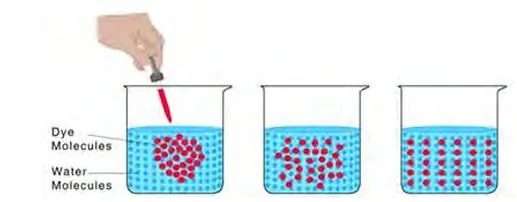
Figure: Water relation notes: diffusion of dye molecules in water
a) What process does the figure represent?
b) What causes the spreading of dye molecules in water?
c) In this process, what do water molecules act as?
d) What effect would be seen if temperature of water is increased?
Osmosis is the movement of water molecules from their higher concentration to their lower concentration through a semi-permeable membrane. A solution with a higher concentration of water is called hypotonic, and one with a lower concentration of water is called hypertonic. So water moves from the hypotonic solution to the hypertonic solution.
Significance of osmosis in plants
Conditions necessary for osmosis
Osmosis in a non-living cell or object. It does not take place in a dead (non-living) cell. When a cell dies, its plasma membrane loses the semi-permeable nature and becomes freely permeable, so the water cannot be held by a membrane and no net osmosis occurs. In a non-living object osmosis can take place only if it has a semi-permeable membrane, for example an egg membrane or a cellophane bag in an osmometer.
When a living plant cell is placed in water or a hypotonic solution, water enters the cell by osmosis. This inward movement of water is called endosmosis. It happens because the cell sap is hypertonic and the surrounding solution is hypotonic.
Effect on the cell: water collects in the vacuole, so the vacuole grows and the protoplast expands. The protoplast presses on the cell wall, which gives the turgor pressure (TP), and the wall presses back with an equal wall pressure (WP). At the end the cell becomes fully expanded and turgid. During endosmosis the osmotic pressure (OP) of the cell falls and the TP rises. In a fully turgid cell OP = TP, so the diffusion pressure deficit (DPD) is zero and no more water enters.
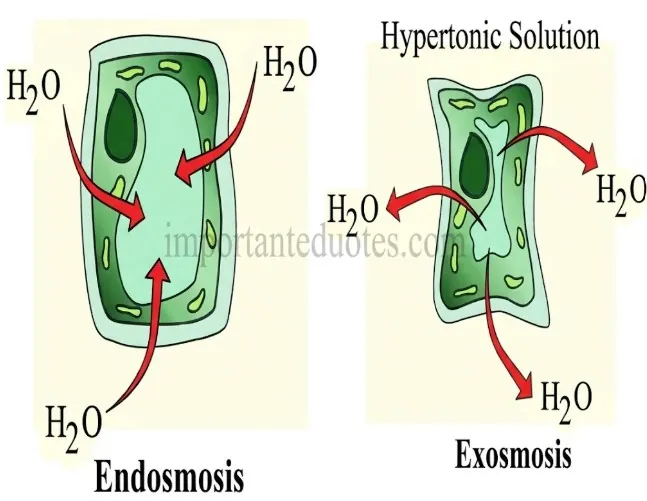
Figure: Water relation notes: endosmosis and exosmosis in a plant cell
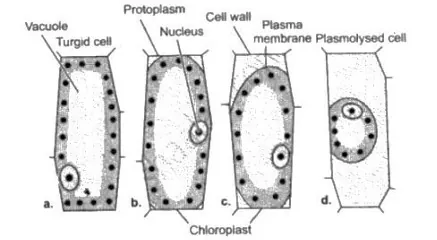
Figure: Water relation notes: successive stages of a plant cell from turgid to plasmolysed
a) Is the solution hypotonic or hypertonic?
b) What type of osmosis is it?
c) The protoplast of cell has shrunken to its minimum volume. What is this phenomenon called?
d) What happens if the cell ‘d’ is placed in water. What is it called?
Figure: Water relation notes: successive stages of a plant cell from turgid to plasmolysed
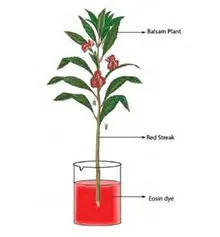
Figure: Water relation notes: balsam twig placed in eosin dye (ascent of sap)
The upward movement of water and minerals from the roots to the leaves and other parts of the plant, against gravity, is called ascent of sap.
Path: epiblema, cortex, endodermis, pericycle, protoxylem, metaxylem, xylem of stem, xylem of branch, xylem of leaf petiole, xylem of leaf (midrib, vein, veinlet) and then the mesophyll cells of the leaf.
Three important points that make it possible
Figure: Water relation notes: balsam twig placed in eosin dye (ascent of sap)
a) Why do white flowers of the twig turn into red?
b) Can colour change be seen in other parts too? If yes, in which part?
c) Transverse section of the twig under the microscope was observed as in above figure. What can be concluded from it?
The loss of water in the form of vapour from the aerial parts of a plant is called transpiration. The water is released in the purest state through stomata, cuticle or lenticels by diffusion.
Types of transpiration
Stomata are minute pores in the epidermis of the aerial parts, and each is guarded by two guard cells. They are the main path of transpiration (80 to 90 %), so they control the amount of water lost by the plant.
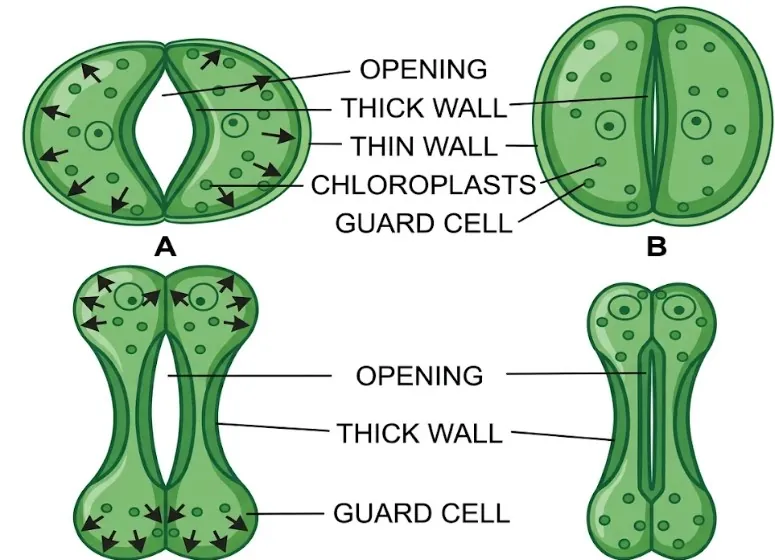
Figure: Water relation notes: opening and closing of a stoma by the guard cells
Stomatal transpiration is carried out in two steps, and both processes help in it.
So osmosis supplies the water and keeps the stomata working, and diffusion carries the vapour out of the leaf.
Light. Light makes the stomata open, so transpiration is high in the day and low at night. High light intensity also raises the temperature of the leaf, which increases evaporation. The quality of light matters too: stomata do not open in green, UV and infra-red light.
Temperature. A rise in temperature increases the kinetic energy of water molecules, so evaporation from the mesophyll cells increases, and the air can hold more vapour. So the rate of transpiration rises with temperature. But if the temperature is too high (about 30 to 35 °C), the stomata close and the rate of transpiration falls.
Transpiration has many uses but it can also harm the plant, so it is called a necessary evil.
Advantages
Disadvantages
| Transpiration | Guttation |
|---|---|
| Takes place through stomata, cuticle and lenticels. | Takes place through hydathodes. |
| Water is lost as vapour. | Water is lost as liquid droplets. |
| Takes place mainly in the daytime. | Takes place generally in the early morning or at night. |
| Prevalent at high temperature. | More common at cooler temperature. |
| Favoured by dry conditions. | Hindered by dry conditions and increases in humid conditions. |
| Involves simple diffusion. | Does not involve diffusion. |
| A controlled process, regulated by the opening and closing of stomata. | An uncontrolled process, because hydathodes do not open and close. |
| Does not need root pressure. | Is driven by root pressure. |
| Only pure water evaporates. | Sugars, salts and amino acids may be lost with water. |
| Gives a cooling effect to the plant. | Does not give a cooling effect. |
Long Answer Questions
Transpiration is the loss of water in the form of vapour from the aerial parts of plants, mainly through the stomata, cuticle and lenticels.
Factors affecting transpiration
A. External factors
B. Internal factors
4. Water Relation Notes PDF
PDF Notes 1: Plant Physiology (Unit 2)
PDF Notes 2: Water Relation (Chapter 2.1)
5. Water Relation: Frequently Asked Questions
What is water relation in plant physiology? (Water relation notes)
What are diffusion, osmosis and plasmolysis?
What is ascent of sap and what causes it?
What are the types of transpiration?
What is the difference between transpiration and guttation?
Where can I get plant physiology class 12 pdf, plant physiology class 12 notes and plant physiology class 12 notes pdf download?
Where can I get water relation pdf, plant water relations PDF and water relation ppt?
Where can I get a plant water relation assignment and plant water relation theory?
Where can I get Class 12 Biology Book PDF Nepal and Class 12 Biology Book PDF Asmita Publication?
Where can I get Class 12 biology notes, Class 12 biology pdf and Class 12 Biology Notes NEB for this chapter?
Where can I get Class 12 Biology notes in the style of Note Mandir?
Students also search for: