
Photosynthesis Notes
Class 12 Biology Notes • NEB Syllabus 2083
Photosynthesis notes for Class 12 Biology Unit 2 chapter 2.2: syllabus, micro syllabus, 19 solved multiple choice questions, all short and long answer questions with diagrams on pigments, light reaction, Calvin cycle, Hatch-Slack pathway, photorespiration and limiting factors, and two PDF notes.
1. Photosynthesis Syllabus
Unit 2: Photosynthesis Notes
These photosynthesis notes follow the NEB Class 12 Biology syllabus (+2 Biology, Nepal), chapter 2.2 of Unit 2 Plant Physiology. Practise the multiple choice questions first, then work through the solved short and long answer questions with their diagrams, and finish with the PDF notes for quick revision.
Micro syllabus: 2. Plant Physiology
Read more about plant physiology, photosynthesis and Calvin cycle on Wikipedia. More notes: Class 12 Biology notes, Class 12 Chemistry notes and Class 12 Physics notes.
2. Photosynthesis Notes: Multiple Choice Questions
Question 1. What is true about photosynthesis?
- a) Anabolic process
- b) Catabolic process
- c) Exothermic process
- d) Energy-yielding process.
Correct Answer: a) Anabolic process
Reason: Photosynthesis builds large organic molecules (glucose) from small ones (CO₂ and H₂O), and it takes in light energy.
Question 2. Which organism shows non-oxygenic photosynthesis?
- a) Animals
- b) Bacteria
- c) Cyanobacteria
- d) Green plants
Correct Answer: b) Bacteria
Reason: Green sulphur and purple bacteria use H₂S, not water, so they release sulphur and no oxygen.
Question 3. During photosynthesis, green plants utilize sunlight, water and CO₂, manufacture organic food and evolve oxygen. What does the oxygen come from?
- a) CO₂
- b) Water
- c) Sunlight
- d) Chlorophyll.
Correct Answer: b) Water
Reason: Oxygen is released by the photolysis (splitting) of water in the light reaction.
Question 4. Which statement is true about chloroplast?
- a) Entire photosynthesis occurs at stroma.
- b) Entire photosynthesis occurs at thylakoids.
- c) Photosynthetic pigments are present in thylakoid membrane.
- d) Light reaction of photosynthesis takes place at stroma of chloroplast.
Correct Answer: c) Photosynthetic pigments are present in thylakoid membrane.
Reason: Pigments lie in the thylakoid membrane. The light reaction is in the thylakoids and the dark reaction is in the stroma.
Question 5. Which is light dependent step of photosynthesis?
- a) Hill reaction
- b) Blackmann reaction
- c) Hatch Slack pathway
- d) Crassulacean acid metabolism
Correct Answer: a) Hill reaction
Reason: The light reaction is also called Hill’s reaction. The others are dark-reaction pathways.
Question 6. In which region of white light, effective absorption takes place?
- a) Blue and green light
- b) Green and red light
- c) Blue and red light
- d) Yellow and green light.
Correct Answer: c) Blue and red light
Reason: Chlorophyll absorbs mainly the blue and red regions and reflects green.
Question 7. In which part of photosystem, the absorbed light energy finally reaches?
- a) Photo-centre
- b) Core molecule
- c) Antenna molecule
- d) Harvesting molecule
Correct Answer: a) Photo-centre
Reason: Antenna (harvesting) pigments pass the energy by resonance to the reaction centre (photo-centre).
Question 8. What is the reaction centre of PSII?
- a) P₆₀₀
- b) P₆₈₀
- c) P₇₀₀
- d) P₇₈₀
Correct Answer: b) P₆₈₀
Reason: The special chlorophyll a pair of PSII absorbs best at 680 nm. PSI has P₇₀₀.
Question 9. Which is the correct order of electron carriers between PSII and PSI?
- a) Primary acceptor, Pc, Cyt. complex, Pq
- b) Primary acceptor, Fd, Pq, Cyt. complex
- c) Primary acceptor, Pq, Cyt. complex, Pc
- d) Primary acceptor, Fd, Cyt. complex, Pc
Correct Answer: c) Primary acceptor, Pq, Cyt. complex, Pc
Reason: Electrons pass from PSII to the primary acceptor, plastoquinone, cytochrome complex and plastocyanin, which gives them to PSI.
Question 10. What is true about cyclic photophosphorylation?
- a) Involves PS II only.
- b) Involves photolysis of water
- c) NADPH₂ is synthesized
- d) Final electron acceptor is P₇₀₀
Correct Answer: d) Final electron acceptor is P₇₀₀
Reason: In the cyclic path the electrons come back to P₇₀₀ of PSI. There is no photolysis and no NADPH₂.
Question 11. Which of following involves ATP synthesis during light reaction?
- a) Photolysis
- b) Photo-excitation
- c) Dark reaction
- d) Photo-phosphorylation
Correct Answer: d) Photo-phosphorylation
Reason: Photophosphorylation is the light-dependent synthesis of ATP from ADP and Pi.
Question 12. Which is the first stable compound of C₃ cycle?
- a) Citric acid
- b) Oxaloacetic acid
- c) Phosphoglycolic acid
- d) Phosphoglyceric acid.
Correct Answer: d) Phosphoglyceric acid.
Reason: The first stable product of the Calvin cycle is the 3-carbon PGA, so it is called the C₃ cycle.
Question 13. What does RUBISCO stand for?
- a) Ribose biphosphate carboxylase
- b) Ribose bisulphate carboxylase
- c) Ribulose biphosphate carboxylase
- d) Ribulose bisulphate carboxylase
Correct Answer: c) Ribulose biphosphate carboxylase
Reason: RuBisCO is ribulose bisphosphate carboxylase, the enzyme that fixes CO₂ to RuBP.
Question 14. In which step of Calvin cycle, sugar is synthesized?
- a) CO₂ fixation
- b) PGA reduction
- c) RUBP regeneration
- d) RUBP carboxylation.
Correct Answer: b) PGA reduction
Reason: PGA is reduced to G3P by ATP and NADPH₂, and G3P is used to make sugar.
Question 15. In C₃ cycle, how many ATPs are required for the fixation of 6CO₂?
- a) 12
- b) 18
- c) 24
- d) 30
Correct Answer: b) 18
Reason: The equation is 6RuBP + 6CO₂ + 18ATP + 12NADPH₂ → C₆H₁₂O₆ + 6RuBP + 18ADP + 12NADP.
Question 16. Under what condition, C₃ plants can not carry out photosynthesis?
- a) When the rate of transpiration is high
- b) When the temperature falls below 5 degree Celsius.
- c) When CO₂ concentration increases above the normal.
- d) When CO₂ concentration becomes low, below 100 ppm.
Correct Answer: d) When CO₂ concentration becomes low, below 100 ppm.
Reason: Below 100 ppm CO₂, RuBisCO acts as an oxygenase and photorespiration replaces photosynthesis.
Question 17. Which of the following is C₄ plant?
- a) Rice
- b) Maize
- c) Wheat
- d) Grass
Correct Answer: b) Maize
Reason: Maize, sugarcane, sorghum and Amaranthus are C₄ plants. Rice and wheat are C₃.
Question 18. Which plant possesses Kranz leaf anatomy and dimorphic chloroplasts?
- a) C₂ plant
- b) C₃ plant
- c) C₄ plant
- d) CAM plant
Correct Answer: c) C₄ plant
Reason: C₄ leaves have a bundle sheath ring (Kranz anatomy) with two kinds of chloroplasts.
Question 19. Which cells of leaf involve in C₄ cycle?
- a) Mesophyll cell and guard cell
- b) Bundle sheath cell and guard cell
- c) Mesophyll cell and epidermis
- d) Mesophyll cell and bundle sheath cell
Correct Answer: d) Mesophyll cell and bundle sheath cell
Reason: CO₂ is first fixed in the mesophyll cells, and then the Calvin cycle runs in the bundle sheath cells.
3. Photosynthesis Notes: Short and Long Answer Questions
Short Answer Questions
Photosynthesis is the biochemical, anabolic and reductive process in which green plants absorb light energy and make organic food from simple molecules like CO₂ and H₂O. It is often called carbon assimilation.
Light energy is changed into chemical energy and stored in organic matter (carbohydrates), and O₂ is released as a by-product. The raw materials are CO₂, which enters from the air through stomata, and H₂O, which is absorbed from the soil by roots. It mainly takes place in the mesophyll cells of the leaf, and inside the cell it takes place in the chloroplast. So the chloroplast is called the “kitchen of the cell”.
The oxygen comes from the breakdown of water, which is called photolysis of water.
Types of photosynthesis
Balanced equation
Significance of photosynthesis
Photosynthetic pigments are the coloured substances in the thylakoid membrane of the chloroplast that absorb light for photosynthesis. There are three groups.
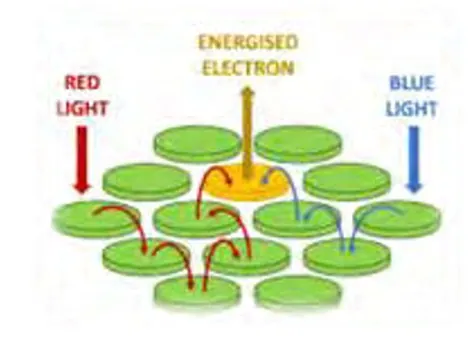
Figure for Q.4
a) Where is it present in chloroplast?
b) Its reaction centre is P₇₀₀. Which photosystem is it?
c) What is the role of reaction centre?
d) Does it carry out photophosphorylation independently? If yes, which one?
Photosynthetic pigments are arranged with proteins in groups called photosystems, in the thylakoid membrane. Each photosystem has a light-harvesting (antenna) complex of 300 to 400 chlorophylls and other pigments, and a reaction centre.
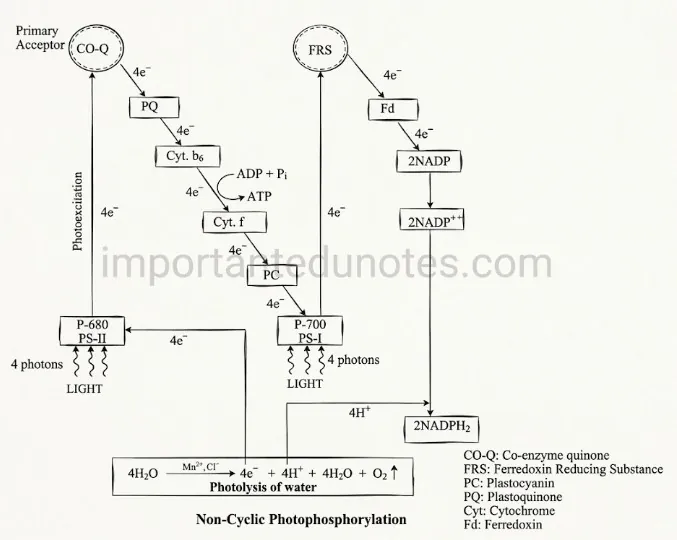
Figure: Photosynthesis notes: non-cyclic photophosphorylation
In non-cyclic photophosphorylation both photosystems work. Electrons flow in a straight line from water to NADP and do not come back to P₆₈₀, so it is called non-cyclic. It works along with the photolysis of water.
Figure: Photosynthesis notes: flow chart of non-cyclic photophosphorylation (Z-scheme)
Figure: Photosynthesis notes: non-cyclic photophosphorylation
| Cyclic photophosphorylation | Non-cyclic photophosphorylation |
|---|---|
| Only PSI is involved. | Both PSII and PSI are involved. |
| The electrons return to the reaction centre P₇₀₀, so the path is a cycle. | The electrons go in a linear path and do not return to P₆₈₀. |
| There is no photolysis of water, and no oxygen is released. | Photolysis of water takes place, and oxygen is released. |
| ATP is formed twice (Fd to Pq, and at the cytochrome complex). | ATP is formed once, at the cytochrome complex. |
| NADP is not reduced, so no NADPH₂ is formed. | NADP is reduced and NADPH₂ is formed. |
| It occurs mainly in primitive autotrophs such as bacteria. Plants use it when more ATP is needed and NADPH₂ is in excess. | It is the common pathway of green plants. |
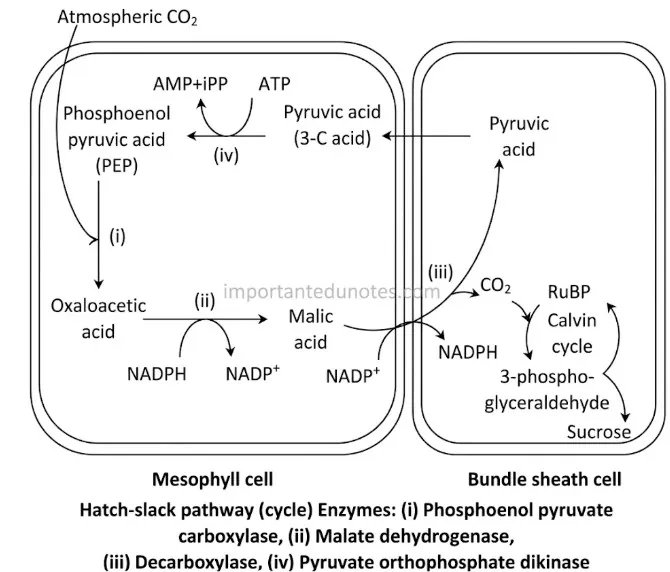
Figure: Photosynthesis notes: Hatch-Slack pathway (C₄ cycle)
The Hatch-Slack pathway is the alternative pathway of the dark reaction, proposed by Hatch and Slack. It is also called the C₄ cycle, because the first stable product is a 4-carbon compound, oxaloacetic acid (OAA). The plants that use it are C₄ plants, for example maize, sugarcane, Sorghum and Amaranthus.
Leaf anatomy. A ring of bundle sheath cells surrounds each vascular bundle (Kranz anatomy). Mesophyll chloroplasts are many and small, have grana but no RuBisCO. Bundle sheath chloroplasts are fewer and larger, have no grana but have RuBisCO.
Mechanism
CO₂ is thus fixed twice. The overall equation is 6CO₂ + 6H₂O + 6PEP + 30ATP + 12NADPH₂ → C₆H₁₂O₆ + 6PEP + 30ADP + 12NADP.
Figure: Photosynthesis notes: Hatch-Slack pathway (C₄ cycle)
| C₃ plants | C₄ plants |
|---|---|
| Follow the Calvin cycle (C₃ cycle). | Follow the Hatch-Slack pathway (C₄ cycle). |
| The first stable product is the 3-carbon PGA. | The first stable product is the 4-carbon OAA. |
| The primary CO₂ acceptor is RuBP (5C). | The primary CO₂ acceptor is PEP (3C). |
| The enzyme for CO₂ fixation is RuBisCO. | The enzyme in the mesophyll is PEP carboxylase, and RuBisCO works in the bundle sheath. |
| CO₂ is fixed once. | CO₂ is fixed twice. |
| Kranz anatomy is absent. The chloroplasts are of one kind. | Kranz anatomy is present. The chloroplasts are of two kinds (dimorphic). |
| Photorespiration is present. | Photorespiration is absent. |
| Needs 18 ATP and 12 NADPH₂ for one glucose. | Needs 30 ATP and 12 NADPH₂ for one glucose. |
| Examples: rice, wheat, cotton, oat, tobacco. About 95 % of the plants are C₃. | Examples: maize, sugarcane, Sorghum, Amaranthus. |
The CO₂-fixing enzyme of C₃ plants is RuBisCO, which has less affinity for CO₂. When the CO₂ concentration falls below 100 ppm, RuBisCO behaves as an oxygenase and binds with O₂. This leads to photorespiration.
Photorespiration is a wasteful process that gives neither glucose nor ATP. It uses up ATP, and it takes place in three organelles: chloroplast, peroxisome and mitochondrion. The first product is a 2-carbon compound, phosphoglycolic acid, so it is also called the C₂ cycle.
In C₄ plants, PEP carboxylase fixes CO₂ first. It has a high affinity for CO₂ and does not bind O₂. So photosynthesis goes on even when the CO₂ concentration is very low (0 to 10 ppm), and there is no photorespiration. That is why C₄ plants are photosynthetically more efficient.
Light
Temperature. The dark reaction is controlled by enzymes, so it depends on temperature. The optimum temperature is 15 to 35 °C. When other factors are not limiting, the rate doubles for every 10 °C rise until the optimum is reached. If the temperature is too high, the enzymes are denatured and the rate falls. Photosynthesis occurs in conifers at high altitude at 35 °C, and some algae of hot springs do it even at 75 °C.
Long Answer Questions
Photosynthesis is the biochemical process in which green plants, algae and some bacteria change light energy into chemical energy. They use sunlight to turn water and carbon dioxide into oxygen and energy-rich organic compounds such as glucose. It is an anabolic process.
Chlorophyll. Chlorophyll is the dominant green pigment of the thylakoid membrane of the chloroplast. It absorbs light mainly in the blue and red areas, and the green light is scattered or reflected, so the plants look green. It has a porphyrin ring with magnesium at the centre and a long phytol tail.
Types of chlorophyll in plants
Figure: Photosynthesis notes: non-cyclic photophosphorylation
Photosynthesis has two steps: the light-dependent step (light reaction, Hill’s reaction) and the light-independent step (dark reaction, Blackman’s reaction).
Light reaction (photochemical phase). It takes place in the thylakoid membrane of the chloroplast. The radiant energy is absorbed by the photosystems and changed into the chemical energy of ATP and NADPH₂. It has three steps.
Photophosphorylation is of two types, non-cyclic and cyclic, as explained in the earlier questions.
Differences between light reaction and dark reaction
| Light reaction | Dark reaction |
|---|---|
| Needs light. | Does not need light directly (light-independent). |
| Takes place in the thylakoids (grana) of the chloroplast. | Takes place in the stroma of the chloroplast. |
| Photochemical process. | Enzymatic process. |
| Water is split and oxygen is released. | CO₂ is reduced to carbohydrate. |
| Produces ATP and NADPH₂ (assimilatory powers). | Uses ATP and NADPH₂ to make glucose. |
| Changes light energy into chemical energy. | Changes chemical energy into food energy. |
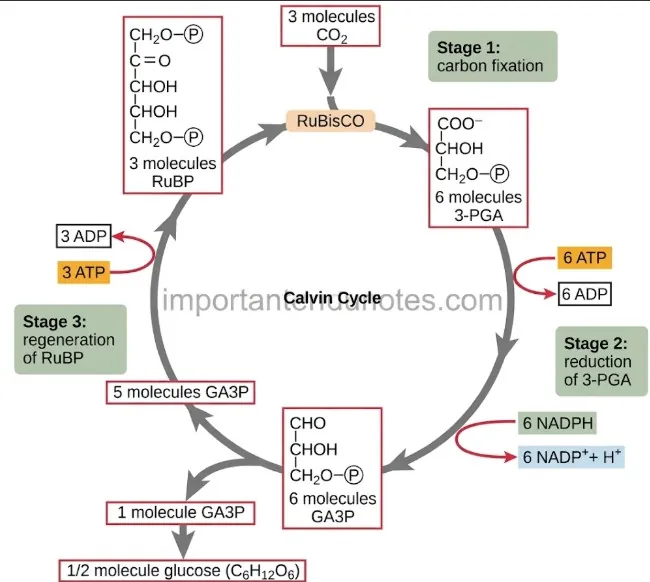
Figure: Photosynthesis notes: Calvin cycle (C₃ cycle)
The Calvin-Benson cycle is the common pathway of the dark reaction. It was first studied in Chlorella (a green alga) by Calvin. The first stable product is the 3-carbon phosphoglyceric acid (PGA), so it is also called the C₃ cycle. It takes place in the stroma. About 95 % of plants are C₃ plants, for example rice, wheat, cotton, oat and tobacco.
Overall reaction: 6RuBP + 6CO₂ + 18ATP + 12NADPH₂ → C₆H₁₂O₆ + 6RuBP + 18ADP + 12NADP
Steps of the Calvin cycle
For one glucose molecule six CO₂ must be fixed, so the cycle must turn six times, using 18 ATP and 12 NADPH₂.
Photosynthesis is affected by external factors and internal factors. The light reaction depends on light, water and pigments, and the dark reaction depends on temperature and available CO₂. According to Blackman’s law of limiting factors, when many factors affect a process, its rate is controlled by the factor that is in the least amount.
A. External factors
B. Internal factors
4. Photosynthesis Notes PDF
PDF Notes 1: Plant Physiology (Unit 2)
PDF Notes 2: Photosynthesis (Chapter 2.2)
5. Photosynthesis: Frequently Asked Questions
What is photosynthesis? (Photosynthesis notes in simple words)
What is the photosynthesis equation?
How do you pronounce photosynthesis?
What is photosynthesis for kids and for class 6?
How do I draw photosynthesis?
What are the photosynthetic pigments?
What is the difference between cyclic and non-cyclic photophosphorylation?
What is the Calvin cycle and the Hatch-Slack pathway?
What is photorespiration and why are C₄ plants more efficient?
Where can I get plant physiology class 12 pdf, plant physiology class 12 notes and plant physiology class 12 notes pdf download?
Where can I get photosynthesis PDF and photosynthesis ppt?
Where can I get Class 12 Biology Book PDF Nepal and Class 12 Biology Book PDF Asmita Publication?
Where can I get Class 12 biology notes, Class 12 biology pdf and Class 12 Biology Notes NEB for this chapter?
Where can I get Class 12 Biology notes in the style of Note Mandir?
Students also search for: