
Plant Respiration Notes
Class 12 Biology Notes • NEB Syllabus 2083
Plant respiration notes for Class 12 Biology Unit 2 chapter 2.3: syllabus, micro syllabus, 15 solved multiple choice questions, all short and long answer questions with the EMP pathway and Kreb’s cycle figures, and two PDF notes on glycolysis, fermentation and the factors affecting respiration.
1. Plant Respiration Syllabus
Unit 2: Plant Physiology (this page: chapter 2.3 Respiration)
These plant respiration notes follow the NEB Class 12 Biology syllabus (+2 Biology, Nepal), chapter 2.3 of Unit 2 Plant Physiology. Practise the multiple choice questions first, then work through the solved short and long answer questions with the EMP pathway and Kreb’s cycle figures, and finish with the PDF notes for quick revision.
Micro syllabus: 2. Plant Physiology
Read more about cellular respiration, glycolysis and the citric acid cycle on Wikipedia. More notes: Class 12 Biology notes, Class 12 Chemistry notes and Class 12 Physics notes.
2. Plant Respiration Notes: Multiple Choice Questions
Question 1. Which organelle is known as the power-house of the cell?
- a) Nucleus
- b) Chloroplast
- c) Mitochondrion
- d) Endoplasmic reticulum
Correct Answer: c) Mitochondrion
Reason: Mitochondria carry out Kreb’s cycle and the electron transport chain, where most of the ATP of the cell is made.
Question 2. What does aerobic respiration involve?
- a) Reduction of CO₂
- b) Photolysis of water
- c) Partial oxidation of organic food
- d) Complete oxidation of organic food
Correct Answer: d) Complete oxidation of organic food
Reason: In aerobic respiration the food (glucose) is oxidised completely to CO₂ and H₂O with oxygen, releasing 38 ATP. Partial oxidation happens in anaerobic respiration.
Question 3. What is the site of anaerobic respiration?
- a) Cytoplasm
- b) Mitochondrion
- c) Cytoplasm and mitochondrion
- d) Chloroplast and mitochondrion
Correct Answer: a) Cytoplasm
Reason: Both steps of anaerobic respiration, glycolysis and fermentation, take place in the cytoplasm only.
Question 4. What is the end product of glycolysis?
- a) Glucose
- b) Citric acid
- c) Pyruvic acid
- d) Acetic acid
Correct Answer: c) Pyruvic acid
Reason: One glucose (6C) is broken into two pyruvic acids (3C) in glycolysis. Citric acid is the first product of Kreb’s cycle.
Question 5. What is the net gain of ATP molecules through glycolysis?
- a) 2
- b) 4
- c) 6
- d) 8
Correct Answer: a) 2
Reason: Glycolysis makes 4 ATP but uses 2 ATP (steps 1 and 3), so the net gain is 2 ATP and 2 NADH₂ per glucose.
Question 6. What is glycolysis also called?
- a) Hill reaction
- b) EMP pathway
- c) Citric acid cycle
- d) CAM pathway
Correct Answer: b) EMP pathway
Reason: It was worked out by Embden, Meyerhof and Parnas, so it is called the EMP pathway. Hill reaction belongs to photosynthesis.
Question 7. What does the link reaction connect in aerobic respiration?
- a) Glycolysis with electron transport chain
- b) Glycolysis with Kreb’s cycle
- c) Kreb’s cycle with electron transport chain
- d) Glycolysis with oxidative phosphorylation
Correct Answer: b) Glycolysis with Kreb’s cycle
Reason: In the link reaction pyruvic acid is changed to acetyl-CoA, which enters Kreb’s cycle.
Question 8. What is the maximum number of ATPs generated from one glucose molecule through aerobic respiration?
- a) 34
- b) 36
- c) 38
- d) 40
Correct Answer: c) 38
Reason: Glycolysis 8 + link reaction 6 + Kreb’s cycle 24 = 38 ATP per glucose.
Question 9. What is the first stable product of Kreb’s cycle?
- a) Malic acid
- b) Citric acid
- c) Succinic acid
- d) Oxaloacetic acid
Correct Answer: b) Citric acid
Reason: Acetyl-CoA (2C) joins oxaloacetic acid (4C) to form citric acid (6C), so the cycle is also called the citric acid cycle.
Question 10. How many ATPs are produced when one molecule of NADH₂ passes through the electron transport chain?
- a) 2
- b) 3
- c) 4
- d) 5
Correct Answer: b) 3
Reason: One NADH₂ gives 3 ATP through oxidative phosphorylation, and one FADH₂ gives 2 ATP.
Question 11. Which of the following steps is common in aerobic and anaerobic respiration?
- a) Kreb’s cycle
- b) Fermentation
- c) Glycolysis
- d) Electron transport chain
Correct Answer: c) Glycolysis
Reason: Glycolysis needs no oxygen, so it is the first step in both aerobic and anaerobic respiration.
Question 12. Which part of the mitochondrion generates ATP?
- a) Matrix
- b) Cristae
- c) Oxysome
- d) Thylakoid
Correct Answer: c) Oxysome
Reason: Oxysomes (F₀-F₁ particles, ATP synthase) on the inner membrane make ATP by oxidative phosphorylation. Thylakoid belongs to the chloroplast.
Question 13. Which fermentation does not evolve CO₂?
- a) Alcoholic fermentation
- b) Lactic acid fermentation
- c) Acetic acid fermentation
- d) All of the above
Correct Answer: b) Lactic acid fermentation
Reason: Pyruvic acid is directly reduced to lactic acid without decarboxylation, so no CO₂ is released.
Question 14. Which of the following is involved in anaerobic respiration?
- a) Algae
- b) Yeast
- c) Bryophytes
- d) Gymnosperms
Correct Answer: b) Yeast
Reason: Yeast carries out alcoholic fermentation without oxygen. Algae, bryophytes and gymnosperms respire mainly aerobically.
Question 15. What is the site for Kreb’s cycle reaction?
- a) Matrix
- b) Stroma
- c) Cytoplasm
- d) Nucleoplasm
Correct Answer: a) Matrix
Reason: The enzymes of Kreb’s cycle are in the mitochondrial matrix. Stroma is the part of the chloroplast.
3. Plant Respiration Notes: Short and Long Answer Questions
Plant Respiration Notes: Short Answer Questions
Cellular respiration is the breakdown of food materials (mainly glucose) within the cell to release energy, which is trapped as ATP. The C-C bonds of the complex compounds are broken by oxidation in a series of slow, enzyme-controlled steps, so it is a catabolic process. ATP is the energy currency of the cell. This is the basis of the plant respiration notes of the chapter.
Significance of respiration
| Aerobic respiration | Anaerobic respiration |
|---|---|
| Occurs in the presence of oxygen in all living cells of higher plants | Occurs in the absence of oxygen in bacteria, certain fungi, germinating seeds and fleshy fruits |
| Oxygen is required | Oxygen is not required |
| Food is completely oxidised to CO₂, H₂O and energy | Food is partly oxidised; end products are alcohol or acid and CO₂ |
| 38 ATP are released from one glucose | 2 ATP are released from one glucose |
| Takes place in cytoplasm and mitochondria | All reactions take place in the cytoplasm |
| Steps: glycolysis, link reaction, Kreb’s cycle and electron transport chain | Steps: glycolysis and fermentation |
| About 686 kcal is released per mole of glucose | About 32 to 50 kcal is released per mole of glucose |
Glycolysis is the first step of respiration in which one molecule of glucose (6C) is broken down into two molecules of pyruvic acid (3C) in the cytoplasm. It was studied by Embden, Meyerhof and Parnas, so it is also called the EMP pathway. It has 10 enzyme-controlled steps, needs no oxygen and gives no CO₂.
Significance of glycolysis
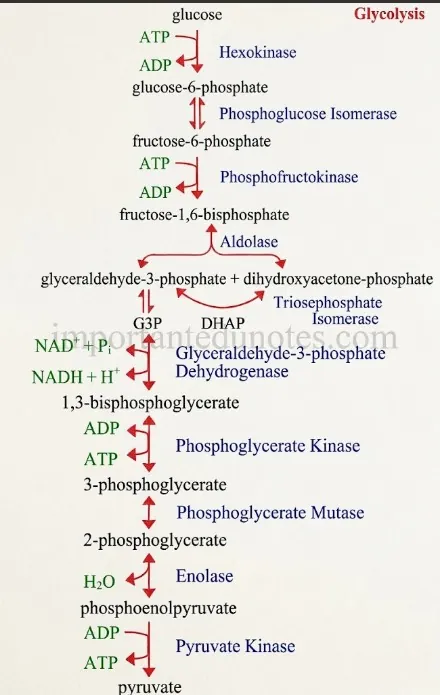
Figure: Plant respiration notes: EMP pathway (glycolysis) from glucose to pyruvic acid
Fermentation is the anaerobic step in which pyruvic acid is reduced to ethanol, lactic acid or other products. In this step NAD⁺ is regenerated from NADH₂ and is used again in glycolysis. It is of three types.
External factors: temperature, oxygen, water, light and carbon dioxide.
Description of two factors
Plant Respiration Notes: Long Answer Questions
Figure: Plant respiration notes: EMP pathway (glycolysis) from glucose to pyruvic acid
The EMP pathway (glycolysis) takes place in the cytoplasm and needs no oxygen. It has 10 reversible, enzyme-dependent steps and breaks one glucose into two pyruvic acids. It is the first stage of plant respiration.
| Step | Reaction | Enzyme |
|---|---|---|
| 1 | Glucose + ATP → glucose 6-phosphate | Hexokinase |
| 2 | Glucose 6-phosphate → fructose 6-phosphate | Phosphohexoisomerase |
| 3 | Fructose 6-phosphate + ATP → fructose 1,6-bisphosphate | Phosphofructokinase |
| 4 | Fructose 1,6-bisphosphate → glyceraldehyde 3-phosphate + dihydroxyacetone phosphate | Aldolase |
| 5 | Dihydroxyacetone phosphate → glyceraldehyde 3-phosphate | Triose phosphate isomerase |
| 6 | 2 Glyceraldehyde 3-phosphate + 2Pi + 2NAD → 2 (1,3-diphosphoglyceric acid) + 2NADH₂ | Triose phosphate dehydrogenase |
| 7 | 2 (1,3-diphosphoglyceric acid) → 2 (3-phosphoglyceric acid) + 2ATP | Phosphoglycerokinase |
| 8 | 3-Phosphoglyceric acid → 2-phosphoglyceric acid | Phosphoglyceromutase |
| 9 | 2-Phosphoglyceric acid → phosphoenolpyruvic acid + H₂O | Enolase |
| 10 | 2 Phosphoenolpyruvic acid → 2 pyruvic acid + 2ATP | Pyruvate kinase |
Summary: 2 ATP are used in steps 1 and 3 and 4 ATP are made in steps 7 and 10, so the net gain is 2 ATP. Two NADH₂ are formed in step 6. Steps 5 to 10 happen twice for each glucose, because two molecules of glyceraldehyde 3-phosphate are formed.
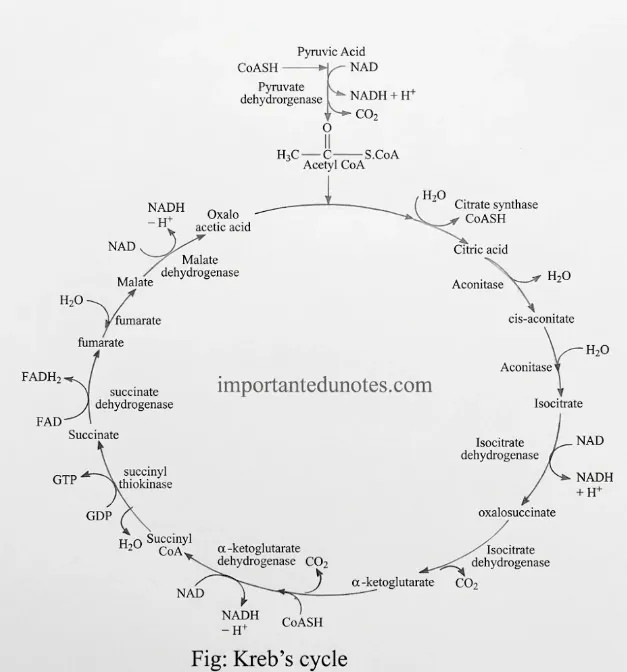
Figure: Plant respiration notes: Kreb’s cycle (citric acid cycle)
Link reaction. The short reaction that connects glycolysis with Kreb’s cycle is the link reaction. Pyruvic acid goes into the mitochondrial matrix and undergoes oxidative decarboxylation (enzyme pyruvate dehydrogenase) to form acetyl-CoA. CO₂ and NADH₂ are the other products of each pyruvic acid.
Kreb’s cycle. It is also known as the citric acid cycle or tricarboxylic acid (TCA) cycle, named after H. A. Krebs. It takes place in the mitochondrial matrix, where all the necessary enzymes are present. The steps are:
| Step | Reaction | Enzyme |
|---|---|---|
| 1 | Acetyl-CoA + oxaloacetic acid + H₂O → citric acid + CoA | Citrate synthetase (condensing enzyme) |
| 2 | Citric acid → cis-aconitic acid + H₂O | Aconitase |
| 3 | Cis-aconitic acid + H₂O → isocitric acid | Aconitase |
| 4 | Isocitric acid + NAD → oxalosuccinic acid + NADH₂ | Isocitrate dehydrogenase |
| 5 | Oxalosuccinic acid → α-ketoglutaric acid + CO₂ | Oxalosuccinate decarboxylase |
| 6 | α-Ketoglutaric acid + CoA + NAD → succinyl-CoA + CO₂ + NADH₂ | α-Ketoglutarate dehydrogenase |
| 7 | Succinyl-CoA + H₂O + GDP + Pi → succinic acid + GTP + CoA (GTP + ADP → ATP + GDP) | Succinyl thiokinase |
| 8 | Succinic acid + FAD → fumaric acid + FADH₂ | Succinic dehydrogenase |
| 9 | Fumaric acid + H₂O → malic acid | Fumarase |
| 10 | Malic acid + NAD → oxaloacetic acid + NADH₂ | Malate dehydrogenase |
Oxaloacetic acid is regenerated, so the cycle continues. For one glucose (two acetyl-CoA, so two turns of the cycle) the net yield is:
| Product | Per turn | Per glucose |
|---|---|---|
| CO₂ | 2 | 4 |
| NADH₂ | 3 | 6 |
| FADH₂ | 1 | 2 |
| ATP (through GTP) | 1 | 2 |
Electron transport chain (terminal oxidation). The NADH₂ and FADH₂ pass their electrons through four complexes on the inner mitochondrial membrane to coenzyme Q, cytochrome c and finally molecular oxygen, which forms water. H⁺ ions are pumped into the intermembrane space and come back through the oxysomes (ATP synthase), making ATP by oxidative phosphorylation.
| Stage | ATP made |
|---|---|
| Glycolysis (2 ATP + 2NADH₂ × 3) | 8 |
| Link reaction (2NADH₂ × 3) | 6 |
| Kreb’s cycle (2 ATP + 6NADH₂ × 3 + 2FADH₂ × 2) | 24 |
| Total | 38 ATP |
Anaerobic respiration is the partial oxidation of food to release energy without molecular oxygen. It takes place only in the cytoplasm in bacteria, certain fungi (yeast), germinating seeds and fleshy fruits. It has two steps.
| Type | Organism | Reaction | CO₂ |
|---|---|---|---|
| Alcoholic | Yeast and some bacteria | C₆H₁₂O₆ → 2C₂H₅OH + 2CO₂ + 2 ATP | Released |
| Lactic acid | Lactobacillus, muscle cells | C₆H₁₂O₆ → 2C₃H₆O₃ + 2 ATP | Not released |
| Acetic acid | Yeast then Acetobacter | C₂H₅OH + O₂ → CH₃COOH + H₂O | – |
Significance
Figure: Plant respiration notes: EMP pathway (glycolysis) from glucose to pyruvic acid
The rate of plant respiration depends on external and internal factors.
A. External factors
B. Internal factors
4. Plant Respiration Notes PDF
PDF Notes 1: Plant Physiology (Unit 2)
PDF Notes 2: Plant Respiration (Chapter 2.3)
5. Plant Respiration: Frequently Asked Questions
What is plant respiration? (Plant respiration notes)
What is the plant respiration equation?
What is the plant respiration process? (Plant respiration process)
What is the difference between aerobic and anaerobic respiration?
What is glycolysis or the EMP pathway?
What is the link reaction?
What is Kreb’s cycle? Where does it take place?
What is the electron transport chain? (Plant respiration diagram)
How many ATP are produced from one glucose in aerobic respiration?
What are the types of fermentation?
What are the factors affecting respiration?
Does respiration take place in plants at night? (Plant respiration at night)
What is the significance of respiration in plants?
Where can I get plant physiology class 12 pdf, plant physiology class 12 notes and plant physiology class 12 notes pdf download?
Where can I get plant respiration pdf and plant respiration notes?
Where can I get respiration in plants Class 11 and Class 10 notes?
Where can I get Class 12 Biology Book PDF Nepal and Class 12 Biology Book PDF Asmita Publication?
Where can I get Class 12 biology notes, Class 12 biology pdf and Class 12 Biology Notes NEB for this chapter?
Where can I get Class 12 Biology notes in the style of Note Mandir?
Students also search for: