
Linkage and Crossing Over Notes
Class 12 Biology Notes • NEB Syllabus 2083
Linkage and crossing over notes for Class 12 Biology Unit 3 Genetics chapter 3.3: syllabus, micro syllabus, 10 solved multiple choice questions, all short and long answer questions with diagrams on linkage, sex-linked inheritance and crossing over, and two PDF notes for the NEB syllabus.
1. Linkage and Crossing Over Syllabus
Unit 3: Linkage and Crossing Over Notes
This page covers chapter 3.3 of Unit 3 Genetics of the NEB Class 12 Biology syllabus.
Micro syllabus: 3. Genetics
Read more about genetics, genetic linkage, crossing over and sex linkage on Wikipedia. More notes: Class 12 Biology notes, Class 12 Chemistry notes and Class 12 Physics notes.
2. Linkage and Crossing Over Notes: Multiple Choice Questions
Question 1. What is the number of linkage group in man?
- a) 23
- b) 46
- c) 44
- d) 2
Correct Answer: a) 23
Reason: The number of linkage groups equals the haploid number of chromosomes. Man has 2n = 46, so n = 23.
Question 2. Which of the given law is not followed by linked genes?
- a) Law of segregation
- b) Law of dominance
- c) Law of independent assortment
- d) Law of purity of gametes
Correct Answer: c) Law of independent assortment
Reason: Linked genes lie on the same chromosome and are inherited together, so they do not assort independently.
Question 3. In Drosophila, how many pairs of chromosomes are autosomes?
- a) 1
- b) 2
- c) 3
- d) 4
Correct Answer: c) 3
Reason: Drosophila has 4 pairs of chromosomes (2n = 8): 3 pairs of autosomes and 1 pair of sex chromosomes.
Question 4. A mother is a carrier for colour blindness and the father has normal vision. What is the probability that their son will be colour blind?
- a) 0%
- b) 25%
- c) 50%
- d) 100%
Correct Answer: c) 50%
Reason: The mother is XCXc and the father is XCY. A son gets his X from the mother, so half of the sons get Xc.
Question 5. Which chromosome carries the gene for eye colour in Drosophila?
- a) Y chromosome
- b) X chromosome
- c) Autosome
- d) Sex chromosome
Correct Answer: b) X chromosome
Reason: Morgan showed that the white-eye gene lies on the X chromosome, and the Y chromosome has no allele for it.
Question 6. Why can males only transmit sex-linked traits to their daughters and not to their sons?
- a) Sons inherit Y chromosome from father, not X
- b) Sons inherit only autosomes from father
- c) Males do not pass on genes
- d) Males transmit mitochondrial DNA to daughters only
Correct Answer: a) Sons inherit Y chromosome from father, not X
Reason: A son gets the Y from his father and the X from his mother. The father’s X goes only to his daughters.
Question 7. In which phase of meiosis does the actual exchange of genetic material take place?
- a) Leptotene
- b) Zygotene
- c) Pachytene
- d) Diakinesis
Correct Answer: c) Pachytene
Reason: Crossing over starts in zygotene and ends in diakinesis, but the actual exchange takes place in pachytene of prophase I.
Question 8. What is the point at which crossing over occurs called?
- a) Centrosome
- b) Centromere
- c) Chiasmata
- d) Chromonema
Correct Answer: c) Chiasmata
Reason: The point where non-sister chromatids cross and exchange segments is the chiasma (plural: chiasmata).
Question 9. Why is crossing over during meiosis important in the long term survival of a species?
- a) It prevents chromosome mutations during cell division.
- b) It ensures the correct number of chromosomes in gametes.
- c) It creates genetic diversity, which allows populations to adapt to changing environments.
- d) It guarantees offspring will inherit only the best traits from both parents.
Correct Answer: c) It creates genetic diversity, which allows populations to adapt to changing environments.
Reason: New gene combinations give variation, which is the raw material for natural selection and adaptation.
Question 10. Name the process shown and label A, B and C of the given diagram.
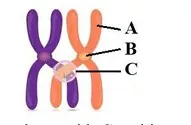
Figure for Question 10
- a) Replication, A – centromere, B – chromatid, C – chiasmata
- b) Crossing over, A – Chromatid, B – chiasmata, C – chromatid
- c) Crossing over, A – Chromatid, B – chromatid, C – Chiasmata
- d) Crossing over, A – Chromatid, B – Chromatid, C – Chiasmata
Correct Answer: c) Crossing over, A – Chromatid, B – chromatid, C – Chiasmata
Reason: The process is crossing over. A and B are chromatids, and C is the chiasma where they cross. Options c and d give the same answer.
3. Linkage and Crossing Over Notes: Short and Long Answer Questions
Short Answer Questions
A gene is the basic unit of heredity. Genes are found on chromosomes, and each chromosome carries many genes because the number of traits is far more than the number of chromosomes. The genes present on the same chromosome are called linked genes, and they are inherited together.
Linkage is the tendency of linked genes to be inherited together in the same progeny, without change in their original sequence. Linked genes do not follow Mendel’s law of independent assortment. They are present in a group called a linkage group, and the number of linkage groups of a species equals its haploid number of chromosomes. Thomas Hunt Morgan discovered linkage in Drosophila melanogaster.
Types of linkage
Figure: Linkage diagram (complete and incomplete linkage)
Drosophila is a small fruit fly, about 2 mm in size, seen hovering over ripe fruits. T. H. Morgan selected it for the study of sex-linked traits for the following reasons.
During meiosis the homologous chromosomes pair up. In crossing over, non-sister chromatids exchange corresponding segments, so new combinations of genes (recombinants) are formed on the chromatids.
Example: one chromosome carries the genes for tall plant and red flower, and its homologue carries dwarf plant and white flower. After crossing over, chromatids with tall plant and white flower, and with dwarf plant and red flower, are also formed.
Red eye (R) is dominant over white eye (r), and the gene is on the X chromosome.
| Gametes of female ↓, male → | Xr | Y |
|---|---|---|
| XR | XRXr (red-eyed female) | XRY (red-eyed male) |
| Xr | XrXr (white-eyed female) | XrY (white-eyed male) |
Phenotypic ratio: 1 red-eyed female : 1 white-eyed female : 1 red-eyed male : 1 white-eyed male. Half of the flies have red eyes and half have white eyes (1 : 1), equally in both sexes.
If all the children have normal vision, the woman must be homozygous normal (XCXC). Colour blindness is an X-linked recessive trait (c).
| Gametes | XC |
|---|---|
| Xc | XCXc (carrier daughter, normal vision) |
| Y | XCY (normal son) |
Explanation: every daughter gets the Xc from the father, but the dominant XC from the mother hides it, so she is a normal carrier. Every son gets the Y from the father and XC from the mother, so he is normal. So 100 % of the children have normal vision.
a) Write down the three possible genotypes and their phenotypes.
| Genotype | Phenotype |
|---|---|
| NN | Normal wings (homozygous dominant) |
| Nn | Normal wings (heterozygous) |
| nn | Vestigial wings (homozygous recessive) |
b) Construct a complete genetic diagram to show the offspring that are produced when a heterozygous fly mates with a fly that is homozygous for the normal wing allele.
| Gametes | N |
|---|---|
| N | NN (normal wings) |
| n | Nn (normal wings) |
Genotypic ratio: 1 NN : 1 Nn. Phenotypic ratio: all offspring (100 %) have normal wings. None has vestigial wings, because the homozygous parent gives a dominant N to every offspring.
Long Answer Questions
When genes are tightly linked and lie very close on the same chromosome, they show a very low frequency of recombination. Only parental (non-crossover) gametes are usually formed. This is complete linkage. The linked genes are not separated during gamete formation, from generation to generation, so the offspring show the same combinations of traits as the parents. It is a rare type.
Example in Drosophila: the grey body with normal wings and the black body with vestigial wings.
| Test cross | Result |
|---|---|
| GN/gn (F₁) × gn/gn | GN/gn: grey body, normal wings (50 %) |
| gn/gn: black body, vestigial wings (50 %) | |
| Recombinants (grey, vestigial or black, normal) | Absent (0 %) |
The body colour gene and the wing gene are completely linked, so the F1 hybrid makes only two types of gametes, each with the parental combination, and there is no recombination.
Note: in Drosophila this happens in the male, where crossing over does not occur.
When genes lie on the same chromosome but are not very close, they show a higher frequency of recombination. Both parental and recombinant gametes are formed, because the genes are separated by crossing over. This is incomplete linkage, and it is more common than complete linkage. It increases genetic variation.
Example in maize: coloured (C) and full (F) seeds are dominant over colourless (c) and shrunken (f) seeds.
| Offspring of the test cross | Type |
|---|---|
| Coloured and full (CcFf) | Parental |
| Coloured and shrunken (Ccff) | Recombinant |
| Colourless and full (ccFf) | Recombinant |
| Colourless and shrunken (ccff) | Parental |
The two parental types are much more frequent (about 96 %), and the two recombinant types are few (about 4 %). If the genes were on different chromosomes, the four types would be equal (1 : 1 : 1 : 1). This shows that the genes for seed colour and seed texture are on the same chromosome but not very close, so crossing over in the F1 hybrid forms the recombinant gametes.
There are two types of chromosomes: autosomes and sex chromosomes. Autosomes control the vegetative characters, and the sex chromosomes determine the sex. Man has 22 pairs of autosomes and one pair of sex chromosomes (female 44+XX, male 44+XY). Drosophila has 3 pairs of autosomes and one pair of sex chromosomes.
The genes present on the sex chromosomes are called sex-linked genes. Sex-linked inheritance is the inheritance of the traits controlled by these genes from parents to offspring in successive generations. Examples are haemophilia, colour blindness and eye colour in Drosophila.
Characters of sex-linked inheritance
Eye colour in Drosophila. Thomas Hunt Morgan, an American zoologist, studied it with his associates and got the Nobel Prize in 1933. He found a white-eyed male fly in his culture. The normal eye colour is red, and white is a mutant form. The gene is on the X chromosome (R = red, r = white).
Cross I: red-eyed female × white-eyed male (XRXR × XrY)
| F₁ gametes | XR | Y |
|---|---|---|
| XR | XRXR red female | XRY red male |
| Xr | XRXr red female | XrY white male |
Cross II: F1 red-eyed female × white-eyed male (XRXr × XrY). Red-eyed and white-eyed females and males were produced in equal proportion. So white eye is not restricted to males, it is present in females also.
Cross III: white-eyed female × red-eyed male (XrXr × XRY). This is the reverse of Cross I. All the sons were white-eyed and all the daughters were red-eyed.
Conclusions of Morgan
Colour blindness is the inability of a person to distinguish red, green or both colours from other colours. The gene for normal vision (C) is dominant. Colour blindness is caused by the defective recessive gene (c) on the X chromosome.
| Sex | Normal vision | Carrier | Colour blind |
|---|---|---|---|
| Female | XCXC | XCXc | XcXc |
| Male | XCY | None (a male cannot be a carrier) | XcY |
a. Colour-blind male × normal female (XcY × XCXC). All the daughters (XCXc) have normal vision but are carriers. All the sons (XCY) are normal, because they get the X from the normal mother. None of the sons is colour blind.
b. Carrier female × normal male (XCXc × XCY). The offspring are 25 % normal daughters (XCXC), 25 % carrier daughters (XCXc), 25 % normal sons (XCY) and 25 % colour-blind sons (XcY). So half of the sons are colour blind.
c. Colour-blind female × normal male (XcXc × XCY). All the daughters (XCXc) are carriers and all the sons (XcY) are colour blind. So 50 % of the offspring are carrier females and 50 % are colour-blind males.
d. Carrier female × colour-blind male (XCXc × XcY). The offspring are 25 % carrier females, 25 % colour-blind females (XcXc), 25 % normal males and 25 % colour-blind males.
Conclusions
Crossing over is the mutual exchange of the corresponding parts of the adjacent paternal and maternal chromatids of the synapsed homologous chromosomes. It produces new combinations of genes, and the chromatids formed by the interchange of segments are called recombinants. The term crossing over was given by Thomas Hunt Morgan.
It occurs during prophase I of meiosis. The actual exchange of genetic material takes place in pachytene, but the process starts in zygotene and ends in diakinesis. The point where the chromatids cross is the chiasma.
According to the number of chiasmata, crossing over may be single (one chiasma), double (two chiasmata) or multiple (more than two chiasmata).
Figure: Crossing over between non-sister chromatids
Significance of crossing over
4. Linkage and Crossing Over Notes PDF
PDF Notes 1: Genetics (Unit 3)
PDF Notes 2: Linkage and Crossing Over (Chapter 3.3)
5. Linkage and Crossing Over: Frequently Asked Questions
What is linkage and crossing over? (Linkage and crossing over notes in simple words)
What are the types of linkage? Give linkage and crossing over examples.
What is the linkage diagram?
Where can I get linkage and crossing over pdf and linkage and crossing over ppt?
Where can I find linkage and crossing over Class 12 notes, linkage and crossing over biology discussion, BYJU’S and Wikipedia versions?
What is sex-linked inheritance and why is Drosophila used?
What is the chance of a colour-blind son if the mother is a carrier and the father is normal?
What are the importance of genetics, genetics in medicine, genetics traits and genetics examples?
Where can I get genetics pdf, genetics ppt, genetics biology notes and a genetics website?
What is the significance of crossing over?
Where can I get Class 12 Biology Book PDF Nepal and Class 12 Biology Book PDF Asmita Publication?
Where can I get Class 12 biology notes, Class 12 biology pdf and Class 12 Biology Notes NEB for this chapter?
Where can I get Class 12 Biology notes in the style of Note Mandir?
Students also search for: