
Class 10 Optional Mathematics Vector
Exercise 10.1: Scalar Product • Exercise 10.2: Position Vectors and Section Formula
63 solved questions with English and Nepali questions, step by step solutions, figures and frequently asked questions for the Nepal Grade 10 SEE.
1. Class 10 Optional Mathematics Vector: Unit Overview and Key Formulas
Unit 10: Vector (Optional Mathematics, Grade 10, SEE, Nepal) • Exercise 10.1 Scalar Product of Vectors • Exercise 10.2 Position Vectors, Mid-point and Section Formula
Class 10 Optional Mathematics Vector is the tenth unit of the course prescribed by the Curriculum Development Centre (CDC), Nepal. This page solves every question of Exercise 10.1 and Exercise 10.2. Every question is written as in the textbook: the main question first (Q.1, Q.2, Q.3 …) with its parts (a, b, c …) listed under it and the Nepali question in brackets. The Miscellaneous Exercise of this unit is on a separate page. Multiple choice solutions and definitions also have Nepali in brackets, and the other solutions are in English because the steps and symbols are the same in both languages.
- Scalar product: \(\vec a\cdot\vec b=|\vec a||\vec b|\cos\theta=x_1x_2+y_1y_2\), a number and not a vector.
- Angle between vectors: \(\cos\theta=\dfrac{\vec a\cdot\vec b}{|\vec a||\vec b|}\).
- Perpendicular and parallel: \(\vec a\perp\vec b\Leftrightarrow\vec a\cdot\vec b=0\) and \(\vec a\parallel\vec b\Leftrightarrow x_1y_2=x_2y_1\).
- Vector between points: \(\overrightarrow{AB}=(x_2-x_1,\ y_2-y_1)\).
- Midpoint (Exercise 10.2): \(\vec p=\dfrac{\vec a+\vec b}{2}\), and \(\overrightarrow{AB}+\overrightarrow{BC}=\overrightarrow{AC}\) by the triangle law.
- Section formula (Exercise 10.2): internal \(\vec p=\dfrac{m\vec b+n\vec a}{m+n}\), external \(\vec p=\dfrac{m\vec b-n\vec a}{m-n}\).
Key formulas to remember
Figure: The angle θ between two vectors a and b and the scalar product a · b = |a||b| cos θ.
For more chapters, visit the complete SEE Class 10 Optional Mathematics notes. You can also read about the dot product for extra understanding.
2. Exercise 10.1 Scalar Product of Vectors: Class 10 Optional Mathematics Vector
Exercise 10.1: Multiple Choice Questions (बहुवैकल्पिक प्रश्न)
Q.1 Tick (✓) the correct option for the given questions.
(दिइएका प्रश्नहरूको उपयुक्त विकल्पमा ठिक चिह्न (✓) लगाउनुहोस् : )
A. If the angle between the vectors \(\vec a\) and \(\vec b\) is \(\theta\), which one is the scalar product of \(\vec a\) and \(\vec b\)? (यदि दुई भेक्टरहरू \(\vec a\) र \(\vec b\) बिचको कोण \(\theta\) भए, तिनीहरूको स्केलर गुणनफल कुन हो ?)
- a) \(\vec a\cdot\vec b=|\vec a||\vec b|\sin\theta\)
- b) \(\vec a\cdot\vec b=|\vec a||\vec b|\cos\theta\)
- c) \(\vec a\cdot\vec b=|\vec a|+|\vec b|\cos\theta\)
- d) \(\vec a\cdot\vec b=|\vec a|+|\vec b|\sin\theta\)
Correct Answer: b) \(\vec a\cdot\vec b=|\vec a||\vec b|\cos\theta\)
Solution:
- The scalar (dot) product is the product of the magnitudes and the cosine of the angle between the vectors.
(दुई भेक्टरको स्केलर गुणनफल \(|\vec a||\vec b|\cos\theta\) हुन्छ ।)
B. If \(\vec a=(x_1,y_1)\) and \(\vec b=(x_2,y_2)\), what is the value of \(\vec a\cdot\vec b\)? (यदि \(\vec a=(x_1,y_1)\) र \(\vec b=(x_2,y_2)\) भए \(\vec a\cdot\vec b\) को मान कति हुन्छ ?)
- a) \(x_1y_1+x_2y_2\)
- b) \(x_1x_2-y_1y_2\)
- c) \(x_1x_2+y_1y_2\)
- d) \(x_1y_2+x_2y_1\)
Correct Answer: c) \(x_1x_2+y_1y_2\)
Solution:
- In component form, add the product of the \(x\)-components and the product of the \(y\)-components.
(घटकहरूको रूपमा \(\vec a\cdot\vec b=x_1x_2+y_1y_2\) हुन्छ ।)
C. If \(\vec a\cdot\vec b=0\) and \(|\vec a|\neq0\), \(|\vec b|\neq0\), what is the angle between \(\vec a\) and \(\vec b\)? (यदि \(\vec a\cdot\vec b=0\) र \(|\vec a|\neq0\), \(|\vec b|\neq0\) भए \(\vec a\) र \(\vec b\) बिचको कोण कति हुन्छ ?)
- a) \(0^\circ\)
- b) \(45^\circ\)
- c) \(90^\circ\)
- d) \(180^\circ\)
Correct Answer: c) \(90^\circ\)
Solution:
Here, \(0=|\vec a||\vec b|\cos\theta\). Since \(|\vec a|\neq0\) and \(|\vec b|\neq0\), divide both sides by \(|\vec a||\vec b|\).
\[\cos\theta=0 \implies \theta=90^\circ\](\(\cos\theta=0\) भएकाले \(\theta=90^\circ\) हुन्छ ।)
D. If \(\vec a\) and \(\vec b\) are parallel and in the same direction, what is the value of \(\vec a\cdot\vec b\)? (यदि \(\vec a\) र \(\vec b\) एउटै दिशामा समानान्तर छन् भने \(\vec a\cdot\vec b\) को मान कति हुन्छ ?)
- a) \(|\vec a||\vec b|\)
- b) \(-|\vec a||\vec b|\)
- c) \(0\)
- d) \(1\)
Correct Answer: a) \(|\vec a||\vec b|\)
Solution:
Parallel vectors in the same direction have \(\theta=0^\circ\).
\[\begin{aligned}\vec a\cdot\vec b &= |\vec a||\vec b|\cos0^\circ \\ &= |\vec a||\vec b|(1) \\ &= |\vec a||\vec b|\end{aligned}\](\(\theta=0^\circ\) भएकाले \(\vec a\cdot\vec b=|\vec a||\vec b|\) हुन्छ ।)
E. If \(\vec a=\begin{pmatrix}2\\3\end{pmatrix}\) and \(\vec b=\begin{pmatrix}-3\\2\end{pmatrix}\), what is the value of \(\vec a\cdot\vec b\)? (यदि \(\vec a=\begin{pmatrix}2\\3\end{pmatrix}\) र \(\vec b=\begin{pmatrix}-3\\2\end{pmatrix}\) भए \(\vec a\cdot\vec b\) को मान कति हुन्छ ?)
- a) \(12\)
- b) \(0\)
- c) \(-12\)
- d) \(1\)
Correct Answer: b) \(0\)
Solution:
Here, \(x_1=2\), \(y_1=3\), \(x_2=-3\), \(y_2=2\).
\[\begin{aligned}\vec a\cdot\vec b &= x_1x_2+y_1y_2 \\ &= (2)(-3)+(3)(2) \\ &= -6+6 \\ &= 0\end{aligned}\](\(\vec a\cdot\vec b=(2)(-3)+(3)(2)=0\) हुन्छ ।)
F. If \(\vec a=\begin{pmatrix}2\\3\end{pmatrix}\), what is the value of \(\vec a^{\,2}\)? (यदि \(\vec a=\begin{pmatrix}2\\3\end{pmatrix}\) भए \(\vec a^{\,2}\) को मान कति हुन्छ ?)
- a) \(5\)
- b) \(-13\)
- c) \(13\)
- d) \(25\)
Correct Answer: c) \(13\)
Solution:
- The square of a vector is the scalar product of the vector with itself, which equals \(|\vec a|^2\).
(\(\vec a^{\,2}=\vec a\cdot\vec a=2^2+3^2=13\) हुन्छ ।)
G. If \(\overrightarrow{OA}=\begin{pmatrix}5\\m\end{pmatrix}\), \(\overrightarrow{OB}=\begin{pmatrix}4\\-2\end{pmatrix}\) and \(\angle AOB=90^\circ\), what is the value of \(m\)? (यदि \(\overrightarrow{OA}=\begin{pmatrix}5\\m\end{pmatrix}\), \(\overrightarrow{OB}=\begin{pmatrix}4\\-2\end{pmatrix}\) र \(\angle AOB=90^\circ\) भए \(m\) को मान कति हुन्छ ?)
- a) \(10\)
- b) \(-10\)
- c) \(6\)
- d) \(-6\)
Correct Answer: a) \(10\)
Solution:
Since \(\angle AOB=90^\circ\), \(\overrightarrow{OA}\cdot\overrightarrow{OB}=0\).
\[\begin{aligned}& 5(4)+m(-2)=0 \\ &\implies 20-2m=0 \\ &\implies m=10\end{aligned}\](\(\overrightarrow{OA}\cdot\overrightarrow{OB}=0\) बाट \(20-2m=0\) र \(m=10\) आउँछ ।)
Exercise 10.1: Written Questions (लेख्ने प्रश्न)
Q.2 What is meant by the scalar product of two vectors? Explain with an example.
(दुई भेक्टरहरूको स्केलर गुणनफल भनेको के हो, उदाहरणसहित स्पष्ट पार्नुहोस् ।)
Definition
The scalar product (dot product) of two vectors \(\vec a\) and \(\vec b\) is the real number (a scalar) obtained by multiplying their magnitudes and the cosine of the angle \(\theta\) between them.
(दुई भेक्टर \(\vec a\) र \(\vec b\) को स्केलर गुणनफल भनेको तिनीहरूको परिमाण र तिनीहरूबिचको कोण \(\theta\) को कोसाइनको गुणनफलबाट प्राप्त हुने वास्तविक सङ्ख्या (स्केलर) हो ।)
Formulas
\[\vec a\cdot\vec b=|\vec a||\vec b|\cos\theta\]In component form, for \(\vec a=\begin{pmatrix}x_1\\y_1\end{pmatrix}\) and \(\vec b=\begin{pmatrix}x_2\\y_2\end{pmatrix}\):
\[\vec a\cdot\vec b=x_1x_2+y_1y_2\]Example
Let \(\vec a=\begin{pmatrix}3\\4\end{pmatrix}\) and \(\vec b=\begin{pmatrix}2\\5\end{pmatrix}\).
\[\begin{aligned}\vec a\cdot\vec b &= (3)(2)+(4)(5) \\ &= 6+20 \\ &= 26\end{aligned}\]The result \(26\) is a real number, not a vector.
Q.3 Under what conditions are two vectors perpendicular or parallel? Give reasons.
(दुई भेक्टरहरू कुन अवस्थामा लम्ब वा समानान्तर हुन्छन्, कारण दिनुहोस् ।)
Perpendicular vectors
Two non-zero vectors \(\vec a\) and \(\vec b\) are perpendicular if and only if \(\vec a\cdot\vec b=0\).
Reason: the angle between them is \(\theta=90^\circ\) and \(\cos90^\circ=0\).
\[\begin{aligned}\vec a\cdot\vec b &= |\vec a||\vec b|\cos90^\circ \\ &= 0\end{aligned}\]In component form: \(x_1x_2+y_1y_2=0\).
Parallel vectors
Two non-zero vectors \(\vec a=\begin{pmatrix}x_1\\y_1\end{pmatrix}\) and \(\vec b=\begin{pmatrix}x_2\\y_2\end{pmatrix}\) are parallel if their components are proportional.
Reason: for parallel vectors \(\vec a=k\vec b\), so \(x_1=kx_2\) and \(y_1=ky_2\). Dividing, \(\dfrac{x_1}{x_2}=\dfrac{y_1}{y_2}=k\), which gives the cross-multiplication condition \(x_1y_2=x_2y_1\).
Q.4 Find the scalar product of the following vectors:
- a. \(\vec i=\begin{pmatrix}1\\0\end{pmatrix}\) and \(\vec j=\begin{pmatrix}0\\1\end{pmatrix}\)
- b. \(\vec a=\begin{pmatrix}2\\0\end{pmatrix}\) and \(\vec b=\begin{pmatrix}3\\0\end{pmatrix}\)
- c. \(\vec a=\begin{pmatrix}-4\\2\end{pmatrix}\) and \(\vec b=\begin{pmatrix}1\\2\end{pmatrix}\)
- d. \(\vec p=\begin{pmatrix}3\\1\end{pmatrix}\) and \(\vec q=\begin{pmatrix}-1\\3\end{pmatrix}\)
(निम्नलिखित भेक्टरहरूको स्केलर गुणनफल पत्ता लगाउनुहोस् : )
Here, \(x_1=1\), \(y_1=0\), \(x_2=0\), \(y_2=1\).
\[\begin{aligned}\vec i\cdot\vec j &= x_1x_2+y_1y_2 \\ &= (1)(0)+(0)(1) \\ &= 0+0 \\ &= 0\end{aligned}\]Here, \(x_1=2\), \(y_1=0\), \(x_2=3\), \(y_2=0\).
\[\begin{aligned}\vec a\cdot\vec b &= x_1x_2+y_1y_2 \\ &= (2)(3)+(0)(0) \\ &= 6+0 \\ &= 6\end{aligned}\]Here, \(x_1=-4\), \(y_1=2\), \(x_2=1\), \(y_2=2\).
\[\begin{aligned}\vec a\cdot\vec b &= x_1x_2+y_1y_2 \\ &= (-4)(1)+(2)(2) \\ &= -4+4 \\ &= 0\end{aligned}\]Here, \(x_1=3\), \(y_1=1\), \(x_2=-1\), \(y_2=3\).
\[\begin{aligned}\vec p\cdot\vec q &= x_1x_2+y_1y_2 \\ &= (3)(-1)+(1)(3) \\ &= -3+3 \\ &= 0\end{aligned}\]Q.5 Find the angle between the following vectors:
- a. \(\vec i=\begin{pmatrix}1\\0\end{pmatrix}\) and \(\vec j=\begin{pmatrix}0\\1\end{pmatrix}\)
- b. \(\vec a=\begin{pmatrix}2\\0\end{pmatrix}\) and \(\vec b=\begin{pmatrix}3\\0\end{pmatrix}\)
- c. \(\vec a=\begin{pmatrix}-4\\2\end{pmatrix}\) and \(\vec b=\begin{pmatrix}1\\2\end{pmatrix}\)
- d. \(\vec p=\begin{pmatrix}3\\1\end{pmatrix}\) and \(\vec q=\begin{pmatrix}-1\\3\end{pmatrix}\)
(निम्नलिखित भेक्टरहरूबिचको कोण पत्ता लगाउनुहोस् : )
Let \(\theta\) be the angle between the vectors.
\[\vec i\cdot\vec j=(1)(0)+(0)(1)=0\]\[\begin{aligned}|\vec i| &= \sqrt{1^2+0^2} \\ &= 1,\qquad |\vec j| \\ &= \sqrt{0^2+1^2} \\ &= 1\end{aligned}\]\[\begin{aligned}\cos\theta &= \frac{\vec i\cdot\vec j}{|\vec i||\vec j|} \\ &= \frac{0}{1\times 1} \\ &= 0\end{aligned}\]\[\theta=90^\circ\]Let \(\theta\) be the angle between the vectors.
\[\vec a\cdot\vec b=(2)(3)+(0)(0)=6\]\[\begin{aligned}|\vec a| &= \sqrt{2^2+0^2} \\ &= 2,\qquad |\vec b| \\ &= \sqrt{3^2+0^2} \\ &= 3\end{aligned}\]\[\begin{aligned}\cos\theta &= \frac{\vec a\cdot\vec b}{|\vec a||\vec b|} \\ &= \frac{6}{2\times 3} \\ &= \frac{6}{6} \\ &= 1\end{aligned}\]\[\theta=0^\circ\]Let \(\theta\) be the angle between the vectors.
\[\vec a\cdot\vec b=(-4)(1)+(2)(2)=0\]\[\begin{aligned}|\vec a| &= \sqrt{(-4)^2+2^2} \\ &= \sqrt{20},\qquad |\vec b| \\ &= \sqrt{1^2+2^2} \\ &= \sqrt{5}\end{aligned}\]\[\begin{aligned}\cos\theta &= \frac{\vec a\cdot\vec b}{|\vec a||\vec b|} \\ &= \frac{0}{\sqrt{20}\times \sqrt{5}} \\ &= 0\end{aligned}\]\[\theta=90^\circ\]Let \(\theta\) be the angle between the vectors.
\[\vec p\cdot\vec q=(3)(-1)+(1)(3)=0\]\[\begin{aligned}|\vec p| &= \sqrt{3^2+1^2} \\ &= \sqrt{10},\qquad |\vec q| \\ &= \sqrt{(-1)^2+3^2} \\ &= \sqrt{10}\end{aligned}\]\[\begin{aligned}\cos\theta &= \frac{\vec p\cdot\vec q}{|\vec p||\vec q|} \\ &= \frac{0}{\sqrt{10}\times \sqrt{10}} \\ &= 0\end{aligned}\]\[\theta=90^\circ\]Q.6 Determine whether the following vectors are perpendicular or parallel:
- a. \(\vec i=\begin{pmatrix}1\\0\end{pmatrix}\) and \(\vec j=\begin{pmatrix}0\\1\end{pmatrix}\)
- b. \(\vec a=\begin{pmatrix}2\\0\end{pmatrix}\) and \(\vec b=\begin{pmatrix}0\\3\end{pmatrix}\)
(निम्नलिखित भेक्टरहरू लम्ब हुन् वा समानान्तर, पत्ता लगाउनुहोस् : )
Calculate the scalar product.
\[\vec i\cdot\vec j=(1)(0)+(0)(1)=0+0=0\]Since the scalar product is zero, the vectors are perpendicular.
Calculate the scalar product.
\[\vec a\cdot\vec b=(2)(0)+(0)(3)=0+0=0\]Since the scalar product is zero, the vectors are perpendicular.
Q.7 If the following vectors are perpendicular, find the value of \(m\):
- a. \(\vec a=\begin{pmatrix}2\\m\end{pmatrix}\) and \(\vec b=\begin{pmatrix}3\\2\end{pmatrix}\)
- b. \(\vec a=\begin{pmatrix}3\\m\end{pmatrix}\) and \(\vec b=\begin{pmatrix}6\\4\end{pmatrix}\)
- c. \(\vec a=3\vec i+m\vec j=\begin{pmatrix}3\\m\end{pmatrix}\) and \(\vec b=6\vec i-2\vec j=\begin{pmatrix}6\\-2\end{pmatrix}\)
- d. \(\vec p=3\vec i-2\vec j=\begin{pmatrix}3\\-2\end{pmatrix}\) and \(\vec q=m\vec i+3\vec j=\begin{pmatrix}m\\3\end{pmatrix}\)
(निम्नलिखित भेक्टरहरू लम्ब भए \(m\) को मान पत्ता लगाउनुहोस् : )
Since the vectors are perpendicular, \(x_1x_2+y_1y_2=0\).
\[\begin{aligned}& (2)(3)+(m)(2)=0 \\ &\implies 6+2m=0 \\ &\implies 2m=-6 \\ &\implies m=-3\end{aligned}\]Q.8 If the following vectors are parallel, find the value of \(m\):
- a. \(\vec a=\begin{pmatrix}2\\m\end{pmatrix}\) and \(\vec b=\begin{pmatrix}3\\2\end{pmatrix}\)
- b. \(\vec a=\begin{pmatrix}3\\m\end{pmatrix}\) and \(\vec b=\begin{pmatrix}6\\4\end{pmatrix}\)
- c. \(\vec a=3\vec i+m\vec j=\begin{pmatrix}3\\m\end{pmatrix}\) and \(\vec b=6\vec i-2\vec j=\begin{pmatrix}6\\-2\end{pmatrix}\)
- d. \(\vec p=3\vec i-2\vec j=\begin{pmatrix}3\\-2\end{pmatrix}\) and \(\vec q=m\vec i+3\vec j=\begin{pmatrix}m\\3\end{pmatrix}\)
(निम्नलिखित भेक्टरहरू समानान्तर भए \(m\) को मान पत्ता लगाउनुहोस् : )
Since the vectors are parallel, \(x_1y_2=x_2y_1\).
\[\begin{aligned}& (2)(2)=(3)(m) \\ &\implies 4=3m \\ &\implies m=\frac43\end{aligned}\]Since the vectors are perpendicular, \(x_1x_2+y_1y_2=0\).
\[\begin{aligned}& (3)(6)+(m)(4)=0 \\ &\implies 18+4m=0 \\ &\implies 4m=-18 \\ &\implies m=-\frac92\end{aligned}\]Since the vectors are parallel, \(x_1y_2=x_2y_1\).
\[\begin{aligned}& (3)(4)=(6)(m) \\ &\implies 12=6m \\ &\implies m=2\end{aligned}\]Since the vectors are perpendicular, \(x_1x_2+y_1y_2=0\).
\[\begin{aligned}& (3)(6)+(m)(-2)=0 \\ &\implies 18-2m=0 \\ &\implies m=9\end{aligned}\]Since the vectors are parallel, \(x_1y_2=x_2y_1\).
\[\begin{aligned}& (3)(-2)=(6)(m) \\ &\implies -6=6m \\ &\implies m=-1\end{aligned}\]Since the vectors are perpendicular, \(x_1x_2+y_1y_2=0\).
\[\begin{aligned}& (3)(m)+(-2)(3)=0 \\ &\implies 3m-6=0 \\ &\implies m=2\end{aligned}\]Since the vectors are parallel, \(x_1y_2=x_2y_1\).
\[\begin{aligned}& (3)(3)=(m)(-2) \\ &\implies 9=-2m \\ &\implies m=-\frac92\end{aligned}\]Q.9 Let \(\vec a=\begin{pmatrix}x_1\\y_1\end{pmatrix}\) and \(\vec b=\begin{pmatrix}x_2\\y_2\end{pmatrix}\) be two vectors.
- a. What is the scalar product \(\vec a\cdot\vec b\)?
- b. If \(\vec a\cdot\vec b=0\), what is the relationship between \(\vec a\) and \(\vec b\)?
- c. If \(\vec a=\begin{pmatrix}2\\3\end{pmatrix}\) and \(\vec b=\begin{pmatrix}4\\5\end{pmatrix}\), find the value of \(\vec a\cdot\vec b\).
- d. Under what condition is \(\vec a\cdot\vec b\) maximum? Discuss with reason.
(मानौँ \(\vec a\) र \(\vec b\) दुई भेक्टर हुन् ।)
Multiply the corresponding \(x\)-components and \(y\)-components and add the results.
\[\vec a\cdot\vec b=x_1x_2+y_1y_2\]Since \(\vec a\cdot\vec b=|\vec a||\vec b|\cos\theta=0\), for non-zero vectors we get \(\cos\theta=0\), so \(\theta=90^\circ\).
Here, \(x_1=2\), \(y_1=3\), \(x_2=4\), \(y_2=5\).
\[\begin{aligned}\vec a\cdot\vec b &= (2)(4)+(3)(5) \\ &= 8+15 \\ &= 23\end{aligned}\]We have \(\vec a\cdot\vec b=|\vec a||\vec b|\cos\theta\). The magnitudes \(|\vec a|\) and \(|\vec b|\) are fixed, so the value depends on \(\cos\theta\).
The greatest value of \(\cos\theta\) is \(1\), which happens when \(\theta=0^\circ\). Then the vectors are parallel and in the same direction.
\[\begin{aligned}(\vec a\cdot\vec b)_{\max} &= |\vec a||\vec b|\cos0^\circ \\ &= |\vec a||\vec b|\end{aligned}\]Q.10 Four points \(A(-2,1)\), \(B(-1,-3)\), \(C(3,-2)\) and \(D(2,2)\) are given.
- a. If \(A(x_1,y_1)\) and \(B(x_2,y_2)\), what is the vector \(\overrightarrow{AB}\)?
- b. Express \(\overrightarrow{AB}\) and \(\overrightarrow{BD}\) in the form of column vectors.
- c. Find the angle between \(\overrightarrow{AC}\) and \(\overrightarrow{BD}\).
- d. Determine whether \(ABCD\) is a parallelogram or a rectangle based on the lengths of sides and angles.
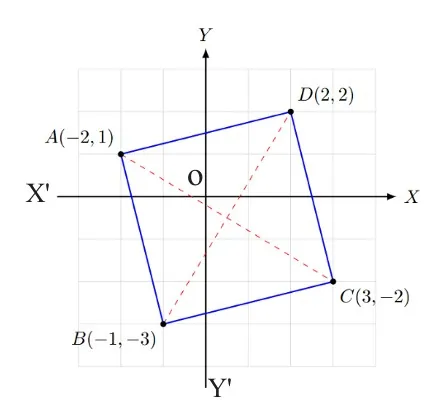
(चार बिन्दुहरू \(A(-2,1)\), \(B(-1,-3)\), \(C(3,-2)\) र \(D(2,2)\) दिइएका छन् ।)
The vector from \(A\) to \(B\) is found by subtracting the coordinates of the starting point from those of the end point.
\[\overrightarrow{AB}=\begin{pmatrix}x_2-x_1\\ y_2-y_1\end{pmatrix}\]Here, \(A(-2,1)\), \(B(-1,-3)\) and \(D(2,2)\).
\[\begin{aligned}\overrightarrow{AB} &= \begin{pmatrix}-1-(-2)\\ -3-1\end{pmatrix} \\ &= \begin{pmatrix}1\\ -4\end{pmatrix}\end{aligned}\]\[\begin{aligned}\overrightarrow{BD} &= \begin{pmatrix}2-(-1)\\ 2-(-3)\end{pmatrix} \\ &= \begin{pmatrix}3\\ 5\end{pmatrix}\end{aligned}\]Since the scalar product is zero, the angle between \(\overrightarrow{AC}\) and \(\overrightarrow{BD}\) is \(90^\circ\).
The side vectors and their lengths
\[\begin{aligned}\overrightarrow{AB} &= \begin{pmatrix}1\\ -4\end{pmatrix},\quad \overrightarrow{BC} \\ &= \begin{pmatrix}4\\ 1\end{pmatrix},\quad \overrightarrow{CD} \\ &= \begin{pmatrix}-1\\ 4\end{pmatrix},\quad \overrightarrow{DA} \\ &= \begin{pmatrix}-4\\ -1\end{pmatrix}\end{aligned}\]\[\begin{aligned}|\overrightarrow{AB}| &= |\overrightarrow{BC}| \\ &= |\overrightarrow{CD}| \\ &= |\overrightarrow{DA}| \\ &= \sqrt{1+16} \\ &= \sqrt{17}\end{aligned}\]Also \(\overrightarrow{CD}=-\overrightarrow{AB}\) and \(\overrightarrow{DA}=-\overrightarrow{BC}\), so opposite sides are equal and parallel: \(ABCD\) is a parallelogram, and all four sides are equal.
An angle
\[\begin{aligned}\overrightarrow{AB}\cdot\overrightarrow{BC} &= (1)(4)+(-4)(1) \\ &= 4-4 \\ &= 0\end{aligned}\]So \(\angle ABC=90^\circ\) and the parallelogram has a right angle.
Conclusion
A parallelogram with a right angle is a rectangle, and it has four equal sides, so it is a square. Its diagonals are also perpendicular (part (c)).
Q.11 Given that \(\vec a+\vec b+\vec c=0\).
- a. What does \(\vec a+\vec b+\vec c=0\) mean?
- b. If \(|\vec a|=3\), \(|\vec b|=5\) and \(|\vec c|=4\), find \(\vec a\cdot\vec c\).
(दिइएको छ \(\vec a+\vec b+\vec c=0\) ।)
Figure: Three vectors with a + b + c = 0 form a closed triangle when placed head to tail (here |a| = 3, |c| = 4, |b| = 5).
The sum of the three vectors is the zero vector. Placing them head to tail in order, the end of the last vector returns to the starting point, so the vectors form a closed triangle.
(तीन भेक्टरको योगफल शून्य भेक्टर हुनुको अर्थ ती भेक्टरलाई क्रमशः जोड्दा बन्द त्रिभुज बन्छ भन्ने हो ।)
From \(\vec a+\vec b+\vec c=0\) we get \(\vec a+\vec c=-\vec b\). Square both sides, using \(\vec v^{\,2}=|\vec v|^2\):
\[(\vec a+\vec c)^2=(-\vec b)^2 \implies |\vec a|^2+2\,\vec a\cdot\vec c+|\vec c|^2=|\vec b|^2\]Substitute the magnitudes:
\[\begin{aligned}& 3^2+2\,\vec a\cdot\vec c+4^2=5^2 \\ &\implies 25+2\,\vec a\cdot\vec c=25 \\ &\implies \vec a\cdot\vec c=0\end{aligned}\]Q.12 If \(|\vec a+\vec b|=|\vec a-\vec b|\), prove that the vectors \(\vec a\) and \(\vec b\) are perpendicular to each other.
(यदि \(|\vec a+\vec b|=|\vec a-\vec b|\) भए भेक्टरहरू \(\vec a\) र \(\vec b\) एकआपसमा लम्ब हुन्छन् भनी प्रमाणित गर्नुहोस् ।)
Square both sides of \(|\vec a+\vec b|=|\vec a-\vec b|\) and use \(|\vec v|^2=\vec v\cdot\vec v\):
\[(\vec a+\vec b)\cdot(\vec a+\vec b)=(\vec a-\vec b)\cdot(\vec a-\vec b)\]Expand both sides:
\[|\vec a|^2+2\,\vec a\cdot\vec b+|\vec b|^2=|\vec a|^2-2\,\vec a\cdot\vec b+|\vec b|^2\]Cancel \(|\vec a|^2+|\vec b|^2\) from both sides:
\[\begin{aligned}& 2\,\vec a\cdot\vec b=-2\,\vec a\cdot\vec b \\ &\implies 4\,\vec a\cdot\vec b=0 \\ &\implies \vec a\cdot\vec b=0\end{aligned}\]Since \(\vec a\cdot\vec b=0\), the vectors are perpendicular.
1. A. b B. c C. c D. a E. b F. c G. a
4. a. \(0\) b. \(6\) c. \(0\) d. \(0\) 5. a. \(90^\circ\) b. \(0^\circ\) c. \(90^\circ\) d. \(90^\circ\)
6. Perpendicular in both 7. a. \(-3\) b. \(-\frac92\) c. \(9\) d. \(2\)
8. a. \(\frac43\) b. \(2\) c. \(-1\) d. \(-\frac92\) 9. c. \(23\)
10. b. \(\begin{pmatrix}1\\-4\end{pmatrix}\), \(\begin{pmatrix}3\\5\end{pmatrix}\) c. \(90^\circ\) d. Square 11. b. \(0\) 12. Proved
3. Exercise 10.2 Position Vectors, Mid-point and Section Formula: Class 10 Optional Mathematics Vector
Exercise 10.2: Multiple Choice Questions (बहुवैकल्पिक प्रश्न)
Q.1 Tick (✓) the correct option for the given questions.
(दिइएका प्रश्नहरूको उपयुक्त विकल्पमा ठिक चिह्न (✓) लगाउनुहोस् : )
A. In triangle \(ABC\), what is \(\overrightarrow{AB}+\overrightarrow{BC}\) equal to? (त्रिभुज \(ABC\) मा \(\overrightarrow{AB}+\overrightarrow{BC}\) कुन भुजासँग बराबर हुन्छ ?)
- a) \(\overrightarrow{CA}\)
- b) \(\overrightarrow{BA}\)
- c) \(\overrightarrow{AC}\)
- d) \(\overrightarrow{CB}\)
Correct Answer: c) \(\overrightarrow{AC}\)
Solution:
- By the triangle law of vector addition, if two vectors are the two sides of a triangle taken in order, their sum is the third side taken from the starting point to the end point.
(त्रिभुजको जोडको नियमअनुसार \(\overrightarrow{AB}+\overrightarrow{BC}=\overrightarrow{AC}\) हुन्छ ।)
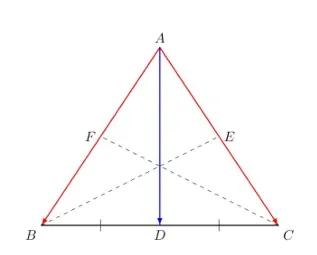
B. In the triangle \(ABC\), \(D\), \(E\), \(F\) are the midpoints of \(BC\), \(CA\), \(AB\). What is \(2\overrightarrow{AD}\) equal to? (दिइएको \(\Delta ABC\) मा \(D\), \(E\), \(F\) क्रमशः \(BC\), \(CA\), \(AB\) का मध्यविन्दुहरू हुन् । \(2\overrightarrow{AD}\) कुन भुजासँग बराबर हुन्छ ?)
- a) \(\overrightarrow{AB}-\overrightarrow{AC}\)
- b) \(\overrightarrow{AB}+\overrightarrow{AC}\)
- c) \(\overrightarrow{AC}-\overrightarrow{AB}\)
- d) \(\dfrac12(\overrightarrow{AB}+\overrightarrow{AC})\)
Correct Answer: b) \(\overrightarrow{AB}+\overrightarrow{AC}\)
Solution:
Since \(D\) is the midpoint of \(BC\), \(\overrightarrow{BD}=\overrightarrow{DC}\), so \(\overrightarrow{CD}=-\overrightarrow{BD}\). By the triangle law,
\[\overrightarrow{AD}=\overrightarrow{AB}+\overrightarrow{BD},\qquad \overrightarrow{AD}=\overrightarrow{AC}+\overrightarrow{CD}\]Add the two equations:
\[\begin{aligned}2\overrightarrow{AD} &= \overrightarrow{AB}+\overrightarrow{AC}+(\overrightarrow{BD}+\overrightarrow{CD}) \\ &= \overrightarrow{AB}+\overrightarrow{AC}+0 \\ &= \overrightarrow{AB}+\overrightarrow{AC}\end{aligned}\](\(D\) मध्यविन्दु भएकाले \(2\overrightarrow{AD}=\overrightarrow{AB}+\overrightarrow{AC}\) हुन्छ ।)
C. If the position vectors of \(A\) and \(B\) are \(\vec a\) and \(\vec b\), what is the position vector of the midpoint of \(AB\)? (यदि \(A\) र \(B\) का स्थिति भेक्टरहरू क्रमशः \(\vec a\) र \(\vec b\) भए, रेखाखण्ड \(AB\) को मध्यविन्दुको स्थिति भेक्टर कुन हो ?)
- a) \(\vec a+\vec b\)
- b) \(\dfrac{\vec a-\vec b}{2}\)
- c) \(\dfrac{\vec a+\vec b}{2}\)
- d) \(2(\vec a+\vec b)\)
Correct Answer: c) \(\dfrac{\vec a+\vec b}{2}\)
Solution:
Here, \(\overrightarrow{OA}=\vec a\) and \(\overrightarrow{OB}=\vec b\). Let \(M\) be the midpoint of \(AB\).
\[\overrightarrow{OM}=\frac{\overrightarrow{OA}+\overrightarrow{OB}}{2}=\frac{\vec a+\vec b}{2}\](मध्यविन्दुको स्थिति भेक्टर \(\dfrac{\vec a+\vec b}{2}\) हुन्छ ।)
D. If \(\overrightarrow{OA}=4\vec i+3\vec j\) and \(\overrightarrow{OB}=3\vec i-4\vec j\), what is the position vector of the midpoint of \(AB\)? (यदि \(\overrightarrow{OA}=4\vec i+3\vec j\) र \(\overrightarrow{OB}=3\vec i-4\vec j\) भए \(AB\) को मध्यविन्दुको स्थिति भेक्टर कति हुन्छ ?)
- a) \(7\vec i-\vec j\)
- b) \(\dfrac12(7\vec i-\vec j)\)
- c) \(\vec i+7\vec j\)
- d) \(\dfrac12(\vec i+7\vec j)\)
Correct Answer: b) \(\dfrac12(7\vec i-\vec j)\)
Solution:
Let \(M\) be the midpoint of \(AB\).
\[\begin{aligned}\overrightarrow{OM} &= \frac{\overrightarrow{OA}+\overrightarrow{OB}}{2} \\ &= \frac{(4\vec i+3\vec j)+(3\vec i-4\vec j)}{2} \\ &= \frac{7\vec i-\vec j}{2} \\ &= \frac12(7\vec i-\vec j)\end{aligned}\](\(\overrightarrow{OM}=\dfrac{7\vec i-\vec j}{2}=\dfrac12(7\vec i-\vec j)\) हुन्छ ।)
E. If the point \(P\) divides the line segment joining the points with position vectors \(\vec a\) and \(\vec b\) internally in the ratio \(m:n\), what is the position vector \(\vec p\)? (यदि विन्दु \(P\) ले स्थिति भेक्टरहरू \(\vec a\) र \(\vec b\) भएका विन्दुहरूलाई जोड्ने रेखाखण्डलाई भित्रबाट \(m:n\) को अनुपातमा विभाजन गर्छ भने \(P\) को स्थिति भेक्टर \(\vec p\) कुन हो ?)
- a) \(\dfrac{m\vec a+n\vec b}{m+n}\)
- b) \(\dfrac{n\vec a+m\vec b}{m+n}\)
- c) \(\dfrac{n\vec a-m\vec b}{n-m}\)
- d) \(\dfrac{m\vec b+n\vec a}{m-n}\)
Correct Answer: b) \(\dfrac{n\vec a+m\vec b}{m+n}\)
Solution:
Since \(AP:PB=m:n\) and \(P\) lies between \(A\) and \(B\), \(n\overrightarrow{AP}=m\overrightarrow{PB}\).
\[\begin{aligned}n(\vec p-\vec a) &= m(\vec b-\vec p) \\ n\vec p-n\vec a &= m\vec b-m\vec p \\ (m+n)\vec p &= n\vec a+m\vec b \\ \vec p &= \frac{n\vec a+m\vec b}{m+n}\end{aligned}\](भित्री विभाजनको सूत्र \(\vec p=\dfrac{n\vec a+m\vec b}{m+n}\) हुन्छ ।)
Exercise 10.2: Written Questions (लेख्ने प्रश्न)
Here, \(\overrightarrow{OP}=4\vec i+7\vec j\) and \(\overrightarrow{OQ}=4\vec i-3\vec j\).
\[\begin{aligned}\overrightarrow{OR} &= \frac{\overrightarrow{OP}+\overrightarrow{OQ}}{2} \\ &= \frac{(4\vec i+7\vec j)+(4\vec i-3\vec j)}{2} \\ &= \frac{8\vec i+4\vec j}{2} \\ &= 4\vec i+2\vec j\end{aligned}\]Here, \(\overrightarrow{OR}=5\vec i-4\vec j\) and \(\overrightarrow{OS}=2\vec i+23\vec j\).
\[\begin{aligned}\overrightarrow{OT} &= \frac{\overrightarrow{OR}+\overrightarrow{OS}}{2} \\ &= \frac{(5\vec i-4\vec j)+(2\vec i+23\vec j)}{2} \\ &= \frac{7\vec i+19\vec j}{2} \\ &= \frac72\vec i+\frac{19}{2}\vec j\end{aligned}\]Q.3 The points \(A(2,-3)\) and \(B(3,2)\) are the end points of the line segment \(AB\).
- a. If \(M\) divides \(AB\) internally in the ratio \(2:3\), find the position vector of \(M\)
- b. If \(N\) divides \(AB\) externally in the ratio \(3:1\), find the position vector of \(N\)
Here, \(\overrightarrow{OA}=2\vec i-3\vec j\), \(\overrightarrow{OB}=3\vec i+2\vec j\) and \(m:n=2:3\).
By the internal section formula, \(\overrightarrow{OM}=\dfrac{m\overrightarrow{OB}+n\overrightarrow{OA}}{m+n}\).
\[\begin{aligned}\overrightarrow{OM} &= \frac{2(3\vec i+2\vec j)+3(2\vec i-3\vec j)}{2+3} \\ &= \frac{(6\vec i+4\vec j)+(6\vec i-9\vec j)}{5} \\ &= \frac{12\vec i-5\vec j}{5} \\ &= \frac{12}{5}\vec i-\vec j\end{aligned}\]Here, \(\overrightarrow{OA}=2\vec i-3\vec j\), \(\overrightarrow{OB}=3\vec i+2\vec j\) and \(m:n=3:1\).
By the external section formula, \(\overrightarrow{ON}=\dfrac{m\overrightarrow{OB}-n\overrightarrow{OA}}{m-n}\).
\[\begin{aligned}\overrightarrow{ON} &= \frac{3(3\vec i+2\vec j)-1(2\vec i-3\vec j)}{3-1} \\ &= \frac{(9\vec i+6\vec j)-(2\vec i-3\vec j)}{2} \\ &= \frac{7\vec i+9\vec j}{2} \\ &= \frac72\vec i+\frac92\vec j\end{aligned}\]Q.4 The position vectors of two points \(A\) and \(B\) are \(\overrightarrow{OA}=6\vec i-2\vec j\) and \(\overrightarrow{OB}=2\vec i+3\vec j\).
- a. If \(P\) divides \(AB\) internally in the ratio \(3:1\), find the position vector of \(P\)
- b. If \(Q\) divides \(AB\) externally in the ratio \(2:1\), find the position vector of \(Q\)
Here, \(m:n=3:1\).
\[\begin{aligned}\overrightarrow{OP} &= \frac{m\overrightarrow{OB}+n\overrightarrow{OA}}{m+n} \\ &= \frac{3(2\vec i+3\vec j)+1(6\vec i-2\vec j)}{3+1} \\ &= \frac{(6\vec i+9\vec j)+(6\vec i-2\vec j)}{4} \\ &= \frac{12\vec i+7\vec j}{4} \\ &= 3\vec i+\frac74\vec j\end{aligned}\]Here, \(m:n=2:1\).
\[\begin{aligned}\overrightarrow{OQ} &= \frac{m\overrightarrow{OB}-n\overrightarrow{OA}}{m-n} \\ &= \frac{2(2\vec i+3\vec j)-1(6\vec i-2\vec j)}{2-1} \\ &= (4\vec i+6\vec j)-(6\vec i-2\vec j) \\ &= -2\vec i+8\vec j\end{aligned}\]Q.5 In triangle \(ABC\), \(F\) and \(E\) are the midpoints of the sides \(AB\) and \(AC\) respectively.
- a. State the mid-point theorem in vector form.
- b. Express \(\overrightarrow{BC}\) in terms of \(\overrightarrow{AB}\) and \(\overrightarrow{AC}\) using the triangle law of vector addition.
- c. Prove by the vector method that \(\overrightarrow{FE}=\frac12\overrightarrow{BC}\).
- d. If \(D\) is the midpoint of \(BC\), prove that \(\overrightarrow{AD}+\overrightarrow{BE}+\overrightarrow{CF}=0\).
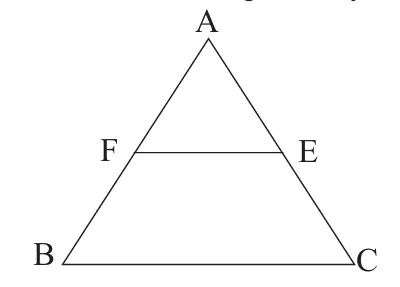
(त्रिभुज \(ABC\) मा \(F\) र \(E\) क्रमशः भुजा \(AB\) र \(AC\) का मध्यबिन्दु हुन् ।)
The line segment joining the midpoints of any two sides of a triangle is parallel to the third side and equal to half of it.
In vector form, if \(F\) and \(E\) are the midpoints of \(AB\) and \(AC\), then
\[\overrightarrow{FE}=\frac12\overrightarrow{BC}\quad\text{or}\quad \overrightarrow{EF}=\frac12\overrightarrow{CB}\]By the triangle law of vector addition in \(\Delta ABC\):
\[\overrightarrow{AB}+\overrightarrow{BC}=\overrightarrow{AC}\]Subtract \(\overrightarrow{AB}\) from both sides:
\[\overrightarrow{BC}=\overrightarrow{AC}-\overrightarrow{AB}\]Given: \(F\) is the midpoint of \(AB\), so \(\overrightarrow{AF}=\dfrac12\overrightarrow{AB}\); \(E\) is the midpoint of \(AC\), so \(\overrightarrow{AE}=\dfrac12\overrightarrow{AC}\).
To prove: \(\overrightarrow{FE}=\dfrac12\overrightarrow{BC}\).
Proof
In \(\Delta AFE\), by the triangle law of vector addition,
\[\overrightarrow{FE}=\overrightarrow{FA}+\overrightarrow{AE}\]Since \(\overrightarrow{FA}=-\overrightarrow{AF}=-\dfrac12\overrightarrow{AB}\) and \(\overrightarrow{AE}=\dfrac12\overrightarrow{AC}\),
\[\begin{aligned}\overrightarrow{FE} &= -\frac12\overrightarrow{AB}+\frac12\overrightarrow{AC} \\ &= \frac12(\overrightarrow{AC}-\overrightarrow{AB}) \\ &= \frac12\overrightarrow{BC}\qquad\text{(from Question 5(b))}\end{aligned}\]Reversing the direction of both sides, \(\overrightarrow{EF}=\dfrac12\overrightarrow{CB}\).
Since \(D\), \(E\), \(F\) are midpoints, each median vector is half the sum of the two side vectors from its vertex (Question 1(B)):
\[\overrightarrow{AD}=\frac12(\overrightarrow{AB}+\overrightarrow{AC}),\quad \overrightarrow{BE}=\frac12(\overrightarrow{BA}+\overrightarrow{BC}),\quad \overrightarrow{CF}=\frac12(\overrightarrow{CA}+\overrightarrow{CB})\]Add the three equations and group the opposite vectors:
\[\begin{aligned}\overrightarrow{AD}+\overrightarrow{BE}+\overrightarrow{CF} &= \frac12\big[(\overrightarrow{AB}+\overrightarrow{BA})+(\overrightarrow{AC}+\overrightarrow{CA})+(\overrightarrow{BC}+\overrightarrow{CB})\big] \\ &= \frac12(\vec 0+\vec 0+\vec 0) \\ &= \vec 0\end{aligned}\]because \(\overrightarrow{BA}=-\overrightarrow{AB}\), \(\overrightarrow{CA}=-\overrightarrow{AC}\) and \(\overrightarrow{CB}=-\overrightarrow{BC}\).
Q.6 The position vectors of the points \(A\) and \(B\) are \(\vec a\) and \(\vec b\). The point \(P\) divides \(AB\) internally in the ratio \(m:n\).
- a. Write the formula for the position vector \(\vec p\) of the internal division point \(P\).
- b. In the figure, why is \(n\overrightarrow{AP}=m\overrightarrow{PB}\) used when \(AP:PB=m:n\)? Give reason.
- c. If \(\vec a=\vec i+2\vec j\) and \(\vec b=4\vec i+8\vec j\), find the position vector of the point dividing \(AB\) internally in the ratio \(1:2\).
- d. Under what condition does \(\vec p=\frac{\vec a+\vec b}{2}\) hold? Give reason.
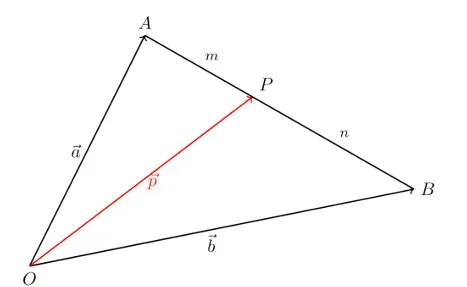
(बिन्दु \(A\) र \(B\) का स्थिति भेक्टर \(\vec a\) र \(\vec b\) छन् । बिन्दु \(P\) ले \(AB\) लाई \(m:n\) अनुपातमा आन्तरिक विभाजन गर्छ ।)
Here, \(\overrightarrow{OA}=\vec a\), \(\overrightarrow{OB}=\vec b\), \(\overrightarrow{OP}=\vec p\) and \(AP:PB=m:n\).
The internal section formula is
\[\vec p=\frac{m\vec b+n\vec a}{m+n}\]Given, \(AP:PB=m:n\), that is \(\dfrac{AP}{PB}=\dfrac mn\), so \(n\cdot AP=m\cdot PB\) for the lengths.
Since \(P\) lies on the segment \(AB\) between \(A\) and \(B\), the vectors \(\overrightarrow{AP}\) and \(\overrightarrow{PB}\) are collinear and point in the same direction. Vectors with the same direction and equal magnitudes are equal, so the length relation holds for the vectors too.
\[n\overrightarrow{AP}=m\overrightarrow{PB}\]Here, \(m:n=1:2\).
\[\begin{aligned}\vec p &= \frac{m\vec b+n\vec a}{m+n} \\ &= \frac{1(4\vec i+8\vec j)+2(\vec i+2\vec j)}{1+2} \\ &= \frac{(4\vec i+8\vec j)+(2\vec i+4\vec j)}{3} \\ &= \frac{6\vec i+12\vec j}{3} \\ &= 2\vec i+4\vec j\end{aligned}\]In the internal division formula \(\vec p=\dfrac{m\vec b+n\vec a}{m+n}\), put \(m=n=1\):
\[\vec p=\frac{1\cdot\vec b+1\cdot\vec a}{1+1}=\frac{\vec a+\vec b}{2}\]The ratio \(1:1\) means \(P\) divides \(AB\) into two equal parts, so \(P\) is the midpoint of \(AB\).
Q.7 The point \(P\) divides the line segment joining the points with position vectors \(\vec a\) and \(\vec b\) externally in the ratio \(m:n\).
- a. Write the formula for the position vector \(\vec p\) of the external division point.
- b. Prove by the vector method that \(\vec p=\frac{m\vec b-n\vec a}{m-n}\).
- c. If \(\vec a=\vec i+4\vec j\) and \(\vec b=5\vec i-3\vec j\), find the position vector of the point dividing \(AB\) externally in the ratio \(1:2\).
- d. If \(m:n=1:1\), does the external division point \(P\) exist? Discuss with reason.
(बिन्दु \(P\) ले स्थिति भेक्टर \(\vec a\) र \(\vec b\) भएका बिन्दुहरू जोड्ने रेखाखण्डलाई \(m:n\) अनुपातमा बाह्य विभाजन गर्छ ।)
Here, \(\overrightarrow{OA}=\vec a\), \(\overrightarrow{OB}=\vec b\) and \(AP:BP=m:n\) (external division).
The external section formula is
\[\vec p=\frac{m\vec b-n\vec a}{m-n}\]Given: \(P\) divides \(AB\) externally in the ratio \(m:n\), so \(\dfrac{AP}{BP}=\dfrac mn\). Also \(\overrightarrow{OA}=\vec a\), \(\overrightarrow{OB}=\vec b\), \(\overrightarrow{OP}=\vec p\).
To prove: \(\vec p=\dfrac{m\vec b-n\vec a}{m-n}\).
Proof
For external division, \(\overrightarrow{AP}\) and \(\overrightarrow{BP}\) point in the same direction, so
\[n\overrightarrow{AP}=m\overrightarrow{BP}\]Write both vectors using the origin \(O\):
\[\overrightarrow{AP}=\vec p-\vec a,\qquad \overrightarrow{BP}=\vec p-\vec b\]\[\begin{aligned}n(\vec p-\vec a) &= m(\vec p-\vec b) \\ n\vec p-n\vec a &= m\vec p-m\vec b \\ m\vec b-n\vec a &= m\vec p-n\vec p \\ m\vec b-n\vec a &= (m-n)\vec p \\ \vec p &= \frac{m\vec b-n\vec a}{m-n}\end{aligned}\]Here, \(m:n=1:2\).
\[\begin{aligned}\vec p &= \frac{m\vec b-n\vec a}{m-n} \\ &= \frac{1(5\vec i-3\vec j)-2(\vec i+4\vec j)}{1-2} \\ &= \frac{(5\vec i-3\vec j)-(2\vec i+8\vec j)}{-1} \\ &= \frac{3\vec i-11\vec j}{-1} \\ &= -3\vec i+11\vec j\end{aligned}\]For \(m:n=1:1\), we have \(m=n\). The external division formula is
\[\vec p=\frac{m\vec b-n\vec a}{m-n}\]When \(m=n\), the denominator is \(m-n=0\), and division by zero is not defined.
Geometrically, external division with ratio \(1:1\) needs a point \(P\) outside \(AB\) on the line \(AB\) with \(AP=BP\). The only point of the line equidistant from \(A\) and \(B\) is the midpoint, which lies inside \(AB\). So no such outside point exists.
Q.8 Prove by using the vector method:
- a. The quadrilateral formed by joining the midpoints of the sides of any quadrilateral is a parallelogram.
- b. The angle subtended by the diameter of a circle is a right angle.
(भेक्टर विधिद्वारा प्रमाणित गर्नुहोस् : )
Figure: E, F, G, H are the midpoints of AB, BC, CD, DA. The dashed quadrilateral EFGH is a parallelogram.
Given: \(ABCD\) is a quadrilateral and \(E\), \(F\), \(G\), \(H\) are the midpoints of \(AB\), \(BC\), \(CD\), \(DA\).
To prove: \(EFGH\) is a parallelogram.
Proof
Let the position vectors of \(A\), \(B\), \(C\), \(D\) be \(\vec a\), \(\vec b\), \(\vec c\), \(\vec d\). By the midpoint formula,
\[\overrightarrow{OE}=\frac{\vec a+\vec b}{2},\quad \overrightarrow{OF}=\frac{\vec b+\vec c}{2},\quad \overrightarrow{OG}=\frac{\vec c+\vec d}{2},\quad \overrightarrow{OH}=\frac{\vec d+\vec a}{2}\]\[\begin{aligned}\overrightarrow{EF} &= \overrightarrow{OF}-\overrightarrow{OE} \\ &= \frac{\vec b+\vec c}{2}-\frac{\vec a+\vec b}{2} \\ &= \frac{\vec c-\vec a}{2}\end{aligned}\]\[\begin{aligned}\overrightarrow{HG} &= \overrightarrow{OG}-\overrightarrow{OH} \\ &= \frac{\vec c+\vec d}{2}-\frac{\vec d+\vec a}{2} \\ &= \frac{\vec c-\vec a}{2}\end{aligned}\]So \(\overrightarrow{EF}=\overrightarrow{HG}\). Two opposite sides \(EF\) and \(HG\) are equal in length and parallel in direction.
Figure: AB is a diameter of the circle with centre O and C is any point on the circle, so angle ACB = 90°.
Given: \(O\) is the centre of a circle, \(AB\) is a diameter and \(C\) is any point on the circle.
To prove: \(\angle ACB=90^\circ\).
Proof
Take \(O\) as the origin. Since \(O\) is the midpoint of the diameter \(AB\), \(\overrightarrow{OB}=-\overrightarrow{OA}\). Let the radius be \(r\), so
\[|\overrightarrow{OA}|=|\overrightarrow{OB}|=|\overrightarrow{OC}|=r\]Express \(\overrightarrow{AC}\) and \(\overrightarrow{BC}\) from the origin:
\[\overrightarrow{AC}=\overrightarrow{OC}-\overrightarrow{OA},\qquad \overrightarrow{BC}=\overrightarrow{OC}-\overrightarrow{OB}=\overrightarrow{OC}+\overrightarrow{OA}\]Take the scalar product:
\[\begin{aligned}\overrightarrow{AC}\cdot\overrightarrow{BC} &= (\overrightarrow{OC}-\overrightarrow{OA})\cdot(\overrightarrow{OC}+\overrightarrow{OA}) \\ &= |\overrightarrow{OC}|^2-|\overrightarrow{OA}|^2 \\ &= r^2-r^2 \\ &= 0\end{aligned}\]Since the scalar product is zero, \(\overrightarrow{AC}\perp\overrightarrow{BC}\).
1. A. c B. b C. c D. b E. b
2. a. \(4\vec i+2\vec j\) b. \(\frac72\vec i+\frac{19}{2}\vec j\)
3. a. \(\frac{12}{5}\vec i-\vec j\) b. \(\frac72\vec i+\frac92\vec j\) 4. a. \(3\vec i+\frac74\vec j\) b. \(-2\vec i+8\vec j\)
5. a. \(\overrightarrow{FE}=\frac12\overrightarrow{BC}\) b. \(\overrightarrow{AC}-\overrightarrow{AB}\) c, d. Proved
6. a. \(\frac{m\vec b+n\vec a}{m+n}\) c. \(2\vec i+4\vec j\) d. \(P\) is the midpoint
7. a. \(\frac{m\vec b-n\vec a}{m-n}\) c. \(-3\vec i+11\vec j\) d. Does not exist
8. a, b. Proved
4. Frequently Asked Questions on Class 10 Optional Mathematics Vector
What is covered in Class 10 Optional Mathematics Vector Exercise 10.1? (कक्षा १० ऐच्छिक गणित भेक्टर अभ्यास १०.१ मा के के समावेश छ ?)
Exercise 10.1 covers the scalar (dot) product of two vectors, the angle between vectors, the conditions for perpendicular and parallel vectors, finding unknown values such as \(m\), the vector \(\overrightarrow{AB}\), and simple proofs. This page solves all 38 questions.
What is the scalar product of two vectors? (दुई भेक्टरको स्केलर गुणनफल भनेको के हो ?)
The scalar (dot) product is the number \(\vec a\cdot\vec b=|\vec a||\vec b|\cos\theta\), where \(\theta\) is the angle between the vectors. The answer is a scalar, not a vector.
How do I find the scalar product in component form? (घटक रूपमा स्केलर गुणनफल कसरी निकाल्ने ?)
For \(\vec a=(x_1,y_1)\) and \(\vec b=(x_2,y_2)\), \(\vec a\cdot\vec b=x_1x_2+y_1y_2\) (Exercise 10.1, Question 1B).
How do I find the angle between two vectors? (दुई भेक्टरबिचको कोण कसरी निकाल्ने ?)
Use \(\cos\theta=\dfrac{\vec a\cdot\vec b}{|\vec a||\vec b|}\), where \(|\vec a|=\sqrt{x_1^2+y_1^2}\) (Exercise 10.1, Question 5).
When are two vectors perpendicular? (दुई भेक्टर कहिले लम्ब हुन्छन् ?)
Two non-zero vectors are perpendicular when \(\vec a\cdot\vec b=0\), that is \(x_1x_2+y_1y_2=0\), because \(\cos90^\circ=0\) (Exercise 10.1, Question 7).
When are two vectors parallel? (दुई भेक्टर कहिले समानान्तर हुन्छन् ?)
Two vectors are parallel when their components are proportional, \(x_1y_2=x_2y_1\), or \(\vec a=k\vec b\) (Exercise 10.1, Question 8).
When is the scalar product maximum? (स्केलर गुणनफल कहिले अधिकतम हुन्छ ?)
When \(\theta=0^\circ\), because \(\cos\theta\) is greatest (equal to 1). The vectors are then parallel in the same direction and \(\vec a\cdot\vec b=|\vec a||\vec b|\).
What is \(\vec a^{\,2}\) for a vector? (भेक्टर \(\vec a\) का लागि \(\vec a^{\,2}\) कति हुन्छ ?)
\(\vec a^{\,2}=\vec a\cdot\vec a=|\vec a|^2=x_1^2+y_1^2\). For \(\vec a=(2,3)\) it is 13 (Exercise 10.1, Question 1F).
How do I find the vector \(\overrightarrow{AB}\) from two points? (दुई बिन्दुबाट भेक्टर \(\overrightarrow{AB}\) कसरी निकाल्ने ?)
Subtract the coordinates of \(A\) from those of \(B\): \(\overrightarrow{AB}=(x_2-x_1,\ y_2-y_1)\) (Exercise 10.1, Question 10).
How do I prove that \(|\vec a+\vec b|=|\vec a-\vec b|\) means \(\vec a\perp\vec b\)? (\(|\vec a+\vec b|=|\vec a-\vec b|\) बाट \(\vec a\perp\vec b\) कसरी प्रमाणित गर्ने ?)
Square both sides and expand with dot products. The terms \(|\vec a|^2\) and \(|\vec b|^2\) cancel and leave \(4\,\vec a\cdot\vec b=0\) (Exercise 10.1, Question 12).
What is the section formula for position vectors? (भेक्टरमा विभाजन सूत्र के हो ?)
If \(A\) and \(B\) have position vectors \(\vec a\) and \(\vec b\), the point dividing \(AB\) in the ratio \(m:n\) has \(\vec p=\dfrac{m\vec b+n\vec a}{m+n}\) internally and \(\vec p=\dfrac{m\vec b-n\vec a}{m-n}\) externally (Exercise 10.2, Questions 6 and 7).
How do I find the position vector of the midpoint of AB? (AB को मध्यविन्दुको स्थिति भेक्टर कसरी निकाल्ने ?)
Add the position vectors of the end points and divide by 2: \(\overrightarrow{OM}=\dfrac{\overrightarrow{OA}+\overrightarrow{OB}}{2}\) (Exercise 10.2, Questions 1C and 2).
Why does the external division point not exist when m = n? (m = n हुँदा बाहिरी विभाजन विन्दु किन हुँदैन ?)
The external formula has \(m-n\) in the denominator. For \(m=n\) it becomes zero, so the formula is undefined (Exercise 10.2, Question 7d).
What does the vector mid-point theorem state? (भेक्टरमा मध्यविन्दु साध्य के हो ?)
The line joining the midpoints of two sides of a triangle is parallel to the third side and half its length: \(\overrightarrow{FE}=\dfrac12\overrightarrow{BC}\) (Exercise 10.2, Question 5).
How many questions are solved in Exercise 10.2? (अभ्यास १०.२ मा कतिओटा प्रश्न हल गरिएका छन् ?)
This page solves all 25 questions of Exercise 10.2: 5 multiple choice questions and 20 written questions, including the proofs on the mid-point theorem, the section formula, the midpoint quadrilateral and the angle in a semicircle.
Are these questions useful for SEE preparation in Nepal? (के यी प्रश्नहरू नेपालमा SEE को तयारीका लागि उपयोगी छन् ?)
Yes, for students who study Optional Mathematics. This set covers every question type of Exercise 10.1 and 10.2: dot products, angles, perpendicular and parallel vectors, position vectors, the section formula, geometric uses and proofs. Practising them builds the skills needed for SEE-style questions.
Students also search for:
More Class 10 Optional Mathematics Vector Solutions
Also Read
- SEE Class 10 Optional Mathematics Notes (all chapters)
- SEE Class 10 Compulsory Mathematics Notes
- SEE Class 10 Science Notes
- Class 10 English Notes (SEE Nepal)
- Nepali Class 10 Vyakaran SEE Notes
- SEE Class 10 Social Studies Notes
- SEE Class 10 Computer Science Notes
- Class 10 Account SEE Notes
- Class 10 Education Notes
- Class 10 Economics Guide