
Class 10 Optional Mathematics Transformation
Exercise 9.1: Translation, Exercises 9.2.1 and 9.2.2: Combined Transformation, Exercise 9.3: Matrix Transformation and Miscellaneous Exercise
117 solved questions (28 of Exercise 9.1, 21 of Exercise 9.2.1, 17 of Exercise 9.2.2, 19 of Exercise 9.3 and 32 of the Miscellaneous Exercise) with English and Nepali questions, step by step solutions, graphs and frequently asked questions for the Nepal Grade 10 SEE.
1. Class 10 Optional Mathematics Transformation: Unit Overview and Key Formulas
Unit 9: Transformation (Optional Mathematics, Grade 10, SEE, Nepal) • Exercise 9.1 Translation
Class 10 Optional Mathematics Transformation is the ninth unit of the course prescribed by the Curriculum Development Centre (CDC), Nepal. This page solves every question of Exercises 9.1, 9.2.1, 9.2.2, 9.3 and the Miscellaneous Exercise. Every question is written as in the textbook: the main question first (Q.1, Q.2, Q.3 …) with its parts (a, b, c …) listed under it and the Nepali question in brackets. Question 2 of Exercise 9.1 uses the textbook figure with its solution. Multiple choice solutions and definitions also have Nepali in brackets, and the other solutions are in English because the steps and symbols are the same in both languages.
- Translation: every point of a figure moves through the same vector \(T=\begin{pmatrix}a\\b\end{pmatrix}\).
- Image of a point: add \(a\) to \(x\) and \(b\) to \(y\).
- Finding the vector: subtract the object from the image, or use \(\overrightarrow{AB}\).
- Congruent image: translation keeps the shape, size and area of the figure.
Key formulas to remember
Figure: Translation: every point moves through the same vector T = (a, b), so P(x, y) goes to P′(x + a, y + b).
For more chapters, visit the complete SEE Class 10 Optional Mathematics notes. You can also read about translation in geometry for extra understanding.
2. Exercise 9.1 Translation: Class 10 Optional Mathematics Transformation
Exercise 9.1: Multiple Choice Questions (बहुवैकल्पिक प्रश्न)
Q.1 Tick (✓) the correct option for the given questions:
(दिइएका प्रश्नहरूको उपयुक्त विकल्पमा ठिक चिह्न (✓) लगाउनुहोस् : )
A. Which of the following is a translation? (तलका मध्ये कुन स्थानान्तरण विस्थापन (translation) हो ?)
- a) Rotating a figure
- b) Moving a figure from one place to another
- c) Enlarging a figure
- d) Making a mirror image of a figure
Correct Answer: b) Moving a figure from one place to another
Solution:
- Translation slides every point of a figure by the same distance in the same direction, without rotating, resizing or reflecting it.
- (a) is rotation, (c) is enlargement and (d) is reflection.
- So (b) is translation.
(आकृतिलाई एक स्थानबाट अर्को स्थानमा सार्नु नै विस्थापन (translation) हो ।)
B. What effect does translation by a vector have on the shape and area of a triangle? (त्रिभुजलाई कुनै भेक्टरले विस्थापन गर्दा त्यसको आकार र क्षेत्रफलमा के प्रभाव पर्छ ?)
- a) Only the shape changes.
- b) Only the area changes.
- c) Both shape and area change.
- d) Both shape and area remain the same.
Correct Answer: d) Both shape and area remain the same.
Solution:
- Translation is a rigid transformation: it keeps distances and angles.
- So the image is congruent to the object, and its shape and area are unchanged.
(विस्थापनले दुरी र कोण परिवर्तन गर्दैन, त्यसैले आकार र क्षेत्रफल दुबै उस्तै रहन्छन् ।)
C. What is the formula to find the image of a point \(P(x,y)\) when it is translated by the vector \(T=\begin{pmatrix}a\\b\end{pmatrix}\)? (कुनै बिन्दु \(P(x,y)\) लाई विस्थापन भेक्टर \(T=\begin{pmatrix}a\\b\end{pmatrix}\) ले विस्थापन गर्दा बन्ने प्रतिबिम्ब पत्ता लगाउने सूत्र कुन हो ?)
- a) \(P(x,y)\xrightarrow{T=\begin{pmatrix}a\\b\end{pmatrix}}P^{\prime}(x+a,y+b)\)
- b) \(P(x,y)\xrightarrow{T=\begin{pmatrix}a\\b\end{pmatrix}}P^{\prime}(x-a,y-b)\)
- c) \(P(x,y)\xrightarrow{T=\begin{pmatrix}a\\b\end{pmatrix}}P^{\prime}(x-a,y+b)\)
- d) \(P(x,y)\xrightarrow{T=\begin{pmatrix}a\\b\end{pmatrix}}P^{\prime}(x+a,y-b)\)
Correct Answer: a) \(P(x,y)\xrightarrow{T=\begin{pmatrix}a\\b\end{pmatrix}}P^{\prime}(x+a,y+b)\)
Solution:
- The horizontal displacement \(a\) is added to the \(x\)-coordinate and the vertical displacement \(b\) is added to the \(y\)-coordinate.
(\(x\)-निर्देशाङ्कमा \(a\) र \(y\)-निर्देशाङ्कमा \(b\) जोडिन्छ, त्यसैले \(P^{\prime}(x+a,y+b)\) हुन्छ ।)
D. If the point \(Q(-2,4)\) is translated by the translation vector \(T=\begin{pmatrix}3\\2\end{pmatrix}\), which of the following is the image \(Q^{\prime}\)? (यदि बिन्दु \(Q(-2,4)\) लाई विस्थापन भेक्टर \(T=\begin{pmatrix}3\\2\end{pmatrix}\) ले विस्थापन गर्दा बन्ने प्रतिबिम्ब \(Q^{\prime}\) को निर्देशाङ्क तलका मध्ये कुन हो ?)
- a) \(Q^{\prime}(-1,6)\)
- b) \(Q^{\prime}(1,6)\)
- c) \(Q^{\prime}(-1,-6)\)
- d) \(Q^{\prime}(5,6)\)
Correct Answer: b) \(Q^{\prime}(1,6)\)
Solution:
Here, \(Q(-2,4)\) and \(T=\begin{pmatrix}3\\2\end{pmatrix}\), so \(a=3\) and \(b=2\).
\[Q^{\prime}=(x+a,y+b)=(-2+3,4+2)=(1,6)\](\(Q^{\prime}=(-2+3,\,4+2)=(1,6)\) हुन्छ ।)
E. If the point \(P(3,-4)\) is translated and its image is \(P^{\prime}(-2,-1)\), what is the value of the translation vector \(T\)? (बिन्दु \(P(3,-4)\) लाई विस्थापन गर्दा प्रतिबिम्ब \(P^{\prime}(-2,-1)\) बन्छ भने विस्थापन भेक्टर \(T\) को मान कति हुन्छ ?)
- a) \(\begin{pmatrix}1\\-3\end{pmatrix}\)
- b) \(\begin{pmatrix}5\\-5\end{pmatrix}\)
- c) \(\begin{pmatrix}-5\\3\end{pmatrix}\)
- d) \(\begin{pmatrix}-1\\-3\end{pmatrix}\)
Correct Answer: c) \(\begin{pmatrix}-5\\3\end{pmatrix}\)
Solution:
Here, \((x+a,y+b)=(x^{\prime},y^{\prime})\).
\[3+a=-2 \implies a=-5\]\[-4+b=-1 \implies b=3\]\[T=\begin{pmatrix}-5\\3\end{pmatrix}\](\(3+a=-2\) बाट \(a=-5\) र \(-4+b=-1\) बाट \(b=3\) आउँछ ।)
F. If the point \(P(-1,4)\) is translated 5 units to the right along the \(X\)-axis, what will be the coordinates of its image? (बिन्दु \(P(-1,4)\) लाई \(x\)-अक्षमा ५ एकाइ दायाँतर्फ विस्थापन गर्दा बन्ने प्रतिबिम्बको निर्देशाङ्क के हुन्छ ?)
- a) \(P^{\prime}(4,4)\)
- b) \(P^{\prime}(-6,4)\)
- c) \(P^{\prime}(-1,9)\)
- d) \(P^{\prime}(4,-4)\)
Correct Answer: a) \(P^{\prime}(4,4)\)
Solution:
Moving \(5\) units to the right means \(a=5\) and \(b=0\), so \(T=\begin{pmatrix}5\\0\end{pmatrix}\).
\[P^{\prime}=(-1+5,4+0)=(4,4)\](दायाँतर्फ ५ एकाइ भनेको \(T=\begin{pmatrix}5\\0\end{pmatrix}\) हो, त्यसैले \(P^{\prime}=(4,4)\) हुन्छ ।)
G. If a point \((x,y)\) is translated by \(\begin{pmatrix}-3\\5\end{pmatrix}\), which of the following is the resulting point? (कुनै बिन्दु \((x,y)\) लाई \(\begin{pmatrix}-3\\5\end{pmatrix}\) ले स्थानान्तरण गरेपछि प्राप्त बिन्दु तलका मध्ये कुन हो ?)
- a) \((x-3,y-5)\)
- b) \((x+3,y+5)\)
- c) \((x-3,y+5)\)
- d) \((x+3,y-5)\)
Correct Answer: c) \((x-3,y+5)\)
Solution:
Here, \(a=-3\) and \(b=5\).
\[(x+a,y+b)=(x+(-3),y+5)=(x-3,y+5)\](\(a=-3\) र \(b=5\) भएकाले प्राप्त बिन्दु \((x-3,\,y+5)\) हुन्छ ।)
Exercise 9.1: Written Questions (लेख्ने प्रश्न)
Q.2 Translate the given figures using the given translation vector:
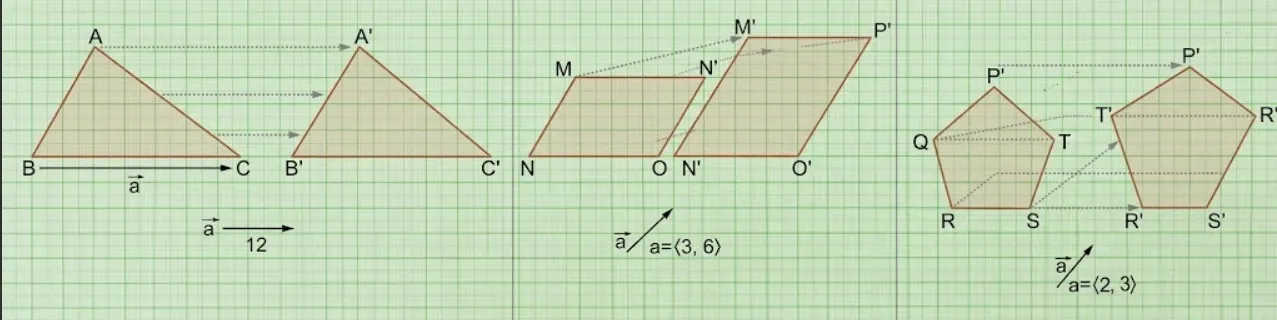
(दिइएका आकृतिहरूलाई दिइएको विस्थापन भेक्टर प्रयोग गरी विस्थापन गर्नुहोस् ।)
Q.3 What is meant by translation? Explain with an example.
(विस्थापन भन्नाले के बुझिन्छ, उदाहरणसहित लेख्नुहोस् ।)
Definition
Translation is a transformation that moves every point of a figure through the same distance in the same direction, given by a vector \(T=\begin{pmatrix}a\\b\end{pmatrix}\), without changing its shape, size or orientation.
(विस्थापन भनेको आकृतिका प्रत्येक बिन्दुलाई भेक्टर \(T=\begin{pmatrix}a\\b\end{pmatrix}\) अनुसार उही दुरी र उही दिशामा सार्ने रूपान्तरण हो, जसले आकार र परिमाण परिवर्तन गर्दैन ।)
Formula
\[P(x,y)\xrightarrow{T=\begin{pmatrix}a\\b\end{pmatrix}}P^{\prime}(x+a,y+b)\]Example
Let \(A(2,3)\) be translated by \(T=\begin{pmatrix}4\\-1\end{pmatrix}\).
\[A(2,3)\xrightarrow{T}A^{\prime}(2+4,3+(-1))=A^{\prime}(6,2)\]The point moves \(4\) units to the right and \(1\) unit down.
Q.4 Using the translation vector \(T=\begin{pmatrix}2\\-2\end{pmatrix}\), find the coordinates of the images of the following points:
- a. \(A(-1,3)\)
- b. \(B(2,-2)\)
- c. \(C(5,6)\)
- d. \(D(-4,-4)\)
- e. \(E(7,2)\)
- f. \(F(2,-4)\)
(दिइएको विस्थापन भेक्टर प्रयोग गरी निम्नलिखित बिन्दुहरूको प्रतिबिम्बका निर्देशाङ्क पत्ता लगाउनुहोस् : )
Here, \(a=2\), \(b=-2\) and \(A(-1,3)\).
\[\begin{aligned}A^{\prime} &= (x+a,y+b) \\ &= (-1+2,3+(-2)) \\ &= (1,1)\end{aligned}\]Here, \(a=2\), \(b=-2\) and \(B(2,-2)\).
\[\begin{aligned}B^{\prime} &= (x+a,y+b) \\ &= (2+2,(-2)+(-2)) \\ &= (4,-4)\end{aligned}\]Here, \(a=2\), \(b=-2\) and \(C(5,6)\).
\[\begin{aligned}C^{\prime} &= (x+a,y+b) \\ &= (5+2,6+(-2)) \\ &= (7,4)\end{aligned}\]Here, \(a=2\), \(b=-2\) and \(D(-4,-4)\).
\[\begin{aligned}D^{\prime} &= (x+a,y+b) \\ &= (-4+2,(-4)+(-2)) \\ &= (-2,-6)\end{aligned}\]Here, \(a=2\), \(b=-2\) and \(E(7,2)\).
\[\begin{aligned}E^{\prime} &= (x+a,y+b) \\ &= (7+2,2+(-2)) \\ &= (9,0)\end{aligned}\]Here, \(a=2\), \(b=-2\) and \(F(2,-4)\).
\[\begin{aligned}F^{\prime} &= (x+a,y+b) \\ &= (2+2,(-4)+(-2)) \\ &= (4,-6)\end{aligned}\]Q.5 If \(P(2,3)\), \(Q(-2,4)\) and \(R(4,-2)\) are the vertices of \(\triangle PQR\) and it is translated by the vector \(T=\begin{pmatrix}3\\2\end{pmatrix}\) to \(\triangle P^{\prime}Q^{\prime}R^{\prime}\), find the coordinates of the vertices of \(\triangle P^{\prime}Q^{\prime}R^{\prime}\).
(यदि \(P(2,3)\), \(Q(-2,4)\) र \(R(4,-2)\) शीर्षबिन्दुहरू भएको \(\triangle PQR\) लाई विस्थापन भेक्टर \(T=\begin{pmatrix}3\\2\end{pmatrix}\) ले \(\triangle P^{\prime}Q^{\prime}R^{\prime}\) मा विस्थापन गर्छ भने \(\triangle P^{\prime}Q^{\prime}R^{\prime}\) का शीर्षबिन्दुहरूको निर्देशाङ्क पत्ता लगाउनुहोस् ।)
Here, \(a=3\) and \(b=2\), and the rule is \((x,y)\to(x+3,y+2)\).
\[P^{\prime}=(2+3,3+2)=(5,5)\]\[Q^{\prime}=(-2+3,4+2)=(1,6)\]\[R^{\prime}=(4+3,-2+2)=(7,0)\]Q.6 Given the points \(A(3,5)\), \(B(-3,5)\) and \(C(3,-5)\):
- a. To which point is \(A\) translated by \(\overrightarrow{AB}\)?
- b. To which point is \(B\) translated by \(\overrightarrow{BC}\)?
- c. To which point is \(C\) translated by \(\overrightarrow{CA}\)?
(दिइएका बिन्दुहरू \(A(3,5)\), \(B(-3,5)\) र \(C(3,-5)\) भए : )
The vector from \(P_1(x_1,y_1)\) to \(P_2(x_2,y_2)\) is \(\overrightarrow{P_1P_2}=\begin{pmatrix}x_2-x_1\\y_2-y_1\end{pmatrix}\).
\[\begin{aligned}\overrightarrow{AB} &= \begin{pmatrix}(-3)-3\\ 5-5\end{pmatrix} \\ &= \begin{pmatrix}-6\\0\end{pmatrix}\end{aligned}\]Translating \(A(3,5)\) by this vector:
\[A^{\prime}=(3+(-6),5+0)=(-3,5)=B\]The vector from \(P_1(x_1,y_1)\) to \(P_2(x_2,y_2)\) is \(\overrightarrow{P_1P_2}=\begin{pmatrix}x_2-x_1\\y_2-y_1\end{pmatrix}\).
\[\begin{aligned}\overrightarrow{BC} &= \begin{pmatrix}3-(-3)\\ (-5)-5\end{pmatrix} \\ &= \begin{pmatrix}6\\-10\end{pmatrix}\end{aligned}\]Translating \(B(-3,5)\) by this vector:
\[B^{\prime}=(-3+6,5+(-10))=(3,-5)=C\]The vector from \(P_1(x_1,y_1)\) to \(P_2(x_2,y_2)\) is \(\overrightarrow{P_1P_2}=\begin{pmatrix}x_2-x_1\\y_2-y_1\end{pmatrix}\).
\[\begin{aligned}\overrightarrow{CA} &= \begin{pmatrix}3-3\\ 5-(-5)\end{pmatrix} \\ &= \begin{pmatrix}0\\10\end{pmatrix}\end{aligned}\]Translating \(C(3,-5)\) by this vector:
\[C^{\prime}=(3+0,-5+10)=(3,5)=A\]Q.7 If a translation vector transforms \(A(-5,6)\) to \(A^{\prime}(-3,3)\), find the translation vector.
(कुनै विस्थापन भेक्टरले \(A(-5,6)\) लाई \(A^{\prime}(-3,3)\) मा विस्थापन गर्छ भने विस्थापन भेक्टर पत्ता लगाउनुहोस् ।)
Let \(T=\begin{pmatrix}a\\b\end{pmatrix}\). Then \((x+a,y+b)=(x^{\prime},y^{\prime})\).
\[-5+a=-3 \implies a=2\]\[6+b=3 \implies b=-3\]Q.8 Find the translation vector that moves the point \(R(4,7)\) to \(R^{\prime}(-3,-5)\). Using this translation vector, find the image of the point \(S(4,1)\).
(बिन्दु \(R(4,7)\) लाई बिन्दु \(R^{\prime}(-3,-5)\) मा विस्थापन गर्ने भेक्टर पत्ता लगाउनुहोस् । उक्त विस्थापन भेक्टरले \(S(4,1)\) लाई कुन बिन्दुमा विस्थापन गर्छ, पत्ता लगाउनुहोस् ।)
The translation vector
\[4+a=-3 \implies a=-7\]\[7+b=-5 \implies b=-12\]So \(T=\begin{pmatrix}-7\\-12\end{pmatrix}\).
The image of \(S(4,1)\)
\[S^{\prime}=(4+(-7),1+(-12))=(-3,-11)\]Q.9 If the point \(U(5,3)\xrightarrow{T}U^{\prime}(4,2)\), find the values of \(a\) and \(b\) for the vector \(T=\begin{pmatrix}a\\b\end{pmatrix}\). Using this vector, find the image of the point \(V(-5,4)\).
(यदि \(U(5,3)\xrightarrow{T}U^{\prime}(4,2)\) भए \(T=\begin{pmatrix}a\\b\end{pmatrix}\) का लागि \(a\) र \(b\) को मान पत्ता लगाउनुहोस् । यस भेक्टरले बिन्दु \(V(-5,4)\) लाई कुन बिन्दुमा विस्थापन गर्छ, पत्ता लगाउनुहोस् ।)
Values of \(a\) and \(b\)
\[5+a=4 \implies a=-1\]\[3+b=2 \implies b=-1\]So \(T=\begin{pmatrix}-1\\-1\end{pmatrix}\).
The image of \(V(-5,4)\)
\[V^{\prime}=(-5+(-1),4+(-1))=(-6,3)\]Q.10 The vertices of \(\triangle ABC\) are \(A(1,-1)\), \(B(-2,2)\) and \(C(3,3)\). If the triangle is translated by the vector \(T=\begin{pmatrix}2\\3\end{pmatrix}\), find the coordinates of the image \(\triangle A^{\prime}B^{\prime}C^{\prime}\). Also represent both triangles on a graph.
(\(\triangle ABC\) का शीर्षबिन्दुहरू \(A(1,-1)\), \(B(-2,2)\) र \(C(3,3)\) भए \(\triangle ABC\) लाई भेक्टर \(T=\begin{pmatrix}2\\3\end{pmatrix}\) ले विस्थापन गर्दा बन्ने प्रतिबिम्ब \(\triangle A^{\prime}B^{\prime}C^{\prime}\) का शीर्षबिन्दुहरूको निर्देशाङ्क पत्ता लगाउनुहोस् । साथै \(\triangle ABC\) र \(\triangle A^{\prime}B^{\prime}C^{\prime}\) लाई लेखाचित्रमा प्रस्तुत गर्नुहोस् ।)
Here, \(a=2\), \(b=3\) and the rule is \((x,y)\to(x+2,y+3)\).
\[A^{\prime}=(1+2,-1+3)=(3,2)\]\[B^{\prime}=(-2+2,2+3)=(0,5)\]\[C^{\prime}=(3+2,3+3)=(5,6)\]Graph
Plot \(A\), \(B\), \(C\) and join them to form \(\triangle ABC\). Plot \(A^{\prime}\), \(B^{\prime}\), \(C^{\prime}\) and join them to form \(\triangle A^{\prime}B^{\prime}C^{\prime}\).
Figure: Graph for Question 10: triangle ABC and its image A′B′C′ after the translation T = (2, 3).
Q.11 The points \(A(1,8)\), \(B(-3,9)\), \(C(0,13)\) and \(D(4,12)\) are the vertices of the parallelogram \(ABCD\).
- a. Find the vector \(\overrightarrow{AB}\)
- b. Using the vector \(\overrightarrow{AB}\), translate the parallelogram \(ABCD\) and find the coordinates of its image. Also represent both parallelograms on a graph
Here, \(A(1,8)\) and \(B(-3,9)\).
\[\begin{aligned}\overrightarrow{AB} &= \begin{pmatrix}-3-1\\9-8\end{pmatrix} \\ &= \begin{pmatrix}-4\\1\end{pmatrix}\end{aligned}\]Here, \(T=\overrightarrow{AB}=\begin{pmatrix}-4\\1\end{pmatrix}\) and the rule is \((x,y)\to(x-4,y+1)\).
\[A^{\prime}=(1-4,8+1)=(-3,9)\]\[B^{\prime}=(-3-4,9+1)=(-7,10)\]\[C^{\prime}=(0-4,13+1)=(-4,14)\]\[D^{\prime}=(4-4,12+1)=(0,13)\]Notice that \(A^{\prime}=B\) and \(D^{\prime}=C\), because \(T=\overrightarrow{AB}\) and \(\overrightarrow{DC}=\overrightarrow{AB}\) in a parallelogram.
Figure: Graph for Question 11: parallelogram ABCD and its image A′B′C′D′ after the translation AB = (−4, 1).
Q.12 The vertices of \(\triangle ABC\) are \(A(-4,6)\), \(B(3,-2)\) and \(C(1,2)\). It is translated by \(T_1=\begin{pmatrix}1\\-2\end{pmatrix}\) to \(\triangle A^{\prime}B^{\prime}C^{\prime}\) and then by \(T_2=\begin{pmatrix}-2\\3\end{pmatrix}\) to \(\triangle A^{\prime\prime}B^{\prime\prime}C^{\prime\prime}\).
- a. Find the coordinates of \(\triangle A^{\prime}B^{\prime}C^{\prime}\) and \(\triangle A^{\prime\prime}B^{\prime\prime}C^{\prime\prime}\)
- b. Represent \(\triangle ABC\), \(\triangle A^{\prime}B^{\prime}C^{\prime}\) and \(\triangle A^{\prime\prime}B^{\prime\prime}C^{\prime\prime}\) on the same graph
First translation by \(T_1=\begin{pmatrix}1\\-2\end{pmatrix}\): \((x,y)\to(x+1,y-2)\)
\[A^{\prime}=(-4+1,6-2)=(-3,4)\]\[B^{\prime}=(3+1,-2-2)=(4,-4)\]\[C^{\prime}=(1+1,2-2)=(2,0)\]Second translation by \(T_2=\begin{pmatrix}-2\\3\end{pmatrix}\): \((x,y)\to(x-2,y+3)\)
\[A^{\prime\prime}=(-3-2,4+3)=(-5,7)\]\[B^{\prime\prime}=(4-2,-4+3)=(2,-1)\]\[C^{\prime\prime}=(2-2,0+3)=(0,3)\]First translation by \(T_1=\begin{pmatrix}1\\-2\end{pmatrix}\)
The rule is \((x,y)\to(x+1,\,y-2)\).
\[A(-4,6)\to A^{\prime}(-4+1,\,6-2)=A^{\prime}(-3,4)\]\[B(3,-2)\to B^{\prime}(3+1,\,-2-2)=B^{\prime}(4,-4)\]\[C(1,2)\to C^{\prime}(1+1,\,2-2)=C^{\prime}(2,0)\]Second translation by \(T_2=\begin{pmatrix}-2\\3\end{pmatrix}\)
Translate \(\triangle A^{\prime}B^{\prime}C^{\prime}\) by the rule \((x,y)\to(x-2,\,y+3)\).
\[A^{\prime}(-3,4)\to A^{\prime\prime}(-3-2,\,4+3)=A^{\prime\prime}(-5,7)\]\[B^{\prime}(4,-4)\to B^{\prime\prime}(4-2,\,-4+3)=B^{\prime\prime}(2,-1)\]\[C^{\prime}(2,0)\to C^{\prime\prime}(2-2,\,0+3)=C^{\prime\prime}(0,3)\]Summary of the coordinates
| Triangle | Vertex A | Vertex B | Vertex C |
|---|---|---|---|
| Original ABC | (−4, 6) | (3, −2) | (1, 2) |
| First A′B′C′ | (−3, 4) | (4, −4) | (2, 0) |
| Second A″B″C″ | (−5, 7) | (2, −1) | (0, 3) |
Graphical representation
Figure: All three triangles plotted on the same coordinate plane. Dashed arrows indicate the two successive translations.
The two successive translations are equal to the single translation \(T_1+T_2=\begin{pmatrix}1-2\\-2+3\end{pmatrix}=\begin{pmatrix}-1\\1\end{pmatrix}\), which takes \(\triangle ABC\) directly to \(\triangle A^{\prime\prime}B^{\prime\prime}C^{\prime\prime}\).
\(A^{\prime}B^{\prime}C^{\prime}:(-3,4),(4,-4),(2,0)\)
\(A^{\prime\prime}B^{\prime\prime}C^{\prime\prime}:(-5,7),(2,-1),(0,3)\)
Q.13 A point \(P(x,y)\) is reflected in the line \(x=1\), and the image is then reflected again in the line \(x=3\). Compare this final image with the image obtained by translating \(P(x,y)\) by the vector \(T=\begin{pmatrix}4\\0\end{pmatrix}\). What conclusion can you draw from this? Explain clearly.
(कुनै बिन्दु \(P(x,y)\) लाई \(x=1\) रेखामा परावर्तन गरेर आउने प्रतिबिम्बलाई फेरि \(x=3\) रेखामा परावर्तन गर्दा आउने प्रतिबिम्ब र उक्त बिन्दु \(P(x,y)\) लाई विस्थापन भेक्टर \(T=\begin{pmatrix}4\\0\end{pmatrix}\) ले विस्थापन गर्दा आउने प्रतिबिम्ब तुलना गर्नुहोस् । यसबाट के निष्कर्ष निकाल्न सकिन्छ, स्पष्ट पार्नुहोस् ।)
The reflection of \(P(x,y)\) in the line \(x=a\) is \(P^{\prime}(2a-x,y)\).
Reflection in \(x=1\)
\[P(x,y)\to P^{\prime}(2(1)-x,y)=P^{\prime}(2-x,y)\]Reflection of \(P^{\prime}\) in \(x=3\)
\[P^{\prime}(2-x,y)\to P^{\prime\prime}(2(3)-(2-x),y)=P^{\prime\prime}(x+4,y)\]Translation by \(T=\begin{pmatrix}4\\0\end{pmatrix}\)
\[P(x,y)\to(x+4,y+0)=(x+4,y)\]Comparison
Both processes give the same image \((x+4,y)\).
1. A. b B. d C. a D. b E. c F. a G. c
4. \(A^{\prime}(1,1)\), \(B^{\prime}(4,-4)\), \(C^{\prime}(7,4)\), \(D^{\prime}(-2,-6)\), \(E^{\prime}(9,0)\), \(F^{\prime}(4,-6)\)
5. \(P^{\prime}(5,5)\), \(Q^{\prime}(1,6)\), \(R^{\prime}(7,0)\) 6. a. \(B\) b. \(C\) c. \(A\) 7. \(\begin{pmatrix}2\\-3\end{pmatrix}\)
8. \(\begin{pmatrix}-7\\-12\end{pmatrix}\), \(S^{\prime}(-3,-11)\) 9. \(a=-1,\ b=-1\), \(V^{\prime}(-6,3)\)
10. \(A^{\prime}(3,2)\), \(B^{\prime}(0,5)\), \(C^{\prime}(5,6)\) 11. a. \(\begin{pmatrix}-4\\1\end{pmatrix}\) b. \(A^{\prime}(-3,9)\), \(B^{\prime}(-7,10)\), \(C^{\prime}(-4,14)\), \(D^{\prime}(0,13)\)
12. \(A^{\prime}(-3,4)\), \(B^{\prime}(4,-4)\), \(C^{\prime}(2,0)\); \(A^{\prime\prime}(-5,7)\), \(B^{\prime\prime}(2,-1)\), \(C^{\prime\prime}(0,3)\) 13. Same image \((x+4,y)\)
3. Exercise 9.2.1 Combined Transformation: Class 10 Optional Mathematics Transformation
Key ideas of combined transformation (संयुक्त स्थानान्तरण)
- \(R_2\circ R_1\) means \(R_1\) is done first and then \(R_2\).
- Reflections in the \(X\)-axis and \(Y\)-axis together give the rotation \([(0,0),180^\circ]\), that is, \((x,y)\to(-x,-y)\).
- Rotations about the same centre: the angles add. For the origin, \(90^\circ:(x,y)\to(-y,x)\); \(180^\circ:(x,y)\to(-x,-y)\); \(270^\circ:(x,y)\to(y,-x)\).
- Reflections in the parallel lines \(x=a\) then \(x=b\) give the translation \(\begin{pmatrix}2(b-a)\\0\end{pmatrix}\).
- Translations add as vectors. Enlargements with the same centre multiply their scale factors.
Exercise 9.2.1: Multiple Choice Questions (बहुवैकल्पिक प्रश्न)
Q.1 Tick (✓) the correct option for the given questions:
(दिइएका प्रश्नहरूको उपयुक्त विकल्पमा ठिक चिह्न (✓) लगाउनुहोस् : )
A. If \(R_1\) represents reflection in the \(X\)-axis and \(R_2\) represents reflection in the \(Y\)-axis, what single transformation is represented by \(R_1\circ R_2\)? (\(R_1\) ले \(X\)-अक्षमा हुने परावर्तन र \(R_2\) ले \(Y\)-अक्षमा हुने परावर्तन जनाउँछन् भने संयुक्त स्थानान्तरण \(R_1\circ R_2\) ले कुन एकल स्थानान्तरणलाई जनाउँछ ?)
- a) Rotation \([(0,0),-90^\circ]\)
- b) Rotation \([(0,0),90^\circ]\)
- c) Rotation \([(0,0),180^\circ]\)
- d) Rotation \([(0,0),270^\circ]\)
Correct Answer: c) Rotation \([(0,0),180^\circ]\)
Solution:
\(R_1\circ R_2\) means \(R_2\) first and then \(R_1\). Reflections in two perpendicular lines meeting at \((0,0)\) are equal to a rotation about the point of intersection through \(2\times 90^\circ=180^\circ\).
\[P(x,y)\xrightarrow{R_2}P^{\prime}(-x,y)\xrightarrow{R_1}P^{\prime\prime}(-x,-y)\]The mapping \((x,y)\to(-x,-y)\) is the rotation through \(180^\circ\) about the origin.
(\(Y\)-अक्ष र \(X\)-अक्षमा क्रमशः परावर्तन गर्दा \((x,y)\to(-x,-y)\) हुन्छ, जुन \(180^\circ\) को परिक्रमण हो ।)
B. If \(R_1\) is reflection in the \(X\)-axis and \(R_2\) is reflection in the \(Y\)-axis, what is the image of \(A(2,3)\) under \(R_1\circ R_2\)? (\(R_1\) ले \(X\)-अक्षमा र \(R_2\) ले \(Y\)-अक्षमा हुने परावर्तन जनाउँछन् भने बिन्दु \(A(2,3)\) लाई \(R_1\circ R_2\) ले स्थानान्तरण गर्दा बन्ने प्रतिबिम्ब कुन हो ?)
- a) \(A^{\prime}(2,-3)\)
- b) \(A^{\prime}(-2,3)\)
- c) \(A^{\prime}(-2,-3)\)
- d) \(A^{\prime}(3,2)\)
Correct Answer: c) \(A^{\prime}(-2,-3)\)
Solution:
\(R_1\circ R_2\) is the rotation \([(0,0),180^\circ]\), so \((x,y)\to(-x,-y)\).
\[A(2,3)\to A^{\prime}(-2,-3)\](\(R_1\circ R_2\) ले \((x,y)\to(-x,-y)\) दिन्छ, त्यसैले \(A^{\prime}(-2,-3)\) हुन्छ ।)
C. If \(r_1\) and \(r_2\) are rotations about \((0,0)\) through \(45^\circ\) and \(45^\circ\) respectively in the same direction, what is the image of \(M(1,2)\) under \(r_1\circ r_2\)? (\(r_1\) र \(r_2\) ले क्रमशः \([(0,0),45^\circ]\) र उही दिशामा \([(0,0),45^\circ]\) को परिक्रमण जनाउँछन् भने \(r_1\circ r_2\) बाट बिन्दु \(M(1,2)\) को प्रतिबिम्ब कति हुन्छ ?)
- a) \(M^{\prime}(-2,1)\)
- b) \(M^{\prime}(1,2)\)
- c) \(M^{\prime}(-1,2)\)
- d) \(M^{\prime}(2,1)\)
Correct Answer: a) \(M^{\prime}(-2,1)\)
Solution:
Rotations about the same centre add their angles: \(45^\circ+45^\circ=90^\circ\). The rule for \(90^\circ\) about the origin is \((x,y)\to(-y,x)\).
\[M(1,2)\to M^{\prime}(-2,1)\](कोणहरू जोडिन्छन् : \(45^\circ+45^\circ=90^\circ\) । \((x,y)\to(-y,x)\) बाट \(M^{\prime}(-2,1)\) आउँछ ।)
D. What transformation is obtained by the composition of reflections in the lines \(x=3\) and \(x=5\)? (रेखाहरू \(x=3\) र \(x=5\) मा हुने परावर्तनको संयुक्त स्थानान्तरणले कुन स्थानान्तरण दिन्छ ?)
- a) Translation by \(\begin{pmatrix}2\\0\end{pmatrix}\)
- b) Rotation \((+180^\circ)\)
- c) Rotation \((+90^\circ)\)
- d) Translation by \(\begin{pmatrix}4\\0\end{pmatrix}\)
Correct Answer: d) Translation by \(\begin{pmatrix}4\\0\end{pmatrix}\)
Solution:
Successive reflections in the parallel lines \(x=a\) and \(x=b\) are equal to the translation \(\begin{pmatrix}2(b-a)\\0\end{pmatrix}\). Here \(a=3\) and \(b=5\).
\[T=\begin{pmatrix}2(5-3)\\0\end{pmatrix}=\begin{pmatrix}4\\0\end{pmatrix}\](समानान्तर रेखा \(x=3\) र \(x=5\) मा क्रमशः परावर्तन गर्दा \(\begin{pmatrix}4\\0\end{pmatrix}\) ले विस्थापन हुन्छ ।)
E. If \(R_1[(0,0),\theta]\) and \(R_2[(0,0),\alpha]\) are rotations, what is the composite transformation \(R_1\circ R_2\)? (परिक्रमण \(R_1[(0,0),\theta]\) र \(R_2[(0,0),\alpha]\) ले दिने संयुक्त स्थानान्तरण \(R_1\circ R_2\) के हुन्छ ?)
- a) \(R_1\circ R_2[(0,0),\theta-\alpha]\)
- b) \(R_1\circ R_2[(0,0),\theta+\alpha]\)
- c) \(R_1\circ R_2[(0,0),\theta\times\alpha]\)
- d) \(R_1\circ R_2[(0,0),\theta\times\frac{1}{\alpha}]\)
Correct Answer: b) \(R_1\circ R_2[(0,0),\theta+\alpha]\)
Solution:
Two rotations about the same centre are equal to one rotation about that centre through the sum of the angles, \(\theta+\alpha\).
(एउटै केन्द्र भएका दुई परिक्रमणका कोणहरू जोडिन्छन् : \(\theta+\alpha\) ।)
F. If translations \(T_1=\begin{pmatrix}m_1\\n_1\end{pmatrix}\) and \(T_2=\begin{pmatrix}m_2\\n_2\end{pmatrix}\) are given, what is the composite transformation \(T_2\circ T_1\)? (यदि विस्थापनहरू \(T_1=\begin{pmatrix}m_1\\n_1\end{pmatrix}\) र \(T_2=\begin{pmatrix}m_2\\n_2\end{pmatrix}\) भए संयुक्त स्थानान्तरण \(T_2\circ T_1\) कति हुन्छ ?)
- a) \(\begin{pmatrix}m_1-m_2\\n_1-n_2\end{pmatrix}\)
- b) \(\begin{pmatrix}m_1+m_2\\n_1+n_2\end{pmatrix}\)
- c) \(\begin{pmatrix}m_1\times m_2\\n_1\times n_2\end{pmatrix}\)
- d) \(\begin{pmatrix}m_1\times n_2\\n_1\times m_2\end{pmatrix}\)
Correct Answer: b) \(\begin{pmatrix}m_1+m_2\\n_1+n_2\end{pmatrix}\)
Solution:
Two translations are equal to one translation by the sum of the vectors.
\[T_2\circ T_1=T_1+T_2=\begin{pmatrix}m_1+m_2\\n_1+n_2\end{pmatrix}\](दुई विस्थापनको संयुक्त स्थानान्तरण भेक्टरहरूको योग हुन्छ ।)
G. If enlargements \(E_1[(a,b),k_1]\) and \(E_2[(a,b),k_2]\) are given, what is the composite transformation \(E_1\circ E_2\)? (विस्तृतीकरण \(E_1[(a,b),k_1]\) र \(E_2[(a,b),k_2]\) को संयुक्त स्थानान्तरण \(E_1\circ E_2\) के हुन्छ ?)
- a) \(E_1\circ E_2[(0,0),k_1+k_2]\)
- b) \(E_1\circ E_2[(0,0),(k_1-k_2)]\)
- c) \(E_1\circ E_2[(0,0),k_1\times k_2]\)
- d) \(E_1\circ E_2[(0,0),k_1\times\frac{1}{k_2}]\)
Correct Answer: c) \(E_1\circ E_2[(0,0),k_1\times k_2]\)
Solution:
Two enlargements with the same centre are equal to one enlargement with that same centre, and the scale factors multiply: \(k=k_1\times k_2\).
Only option (c) has the product \(k_1\times k_2\), so it is the answer (the centre of the combined enlargement stays at the common centre of \(E_1\) and \(E_2\)).
(एउटै केन्द्र भएका दुई विस्तृतीकरणको नापो गुणन हुन्छ : \(k=k_1\times k_2\) ।)
Exercise 9.2.1: Written Questions (लेख्ने प्रश्न)
Meaning of combined transformation
A combined (composite) transformation is a single result obtained by performing two or more transformations one after another, where the image of the first transformation is the object of the second.
(दुई वा सोभन्दा बढी स्थानान्तरण एकपछि अर्को गर्दा बन्ने स्थानान्तरणलाई संयुक्त स्थानान्तरण भनिन्छ ।)
Image of the triangle
Reflection in the \(X\)-axis: \((x,y)\to(x,-y)\). Reflection in the \(Y\)-axis: \((x,y)\to(-x,y)\). Together, \((x,y)\to(-x,-y)\).
\[A(2,2)\to A^{\prime}(2,-2)\to A^{\prime\prime}(-2,-2)\]\[B(6,2)\to B^{\prime}(6,-2)\to B^{\prime\prime}(-6,-2)\]\[C(2,5)\to C^{\prime}(2,-5)\to C^{\prime\prime}(-2,-5)\]Reflection in \(x=a\): \((x,y)\to(2a-x,y)\). Reflection in \(y=b\): \((x,y)\to(x,2b-y)\). Here \(a=-3\) and \(b=4\), so the rule is \((x,y)\to(-6-x,\,8-y)\) after both reflections.
\[A(1,2)\to A^{\prime}(-6-1,2)=(-7,2)\to A^{\prime\prime}(-7,8-2)=(-7,6)\]\[B(4,-1)\to B^{\prime}(-10,-1)\to B^{\prime\prime}(-10,8+1)=(-10,9)\]\[C(2,5)\to C^{\prime}(-8,5)\to C^{\prime\prime}(-8,8-5)=(-8,3)\]The combined transformation
Reflections in the parallel lines \(x=a\) then \(x=b\) are equal to the translation \(\begin{pmatrix}2(b-a)\\0\end{pmatrix}\). Here \(a=4\) and \(b=-1\).
\[T=\begin{pmatrix}2(-1-4)\\0\end{pmatrix}=\begin{pmatrix}-10\\0\end{pmatrix}\]The image
The rule is \((x,y)\to(x-10,y)\).
\[A^{\prime\prime}=(1-10,2)=(-9,2)\]\[B^{\prime\prime}=(4-10,-1)=(-6,-1)\]\[C^{\prime\prime}=(2-10,5)=(-8,5)\]Single transformation
Total angle \(=90^\circ+180^\circ=270^\circ\) (the same as \(-90^\circ\)). So the combined transformation is the rotation \([(0,0),270^\circ]\).
The image
Rule for \(270^\circ\) about the origin: \((x,y)\to(y,-x)\).
\[A(4,0)\to A^{\prime\prime}(0,-4)\]\[B(3,3)\to B^{\prime\prime}(3,-3)\]\[C(1,-1)\to C^{\prime\prime}(-1,-1)\]Single transformation
Total angle \(=(-90^\circ)+(-180^\circ)=-270^\circ\), which is the same as \(+90^\circ\). So the combined transformation is the rotation \([(0,0),-270^\circ]=[(0,0),90^\circ]\).
The image
Rule for \(+90^\circ\) about the origin: \((x,y)\to(-y,x)\).
\[P(1,2)\to P^{\prime\prime}(-2,1)\]\[Q(4,-1)\to Q^{\prime\prime}(1,4)\]\[R(2,5)\to R^{\prime\prime}(-5,2)\]Single transformation
Total angle \(=90^\circ+(-270^\circ)=-180^\circ\), which is the same as \(180^\circ\). So \(R_2\circ R_1\) is the rotation \([(0,0),180^\circ]\).
The image
Rule for \(180^\circ\) about the origin: \((x,y)\to(-x,-y)\).
\[A(-4,0)\to A^{\prime\prime}(4,0)\]\[B(-6,2)\to B^{\prime\prime}(6,-2)\]\[C(-4,3)\to C^{\prime\prime}(4,-3)\]\[D(2,5)\to D^{\prime\prime}(-2,-5)\]Single transformation
Total angle \(=180^\circ+90^\circ=270^\circ\). The combined transformation is the rotation \([(0,0),270^\circ]\).
The image
Rule: \((x,y)\to(y,-x)\).
\[A(3,0)\to A^{\prime\prime}(0,-3)\]\[B(4,2)\to B^{\prime\prime}(2,-4)\]\[C(2,3)\to C^{\prime\prime}(3,-2)\]\[D(1,2)\to D^{\prime\prime}(2,-1)\]Q.4 The points \(P(2,1)\), \(Q(-1,4)\) and \(R(-2,2)\) are the vertices of \(\triangle PQR\). If \(T_1=\begin{pmatrix}2\\-3\end{pmatrix}\) and \(T_2=\begin{pmatrix}3\\2\end{pmatrix}\) are two translation vectors, find the image of \(\triangle PQR\) using the combined transformation \(T_1\circ T_2\) or \(T_2\circ T_1\).
(बिन्दुहरू \(P(2,1)\), \(Q(-1,4)\) र \(R(-2,2)\) \(\triangle PQR\) का शीर्षबिन्दुहरू हुन् । यदि \(T_1=\begin{pmatrix}2\\-3\end{pmatrix}\) र \(T_2=\begin{pmatrix}3\\2\end{pmatrix}\) दुईओटा विस्थापन भेक्टर भए, संयुक्त स्थानान्तरण \(T_1\circ T_2\) अथवा \(T_2\circ T_1\) को प्रयोग गरी \(\triangle PQR\) को प्रतिबिम्ब पत्ता लगाउनुहोस् ।)
The combined vector
\[T=T_1+T_2=\begin{pmatrix}2+3\\-3+2\end{pmatrix}=\begin{pmatrix}5\\-1\end{pmatrix}\]The image
The rule is \((x,y)\to(x+5,y-1)\).
\[P^{\prime}=(2+5,1-1)=(7,0)\]\[Q^{\prime}=(-1+5,4-1)=(4,3)\]\[R^{\prime}=(-2+5,2-1)=(3,1)\]Q.5 A triangle \(BUN\) has vertices \(B(5,3)\), \(U(1,4)\) and \(N(2,1)\). If two translation vectors are \(T_1=\begin{pmatrix}-3\\-2\end{pmatrix}\) and \(T_2=\begin{pmatrix}-1\\-4\end{pmatrix}\):
- a. Find the combined transformation \(T_1\circ T_2\)
- b. Using \(T_2\circ T_1\), find the image of \(\triangle BUN\)
(\(\triangle BUN\) का शीर्षबिन्दुहरू क्रमशः \(B(5,3)\), \(U(1,4)\) र \(N(2,1)\) छन् । यदि दुईओटा विस्थापन भेक्टर \(T_1=\begin{pmatrix}-3\\-2\end{pmatrix}\) र \(T_2=\begin{pmatrix}-1\\-4\end{pmatrix}\) भए, (क) संयुक्त स्थानान्तरण \(T_1\circ T_2\) पत्ता लगाउनुहोस् । (ख) संयुक्त स्थानान्तरण \(T_2\circ T_1\) प्रयोग गरी \(\triangle BUN\) को प्रतिबिम्ब पत्ता लगाउनुहोस् ।)
a. The combined transformation \(T_1\circ T_2\)
\[T_1\circ T_2=T_1+T_2=\begin{pmatrix}-3-1\\-2-4\end{pmatrix}=\begin{pmatrix}-4\\-6\end{pmatrix}\]b. The image under \(T_2\circ T_1\)
Vector addition does not depend on the order, so \(T_2\circ T_1=\begin{pmatrix}-4\\-6\end{pmatrix}\) as well. The rule is \((x,y)\to(x-4,y-6)\).
\[B^{\prime}=(5-4,3-6)=(1,-3)\]\[U^{\prime}=(1-4,4-6)=(-3,-2)\]\[N^{\prime}=(2-4,1-6)=(-2,-5)\]Q.6 The line segment \(PQ\) has endpoints \(P(-3,5)\) and \(Q(7,-4)\). If \(E_1=[(0,0),2]\) and \(E_2=\left[(0,0),\frac{3}{2}\right]\) are two enlargements and \(PQ\) is transformed by \(E_1\circ E_2\):
- a. Find the centre and the scale factor of the combined enlargement
- b. Find the coordinates of the image \(P^{\prime}Q^{\prime}\)
(रेखाखण्ड \(PQ\) मा \(P(-3,5)\) र \(Q(7,-4)\) छन् । यदि \(E_1=[(0,0),2]\) र \(E_2=\left[(0,0),\frac{3}{2}\right]\) दुईओटा विस्तृतीकरण भए र रेखाखण्ड \(PQ\) लाई \(E_1\circ E_2\) ले स्थानान्तरण गर्छ भने, (क) संयुक्त स्थानान्तरण \(E_1\circ E_2\) ले जनाउने विस्तृतीकरणको केन्द्र र नापो कति हुन्छ, पत्ता लगाउनुहोस् । (ख) प्रतिबिम्ब रेखाखण्ड \(P^{\prime}Q^{\prime}\) का निर्देशाङ्कहरू पत्ता लगाउनुहोस् ।)
a. Centre and scale factor
Both enlargements have the centre \((0,0)\), so the combined enlargement also has the centre \((0,0)\). The scale factors multiply:
\[k=k_1\times k_2=2\times\frac{3}{2}=3\]So \(E_1\circ E_2=[(0,0),3]\).
b. The image
The rule is \((x,y)\to(3x,3y)\).
\[P^{\prime}=(3\times(-3),3\times5)=(-9,15)\]\[Q^{\prime}=(3\times7,3\times(-4))=(21,-12)\]Q.7 \(\triangle ABC\) has vertices \(A(2,3)\), \(B(4,5)\) and \(C(6,2)\). If two enlargements are \(E_1=[(0,0),4]\) and \(E_2=\left[(0,0),\frac{1}{2}\right]\):
- a. Find the scale factor of the combined enlargement \(E_2\circ E_1\)
- b. Using \(E_2\circ E_1\), find the coordinates of the image \(\triangle A^{\prime}B^{\prime}C^{\prime}\)
(\(\triangle ABC\) का शीर्षबिन्दुहरू \(A(2,3)\), \(B(4,5)\) र \(C(6,2)\) छन् । यदि दुईओटा विस्तृतीकरण \(E_1=[(0,0),4]\) र \(E_2=\left[(0,0),\frac{1}{2}\right]\) भए, (क) संयुक्त विस्तृतीकरण \(E_2\circ E_1\) को नापो पत्ता लगाउनुहोस् । (ख) \(E_2\circ E_1\) को प्रयोग गरी \(\triangle ABC\) को प्रतिबिम्ब \(\triangle A^{\prime}B^{\prime}C^{\prime}\) का निर्देशाङ्कहरू पत्ता लगाउनुहोस् ।)
a. Combined scale factor
\[k=k_1\times k_2=4\times\frac{1}{2}=2\]b. The image
The rule is \((x,y)\to(2x,2y)\).
\[A^{\prime}=(2\times2,2\times3)=(4,6)\]\[B^{\prime}=(2\times4,2\times5)=(8,10)\]\[C^{\prime}=(2\times6,2\times2)=(12,4)\]1. A. c B. c C. a D. d E. b F. b G. c
2. A. \(A^{\prime\prime}(-2,-2)\), \(B^{\prime\prime}(-6,-2)\), \(C^{\prime\prime}(-2,-5)\) B. \(A^{\prime\prime}(-7,6)\), \(B^{\prime\prime}(-10,9)\), \(C^{\prime\prime}(-8,3)\) C. \(\begin{pmatrix}-10\\0\end{pmatrix}\); \(A^{\prime\prime}(-9,2)\), \(B^{\prime\prime}(-6,-1)\), \(C^{\prime\prime}(-8,5)\)
3. A. \(270^\circ\); \(A^{\prime\prime}(0,-4)\), \(B^{\prime\prime}(3,-3)\), \(C^{\prime\prime}(-1,-1)\) B. \(90^\circ\); \(P^{\prime\prime}(-2,1)\), \(Q^{\prime\prime}(1,4)\), \(R^{\prime\prime}(-5,2)\)
C. \(180^\circ\); \(A^{\prime\prime}(4,0)\), \(B^{\prime\prime}(6,-2)\), \(C^{\prime\prime}(4,-3)\), \(D^{\prime\prime}(-2,-5)\) D. \(A^{\prime\prime}(0,-3)\), \(B^{\prime\prime}(2,-4)\), \(C^{\prime\prime}(3,-2)\), \(D^{\prime\prime}(2,-1)\)
4. \(P^{\prime}(7,0)\), \(Q^{\prime}(4,3)\), \(R^{\prime}(3,1)\) 5. a. \(\begin{pmatrix}-4\\-6\end{pmatrix}\) b. \(B^{\prime}(1,-3)\), \(U^{\prime}(-3,-2)\), \(N^{\prime}(-2,-5)\)
6. a. \((0,0)\), \(k=3\) b. \(P^{\prime}(-9,15)\), \(Q^{\prime}(21,-12)\) 7. a. \(k=2\) b. \(A^{\prime}(4,6)\), \(B^{\prime}(8,10)\), \(C^{\prime}(12,4)\)
4. Exercise 9.2.2 Combined Transformation (Mixed): Class 10 Optional Mathematics Transformation
Key ideas for mixed combined transformations
- Do the first transformation, then apply the second to its image. \(R\circ T\) means \(T\) first and then \(R\).
- Reflection in \(y=x\): \((x,y)\to(y,x)\). Reflection in \(y=-x\): \((x,y)\to(-y,-x)\). Reflection in \(x=h\): \((x,y)\to(2h-x,y)\).
- Enlargement with centre \((a,b)\) and scale factor \(k\): \((x,y)\to(k(x-a)+a,\;k(y-b)+b)\).
- Rotation of \(+90^\circ\) about \((a,b)\): \((x,y)\to(-(y-b)+a,\;(x-a)+b)\).
Exercise 9.2.2: Multiple Choice Questions (बहुवैकल्पिक प्रश्न)
Q.1 Tick (✓) the correct option for the given questions:
(दिइएका प्रश्नहरूको उपयुक्त विकल्पमा ठिक चिह्न (✓) लगाउनुहोस् : )
A. The point \(A(4,2)\) is reflected in the line \(y=x\) to get \(A^{\prime}(2,4)\). Then \(A^{\prime}\) is rotated \(90^\circ\) anticlockwise about the origin. Which single transformation is equivalent to this combined transformation? (बिन्दु \(A(4,2)\) लाई \(y=x\) मा परावर्तन गर्दा प्राप्त प्रतिबिम्ब \(A^{\prime}(2,4)\) लाई उद्गमबिन्दुको वरिपरि धनात्मक \(90^\circ\) मा परिक्रमण गराउँदा बन्ने संयुक्त स्थानान्तरणले कुन एकल स्थानान्तरणलाई जनाउँछ ?)
- a) Reflection in the \(X\)-axis
- b) Reflection in the \(Y\)-axis
- c) Reflection in the line \(y=x\)
- d) Reflection in the line \(y=-x\)
Correct Answer: b) Reflection in the \(Y\)-axis
Solution:
Reflection in \(y=x\): \((x,y)\to(y,x)\). Rotation through \(+90^\circ\) about the origin: \((x,y)\to(-y,x)\).
\[P(x,y)\to P^{\prime}(y,x)\to P^{\prime\prime}(-x,y)\]The rule \((x,y)\to(-x,y)\) is reflection in the \(Y\)-axis. Check: \(A(4,2)\to A^{\prime}(2,4)\to A^{\prime\prime}(-4,2)\).
(\((x,y)\to(y,x)\to(-x,y)\) हुन्छ, जुन \(Y\)-अक्षमा परावर्तनको नियम हो ।)
B. Under a transformation the point \(P(x,y)\) finally becomes \(P^{\prime\prime}(-y,-x)\). Which single transformation represents the combined transformation? (दिइएको सम्बन्धमा \(P(x,y)\) को अन्तिम प्रतिबिम्ब \(P^{\prime\prime}(-y,-x)\) बन्छ भने संयुक्त स्थानान्तरणले कुन एकल स्थानान्तरणलाई जनाउँछ ?)
- a) Reflection in the \(X\)-axis
- b) Reflection in the \(Y\)-axis
- c) Reflection in the line \(y=x\)
- d) Reflection in the line \(y=-x\)
Correct Answer: d) Reflection in the line \(y=-x\)
Solution:
The standard rules are: \(X\)-axis \((x,y)\to(x,-y)\); \(Y\)-axis \((x,y)\to(-x,y)\); \(y=x\): \((x,y)\to(y,x)\); \(y=-x\): \((x,y)\to(-y,-x)\).
Since \((x,y)\to(-y,-x)\), it is reflection in the line \(y=-x\). (Check: reflection in the \(Y\)-axis gives \((-x,y)\), and a \(+90^\circ\) rotation then gives \((-y,-x)\).)
(\((x,y)\to(-y,-x)\) भनेको रेखा \(y=-x\) मा परावर्तन हो ।)
C. The point \(A(4,-1)\) is first reflected in the line \(y=x\). The image \(A^{\prime}\) is then rotated about the origin through \(180^\circ\). What are the coordinates of the final image \(A^{\prime\prime}\)? (बिन्दु \(A(4,-1)\) लाई पहिले रेखा \(y=x\) मा परावर्तन गरिन्छ । प्राप्त प्रतिबिम्ब \(A^{\prime}\) लाई उद्गमबिन्दुको वरिपरि अर्धपरिक्रमण गराउँदा प्राप्त अन्तिम प्रतिबिम्ब \(A^{\prime\prime}\) को निर्देशाङ्क कुन हुन्छ ?)
- a) \(A^{\prime\prime}(-1,4)\)
- b) \(A^{\prime\prime}(-1,-4)\)
- c) \(A^{\prime\prime}(1,-4)\)
- d) \(A^{\prime\prime}(1,4)\)
Correct Answer: c) \(A^{\prime\prime}(1,-4)\)
Solution:
Step 1, reflection in \(y=x\): \(A(4,-1)\to A^{\prime}(-1,4)\).
Step 2, rotation through \(180^\circ\): \((x,y)\to(-x,-y)\), so \(A^{\prime}(-1,4)\to A^{\prime\prime}(1,-4)\).
(\(A(4,-1)\to A^{\prime}(-1,4)\to A^{\prime\prime}(1,-4)\) हुन्छ ।)
D. The point \(B(3,2)\) is first enlarged by \(E[(1,2),-2]\). The image is then translated by the vector \(T=\begin{pmatrix}1\\2\end{pmatrix}\). What are the coordinates of \(B^{\prime\prime}\)? (बिन्दु \(B(3,2)\) लाई पहिले \(E[(1,2),-2]\) बाट विस्तृतीकरण गर्दा प्राप्त प्रतिबिम्बलाई विस्थापन भेक्टर \(T=\begin{pmatrix}1\\2\end{pmatrix}\) ले विस्थापन गर्दा बन्ने प्रतिबिम्ब \(B^{\prime\prime}\) को निर्देशाङ्क कुन हुन्छ ?)
- a) \(B^{\prime\prime}(-2,4)\)
- b) \(B^{\prime\prime}(-2,3)\)
- c) \(B^{\prime\prime}(2,-4)\)
- d) \(B^{\prime\prime}(-3,2)\)
Correct Answer: a) \(B^{\prime\prime}(-2,4)\)
Solution:
Enlargement with centre \((a,b)\) and scale factor \(k\): \((x,y)\to(k(x-a)+a,\;k(y-b)+b)\). Here \((a,b)=(1,2)\) and \(k=-2\).
\[x^{\prime}=-2(3-1)+1=-3,\qquad y^{\prime}=-2(2-2)+2=2\]So \(B^{\prime}(-3,2)\). Translating by \(\begin{pmatrix}1\\2\end{pmatrix}\):
\[B^{\prime\prime}=(-3+1,2+2)=(-2,4)\](\(B^{\prime}(-3,2)\) र त्यसपछि \(B^{\prime\prime}=(-3+1,2+2)=(-2,4)\) हुन्छ ।)
Exercise 9.2.2: Written Questions (लेख्ने प्रश्न)
Q.2 \(\triangle ABC\) has vertices \(A(2,-1)\), \(B(2,1)\) and \(C(4,-1)\). First reflect it in the line \(y-x=0\). Then rotate the image about the origin through \(180^\circ\). Present the final image \(\triangle A^{\prime\prime}B^{\prime\prime}C^{\prime\prime}\) and \(\triangle ABC\) in the same graph.
(शीर्षबिन्दुहरू \(A(2,-1)\), \(B(2,1)\) र \(C(4,-1)\) भएको \(\triangle ABC\) लाई पहिले रेखा \(y-x=0\) मा परावर्तन गर्नुहोस् । प्राप्त प्रतिबिम्बलाई पुनः उद्गमबिन्दुको वरिपरि अर्धपरिक्रमण गराउनुहोस् । अन्तिम प्रतिबिम्ब \(\triangle A^{\prime\prime}B^{\prime\prime}C^{\prime\prime}\) र \(\triangle ABC\) लाई एउटै लेखाचित्रमा प्रस्तुत गर्नुहोस् ।)
Reflection in \(y=x\)
The line \(y-x=0\) is \(y=x\), and \((x,y)\to(y,x)\).
\[A(2,-1)\to A^{\prime}(-1,2)\]\[B(2,1)\to B^{\prime}(1,2)\]\[C(4,-1)\to C^{\prime}(-1,4)\]Rotation through \(180^\circ\)
The rule is \((x,y)\to(-x,-y)\).
\[A^{\prime}(-1,2)\to A^{\prime\prime}(1,-2)\]\[B^{\prime}(1,2)\to B^{\prime\prime}(-1,-2)\]\[C^{\prime}(-1,4)\to C^{\prime\prime}(1,-4)\]Graph
Figure: Graph for Question 2: △ABC (brown), △A′B′C′ (green) and the final image △A″B″C″ (red).
Translation by \(T=\begin{pmatrix}1\\2\end{pmatrix}\)
The rule is \((x,y)\to(x+1,y+2)\).
\[B(1,2)\to B^{\prime}(2,4)\]\[I(-1,-2)\to I^{\prime}(0,0)\]\[N(5,0)\to N^{\prime}(6,2)\]Reflection in the \(X\)-axis
The rule is \((x,y)\to(x,-y)\).
\[B^{\prime}(2,4)\to B^{\prime\prime}(2,-4)\]\[I^{\prime}(0,0)\to I^{\prime\prime}(0,0)\]\[N^{\prime}(6,2)\to N^{\prime\prime}(6,-2)\]Graph
Figure: Graph for Question 3(A): △BIN (brown), △B′I′N′ (green) and △B″I″N″ (red).
Translation by \(T=\begin{pmatrix}1\\2\end{pmatrix}\)
\[M(-1,2)\to M^{\prime}(0,4)\]\[A(2,1)\to A^{\prime}(3,3)\]\[N(1,0)\to N^{\prime}(2,2)\]Reflection in \(x=-2\)
Reflection in \(x=h\): \((x,y)\to(2h-x,y)\). With \(h=-2\) the rule is \((x,y)\to(-4-x,y)\).
\[M^{\prime}(0,4)\to M^{\prime\prime}(-4,4)\]\[A^{\prime}(3,3)\to A^{\prime\prime}(-7,3)\]\[N^{\prime}(2,2)\to N^{\prime\prime}(-6,2)\]Graph
Figure: Graph for Question 3(B): △MAN (brown), △M′A′N′ (green) and △M″A″N″ (red).
\(R\circ T\) means \(T\) first and then \(R\). The vector is \(\overrightarrow{AB}=\begin{pmatrix}2-2\\4-1\end{pmatrix}=\begin{pmatrix}0\\3\end{pmatrix}\).
Translation \((x,y)\to(x,y+3)\)
\[A(2,1)\to A^{\prime}(2,4)\]\[B(2,4)\to B^{\prime}(2,7)\]\[C(5,2)\to C^{\prime}(5,5)\]Rotation \(+90^\circ\), \((x,y)\to(-y,x)\)
\[A^{\prime}(2,4)\to A^{\prime\prime}(-4,2)\]\[B^{\prime}(2,7)\to B^{\prime\prime}(-7,2)\]\[C^{\prime}(5,5)\to C^{\prime\prime}(-5,5)\]Graph
Figure: Graph for Question 4(A): △ABC (brown), △A′B′C′ (green) and △A″B″C″ (red).
The vector is \(\overrightarrow{AC}=\begin{pmatrix}7-1\\5-4\end{pmatrix}=\begin{pmatrix}6\\1\end{pmatrix}\).
Translation \((x,y)\to(x+6,y+1)\)
\[A(1,4)\to A^{\prime}(7,5)\]\[B(4,1)\to B^{\prime}(10,2)\]\[C(7,5)\to C^{\prime}(13,6)\]Rotation \(-90^\circ\), \((x,y)\to(y,-x)\)
\[A^{\prime}(7,5)\to A^{\prime\prime}(5,-7)\]\[B^{\prime}(10,2)\to B^{\prime\prime}(2,-10)\]\[C^{\prime}(13,6)\to C^{\prime\prime}(6,-13)\]Graph
Figure: Graph for Question 4(B): △ABC (brown), △A′B′C′ (green) and △A″B″C″ (red).
Translation \((x,y)\to(x-2,y+3)\)
\[X(2,3)\to X^{\prime}(0,6)\]\[Y(2,6)\to Y^{\prime}(0,9)\]\[Z(3,4)\to Z^{\prime}(1,7)\]Enlargement \(E[(0,0),2]\), \((x,y)\to(2x,2y)\)
\[X^{\prime}(0,6)\to X^{\prime\prime}(0,12)\]\[Y^{\prime}(0,9)\to Y^{\prime\prime}(0,18)\]\[Z^{\prime}(1,7)\to Z^{\prime\prime}(2,14)\]Graph
Figure: Graph for Question 5(A): △XYZ (brown), △X′Y′Z′ (green) and △X″Y″Z″ (red).
Rotation \(+90^\circ\), \((x,y)\to(-y,x)\)
\[M(1,1)\to M^{\prime}(-1,1)\]\[N(3,1)\to N^{\prime}(-1,3)\]\[P(2,3)\to P^{\prime}(-3,2)\]Enlargement with centre \((-1,2)\) and \(k=2\)
The rule is \((x,y)\to(2(x+1)-1,\;2(y-2)+2)\).
\[M^{\prime\prime}=(2(-1+1)-1,\,2(1-2)+2)=(-1,0)\]\[N^{\prime\prime}=(2(-1+1)-1,\,2(3-2)+2)=(-1,4)\]\[P^{\prime\prime}=(2(-3+1)-1,\,2(2-2)+2)=(-5,2)\]Graph
Figure: Graph for Question 5(B): △MNP (brown), △M′N′P′ (green) and △M″N″P″ (red).
\(E\circ R\) means \(R\) first and then \(E\).
Reflection in \(y=x\), \((x,y)\to(y,x)\)
\[A(2,3)\to A^{\prime}(3,2)\]\[B(4,5)\to B^{\prime}(5,4)\]\[C(1,-2)\to C^{\prime}(-2,1)\]Enlargement \(E[(3,1),2]\), \((x,y)\to(2(x-3)+3,\;2(y-1)+1)\)
\[A^{\prime\prime}=(2(3-3)+3,\,2(2-1)+1)=(3,3)\]\[B^{\prime\prime}=(2(5-3)+3,\,2(4-1)+1)=(7,7)\]\[C^{\prime\prime}=(2(-2-3)+3,\,2(1-1)+1)=(-7,1)\]Graph
Figure: Graph for Question 6(A): △ABC (brown), △A′B′C′ (green) and △A″B″C″ (red).
\(G_2\circ G_1\) means \(G_1\) first and then \(G_2\).
Enlargement \(G_1[(3,4),2]\), \((x,y)\to(2(x-3)+3,\;2(y-4)+4)\)
\[P^{\prime}=(2(-3-3)+3,\,2(5-4)+4)=(-9,6)\]\[Q^{\prime}=(2(7-3)+3,\,2(4-4)+4)=(11,4)\]\[R^{\prime}=(2(6-3)+3,\,2(-2-4)+4)=(9,-8)\]Reflection in \(y=x\), \((x,y)\to(y,x)\)
\[P^{\prime}(-9,6)\to P^{\prime\prime}(6,-9)\]\[Q^{\prime}(11,4)\to Q^{\prime\prime}(4,11)\]\[R^{\prime}(9,-8)\to R^{\prime\prime}(-8,9)\]Graph
Figure: Graph for Question 6(B): △PQR (brown), △P′Q′R′ (green) and △P″Q″R″ (red).
Rotation \(-90^\circ\), \((x,y)\to(y,-x)\)
\[C(2,5)\to C^{\prime}(5,-2)\]\[U(-1,3)\to U^{\prime}(3,1)\]\[T(4,1)\to T^{\prime}(1,-4)\]Enlargement \(E[(0,0),2]\), \((x,y)\to(2x,2y)\)
\[C^{\prime}(5,-2)\to C^{\prime\prime}(10,-4)\]\[U^{\prime}(3,1)\to U^{\prime\prime}(6,2)\]\[T^{\prime}(1,-4)\to T^{\prime\prime}(2,-8)\]Graph
Figure: Graph for Question 7(A): △CUT (brown), △C′U′T′ (green) and △C″U″T″ (red).
Rotation \(+90^\circ\), \((x,y)\to(-y,x)\)
\[G(2,2)\to G^{\prime}(-2,2)\]\[I(6,2)\to I^{\prime}(-2,6)\]\[T(7,4)\to T^{\prime}(-4,7)\]\[A(3,4)\to A^{\prime}(-4,3)\]Enlargement \(E[(0,0),3]\), \((x,y)\to(3x,3y)\)
\[G^{\prime\prime}(-6,6),\ I^{\prime\prime}(-6,18),\ T^{\prime\prime}(-12,21),\ A^{\prime\prime}(-12,9)\]Graph
Figure: Graph for Question 7(B): GITA (brown), G′I′T′A′ (green) and G″I″T″A″ (red).
Rotation \(+90^\circ\) about \((a,b)=(1,3)\)
The rule is \((x,y)\to(-(y-b)+a,\;(x-a)+b)=(4-y,\;x+2)\).
\[B(4,6)\to B^{\prime}(-2,6)\]\[A(2,2)\to A^{\prime}(2,4)\]\[T(8,2)\to T^{\prime}(2,10)\]Reflection in the \(X\)-axis, \((x,y)\to(x,-y)\)
\[B^{\prime}(-2,6)\to B^{\prime\prime}(-2,-6)\]\[A^{\prime}(2,4)\to A^{\prime\prime}(2,-4)\]\[T^{\prime}(2,10)\to T^{\prime\prime}(2,-10)\]Graph
Figure: Graph for Question 8(A): △BAT (brown), △B′A′T′ (green) and △B″A″T″ (red).
Rotation \(+90^\circ\) about \((a,b)=(4,0)\)
The rule is \((x,y)\to(-(y-0)+4,\;(x-4)+0)=(4-y,\;x-4)\).
\[D(2,3)\to D^{\prime}(1,-2)\]\[U(1,1)\to U^{\prime}(3,-3)\]\[C(4,1)\to C^{\prime}(3,0)\]\[K(5,3)\to K^{\prime}(1,1)\]Reflection in \(x=y\), \((x,y)\to(y,x)\)
\[D^{\prime\prime}(-2,1),\ U^{\prime\prime}(-3,3),\ C^{\prime\prime}(0,3),\ K^{\prime\prime}(1,1)\]Graph
Figure: Graph for Question 8(B): DUCK (brown), D′U′C′K′ (green) and D″U″C″K″ (red).
1. A. b B. d C. c D. a
2. \(A^{\prime\prime}(1,-2)\), \(B^{\prime\prime}(-1,-2)\), \(C^{\prime\prime}(1,-4)\)
3. A. \(B^{\prime\prime}(2,-4)\), \(I^{\prime\prime}(0,0)\), \(N^{\prime\prime}(6,-2)\) B. \(M^{\prime\prime}(-4,4)\), \(A^{\prime\prime}(-7,3)\), \(N^{\prime\prime}(-6,2)\)
4. A. \(A^{\prime\prime}(-4,2)\), \(B^{\prime\prime}(-7,2)\), \(C^{\prime\prime}(-5,5)\) B. \(A^{\prime\prime}(5,-7)\), \(B^{\prime\prime}(2,-10)\), \(C^{\prime\prime}(6,-13)\)
5. A. \(X^{\prime\prime}(0,12)\), \(Y^{\prime\prime}(0,18)\), \(Z^{\prime\prime}(2,14)\) B. \(M^{\prime\prime}(-1,0)\), \(N^{\prime\prime}(-1,4)\), \(P^{\prime\prime}(-5,2)\)
6. A. \(A^{\prime\prime}(3,3)\), \(B^{\prime\prime}(7,7)\), \(C^{\prime\prime}(-7,1)\) B. \(P^{\prime\prime}(6,-9)\), \(Q^{\prime\prime}(4,11)\), \(R^{\prime\prime}(-8,9)\)
7. A. \(C^{\prime\prime}(10,-4)\), \(U^{\prime\prime}(6,2)\), \(T^{\prime\prime}(2,-8)\) B. \(G^{\prime\prime}(-6,6)\), \(I^{\prime\prime}(-6,18)\), \(T^{\prime\prime}(-12,21)\), \(A^{\prime\prime}(-12,9)\)
8. A. \(B^{\prime\prime}(-2,-6)\), \(A^{\prime\prime}(2,-4)\), \(T^{\prime\prime}(2,-10)\) B. \(D^{\prime\prime}(-2,1)\), \(U^{\prime\prime}(-3,3)\), \(C^{\prime\prime}(0,3)\), \(K^{\prime\prime}(1,1)\)
5. Exercise 9.3 Matrix Transformation: Class 10 Optional Mathematics Transformation
Key ideas of matrix transformation (मेट्रिक्स स्थानान्तरण)
- Image \(=\) Matrix \(\times\) Object, that is, \(I=M\times O\). A translation is done by adding a column matrix.
- Reflection in the \(X\)-axis: \(\begin{pmatrix}1&0\\0&-1\end{pmatrix}\). In the \(Y\)-axis: \(\begin{pmatrix}-1&0\\0&1\end{pmatrix}\). In \(y=x\): \(\begin{pmatrix}0&1\\1&0\end{pmatrix}\). In \(y=-x\): \(\begin{pmatrix}0&-1\\-1&0\end{pmatrix}\).
- Rotation through \(+90^\circ\): \(\begin{pmatrix}0&-1\\1&0\end{pmatrix}\). Through \(-90^\circ\): \(\begin{pmatrix}0&1\\-1&0\end{pmatrix}\). Through \(180^\circ\): \(\begin{pmatrix}-1&0\\0&-1\end{pmatrix}\).
- To find \(M=\begin{pmatrix}a&b\\c&d\end{pmatrix}\) from \((x,y)\to(ax+by,\,cx+dy)\), read off the coefficients. For the unit square, the first column of \(M\) is the image of \(A(1,0)\) and the second column is the image of \(C(0,1)\).
- For two transformations, \(BA\) means \(A\) first and then \(B\).
Exercise 9.3: Multiple Choice Questions (बहुवैकल्पिक प्रश्न)
Q.1 Tick (✓) the correct option for the given questions:
(दिइएका प्रश्नहरूको उपयुक्त विकल्पमा ठिक चिह्न (✓) लगाउनुहोस् : )
A. Which transformation is represented by the matrix \(\begin{pmatrix}0&-1\\-1&0\end{pmatrix}\)? (मेट्रिक्स \(\begin{pmatrix}0&-1\\-1&0\end{pmatrix}\) ले कुन स्थानान्तरणलाई जनाउँछ ?)
- a) Reflection in the \(X\)-axis
- b) Reflection in the \(Y\)-axis
- c) Reflection in the line \(y=x\)
- d) Reflection in the line \(y=-x\)
Correct Answer: d) Reflection in the line \(y=-x\)
Solution:
Image \(=\) Matrix \(\times\) Object.
\[\begin{pmatrix}0&-1\\-1&0\end{pmatrix}\begin{pmatrix}x\\y\end{pmatrix}=\begin{pmatrix}-y\\-x\end{pmatrix}\]So \((x,y)\to(-y,-x)\), which is reflection in the line \(y=-x\).
(\((x,y)\to(-y,-x)\) भनेको रेखा \(y=-x\) मा परावर्तन हो ।)
B. Which of the following matrices represents the unit square in the first quadrant? (पहिलो चतुर्थांशमा पर्ने एकाइ वर्गले जनाउने मेट्रिक्स तलका मध्ये कुन हो ?)
- a) \(\begin{pmatrix}0&-1&-1&0\\0&1&-1&-1\end{pmatrix}\)
- b) \(\begin{pmatrix}0&1&1&0\\0&0&-1&-1\end{pmatrix}\)
- c) \(\begin{pmatrix}0&1&1&0\\0&0&1&1\end{pmatrix}\)
- d) \(\begin{pmatrix}0&-1&-1&0\\0&0&1&1\end{pmatrix}\)
Correct Answer: c) \(\begin{pmatrix}0&1&1&0\\0&0&1&1\end{pmatrix}\)
Solution:
The vertices of the unit square in the first quadrant are \(O(0,0)\), \(A(1,0)\), \(B(1,1)\) and \(C(0,1)\). Writing each vertex as a column:
\[\begin{pmatrix}0&1&1&0\\0&0&1&1\end{pmatrix}\](एकाइ वर्गका शीर्षबिन्दुहरू \(O(0,0)\), \(A(1,0)\), \(B(1,1)\), \(C(0,1)\) लाई स्तम्भका रूपमा लेख्दा विकल्प (c) आउँछ ।)
C. Which \(2\times2\) matrix is related to reflection in the \(X\)-axis? (\(X\)-अक्षको परावर्तनसँग सम्बन्धित \(2\times2\) मेट्रिक्स कुन हो ?)
- a) \(\begin{pmatrix}1&0\\0&-1\end{pmatrix}\)
- b) \(\begin{pmatrix}0&-1\\-1&0\end{pmatrix}\)
- c) \(\begin{pmatrix}-1&0\\0&-1\end{pmatrix}\)
- d) \(\begin{pmatrix}0&1\\1&0\end{pmatrix}\)
Correct Answer: a) \(\begin{pmatrix}1&0\\0&-1\end{pmatrix}\)
Solution:
Reflection in the \(X\)-axis: \(x^{\prime}=x=1\cdot x+0\cdot y\) and \(y^{\prime}=-y=0\cdot x+(-1)\cdot y\).
\[\begin{pmatrix}x’\\y’\end{pmatrix}=\begin{pmatrix}1&0\\0&-1\end{pmatrix}\begin{pmatrix}x\\y\end{pmatrix}\](\(x^{\prime}=x\), \(y^{\prime}=-y\) भएकोले मेट्रिक्स \(\begin{pmatrix}1&0\\0&-1\end{pmatrix}\) हुन्छ ।)
D. Which \(2\times2\) matrix is related to a \(+90^\circ\) rotation about the origin? (उद्गमबिन्दुको वरिपरि हुने धनात्मक \(90^\circ\) सँग सम्बन्धित \(2\times2\) मेट्रिक्स कुन हो ?)
- a) \(\begin{pmatrix}-1&0\\0&-1\end{pmatrix}\)
- b) \(\begin{pmatrix}0&-1\\1&0\end{pmatrix}\)
- c) \(\begin{pmatrix}0&1\\1&0\end{pmatrix}\)
- d) \(\begin{pmatrix}0&-1\\-1&0\end{pmatrix}\)
Correct Answer: b) \(\begin{pmatrix}0&-1\\1&0\end{pmatrix}\)
Solution:
A \(+90^\circ\) rotation maps \(P(x,y)\to P^{\prime}(-y,x)\), so \(x^{\prime}=0\cdot x+(-1)\cdot y\) and \(y^{\prime}=1\cdot x+0\cdot y\).
\[\begin{pmatrix}x’\\y’\end{pmatrix}=\begin{pmatrix}0&-1\\1&0\end{pmatrix}\begin{pmatrix}x\\y\end{pmatrix}\](\((x,y)\to(-y,x)\) बाट मेट्रिक्स \(\begin{pmatrix}0&-1\\1&0\end{pmatrix}\) आउँछ ।)
Exercise 9.3: Written Questions (लेख्ने प्रश्न)
Q.2 Define: Unit square and matrix transformation.
(एकाइ वर्ग र मेट्रिक्स स्थानान्तरणलाई परिभाषित गर्नुहोस् ।)
Unit square
A unit square is a square on the coordinate plane whose sides are \(1\) unit long. In the first quadrant, with one vertex at the origin, its vertices are \(O(0,0)\), \(A(1,0)\), \(B(1,1)\) and \(C(0,1)\). In matrix form:
\[\begin{pmatrix}0&1&1&0\\0&0&1&1\end{pmatrix}\](भुजाको लम्बाइ १ एकाइ भएको वर्गलाई एकाइ वर्ग भनिन्छ ।)
Matrix transformation
A matrix transformation changes the coordinates of a point or figure, written as a column vector or matrix, into the coordinates of its image by multiplying with a transformation matrix \(M\):
\[\text{Image }(I)=\text{Matrix }(M)\times\text{Object }(O)\](वस्तुको मेट्रिक्सलाई स्थानान्तरण मेट्रिक्सले गुणन गरी प्रतिबिम्ब प्राप्त गर्ने विधिलाई मेट्रिक्स स्थानान्तरण भनिन्छ ।)
Q.3 Transform the point \(A(-4,6)\) using the given matrices:
- a. \(\begin{pmatrix}3\\0\end{pmatrix}\)
- b. \(\begin{pmatrix}6\\0\end{pmatrix}\)
- c. \(\begin{pmatrix}3\\2\end{pmatrix}\)
- d. \(\begin{pmatrix}\frac12\\\frac13\end{pmatrix}\)
(बिन्दु \(A(-4,6)\) लाई दिइएका मेट्रिक्सहरूद्वारा स्थानान्तरण गर्नुहोस् : (क) \(\begin{pmatrix}3\\0\end{pmatrix}\) (ख) \(\begin{pmatrix}6\\0\end{pmatrix}\) (ग) \(\begin{pmatrix}3\\2\end{pmatrix}\) (घ) \(\begin{pmatrix}\frac12\\\frac13\end{pmatrix}\) ।)
Write \(A(-4,6)\) as the column \(O=\begin{pmatrix}-4\\6\end{pmatrix}\). For a translation matrix \(T=\begin{pmatrix}p\\q\end{pmatrix}\), the image is \(I=O+T\).
(a) Matrix \(\begin{pmatrix}3\\0\end{pmatrix}\)
\[\begin{pmatrix}-4\\6\end{pmatrix}+\begin{pmatrix}3\\0\end{pmatrix}=\begin{pmatrix}-4+3\\6+0\end{pmatrix}=\begin{pmatrix}-1\\6\end{pmatrix}\]So \(A^{\prime}(-1,6)\).
(b) Matrix \(\begin{pmatrix}6\\0\end{pmatrix}\)
\[\begin{pmatrix}-4\\6\end{pmatrix}+\begin{pmatrix}6\\0\end{pmatrix}=\begin{pmatrix}-4+6\\6+0\end{pmatrix}=\begin{pmatrix}2\\6\end{pmatrix}\]So \(A^{\prime}(2,6)\).
(c) Matrix \(\begin{pmatrix}3\\2\end{pmatrix}\)
\[\begin{pmatrix}-4\\6\end{pmatrix}+\begin{pmatrix}3\\2\end{pmatrix}=\begin{pmatrix}-4+3\\6+2\end{pmatrix}=\begin{pmatrix}-1\\8\end{pmatrix}\]So \(A^{\prime}(-1,8)\).
(d) Matrix \(\begin{pmatrix}\frac12\\\frac13\end{pmatrix}\)
\[\begin{pmatrix}-4\\6\end{pmatrix}+\begin{pmatrix}\frac12\\\frac13\end{pmatrix}=\begin{pmatrix}-4+\frac12\\6+\frac13\end{pmatrix}=\begin{pmatrix}-\frac72\\\frac{19}{3}\end{pmatrix}\]So \(A^{\prime}\left(-\frac72,\frac{19}{3}\right)\).
Let \(M=\begin{pmatrix}a&b\\c&d\end{pmatrix}\). Then \(\begin{pmatrix}x^{\prime}\\y^{\prime}\end{pmatrix}=\begin{pmatrix}ax+by\\cx+dy\end{pmatrix}\). Comparing with \(x^{\prime}=2x+1y\) and \(y^{\prime}=3x+4y\):
\[a=2,\ b=1,\ c=3,\ d=4\]Comparing \(x^{\prime}=1x-2y\) and \(y^{\prime}=2x-3y\) with \(ax+by\) and \(cx+dy\):
\[a=1,\ b=-2,\ c=2,\ d=-3\]Object matrix \(O=\begin{pmatrix}3&8\\4&4\end{pmatrix}\). Image \(I=M\times O\).
\[\begin{pmatrix}3&2\\1&1\end{pmatrix}\begin{pmatrix}3&8\\4&4\end{pmatrix}=\begin{pmatrix}9+8&24+8\\3+4&8+4\end{pmatrix}=\begin{pmatrix}17&32\\7&12\end{pmatrix}\]Object matrix \(O=\begin{pmatrix}2&2&5&5\\3&6&2&6\end{pmatrix}\). Image \(I=M\times O\).
\[\begin{pmatrix}1&0\\2&1\end{pmatrix}\begin{pmatrix}2&2&5&5\\3&6&2&6\end{pmatrix}=\begin{pmatrix}2&2&5&5\\4+3&4+6&10+2&10+6\end{pmatrix}=\begin{pmatrix}2&2&5&5\\7&10&12&16\end{pmatrix}\]Image \(I=M\times O\).
\[\begin{pmatrix}3&2\\1&5\end{pmatrix}\begin{pmatrix}0&1&1&0\\0&0&1&1\end{pmatrix}=\begin{pmatrix}0&3&3+2&2\\0&1&1+5&5\end{pmatrix}=\begin{pmatrix}0&3&5&2\\0&1&6&5\end{pmatrix}\]Let \(M=\begin{pmatrix}a&b\\c&d\end{pmatrix}\). The image of the unit square is \(\begin{pmatrix}0&a&a+b&b\\0&c&c+d&d\end{pmatrix}\).
The second column gives \(a=3\), \(c=0\). The fourth column gives \(b=1\), \(d=1\).
Check with the third column: \(a+b=4\), \(c+d=1\), which matches the given image.
Let \(M=\begin{pmatrix}a&b\\c&d\end{pmatrix}\). The image of the unit square is \(\begin{pmatrix}0&a&a+b&b\\0&c&c+d&d\end{pmatrix}\).
The second column gives \(a=3\), \(c=1\). The fourth column gives \(b=1\), \(d=2\).
Check with the third column: \(a+b=4\), \(c+d=3\), which matches the given image.
Let \(M=\begin{pmatrix}a&b\\c&d\end{pmatrix}\). The image of the unit square is \(\begin{pmatrix}0&a&a+b&b\\0&c&c+d&d\end{pmatrix}\).
The second column gives \(a=2\), \(c=3\). The fourth column gives \(b=3\), \(d=1\).
Check with the third column: \(a+b=5\), \(c+d=4\), which matches the given image.
The matrices
Rotation of \(-90^\circ\): \((x,y)\to(y,-x)\), so \(A=\begin{pmatrix}0&1\\-1&0\end{pmatrix}\). Reflection in \(x=0\) (the \(Y\)-axis): \(B=\begin{pmatrix}-1&0\\0&1\end{pmatrix}\). Reflection in \(y=-x\): \(C=\begin{pmatrix}0&-1\\-1&0\end{pmatrix}\).
The product \(BA\) (rotation first, then reflection)
\[BA=\begin{pmatrix}-1&0\\0&1\end{pmatrix}\begin{pmatrix}0&1\\-1&0\end{pmatrix}=\begin{pmatrix}(-1)(0)+0(-1)&(-1)(1)+0(0)\\0(0)+1(-1)&0(1)+1(0)\end{pmatrix}=\begin{pmatrix}0&-1\\-1&0\end{pmatrix}\]Since \(BA=C\), the combined transformation is reflection in the line \(y=-x\). Hence proved.
The matrices
Rotation of \(+90^\circ\): \(A=\begin{pmatrix}0&-1\\1&0\end{pmatrix}\). Reflection in the \(Y\)-axis: \(B=\begin{pmatrix}-1&0\\0&1\end{pmatrix}\). Reflection in \(y=x\): \(C=\begin{pmatrix}0&1\\1&0\end{pmatrix}\).
The product \(BA\)
\[BA=\begin{pmatrix}-1&0\\0&1\end{pmatrix}\begin{pmatrix}0&-1\\1&0\end{pmatrix}=\begin{pmatrix}(-1)(0)+0(1)&(-1)(-1)+0(0)\\0(0)+1(1)&0(-1)+1(0)\end{pmatrix}=\begin{pmatrix}0&1\\1&0\end{pmatrix}\]Since \(BA=C\), the combined transformation is reflection in the line \(y=x\). Hence proved.
1. A. d B. c C. a D. b
3. (a) \((-1,6)\) (b) \((2,6)\) (c) \((-1,8)\) (d) \(\left(-\frac72,\frac{19}{3}\right)\)
4. A. \(\begin{pmatrix}2&1\\3&4\end{pmatrix}\) B. \(\begin{pmatrix}1&-2\\2&-3\end{pmatrix}\)
5. A. \(P^{\prime}(17,7)\), \(Q^{\prime}(32,12)\) B. \(A^{\prime}(2,7)\), \(B^{\prime}(2,10)\), \(C^{\prime}(5,12)\), \(D^{\prime}(5,16)\) C. \(O^{\prime}(0,0)\), \(A^{\prime}(3,1)\), \(B^{\prime}(5,6)\), \(C^{\prime}(2,5)\)
6. A. \(\begin{pmatrix}3&1\\0&1\end{pmatrix}\) B. \(\begin{pmatrix}3&1\\1&2\end{pmatrix}\) C. \(\begin{pmatrix}2&3\\3&1\end{pmatrix}\)
7. A. \(BA=\begin{pmatrix}0&-1\\-1&0\end{pmatrix}\) (reflection in \(y=-x\)) B. \(BA=\begin{pmatrix}0&1\\1&0\end{pmatrix}\) (reflection in \(y=x\))
6. Miscellaneous Exercise: Class 10 Optional Mathematics Transformation
Key ideas for the Miscellaneous Exercise
- Slope through \((x_1,y_1)\) and \((x_2,y_2)\): \(m=\dfrac{y_2-y_1}{x_2-x_1}\). Parallel lines have equal slopes. For perpendicular lines \(m_1m_2=-1\).
- Circle \(x^2+y^2+2gx+2fy+c=0\): centre \((-g,-f)\) and radius \(\sqrt{g^2+f^2-c}\).
- Conic sections: a plane parallel to the base gives a circle, and a plane parallel to a generator gives a parabola, with the angle between the axis and the plane equal to the semi-vertical angle.
- Centroid of a triangle: \(\left(\dfrac{x_1+x_2+x_3}{3},\dfrac{y_1+y_2+y_3}{3}\right)\).
Q.1 A circle passes through the points \((-2,0)\) and \((0,-2)\), and its centre lies on the line \(2x-3y+1=0\).
- a. Define the circle in terms of conic section
- b. Find the coordinates of the centre of the circle
- c. Find the equation of the line passing through the centre and perpendicular to the line \(2x-3y+1=0\)
(कुनै वृत्त बिन्दुहरू \((-2,0)\) र \((0,-2)\) भएर जान्छ र केन्द्रबिन्दु सीधा रेखा \(2x-3y+1=0\) मा पर्छ भने, (क) साङ्कुविक क्षेत्रका आधारमा वृत्तलाई परिभाषित गर्नुहोस् । (ख) वृत्तको केन्द्रबिन्दुको निर्देशाङ्क पत्ता लगाउनुहोस् । (ग) केन्द्रबिन्दु भएर जाने र रेखा \(2x-3y+1=0\) मा लम्ब हुने रेखाको समीकरण पत्ता लगाउनुहोस् ।)
a. Circle as a conic section
A circle is the conic section formed when a plane cuts a right circular cone perpendicular to its axis, that is, parallel to the base of the cone.
(सोलीलाई यसको अक्षसँग लम्ब हुने गरी, अर्थात् आधारसँग समानान्तर हुने गरी समतल सतहले काट्दा बन्ने साङ्कुविक क्षेत्रलाई वृत्त भनिन्छ ।)
b. Centre of the circle
Let the centre be \(C(h,k)\). It lies on \(2x-3y+1=0\), so
\[2h-3k+1=0\quad\cdots(1)\]The points \(A(-2,0)\) and \(B(0,-2)\) are on the circle, so \(CA^2=CB^2\):
\[(h+2)^2+k^2=h^2+(k+2)^2\ \Rightarrow\ 4h=4k\ \Rightarrow\ h=k\quad\cdots(2)\]Putting \(h=k\) in (1): \(2k-3k+1=0\), so \(k=1\) and \(h=1\). The centre is \((1,1)\).
c. The perpendicular line
A line perpendicular to \(2x-3y+1=0\) has the form \(3x+2y+K=0\). It passes through \((1,1)\), so \(3+2+K=0\) and \(K=-5\).
Q.2 A line segment \(PQ\) passes through \(P(2,-3)\) and \(Q(-4,9)\).
- a. Find the equation of the line \(PQ\)
- b. Find the equation of the line parallel to \(PQ\) passing through \(M(-1,1)\)
- c. Find the equation of the line perpendicular to \(PQ\) passing through \(N(1,3)\)
- d. Using the translation vector \(\overrightarrow{PQ}\), translate \(P\) and \(Q\) and find the images \(P^{\prime}\) and \(Q^{\prime}\)
(बिन्दुहरू \(P(2,-3)\) र \(Q(-4,9)\) भएर जाने एउटा रेखाखण्ड \(PQ\) छ भने, (क) रेखा \(PQ\) को समीकरण पत्ता लगाउनुहोस् । (ख) \(PQ\) सँग समानान्तर हुने र बिन्दु \(M(-1,1)\) भएर जाने रेखाको समीकरण पत्ता लगाउनुहोस् । (ग) \(PQ\) सँग लम्ब हुने र बिन्दु \(N(1,3)\) भएर जाने रेखाको समीकरण पत्ता लगाउनुहोस् । (घ) विस्थापन भेक्टर \(\overrightarrow{PQ}\) ले \(P\) र \(Q\) लाई स्थानान्तरण गर्दा बन्ने प्रतिबिम्ब \(P^{\prime}\) र \(Q^{\prime}\) का निर्देशाङ्कहरू पत्ता लगाउनुहोस् ।)
a. Equation of PQ
Slope \(m_1=\dfrac{9-(-3)}{-4-2}=\dfrac{12}{-6}=-2\). Using \(y-y_1=m(x-x_1)\) with \(P(2,-3)\):
\[y+3=-2(x-2)\ \Rightarrow\ 2x+y-1=0\]b. Parallel line through M(−1, 1)
Parallel lines have the same slope, \(m=-2\).
\[y-1=-2(x+1)\ \Rightarrow\ 2x+y+1=0\]c. Perpendicular line through N(1, 3)
Slope \(m_2=-\dfrac{1}{m_1}=\dfrac12\).
\[y-3=\tfrac12(x-1)\ \Rightarrow\ x-2y+5=0\]d. Translation by \(\overrightarrow{PQ}\)
\(\overrightarrow{PQ}=\begin{pmatrix}-4-2\\9+3\end{pmatrix}=\begin{pmatrix}-6\\12\end{pmatrix}\), so \((x,y)\to(x-6,y+12)\).
\[P(2,-3)\to P^{\prime}(-4,9),\qquad Q(-4,9)\to Q^{\prime}(-10,21)\]Q.3 A cone has a vertical angle of \(70^\circ\). When the cone is cut by a plane, a parabola is formed.
- a. Define the parabola
- b. Find the angle between the axis of the cone and the cutting plane
(एउटा सोलीको शीर्षकोण \(70^\circ\) छ । सो सोलीलाई एउटा समतल सतहले प्रतिच्छेदन गर्दा पाराबोला (parabola) बन्छ भने, (क) पाराबोलालाई परिभाषित गर्नुहोस् । (ख) सो सोलीको अक्ष र समतल सतहबिचको कोण कति हुन्छ, पत्ता लगाउनुहोस् ।)
a. Parabola
A parabola is the conic section formed when a plane cuts a right circular cone parallel to a generator (slant line) of the cone. Then the angle between the axis and the plane equals the semi-vertical angle.
(सोलीको जेनेरेटर (छड्के रेखा) सँग समानान्तर हुने गरी समतल सतहले काट्दा बन्ने साङ्कुविक क्षेत्रलाई पाराबोला भनिन्छ ।)
b. Angle between the axis and the plane
Semi-vertical angle \(\alpha=\dfrac{70^\circ}{2}=35^\circ\). For a parabola the angle \(\theta\) between the axis and the plane equals \(\alpha\), so \(\theta=35^\circ\).
Q.4 A circle has the equation \(4x^2+4y^2-24x-20y-3=0\).
- a. If a plane cuts a cone parallel to its base, which conic is formed?
- b. Find the coordinates of the centre and the radius of the circle
- c. If one end of a diameter is \((1,2)\), find the equation of the diameter
(एउटा वृत्तको समीकरण \(4x^2+4y^2-24x-20y-3=0\) छ भने, (क) कुनै समतल सतहले सोलीलाई आधारसँग समानान्तर हुने गरी काट्दा कुन साङ्कुविक बन्छ, लेख्नुहोस् । (ख) वृत्तको केन्द्रबिन्दु र अर्धव्यास पत्ता लगाउनुहोस् । (ग) यदि सो वृत्तको एउटा व्यासको एक छेउ \((1,2)\) भए व्यासको समीकरण पत्ता लगाउनुहोस् ।)
a. Conic formed
A plane parallel to the base of the cone gives a circle.
b. Centre and radius
Divide by \(4\): \(x^2+y^2-6x-5y-\dfrac34=0\). Compare with \(x^2+y^2+2gx+2fy+c=0\):
\[g=-3,\quad f=-\tfrac52,\quad c=-\tfrac34\]Centre \((-g,-f)=\left(3,\dfrac52\right)\).
\[r=\sqrt{g^2+f^2-c}=\sqrt{9+\tfrac{25}{4}+\tfrac34}=\sqrt{9+7}=\sqrt{16}=4\]c. Equation of the diameter
A diameter passes through the centre \(\left(3,\frac52\right)\) and the given point \((1,2)\).
\[m=\dfrac{\frac52-2}{3-1}=\dfrac{1/2}{2}=\dfrac14\]\[y-2=\tfrac14(x-1)\ \Rightarrow\ 4y-8=x-1\ \Rightarrow\ x-4y+7=0\]Q.5 A circle has the equation \(x^2+y^2-2x+4y-4=0\).
- a. Define the circle in standard form
- b. Find the coordinates of the centre of the circle
- c. If one end of a diameter is \((1,2)\), find the equation of the line perpendicular to this diameter and passing through \(B(-3,1)\)
(एउटा वृत्तको समीकरण \(x^2+y^2-2x+4y-4=0\) छ भने, (क) साङ्कुविक क्षेत्रका आधारमा वृत्तलाई परिभाषित गर्नुहोस् । (ख) वृत्तको केन्द्रबिन्दु पत्ता लगाउनुहोस् । (ग) यदि सो वृत्तको एउटा व्यासको एक छेउ \((1,2)\) भए व्यासलाई लम्ब हुने र बिन्दु \(B(-3,1)\) भएर जाने रेखाको समीकरण पत्ता लगाउनुहोस् ।)
a. Circle in standard form
A circle is the conic section formed by a plane parallel to the base of the cone. The standard equation of a circle with centre \((h,k)\) and radius \(r\) is
\[(x-h)^2+(y-k)^2=r^2\]b. Centre of the circle
Compare with \(x^2+y^2+2gx+2fy+c=0\): \(2g=-2\), \(2f=4\), so \(g=-1\), \(f=2\). The centre is \((-g,-f)=(1,-2)\).
Radius \(r=\sqrt{1+4+4}=3\) units.
c. The perpendicular line
The diameter passes through the centre \((1,-2)\) and the point \((1,2)\), so it is the vertical line \(x=1\). A line perpendicular to it is horizontal, \(y=\) constant. Through \(B(-3,1)\), this is \(y=1\).
Q.6 Let \(R_1\) be reflection in the \(X\)-axis and \(R_2\) be reflection in the \(Y\)-axis. \(A(1,5)\), \(B(5,1)\) and \(C(8,3)\) are the vertices of \(\triangle ABC\).
- a. Find the equations of the sides \(AB\) and \(BC\)
- b. What single transformation does \(R_1\circ R_2\) represent?
- c. Using it, find the image \(\triangle A^{\prime}B^{\prime}C^{\prime}\)
- d. Draw \(\triangle ABC\) and its image on the same diagram
(यदि \(R_1\) ले \(X\)-अक्षमा हुने परावर्तन र \(R_2\) ले \(Y\)-अक्षमा हुने परावर्तनलाई जनाउँछ । बिन्दुहरू \(A(1,5)\), \(B(5,1)\) र \(C(8,3)\) \(\triangle ABC\) का निर्देशाङ्कहरू हुन् भने, (क) \(\triangle ABC\) का भुजाहरू \(AB\) र \(BC\) का समीकरणहरू पत्ता लगाउनुहोस् । (ख) \(R_1\circ R_2\) ले कुन एकल स्थानान्तरण जनाउँछ ? (ग) सो एकल स्थानान्तरणको प्रयोग गरी प्रतिबिम्ब \(\triangle A^{\prime}B^{\prime}C^{\prime}\) पत्ता लगाउनुहोस् । (घ) \(\triangle ABC\) र प्रतिबिम्बलाई एउटै लेखाचित्रमा प्रस्तुत गर्नुहोस् ।)
a. Sides AB and BC
\(m_{AB}=\dfrac{1-5}{5-1}=-1\): \(y-5=-(x-1)\), so \(x+y-6=0\).
\(m_{BC}=\dfrac{3-1}{8-5}=\dfrac23\): \(y-1=\tfrac23(x-5)\), so \(2x-3y-7=0\).
b. The single transformation
\(R_2\): \((x,y)\to(-x,y)\). Then \(R_1\): \((-x,y)\to(-x,-y)\). So \(R_1\circ R_2\) is the rotation \([(0,0),180^\circ]\).
c. The image
The rule is \((x,y)\to(-x,-y)\).
\[A(1,5)\to A^{\prime}(-1,-5),\ B(5,1)\to B^{\prime}(-5,-1),\ C(8,3)\to C^{\prime}(-8,-3)\]d. Diagram
Figure: Graph for Question 6: △ABC (brown) and △A′B′C′ (red).
Q.7 The points \(P(1,2)\), \(Q(5,2)\) and \(R(1,5)\) are the vertices of \(\triangle PQR\).
- a. Write the transformation matrix for reflection in the \(X\)-axis
- b. Using the matrix \(\begin{pmatrix}1&3\\2&1\end{pmatrix}\), find the coordinates of the image of \(\triangle PQR\)
- c. Find the equation of the perpendicular \(PS\) drawn from \(P\) to the side \(QR\)
(\(P(1,2)\), \(Q(5,2)\) र \(R(1,5)\) \(\triangle PQR\) का निर्देशाङ्कहरू हुन् भने, (क) \(X\)-अक्षमा हुने परावर्तनलाई जनाउने स्थानान्तरण मेट्रिक्स लेख्नुहोस् । (ख) मेट्रिक्स \(\begin{pmatrix}1&3\\2&1\end{pmatrix}\) ले \(\triangle PQR\) लाई स्थानान्तरण गर्दा प्राप्त हुने प्रतिबिम्बका निर्देशाङ्कहरू पत्ता लगाउनुहोस् । (ग) \(\triangle PQR\) को शीर्षबिन्दु \(P\) बाट \(QR\) मा खिचिएको लम्ब \(PS\) को समीकरण पत्ता लगाउनुहोस् ।)
a. Matrix for reflection in the X-axis
\(x^{\prime}=1x+0y\) and \(y^{\prime}=0x-1y\), so the matrix is \(\begin{pmatrix}1&0\\0&-1\end{pmatrix}\).
b. Image under the given matrix
\[\begin{pmatrix}1&3\\2&1\end{pmatrix}\begin{pmatrix}1&5&1\\2&2&5\end{pmatrix}=\begin{pmatrix}1+6&5+6&1+15\\2+2&10+2&2+5\end{pmatrix}=\begin{pmatrix}7&11&16\\4&12&7\end{pmatrix}\]So \(P^{\prime}(7,4)\), \(Q^{\prime}(11,12)\), \(R^{\prime}(16,7)\).
c. Equation of PS
\(m_{QR}=\dfrac{5-2}{1-5}=-\dfrac34\), so \(m_{PS}=-\dfrac{1}{m_{QR}}=\dfrac43\).
\[y-2=\tfrac43(x-1)\ \Rightarrow\ 3y-6=4x-4\ \Rightarrow\ 4x-3y+2=0\]Q.8 \(\triangle MUN\) has vertices \(M(-2,2)\), \(U(2,2)\) and \(N(2,8)\), and it is transformed by the vectors \(T_1=\begin{pmatrix}1\\2\end{pmatrix}\) and \(T_2=\begin{pmatrix}3\\1\end{pmatrix}\).
- a. Find the composition \(T_1\circ T_2\)
- b. Using it, find the image \(\triangle M^{\prime}U^{\prime}N^{\prime}\)
- c. Draw \(\triangle MUN\) and its image on the same graph
(\(M(-2,2)\), \(U(2,2)\) र \(N(2,8)\) शीर्षबिन्दुहरू भएको \(\triangle MUN\) लाई स्थानान्तरण भेक्टर \(T_1=\begin{pmatrix}1\\2\end{pmatrix}\) र \(T_2=\begin{pmatrix}3\\1\end{pmatrix}\) द्वारा स्थानान्तरण गरिएको छ भने, (क) संयुक्त स्थानान्तरण \(T_1\circ T_2\) पत्ता लगाउनुहोस् । (ख) \(T_1\circ T_2\) को प्रयोग गरी प्रतिबिम्ब \(\triangle M^{\prime}U^{\prime}N^{\prime}\) का निर्देशाङ्क पत्ता लगाउनुहोस् । (ग) \(\triangle MUN\) र प्रतिबिम्बलाई एउटै लेखाचित्रमा प्रस्तुत गर्नुहोस् ।)
a. The combined transformation \(T_1\circ T_2\)
Translations add as vectors.
\[T=T_1+T_2=\begin{pmatrix}1\\2\end{pmatrix}+\begin{pmatrix}3\\1\end{pmatrix}=\begin{pmatrix}4\\3\end{pmatrix}\]b. The image
The rule is \((x,y)\to(x+4,y+3)\).
\[M(-2,2)\to M^{\prime}(2,5),\quad U(2,2)\to U^{\prime}(6,5),\quad N(2,8)\to N^{\prime}(6,11)\]c. Diagram
Figure: Graph for Question 8: △MUN (brown) and △M′U′N′ (red).
Q.9 Let \(R_1\) be reflection in the line \(y=x\) and \(R_2\) be reflection in the line \(x=0\). The vertices of \(\triangle ABC\) are \(A(3,2)\), \(B(1,2)\) and \(C(2,3)\).
- a. What single transformation does \(R_1\circ R_2\) represent?
- b. Using it, find the image \(\triangle A^{\prime}B^{\prime}C^{\prime}\)
- c. Draw \(\triangle ABC\) and its image on the same graph
- d. Find the equation of the altitude \(AD\) drawn from \(A(3,2)\) to the side \(BC\)
(यदि \(R_1\) ले \(y=x\) रेखामा हुने परावर्तन र \(R_2\) ले \(x=0\) रेखामा हुने परावर्तनलाई जनाउँछ । \(\triangle ABC\) का निर्देशाङ्कहरू \(A(3,2)\), \(B(1,2)\) र \(C(2,3)\) छन् भने, (क) \(R_1\circ R_2\) ले कुन एकल स्थानान्तरणलाई जनाउँछ ? (ख) सो एकल स्थानान्तरणको प्रयोग गरी प्रतिबिम्ब \(\triangle A^{\prime}B^{\prime}C^{\prime}\) पत्ता लगाउनुहोस् । (ग) \(\triangle ABC\) र प्रतिबिम्बलाई एउटै लेखाचित्रमा प्रस्तुत गर्नुहोस् । (घ) शीर्षबिन्दु \(A(3,2)\) बाट \(BC\) मा खिचिएको उचाइ \(AD\) को समीकरण पत्ता लगाउनुहोस् ।)
a. The single transformation
\(R_2\) (reflection in \(x=0\)): \((x,y)\to(-x,y)\). Then \(R_1\) (reflection in \(y=x\)): \((-x,y)\to(y,-x)\). The rule \((x,y)\to(y,-x)\) is the rotation \([(0,0),270^\circ]\), which is the same as \(-90^\circ\).
b. The image
\[A(3,2)\to A^{\prime}(2,-3),\quad B(1,2)\to B^{\prime}(2,-1),\quad C(2,3)\to C^{\prime}(3,-2)\]c. Diagram
Figure: Graph for Question 9: △ABC (brown) and △A′B′C′ (red).
d. Altitude AD
\(m_{BC}=\dfrac{3-2}{2-1}=1\), so \(m_{AD}=-1\). Through \(A(3,2)\):
\[y-2=-(x-3)\ \Rightarrow\ x+y-5=0\]Q.10 \(\triangle BUT\) has vertices \(B(3,2)\), \(U(1,-1)\) and \(T(5,-5)\).
- a. If two lines have slopes \(m_1\) and \(m_2\) and the angle between them is \(\theta\), write the relation between \(m_1\), \(m_2\) and \(\theta\)
- b. Find the equation of the line through the centroid \(G\) of \(\triangle BUT\) parallel to the side \(UT\)
- c. Using the matrix \(\begin{pmatrix}-1&0\\0&-1\end{pmatrix}\), find the image \(\triangle B^{\prime}U^{\prime}T^{\prime}\)
(\(B(3,2)\), \(U(1,-1)\) र \(T(5,-5)\) \(\triangle BUT\) का शीर्षबिन्दुहरू हुन् भने, (क) यदि दुई सिधा रेखाहरूका झुकावहरू क्रमशः \(m_1\) र \(m_2\) छन् र तिनीहरूबिचको कोण \(\theta\) भए \(m_1\), \(m_2\) र \(\theta\) को सम्बन्ध लेख्नुहोस् । (ख) गुरुत्वकेन्द्र \(G\) बाट जाने र भुजा \(UT\) सँग समानान्तर हुने रेखाको समीकरण पत्ता लगाउनुहोस् । (ग) मेट्रिक्स \(\begin{pmatrix}-1&0\\0&-1\end{pmatrix}\) ले \(\triangle BUT\) लाई स्थानान्तरण गर्दा प्राप्त प्रतिबिम्ब \(\triangle B^{\prime}U^{\prime}T^{\prime}\) का निर्देशाङ्कहरू पत्ता लगाउनुहोस् ।)
a. Angle between two lines
\[\tan\theta=\left|\dfrac{m_1-m_2}{1+m_1m_2}\right|\]b. Line through the centroid parallel to UT
Centroid \(G=\left(\dfrac{3+1+5}{3},\dfrac{2-1-5}{3}\right)=\left(3,-\dfrac43\right)\). Slope of \(UT=\dfrac{-5+1}{5-1}=-1\).
\[y+\tfrac43=-(x-3)\ \Rightarrow\ 3y+4=-3x+9\ \Rightarrow\ 3x+3y-5=0\]c. Image under the matrix
\[\begin{pmatrix}-1&0\\0&-1\end{pmatrix}\begin{pmatrix}3&1&5\\2&-1&-5\end{pmatrix}=\begin{pmatrix}-3&-1&-5\\-2&1&5\end{pmatrix}\]So \(B^{\prime}(-3,-2)\), \(U^{\prime}(-1,1)\), \(T^{\prime}(-5,5)\).
1. (b) \((1,1)\) (c) \(3x+2y-5=0\)
2. (a) \(2x+y-1=0\) (b) \(2x+y+1=0\) (c) \(x-2y+5=0\) (d) \(P^{\prime}(-4,9)\), \(Q^{\prime}(-10,21)\)
3. (b) \(35^\circ\)
4. (b) \(\left(3,\frac52\right)\), \(r=4\) (c) \(x-4y+7=0\)
5. (b) \((1,-2)\) (c) \(y-1=0\)
6. (a) \(x+y-6=0\), \(2x-3y-7=0\) (b) \(180^\circ\) rotation (c) \(A^{\prime}(-1,-5)\), \(B^{\prime}(-5,-1)\), \(C^{\prime}(-8,-3)\)
7. (a) \(\begin{pmatrix}1&0\\0&-1\end{pmatrix}\) (b) \(P^{\prime}(7,4)\), \(Q^{\prime}(11,12)\), \(R^{\prime}(16,7)\) (c) \(4x-3y+2=0\)
8. (a) \(\begin{pmatrix}4\\3\end{pmatrix}\) (b) \(M^{\prime}(2,5)\), \(U^{\prime}(6,5)\), \(N^{\prime}(6,11)\)
9. (a) \(270^\circ\) rotation (b) \(A^{\prime}(2,-3)\), \(B^{\prime}(2,-1)\), \(C^{\prime}(3,-2)\) (d) \(x+y-5=0\)
10. (b) \(3x+3y-5=0\) (c) \(B^{\prime}(-3,-2)\), \(U^{\prime}(-1,1)\), \(T^{\prime}(-5,5)\)
7. Frequently Asked Questions on Class 10 Optional Mathematics Transformation
What is covered in Class 10 Optional Mathematics Transformation Exercise 9.1? (कक्षा १० ऐच्छिक गणित रूपान्तरण अभ्यास ९.१ मा के के समावेश छ ?)
Exercise 9.1 covers translation: the meaning of translation, the formula \(P(x,y)\to P^{\prime}(x+a,y+b)\), finding the translation vector, translating triangles and parallelograms, successive translations, and the link between two reflections in parallel lines and a translation. This page solves all 28 questions.
What is translation in transformation? (रूपान्तरणमा विस्थापन (translation) भनेको के हो ?)
Translation slides every point of a figure through the same distance in the same direction, given by a vector \(T=\begin{pmatrix}a\\b\end{pmatrix}\). The figure is not rotated, resized or reflected.
What is the formula for the image of a point under translation? (विस्थापनमा बिन्दुको प्रतिबिम्बको सूत्र के हो ?)
If \(P(x,y)\) is translated by \(T=\begin{pmatrix}a\\b\end{pmatrix}\), its image is \(P^{\prime}(x+a,y+b)\) (Exercise 9.1, Question 1C).
How do I find the translation vector when the point and its image are given? (बिन्दु र त्यसको प्रतिबिम्ब दिइएको छ भने विस्थापन भेक्टर कसरी निकाल्ने ?)
Subtract: \(a=x^{\prime}-x\) and \(b=y^{\prime}-y\). For \(P(3,-4)\to P^{\prime}(-2,-1)\), \(T=\begin{pmatrix}-5\\3\end{pmatrix}\) (Exercise 9.1, Question 1E).
How do I find the vector \(\overrightarrow{AB}\)? (भेक्टर \(\overrightarrow{AB}\) कसरी निकाल्ने ?)
\(\overrightarrow{AB}=\begin{pmatrix}x_2-x_1\\y_2-y_1\end{pmatrix}\) for \(A(x_1,y_1)\) and \(B(x_2,y_2)\). Translating \(A\) by \(\overrightarrow{AB}\) gives exactly the point \(B\) (Exercise 9.1, Question 6).
Does translation change the shape or area of a figure? (के विस्थापनले आकृतिको आकार वा क्षेत्रफल परिवर्तन गर्छ ?)
No. Translation is a rigid transformation, so the image is congruent to the object: lengths, angles, shape and area stay the same.
How do I translate a triangle or a polygon? (त्रिभुज वा बहुभुजलाई कसरी विस्थापन गर्ने ?)
Add \((a,b)\) to the coordinates of every vertex, then join the image vertices in the same order (Exercise 9.1, Questions 5, 10 and 11).
What happens in two successive translations? (दुई क्रमिक विस्थापन गर्दा के हुन्छ ?)
They are equal to one translation by the sum of the vectors. For \(T_1=\begin{pmatrix}1\\-2\end{pmatrix}\) and \(T_2=\begin{pmatrix}-2\\3\end{pmatrix}\), the single vector is \(\begin{pmatrix}-1\\1\end{pmatrix}\) (Exercise 9.1, Question 12).
How are two reflections in parallel lines related to a translation? (समानान्तर रेखामा गरिएका दुई परावर्तन र विस्थापनबीच के सम्बन्ध छ ?)
Reflecting in \(x=a\) and then in \(x=b\) is the same as translating by \(\begin{pmatrix}2(b-a)\\0\end{pmatrix}\), twice the distance between the lines (Exercise 9.1, Question 13).
How do I move a point 5 units right or 3 units down? (बिन्दुलाई ५ एकाइ दायाँ वा ३ एकाइ तल कसरी सार्ने ?)
Right and up are positive, left and down are negative. So 5 units right is \(\begin{pmatrix}5\\0\end{pmatrix}\) and 3 units down is \(\begin{pmatrix}0\\-3\end{pmatrix}\).
Are these questions useful for SEE preparation in Nepal? (के यी प्रश्नहरू नेपालमा SEE को तयारीका लागि उपयोगी छन् ?)
Yes, for students who study Optional Mathematics. This set covers every question type of Exercise 9.1: finding images, finding vectors, translating figures and combining transformations. Practising them builds the skills needed for SEE-style questions.
Are the solutions available in Nepali? (के समाधान नेपाली भाषामा पनि उपलब्ध छन् ?)
Every question is shown in English with the Nepali question in brackets. Multiple choice solutions and definitions also have Nepali in brackets. All other solutions are in English only, because the steps and symbols of mathematics are the same in both languages.
What is a combined transformation? (संयुक्त स्थानान्तरण भनेको के हो ?)
A combined transformation is the result of performing two or more transformations one after another. \(R_2\circ R_1\) means \(R_1\) is done first and then \(R_2\) (Exercise 9.2.1, Question 2A).
Which single transformation is equal to reflections in the X-axis and Y-axis? (X-अक्ष र Y-अक्षमा क्रमशः परावर्तन गर्दा कुन एकल स्थानान्तरण बन्छ ?)
It is the rotation \([(0,0),180^\circ]\), because \((x,y)\to(-x,-y)\) (Exercise 9.2.1, Question 1A).
How do I combine two rotations about the origin? (उद्गमबिन्दुका दुई परिक्रमण कसरी संयुक्त गर्ने ?)
Add the angles. For \(90^\circ\) then \(180^\circ\) the total is \(270^\circ\), and \((x,y)\to(y,-x)\) (Exercise 9.2.1, Question 3A).
What is the scale factor of two enlargements with the same centre? (एउटै केन्द्रका दुई विस्तृतीकरणको नापो कति हुन्छ ?)
Multiply the scale factors: \(k=k_1\times k_2\). For \(2\) and \(\frac{3}{2}\) the result is \(3\) (Exercise 9.2.1, Question 6).
In R∘T, which transformation is done first? (R∘T मा कुन स्थानान्तरण पहिले गरिन्छ ?)
\(T\) is done first and then \(R\). Always apply the right-hand transformation first (Exercise 9.2.2, Question 4).
What single transformation equals reflection in y=x followed by a 90° anticlockwise rotation? (y=x मा परावर्तन र त्यसपछि धनात्मक 90° परिक्रमणले कुन एकल स्थानान्तरण दिन्छ ?)
\((x,y)\to(y,x)\to(-x,y)\), which is reflection in the \(Y\)-axis (Exercise 9.2.2, Question 1A).
How do I enlarge a point about a centre other than the origin? (उद्गमबिन्दुबाहेकको केन्द्रबाट विस्तृतीकरण कसरी गर्ने ?)
Use \((x,y)\to(k(x-a)+a,\,k(y-b)+b)\) for the centre \((a,b)\) (Exercise 9.2.2, Questions 1D, 5B and 6).
How do I rotate a point through 90° about a point other than the origin? (उद्गमबिन्दुबाहेकको बिन्दुबाट परिक्रमण कसरी गर्ने ?)
For \(+90^\circ\) about \((a,b)\) use \((x,y)\to(-(y-b)+a,\,(x-a)+b)\) (Exercise 9.2.2, Question 8).
How do I find the matrix of a transformation given as \((x,y)\to(2x+y,\,3x+4y)\)? (दिइएको सम्बन्धबाट मेट्रिक्स कसरी पत्ता लगाउने ?)
Compare with \((ax+by,\,cx+dy)\) and write the coefficients as \(\begin{pmatrix}a&b\\c&d\end{pmatrix}\). Here it is \(\begin{pmatrix}2&1\\3&4\end{pmatrix}\) (Exercise 9.3, Question 4A).
How do I find the matrix that changes the unit square into a given parallelogram? (एकाइ वर्गलाई समानान्तर चतुर्भुजमा बदल्ने मेट्रिक्स कसरी पत्ता लगाउने ?)
The first column of \(M\) is the image of \((1,0)\), and the second column is the image of \((0,1)\). Then check with the third vertex \((a+b,\,c+d)\) (Exercise 9.3, Question 6).
Which matrix represents reflection in the line y = −x? (रेखा y = −x मा परावर्तनको मेट्रिक्स कुन हो ?)
It is \(\begin{pmatrix}0&-1\\-1&0\end{pmatrix}\), because \((x,y)\to(-y,-x)\) (Exercise 9.3, Question 1A).
How do I prove a combined transformation using matrices? (मेट्रिक्सबाट संयुक्त स्थानान्तरण कसरी प्रमाणित गर्ने ?)
Write the matrix of each transformation, multiply them as \(BA\) (first transformation \(A\), then \(B\)), and show that the product equals the matrix of the single transformation (Exercise 9.3, Question 7).
How do I find the centre and radius of x² + y² + 2gx + 2fy + c = 0? (वृत्तको केन्द्रबिन्दु र अर्धव्यास कसरी पत्ता लगाउने ?)
The centre is \((-g,-f)\) and the radius is \(\sqrt{g^2+f^2-c}\). If the \(x^2\) and \(y^2\) terms have a coefficient other than \(1\), divide the whole equation by it first (Miscellaneous Exercise, Question 4).
How do I find a line parallel or perpendicular to a given line? (समानान्तर वा लम्ब रेखाको समीकरण कसरी पत्ता लगाउने ?)
A parallel line has the same slope. A perpendicular line has slope \(-\frac{1}{m}\). Then use \(y-y_1=m(x-x_1)\) with the given point (Miscellaneous Exercise, Question 2).
Which conic is formed when a plane cuts a cone parallel to its base or to a generator? (समतल सतहले सोलीलाई आधार वा जेनेरेटरसँग समानान्तर काट्दा कुन साङ्कुविक बन्छ ?)
Parallel to the base gives a circle. Parallel to a generator gives a parabola, where the angle between the axis and the plane equals the semi-vertical angle (Miscellaneous Exercise, Questions 1 and 3).
What is the formula for the angle between two lines? (दुई रेखाबिचको कोणको सूत्र के हो ?)
\(\tan\theta=\left|\dfrac{m_1-m_2}{1+m_1m_2}\right|\) (Miscellaneous Exercise, Question 10).
Students also search for:
Also Read
- SEE Class 10 Optional Mathematics Notes (all chapters)
- SEE Class 10 Compulsory Mathematics Notes
- SEE Class 10 Science Notes
- Class 10 English Notes (SEE Nepal)
- Nepali Class 10 Vyakaran SEE Notes
- SEE Class 10 Social Studies Notes
- SEE Class 10 Computer Science Notes
- Class 10 Account SEE Notes
- Class 10 Education Notes
- Class 10 Economics Guide