
Reproductive System Notes Class 12
Class 12 Biology Notes • NEB Syllabus 2083
Reproductive system notes for Class 12 Biology Unit 8 chapter 8.8: syllabus, micro syllabus, 12 solved multiple choice questions, short and long answers on male and female reproductive organs, the ovarian cycle and the menstrual cycle, and two PDF notes.
1. Reproductive System Syllabus
Unit 8: Human Biology (this page: chapter 8.8 Reproductive system)
These Reproductive system notes follow the NEB Class 12 Biology syllabus (+2 Biology, Nepal), chapter 8.8 of Unit 8 Human Biology. Practise the multiple choice questions first, then work through the solved short and long answer questions with the reproductive system diagram figures, and finish with the PDF notes for quick revision.

Figure: Reproductive system notes, Class 12 Biology (NEB)
Micro syllabus: 8. Human Biology
Read more about the reproductive system, the male reproductive system, the female reproductive system and the menstrual cycle on Wikipedia. More notes: Class 12 Biology notes, Class 12 Chemistry notes and Class 12 Physics notes.
2. Reproductive System: Multiple Choice Questions
Question 1. The main purpose of reproduction is to:
- a) Produce one’s own kind
- b) Make one’s own copy
- c) Continue one’s own race
- d) All of the above
Correct Answer: d) All of the above
Reason: Reproduction produces offspring of the same kind, makes copies of genes and continues the race, so all three are correct.
Question 2. Which one of the following is the primary sex organ of the human male?
- a) Testes
- b) Epididymides
- c) Vas deferens
- d) Seminal vesicles
Correct Answer: a) Testes
Reason: Testes are the gonads: they form sperms and secrete testosterone. The other organs are secondary sex organs or glands.
Question 3. The structural and functional unit of the testes is:
- a) Nephrons
- b) Seminiferous tubules
- c) Uriniferous tubules
- d) Vasa deferentia
Correct Answer: b) Seminiferous tubules
Reason: Each testis is made of lobules containing coiled seminiferous tubules, where sperms are formed. Nephrons and uriniferous tubules belong to the kidney.
Question 4. Which organ of the male reproductive system releases male sex hormones?
- a) Testes
- b) Vas deferens
- c) Ejaculatory duct
- d) Urethra
Correct Answer: a) Testes
Reason: Interstitial (Leydig) cells of the testes secrete testosterone. The ducts only carry sperms or semen.
Question 5. The major volume of semen is from the:
- a) Seminal vesicles
- b) Prostate gland
- c) Cowper’s glands
- d) Bartholin’s glands
Correct Answer: a) Seminal vesicles
Reason: Seminal fluid from the seminal vesicles forms about 70% of semen, prostatic fluid about 20%. Bartholin’s glands are female glands.
Question 6. Which one of the following should be considered the urino-genital organ of a man?
- a) Male urethra
- b) Female urethra
- c) Male scrotum
- d) Female labia majora
Correct Answer: a) Male urethra
Reason: Both urine and semen pass through the male urethra, so it is the urino-genital duct.
Question 7. Which one of the following organs is homologous to the scrotum?
- a) Clitoris
- b) Glans clitoris
- c) Labia minora
- d) Labia majora
Correct Answer: d) Labia majora
Reason: The labia majora of the female are homologous to the scrotum of the male. The clitoris is homologous to the penis.
Question 8. The structural and functional unit of the ovary is the:
- a) Vagina
- b) Uterus
- c) Fallopian tube
- d) Ovarian follicle
Correct Answer: d) Ovarian follicle
Reason: The ovarian cortex consists of ovarian follicles, which form the egg and secrete oestrogen. The other options are not parts of the ovary.
Question 9. The menstrual cycle occurs in all of the following except:
- a) Lemur
- b) Monkey
- c) Apes
- d) Man
Correct Answer: a) Lemur
Reason: Menstrual cycle occurs in anthropoids (monkeys, apes, man). Lemurs have an oestrous cycle without menstruation.
Question 10. At what time of the menstrual cycle does ovulation take place in an adult female?
- a) At the beginning of the proliferative phase
- b) At the end of the proliferative phase
- c) At the beginning of the menstrual phase
- d) At the end of the secretory phase
Correct Answer: b) At the end of the proliferative phase
Reason: Ovulation occurs about the 14th day, at the end of the proliferative phase, just before the secretory phase begins.
Question 11. Hormones which regulate the menstrual cycle are:
- a) Oestrogen and progesterone
- b) Insulin and glucagon
- c) Thyroxine and calcitonin
- d) Adrenaline and noradrenaline
Correct Answer: a) Oestrogen and progesterone
Reason: Oestrogen controls the proliferative phase and progesterone controls the secretory phase.
Question 12. The endometrium is found in the:
- a) Vagina
- b) Uterus
- c) Fallopian tube
- d) Ovary
Correct Answer: b) Uterus
Reason: The endometrium is the inner glandular, vascular lining of the uterus. It is shed during menstruation.
3. Reproductive System: Short and Long Answer Questions
Reproductive System: Short Answer Questions
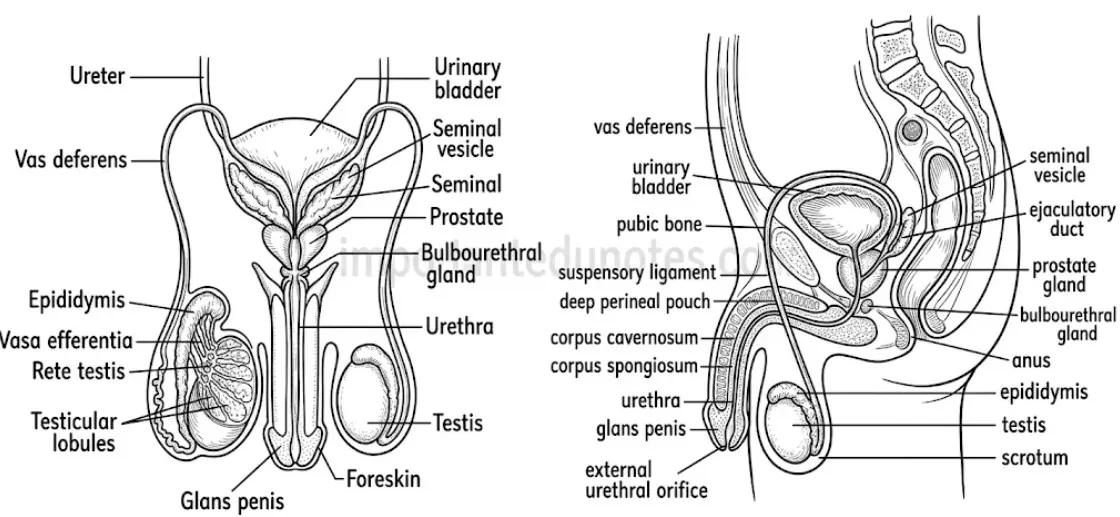
Figure: Human male reproductive organs (1 to 6)
| No. | Part | Function |
|---|---|---|
| 1 | Penis | Erectile copulatory organ; transmits semen into the vagina. |
| 2 | Urethra | Urino-genital duct; common passage for urine and semen. |
| 3 | Scrotum | Sac holding the testes 2–4 °C below body temperature, needed for sperm formation. |
| 4 | Testicle (testis) | Primary sex organ; forms sperms and secretes testosterone. |
| 5 | Seminal vesicle | Gland secreting seminal fluid (about 70% of semen) rich in fructose, the energy source of sperms. |
| 6 | Vas deferens | Sperm duct from the epididymis; joins the seminal vesicle duct to form the ejaculatory duct. |
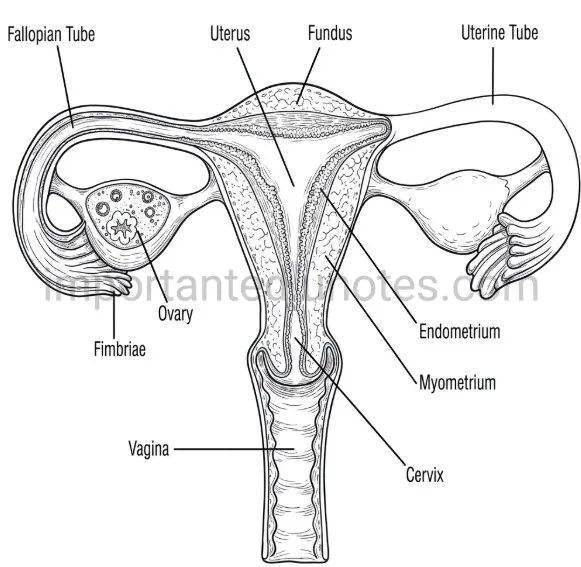
Figure: Human female reproductive organs (1 to 7)
| No. | Part | Function |
|---|---|---|
| 1 | Vagina | Receives semen; birth canal during delivery. |
| 2 | Cervix | Lower end of uterus connecting it to the vagina. |
| 3 | Endometrium | Glandular vascular lining of uterus; site of implantation; shed in menstruation. |
| 4 | Ovary | Primary sex organ; forms ova and secretes oestrogen and progesterone. |
| 5 | Fimbriae | Finger-like ciliated projections of the infundibulum that catch the ovum. |
| 6 | Fallopian tube | Carries the ovum; fertilization takes place here. |
| 7 | Uterus | Muscular sac (womb); blastocyst implants and embryo develops here. |
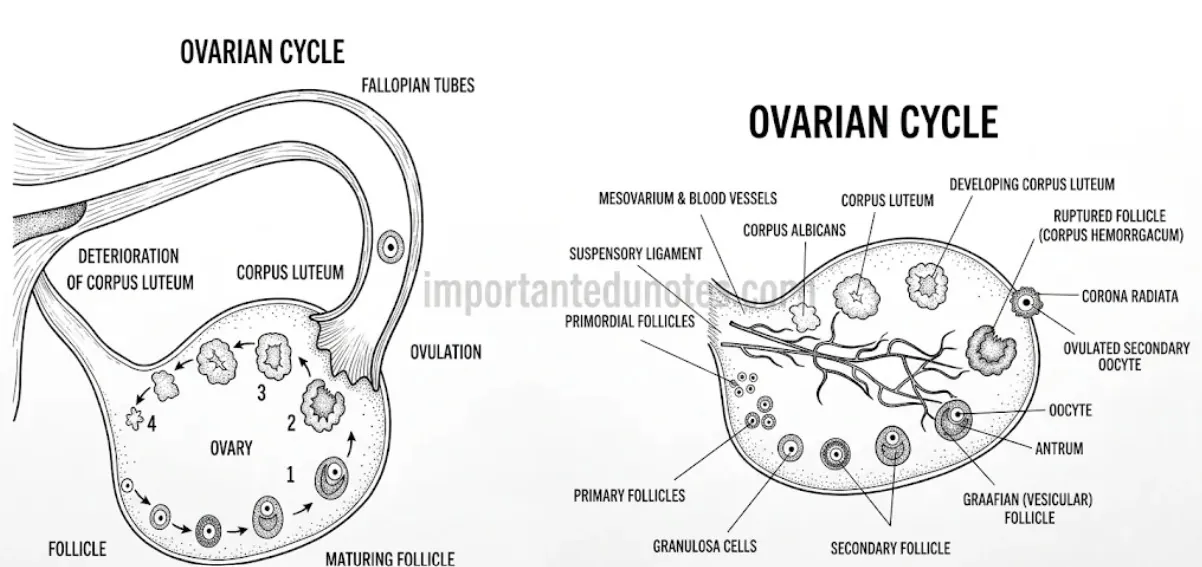
Figure: Human female ovarian cycle
The ovarian cycle occurs in the cortex of the ovary, one month in one ovary and the next month in the other. It has three phases:
i. Follicular phase: Under FSH, many primary follicles grow but only one reaches the Graafian follicle; the others degenerate (atresia). The Graafian follicle secretes oestrogens.
ii. Ovulation: The Graafian follicle ruptures and releases the secondary oocyte, usually on the 14th day, about 14 days before the next menstruation.
iii. Luteal phase: The ruptured follicle becomes the corpus haemorrhagicum (about 3 days), then the yellowish corpus luteum, which secretes progesterone and some oestrogen. Without fertilization it degenerates into the corpus albicans.
Figure: Phases of the menstrual cycle
The menstrual (uterine) cycle occurs in the endometrium. It runs from the first day of one menstruation to the first day of the next, about 28 days (21–40 days normally), from menarche to menopause. It has four phases:
| Phase | Days | Events |
|---|---|---|
| Menstrual | 3–5 days | Corpus luteum degenerates, progesterone and oestrogen fall, spiral arteries spasm, and the endometrium is shed with blood. |
| Regenerative | 4th–6th | Stratum basale repairs the endometrium. |
| Proliferative | 7th–15th | Oestrogen from the Graafian follicle thickens the endometrium (follicular phase of ovary). |
| Secretory | 16th–28th | Progesterone from corpus luteum makes the endometrium thick and glandular (luteal phase of ovary). |
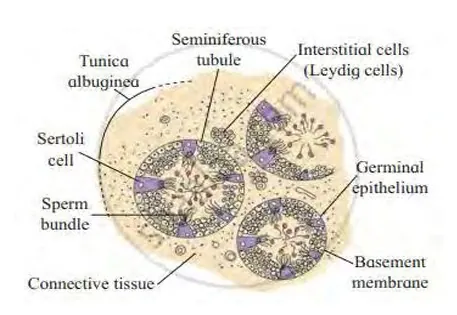
Figure: T.S. of human testis
Labels: seminiferous tubule, tunica albuginea, interstitial cells (Leydig cells), Sertoli cell, germinal epithelium, sperm bundle, basement membrane, connective tissue. In the enlarged part: spermatogonium, primary spermatocyte, secondary spermatocyte, spermatid, spermatozoa and Sertoli cell.
Ovaries are the primary female sex organs (gonads). They form eggs and secrete oestrogen and progesterone.
Location and size: One pair, lying inside the pelvic cavity on either side of the uterus, attached by the mesovarium. Each is almond-shaped, light gray to white, 4 cm long, 2 cm wide, 1 cm thick and weighs 2–4 g. Blood vessels and nerves enter through the hilus.
Structure: Covered by germinal epithelium of cuboidal cells. Inside is the stroma with a dense outer cortex, containing ovarian follicles (primary, secondary, tertiary, Graafian), and a loose inner medulla. The Graafian follicle has an oocyte surrounded by zona pellucida, corona radiata, membrana granulosa, theca interna and theca externa, with a fluid-filled antrum (liquor folliculi).
Function: Oogenesis and ovulation; oestrogens from the Graafian follicle and progesterone from the corpus luteum.
| Gland | Position | Secretion and function |
|---|---|---|
| Seminal vesicles (pair) | Behind the urinary bladder, at the junction of vas deferens and prostate | About 70% of semen; pH 7.4; fructose (main energy for sperms), ascorbic acid, citrate, prostaglandins, enzymes. |
| Prostate gland (single) | Around the first part of the urethra | About 20% of semen; slightly acidic (pH 6.5) with citric acid, albumin, fibrinolysin and fibrinogenase that help sperm motility. |
| Cowper’s glands (pair) | Beneath the prostate, behind the urethra | Slightly alkaline secretion during sexual stimulation; neutralizes urine in the urethra and lubricates the glans penis. |
Semen contains about 5% spermatozoa, 70% seminal fluid, 20% prostatic fluid and 5% Cowper’s fluid.
Reproductive System: Long Answer Questions
Figure: Human male reproductive organs
Human male reproductive organs are the testes, epididymis, vas deferens, seminal vesicles, prostate gland, Cowper’s glands, urethra, penis and scrotum. The testes are primary sex organs; the rest are secondary organs and accessory glands.
| Organ | Description and function |
|---|---|
| Testes | Oval, yellow, one pair in the scrotum; each 4.5–5 cm long, 3 cm wide, 2 cm high, 15–30 g (right slightly larger). Covered by tunica vaginalis, tunica albuginea and tunica vasculosa. About 250 lobules, each with 1–4 coiled seminiferous tubules (30–80 cm long). Germ cells form sperms; Sertoli cells nourish sperms and secrete inhibin; interstitial Leydig cells secrete testosterone. Tubules open into the rete testis, then vasa efferentia. |
| Epididymis | Highly coiled tube on the testis with caput, corpus and cauda. Maturation, motility and temporary storage of sperms. |
| Vas deferens | Arises from the cauda epididymis, ascends to the abdomen, passes over the bladder and joins the seminal vesicle duct to form the ejaculatory duct, which opens into the urethra through the prostate. |
| Seminal vesicles | Pair of long pouches behind the bladder; fructose-rich fluid, about 70% of semen. |
| Prostate gland | Single gland around the urethra; slightly acidic fluid, about 20% of semen, aids sperm motility. |
| Cowper’s glands | Pair beneath the prostate; alkaline secretion neutralizes urine and lubricates. |
| Urethra | Single muscular urino-genital duct from the bladder to the tip of the penis. |
| Penis | Erectile copulatory organ with two corpora cavernosa above and corpus spongiosum around the urethra; glans penis covered by prepuce. Transmits semen into the vagina. |
| Scrotum | Single sac divided by a septum into two compartments, each with a testis held by the gubernaculum. It keeps the testes 2–4 °C cooler than the body. Non-descent of testes (cryptorchidism) causes sterility. |
Figure: T.S. of human testis showing seminiferous tubules and Leydig cells
Female reproductive cycles are rhythmic changes in the ovary and uterus, once every lunar month of 28 days, from menarche (puberty, 10–14 years) to menopause (50–55 years). They are the ovarian cycle and the menstrual (uterine) cycle, which run at the same time.
Figure: Human female ovarian cycle
I. Ovarian cycle
Figure: Phases of the ovarian cycle
i. Follicular phase (pre-ovulatory, estrogenic): FSH from the anterior pituitary grows many follicles, but one reaches Graafian stage; others become atretic. The Graafian follicle secretes oestrogens.
ii. Ovulation: Rupture of the Graafian follicle and release of the secondary oocyte, usually on the 14th day (±1), caused by oestrogen inhibiting FSH and stimulating LH and LTH. It does not occur in pregnancy.
iii. Luteal phase (post-ovulatory, progestational): The collapsed follicle forms a blood clot, the corpus haemorrhagicum (about 3 days). Under LH it becomes the yellow corpus luteum of enlarged granulosa lutea and theca lutein cells, which secretes progesterone and some oestrogen. If there is no fertilization it lasts 9–14 days and degenerates into the corpus albicans; progesterone inhibits LH and LTH and falling oestrogen lets FSH start a new cycle. If fertilization occurs, HCG keeps it for about four months as the corpus luteum of pregnancy, then the placenta takes over.
II. Menstrual cycle
| Phase | Days | Control | Events |
|---|---|---|---|
| Menstrual | 3–5 days | Fall of progesterone and oestrogen | Spasm of spiral arteries, necrosis; superficial endometrium shed with blood that does not clot (anticoagulants). |
| Regenerative | 4th–6th | – | Stratum basale regenerates the epithelium; endometrium begins to thicken. |
| Proliferative | 7th–15th | Oestrogen (Graafian follicle) | Endometrium thickens; glands straight and long; matches follicular phase. |
| Secretory | 16th–28th | Progesterone (corpus luteum) | Thick, soft, water-loaded endometrium with stratum compactum, spongiosum and basale; matches luteal phase. |
Note: Menstrual cycle occurs in monkeys, apes and man; other mammals have an oestrous cycle. Amenorrhea means no menstruation, as in pregnancy.
4. Reproductive System PDF Notes
PDF Notes 1: Human Biology (Unit 8)
PDF Notes 2: Reproductive System (Chapter 8)
5. Reproductive System: Frequently Asked Questions
What is the reproductive system?
What is the reproductive system male and female difference?
What is the reproductive system female function?
What is the reproductive system function in males?
What are primary and secondary sex organs?
Which organs are homologous in male and female?
How to do a reproductive system drawing or diagram?
What are the phases of the ovarian and menstrual cycles?
Where can I download Reproductive system PDF for Class 12 Biology?
Is this Class 12 Biology book PDF for Nepal NEB?
Students also search for: