
Aldehydes and Ketones
Class 12 Chemistry Notes • NEB Syllabus 2083
Syllabus, 29 solved multiple choice questions, the full textbook exercise with solutions and diagrams, handwritten and typed PDF notes and frequently asked questions on aliphatic and aromatic aldehydes and ketones.
1. Syllabus
Unit 13: Aldehydes and Ketones
These notes follow the NEB Class 12 Chemistry syllabus (+2 Chemistry, Nepal). Practise the multiple choice questions first, then work through the solved numerical and subjective questions, and finish with the PDF notes for quick revision.
2. Multiple Choice Questions
Question 1. Which one could be true about the information given in the following table?
| SN | Compounds | Possible reactions/products |
|---|---|---|
| 1. | A | Gives Tollen’s test but not Fehling’s test |
| 2. | B | Gives Cannizzaro’s reaction |
| 3. | C | Gives 2-hydroxy-2-methylpropanoic acid by reacting C with HCN followed by hydrolysis |
- a) A is acetone, B is acetaldehyde and C is formaldehyde
- b) A is benzaldehyde, B is acetone and C is acetaldehyde
- c) A is acetaldehyde, B is acetone and C is benzaldehyde
- d) A is benzaldehyde, B is formaldehyde and C is acetone
Correct Answer: d) A is benzaldehyde, B is formaldehyde and C is acetone
Reason: A gives Tollen’s test but not Fehling’s test: an aromatic aldehyde, benzaldehyde (aliphatic aldehydes give both). B gives Cannizzaro’s reaction, so it has no alpha-hydrogen: formaldehyde. C gives 2-hydroxy-2-methylpropanoic acid after HCN and hydrolysis: \(\mathrm{CH_3COCH_3+HCN\longrightarrow(CH_3)_2C(OH)CN\xrightarrow{H_3O^+}(CH_3)_2C(OH)COOH}\), so C is acetone.
Question 2. Which of the following is true about carbonyl compounds?
- a) They give a positive iodoform test
- b) They give a positive Claisen condensation test
- c) They give a negative iodoform test
- d) They give a positive DNP test
Correct Answer: d) They give a positive DNP test
Reason: Every aldehyde and ketone has the >C=O group, which adds 2,4-dinitrophenylhydrazine to form an orange-yellow 2,4-dinitrophenylhydrazone. The iodoform test is given only by compounds with the \(\mathrm{CH_3CO-}\) group, so a and c are not true for all carbonyl compounds, and Claisen condensation is a reaction of esters, not a test.
Question 3. What would be the product when 2-methylbut-2-ene is ozonolyzed?
- a) 2 molecules of ethanal
- b) Ethanal and propanal
- c) Ethanal and propan-2-one
- d) Ethanal and methanal
Correct Answer: c) Ethanal and propan-2-one
Reason: \(\mathrm{(CH_3)_2C=CHCH_3\xrightarrow{1)\ O_3;\ 2)\ Zn/H_2O}(CH_3)_2C=O+O=CHCH_3}\). The C=C bond is broken and each carbon gets an =O: the carbon with two methyl groups gives propan-2-one and the carbon with one methyl and H gives ethanal.
Question 4. Choose the best alternative from the following table.
| Reactants | Condition | Products |
|---|---|---|
| X | \(\mathrm{Cu(OH)_2}\) + boil | Ethanoic acid |
| \(\mathrm{CH_3CHO}\) | Dil. NaOH | Y |
| \(\mathrm{CH_3-CO-CH_3}\) | Z | cyanohydrin |
- a) X is ethanal, Y is sodium ethanoate and Z is potassium cyanide
- b) X is ethanal, Y is 3-hydroxybutanol and Z is potassium cyanide
- c) X is ethanol, Y is 3-hydroxybutanal and Z is hydrogen cyanide
- d) X is ethanal, Y is 3-hydroxybutanal and Z is hydrogen cyanide
Correct Answer: d) X is ethanal, Y is 3-hydroxybutanal and Z is hydrogen cyanide
Reason: X is oxidised to ethanoic acid by \(\mathrm{Cu(OH)_2}\) (Fehling’s solution) on boiling, so X is ethanal (ethanol does not react). Ethanal with dil. NaOH gives the aldol 3-hydroxybutanal, \(\mathrm{2CH_3CHO\xrightarrow{dil.\ NaOH}CH_3CH(OH)CH_2CHO}\). Propanone adds HCN to give a cyanohydrin.
Question 5. Which of the following is correct for Z? \(\mathrm{CH_3CHO}\) with Zn-Hg/HCl gives Z
- a) Z is ethene
- b) Z is ethane
- c) Z is ethanol
- d) Z is ethanal
Correct Answer: b) Z is ethane
Reason: Zn-Hg/HCl is the Clemmensen reduction reagent, which reduces >C=O to >CH₂: \(\mathrm{CH_3CHO+4[H]\xrightarrow{Zn-Hg/HCl}CH_3CH_3+H_2O}\).
Question 6. Which reaction represents the following chemical equation? \(\mathrm{CH_3COCl+H_2}\) (Pd/\(\mathrm{BaSO_4}\)) gives \(\mathrm{CH_3CHO+HCl}\)
- a) Clemmensen’s reduction
- b) Wolff-Kishner’s reduction
- c) Rosenmund’s reduction
- d) Catalytic reduction
Correct Answer: c) Rosenmund’s reduction
Reason: Reduction of an acyl chloride to an aldehyde with hydrogen over palladium poisoned with \(\mathrm{BaSO_4}\) is Rosenmund’s reduction. The poisoned catalyst stops the reduction at the aldehyde stage and prevents further reduction to the alcohol.
Question 7. How are ketones prepared?
- a) By the oxidation of primary alcohols
- b) By the oxidation of secondary alcohols
- c) By the oxidation of tertiary alcohols
- d) By the oxidation of aldehydes
Correct Answer: b) By the oxidation of secondary alcohols
Reason: \(\mathrm{CH_3CH(OH)CH_3\xrightarrow{K_2Cr_2O_7/H^+}CH_3COCH_3}\). Primary alcohols give aldehydes (then acids), tertiary alcohols resist oxidation, and aldehydes give carboxylic acids.
Question 8. Which of the following compounds gives Cannizzaro’s reaction?
- a) Formic acid
- b) Acetaldehyde
- c) Acetone
- d) Formaldehyde
Correct Answer: d) Formaldehyde
Reason: Cannizzaro’s reaction is given by aldehydes that have no alpha-hydrogen: \(\mathrm{2HCHO+NaOH\longrightarrow CH_3OH+HCOONa}\). Acetaldehyde has alpha-hydrogens and gives aldol condensation instead; formic acid is an acid and acetone is a ketone.
Question 9. Which of the following combinations is correct for the preparation of Bakelite?
- a) Phenol + formaldehyde
- b) Phenol + formic acid
- c) Phenol + acetaldehyde
- d) Phenol + acetic acid
Correct Answer: a) Phenol + formaldehyde
Reason: Bakelite is a thermosetting polymer made by the condensation polymerisation of phenol with methanal (formaldehyde) in the presence of an acid or a base.
Question 10. Which of the following compounds gives both iodoform and Fehling’s tests?
- a) Acetone
- b) Ethanol
- c) Acetaldehyde
- d) Propan-2-ol
Correct Answer: c) Acetaldehyde
Reason: Acetaldehyde is an aliphatic aldehyde, so it reduces Fehling’s solution, and it has the \(\mathrm{CH_3CO-}\) group, so it gives iodoform. Acetone gives only iodoform; ethanol and propan-2-ol give only iodoform (they are oxidised to carbonyl compounds by the hypoiodite) and not Fehling’s test.
Question 11. What would be the product when acetone reacts with chloroform in the presence of KOH?
- a) Trichloromethanol
- b) Chloropicrin
- c) Chloretone
- d) Trichloroacetaldehyde
Correct Answer: c) Chloretone
Reason: \(\mathrm{CH_3COCH_3+CHCl_3\xrightarrow{KOH}(CH_3)_2C(OH)CCl_3}\). The product is 1,1,1-trichloro-2-methylpropan-2-ol, called chloretone, a hypnotic and preservative.
Question 12. Which of the following reagents is used to distinguish between pentan-2-one and pentan-3-one?
- a) \(\mathrm{Zn-Hg/HCl}\)
- b) dil. NaOH
- c) \(\mathrm{NaOH+I_2}\)
- d) \(\mathrm{K_2Cr_2O_7/H^+}\)
Correct Answer: c) \(\mathrm{NaOH+I_2}\)
Reason: Pentan-2-one, \(\mathrm{CH_3COCH_2CH_2CH_3}\), is a methyl ketone and gives a yellow precipitate of iodoform. Pentan-3-one, \(\mathrm{CH_3CH_2COCH_2CH_3}\), has no \(\mathrm{CH_3CO-}\) group and gives none. Both are reduced by Zn-Hg/HCl, both give aldol-type products and both resist dichromate.
Question 13. Which of the following is correct about the information given in the table?
| Reactions | Products |
|---|---|
| A. Perkin’s condensation | 1. Benzoin |
| B. Aldol condensation | 2. Beta-hydroxybutanal |
| C. Claisen condensation | 3. Cinnamic acid |
| D. Benzoin condensation | 4. Beta-keto ester |
- a) A-3, B-2, C-1, D-4
- b) A-3, B-1, C-2, D-4
- c) A-3, B-2, C-4, D-1
- d) A-3, B-1, C-4, D-2
Correct Answer: c) A-3, B-2, C-4, D-1
Reason: Perkin’s condensation (benzaldehyde + acetic anhydride) gives cinnamic acid (3). Aldol condensation of ethanal gives beta-hydroxybutanal (2). Claisen condensation of esters gives a beta-keto ester (4). Benzoin condensation of benzaldehyde gives benzoin (1).
Question 14. The aromatic organic compound Z does not give Fehling’s test but gives Tollen’s test. What would be the compound Z?
- a) Acetophenone
- b) Benzophenone
- c) Benzaldehyde
- d) Benzoic acid
Correct Answer: c) Benzaldehyde
Reason: Aromatic aldehydes are weaker reducing agents than aliphatic ones: they reduce Tollen’s reagent to a silver mirror but not Fehling’s solution. Acetophenone and benzophenone are ketones and benzoic acid is an acid, so none of them reduces Tollen’s reagent.
Question 15. What would be the product when propyne is catalytically hydrated in the presence of dil. \(\mathrm{H_2SO_4}\) and 1% \(\mathrm{HgSO_4}\)?
- a) \(\mathrm{CH_3CH_2CHO}\)
- b) \(\mathrm{CH_3CH_2CH_2OH}\)
- c) \(\mathrm{CH_3COCH_3}\)
- d) \(\mathrm{CH_3-O-CH_2CH_3}\)
Correct Answer: c) \(\mathrm{CH_3COCH_3}\)
Reason: Addition of water follows Markovnikov’s rule, so the OH adds to the middle carbon and gives the enol \(\mathrm{CH_3C(OH)=CH_2}\), which changes (tautomerises) to the stable ketone: \(\mathrm{CH_3C\equiv CH+H_2O\xrightarrow{HgSO_4/H_2SO_4}CH_3COCH_3}\). Only ethyne gives an aldehyde (ethanal).
Question 16. Which of the following conditions is correct for Cannizzaro’s reaction?
- a) Dil. NaOH, Heat, alpha-hydrogen
- b) Conc. NaOH, Heat, alpha-hydrogen
- c) Dil. NaOH, Heat, without alpha-hydrogen
- d) Conc. NaOH, Heat, without alpha-hydrogen
Correct Answer: d) Conc. NaOH, Heat, without alpha-hydrogen
Reason: Cannizzaro’s reaction needs an aldehyde without alpha-hydrogen and a concentrated alkali. With dilute NaOH an aldehyde that has alpha-hydrogen undergoes aldol condensation instead.
Question 17. Which of the following is correct about butan-2-one?
- a) It does not give the iodoform test but gives Tollen’s test
- b) It does not give Tollen’s test but gives Fehling’s test
- c) It does not give Fehling’s test but gives the DNP test
- d) It does not give the DNP test but gives the iodoform test
Correct Answer: c) It does not give Fehling’s test but gives the DNP test
Reason: Butan-2-one, \(\mathrm{CH_3COCH_2CH_3}\), is a ketone: it gives no Tollen’s or Fehling’s test and it does give the 2,4-DNP test (all carbonyl compounds do). It also gives the iodoform test, so a and d are wrong (d says it gives no DNP test), and b is wrong. Option c is correct as stated.
Question 18. The following diagram shows the four compounds W, X, Y and Z. Each compound has hydrogen, carbon and oxygen. The histogram shows the mass of these elements.
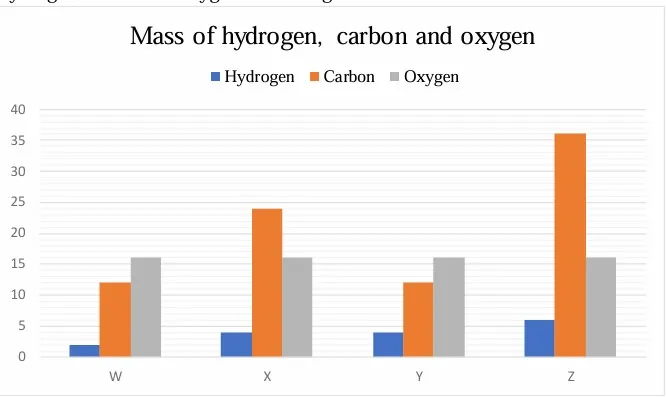
Figure: Mass of hydrogen, carbon and oxygen in the compounds W, X, Y and Z
- a) W is methanol, X is methanal, Y is ethanal and Z is propanal
- b) W is methanal, X is methanol, Y is ethanal and Z is propanol
- c) W is methanol, X is ethanal, Y is ethanol and Z is propanal
- d) W is methanal, X is ethanal, Y is methanol and Z is propanal
Correct Answer: d) W is methanal, X is ethanal, Y is methanol and Z is propanal
Reason: Read the masses (H, C, O) from the histogram and divide by the atomic masses (1, 12, 16). W: 2, 12, 16 gives H 2 : C 1 : O 1, so \(\mathrm{CH_2O}\), methanal. X: 4, 24, 16 gives H 4 : C 2 : O 1, so \(\mathrm{C_2H_4O}\), ethanal. Y: 4, 12, 16 gives H 4 : C 1 : O 1, so \(\mathrm{CH_4O}\), methanol. Z: 6, 36, 16 gives H 6 : C 3 : O 1, so \(\mathrm{C_3H_6O}\), propanal. Only option d matches.
Question 19. What is formalin?
- a) 30% formaldehyde
- b) 50% formaldehyde
- c) 40% formaldehyde
- d) 60% formaldehyde
Correct Answer: c) 40% formaldehyde
Reason: Formalin is a colourless solution of about 40% (37 to 40%) methanal in water, with a little methanol added to prevent polymerisation. It is used to preserve biological specimens.
Question 20. Which of the following is correct about the following table?
| Compounds | Products |
|---|---|
| a. \(\mathrm{CH_3CHO}\) | 1. Cinnamic acid |
| b. \(\mathrm{CH_3COCH_3}\) | 2. 4-Hydroxy-4-methylpentan-2-one |
| c. \(\mathrm{C_6H_5CHO}\) | 3. Formalin |
| d. HCHO | 4. Ethane |
- a) a-1, b-2, c-3, d-4
- b) a-3, b-4, c-1, d-2
- c) a-2, b-3, c-4, d-1
- d) a-4, b-2, c-1, d-3
Correct Answer: d) a-4, b-2, c-1, d-3
Reason: Ethanal on Clemmensen (or Wolff-Kishner) reduction gives ethane (4). Propanone with dil. NaOH gives diacetone alcohol, 4-hydroxy-4-methylpentan-2-one (2). Benzaldehyde gives cinnamic acid by Perkin’s condensation (1). Methanal is sold as a 40% solution, formalin (3).
Question 21. Which of the following is true about benzaldehyde?
- a) It gives the DNP test, iodoform test and gives benzoin condensation
- b) It gives aldol condensation, iodoform test and Perkin’s condensation
- c) It gives Tollen’s test, Perkin’s condensation and Clemmensen’s reduction
- d) It gives Perkin’s condensation, Fehling’s test and Clemmensen’s reduction
Correct Answer: c) It gives Tollen’s test, Perkin’s condensation and Clemmensen’s reduction
Reason: Benzaldehyde reduces Tollen’s reagent, gives cinnamic acid with acetic anhydride (Perkin), and is reduced to toluene by Zn-Hg/HCl. It does not give the iodoform test (no \(\mathrm{CH_3CO-}\) group), aldol condensation (no alpha-hydrogen) or Fehling’s test.
Question 22. \(\mathrm{CH_3CHO\xrightarrow{HCN}X\xrightarrow{H_3O^+}Y}\) In the above sequence of the reaction, what could be Y?
- a) Ethanoic acid
- b) β-hydroxypropanoic acid
- c) α-hydroxypropanoic acid
- d) α-hydroxyethanoic acid
Correct Answer: c) α-hydroxypropanoic acid
Reason: \(\mathrm{CH_3CHO+HCN\longrightarrow CH_3CH(OH)CN\ (X)}\); hydrolysis of the nitrile: \(\mathrm{CH_3CH(OH)CN+2H_2O+HCl\longrightarrow CH_3CH(OH)COOH\ (Y)+NH_4Cl}\). Y is 2-hydroxypropanoic acid (lactic acid); the OH is on the carbon next to -COOH, so it is an alpha-hydroxy acid.
Question 23. Which of the following is related with \(\mathrm{(CH_2)_6N_4}\)?
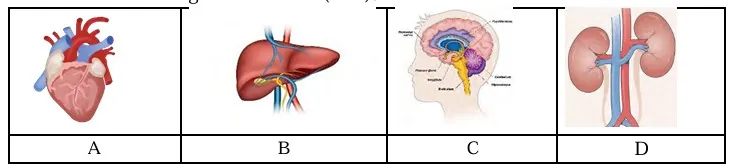
Figure: Options A to D for Question 23 (heart, liver, brain and kidneys)
- a) Heart
- b) Liver
- c) Brain
- d) Kidney
Correct Answer: d) Kidney (the options A to D show the heart, liver, brain and kidneys)
Reason: \(\mathrm{(CH_2)_6N_4}\) is urotropine (hexamethylenetetramine, hexamine), formed from methanal and ammonia: \(\mathrm{6HCHO+4NH_3\longrightarrow(CH_2)_6N_4+6H_2O}\). It is used as a urinary antiseptic, so it is related to the kidneys and urinary system.
Question 24. Choose the best alternative from the followings.
| Reaction condition | Name of the reaction |
|---|---|
| a. Dil. NaOH | 1. Tollen’s test |
| b. Zn-Hg/HCl | 2. Aldol condensation |
| c. Hydrazine/glycerol/KOH | 3. Clemmensen’s reduction |
| d. Ammoniacal \(\mathrm{AgNO_3}\) | 4. Wolff-Kishner’s reduction |
- a) a-1, b-2, c-3, d-4
- b) a-3, b-4, c-1, d-2
- c) a-2, b-3, c-4, d-1
- d) a-4, b-2, c-1, d-3
Correct Answer: c) a-2, b-3, c-4, d-1
Reason: Dil. NaOH is the catalyst of aldol condensation (2). Zn-Hg/HCl is Clemmensen’s reduction (3). Hydrazine with KOH in glycerol is Wolff-Kishner’s reduction (4). Ammoniacal \(\mathrm{AgNO_3}\) is Tollen’s reagent (1).
Question 25. What would be the products A and B in the following reaction sequence? \(\mathrm{CH_3-CH=CH_2\xrightarrow[2)\ Zn,\ H_2O]{1)\ O_3}A+B}\)
- a) A is ethanol and B is methanol
- b) A is ethanol and B is methanal
- c) A is ethanal and B is methanol
- d) A is ethanal and B is methanal
Correct Answer: d) A is ethanal and B is methanal
Reason: Ozonolysis (the reagent in the book is printed as O₂, but ozone, O₃, is meant) cleaves the C=C bond of propene, and zinc and water prevent oxidation of the products to acids: \(\mathrm{CH_3CH=CH_2\longrightarrow CH_3CHO+HCHO}\). The two products are carbonyl compounds, not alcohols.
Question 26. The reaction: A (acetone/alkali) gives chloretone. Identify compound A.
- a) Trichloromethane
- b) Bromoform
- c) Iodoform
- d) Haloalkane
Correct Answer: a) Trichloromethane
Reason: Chloretone is made from propanone and chloroform (trichloromethane, \(\mathrm{CHCl_3}\)) with solid alkali: \(\mathrm{CH_3COCH_3+CHCl_3\xrightarrow{KOH}(CH_3)_2C(OH)CCl_3}\). Chloretone contains three chlorine atoms, so bromoform and iodoform cannot give it.
Question 27. What would be the major product when propan-2-one is treated with dil. NaOH?
- a) 3-Hydroxy butan-2-one
- b) 4-Hydroxypentan-2-one
- c) 3-Hydroxy 3-methyl butan-2-one
- d) 4-Hydroxy 4-methyl pentan-2-one
Correct Answer: d) 4-Hydroxy 4-methyl pentan-2-one
Reason: The enolate of one propanone molecule adds to the C=O of a second molecule (aldol addition): \(\mathrm{2CH_3COCH_3\xrightarrow{dil.\ NaOH}CH_3C(OH)(CH_3)CH_2COCH_3}\). The product is diacetone alcohol, 4-hydroxy-4-methylpentan-2-one.
Question 28. Which of the following compounds give iodoform test?
- a) Methanal
- b) Propanal
- c) Butanal
- d) Propan-2-one
Correct Answer: d) Propan-2-one
Reason: The iodoform test needs the \(\mathrm{CH_3CO-}\) group (or \(\mathrm{CH_3CH(OH)-}\)). Only propan-2-one has it: \(\mathrm{CH_3COCH_3+3I_2+4NaOH\longrightarrow CHI_3\downarrow+CH_3COONa+3NaI+3H_2O}\). Methanal, propanal and butanal have no methyl group on the carbonyl carbon.
Question 29. What could be W, X, Y and Z in the following reaction sequence? W gives positive test with 2,4-DNP; X gives Tollen’s test; Y gives Fehling’s test; Z is carboxylic acid.
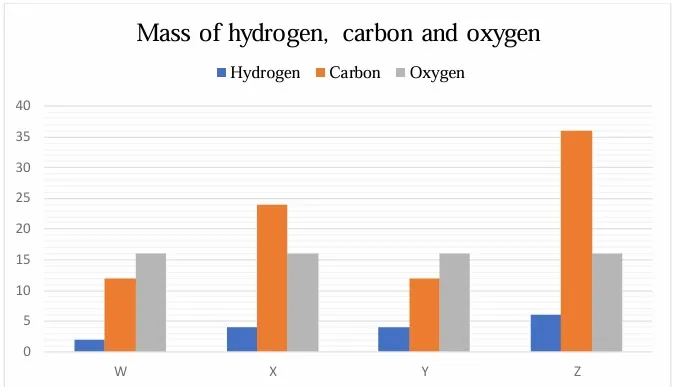
Figure: Reference diagram for Question 29
- a) W – alcoholic compounds, X – ketone, Y – aliphatic aldehyde and Z can be ethanoic acid
- b) W – carbonyl compounds, X – aldehyde, Y – aliphatic aldehyde and Z can be ethanoic acid
- c) W – carboxylic acid, X – aldehyde, Y – aliphatic aldehyde and Z can be benzoic acid
- d) W – alcohol, X – ketone, Y – aliphatic aldehyde and Z can be benzoic acid
Correct Answer: b) W – carbonyl compounds, X – aldehyde, Y – aliphatic aldehyde and Z can be ethanoic acid
Reason: A positive 2,4-DNP test shows a carbonyl compound (aldehyde or ketone). Tollen’s test shows an aldehyde (ketones do not give it). Fehling’s test shows an aliphatic aldehyde. Z is a carboxylic acid, which can be ethanoic acid. Options a and d name an alcohol and a ketone, which do not give Tollen’s test, and option c names an acid for W, which does not give the DNP test.
3. Numerical and Subjective Questions
Short Answer Questions
Ethanal and propanone both contain the \(\mathrm{CH_3CO-}\) group and both give the 2,4-DNP test and the iodoform test, so those tests cannot separate them. They are separated by tests that need an aldehyde group: Tollen’s test and Fehling’s test.
| Test | Ethanal, \(\mathrm{CH_3CHO}\) | Propanone, \(\mathrm{CH_3COCH_3}\) |
|---|---|---|
| Tollen’s reagent (ammoniacal \(\mathrm{AgNO_3}\), warm) | Bright silver mirror | No change |
| Fehling’s solution (boil) | Red precipitate of \(\mathrm{Cu_2O}\) | Blue colour remains |
| 2,4-DNP | Orange-yellow precipitate | Orange-yellow precipitate |
| Iodine + NaOH | Yellow \(\mathrm{CHI_3}\) | Yellow \(\mathrm{CHI_3}\) |
Structures.
| Name | Condensed formula | Type |
|---|---|---|
| Butan-2-one | \(\mathrm{CH_3-CO-CH_2-CH_3}\) | Ketone (ethyl methyl ketone) |
| 3-Hydroxybutanal | \(\mathrm{CH_3-CH(OH)-CH_2-CHO}\) | Hydroxy aldehyde (aldol) |
A. The aromatic aldehyde with molecular mass 106 is benzaldehyde: \(\mathrm{C_6H_5CHO}\), M = 7(12) + 6(1) + 16 = 106. The other members of the cycle follow from its reactions:
| Name | Formula | Step | |
|---|---|---|---|
| E | Toluene | \(\mathrm{C_6H_5CH_3}\) | D to E: Friedel-Crafts methylation of benzene |
| A | Benzaldehyde | \(\mathrm{C_6H_5CHO}\) | E to A: oxidation of toluene |
| B | Benzoic acid | \(\mathrm{C_6H_5COOH}\) | A to B: oxidation of the aldehyde |
| C | Sodium benzoate | \(\mathrm{C_6H_5COONa}\) | B to C: neutralisation with NaOH |
| D | Benzene | \(\mathrm{C_6H_6}\) | C to D: decarboxylation with soda lime |
Figure: Cyclic pattern of reactions, where A is benzaldehyde (molecular mass 106) and the cycle returns to toluene
Reasoning. A positive 2,4-DNP test shows a carbonyl group, and a negative Tollen’s (silver nitrate) test shows that A is not an aldehyde. So A is a ketone of formula \(\mathrm{C_5H_{10}O}\). Vigorous oxidation breaks the ketone at the carbonyl group and gives acids; the acid with the formula \(\mathrm{C_3H_6O_2}\) is propanoic acid, \(\mathrm{CH_3CH_2COOH}\). This is formed from pentan-3-one (and also from pentan-2-one), so A is taken as the symmetrical ketone pentan-3-one.
| Name | Structure | |
|---|---|---|
| A | Pentan-3-one | \(\mathrm{CH_3CH_2COCH_2CH_3}\) |
| B | Propanoic acid | \(\mathrm{CH_3CH_2COOH}\) |
| C | Butane | \(\mathrm{CH_3CH_2CH_2CH_3}\) |
Kolbe’s electrolysis: two propanoate ions lose electrons at the anode, lose CO₂, and the two ethyl radicals join:
(Pentan-2-one, \(\mathrm{CH_3COCH_2CH_2CH_3}\), also oxidises to propanoic acid and ethanoic acid, so it fits the data in the same way. Butane is the answer for C either way.)
Reasoning. An aromatic hydrocarbon with M = 78 is benzene, \(\mathrm{C_6H_6}\) (6 × 12 + 6 × 1 = 78), so X is benzene. W changes into benzene on heating with zinc dust: that is the reduction of phenol. Benzene with \(\mathrm{CH_3Cl}\) and anhydrous \(\mathrm{AlCl_3}\) (Friedel-Crafts alkylation) gives toluene (Y), and oxidation of the methyl group of toluene gives benzaldehyde (Z).
| Name | Formula | |
|---|---|---|
| W | Phenol | \(\mathrm{C_6H_5OH}\) |
| X | Benzene | \(\mathrm{C_6H_6}\) |
| Y | Toluene | \(\mathrm{C_6H_5CH_3}\) |
| Z | Benzaldehyde | \(\mathrm{C_6H_5CHO}\) |
Figure: Reaction sequence W to Z. X is benzene (molecular mass 78)
a. Formaldehyde is treated with 2,4-DNP?
Methanal adds 2,4-dinitrophenylhydrazine and loses water (condensation). A yellow-orange precipitate of methanal 2,4-dinitrophenylhydrazone is formed; it shows the presence of a carbonyl group.
Figure: Methanal gives a yellow-orange precipitate of its 2,4-dinitrophenylhydrazone with 2,4-DNP
b. Methanal is heated with ammonia?
Urotropine (hexamethylenetetramine, hexamine) is formed. It is used as a urinary antiseptic and in the manufacture of the explosive RDX.
c. Acetone is reacted with hydroxyl amine?
Propanone oxime (acetoxime) is formed with the loss of water:
d. Ethanal is treated with HCN followed by acid hydrolysis?
Ethanal adds HCN to give the cyanohydrin, which on hydrolysis gives 2-hydroxypropanoic acid (lactic acid):
e. Benzaldehyde is heated with alc. KCN?
Benzoin condensation takes place: two molecules of benzaldehyde join to give benzoin, an alpha-hydroxy ketone (the cyanide ion is the catalyst):
Figure: Benzoin condensation. Two molecules of benzaldehyde couple in the presence of alcoholic KCN
a. Tollen’s test
Ethanal gives a silver mirror when warmed with ammoniacal silver nitrate (any aldehyde, including benzaldehyde, gives the test):
b. Fehling’s test
Ethanal (an aliphatic aldehyde) gives a red precipitate of copper(I) oxide on boiling with Fehling’s solution:
c. Aldol condensation
Ethanal, which has alpha-hydrogens, gives 3-hydroxybutanal with dilute NaOH:
d. Cannizzaro’s reaction
Methanal (no alpha-hydrogen) with concentrated NaOH gives methanol and sodium methanoate. Benzaldehyde behaves in the same way (benzyl alcohol and sodium benzoate):
Figure: Cannizzaro reaction of benzaldehyde, which has no α-hydrogen
e. Clemmensen’s reduction
Propanone is reduced to propane by zinc amalgam and concentrated HCl:
| Compound | Molecular formula | Identity |
|---|---|---|
| A | \(\mathrm{C_2H_5Cl}\) | Chloroethane |
| B | \(\mathrm{C_4H_{10}}\) | Butane |
| C | \(\mathrm{CH_2O}\) | Methanal |
| D | \(\mathrm{C_2H_4O}\) | Ethanal |
| E | \(\mathrm{C_2H_6O}\) | Ethanol (primary alcohol) |
A to B (Wurtz reaction). Chloroethane is heated with sodium metal in dry ether:
E to A. Ethanol is converted into chloroethane with thionyl chloride (or PCl₅, or HCl/ZnCl₂):
A to D (ethanal). Hydrolysis with aqueous KOH gives ethanol, and mild oxidation with PCC stops at the aldehyde:
A to C (methanal). Dehydrohalogenation with alcoholic KOH gives ethene, and ozonolysis of ethene gives two molecules of methanal:
Reasoning. A does not react with phenylhydrazine, so it has no C=O group; it forms a carbonyl compound B on oxidation, so it is an alcohol. B reacts with 2,4-DNP (carbonyl) but not with Tollen’s reagent (not an aldehyde), so B is a ketone, \(\mathrm{C_4H_8O}\) = butan-2-one, and A is the secondary alcohol butan-2-ol. Dehydration of A gives but-2-ene (Saytzeff’s rule), and its ozonolysis gives two identical molecules of ethanal, which agrees with the data.
| Name | Structure | |
|---|---|---|
| A | Butan-2-ol | \(\mathrm{CH_3CH(OH)CH_2CH_3}\) |
| B | Butan-2-one | \(\mathrm{CH_3COCH_2CH_3}\) |
| C | But-2-ene | \(\mathrm{CH_3CH=CHCH_3}\) |
Acetone with HCN, then acid hydrolysis. The cyanohydrin is hydrolysed to 2-hydroxy-2-methylpropanoic acid:
Reasoning (working backwards). E gives ethanoic acid on oxidation, so E is ethanal; it is formed by hydration of ethyne with \(\mathrm{HgSO_4}\)/aq. \(\mathrm{H_2SO_4}\), so D is ethyne. Ethyne is formed when iodoform is heated with silver powder, so C is iodoform, and the yellow precipitate shows that B has the \(\mathrm{CH_3CO-}\) group. B gives no Fehling’s test and is the only product of ozonolysis, so it is propanone. The symmetrical alkene which gives two molecules of propanone is 2,3-dimethylbut-2-ene (3 + 3 = 6 carbon atoms).
| Name | Formula | |
|---|---|---|
| A | 2,3-Dimethylbut-2-ene | \(\mathrm{(CH_3)_2C=C(CH_3)_2}\) |
| B | Propanone | \(\mathrm{CH_3COCH_3}\) |
| C | Iodoform (triiodomethane) | \(\mathrm{CHI_3}\) |
| D | Ethyne | \(\mathrm{HC\equiv CH}\) |
| E | Ethanal | \(\mathrm{CH_3CHO}\) |
Long Answer Questions
a. Identify the compounds W, X, Y and Z.
Divide each mass in the histogram by the atomic mass (H = 1, C = 12, O = 16) to get the mole ratio:
| Compound | Mass H | Mass C | Mass O | Mole ratio H : C : O | Formula | Compound |
|---|---|---|---|---|---|---|
| W | 2 | 12 | 16 | 2 : 1 : 1 | \(\mathrm{CH_2O}\) | Methanal |
| X | 4 | 24 | 16 | 4 : 2 : 1 | \(\mathrm{C_2H_4O}\) | Ethanal |
| Y | 4 | 12 | 16 | 4 : 1 : 1 | \(\mathrm{CH_4O}\) | Methanol |
| Z | 6 | 36 | 16 | 6 : 3 : 1 | \(\mathrm{C_3H_6O}\) | Propanal |
Figure: Mass of hydrogen, carbon and oxygen in the compounds W, X, Y and Z
b. What happens when compound W is heated with ammonia?
Methanal and ammonia condense to form urotropine (hexamethylenetetramine), a white crystalline solid used as a urinary antiseptic:
c. Write the isomers of compound Z.
Z is propanal, \(\mathrm{C_3H_6O}\). Its carbonyl isomers are:
| Isomer | Structure | Type |
|---|---|---|
| Propanal | \(\mathrm{CH_3CH_2CHO}\) | Aldehyde (Z) |
| Propanone | \(\mathrm{CH_3COCH_3}\) | Ketone (functional isomer) |
Other compounds of the same formula are the unsaturated alcohol prop-2-en-1-ol, \(\mathrm{CH_2=CHCH_2OH}\), the ether methoxyethene, \(\mathrm{CH_2=CHOCH_3}\), and the cyclic compounds methyloxirane and oxetane.
d. Write difference between compounds X and Y with a chemical test of each.
| X: Ethanal, \(\mathrm{CH_3CHO}\) | Y: Methanol, \(\mathrm{CH_3OH}\) | |
|---|---|---|
| Functional group | Aldehyde, -CHO | Alcohol, -OH |
| Chemical test | Tollen’s test: silver mirror with ammoniacal \(\mathrm{AgNO_3}\); Fehling’s test: red \(\mathrm{Cu_2O}\); 2,4-DNP: orange precipitate | Sodium metal: bubbles of \(\mathrm{H_2}\); no reaction with Tollen’s, Fehling’s or 2,4-DNP |
| Reaction with Na | No reaction | Gives \(\mathrm{CH_3ONa}\) and hydrogen |
| Oxidation product | Ethanoic acid | Methanal, then methanoic acid |
A. Identify V, W, X, Y and Z
W is formed when acetylene is passed through a red-hot iron tube (cyclic polymerisation), so W is benzene: \(\mathrm{3HC\equiv CH\xrightarrow{red\ hot\ Fe\ tube}C_6H_6}\). V gives benzene on heating with zinc dust, so V is phenol. Benzene with \(\mathrm{CH_3Cl}\)/anhydrous \(\mathrm{AlCl_3}\) gives toluene (X), toluene is oxidised to benzaldehyde (Y), and benzaldehyde heated with sodium ethanoate (with ethanoic anhydride) gives cinnamic acid (Z) by Perkin’s condensation.
| Name | Formula | |
|---|---|---|
| V | Phenol | \(\mathrm{C_6H_5OH}\) |
| W | Benzene | \(\mathrm{C_6H_6}\) |
| X | Toluene | \(\mathrm{C_6H_5CH_3}\) |
| Y | Benzaldehyde | \(\mathrm{C_6H_5CHO}\) |
| Z | Cinnamic acid (3-phenylprop-2-enoic acid) | \(\mathrm{C_6H_5CH=CHCOOH}\) |
Figure: Reaction sequence V to Z. W (benzene) is also formed from acetylene in a red-hot iron tube
B. Identify M, N and O
(The compounds in this part are M, N and O.) M decolorises bromine, so it is an alkene. It does not react with sodium (no -OH) or with phenylhydrazine (no C=O). Ozonolysis gives two carbonyl compounds. N gives Tollen’s and iodoform tests, so it is ethanal, \(\mathrm{CH_3CHO}\). O has M = 72 and is a carbonyl compound: \(\mathrm{C_4H_8O}\) (4 × 12 + 8 + 16 = 72). Since M has 6 carbons and N supplies 2, O has 4. Taking O as butan-2-one, the two carbonyl carbons join through a double bond:
| Name | Structure | |
|---|---|---|
| M | 3-Methylpent-2-ene | \(\mathrm{CH_3CH=C(CH_3)CH_2CH_3}\) |
| N | Ethanal | \(\mathrm{CH_3CHO}\) |
| O | Butan-2-one | \(\mathrm{CH_3COCH_2CH_3}\) |
The data also fit M = hex-2-ene if O is butanal, or M = 4-methylpent-2-ene if O is 2-methylpropanal, because each of these carbonyl compounds has the molecular mass 72 and reacts with phenylhydrazine. The answer commonly given is 3-methylpent-2-ene with butan-2-one.
A. Identify P, Q, R, S and T
| Clue | Compound | |
|---|---|---|
| P | Same functional group (-OH) as ethanol: an alcohol | Methanol, \(\mathrm{CH_3OH}\) (any alcohol fits; methanol is the simplest) |
| Q | Not aliphatic and gives Cannizzaro’s reaction (aldehyde, no alpha-hydrogen) | Benzaldehyde, \(\mathrm{C_6H_5CHO}\) |
| R | Oxidation product of Q | Benzoic acid, \(\mathrm{C_6H_5COOH}\) |
| S | A compound of ammonia, formed from an aldehyde (this unit) | Urotropine, \(\mathrm{(CH_2)_6N_4}\) (from methanal and ammonia) |
| T | Nitration of benzene, the fundamental aromatic compound | Nitrobenzene, \(\mathrm{C_6H_5NO_2}\) |
Figure: Cannizzaro reaction of benzaldehyde, which has no α-hydrogen
B. Identify W, X and Y
A primary alcohol that gives the iodoform test must contain the \(\mathrm{CH_3CH(OH)-}\) group, and the only primary alcohol that does is ethanol. So W is ethanol. Acidified dichromate oxidises it to ethanal (X), and ethanal gives an orange-yellow precipitate with 2,4-DNP (Y).
| Name | Formula | |
|---|---|---|
| W | Ethanol | \(\mathrm{CH_3CH_2OH}\) |
| X | Ethanal | \(\mathrm{CH_3CHO}\) |
| Y | Ethanal 2,4-dinitrophenylhydrazone | \(\mathrm{CH_3CH=N-NH-C_6H_3(NO_2)_2}\) |
A. Identify A, B and C
| Name | Formula | |
|---|---|---|
| A | Toluene | \(\mathrm{C_6H_5CH_3}\) |
| B | Benzaldehyde | \(\mathrm{C_6H_5CHO}\) |
| C | Cinnamic acid | \(\mathrm{C_6H_5CH=CHCOOH}\) |
The last step is Perkin’s condensation; sodium ethanoate acts as the base and ethanoic anhydride supplies the -CH₂COOH unit.
Figure: Reaction sequence from benzene to A, B and C
B. Identify P, Q, R, S and T
S and T. S (\(\mathrm{C_3H_6O}\)) gives iodoform and no Tollen’s test: propanone. T gives Tollen’s test and no iodoform: propanal. R is the alkene that gives these two on ozonolysis: \(\mathrm{(CH_3)_2C=CHCH_2CH_3}\), 2-methylpent-2-ene. Q is an alcohol that loses water to give R and is formed by hydrogenation of the carbonyl compound P. P does not react with Tollen’s reagent, so it is a ketone and Q is a secondary alcohol: 2-methylpentan-3-ol, whose dehydration gives the more substituted alkene R (Saytzeff’s rule). So P is 2-methylpentan-3-one.
| Name | Structure | |
|---|---|---|
| P | 2-Methylpentan-3-one | \(\mathrm{(CH_3)_2CHCOCH_2CH_3}\) |
| Q | 2-Methylpentan-3-ol | \(\mathrm{(CH_3)_2CHCH(OH)CH_2CH_3}\) |
| R | 2-Methylpent-2-ene | \(\mathrm{(CH_3)_2C=CHCH_2CH_3}\) |
| S | Propanone | \(\mathrm{CH_3COCH_3}\) |
| T | Propanal | \(\mathrm{CH_3CH_2CHO}\) |
a. Identify A, B and C
B gives 4-hydroxy-4-methylpentan-2-one with dilute NaOH: this is the aldol product of propanone, \(\mathrm{CH_3COCH_3}\) (M = 58). A (M = 44) is oxidised by Fehling’s solution to a carboxylic acid, so it is an aliphatic aldehyde: ethanal, \(\mathrm{CH_3CHO}\) (2 × 12 + 4 + 16 = 44). Its reduction gives ethanol, which is the antiseptic. C (M = 106) reduces Tollen’s reagent but not Fehling’s solution, so it is an aromatic aldehyde, benzaldehyde, which forms cinnamic acid (an aromatic unsaturated acid) with ethanoic anhydride.
| Name | Formula | M | |
|---|---|---|---|
| A | Ethanal | \(\mathrm{CH_3CHO}\) | 44 |
| B | Propanone | \(\mathrm{CH_3COCH_3}\) | 58 |
| C | Benzaldehyde | \(\mathrm{C_6H_5CHO}\) | 106 |
Reactions of A.
Reaction of B.
Reactions of C.
Figure: Perkin condensation. Benzaldehyde and acetic anhydride give cinnamic acid
b. Identify the aldehyde, write the reactions and its preparation
The product 2-hydroxypropanoic acid, \(\mathrm{CH_3CH(OH)COOH}\), has three carbon atoms, and the -CN group of the cyanohydrin supplies one. So the aldehyde has two carbons: ethanal, \(\mathrm{CH_3CHO}\).
Preparation of ethanal. Mild oxidation of ethanol with PCC (or by passing ethanol over hot copper); ethyne with water and \(\mathrm{HgSO_4}\)/\(\mathrm{H_2SO_4}\) also gives ethanal:
4. View PDF Notes
i. Handwritten Notes
ii. Typed PDF Notes
5. Frequently Asked Questions
What are aldehydes and ketones? What is their general formula and functional group? (Aldehydes and ketones formula)
Give examples of aldehydes and ketones with their IUPAC and common names. (Aldehydes and ketones examples)
What is the difference between aldehydes and ketones?
How are aldehydes and ketones prepared?
How do you distinguish between aldehydes and ketones? Which chemical tests are used?
What are the reactions of aldehydes and ketones with HCN, hydroxylamine, ammonia and 2,4-DNP?
What is the aldol condensation? Which compounds give it?
What is Cannizzaro’s reaction?
What are Clemmensen’s, Wolff-Kishner’s and Rosenmund’s reductions?
What are the reactions of benzaldehyde? (Aromatic aldehydes and ketones)
What is formalin? What is Bakelite? What are the uses of aldehydes and ketones?
What is chloretone and how is it prepared?
Where can I get Aldehydes and ketones Class 12 notes, notes PDF and handwritten notes?
What topics are included in Unit 13 Aldehydes and Ketones of NEB Class 12 Chemistry?
Where can I get Class 12 Chemistry notes of NEB (handwritten, PDF, Nepal)?
Students also search for: