
Asexual Reproduction in Plants
Class 12 Biology Notes • NEB Syllabus 2083
Asexual reproduction in plants for Class 12 Biology Unit 4 Embryology: meaning, syllabus, micro syllabus, 9 solved multiple choice questions, short and long answer questions on vegetative propagation, cutting, layering, grafting and micropropagation, with figures and two PDF notes.
1. Asexual Reproduction in Plants Syllabus
Unit 4: Embryology (this page: Asexual reproduction)
Asexual reproduction in plants (asexual reproduction meaning) is reproduction without the fusion of gametes or the formation of seed by fertilisation. It gives genetically identical offspring from a single parent. These notes follow the NEB Class 12 Biology syllabus (+2 Biology, Nepal), Unit 4 Embryology, chapter 1. Practise the multiple choice questions, then the solved short and long answers, then the PDF notes.

Figure: Asexual reproduction in plants, Class 12 Biology (NEB)
Micro syllabus: 4. Embryology
Read more about asexual reproduction, vegetative reproduction and micropropagation on Wikipedia. More notes: Class 12 Biology notes, Class 12 Chemistry notes and Class 12 Physics notes.
2. Multiple Choice Questions
Question 1. Which of the following is a method of asexual reproduction in angiosperms where embryos develop without fertilization?
- a) Vegetative propagation
- b) Agamospermy
- c) Self-pollination
- d) Cross-pollination
Correct Answer: b) Agamospermy
Reason: In agamospermy (asexual seed formation) the embryo develops without fertilisation. Self- and cross-pollination are sexual.
Question 2. In which type of apomixis does the embryo develop from diploid cells of the nucellus or integuments?
- a) Recurrent Agamospermy
- b) Non-recurrent Agamospermy
- c) Adventive embryony
- d) Vegetative propagation
Correct Answer: c) Adventive embryony
Reason: Adventive (nucellar) embryony forms the embryo from diploid somatic cells of the nucellus or integuments, as in citrus and mango.
Question 3. Which of the following is an example of a plant that reproduces through rhizomes?
- a) Potato
- b) Onion
- c) Ginger
- d) Sweet potato
Correct Answer: c) Ginger
Reason: Ginger, turmeric and bamboo have rhizomes. Potato has tubers, onion has bulbs and sweet potato uses roots.
Question 4. What is the horizontal stem that grows along the ground and produces new plants at nodes called?
- a) Tuber
- b) Runner
- c) Offset
- d) Stolon
Correct Answer: b) Runner
Reason: A runner is a slender horizontal stem creeping along the ground and giving new plants at its nodes, as in Cynodon (dubo).
Question 5. Which of the following is a disadvantage of vegetative propagation?
- a) Rapid reproduction
- b) Genetic variation
- c) Susceptibility to diseases
- d) Uniform growth
Correct Answer: c) Susceptibility to diseases
Reason: Clones are genetically identical and have no variation, so plants stay open to attack by diseases and insects.
Question 6. Name the small piece of plant used in micropropagation.
- a) Clone
- b) Explant
- c) Graft
- d) Scion
Correct Answer: b) Explant
Reason: An explant is the small piece of plant tissue grown on sterile nutrient medium in micropropagation. A clone is the product.
Question 7. Study the given diagram of a strawberry plant. Name the method of vegetative propagation shown in the figure.
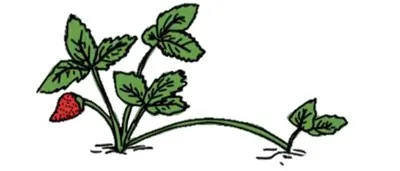
Figure: Strawberry plant diagram
- a) Bulbil
- b) Runner
- c) Rhizome
- d) Tuber
Correct Answer: b) Runner
Reason: Strawberry spreads by slender creeping stems over the soil that root at nodes (runners). Rhizomes and tubers are underground.
Question 8. A rare orchid species is on the verge of extinction. Scientists plan to multiply it rapidly in the lab. Which of the following will help achieve this?
- a) Cross pollination
- b) Grafting
- c) Tissue culture using explants
- d) Cutting and layering
Correct Answer: c) Tissue culture using explants
Reason: Tissue culture (micropropagation) makes many healthy plantlets quickly from a tiny explant in the laboratory.
Question 9. Why is it ecologically dangerous when aquatic weeds like Eichornia propagate through offsets?
- a) They increase pollinator diversity
- b) They reduce water pollution
- c) They spread rapidly and choke water bodies
Correct Answer: c) They spread rapidly and choke water bodies
Reason: Offsets of water hyacinth multiply fast, cover the water surface and block light and oxygen for aquatic life.
3. Short and Long Answer Questions
Asexual Reproduction in Plants: Short Answer Questions
Figure: Types of asexual reproduction in angiosperms: agamospermy and vegetative propagation
Vegetative propagation is a form of asexual reproduction in angiosperms in which new plants develop from the vegetative parts of a plant, such as root, stem, leaf and bud, without fertilisation and without seed formation. The offspring are genetically identical to the parent and are called clones.
Figure: Micropropagation: explant to sterile medium, callus, plantlets and transplanting
Micropropagation is the artificial method of vegetative propagation in which many similar plants are developed from a small piece of plant tissue (explant) by plant tissue culture. It is carried out under sterile laboratory conditions with nutrient medium and plant hormones.
Importance:
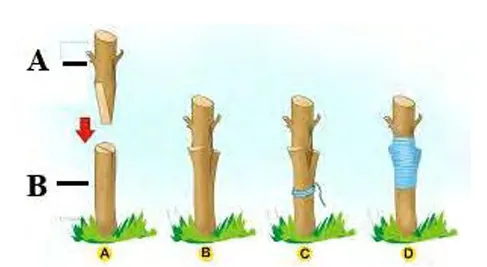
Figure: Grafting: A is the scion and B is the stock
| Cutting | Grafting |
|---|---|
| A part of a plant (stem, leaf or root) is cut and planted to grow into a new plant. | Two plants are joined together to form a single plant. |
| Only one plant part is used. | Two parts are used: the upper scion and the lower stock. |
| The cutting must form its own new roots. | The root system is provided by the stock. |
| The new plant has the traits of only one parent plant. | It combines the desired traits of the scion with the strong roots and disease resistance of the stock. |
| Examples: rose, sugarcane, bougainvillea. | Examples: mango, apple, citrus, rose. |
Vegetative propagation uses only the vegetative parts of the plant and involves no gamete formation, no fertilisation and no genetic recombination. New plants arise by mitotic cell division, so the offspring are exact genetic copies (clones) of the parent.
Therefore the desirable characters of the parent, such as fruit size, taste, colour and yield, are passed on unchanged generation after generation. It also ensures uniform growth and yield.
Figure: Grafting: A is the scion and B is the stock
Asexual Reproduction in Plants: Long Answer Questions
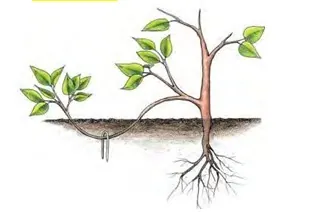
Figure: Process of layering (simple layering)
Layering is the artificial method of vegetative propagation in which roots are induced on a part (branch) of a plant while it is still attached to the parent plant. After roots form, the branch is cut off and grows as a new, independent plant.
Process of simple layering (mound layering):
Other types:
I would use the stem cutting method (artificial vegetative propagation). The new plants will be identical to the healthy parent rose.
Figure: Steps of stem cutting in a rose plant: cut, remove lower leaves and plant in moist soil
Figure: Grafting: A is the scion and B is the stock
a. What type of vegetative propagation is shown in the diagram?
The diagram shows grafting, an artificial method of vegetative propagation in which two plants are joined to grow as one.
b. Label A and B.
c. Name one plant that reproduces by this method.
Mango (also apple, citrus and rose).
d. State two advantages of this method.
Vegetative propagation gives identical clones. This is useful to farmers but also creates danger because the clones have no genetic variation.
Benefits:
Risks:
Conclusion: Vegetative propagation is valuable for uniform, high-quality crops, but farmers should keep several varieties and breed new resistant ones to reduce the risk.
4. Asexual Reproduction in Plants PDF
PDF Notes 1: Embryology (Unit 4)
PDF Notes 2: Asexual Reproduction (Chapter 1)
5. Asexual Reproduction in Plants: Frequently Asked Questions
What is asexual reproduction in plants? (Asexual reproduction meaning)
What are the types of asexual reproduction?
What are the examples of asexual reproduction?
What are the types of artificial vegetative propagation?
What is the diagram of asexual reproduction?
What are the advantages and disadvantages of asexual reproduction?
Is there asexual reproduction in animals and humans?
Where can I download the PDF for Class 12 Biology?
Is this Class 12 Biology book PDF for Nepal NEB?
Students also search for: