Sexual Reproduction Notes Class 12 Biology: 20 Solved Questions, PDF
Importantedunotes.com
Class 12 Bio

1. Sexual Reproduction Syllabus

Unit 4: Sexual Reproduction Notes

4. Embryology: Asexual and sexual reproductions in angiosperms, pollination, fertilization, development of male and female gametophytes, development of dicot and monocot embryos, concept of endosperm.

This page covers chapter 4.2 of Unit 4 Embryology of the NEB Class 12 Biology syllabus.

Micro syllabus: 4. Embryology

Explain sexual and asexual reproduction in angiosperms, pollination, and fertilization. (this chapter)
Describe the development of male and female gametophytes. (this chapter)
Demonstrate the developmental process of dicot and monocot embryos. (this chapter)
Describe the endosperm and its importance. (this chapter)

Read more about sexual reproduction, pollination, double fertilization and endosperm on Wikipedia. More notes: Class 12 Biology notes, Class 12 Chemistry notes and Class 12 Physics notes.

2. Sexual Reproduction Notes: Multiple Choice Questions

Question 1. Which of the following is the female reproductive part of a flower?

  • a) Calyx
  • b) Corolla
  • c) Androecium
  • d) Gynoecium

Correct Answer: d) Gynoecium

Reason: The gynoecium (pistil or carpels) is the female whorl. The androecium is the male whorl of stamens.


Question 2. Which layer of the anther provides nutrition to the developing pollen grains?

  • a) Epidermis
  • b) Endothecium
  • c) Tapetum
  • d) Middle layer

Correct Answer: c) Tapetum

Reason: The tapetum is the innermost wall layer and feeds the developing microspores. The endothecium helps in dehiscence.


Question 3. How many microsproangia are typically found in a bilobed anther?

  • a) Two
  • b) Three
  • c) Four
  • d) One

Correct Answer: c) Four

Reason: Each of the two lobes has two microsporangia (pollen sacs), so the anther is tetrasporangiate.


Question 4. How many male gametes are carried by the pollen tube?

  • a) One
  • b) Two
  • c) Three
  • d) Four

Correct Answer: b) Two

Reason: The generative cell divides to give two male gametes, one for syngamy and one for triple fusion.

Question 5. Which of the following develops into the embryo in a flowering plant?

  • a) Endosperm
  • b) Zygote
  • c) Polar nuclei
  • d) Ovary wall

Correct Answer: b) Zygote

Reason: The zygote formed by syngamy divides repeatedly to form the embryo. The endosperm feeds it.


Question 6. If the micropyle of an ovule is blocked, which process will be directly affected?

  • a) Pollination
  • b) Pollen tube entry
  • c) Formation of antipodals
  • d) Differentiation of megaspore mother cell

Correct Answer: b) Pollen tube entry

Reason: The pollen tube usually enters the ovule through the micropyle (porogamy). Pollination happens on the stigma.


Question 7. A plant breeder wants to maintain a pure line of a particular plant variety. Which pollination strategy would be most effective for this purpose?

  • a) Anemophily
  • b) Cross pollination
  • c) Autogamy
  • d) Entomophily

Correct Answer: c) Autogamy

Reason: Self-pollination (autogamy) keeps the genes of the same plant and so maintains a pure line.


Question 8. Which of the following correctly represents the nuclear condition after fertilization events in angiosperms?

  • a) Zygote-haploid; Endosperm-diploid
  • b) Zygote-diploid; Endosperm-triploid
  • c) Zygote-triploid; Endosperm-diploid
  • d) Both Zygote and Endosperm- triploid

Correct Answer: b) Zygote-diploid; Endosperm-triploid

Reason: Syngamy gives a diploid zygote (n + n). Triple fusion gives a triploid endosperm (n + n + n).

3. Sexual Reproduction Notes: Short and Long Answer Questions

Short Answer Questions


Q.1 What is microsprogogenesis? Where does it occur?

Microsporogenesis is the process of formation and maturation of microspores (pollen grains) inside the microsporangia (pollen sacs) of the anther in angiosperms, through meiotic division.

Where: it occurs in the microsporangia of the anther of the flower. A typical bilobed anther has two thecae in each lobe, so it is dithecous and tetrasporangiate (four pollen sacs).

The primary sporogenous tissue of the microsporangium divides by mitosis and becomes the microspore mother cells (MMC, diploid).
Each MMC divides by meiosis and forms a tetrad of four haploid microspores (pollen cells).
The wall of the pollen sac has the epidermis, endothecium, middle layers and the innermost tapetum, which feeds the microspores.

Q.2 Why cross-pollinated plants are better adapted for evolution?
Cross-pollination mixes the genes of two different plants of the same species, so new gene combinations are formed.
It produces variation in the offspring, and variation is the raw material for natural selection.
It gives better adaptability, so the plants can face changes in the environment.
New and more useful varieties are formed, with high productivity, and defective characters are eliminated.
So cross-pollination plays a role in evolution, while self-pollination does not.

Q.3 What type of pollination is practiced by flowers pollinated by bats? Mention some floral adaptation supporting it.

Pollination by bats is a type of zoophily (cross-pollination by animals) called chiropterophily.

Floral adaptations

Flowers open at night (nocturnal), when the bats are active.
They give out a strong fruity or musty smell to attract bats from a distance.
The flowers are large, stout and tough, to bear the weight of the bat. Examples are Kigelia (sausage tree) and Adansonia (baobab).
They produce a lot of nectar and pollen, because the bats need much food.
Q.4 Mention the advantages and disadvantages of self pollination.

Advantages

It maintains the pure line.
It is more economical, because less pollen is required.
It is independent of other factors such as wind, water or animals.
The flowers do not need to develop attractive parts.
It ensures seed production.
It prevents the introduction of new genetic variations (unwanted characters).

Disadvantages

It does not allow new characters to be introduced.
It decreases the adaptability of races.
It does not cause variation in the new generations.
Continuous self-pollination may lead to extinction of races.
It may carry unwanted characters to new individuals.
It does not play any role in evolution.

Q.5 Compare between self pollination and cross pollination.
Self-pollinationCross-pollination
Transfer of pollen to the stigma of the same flower (autogamy) or another flower of the same plant (geitonogamy).Transfer of pollen from a flower of one plant to the stigma of a flower of a genetically different plant of the same species.
Does not need external agents.Needs external agents such as wind, water, insects, birds or bats.
Pollen is not wasted much. It is economical.Much pollen is wasted. It is expensive for the plant.
Maintains the pure line, no new variation.Gives variation and new useful varieties.
Does not help evolution and adaptability.Helps evolution and gives better adaptability.
Flowers are small, with no showy parts, scent or nectar.Flowers are large, coloured, scented and have nectar.
Seed production is assured.Seed production is less assured.

Q.6 Write short notes about endosperm.

The endosperm is the nutritive tissue of the seed. It is formed when the second male gamete (n) fuses with the two polar nuclei or the diploid secondary nucleus (2n) in triple fusion. This gives the triploid (3n) primary endosperm nucleus (PEN), which divides repeatedly to form the endosperm.

It is rich in reserve food (starch, proteins and fats). It feeds the developing embryo, and the embryo develops after the endosperm has started to form.

Types of endosperm

Nuclear type: the PEN divides by mitosis without wall formation, giving many free nuclei. A big central vacuole pushes them to the periphery, and later walls form to make a multicellular endosperm. Example: coconut. The outer fleshy part (coconut meat) is the endosperm with walls, and the central milky water (coconut milk) is the free-nuclear endosperm.
Cellular type: a cell wall forms after every nuclear division. Examples: Petunia, Balsam and Datura.
Helobial type: an intermediate type. The first division is followed by a wall, which gives a small chalazal cell and a larger micropylar cell. The micropylar cell divides like the nuclear type, then walls form. It is mostly found in monocots. Example: Eremurus.
Three types of endosperm developmentNuclearno walls (coconut)Cellularwalls form (Petunia)Helobialmixed (Eremurus)

Figure: Types of endosperm (nuclear, cellular, helobial)


Q.7 Observe the given diagram carefully and answer the following questions:

a) Name the figure.

The figure shows an ovule with a mature embryo sac (a section of an angiosperm ovule).

b) Label B, C, D and E.

B: egg cell (in the egg apparatus).
C: integument (the protective layer around the nucellus).
D: micropyle (the opening through which the pollen tube enters).
E: funiculus (the stalk by which the ovule is attached to the ovary wall).
(A is the polar nuclei of the central cell.)

c) Which one of the following becomes triploid after fertilization?

A, the polar nuclei. They fuse with the second male gamete in triple fusion and form the triploid primary endosperm nucleus (3n).

d) Which one of the following form zygote after fertilization?

B, the egg cell. It fuses with the first male gamete in syngamy and forms the diploid zygote (2n).
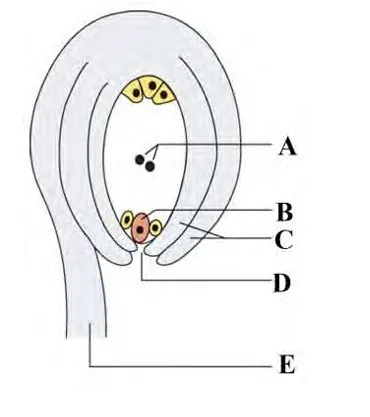
Class 12 Biology Unit 4 Sexual reproduction notes - ovule and embryo sac figure for Q.7

Figure for Q.7

Long Answer Questions


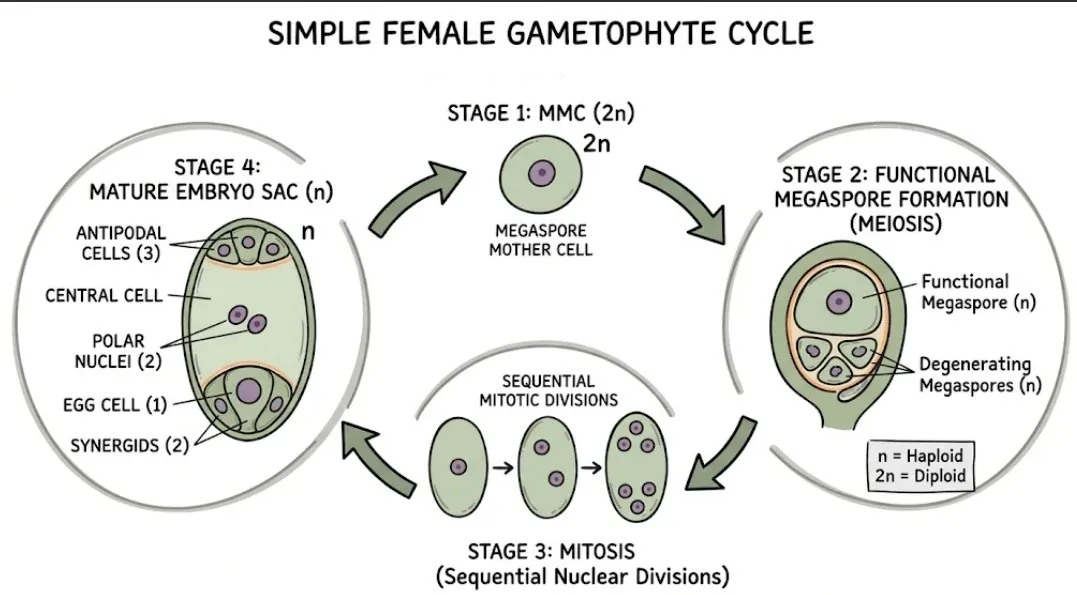
Q.1 Describe the structure of a mature female gametophyte (embryo sac).

The mature female gametophyte of an angiosperm is the embryo sac. It lies inside the nucellus of the ovule, and it is typically 7-celled and 8-nucleate. The ovule has a central nucellus, covered by one or two integuments with a small opening, the micropyle. It is attached to the ovary wall by the funiculus, the point of attachment is the hilum, and the base opposite the micropyle is the chalaza.

Structure of the embryo sac

Egg apparatus (at the micropylar end): three cells. One is the egg cell (female gamete), and the other two are synergids. The synergids have finger-like thickenings called the filiform apparatus, which guide the pollen tube.
Antipodal cells (at the chalazal end): three cells, which are vegetative cells. They give nutrition, and they usually degenerate after fertilization.
Central cell: the large cell in the middle, with two polar nuclei. The polar nuclei often fuse to form a diploid secondary (definitive) nucleus.

So 3 cells of the egg apparatus + 3 antipodals + 1 central cell = 7 cells, and the nuclei are 3 + 3 + 2 = 8.
Class 12 Biology Unit 4 Sexual reproduction notes - structure of mature female gametophyte (embryo sac) diagram

Figure: Structure of a mature female gametophyte (7-celled, 8-nucleate embryo sac)


Q.2 Explain the process of fertilization with diagram.

Fertilization in angiosperms is a unique process called double fertilization (discovered by S. G. Nawaschin). It occurs after a pollen grain lands on the stigma, grows a pollen tube through the style and reaches the ovule. The fertilization that occurs through a pollen tube is called siphonogamy.

Steps of fertilization

1. Entry of pollen tube: the pollen grain absorbs fluid and swells. The exine ruptures at a germ pore and the intine comes out as the pollen tube. The tube carries two male gametes. It usually enters the ovule through the micropyle (porogamy), and if it enters from another part it is aporogamy. It enters the embryo sac through one of the synergids and degenerates that synergid.
2. Syngamy: one male gamete (n) fuses with the egg cell (n) and forms the diploid zygote (2n). This is the true fertilization, and the zygote grows into the embryo.
3. Triple fusion: the second male gamete (n) fuses with the two polar nuclei (or the diploid secondary nucleus) in the central cell. It forms the triploid primary endosperm nucleus (3n), which divides to form the endosperm. Three haploid nuclei are involved, so it is called triple fusion.

Syngamy and triple fusion together make double fertilization.
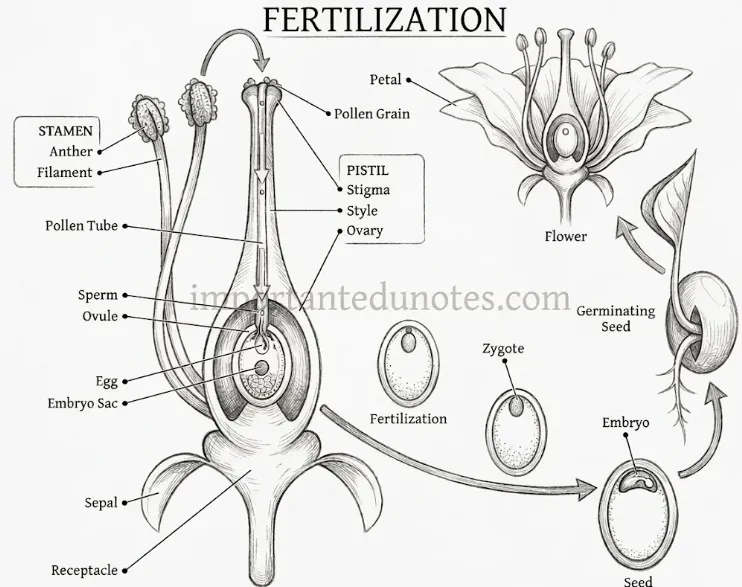
Class 12 Biology Unit 4 Sexual reproduction notes - fertilization in angiosperms diagram (double fertilization)

Figure: Fertilization in angiosperms (syngamy and triple fusion)

Q.3 Explain the microgametogenesis and the formation of male gametophyte.

Microgametogenesis is the process by which a haploid microspore (pollen grain) develops into a mature male gametophyte. It occurs inside the anther and ends with the formation of sperm cells (male gametes).

The nucleus of the microspore divides by mitosis and forms two cells inside the pollen grain.
The larger cell is the vegetative cell (tube cell). It has an irregular nucleus and plenty of cytoplasm rich in food. It will form the pollen tube.
The smaller cell is the generative cell. It has a spindle-shaped nucleus and little cytoplasm. At first it is attached to the pollen wall, but soon it becomes free and floats in the cytoplasm of the vegetative cell.

In about 60 % of angiosperms the pollen is shed at this 2-celled stage. After it lands on the stigma, the generative cell divides by mitosis in the pollen tube and gives two male gametes. In the remaining species (about 40 %) the generative cell divides before the pollen is shed, so the pollen is shed at the 3-celled stage.

The mature male gametophyte is therefore a 3-celled structure: one vegetative cell and two male gametes, within the pollen grain wall. The pollen wall has the outer tough exine (of sporopollenin), the inner intine (of cellulose and pectin) and the thin germ pores, from which the pollen tube comes out.

Microgametogenesis: microspore to male gametophyteMicrospore(1 nucleus, n)Pollen grain(2 cells)Vegetative nucleusGenerative cellPollen tube formed(3 cells in all)2 male gametes

Figure: Microgametogenesis (formation of the male gametophyte)


Q.4 Explain the development of the female gametophyte in angiosperms with the necessary diagram.

The female gametophyte (embryo sac) develops from a megaspore inside the nucellus of the ovule. It has two stages: megasporogenesis and megagametogenesis.

1. Megasporogenesis

A cell of the nucellus near the micropyle enlarges and acts as the archesporial cell. It forms the diploid megaspore mother cell (MMC), directly or after dividing.
The MMC divides by meiosis and forms a linear tetrad of four haploid megaspores.
Usually three megaspores degenerate, and one (the chalazal one) stays as the functional megaspore.

2. Megagametogenesis

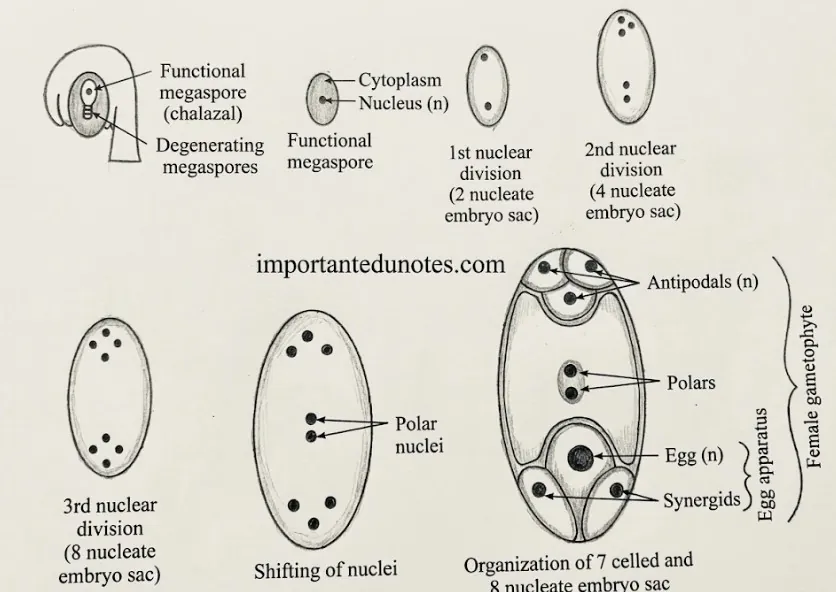
The nucleus of the functional megaspore divides by mitosis three times, without wall formation. This gives 2 nuclei, then 4 nuclei, then the 8-nucleate stage.
Four nuclei move to each pole, the micropylar and the chalazal.
One nucleus from each pole moves to the centre. They are the polar nuclei, and they form the central cell.
At the micropylar end, three cells form: the egg and two synergids (egg apparatus). At the chalazal end, three cells form the antipodals.

So the mature embryo sac is 7-celled and 8-nucleate. This type, which comes from one megaspore, is monosporic (the Polygonum type).
Class 12 Biology Unit 4 Sexual reproduction notes - development of female gametophyte in angiosperms diagram

Figure: Development of the female gametophyte (embryo sac) in angiosperms


Q.5 Describe the role of suspensor in embryo development, highlighting the differences observed between monocot and dicot plants.

After fertilization, the diploid zygote grows into the embryo (embryogeny). The early development is similar in monocots and dicots, and the differences come in the later stages.

Suspensor. The zygote divides unequally. The basal (larger) cell forms the suspensor, and the terminal cell forms the embryo. The suspensor is a temporary stalk-like structure. It pushes the embryo deep into the nutritive endosperm, and it absorbs and passes food to the embryo. It later degenerates.

Dicot embryo: the basal cell divides transversely and forms a suspensor of 6 to 10 cells. The cell nearest to the embryo is the hypophysis, which gives the tip of the radicle and the root cap. The lowermost cell swells as a haustorium (vesicular cell). The terminal cell divides to an 8-celled embryo. The lower tier forms the hypocotyl and radicle, and the upper tier forms the plumule and cotyledons. It passes through globular, heart-shaped and mature stages. The mature embryo has two cotyledons, and the plumule is terminal.

Monocot embryo: the terminal cell divides transversely. The upper cell forms the plumule and the single cotyledon (scutellum), which grows fast and pushes the plumule to one side. The middle cell forms the hypocotyl and radicle, and adds a few cells to the suspensor. In cereals the plumule and radicle are covered by the coleoptile and coleorhiza.

DicotMonocot
The suspensor is long, of 6 to 10 cells.The suspensor is short and weak.
The lowermost cell swells to form a haustorium.No special haustorial cell.
Two cotyledons.One cotyledon (scutellum).
The plumule is terminal, the cotyledons are lateral.The cotyledon is terminal, the plumule is pushed to the side.
No coleoptile and coleorhiza.Coleoptile and coleorhiza are present in cereals.

4. Sexual Reproduction Notes PDF

PDF Notes 1: Embryology (Unit 4)

PDF Notes 2: Sexual Reproduction (Chapter 4.2)

5. Sexual Reproduction: Frequently Asked Questions

What is sexual reproduction? (Sexual reproduction notes in simple words)
Sexual reproduction is the formation of a new individual by the fusion of a male gamete and a female gamete. In flowering plants it includes gamete formation, pollination, fertilization and seed formation, and it gives offspring with new combinations of genes.
What is sexual reproduction in plants? Give sexual reproduction examples.
In flowering plants the flower is the reproductive organ. The anther makes pollen grains (male gametophytes) and the ovule makes the embryo sac (female gametophyte). Pollen reaches the stigma by pollination, the male gametes fuse with the egg and the polar nuclei in double fertilization, and the ovule becomes a seed. Examples are mustard, pea, maize, hibiscus and mango.
What is the difference between sexual reproduction and asexual reproduction?
Sexual reproduction needs two gametes and gives offspring that differ from the parents, so it brings variation. Asexual reproduction needs only one parent, has no fusion of gametes, and gives offspring that are identical to the parent, for example by vegetative propagation. Variation from sexual reproduction helps in evolution.
What is sexual reproduction in animals and sexual reproduction in human?
In animals, including humans, a sperm from the male fuses with an egg from the female (fertilization) to form a zygote, which develops into the embryo. In humans fertilization is internal and takes place in the oviduct. This page explains the sexual reproduction of flowering plants, as the NEB Class 12 chapter does.
What is sexual reproduction class 8 level and how can I do a sexual reproduction drawing?
For class 8, sexual reproduction is the way living things produce young ones by joining a male and a female cell. For a drawing in Class 12, draw the embryo sac, the pollen grain stages, double fertilization and the dicot embryo stages. This page has diagrams of the female gametophyte, fertilization, the pollen grain and the types of endosperm to help you.
Is there a sexual reproduction video?
This page does not host a video. It has labelled diagrams and step-by-step answers for pollination, double fertilization and the development of gametophytes, embryo and endosperm.
What is double fertilization?
Double fertilization is the unique process of angiosperms. One male gamete fuses with the egg to form the diploid zygote (syngamy), and the second male gamete fuses with the two polar nuclei to form the triploid primary endosperm nucleus (triple fusion). It was discovered by S. G. Nawaschin.
What is embryology and what are the embryology stages? (Embryology notes, embryology anatomy)
Embryology is the study of the formation and development of the embryo. In flowering plants the stages are gamete formation, pollination, fertilization, embryo development (zygote, proembryo, globular, heart-shaped and mature embryo) and endosperm development. Embryology anatomy means the structure of the anther, pollen, ovule and embryo sac, and these are explained in the answers.
Where can I get embryology pdf, embryology book and embryology ppt?
This page has two PDF notes that you can read online: the PDF notes of Unit 4 Embryology and the PDF notes of the chapter Sexual Reproduction. For an embryology book, use the Class 12 Biology textbook of your board together with these notes. For an embryology ppt, the diagrams and answers on this page can be used to make your own slides.
What is embryology in zoology and what is the embryology salary?
In zoology, embryology deals with the development of animal embryos from the zygote. Embryologists work in universities, research labs, hospitals and IVF clinics. The salary depends on the country, the employer, the degree and the experience, so there is no fixed figure.
Where can I get Class 12 Biology Book PDF Nepal and Class 12 Biology Book PDF Asmita Publication?
The Class 12 Biology book of Asmita Publication is a textbook of its publisher, and this page does not claim to host it. These notes follow the NEB Class 12 Biology syllabus of Unit 4 Embryology, solve the exercise of the chapter Sexual Reproduction and add diagrams, so you can use them together with the textbook.
Where can I get Class 12 biology notes, Class 12 biology pdf and Class 12 Biology Notes NEB for this chapter?
This page gives the Class 12 biology notes NEB of the chapter Sexual Reproduction (chapter 4.2 of Unit 4): syllabus, micro syllabus, solved multiple choice questions, short and long answers and the notes PDF. The Class 12 biology notes pdf of the other units are on the Class 12 Biology page of the website.
Where can I get Class 12 Biology notes in the style of Note Mandir?
Students who look for notes in the style of Note Mandir will find this chapter in the same way: syllabus, micro syllabus, solved exercise with diagrams and PDF notes. These are NEB Class 12 Biology notes for Unit 4, chapter Sexual Reproduction.

Students also search for:

Embryology pdf Embryology anatomy Embryology book Embryology in zoology Embryology salary Embryology ppt Embryology stages Embryology notes Sexual reproduction in human Sexual reproduction in plants Sexual reproduction video Sexual reproduction Examples Sexual reproduction in animals Sexual reproduction and asexual reproduction What is sexual reproduction class 8 Sexual reproduction drawing Class 12 Biology Book PDF Nepal Class 12 biology notes Class 12 biology pdf Class 12 biology chapter 1 Class 12 Biology Book PDF Asmita Publication Class 12 Biology Notes NEB Class 12 biology notes pdf Class 12 biology notes neb 2083 Class 12 biology notes unit 4 Class 12 biology sexual reproduction Class 12 biology notes note mandir Class 12 Biology syllabus NEB PDF

Also Read: NEB Class 12 Notes

Scroll to Top