
Nervous System
Class 12 Biology Notes • NEB Syllabus 2083
Nervous System for Class 12 Biology Unit 8 Human Biology: syllabus, micro syllabus, 24 solved multiple choice questions, short and long answer questions on CNS, PNS, ANS, the brain and nerve impulse, with figures and two PDF notes.
1. Nervous System Syllabus
Unit 8: Human Biology (Chapter 8.5)
A Nervous System shows the brain, spinal cord and nerves that control and coordinate the body by nerve impulse conduction. These notes follow the NEB Class 12 Biology syllabus (+2 Biology, Nepal), Unit 8, chapter 5. Practise the multiple choice questions, then the solved short and long answers with figures, then the PDF notes.

Figure: Nervous system, Class 12 Biology (NEB)
Micro syllabus: 8. Human Biology
Read more about the nervous system, action potential and synapse on Wikipedia. More notes: Class 12 Biology notes, Class 12 Chemistry notes and Class 12 Physics notes.
2. Multiple Choice Questions
Question 1. Sensitivity or irritability is the characteristic feature of
- a) animals
- b) plants
- c) organisms
- d) protoplasm
Correct Answer: d) protoplasm
Reason: Sensitivity (irritability) is the ability to respond to a stimulus, a basic property of living protoplasm.
Question 2. How many meninges are found in man?
- a) One
- b) Two
- c) Three
- d) Four
Correct Answer: c) Three
Reason: Duramater, arachnoidmater and piamater cover the brain and spinal cord.
Question 3. Which one of the following layer of meninges closely adheres to the surface of brain?
- a) Duramater
- b) Arachnoid
- c) Piamater
- d) Cranium
Correct Answer: c) Piamater
Reason: Piamater is the innermost, thin, vascular layer closely attached to the brain and spinal cord.
Question 4. Which one of the following is correct order of the meninges from inner to outer side?
- a) Duramater-arachnoid mater-piamater
- b) Duramater-piamater-arachnoidmater
- c) Piamater-arachnoid mater-duramater
- d) Arachnoid mater-duramater-piamater
Correct Answer: c) Piamater-arachnoid mater-duramater
Reason: From outer to inner the order is dura, arachnoid, pia; so inner to outer is pia, arachnoid, dura.
Question 5. How many neurones are found in human brain?
- a) 5 billion
- b) 45 billion
- c) 85 billion
- d) 86 billion
Correct Answer: d) 86 billion
Reason: The brain has about 86 billion neurones, the largest number in the body, plus about 85 billion neuroglia.
Question 6. The corpus callosum is not found in
- a) Man
- b) Rabbit
- c) Dog
- d) Duckbilled platypus
Correct Answer: d) Duckbilled platypus
Reason: Corpus callosum joins the cerebral hemispheres of placental mammals. Egg-laying mammals such as the platypus lack it.
Question 7. Which one of the following association areas of human brain functions in speaking?
- a) Broca’s area
- b) Soma-aesthetic area
- c) Wernicke’s area
- d) Visual area
Correct Answer: a) Broca’s area
Reason: Broca’s area in the frontal lobe controls speaking. Wernicke’s area (temporal lobe) is for understanding speech.
Question 8. If you are a right-handed person then which one of the following part of your brain tends to be active?
- a) Left cerebral hemisphere
- b) Right cerebral hemisphere
- c) Left cerebellar hemisphere
- d) Right cerebellar hemisphere
Correct Answer: a) Left cerebral hemisphere
Reason: The left cerebral hemisphere commands and controls the right side of the body.
Question 9. Cerebral cortex of human forebrain contains many functional areas. What would happen, if the frontal lobe of cerebrum is accidently damaged?
- a) Loss of memory and learning
- b) Loss of vision and hearing
- c) Impaired respiration and circulation
- d) Impaired water balance and hunger
Correct Answer: a) Loss of memory and learning
Reason: Frontal lobe has the motor, premotor and Broca’s areas and takes part in thinking and memory. Vision is in the occipital and hearing in the temporal lobe.
Question 10. Which part of the brain is centre of intelligence?
- a) Cerebrum
- b) Cerebellum
- c) Pons varolli
- d) Medulla oblongata
Correct Answer: a) Cerebrum
Reason: The folded cerebral cortex is the seat of intelligence, memory, reasoning and will power.
Question 11. Cerebellum is concerned with
- a) Intelligence
- b) Memory
- c) Involuntary actions
- d) Coordination of muscle movement
Correct Answer: d) Coordination of muscle movement
Reason: Cerebellum maintains posture, orientation and equilibrium and controls rapid muscular activity.
Question 12. The foramen of Monro connects
- a) first ventricle with second
- b) first ventricle with third
- c) second ventricle with third
- d) first and second with third
Correct Answer: d) first and second with third
Reason: The interventricular foramen of Monro joins both lateral ventricles (first and second) to the third ventricle.
Question 13. All ventricles of brain are communicated with each other. Which one of the following connects third ventricle to lateral ventricles?
- a) Foramen of Monro
- b) Foramen magnum
- c) Cerebral aqueduct
- d) Foramen of Magendie
Correct Answer: a) Foramen of Monro
Reason: Cerebral aqueduct joins the third and fourth ventricles. Magendie is an opening of the fourth ventricle.
Question 14. Which one of the following is auditory nerve?
- a) CN VI
- b) CN VII
- c) CN VIII
- d) CN IX
Correct Answer: c) CN VIII
Reason: CN VIII (auditory or vestibulo-cochlear) carries hearing and balance signals. CN VI is abducens, VII facial, IX glossopharyngeal.
Question 15. How many pairs of spinal nerves are found in man?
- a) 9 pairs
- b) 10 pairs
- c) 31 pairs
- d) 37 pairs
Correct Answer: c) 31 pairs
Reason: C8 T12 L5 S5 Cd1 gives 31 pairs of spinal nerves, all mixed.
Question 16. Ions responsible for the conduction of nerve impulse are
- a) S and P
- b) Na and K
- c) Fe and Cu
- d) Zn and Mg
Correct Answer: b) Na and K
Reason: Na+ influx and K+ efflux change the membrane potential during an impulse.
Question 17. Nerve impulse transmission occurs when the nerve is
- a) polarized
- b) depolarized
- c) repolarized
- d) in resting potential
Correct Answer: b) depolarized
Reason: A nerve impulse (action potential) is the depolarization of the membrane, with the inside becoming positive.
Question 18. Nerve impulse conduction is termed as
- a) wave of polarization along the nerve fibre
- b) wave of repolarization along the nerve fibre
- c) wave of no polarization along the nerve fibre
- d) wave of depolarization along the nerve fibre
Correct Answer: d) wave of depolarization along the nerve fibre
Reason: Successive depolarization and repolarization sweep along the axon membrane.
Question 19. If the cerebellum of a person gets injured, it will have effect on which of the physiological function?
- a) Memory function
- b) Smelling power
- c) Body movement
- d) Respiratory ability
Correct Answer: c) Body movement
Reason: Cerebellum coordinates muscle movement and balance. Respiration is under the medulla oblongata.
Question 20. Parasympathetic nervous system releases a hormone acetylcholine. Which one of the following is activated by this hormone?
- a) Increase myocardial contractility
- b) Decrease heartbeat rate
- c) Increase blood pressure
- d) Regulate involuntary response
Correct Answer: b) Decrease heartbeat rate
Reason: Parasympathetic nerves slow the heart (rest and digest). Sympathetic nerves accelerate it.
Question 21. Two systems having opposite actions on the same organ are
- a) Exocrine and endocrine systems
- b) Muscular and nervous systems
- c) Nervous and endocrine systems
- d) Sympathetic and parasympathetic systems
Correct Answer: d) Sympathetic and parasympathetic systems
Reason: They are antagonistic, for example pupil dilation and pupil constriction.
Question 22. A part of our body where the axons may be more than a metre in length is
- a) cranial nerves
- b) spinal nerves
- c) autonomic nerves
- d) spinal cord
Correct Answer: b) spinal nerves
Reason: Spinal nerves reach from the cord to the limbs, so their axons can exceed a metre.
Question 23. Human brain is divisible into fore-, mid-, and hind-brain. Which one of the following is not a part of forebrain?
- a) Rhinenecephalon
- b) Talencephalon
- c) Diencephalon
- d) Rhombencephalon
Correct Answer: d) Rhombencephalon
Reason: Rhombencephalon is the hindbrain. Forebrain = telencephalon (cerebrum, with rhinencephalon) and diencephalon.
Question 24. Resting potential of the membrane of a nerve fibre is
- a) +50 mV
- b) -50 mV
- c) +70 mV
- d) -70 mV
Correct Answer: d) -70 mV
Reason: In a non-conducting fibre the inside is -70 mV (polarized) because of the Na+/K+ pump and negative proteins.
3. Short and Long Answer Questions
Nervous System: Short Answer Questions
Both are integrative systems and together form the neuro-endocrine system, which controls metabolism, growth, stress response and reproduction through the hypothalamus and pituitary.
Differences
| Nervous system | Endocrine system |
|---|---|
| Control by nerve impulse conduction (electro-chemical). | Control by chemical messengers (hormones). |
| Impulse travels along nerves. | Hormones travel in blood. |
| Very fast response. | Slower response. |
| Effect is short-lived and localised. | Effect is long-lasting and widespread. |
| Unit: neurone. | Unit: gland cells. |
A meninx (plural meninges) is each connective tissue layer covering the brain and spinal cord. There are three, from outer to inner:
Spaces: epidural (skull and dura), subdural (dura and arachnoid) and subarachnoid (arachnoid and pia), the last filled with CSF. Inflammation by bacteria such as Neisseria meningitidis is meningitis.
Figure: Flow of cerebrospinal fluid through the ventricles of the brain
The brain is hollow. The cavities (neurocoel) of the brain are cerebral ventricles, filled with cerebrospinal fluid (CSF); in the spinal cord the cavity is the central canal. There are four ventricles.
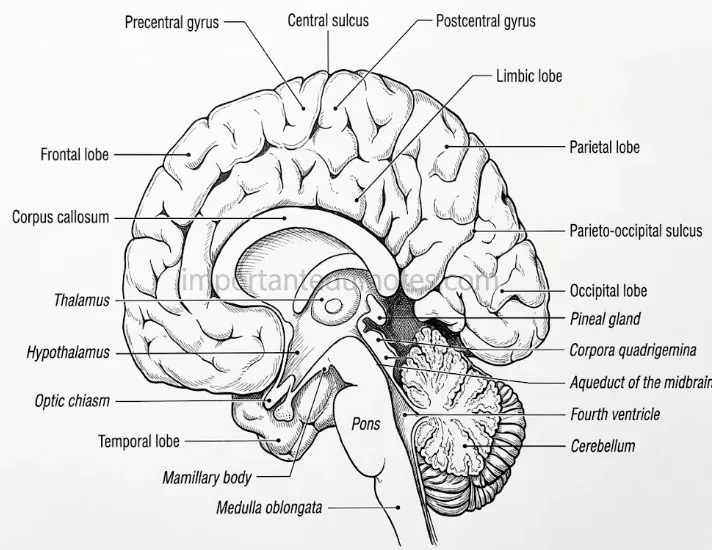
Figure: Structure of the human brain
Labels
Frontal lobe, parietal lobe, temporal lobe and occipital lobe of the cerebrum; cerebellum; brain stem; spinal cord.
Association areas
| Lobe | Association area | Function |
|---|---|---|
| Frontal | Pre-motor area | Higher centre for muscle movements and ANS |
| Motor area | Voluntary movement of muscles | |
| Broca’s area | Speaking | |
| Parietal | Soma-aesthetic area | Touch, hot, cold, pain |
| Gustatory area | Taste | |
| Temporal | Auditory area | Hearing |
| Olfactory area | Smell | |
| Wernicke’s area | Understanding speech | |
| Occipital | Visual area | Sense of light (vision) |
Histologically the brain has grey matter outside (aggregated grey cell bodies) and white matter inside (white myelinated nerve fibres). Neurones (86 billion) are embedded among about 85 billion neuroglia that support and nourish them.
The hypothalamus is a neuro-hormonal organ at the base of the thalamus, on the floor of the third ventricle, above the pituitary.
The medulla oblongata, mainly white matter, lies between pons and spinal cord. Its motor nuclei are:
| Feature | Sympathetic (SNS) | Parasympathetic (PaNS) |
|---|---|---|
| Outflow | Thoraco-lumbar (T1 to L2) | Cranio-sacral (CN III, VII, IX, X and S2-S4) |
| Pre-ganglionic fibre | Short; branches to several ganglia | Long; enters one ganglion |
| Post-ganglionic fibre | Long; adrenergic | Short; cholinergic |
| Ganglia | Form a chain near the spinal cord | Isolated, near or inside organs |
| Active in | Stress, fear, anger, pain | Rest, comfort, pleasure |
| Pupil / heart | Dilates / accelerates | Constricts / slows |
| Digestion | Inhibits peristalsis and secretion | Stimulates them |
| Bronchi / bladder | Relaxes / relaxes | Constricts / contracts |
A neurotransmitter is the chemical released at a nerve ending that crosses the synapse and passes the impulse on.
The intended term is synapse: the area of functional contact between one neurone and another for transferring a nerve impulse, usually between the axon terminals of one and the dendrites of the next (axo-dendrite synapse).
Structure
Types
Electrical synapse (gap junctions, fast, rare: cardiac muscle, intestinal unstriped muscle, lens epithelium) and chemical synapse (synaptic cleft, slower, common).
Chemical transmission
Impulse arrives → Ca2+ enters the knob → vesicles move to the surface and release neurotransmitter by exocytosis → it binds receptors on the post-synaptic membrane → Na+ enters → new action potential. The neurotransmitter is then quickly removed from the cleft.
The brainstem is formed by the midbrain, pons and medulla (all together). It connects the brain with the spinal cord.
Nervous System: Long Answer Questions
The nervous system controls, coordinates, integrates and regulates the body through nerve impulse conduction. Its structural and functional unit is the neurone.
Figure: Types of nervous system: central, peripheral and autonomic
Types and parts
Three types: central (CNS), peripheral (PNS) and autonomic (ANS) nervous systems. The CNS has two parts, the brain and the spinal cord, covered by three meninges.
Structure of the brain
The brain weighs about 1.4 kg (2% of body weight), uses 20% of oxygen, has grey matter outside and white matter inside, and has three parts: forebrain, midbrain and hindbrain.
Figure: Structure of the human brain
Parts and functions
| Part | Structure | Function |
|---|---|---|
| Cerebrum (forebrain) | Largest part; two hemispheres joined by corpus callosum; four lobes; cortex with gyri and sulci | Intelligence, thinking, reasoning, memory, will, speech, voluntary movement; sensory, motor and association areas |
| Rhinencephalon | Pair of olfactory bulbs | Smell |
| Diencephalon (forebrain) | Epithalamus, thalamus, hypothalamus, subthalamus | Thalamus is the gateway for sensory inputs; hypothalamus controls temperature, hunger, thirst, emotions, ANS and pituitary |
| Midbrain | Crura cerebri and corpora quadrigemina | Visual and auditory reflexes; conduction |
| Cerebellum (hindbrain) | Second largest; vermis and hemispheres; arbor vitae | Posture, equilibrium, coordination of muscle movement |
| Pons varolii | Bridge of nerve tracts | Links cerebrum and cerebellum; breathing control |
| Medulla oblongata | Continues as spinal cord | Heartbeat, blood pressure, breathing, swallowing, vomiting |
The CNS consists of the brain and spinal cord. It receives impulses from receptors through sensory neurones, and relays orders through interneurones and motor neurones to effectors.
Medulla oblongata
Spinal cord: structure
Functions
The PNS is made of the peripheral nerves that come from the CNS and join it with receptors and effectors: cranial nerves from the brain and spinal nerves from the spinal cord.
Cranial nerves: 12 pairs
| No. | Nerve | Type | Distribution and function |
|---|---|---|---|
| I | Olfactory | Sensory | Nose; smell |
| II | Optic | Sensory | Retina; vision |
| III | Oculomotor | Motor | Four eyeball muscles; eye movement |
| IV | Trochlear | Motor | Superior oblique muscle; eye movement |
| V | Trigeminal | Mixed | Ophthalmic, maxillary (sensation) and mandibular (chewing) |
| VI | Abducens | Motor | External rectus; eye movement |
| VII | Facial | Mixed | Facial expression and taste |
| VIII | Auditory | Sensory | Internal ear; hearing and balance |
| IX | Glossopharyngeal | Mixed | Tongue and pharynx; taste, swallowing |
| X | Vagus | Mixed | Larynx, heart, lungs, oesophagus, stomach; longest |
| XI | Accessory | Motor | Neck; head turning |
| XII | Hypoglossal | Motor | Neck and tongue; tongue movement |
Spinal nerves: 31 pairs
The ANS is the involuntary part of the nervous system. It automatically regulates unstriped muscles, cardiac muscle and glands, under the control of the cerebral cortex, hypothalamus and medulla. All autonomic fibres are efferent: a myelinated pre-ganglionic fibre runs from the CNS to a ganglion and an unmyelinated post-ganglionic fibre runs to the organ.
Sympathetic: thoraco-lumbar outflow
Parasympathetic: cranio-sacral outflow
Nerve impulse conduction is the electro-chemical travel of an action potential (a wave of depolarization of the neurone membrane) along a nerve fibre and across the synapse. It depends on two neurone properties, excitability and conductivity, and follows the all-or-none law (Bowditch) and the membrane or ionic theory (Hodgkin and Huxley).
Figure: Action potential (nerve impulse): resting potential, depolarization, repolarization and hyperpolarization
1. Polarization (resting potential)
The Na+/K+ pump moves 3 Na+ out for 2 K+ in. Outside is positive and inside is negative: -70 mV.
2. Depolarization (action potential)
A threshold stimulus opens voltage-gated Na+ channels. Na+ rushes in, the polarity reverses and the inside becomes about +30 mV. This is the nerve impulse.
3. Repolarization
K+ channels open, K+ moves out and the membrane returns toward -70 mV (it may go slightly below: hyperpolarization). The Na+/K+ pump restores the original ion gradients using ATP. During the refractory period no new impulse can arise (absolute) or only a stronger stimulus works (relative).
4. Propagation
Successive depolarization along the axon carries the impulse, without decrement. In unmyelinated fibres it is continuous (0.5-10 m/s). In myelinated fibres it leaps from one node of Ranvier to the next (saltatory conduction), about 50 times faster, using less energy.
Role of neurotransmitters
At the synapse the impulse cannot cross the cleft electrically. Ca2+ enters the pre-synaptic knob, vesicles release neurotransmitter (acetylcholine, noradrenaline, GABA) by exocytosis, it binds receptors on the post-synaptic membrane and opens channels. Na+ enters for an excitatory impulse (EPSP); Cl– channels give an inhibitory impulse (IPSP). The sum at the axon hillock decides whether a new action potential forms. The neurotransmitter is then removed from the cleft, clearing the way for the next message.
4. Nervous System PDF
PDF Notes 1: Human Biology (Unit 8)
PDF Notes 2: Nervous System (Chapter 5)
5. Nervous System: Frequently Asked Questions
What is the nervous system?
What are the nervous system parts?
What is the nervous system classification?
What is the function of the nervous system?
Where can I see a Nervous System?
What is the nervous system example of a reflex or antagonistic action?
What are the three meninges?
What is the resting potential of a nerve fibre?
Where can I download the nervous system PDF for Class 12 Biology?
Is this Class 12 Biology book PDF for Nepal NEB?
Students also search for: