
PABSON Kathmandu Compulsory Mathematics 2082 Pre-Qualifying Examination Solution Class 10 | अनिवार्य गणित

Welcome to the complete solution set for the PABSON Kathmandu Compulsory Mathematics 2082. This post provides a detailed, step-by-step guide to solving the questions asked in the recent Class 10 pre-qualifying exam. Whether you are an English medium student or a Nepali medium student, this guide covers both languages to help you prepare effectively for your SEE examination.
Practicing past papers like the PABSON Kathmandu Compulsory Mathematics 2082 is crucial for understanding the exam pattern and marking scheme. Below, you will find the questions, their Nepali translations, and the official marking scheme. For more educational resources, you can also visit the Ministry of Education website.
Table of Contents
PABSON Kathmandu Compulsory Mathematics 2082 – Part 1
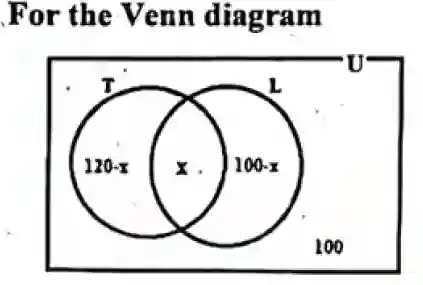
In a survey of 300 people, 120 people like Tablet and 100 people like Laptop. But one-third of the people do not like both.
(३०० जनामा गरिएको एउटा सर्वेक्षणमा १२० जनालाई ट्याबलेट मन पर्छ, १०० जनालाई ल्यापटप मन पर्छ। तर एक तिहाइ मानिसहरूलाई दुवै मन पर्दैन।)
-
a) If T and L be the sets of people who like Tablet and Laptop respectively, write the cardinality of $n(L \cup T)$. [1]
(यदि T र L क्रमशः ट्याबलेट र ल्यापटप मन पराउने व्यक्तिहरूको समुह हो भने, $n(L \cup T)$ को गणनात्मकता लेख्नुहोस्।)
-
b) Represent the above information in a Venn diagram. [1]
(माथिको जानकारीलाई भेन चित्रमा प्रस्तुत गर्नुहोस्।)
-
c) Find the number of people who like only one item. [3]
(एउटा मात्र वस्तु मन पराउने व्यक्तिहरूको संख्या पत्ता लगाउनुहोस्।)
-
d) Find the percentage of people who like at most one of these items. [1]
(बढीमा एउटा वस्तु मन पराउने व्यक्तिहरूको प्रतिशत पत्ता लगाउनुहोस्।)
Solution:
a) $n(L\cup T)=200$
Explanation: Total people = 300, 1/3 dislike both = 100. So, people who like at least one item = 300 – 100 = 200.
b) Venn diagram representation:
c)
Let $x$ be the number of people who like both Tablet and Laptop.
$120 + 100 – x + 100 = 300$
$320 – x = 300$
$x = 20$
Only Tablet = $120 – 20 = 100$
Only Laptop = $100 – 20 = 80$
Number of people who like only one item = $100 + 80 = \mathbf{180}$.
d)
Number of people who like at most one item = Only one item + None = $180 + 100 = 280$
Percentage = $\frac{280}{300} \times 100\% = \mathbf{93.33\%}$.
Harka is going to deposit Rs 2,00,000 in a bank for 2 years. The bank has offered Harka two options: half-yearly compound interest or quarterly compound interest at the rate of 8% p.a.
(हर्कले २ वर्षको लागि बैंकमा रु. २,००,००० जम्मा गर्ने भएको छ। बैंकले हर्कलाई प्रति वर्ष ८% ब्याजदरमा दुई विकल्पहरू: अर्धवार्षिक चक्रिय ब्याज वा त्रैमासिक चक्रिय ब्याज प्रस्ताव गरेको छ।)
-
a) Which option is more profitable for Harka? [1]
(हर्कको लागि कुन विकल्प बढी फाइदाजनक छ?)
-
b) How much compound amount can he get at the end of 2 years at the rate of half-yearly compound interest? [2]
(दुई वर्षको अन्त्यमा अर्धवार्षिक चक्रिय व्याजदरले उसले कति चक्रिय मिश्रधन पाउँछ?)
-
c) If the bank changes its policy to pay interest compounded quarterly instead of interest compounded half-yearly after one year, how much total interest will he get in two years? [2]
(यदि बैंकले एक वर्ष पछि अर्धवार्षिक चक्रिय ब्याजदरबाट त्रैमासिक चक्रिय व्याजदरको नीति परिवर्तन गर्छ भने उसले दुई वर्षमा कुल कति ब्याज पाउनेछ?)
Solution:
a) Quarterly compound interest is more profitable because interest is compounded more frequently.
b) For half-yearly compounding:
Principal (P) = Rs 2,00,000
Annual rate (R) = 8%
Half-yearly rate = 8/2 = 4%
Time (T) = 2 years = 4 half-years
Amount (A) = $P \left(1 + \frac{R}{100}\right)^n = 200000 \left(1 + \frac{4}{100}\right)^4$
= $200000 \times (1.04)^4$
= $200000 \times 1.16985856$
= Rs 2,33,971.71
Compound Amount = Rs 2,33,971.71
c)
First year (half-yearly):
Amount after 1 year = $200000 \left(1 + \frac{4}{100}\right)^2 = 200000 \times 1.0816 = Rs 2,16,320$
Second year (quarterly):
Principal = Rs 2,16,320
Quarterly rate = 8/4 = 2%
Number of quarters = 4
Amount after 2nd year = $216320 \left(1 + \frac{2}{100}\right)^4 = 216320 \times 1.08243216 = Rs 2,34,151.72$
Total interest in two years = Final Amount – Principal = $2,34,151.72 – 2,00,000 = \mathbf{Rs~34,151.72}$.
The present population of a municipality of Madesh province is 59,895. The annual population growth rate is 10%.
(मधेश प्रदेशको एउटा नगरपालिकाको हालको जनसंख्या ५९,८९५ छ। वार्षिक जनसंख्या वृद्धि दर १०% रहेको छ।)
-
a) Write the formula for finding the population after T years. [1]
(T वर्ष पछि जनसंख्या पत्ता लगाउने सूत्र लेख्नुहोस्।)
-
b) What was the population of the municipality 3 years ago? [2]
(तीन वर्ष अगाडि नगरपालिकाको जनसंख्या कति थियो?)
-
c) If the population growth were 8% before one year, what would be the present population of the municipality? [2]
(यदि एक वर्ष अगाडि जनसंख्या वृद्धि ८% थियो भने, नगरपालिकाको हालको जनसंख्या कति हुनेछ?)
Solution:
a) $P_T = P \left(1 + \frac{R}{100}\right)^T$, where $P_T$ = population after T years, $P$ = initial population, $R$ = growth rate.
b)
Let population 3 years ago be $P$.
$59,895 = P \left(1 + \frac{10}{100}\right)^3$
$59,895 = P \times (1.1)^3$
$59,895 = P \times 1.331$
$P = \frac{59895}{1.331} = \mathbf{45,000}$
Population 3 years ago = 45,000.
c)
Population 2 years ago = 45,000
Population 1 year ago = $45,000 \times 1.1 = 49,500$
If growth rate was 8% last year:
Present population = $49,500 \times 1.08 = \mathbf{53,460}$.
Financial Math & Mensuration – PABSON 2082
A businessman exchanged Chinese Yuan with Rs. 9,56,000 at the rate of Chinese Yuan (¥) 1 = Rs. 19.12. After some days, Nepali currency was devaluated by 1% in comparison to Chinese Yuan and on that day he exchanged Chinese Yuan into Nepali currency again.
(एक व्यापारीले रु ९,५६,००० चिनियाँ युआन (¥) १ = १९.१२ रुपैयाँको दरले साटे। केही दिनपछि, नेपाली मुद्रा चिनियाँ युआनको तुलनामा १% ले अवमूल्यन भयो र त्यस दिन उनले चिनियाँ युआनलाई फेरि नेपाली मुद्रामा साटे।)
-
a) How many Chinese Yuan did the businessman exchange? Find it. [1]
(व्यापारीले कति चिनियाँ युआन साटे? पत्ता लगाउनुहोस्।)
-
b) How many Nepali rupees did the businessman receive when he exchanged after devaluation? [1]
(अवमूल्यन पछि नेपाली रुपैयाँमा परिवर्तन गर्दा व्यवसायीले कति नेपाली रुपैयाँ प्राप्त गरे?)
-
c) What profit or loss percent did the businessman make in that transaction? Find it. [2]
(उक्त कारोबारबाट व्यापारीलाई कति प्रतिशत नाफा वा घाटा भयो? पत्ता लगाउनुहोस्।)
Solution:
a) Amount of Chinese Yuan = $\frac{9,56,000}{19.12} = \mathbf{50,000}$ Yuan.
b)
After devaluation, new rate: 1 Yuan = $19.12 \times 1.01 = Rs 19.3112$
Nepali rupees received = $50,000 \times 19.3112 = \mathbf{Rs~9,65,560}$.
c)
Profit = Final amount – Initial amount = $9,65,560 – 9,56,000 = Rs 9,560$
Profit percent = $\frac{9,560}{9,56,000} \times 100\% = \mathbf{1\%}$.
The volume of a metallic square-based pyramid is 384 cm³ and the length of the side of the base is 12 cm.
(एउटा वर्गाकार धातुको पिरामिडको आयतन ३८४ घन सेमी र आधारको लम्बाइ १२ सेमी छ।)
-
a) What is the formula to find the lateral surface area of a square-based pyramid? [1]
(वर्गाकार पिरामिडको छड्के सतहको क्षेत्रफल पत्ता लगाउने सूत्र कुन हो?)
-
b) Find the cost of coloring the surfaces of the pyramid at the rate of Rs 2 per sq. cm. [2]
(प्रति वर्ग सेमी रु २ को दरले पिरामिडको सतहहरुमा रङ लगाउदा लाग्ने लागत पत्ता लगाउनुहोस्।)
-
c) If the pyramid is melted and recast into another square-based pyramid of height 18 cm, what would be the length of its base? [2]
(यदि उक्त पिरामिडलाई पगालेर १८ सेमी उचाइ भएको अर्को वर्गाकार पिरामिड पुनः बनाइन्छ भने, यसको आधारको लम्बाइ कति हुनेछ?)
Solution:
a) Lateral surface area = $2al$, where $a$ = base side, $l$ = slant height.
b)
Volume = $\frac{1}{3} \times \text{Base Area} \times \text{Height}$
$384 = \frac{1}{3} \times (12)^2 \times h$
$384 = \frac{1}{3} \times 144 \times h$
$h = \frac{384 \times 3}{144} = 8$ cm
Slant height $(l) = \sqrt{h^2 + \left(\frac{a}{2}\right)^2} = \sqrt{8^2 + 6^2} = \sqrt{64+36} = \sqrt{100} = 10$ cm
Lateral surface area = $2 \times 12 \times 10 = 240$ cm²
Base area = $12^2 = 144$ cm²
Total surface area = $240 + 144 = 384$ cm²
Cost = $384 \times 2 = \mathbf{Rs~768}$.
c)
Volume remains same = 384 cm³
For new pyramid: $\frac{1}{3} \times a^2 \times 18 = 384$
$6a^2 = 384$
$a^2 = 64$
$a = \mathbf{8}$ cm.
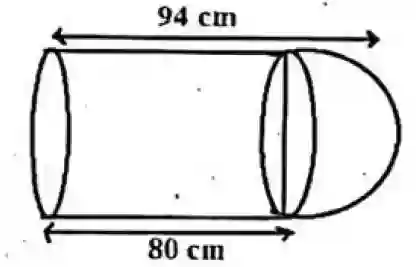
The given solid object is made up of a hemisphere and a cylinder. The height of the cylinder is 80 cm and the height of the solid object is 94 cm.
(दिइएको ठोस वस्तु अर्धगोलार्ध र सिलिन्डर मिलेर बनेको छ। सिलिन्डरको उचाइ ८० सेमी र ठोस वस्तुको उचाइ ९४ सेन्टिमिटर छ।)
-
a) Which formula is used to calculate the volume of a hemisphere? [1]
(अर्धगोलाको आयतन गणना गर्न कुन सूत्र प्रयोग गरिन्छ?)
-
b) Find the total surface area of the solid. [3]
(दिइएको ठोस बस्तुको पुरा सतहको क्षेत्रफल पत्ता लगाउनुहोस्।)
Solution:
a) Volume of hemisphere = $\frac{2}{3}\pi r^3$.
b)
Height of hemisphere = Total height – Cylinder height = $94 – 80 = 14$ cm
Radius $(r) = 14$ cm
Cylinder surface area = $2\pi r h + \pi r^2$ (only one circle included as top is covered by hemisphere)
= $2\pi \times 14 \times 80 + \pi \times 14^2$
= $2240\pi + 196\pi = 2436\pi$ cm²
Hemisphere curved surface area = $2\pi r^2 = 2\pi \times 14^2 = 392\pi$ cm²
Total surface area = $2436\pi + 392\pi = 2828\pi$ cm²
Using $\pi = \frac{22}{7}$: $2828 \times \frac{22}{7} = 2828 \times 3.142857 \approx \mathbf{8888}$ cm².
Algebra & Mensuration – PABSON 2082 Math
The length of a wall is 20 m, width is 50 cm and height is 3 m. Bricks of size $20cm \times 10cm \times 8cm$ are used to build the wall.
(एउटा पर्खालको लम्बाइ २० मिटर, चौडाइ ५० सेन्टिमिटर र उचाइ ३ मिटर छ। पर्खाल बनाउन २० सेन्टिमिटर $\times$ १० सेन्टिमिटर $\times$ ८ सेन्टिमिटर आकारका इँटाहरू प्रयोग गरिन्छ।)
-
a) Find the volume of the wall. [1]
(पर्खालको आयतन पत्ता लगाउनुहोस्।)
-
b) How many bricks are used to construct the wall? [2]
(पर्खाल बनाउन कति इँटा प्रयोग हुन्छ?)
-
c) Estimate the cost of bricks used in the wall at the rate of Rs 13,500 per 1000 bricks. [1]
(प्रति १००० इँटाको रु १३,५०० को दरले पर्खाल बनाउन प्रयोग हुने इँटाको लागत अनुमान गर्नुहोस्।)
Solution:
a) Volume = Length × Width × Height = $20 \times 0.5 \times 3 = \mathbf{30}$ m³.
b)
Volume of one brick = $0.2 \times 0.1 \times 0.08 = 0.0016$ m³
Number of bricks = $\frac{30}{0.0016} = \mathbf{18,750}$ bricks.
c)
Cost per brick = $\frac{13,500}{1000} = Rs 13.5$
Total cost = $18,750 \times 13.5 = \mathbf{Rs~2,53,125}$.
The fifth and the twelfth terms of an arithmetic sequence are 34 and 83 respectively.
(अंकगणितीय अनुक्रमको पाँचौं र बाह्रौं पदहरू क्रमशः ३४ र ८३ छन्।)
-
a) What is the arithmetic mean between two numbers a and b? [1]
(दुई संख्याहरू a र b बीचको अंकगणितीय मध्यक कति हुन्छ?)
-
b) Find the common difference and the first term. [2]
(समान भिन्नता र पहिलो पद पत्ता लगाउनुहोस्।)
-
c) Find the sum of the first five terms of the sequence. [2]
(अनुक्रमको पहिलो पाँच पदहरूको योगफल पत्ता लगाउनुहोस्।)
Solution:
a) Arithmetic mean between a and b = $\frac{a+b}{2}$.
b)
$t_5 = a + 4d = 34$ … (i)
$t_{12} = a + 11d = 83$ … (ii)
Subtracting (i) from (ii): $(a+11d) – (a+4d) = 83 – 34$
$7d = 49 \Rightarrow d = \mathbf{7}$
Substitute in (i): $a + 4(7) = 34 \Rightarrow a = 34 – 28 = \mathbf{6}$
Common difference = 7, First term = 6.
c)
Sum of first 5 terms = $\frac{n}{2}[2a + (n-1)d] = \frac{5}{2}[2\times6 + (5-1)\times7]$
= $\frac{5}{2}[12 + 28] = \frac{5}{2} \times 40 = \mathbf{100}$.
The sum of the present ages of Ramu and Jinu is 19 years. After 1 year, the product of their ages will be 104.
(रामु र जिनुको हालको उमेरको योगफल १९ वर्ष छ। एक बर्ष पछाडी उनीहरूको उमेरको गुणनफल १०४ हुनेछ।)
-
a) What are the roots of x in the quadratic equation $ax^{2}+bx+c=0$, $a \ne 0$? [1]
(बर्ग समीकरण $ax^2 + bx + c = 0$, $a \ne 0$ मा x का मूलहरू के हुन्?)
-
b) Find the present ages of Ramu and Jinu. [3]
(रामु र जिनुको वर्तमान उमेर पत्ता लगाउनुहोस्।)
-
c) After how many years will the sum of their ages be 25? [1]
(कति वर्ष पछि, उनीहरूको उमेरको योगफल २५ हुनेछ?)
Solution:
a) Roots are given by: $x = \frac{-b \pm \sqrt{b^2 – 4ac}}{2a}$.
b)
Let Ramu’s age = $x$, Jinu’s age = $y$
$x + y = 19$ … (i)
After 1 year: $(x+1)(y+1) = 104$
$xy + x + y + 1 = 104$
$xy + 19 + 1 = 104$ (from i)
$xy = 84$ … (ii)
From (i) and (ii): $x(19-x) = 84$
$19x – x^2 = 84$
$x^2 – 19x + 84 = 0$
$(x-12)(x-7) = 0$
$x = 12$ or $x = 7$
If $x=12$, $y=7$; if $x=7$, $y=12$
Present ages: Ramu = 12 years, Jinu = 7 years.
c)
Current sum = 19
Required increase = 25 – 19 = 6 years
This increase will be shared by both, so time = $\frac{6}{2} = \mathbf{3}$ years.
Algebra & Geometry – PABSON 2082
a) Simplify: $\frac{1}{(x+1)^{2}}+\frac{1}{(x+2)^{2}}-\frac{1}{(x+1)^{2}(x+2)^{2}}$
(सरल गर्नुहोस्)
b) Solve: $9^{x-2}+2\times3^{2x-3}=63$
(हल गर्नुहोस्)
Solution:
a)
$\frac{1}{(x+1)^2} + \frac{1}{(x+2)^2} – \frac{1}{(x+1)^2(x+2)^2}$
= $\frac{(x+2)^2 + (x+1)^2}{(x+1)^2(x+2)^2} – \frac{1}{(x+1)^2(x+2)^2}$
= $\frac{x^2+4x+4 + x^2+2x+1 – 1}{(x+1)^2(x+2)^2}$
= $\frac{2x^2+6x+4}{(x+1)^2(x+2)^2}$
= $\frac{2(x^2+3x+2)}{(x+1)^2(x+2)^2}$
= $\frac{2(x+1)(x+2)}{(x+1)^2(x+2)^2}$
= $\mathbf{\frac{2}{(x+1)(x+2)}}$.
b)
$9^{x-2} + 2\times3^{2x-3} = 63$
$3^{2(x-2)} + 2\times3^{2x-3} = 63$
$3^{2x-4} + 2\times3^{2x-3} = 63$
Let $y = 3^{2x}$, then:
$\frac{y}{3^4} + 2\times\frac{y}{3^3} = 63$
$\frac{y}{81} + \frac{2y}{27} = 63$
$\frac{y + 6y}{81} = 63$
$\frac{7y}{81} = 63$
$7y = 63 \times 81$
$y = 9 \times 81 = 729$
$3^{2x} = 729 = 3^6$
$2x = 6$
$\mathbf{x = 3}$.
A parallelogram PQRS and a triangle PQM are standing on the same base and between the same parallel lines.
(एउटै आधार र उही समानान्तर रेखा बीच समानान्तर चतुर्भुज PQRS र त्रिभुज PQM बनेका छन्।)
-
a) If the area of parallelogram PQRS is $x$ cm² and the area of $\triangle PQM$ is $y$ cm², then write the relation between $x$ and $y$. [1]
(यदि समानान्तर चतुर्भुज PQRS को क्षेत्रफल $x$ cm² छ र $\triangle PQM$ को क्षेत्रफल $y$ cm² छ भने $x$ र $y$ बीचको सम्बन्ध लेख्नुहोस्।)
-
b) Prove theoretically the relation between the areas of parallelogram PQRS and $\triangle PQM$. [2]
(समानान्तर चतुर्भुज PQRS र $\triangle PQM$ को क्षेत्रफल बीचको सम्बन्ध सैद्धान्तिक रूपमा प्रमाणित गर्नुहोस्।)
-
c) Construct a quadrilateral ABCD, in which $AB=4.2$ cm, $BC=5.6$ cm, $CD=5$ cm, $AD=4.8$ cm and $BD=6.5$ cm. Also construct $\triangle ADP$ which is equal to the area of the quadrilateral. [3]
($AB=4.2$ cm, $BC=5.6$ cm, $CD=5$ cm, $AD=4.8$ cm, $BD=6.5$ cm भएको चतुर्भुज ABCD बनाउनुहोस्। साथै चतुर्भुजको क्षेत्रफल बराबर भएको $\triangle ADP$ पनि बनाउनुहोस्।)
Solution:
a) $x = 2y$ or $y = \frac{x}{2}$.
b)
Proof: Parallelogram PQRS and triangle PQM stand on same base PQ and between same parallels PQ and SM.
Area of parallelogram = base × height = PQ × h
Area of triangle = $\frac{1}{2}$ × base × height = $\frac{1}{2}$ × PQ × h
Thus, area of parallelogram = 2 × area of triangle.
Hence, $x = 2y$.
c) Construction steps:
1. Draw AB = 4.2 cm
2. With center A and radius 4.8 cm, draw an arc
3. With center B and radius 6.5 cm, draw another arc intersecting first arc at D
4. Join AD and BD
5. With center B and radius 5.6 cm, draw an arc
6. With center D and radius 5 cm, draw another arc intersecting at C
7. Join BC, CD to complete quadrilateral ABCD
8. To construct triangle ADP with equal area: Draw line through C parallel to BD meeting AD extended at P
9. Join AP to get triangle ADP.
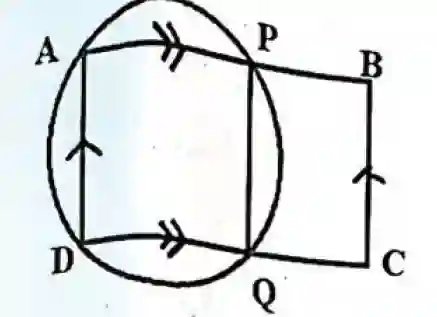
In the given figure, ABCD is a parallelogram.
(दिइएको चित्रमा ABCD एउटा समानान्तर चतुर्भुज हो।)
-
a) Prove that: $\angle PQD = \angle ABC$ [2]
(प्रमाणित गर्नुहोस्: $\angle PQD = \angle ABC$)
-
b) Is PBCQ a cyclic quadrilateral? Give reason. [1]
(के PBCQ चक्रिय चतुर्भुज हो? कारण दिनुहोस्।)
Solution:
a)
In parallelogram ABCD: $\angle DAB + \angle ABC = 180^\circ$ (co-interior angles) … (i)
In cyclic quadrilateral APQD: $\angle DAP + \angle PQD = 180^\circ$ (opposite angles) … (ii)
But $\angle DAP = \angle DAB$ (same angle)
From (i) and (ii): $\angle DAB + \angle ABC = \angle DAB + \angle PQD$
Therefore, $\angle ABC = \angle PQD$.
b)
Yes, PBCQ is a cyclic quadrilateral.
Reason: $\angle PQD = \angle ABC$ (proved above) and $\angle PQD$ is the exterior angle of quadrilateral PBCQ at vertex Q, which equals the opposite interior angle at C ($\angle ABC$). When exterior angle equals opposite interior angle, the quadrilateral is cyclic.
Geometry & Statistics – PABSON 2082
In the given figure, O is the center of the circle, $\angle PQS=45^{\circ}$.
(दिइएको चित्रमा, O वृत्तको केन्द्र हो, $\angle PQS=45^{\circ}$ रहेको छ।)

-
a) What is the value of $\angle PSQ$? [1]
($\angle PSQ$ को मान कति हो?)
-
b) Find the value of $\angle QRS$. [1]
($\angle QRS$ को मान पत्ता लगाउनुहोस्।)
-
c) Verify experimentally that the central angle of a circle is twice the circumference angle standing on the same arc. (At least two circles with radii more than 3 cm are necessary). [2]
(एउटै चापमा रहेका वृत्तको केन्द्रीय कोण परिधि कोणको दोब्बर छ भनी प्रयोगात्मक रूपमा प्रमाणित गर्नुहोस्। ३ सेमी भन्दा बढी अर्धव्यास भएका कम्तिमा दुई वृत्तहरू आवश्यक छन्।)
Solution:
a) $\angle PSQ = 90^\circ$ (Angle in a semicircle).
b)
In cyclic quadrilateral PQRS: $\angle PQS + \angle PRS = 180^\circ$
$45^\circ + \angle PRS = 180^\circ \Rightarrow \angle PRS = 135^\circ$
$\angle QRS = \angle PRS – \angle PRQ$
But $\angle PRQ = \angle PSQ = 90^\circ$ (angles in same segment)
$\angle QRS = 135^\circ – 90^\circ = \mathbf{45^\circ}$.
c)
Experimental verification:
1. Draw two circles with radii > 3 cm
2. In each circle, mark an arc AB
3. Measure central angle AOB and circumference angle ACB standing on same arc AB
4. Tabulate results:
| Circle | Central angle | Circumference angle | Ratio |
|---|---|---|---|
| 1 | 80° | 40° | 2:1 |
| 2 | 120° | 60° | 2:1 |
A monkey on the top of a tree observes a top of a temple and finds the angle of depression of $30^{\circ}$. The height of the temple is 10 m and the distance between the tree and the temple is 12 m.
(रूखको टुप्पोमा रहेको बाँदरले मन्दिरको टुप्पो हेर्छ र $30^{\circ}$ को अवनती कोण बनाउँछ। मन्दिरको उचाइ १० मिटर छ र रूख र मन्दिर बीचको दूरी १२ मिटर छ।)
-
a) Define angle of depression. [1]
(अवनती कोणको परिभाषा दिनुहोस्।)
-
b) Draw a figure according to the context. [1]
(सन्दर्भ अनुसार चित्र बनाउनुहोस्।)
-
c) Find the height of the tree. [1]
(रूखको उचाइ पत्ता लगाउनुहोस्।)
-
d) Find the shortest distance between the foot of the temple and the top of the tree. [1]
(मन्दिरको फेद र रूखको टुप्पो बीचको सबैभन्दा छोटो दूरी पत्ता लगाउनुहोस्।)
Solution:
a) The angle of depression is the angle formed between the horizontal line from the observer’s eye and the line of sight to an object below the horizontal level.
b)
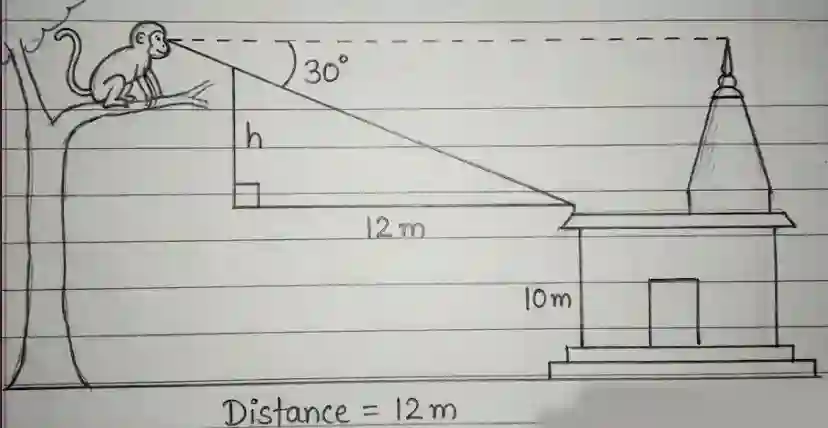
c)
Let tree height = $h$ m
From diagram: $\tan 30^\circ = \frac{h-10}{12}$
$\frac{1}{\sqrt{3}} = \frac{h-10}{12}$
$h-10 = \frac{12}{\sqrt{3}} = 4\sqrt{3} \approx 6.928$
$h = 10 + 6.928 = \mathbf{16.93}$ m.
d)
Shortest distance = $\sqrt{12^2 + (16.93)^2}$
= $\sqrt{144 + 286.62}$
= $\sqrt{430.62} \approx \mathbf{20.75}$ m.
The following table shows the marks obtained by students in the Mathematics mid-term examination.
(निम्न तालिकाले गणित विषयको मध्य त्रैमासिक परीक्षामा विद्यार्थीले प्राप्त गरेको अंक देखाएको छ।)
| Marks | 0-10 | 10-20 | 20-30 | 30-40 | 40-50 | 50-60 |
|---|---|---|---|---|---|---|
| Students | 12 | 18 | 27 | X | 17 | 6 |
-
a) Write the formula to find the arithmetic mean of continuous data by the direct method. [1]
(प्रत्यक्ष विधिद्वारा अखण्डित तथ्यांकको अंकगणितीय मध्यक पत्ता लगाउने सूत्र लेख्नुहोस्।)
-
b) If the average mark of the students is 28, find the value of x. [2]
(यदि विद्यार्थीहरूको औसत अंक २८ छ भने, x को मान पत्ता लगाउनुहोस्।)
-
c) Find the median marks of the students. [2]
(विद्यार्थीहरूको मध्यिका अंक पत्ता लगाउनुहोस्।)
-
d) If marks less than 30 are considered as failing marks, find the percentage of failed students. [1]
(यदि ३० भन्दा कम अङ्ग प्राप्त गर्ने विद्यार्थीहरूलाई असफल मानिन्छ भने, असफल विद्यार्थीहरूको प्रतिशत निकाल्नुहोस्।)
Solution:
a) Arithmetic mean = $\frac{\sum fm}{N}$, where f = frequency, m = mid-value, N = total frequency.
b)
| Marks | f | m | fm |
|---|---|---|---|
| 0-10 | 12 | 5 | 60 |
| 10-20 | 18 | 15 | 270 |
| 20-30 | 27 | 25 | 675 |
| 30-40 | x | 35 | 35x |
| 40-50 | 17 | 45 | 765 |
| 50-60 | 6 | 55 | 330 |
| Total | 80+x | 2100+35x |
$2100+35x = 28(80+x)$
$2100+35x = 2240+28x$
$7x = 140$
$\mathbf{x = 20}$.
c)
Total students = 80+20 = 100
Median position = $\frac{N}{2} = \frac{100}{2} = 50$
Cumulative frequencies: 12, 30, 57, 77, 94, 100
Median class = 20-30 (where cumulative frequency reaches 50)
$L = 20$, $c.f. = 30$, $f = 27$, $i = 10$
Median = $L + \frac{\frac{N}{2} – c.f.}{f} \times i$
= $20 + \frac{50-30}{27} \times 10$
= $20 + \frac{20}{27} \times 10$
= $20 + 7.41 = \mathbf{27.41}$.
d)
Failed students = students with marks < 30 = 12+18+27 = 57
Percentage = $\frac{57}{100} \times 100\% = \mathbf{57\%}$.
Probability – PABSON 2082
A bag contains 4 red and 5 blue balls of same size and sizes.
(एउटा झोलामा एउटै आकार र उस्तै ४ वटा राता र ५ वटा नीला बलहरू छन्।)
-
a) If $P(A \cap B)=P(A) \times P(B)$, what type of event are A and B? [1]
(यदि $P(A \cap B)=P(A) \times P(B)$ छ भने A र B कस्तो प्रकारको घटना हुन्?)
-
b) Two balls are drawn randomly one after another without replacement; show the probabilities in a tree diagram. [2]
(दुईवटा बलहरू एक पछि अर्को नहेरीकन (पुन नराखीकन) निकालिएका छन् भने परिणामहरुको सम्भाब्यतालाई वृक्ष चित्रमा देखाउनुहोस्।)
-
c) Find the probability of getting both blue balls. [1]
(दुवै नीलो बलहरू प्राप्त गर्ने सम्भाब्यता पत्ता लगाउनुहोस्।)
-
d) Compare the probability of getting balls of same color and the probability of different color. [1]
(एउटै रंगका बलहरू प्राप्त गर्ने सम्भाव्यता र फरक रंगका बलहरू प्राप्त गर्ने सम्भाव्यताको तुलना गर्नुहोस्।)
Solution:
a) A and B are independent events.
b) Tree diagram:

c) Probability (both blue) = $\frac{5}{9} \times \frac{4}{8} = \frac{20}{72} = \mathbf{\frac{5}{18}}$.
d)
Probability (same color) = P(RR) + P(BB)
P(RR) = $\frac{4}{9} \times \frac{3}{8} = \frac{12}{72} = \frac{1}{6}$
P(BB) = $\frac{5}{18}$
P(same) = $\frac{1}{6} + \frac{5}{18} = \frac{3+5}{18} = \frac{8}{18} = \frac{4}{9}$
Probability (different color) = 1 – P(same) = $1 – \frac{4}{9} = \frac{5}{9}$
Comparison: $\frac{5}{9} > \frac{4}{9}$, so probability of different colors is higher.