
Iron
Class 12 Chemistry Notes • NEB Syllabus 2083
Syllabus, 15 solved multiple choice questions, 15 short and 5 long answer questions, handwritten and typed PDF notes and frequently asked questions on the extraction of iron, its properties and uses, steel manufacture and corrosion.
1. Syllabus
Unit 7: Studies of Heavy Metals
These notes follow the NEB Class 12 Chemistry syllabus (+2 Chemistry, Nepal). This page covers 7.4 Iron. Practise the multiple choice questions first, then work through the solved short and long answer questions, and finish with the PDF notes for quick revision.
2. Multiple Choice Questions
- a) Haematite
- b) Cryolite
- c) Siderite
- d) Copper pyrite
Correct Answer: a) Haematite
Reason: Haematite, \(Fe_2O_3\), is the chief ore of iron. It has a high iron content (about 70%), it is abundant and it is easily reduced by carbon monoxide. Cryolite (\(Na_3AlF_6\)) is used in the extraction of aluminium, copper pyrite (\(CuFeS_2\)) is an ore of copper, and siderite (\(FeCO_3\)) is a poorer ore of iron.
- a) \(CO_2\)
- b) \(CO\)
- c) \(C\)
- d) \(Zn\)
Correct Answer: b) \(CO\)
Reason: Coke burns in the hot air blast and the carbon dioxide formed is reduced by more hot coke to carbon monoxide, \(CO_2+C\rightarrow2CO\). This gas rises through the furnace and reduces the iron oxide, \(Fe_2O_3+3CO\rightarrow2Fe+3CO_2\). \(CO_2\) cannot reduce the ore, and carbon acts mostly through \(CO\).
- a) Quartz
- b) Silica
- c) Magnesia
- d) Limestone
Correct Answer: d) Limestone
Reason: The gangue of haematite is mainly acidic silica, \(SiO_2\). Limestone decomposes to the basic oxide \(CaO\) (\(CaCO_3\rightarrow CaO+CO_2\)) which combines with silica to form fusible calcium silicate slag, \(CaO+SiO_2\rightarrow CaSiO_3\). Quartz and silica are themselves acidic impurities, not fluxes for this ore.
- a) \(Fe_2O_3+3CO\rightarrow2Fe+3CO_2\)
- b) \(Fe_2O_3+3C\rightarrow2Fe+3CO\)
- c) \(Fe_2O_3+3H_2\rightarrow2Fe+3H_2O\)
- d) \(FeO+CO_2\rightarrow Fe+CO\)
Correct Answer: a) \(Fe_2O_3+3CO\rightarrow2Fe+3CO_2\)
Reason: In the zone of reduction (400 to 700 degrees Celsius) the rising carbon monoxide reduces haematite to spongy iron. The reaction with solid carbon (option b) does take place only to a small extent in the lower, hotter zones. No hydrogen is present in the furnace, and option d is the wrong direction (\(CO_2\) cannot reduce \(FeO\)).
- a) LD process
- b) Bessemer process
- c) Siemen-Martin process
- d) Electrolytic process
Correct Answer: c) Siemen-Martin process
Reason: The open hearth process was developed by Carl Wilhelm Siemens and Pierre-Emile Martin, so it is also called the Siemens-Martin process. The LD process is the basic oxygen process, and the Bessemer process uses a converter blown with air.
- a) \(MgO\)
- b) \(CaO\)
- c) \(CaCO_3\)
- d) \(SiO_2\)
Correct Answer: d) \(SiO_2\)
Reason: The acidic process has a furnace lined with acidic material such as sand or silica, \(SiO_2\), which does not react with the acidic oxides formed. It is used when the pig iron has little phosphorus and sulphur. \(MgO\), \(CaO\) and \(CaCO_3\) (dolomite) are basic and are used to line the furnace of the basic process.
- a) Scrap iron
- b) Haematite
- c) Molten pig iron
- d) Scrap steel only
Correct Answer: c) Molten pig iron
Reason: The basic oxygen process starts with carbon-rich molten pig iron from the blast furnace, to which a little steel scrap is added to control the temperature. Haematite is the ore used for making pig iron, not the charge of the converter.
- a) To add flux
- b) To oxidize impurities
- c) To increase carbon content
- d) To cool the furnace
Correct Answer: b) To oxidize impurities
Reason: A jet of pure oxygen blown through the water-cooled lance oxidises carbon, silicon, phosphorus and manganese of the pig iron to \(CO\), \(SiO_2\), \(P_2O_5\) and \(MnO\). The oxidation is exothermic, so the oxygen heats the bath instead of cooling it, and it lowers the carbon content, it does not raise it.
- a) Oxidation
- b) Reduction
- c) Combustion
- d) Sublimation
Correct Answer: a) Oxidation
Reason: In rusting iron loses electrons and is oxidised to \(Fe^{2+}\) (\(Fe\rightarrow Fe^{2+}+2e^-\)), which is further oxidised to \(Fe^{3+}\) and appears as hydrated ferric oxide. Rusting is a slow electrochemical oxidation, not a burning (combustion) process.
- a) \(Fe_3O_4\)
- b) \(Fe_2O_3\cdot xH_2O\)
- c) \(FeCO_3\)
- d) \(Fe(OH)_2\)
Correct Answer: b) \(Fe_2O_3\cdot xH_2O\)
Reason: Rust is hydrated ferric oxide, \(Fe_2O_3\cdot xH_2O\), a reddish brown flaky layer. The amount of water of hydration (x) varies. \(Fe_3O_4\) is the ferroso-ferric oxide formed by steam on red hot iron, and \(FeCO_3\) is the mineral siderite.
- a) Cathode
- b) Salt bridge
- c) Anode
- d) Electrolyte
Correct Answer: c) Anode
Reason: The part of the iron surface with the lower reduction potential acts as the anode, where iron is oxidised, \(Fe\rightarrow Fe^{2+}+2e^-\). The electrons flow through the metal to the cathodic region, where oxygen is reduced, and the moisture with dissolved gases is the electrolyte.
- a) Sodium chloride
- b) Sugar
- c) Alcohol
- d) Oil
Correct Answer: a) Sodium chloride
Reason: Sodium chloride dissolves in the moisture on the iron and increases its conductivity, so the electrochemical cell works faster. This is why iron rusts faster near the sea. Sugar and alcohol are non-electrolytes, and oil forms a barrier that protects the iron.
- a) Oxygen
- b) Water
- c) Carbon dioxide
- d) Iron
Correct Answer: c) Carbon dioxide
Reason: Rusting needs iron, oxygen and water (moisture). Dissolved carbon dioxide forms carbonic acid and supplies hydrogen ions, so it speeds up rusting, but rusting can also go on without it, as the electrochemical theory shows (the chemical theory, which needs \(CO_2\), cannot explain this).
- a) Oiling
- b) Galvanizing
- c) Exposing to salt water
- d) Painting
Correct Answer: c) Exposing to salt water
Reason: Salt water is a strong electrolyte and it accelerates rusting instead of preventing it. Oiling and painting form a barrier between iron and air or water, and galvanizing coats the iron with zinc, which also protects it by sacrificial action.
- a) Zone of combustion
- b) Zone of reduction
- c) Zone of fusion
- d) Zone of slag formation
Correct Answer: a) Zone of combustion
Reason: The zone of combustion lies near the tuyeres at the bottom of the furnace, where coke burns in the hot air blast (\(2C+O_2\rightarrow2CO+\text{heat}\), \(2CO+O_2\rightarrow2CO_2+\text{heat}\)). The temperature reaches about 1500 degrees Celsius. The zone of reduction at the top is the coolest (400 to 700 degrees Celsius).
3. Numerical and Subjective Questions
Short Answer Questions
a. Iron is coated with zinc.
Coating iron with zinc is called galvanization. The zinc layer keeps air and moisture away from the iron (barrier protection). Zinc is more electropositive than iron, so even when the coating is scratched, zinc is oxidised in preference to iron and acts as a sacrificial anode: \(Zn\rightarrow Zn^{2+}+2e^-\). In this way the iron is protected from rusting.
b. Coke acts as both fuel and reducing agent in blast furnace.
Coke burns in the hot air blast to give a large amount of heat, which keeps the furnace hot enough to melt the iron and the slag: \(2C+O_2\rightarrow2CO+\text{heat}\), \(2CO+O_2\rightarrow2CO_2+\text{heat}\). This makes it the fuel. The \(CO_2\) formed is reduced by hot coke to carbon monoxide, \(CO_2+C\rightarrow2CO\), and the carbon monoxide reduces the ore, \(Fe_2O_3+3CO\rightarrow2Fe+3CO_2\). So coke is also the reducing agent.
c. Pure iron is not commonly used for making tools or structure.
Pure iron is soft, malleable and ductile, and it bends easily, so it does not have enough hardness and tensile strength for tools or for load-bearing structures. When a little carbon is added, the iron becomes hard and strong, so it is used as steel (alloy of iron with 0.2 to 2% carbon) or as cast iron. Pure iron also rusts easily.
d. Water and oxygen are essential for rusting of iron.
Rusting is an electrochemical process. Water (with the dissolved gases) works as the electrolyte that carries the ions between the anodic and the cathodic regions. Oxygen is the oxidising agent that takes up the electrons at the cathode (\(O_2+4H^++4e^-\rightarrow2H_2O\)) and it further oxidises \(Fe^{2+}\) to rust. Iron in dry air or in air-free water does not rust.
Spiegeleisen (German, mirror iron) is an alloy of iron, manganese and carbon, containing roughly 15 to 30% manganese and 4 to 5% carbon. In steel making a calculated amount of this mixture of \(Fe\), \(Mn\) and \(C\) is added after the impurities have been oxidised away.
Importance:
1. It restores the required amount of carbon (recarburiser) to the purified iron, so steel of the desired quality is obtained.
2. Manganese removes the dissolved oxygen and oxides (it works as a deoxidiser), and also removes sulphur as slag: \(Mn+FeO\rightarrow MnO+Fe\).
Rusting is the slow corrosion of iron in moist air, in which a reddish brown layer of hydrated ferric oxide, \(Fe_2O_3\cdot xH_2O\) (rust), is formed on the surface of iron.
Two methods of prevention:
1. Galvanization: coating the iron with a thin layer of zinc, which protects it as a barrier and as a sacrificial metal.
2. Barrier protection: painting, oiling, greasing or enamelling the surface to keep out air and moisture. (Alloying with chromium and nickel to make stainless steel is another method.)
a. Haematite
\(Fe_2O_3\) (ferric oxide).
b. Magnetite
\(Fe_3O_4\) (ferroso-ferric oxide).
c. Limonite
\(2Fe_2O_3\cdot3H_2O\) (brown haematite).
d. Siderite
\(FeCO_3\) (ferrous carbonate).
Prediction: the iron vessel will be attacked and the solution will be spoiled. Iron lies above copper and silver in the electrochemical series, so iron is more reactive and it displaces both metals from their salts (displacement reaction). The vessel itself dissolves as \(Fe^{2+}\) and the less reactive metals are deposited.
Observations: the blue colour of the copper sulphate solution fades and the solution becomes pale green because of ferrous sulphate. A reddish brown deposit of copper and a grey deposit of silver form on the inner wall of the vessel, which gets thinner and may develop holes.
Modification: the solution should be stored in a vessel of glass, plastic or porcelain, which does not react with the metal salts. A metal vessel less reactive than copper and silver (for example one lined with an inert material) can also be used.
a. What is the reddish-brown coating, and how is it formed?
The coating is rust, hydrated ferric oxide, \(Fe_2O_3\cdot xH_2O\). It is formed when iron is in contact with oxygen of air and moisture. Small voltaic cells form on the surface, the iron is oxidised to \(Fe^{2+}\), and this is further oxidised to rust: \(4Fe+3O_2+2xH_2O\rightarrow2Fe_2O_3\cdot xH_2O\).
b. Why did the tools rust more during the rainy season?
In the rainy season the tools stay wet and the air is very humid. Water is the electrolyte which is needed for the electrochemical cells on the iron surface, so more water means faster rusting. Dissolved gases such as \(CO_2\) in the rain water also supply \(H^+\) ions and speed up the process.
c. Suggest any two methods the farmer can use to protect the new tools from rusting.
1. Clean and dry the tools after use and apply oil or grease on them (barrier protection).
2. Paint the tools or use galvanized (zinc coated) tools or tools of stainless steel.
d. If the farmer decides to coat the tools with paint, what should he keep in mind to ensure long-term protection?
First remove the old rust and dirt and dry the surface, then apply a continuous, uniform coat (a primer and then the paint). The coating must have no gaps or scratches. If it is chipped, moisture enters, the exposed iron acts as the anode, rust spreads under the paint and the paint flakes off. So the paint should be inspected and renewed from time to time.
a. Action of dilute nitric acid on iron.
(With warm dilute nitric acid nitric oxide is given off: \(3Fe+8HNO_3\rightarrow3Fe(NO_3)_2+2NO\uparrow+4H_2O\).)
b. Action of steam on iron.
c. Reduction of ferric oxide in the blast furnace.
Spongy iron is obtained, which melts lower down in the zone of fusion.
Figure: Electrochemical theory of rusting of iron
According to this theory, a tiny voltaic cell develops on the surface of iron because the surface is uneven or has impurities or stains. The part with the lower reduction potential acts as the anode and the part with the higher reduction potential acts as the cathode. The moisture on the iron, with dissolved oxygen, carbon dioxide and other gases, works as the electrolytic solution.
At the anode iron atoms are oxidised to ferrous ions and the electrons move through the metal to the cathode:
At the cathode hydrogen ions (from water or from carbonic acid, \(CO_2+H_2O\rightarrow H_2CO_3\rightleftharpoons2H^++CO_3^{2-}\)) take up the electrons, and dissolved oxygen is reduced to water:
Overall cell reaction:
Formation of rust: the ferrous ions are further oxidised by atmospheric oxygen and precipitate as hydrated ferric oxide:
Figure: Blast furnace showing the zones of the furnace with temperature and main reactions
Iron is extracted from haematite, \(Fe_2O_3\), by pyrometallurgy. The steps are:
1. Crushing and pulverization: big lumps of ore are broken into small pieces by a jaw crusher or hammer and powdered in a ball mill.
2. Concentration: the powdered ore is washed with a stream of running water (gravity separation). The heavy ore particles settle and the lighter earthy impurities (gangue) are washed away. If magnetic impurities are present, magnetic separation is used.
3. Calcination: the concentrated ore is heated with a little coal in a limited supply of air in a shaft furnace or a rotary kiln. Moisture is removed, ferrous carbonate is changed to ferric oxide, and the impurities \(P\), \(S\), \(As\), \(Sb\) go away as volatile oxides:
4. Reduction (smelting) in the blast furnace: the calcined ore, coke and limestone are mixed in the ratio 8 : 4 : 1 (this mixture is the charge) and fed from the top of the blast furnace. Hot air is blown in through the tuyeres at the bottom. The following changes occur in the different zones, from the bottom to the top:
(i) Zone of combustion (1300 to 1500 degrees Celsius): coke burns and a large amount of heat is produced, \(2C+O_2\rightarrow2CO+\text{heat}\); \(2CO+O_2\rightarrow2CO_2+\text{heat}\).
(ii) Zone of fusion (1200 to 1300 degrees Celsius): the \(CO_2\) from the zone below is reduced by hot coke to \(CO\) (endothermic), \(CO_2+C\rightarrow2CO-\text{heat}\). The fall in temperature is enough to melt the spongy iron, which absorbs carbon, \(3Fe+C\rightarrow Fe_3C\), and also \(P\), \(Si\) and \(S\). Any remaining \(Fe_2O_3\) is reduced, \(Fe_2O_3+3C\rightarrow2Fe+3CO\).
(iii) Zone of slag formation (700 to 1000 degrees Celsius): limestone decomposes, \(CaCO_3\rightarrow CaO+CO_2\), and the lime combines with silica to form slag, \(CaO+SiO_2\rightarrow CaSiO_3\).
(iv) Zone of reduction (400 to 700 degrees Celsius): the carbon monoxide reduces the ore to spongy iron, \(Fe_2O_3+3CO\rightarrow2Fe+3CO_2\).
The molten iron collects at the hearth below the lighter molten slag, and both are tapped out separately. The iron which solidifies in big lumps is pig iron (about 4% carbon with some \(Si\), \(P\), \(S\) and \(Mn\)).
5. Refining: pig iron is converted to cast iron, to wrought iron (the purest form, 99.5% iron) or to steel by oxidising its impurities.
Quenching of steel: it is the process of heating steel to a high temperature (red hot) and then cooling it rapidly by dipping it in water or oil. It is done to increase the hardness of the steel, but quenched steel is also very brittle.
Tempering of steel: it is the process of reheating the quenched steel to a lower temperature (about 200 to 300 degrees Celsius) and then cooling it slowly. It is done to reduce the brittleness and to improve the toughness of the steel, while it keeps enough hardness.
Steel is an alloy of iron which contains 0.2 to 2% carbon and traces of other elements like \(S\), \(P\), \(V\), \(Cr\), \(Ni\), \(Mn\) and \(Co\). If only carbon is present it is plain steel, and if \(Ni\), \(Mn\), \(Cr\) etc. are also present it is special steel (for example stainless steel, which contains \(Fe\), \(C\), \(Cr\) and \(Ni\)).
Principle of the open hearth process: the impurities (\(C\), \(Si\), \(S\), \(P\), \(Mn\)) of the charge, which is a mixture of about 70 to 80% pig (cast) iron, 20 to 30% scrap iron, haematite and lime, are oxidised by haematite (and by air) on a shallow open hearth, which is heated by burning producer gas. The oxides of carbon and sulphur escape as gases and the oxides of silicon, phosphorus and manganese combine with the flux and are removed as slag:
When the impurities have been removed, a calculated amount of spiegeleisen (a mixture of \(Fe\), \(Mn\) and \(C\)) is added to get steel with the desired carbon content.
Figure: Basic oxygen process (LD converter)
The basic oxygen process (BOP), also called the LD (Linz-Donawitz) process, was discovered by Robert Durrer. It is a modified version of the Bessemer process. Molten pig iron from the blast furnace is poured into a vessel called the LD converter, which has a basic lining. A water-cooled lance is lowered into it and extremely pure oxygen is blown through the lance at high pressure.
Theory: the carbon of the pig iron is oxidised to carbon monoxide and carbon dioxide, and silicon, phosphorus and the other impurities are oxidised to their oxides:
After some time the supply of oxygen is stopped and a basic flux, quicklime (\(CaO\)), is added. It combines with the acidic oxides to form slag, and the sulphur, if present, dissolves in the slag and is removed:
The oxidation reactions are exothermic, so the process needs no external fuel (it is autogenous). When the steel has the required amount of carbon, the vessel is tilted and the molten steel is tapped off below the level of the slag, and then the slag is poured out by tilting the vessel to the other side. The whole process is completed in 40 to 45 minutes.
| Basis | Open hearth process | Basic oxygen process (BOP) |
|---|---|---|
| Other name | Siemens-Martin process | LD (Linz-Donawitz) process |
| Charge (raw material) | Pig iron (70 to 80%) and scrap iron (20 to 30%), haematite and lime | Molten pig iron with a little scrap, quicklime |
| Oxidising agent | Haematite and air | Pure oxygen blown through a lance |
| Fuel | Needs an external fuel such as producer gas | No fuel; the heat comes from the oxidation (autogenous) |
| Time | Slow (many hours per batch) | Very fast (40 to 45 minutes) |
| Control of composition | Easy, as samples can be tested while it is slow | Quick, so needs more careful control |
| Pollution | Large amount of fuel and harmful gases (CO, CO₂, SO₂) | Very little air pollution |
| Lining of furnace | Acidic (SiO₂) or basic (dolomite) | Basic lining |
a. Open hearth process
1. It can produce high quality steel on a large scale.
2. It allows good control over the carbon content and the composition of the steel, because the process is slow and samples can be taken.
3. It uses scrap iron as well as pig iron as raw materials.
4. It removes impurities such as \(Si\), \(P\) and \(S\) effectively, and different grades of steel can be produced.
b. Basic oxygen process
1. It can produce high quality steel on a large scale within a short time of 30 to 45 minutes.
2. The steel is of better quality than that of the open hearth process (free from nitrogen, because pure oxygen is used).
3. The process is autogenous, that is, the heat required is obtained from the oxidation reactions, so no fuel is needed.
4. It causes very less air pollution and most of the steel of the world is made by this method.
a. Identify the metal and write the formula of the ore.
The metal is iron (\(Fe\)) and its oxide ore is haematite, \(Fe_2O_3\).
b. Draw the clean and labelled diagram of the blast furnace showing different zones.
Figure: Blast furnace showing the zones of the furnace with temperature and main reactions
c. Write the chemical reactions occurring in the zone of slag formation.
This zone (700 to 1000 degrees Celsius) lies in the middle part of the furnace. The limestone decomposes into quicklime (a basic flux) and the quicklime combines with silica, the acidic gangue, to form the fusible slag:
Long Answer Questions
a. Identify the metal ‘M’.
The metal \(M\) is iron (\(Fe\)): atomic number 26, atomic mass 55.85 amu, 3d series, period 4 and group 8 (melting point 1530 degrees Celsius, boiling point 2750 degrees Celsius, specific gravity 7.86).
b. Write the formula of the chief ore of ‘M’.
The chief ore is haematite, \(Fe_2O_3\).
c. How would you extract ‘M’ starting from its chief ore?
Haematite is crushed and powdered, concentrated by gravity separation (washing with water), and calcined with a little coal in a limited supply of air to remove moisture and volatile impurities. The calcined ore is mixed with coke and limestone (8 : 4 : 1) and smelted in the blast furnace with a blast of hot air. Coke burns to give heat and carbon monoxide, which reduces the ore:
Limestone gives \(CaO\), which removes silica as slag (\(CaO+SiO_2\rightarrow CaSiO_3\)). The molten iron is tapped from the bottom as pig iron, which is refined to cast iron, wrought iron or steel.
d. What happens when ‘M’ is treated with sulphuric acid?
With dilute sulphuric acid iron liberates hydrogen and forms ferrous sulphate (iron lies above hydrogen in the electrochemical series):
With concentrated sulphuric acid it gives sulphur dioxide:
(With excess of hot concentrated acid the product is ferric sulphate: \(2Fe+6H_2SO_4\rightarrow Fe_2(SO_4)_3+3SO_2\uparrow+6H_2O\).)
e. What happens when ‘M’ is exposed to moist air for long time?
Pure iron is not affected by dry air, but when iron is exposed to moist air for a long time, a reddish brown layer of hydrated ferric oxide (rust) forms on its surface by electrochemical corrosion:
f. Write any two uses of ‘M’.
1. Iron is used as a construction material for roads, bridges, buildings, ships, pipes and vehicles, and it is used to make steel and other alloys.
2. Iron is an essential ingredient of haemoglobin in blood for the transport of oxygen, and it is used to make magnetic tapes, hard drives and cooking pots and pans.
a. Identify the suitable ore of iron from deposits and write the impurities present in it.
The suitable ore is the iron oxide, haematite, \(Fe_2O_3\), which is the chief ore of iron (the iron carbonate present is siderite, \(FeCO_3\), which is changed to the oxide during calcination). The impurities (gangue) present are silica, \(SiO_2\), and alumina, \(Al_2O_3\).
b. What suitable method of concentration is applied to clean the ore?
Gravity separation (hydraulic washing). The powdered ore is washed with a stream of running water: the heavy ore particles settle down and the lighter impurities of silica and alumina are washed away. If magnetic impurities are present, magnetic separation is used.
c. Describe the steps required to extract this element from blast furnace with necessary diagram.
Figure: Blast furnace showing the zones of the furnace with temperature and main reactions
1. Crushing and pulverization: by jaw crusher and ball mill.
2. Concentration: gravity separation with running water.
3. Calcination: heating with a little coal in a limited supply of air. Moisture is removed, siderite is decomposed, and ferrous oxide is oxidised to ferric oxide (this prevents the loss of iron as ferrous silicate slag, \(FeO+SiO_2\rightarrow FeSiO_3\)):
4. Smelting in the blast furnace: the charge (calcined ore : coke : limestone = 8 : 4 : 1) is fed from the top, and hot air is blown from the tuyeres.
In the zone of combustion (1300 to 1500 degrees Celsius) coke burns, \(2C+O_2\rightarrow2CO+\text{heat}\). In the zone of fusion (1200 to 1300 degrees Celsius) \(CO_2+C\rightarrow2CO\), and the spongy iron melts and takes up carbon. In the zone of slag formation (700 to 1000 degrees Celsius) \(CaCO_3\rightarrow CaO+CO_2\) and \(CaO+SiO_2\rightarrow CaSiO_3\); alumina is also taken into the slag. In the zone of reduction (400 to 700 degrees Celsius) \(Fe_2O_3+3CO\rightarrow2Fe+3CO_2\).
The molten pig iron and the slag are tapped from different outlets at the hearth.
d. What are cast iron and wrought iron? Write their uses.
| Basis | Cast iron | Wrought iron |
|---|---|---|
| Carbon content | 2 to 4.5% (major impurity is carbon) | Less than 0.1% (purest form, about 99.5% iron) |
| Preparation | Pig iron is melted with scrap iron and coke, and poured into moulds | Pig iron is refined, so that nearly all impurities are oxidised |
| Properties | Hard and brittle | Soft, malleable and ductile |
| Uses | Pipes, stoves, radiators, manhole covers, machine parts | Chains, anchors, nails, wire, electromagnets, agricultural tools |
Steel (0.2 to 2% carbon) lies between the two: it is hard and strong and also malleable.
e. Why is this element coated with zinc?
Iron is coated with zinc (galvanization) to protect it from rusting. The zinc layer keeps out air and moisture, and zinc, being more electropositive than iron, acts as a sacrificial anode. If the coating is scratched, zinc is oxidised first (\(Zn\rightarrow Zn^{2+}+2e^-\)) and the iron is not corroded.
a. Write the principle involved in the manufacture of steel by this process.
The impurities (\(C\), \(Si\), \(S\), \(P\), \(Mn\)) of the pig iron are oxidised by haematite (and air) on an open hearth heated by burning producer gas. The oxides of carbon and sulphur escape as gases, and the oxides of silicon, phosphorus and manganese combine with the flux and are removed as slag. Finally a calculated amount of spiegeleisen is added to get the desired quality of steel.
b. What are the raw materials for this process?
Pig (cast) iron (70 to 80%) and scrap (waste) iron (20 to 30%), haematite as the oxidising agent, lime or limestone as the flux, spiegeleisen (added at the end), and producer gas as the fuel. The furnace is lined with silica (acidic process) or dolomite (basic process).
c. Mention the impurities present in the raw materials and how are they removed?
The impurities are carbon, sulphur, silicon, phosphorus and manganese. They are oxidised by haematite:
The gases \(SO_2\) and \(CO\) escape. In the acidic process the oxides are removed as slag by the flux, \(MnO+SiO_2\rightarrow MnSiO_3\). In the basic process (high phosphorus) lime is used as the basic flux: \(CaCO_3\rightarrow CaO+CO_2\) and \(P_2O_5+3CaO\rightarrow Ca_3(PO_4)_2\) (slag).
d. Why is this process suitable for producing low carbon steel?
The open hearth process is slow, so the operator can take samples of the metal from time to time and analyse them. The oxidation can be stopped at the moment when the carbon content has fallen to the low value which is needed (below about 0.25%), and so there is good control over the carbon content. This gives soft, formable steel for vehicle body parts.
e. Write the merits and demerits of this process.
Merits: it produces high quality steel on a large scale, it gives control over the carbon content, it can use scrap iron as well as pig iron, it removes \(Si\), \(P\) and \(S\) effectively, and many grades of steel can be made.
Demerits: it is slow and time consuming, it needs a large amount of fuel and energy, the investment is high, and it is not eco-friendly because it gives harmful gases like \(CO\), \(CO_2\) and \(SO_2\).
a. Write the principle involved in the manufacture of steel by this process.
Carbon-rich molten pig iron is poured into the LD converter and a jet of pure oxygen is blown on it through a water-cooled lance. The oxygen oxidises carbon, silicon, phosphorus and the other impurities. The oxides of carbon escape as gases and the other oxides are removed as slag by the basic flux \(CaO\). The oxidation is exothermic, so the process is autogenous.
b. Mention the key raw materials used in this process.
Molten pig iron (the main raw material), a small amount of steel scrap, pure oxygen gas and quicklime (\(CaO\)) as the basic flux.
c. What environmental advantages does this process offer?
It causes very little air pollution. As pure oxygen is used instead of air, no nitrogen is blown through the metal. No external fuel is burnt, so there is less smoke, and the carbon monoxide that comes out can be collected through the fume hood and used as a fuel gas.
d. List the advantages of this process.
1. It produces high quality steel on a large scale within 30 to 45 minutes.
2. The steel is of better quality than that of the open hearth process.
3. It is autogenous, so the thermal energy is generated during oxidation and no fuel is needed.
4. It causes very less air pollution, and the majority of the world’s steel is manufactured by this method.
a. What causes the formation of reddish-brown patches on the iron pillars?
The patches are rust. They are caused by the corrosion (rusting) of iron when it is in contact with the moist air containing oxygen. Iron is oxidised by the oxygen in the presence of water, and the product forms a reddish brown flaky layer.
b. Write the formula of these reddish-brown patches.
Hydrated ferric oxide, \(Fe_2O_3\cdot xH_2O\).
c. Why does iron corrode faster in coastal areas compared to inland areas?
The air in coastal areas is very humid and carries sea salt (mainly sodium chloride). The salt dissolves in the film of moisture on the iron and makes it a good electrolyte, which increases its conductivity and lets the electrons and ions move faster between the anodic and the cathodic sites. So the electrochemical corrosion is much faster than in inland areas.
d. Explain the electrochemical theory of rusting of iron.
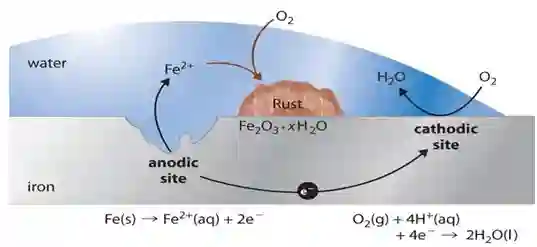
Figure: Electrochemical theory of rusting of iron
A tiny voltaic cell is formed on the iron surface. The part with lower reduction potential is the anode, \(Fe\rightarrow Fe^{2+}+2e^-\), and the electrons move through the metal to the cathodic region, where \(O_2+4H^++4e^-\rightarrow2H_2O\). The overall reaction is \(2Fe+4H^++O_2\rightarrow2Fe^{2+}+2H_2O\). The moist surface with dissolved gases works as the electrolyte. The ferrous ions are further oxidised, \(4Fe^{2+}+O_2+4H_2O\rightarrow2Fe_2O_3+8H^+\), and the product combines with water to give rust, \(Fe_2O_3\cdot xH_2O\).
e. What are some of the methods of preventing rusting of iron?
1. Galvanization: coating the iron with a thin layer of zinc, which gives barrier as well as sacrificial (cathodic) protection. More electropositive metals like \(Zn\), \(Al\) and \(Mg\) in contact with the iron are corroded in place of it.
2. Forming alloys: alloying iron with \(Cr\), \(Ni\), \(Mn\) or \(Si\), for example stainless steel, which resists corrosion. Chromium is the most effective metal for this.
3. Forming a protective barrier: coating the surface with paint, grease, oil, enamel or varnish.
4. Bower-Barff process: iron is exposed to steam so that a thin protective layer of magnetic oxide forms on the surface.
5. Corrosion inhibitors: chemicals such as phosphates, chromates, amines and soaps, which neutralise the corrosive substances or form a protective layer.
4. View PDF Notes
i. Handwritten Notes
ii. Typed PDF Notes
5. Frequently Asked Questions
What is iron? (Class 12 Chemistry)
What topics are included in Unit 7 Studies of Heavy Metals of NEB Class 12 Chemistry?
Which are the heavy metals and where do they come in the periodic table?
What are the ores of iron and where are they found in Nepal?
Why is haematite chosen as the chief ore for the extraction of iron?
How is iron extracted from haematite? (Extraction of iron Class 12)
What are the zones of a blast furnace and the reactions in each zone?
What is the function of limestone and coke in the blast furnace?
Why is the conversion of FeO to Fe2O3 preferred during extraction of iron from haematite?
What are the differences between pig iron, cast iron, wrought iron and steel?
What are the physical properties of iron?
What are the chemical properties of iron?
What is passivity of iron?
Can silver nitrate solution be stored in an iron vessel?
What is steel and how is it manufactured?
What is spiegeleisen and why is it added in steel making?
What is the open hearth process and what are its advantages and disadvantages?
What is the basic oxygen process (LD process)?
What is the difference between the open hearth process and the basic oxygen process?
What are quenching and tempering of steel?
What is rusting and what is the electrochemical theory of rusting?
How can rusting of iron be prevented?
Why is stainless steel more resistant to rust, and which iron nail is used in a wooden fence?
Where can I get Class 12 Chemistry Iron notes in PDF (Iron class 12 notes PDF, Extraction of iron class 12 PDF)?
Where can I get Class 12 Chemistry notes of NEB (handwritten, PDF, Nepal)?
Students also search for: