
Study of Heavy Metals: Zinc
Class 12 Chemistry Notes • NEB Syllabus 2083
Syllabus, 10 solved multiple choice questions, the full exercise with solutions and diagrams, handwritten and typed PDF notes and frequently asked questions on the extraction, properties, uses and compounds of zinc.
1. Syllabus
Unit 7: Study of Heavy Metals: Zinc
These notes follow the NEB Class 12 Chemistry syllabus (+2 Chemistry, Nepal). Practise the multiple choice questions first, then work through the solved numerical and subjective questions, and finish with the PDF notes for quick revision.
2. Multiple Choice Questions
Question 1. Which of the following is an ore of zinc?
- a) Zinc blende
- b) Philosopher’s wool
- c) Chalcopyrite
- d) Ruby copper
Correct Answer: a) Zinc blende
Reason: Zinc blende (\(\mathrm{ZnS}\)) is the chief ore of zinc. Philosopher’s wool is zinc oxide, a product and not an ore. Chalcopyrite (\(\mathrm{CuFeS_2}\)) and ruby copper (\(\mathrm{Cu_2O}\)) are copper ores.
Question 2. What is the formula of Rinmann’s green?
- a) \(\mathrm{ZnCO_3}\)
- b) \(\mathrm{CoZnO_2}\)
- c) \(\mathrm{Co(NO_3)_2\cdot ZnO}\)
- d) \(\mathrm{ZnO}\)
Correct Answer: b) \(\mathrm{CoZnO_2}\)
Reason: Rinmann’s green (cobalt green) is cobalt zincate, \(\mathrm{CoO\cdot ZnO}\) or \(\mathrm{CoZnO_2}\). It forms when zinc oxide is heated with cobalt nitrate (option c is the mixture that is heated, not the product).
Question 3. What is the formula of white vitriol?
- a) \(\mathrm{ZnSO_4\cdot5H_2O}\)
- b) \(\mathrm{ZnSO_4\cdot7H_2O}\)
- c) \(\mathrm{MgSO_4\cdot7H_2O}\)
- d) \(\mathrm{FeSO_4\cdot6H_2O}\)
Correct Answer: b) \(\mathrm{ZnSO_4\cdot7H_2O}\)
Reason: White vitriol is zinc sulphate heptahydrate. Option c is Epsom salt (magnesium sulphate), and green vitriol is \(\mathrm{FeSO_4\cdot7H_2O}\).
Question 4. In electrolytic refining of zinc, what is the cathode made up of?
- a) Impure zinc
- b) Impure carbon
- c) Pure zinc
- d) Pure copper
Correct Answer: c) Pure zinc
Reason: The anode is the impure zinc and the cathode is a thin sheet of pure zinc. Zinc from the anode dissolves as \(\mathrm{Zn^{2+}}\) and deposits on the cathode.
Question 5. Which of the following reducing agents is used in the smelting of zinc oxide?
- a) Aluminium
- b) Copper
- c) Carbon dioxide
- d) Carbon
Correct Answer: d) Carbon
Reason: Zinc oxide is reduced with carbon (coke) at 1400 to 1500 °C in a retort. Carbon dioxide is not a reducing agent here.
Question 6. Which of the following reactions takes place during the smelting of zinc oxide?
- a) \(\mathrm{ZnO+C\rightarrow Zn+CO}\)
- b) \(\mathrm{ZnCO_3\rightarrow ZnO+CO_2}\)
- c) \(\mathrm{ZnSO_4\rightarrow ZnO+SO_2}\)
- d) \(\mathrm{ZnS+O_2\rightarrow ZnO+SO_2}\)
Correct Answer: a) \(\mathrm{ZnO+C\rightarrow Zn+CO}\)
Reason: Smelting is the reduction step. Zinc oxide is reduced by carbon to zinc vapour and carbon monoxide. Options b and d are calcination and roasting, and option c occurs on strongly heating zinc sulphate.
Question 7. Which of the following is an ore of zinc?
- a) Haematite
- b) Lunar caustic
- c) Calamine
- d) Calomel
Correct Answer: c) Calamine
Reason: Calamine is zinc carbonate, \(\mathrm{ZnCO_3}\). Haematite (\(\mathrm{Fe_2O_3}\)) is an iron ore, lunar caustic is silver nitrate and calomel is mercury(I) chloride.
Question 8. Which of the following is a major use of zinc?
- a) Electrical wiring
- b) Galvanizing iron
- c) Making jewelry
- d) Manufacturing glass
Correct Answer: b) Galvanizing iron
Reason: Zinc is coated on iron and steel (galvanisation) to prevent rusting. Zinc is also above iron in the electrochemical series, so it protects the iron even when the coating is scratched.
Question 9. Which of the following is not a transition element?
- a) Zn
- b) Cu
- c) Ni
- d) Cu
Correct Answer: a) Zn
Reason: Zinc (\([\mathrm{Ar}]3d^{10}4s^2\)) and its only common ion \(\mathrm{Zn^{2+}}\) (\(3d^{10}\)) have a completely filled d subshell, so zinc is a non-typical transition element. Cu (copper, also \(\mathrm{Cu^{2+}}\), \(3d^9\)) and Ni are typical transition elements. (Options b and d are both Cu in the textbook.)
Question 10. \(\mathrm{ZnSO_4+BaS\rightarrow X}\)
- a) White vitriol
- b) Lithopone
- c) Philosopher’s wool
- d) Zinc blende
Correct Answer: b) Lithopone
Reason: Zinc sulphate and barium sulphide solutions give two white precipitates, \(\mathrm{ZnS}\) and \(\mathrm{BaSO_4}\), which together are the white pigment lithopone.
3. Numerical and Subjective Questions
Short Answer Questions
a. Iron is coated with zinc.
Coating iron with zinc is called galvanisation. Zinc stops rusting in two ways. The zinc layer keeps air and water away from the iron. Even when the layer is scratched, zinc (\(E^\circ=-0.76\ \mathrm{V}\)) is more reactive than iron (\(E^\circ=-0.44\ \mathrm{V}\)), so zinc is oxidised in place of the iron (it acts as the sacrificial anode) and the iron is protected.
b. Zinc is not considered as typical transition element.
A typical transition element has a partly filled d subshell in its atom or in its common ions. Zinc is \([\mathrm{Ar}]3d^{10}4s^2\) and forms only \(\mathrm{Zn^{2+}}\) (\(3d^{10}\)), so its d subshell is completely filled in the atom and in the ion. It therefore does not show variable oxidation states, coloured compounds or paramagnetism.
c. Zinc does not form colored salts.
Colour in transition metal salts comes from d-d electronic transitions, which need a partly filled d subshell. \(\mathrm{Zn^{2+}}\) has the full \(3d^{10}\) configuration, so there is no vacant d orbital for an electron to move into and no visible light is absorbed. Zinc salts are therefore white or colourless.
Spelter is the crude, impure zinc (about 97 to 98% pure) that is obtained when zinc vapour from the retort is condensed. It contains impurities such as iron, lead, cadmium and arsenic.
Purification of spelter:
(i) Fractional distillation. The boiling points are Zn 907 °C, Cd 767 °C, Pb 1620 °C and Fe 3000 °C. When spelter is heated to about 1000 °C, zinc and cadmium distil over and lead and iron stay behind. The distillate is re-distilled at about 800 °C, when cadmium distils first and pure zinc (99.5%) remains.
(ii) Electrolytic refining (modern method). The impure zinc is the anode, a thin sheet of pure zinc is the cathode, and acidified zinc sulphate solution is the electrolyte:
Zinc of 99.9% purity is obtained, and the insoluble impurities settle below the anode as anode mud. An impure rod is the anode because it has to supply the \(\mathrm{Zn^{2+}}\) ions that deposit on the cathode.
Lithopone is a white pigment made of an equimolar mixture of zinc sulphide and barium sulphate, \(\mathrm{ZnS\cdot BaSO_4}\).
Preparation: by mixing solutions of zinc sulphate and barium sulphide. Both products are insoluble white solids:
Application: it is used as a white pigment in interior wall paints, and also in paper coating, rubber and plastics, because it gives a bright, opaque finish.
a. Zincite
\(\mathrm{ZnO}\) (zinc oxide).
b. Calamine
\(\mathrm{ZnCO_3}\) (zinc carbonate).
c. Zinc blende
\(\mathrm{ZnS}\) (zinc sulphide).
d. White vitriol
\(\mathrm{ZnSO_4\cdot7H_2O}\) (zinc sulphate heptahydrate).
Prediction: no displacement reaction takes place. Zinc is more reactive than iron (\(E^\circ_{\mathrm{Zn^{2+}/Zn}}=-0.76\ \mathrm{V}\) and \(E^\circ_{\mathrm{Fe^{2+}/Fe}}=-0.44\ \mathrm{V}\)). A less reactive metal cannot displace a more reactive metal from its salt:
The potential for the reaction is \(E^\circ_{cell}=-0.76-(-0.44)=-0.32\ \mathrm{V}\), which is negative, so it is not spontaneous. (This is different from an iron vessel holding copper sulphate, where iron displaces copper.)
Observation: the water evaporates and white crystals of zinc sulphate remain; there is no deposit of zinc on the vessel. However, the zinc sulphate solution is slightly acidic because \(\mathrm{Zn^{2+}}\) hydrolyses, so the hot solution can attack the iron a little: \(\mathrm{Fe+2H^+\rightarrow Fe^{2+}+H_2\uparrow}\). The vessel may rust, and the crystals can be contaminated with iron(II) salts and look slightly yellow-green.
Modification: use a vessel that does not react, an evaporating dish of porcelain or glass (borosilicate), and heat gently on a water bath, then crystallise.
a. Starting from metallic zinc, how would you prepare white vitriol?
Dissolve zinc in dilute sulphuric acid:
Filter the solution to remove the unreacted zinc and impurities, concentrate it by gentle heating and cool it. Colourless crystals of white vitriol, \(\mathrm{ZnSO_4\cdot7H_2O}\), separate out.
b. Write the action of heat on white vitriol.
The crystals lose their water of crystallisation and become anhydrous, and then the anhydrous salt decomposes:
c. What happens when aqueous solution of this compound is treated with barium sulphide?
Lithopone, a white precipitate of zinc sulphide and barium sulphate, is formed:
a. Roasting of zinc sulphide ore.
Part of the zinc sulphide first changes into zinc sulphate, which then decomposes:
b. Thermal decomposition of white vitriol.
c. Action of air on zinc.
In moist air containing carbon dioxide, zinc is covered by a grey layer of basic zinc carbonate:
When heated in air at 500 °C, zinc burns with a bluish flame to give white zinc oxide (philosopher’s wool):
Introduction: white vitriol is zinc sulphate heptahydrate, \(\mathrm{ZnSO_4\cdot7H_2O}\). It is called seto tutho in Nepali.
Preparation: by the action of dilute sulphuric acid on zinc, ZnO or \(\mathrm{ZnCO_3}\), followed by crystallisation:
Physical properties: it is a colourless (white) crystalline solid, soluble in water, and it is efflorescent, that is, it loses water of crystallisation when exposed to the atmosphere.
Chemical properties:
Uses:
The chief ore of zinc is zinc blende, \(\mathrm{ZnS}\). Zinc is extracted from it by pyrometallurgy in the following steps.
Figure: Flow chart of the extraction of zinc from zinc blende
1. Crushing and pulverisation. The big lumps of ore are broken into small pieces by a jaw crusher or hammer and then ground to a powder in a ball mill.
2. Concentration (froth flotation). The powdered ore is mixed with pine oil and water in a tank and agitated with compressed air. The ore particles float in the froth and the earthy impurities (gangue) settle at the bottom.
Figure: Froth flotation. Sulphide ore particles stick to the oil, rise in the froth and are skimmed off; the earthy gangue settles at the bottom
3. Roasting. The concentrated ore is strongly heated in an excess of air in a reverberatory furnace, and zinc sulphide changes into zinc oxide. Some of the sulphide first becomes sulphate, which then decomposes. The impurities of P, S and As are removed as volatile oxides.
If calamine, \(\mathrm{ZnCO_3}\), is present with the zinc sulphide, it is changed into the oxide by calcination: \(\mathrm{ZnCO_3\xrightarrow{\Delta}ZnO+CO_2\uparrow}\).
4. Reduction (smelting). Briquettes of zinc oxide powder and coke (2 : 1) are fed into a vertical retort furnace. The retort is heated from outside by burning producer gas (CO + N₂), and at 1400 to 1500 °C the oxide is reduced to zinc vapour, which leaves the retort and is condensed into molten zinc called spelter (97.8% pure) while carbon monoxide escapes:
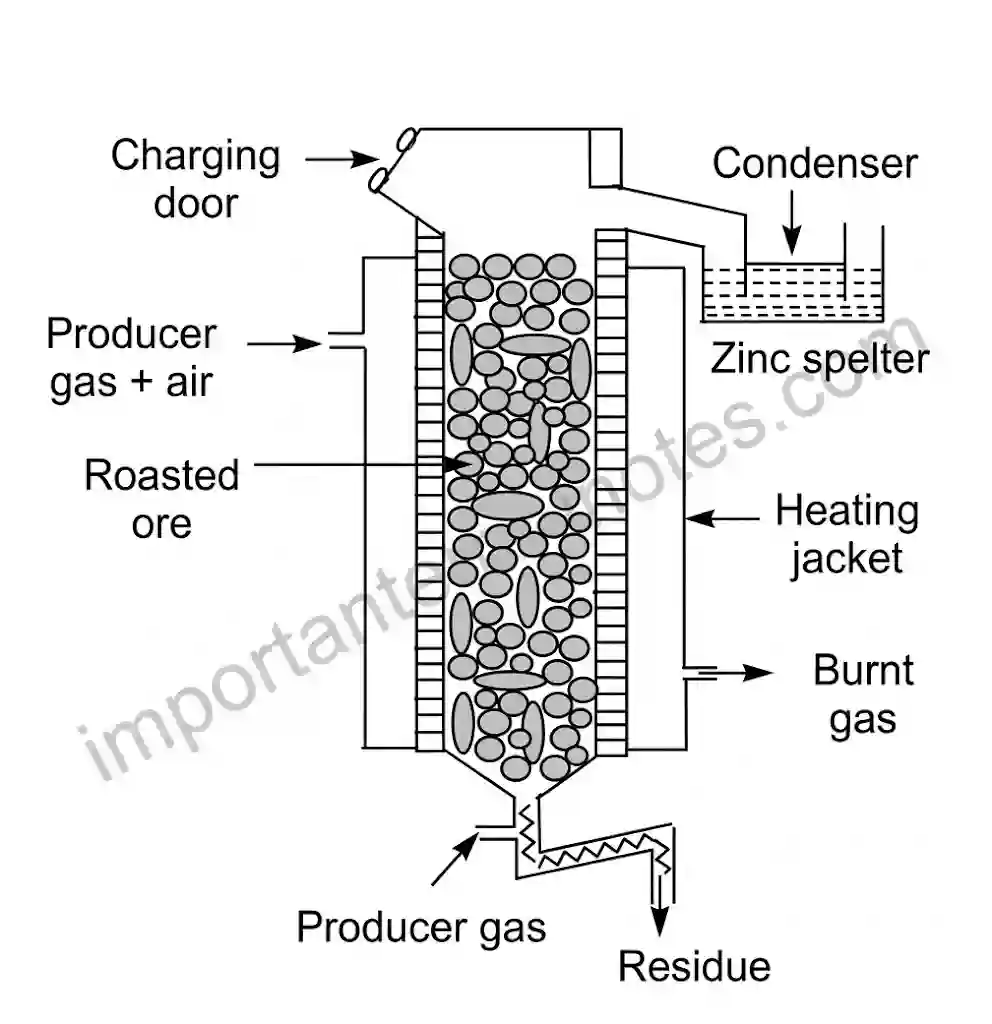
Figure: Reduction of zinc
5. Purification. The spelter contains iron, lead, cadmium and arsenic. It is purified by fractional distillation (99.5% pure zinc) or, by the modern method, by electrolytic refining. Impure zinc is the anode, pure zinc is the cathode and acidified zinc sulphate is the electrolyte:
The zinc obtained is 99.9% pure, and the impurities fall as anode mud.
Figure: Electrolytic refining of zinc. Impure zinc dissolves at the anode and pure zinc deposits on the cathode; the impurities fall as anode mud
Long Answer Questions
a. Identify the metal ‘M’.
The metal M is zinc (Zn). Its atomic number is 30 and its configuration is \([\mathrm{Ar}]3d^{10}4s^2\). Roofs of galvanised (zinc-coated) iron sheets are common.
b. Write the formula of the chief ore of ‘M’.
The chief ore is zinc blende, \(\mathrm{ZnS}\).
c. How would you extract ‘M’ starting from its chief ore?
(The diagrams are given with Short Answer Question 9.)
d. What happens when ‘M’ is treated with dilute sulphuric acid followed by crystallization?
Zinc lies above hydrogen in the electrochemical series, so it dissolves in dilute sulphuric acid and liberates hydrogen:
When the solution is concentrated and cooled, colourless crystals of white vitriol, \(\mathrm{ZnSO_4\cdot7H_2O}\), are obtained.
e. What happens when ‘M’ is heated with steam at \(500^\circ\mathrm{C}\)?
Zinc decomposes steam at about 500 °C (red heat). It forms zinc oxide and liberates hydrogen:
f. Write any two uses of ‘M’.
a. Identify the element and write its chief ore.
The element is zinc (Group 12, oxidation state +2). The sulphide is zinc blende, \(\mathrm{ZnS}\) (the chief ore), and the carbonate is calamine, \(\mathrm{ZnCO_3}\).
b. Describe the steps required to extract this element from its chief ore with the necessary diagram.
Figure: Froth flotation. Sulphide ore particles stick to the oil, rise in the froth and are skimmed off; the earthy gangue settles at the bottom
Figure: Vertical retort furnace. Zinc oxide briquettes and coke are charged from the top, the retort is heated from outside by producer gas, and zinc vapour is condensed as spelter
Figure: Electrolytic refining of zinc. Impure zinc dissolves at the anode and pure zinc deposits on the cathode; the impurities fall as anode mud
(The flow chart is given with Short Answer Question 9.)
c. How does this element react with nitric acid under different conditions?
The product depends on the concentration of the acid. The more dilute the acid, the more the nitrogen is reduced:
| Nitric acid | Reaction | Product |
|---|---|---|
| Concentrated | \(\mathrm{Zn+4HNO_3\rightarrow Zn(NO_3)_2+2NO_2\uparrow+2H_2O}\) | Brown \(\mathrm{NO_2}\) |
| Cold, dilute | \(\mathrm{3Zn+8HNO_3\rightarrow3Zn(NO_3)_2+2NO\uparrow+4H_2O}\) | Colourless NO |
| Dilute | \(\mathrm{4Zn+10HNO_3\rightarrow4Zn(NO_3)_2+N_2O\uparrow+5H_2O}\) | \(\mathrm{N_2O}\) |
| Very dilute | \(\mathrm{4Zn+10HNO_3\rightarrow4Zn(NO_3)_2+NH_4NO_3+3H_2O}\) | \(\mathrm{NH_4NO_3}\) |
d. Write any two uses of this element.
4. View PDF Notes
i. Handwritten Notes
ii. Typed PDF Notes
5. Frequently Asked Questions
What is zinc? What are its symbol, atomic number and atomic mass?
What topics are included in Unit 7 Study of Heavy Metals of NEB Class 12 Chemistry?
What are heavy metals? Give the heavy metals list and names.
Are there heavy metals in the body? Which are essential and which are toxic?
How do heavy metals get into water and food?
What are the ores (minerals) of zinc?
How is zinc extracted from zinc blende? Write the steps.
What is spelter and how is zinc refined electrolytically?
What are the physical and chemical properties of zinc?
What is white vitriol? How is it prepared and what are its uses?
What is lithopone? What is it used for?
Is zinc a vitamin? What are the zinc foods, supplements and tablets?
What is the zinc colour? Why do zinc salts have no colour?
Where can I get Class 12 Chemistry Heavy Metals notes in PDF?
Where can I get Class 12 Chemistry notes of NEB (handwritten, PDF, Nepal)?
Students also search for: