
Transition Metals
Class 12 Chemistry Notes • NEB Syllabus 2083
Syllabus, 10 solved multiple choice questions, the full exercise with solutions and figures, handwritten and typed PDF notes and frequently asked questions on transition metals, oxidation states, complex ions, crystal field theory, colour and catalysis.
1. Syllabus
Unit 6: Transition Metals
These notes follow the NEB Class 12 Chemistry syllabus (+2 Chemistry, Nepal). Practise the multiple choice questions first, then work through the solved numerical and subjective questions, and finish with the PDF notes for quick revision.
2. Multiple Choice Questions
Question 1. What is the maximum oxidation state shown by transition elements?
- a) +5
- b) +6
- c) +7
- d) +8
Correct Answer: d) +8
Reason: The highest oxidation state in the whole d-block is +8, shown by the 4d and 5d elements ruthenium and osmium in \(\mathrm{RuO_4}\) and \(\mathrm{OsO_4}\).
Question 2. What is the maximum oxidation state shown by the 3d series?
- a) +9
- b) +8
- c) +7
- d) +6
Correct Answer: c) +7
Reason: Manganese (\([\mathrm{Ar}]3d^54s^2\)) can use all seven valence electrons, as in the permanganate ion \(\mathrm{MnO_4^-}\). This is the highest state in the 3d series.
Question 3. Which of the following does not form colorful compound?
- a) \(\mathrm{Cu^{2+}}\)
- b) \(\mathrm{Fe^{2+}}\)
- c) \(\mathrm{Cu^{+}}\)
- d) \(\mathrm{Co^{2+}}\)
Correct Answer: c) \(\mathrm{Cu^{+}}\)
Reason: Colour comes from d-d transitions, which need a partly filled d subshell. \(\mathrm{Cu^+}\) is \(3d^{10}\) (completely filled), so no d-d transition is possible and it is colourless. \(\mathrm{Cu^{2+}}\) (\(3d^9\)), \(\mathrm{Fe^{2+}}\) (\(3d^6\)) and \(\mathrm{Co^{2+}}\) (\(3d^7\)) are coloured.
Question 4. What is the general electronic configuration of transition metals?
- a) \(ns^{1-2}(n-1)d^{1-9}\)
- b) \(ns^{1-2}(n-1)d^{10}\)
- c) \(ns^{2}(n-1)d^{1-10}\)
- d) \(ns^{1-2}(n-1)d^{1-10}\)
Correct Answer: d) \(ns^{1-2}(n-1)d^{1-10}\)
Reason: The (n-1)d subshell is being filled. Some elements have one ns electron (Cr, Cu), the others have two, and the d subshell holds 1 to 10 electrons across the series.
Question 5. Which of the following element shows maximum number of oxidation state?
- a) Mn
- b) Ni
- c) Cr
- d) Cu
Correct Answer: a) Mn
Reason: Manganese shows every oxidation state from +2 to +7 (six states). Ni shows +2 to +4, Cr shows +2, +3 and +6 as the common ones, and Cu shows +1 and +2.
Question 6. Find the number of unpaired electron in iron metal ion of \(\mathrm{[Fe(H_2O)_6]^{2+}}\)?
- a) 2
- b) 3
- c) 4
- d) 5
Correct Answer: c) 4
Reason: The oxidation state of Fe is \(x+6(0)=+2\), so Fe is \(\mathrm{Fe^{2+}}\) with configuration \(3d^6\). Water is a weak field ligand, so the splitting is small and the electrons occupy the orbitals singly first (high spin): \(t_{2g}^{4}e_g^{2}\). Five orbitals hold six electrons, so one orbital is paired and four are unpaired.
Question 7. What is the coordination number of octahedral complexes?
- a) 2
- b) 4
- c) 5
- d) 6
Correct Answer: d) 6
Reason: An octahedral complex has six ligand donor atoms around the metal ion, placed at the six corners of an octahedron.
Question 8. Which of the following ion has no d electron?
- a) \(\mathrm{Cr^{3+}}\)
- b) \(\mathrm{Cu^{+}}\)
- c) \(\mathrm{Sc^{3+}}\)
- d) \(\mathrm{Fe^{2+}}\)
Correct Answer: c) \(\mathrm{Sc^{3+}}\)
Reason: Sc is \([\mathrm{Ar}]3d^14s^2\). After losing three electrons, \(\mathrm{Sc^{3+}}\) is \([Ar]3d^0\). The others are \(\mathrm{Cr^{3+}}\) (\(3d^3\)), \(\mathrm{Cu^+}\) (\(3d^{10}\)) and \(\mathrm{Fe^{2+}}\) (\(3d^6\)).
Question 9. What do we call the energy difference between the two sets of d-orbitals in an octahedral field splitting?
- a) Bond enthalpy
- b) Crystal field splitting energy
- c) Ligand field energy
- d) Coordination energy
Correct Answer: b) Crystal field splitting energy
Reason: The gap between the lower \(t_{2g}\) set and the higher \(e_g\) set is the crystal field splitting energy \(\Delta_o\).
Question 10. Which of the following ligand produces a strong crystal field?
- a) \(\mathrm{CN^-}\)
- b) \(\mathrm{H_2O}\)
- c) \(\mathrm{NH_3}\)
- d) \(\mathrm{I^-}\)
Correct Answer: a) \(\mathrm{CN^-}\)
Reason: In the spectrochemical series, \(\mathrm{I^-}\) < \(\mathrm{Cl^-}\) < \(\mathrm{H_2O}\) < \(\mathrm{NH_3}\) < \(\mathrm{CN^-}\) < CO, the field strength increases to the right. Cyanide is a strong field ligand and gives a large splitting.
3. Numerical and Subjective Questions
Short Answer Questions
a. Zinc is non typical transition element.
A typical transition element has a partly filled d subshell, either in the atom or in its common ions. Zinc is \([\mathrm{Ar}]3d^{10}4s^2\) and its only common ion, \(\mathrm{Zn^{2+}}\), is \(3d^{10}\). The d subshell is completely filled in both, so zinc does not show the typical properties: it has a single oxidation state (+2), its compounds are colourless and diamagnetic, and it is softer with lower melting point. Zinc is therefore called a non-typical transition element.
b. Transition element exhibits variable oxidation state.
The (n-1)d and ns orbitals have almost the same energy. After the ns electrons are lost, the (n-1)d electrons can also take part in bonding, so the element can lose different numbers of electrons under different conditions. Example: manganese shows +2, +3, +4, +5, +6 and +7.
| Element | Configuration | Oxidation states |
|---|---|---|
| Ti | \([\mathrm{Ar}]3d^24s^2\) | +2, +3, +4 |
| V | \([\mathrm{Ar}]3d^34s^2\) | +2, +3, +4, +5 |
| Cr | \([\mathrm{Ar}]3d^54s^1\) | +1, +2, +3, +4, +5, +6 |
| Mn | \([\mathrm{Ar}]3d^54s^2\) | +2, +3, +4, +5, +6, +7 |
| Fe | \([\mathrm{Ar}]3d^64s^2\) | +2, +3 (also +4, +5, +6) |
| Cu | \([\mathrm{Ar}]3d^{10}4s^1\) | +1, +2 |
The half-filled (\(d^5\)) and filled (\(d^{10}\)) arrangements are specially stable, so \(\mathrm{Mn^{2+}}\) (\(3d^5\)) is more stable than \(\mathrm{Mn^{3+}}\) (\(3d^4\)). Lower states (+2, +3) are generally ionic and the higher states are covalent (CrO is ionic, \(\mathrm{CrO_3}\) is covalent).
c. Transition metals behave as good catalyst.
(i) Variable oxidation states: the metal can take part in the reaction by gaining or losing electrons, forms unstable intermediate compounds with the reactants and gives a new path with a lower activation energy; it returns to its original state at the end. (ii) Surface adsorption: the metals and their compounds have a large surface with vacant or partly filled d orbitals; the reactant molecules are adsorbed on it, their bonds weaken, and the reaction is faster. Examples: Fe in the Haber process and \(\mathrm{V_2O_5}\) in the Contact process.
Position and configuration: They are the d-block elements in the middle of the periodic table, groups 3 to 12, with general configuration \((n-1)d^{1-10}ns^{1-2}\).
In a free metal ion all five d orbitals have the same energy (they are degenerate). When ligands approach, the negative charge of the ligands repels the d electrons, and the repulsion is not the same for every d orbital, because the orbitals point in different directions. The d orbitals therefore split into groups of different energy. This loss of degeneracy of the d orbitals in the field of the ligands is called crystal field splitting. In an octahedral complex the five orbitals split into a lower \(t_{2g}\) set and a higher \(e_g\) set.
Transition elements are the elements whose atoms, or common ions, have a partly filled d subshell. They are the d-block elements of groups 3 to 12, with the last electron entering the (n-1)d subshell.
Why they are called so: they lie between the s-block elements (strongly electropositive metals, on the left) and the p-block elements (on the right). Their properties change gradually from one block to the other, so they form a transition between them.
a. Ligands
A ligand is an atom, ion or neutral molecule that donates a lone pair of electrons to the central metal ion to form a coordinate bond. It acts as a Lewis base. Examples: \(\mathrm{H_2O}\), \(\mathrm{NH_3}\), \(\mathrm{Cl^-}\), \(\mathrm{CN^-}\). Ligands are monodentate (one donor atom), bidentate (two, for example ethylenediamine and oxalate), tridentate or polydentate (for example EDTA).
b. Coordination sphere
The central metal ion with the ligands directly attached to it, written in square brackets, is the coordination sphere. In \(\mathrm{[Co(NH_3)_6]Cl_3}\), the coordination sphere is \(\mathrm{[Co(NH_3)_6]^{3+}}\), and the three \(\mathrm{Cl^-}\) ions lie outside it.
c. Complex ion
A complex ion is a charged species made of a central metal ion bonded to a definite number of ligands. Its charge is the sum of the metal ion charge and the ligand charges. Examples: \(\mathrm{[Cu(NH_3)_4]^{2+}}\) (complex cation) and \(\mathrm{[Fe(CN)_6]^{3-}}\) (complex anion). A complex with no net charge, such as \(\mathrm{Ni(CO)_4}\), is a neutral complex.
\(\mathrm{Fe^{2+}}\): Fe is \([\mathrm{Ar}]3d^64s^2\); losing the two 4s electrons gives \(3d^6\). The six electrons fill five orbitals, one orbital is paired and four are single: 4 unpaired electrons.
\(\mathrm{Cr^{3+}}\): Cr is \([\mathrm{Ar}]3d^54s^1\); losing three electrons gives \(3d^3\), with three single electrons: 3 unpaired electrons.
So \(\mathrm{Fe^{2+}}\) has more unpaired electrons (4 against 3).
Orbitals that have the same energy are called degenerate orbitals. The five d orbitals of a free metal ion (\(d_{xy},d_{yz},d_{xz},d_{x^2-y^2},d_{z^2}\)) are degenerate, and so are the three p orbitals of an atom. The ligand field of a complex removes the degeneracy of the d orbitals.
The crystal field splitting energy is the energy difference between the two sets of d orbitals formed in the field of the ligands. In an octahedral complex it is called \(\Delta_o\) and it is the gap between the \(e_g\) and \(t_{2g}\) sets. The \(t_{2g}\) orbitals lie \(0.4\Delta_o\) below the average energy and the \(e_g\) orbitals lie \(0.6\Delta_o\) above it.
The value of \(\Delta_o\) depends on the nature of the ligand (strong field ligands such as \(\mathrm{CN^-}\) give a large value), the oxidation state of the metal and the geometry of the complex.
1. Tetraamminecopper(II) ion, \(\mathrm{[Cu(NH_3)_4]^{2+}}\) (complex cation, square planar).
2. Hexacyanoferrate(III) ion, \(\mathrm{[Fe(CN)_6]^{3-}}\) (complex anion, octahedral).
Other examples: \(\mathrm{[Fe(H_2O)_6]^{2+}}\), \(\mathrm{[Ag(NH_3)_2]^+}\) and \(\mathrm{[Ni(CN)_4]^{2-}}\).
A substance is paramagnetic when it has unpaired electrons, because each unpaired electron behaves as a tiny magnet due to its spin and the substance is weakly attracted by a magnetic field. Most transition metal ions have a partly filled d subshell (\(d^1\) to \(d^9\)). By Hund’s rule the electrons occupy the d orbitals singly before they pair, so the ions have unpaired electrons and are paramagnetic. Ions with \(d^0\) or \(d^{10}\) (\(\mathrm{Sc^{3+}}\), \(\mathrm{Zn^{2+}}\)) have no unpaired electrons and are diamagnetic.
Long Answer Questions
Crystal Field Theory (CFT) was developed by Hans Bethe and John Van Vleck in the 1930s. It explains the bonding, colour and magnetic properties of complexes by treating the metal-ligand attraction as purely electrostatic.
Postulates:
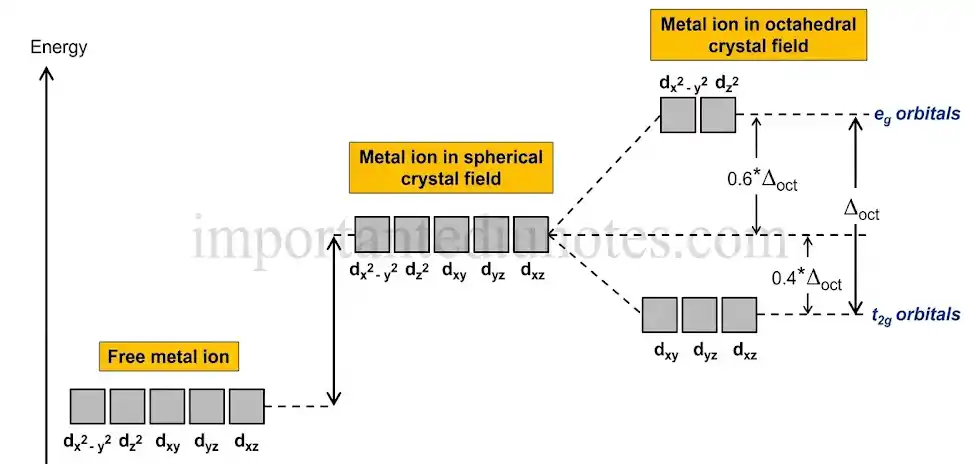
Place the metal ion at the origin and let the six ligands approach along the +x, -x, +y, -y, +z and -z axes. The five d orbitals fall into two groups according to their direction:
If the ligand field were spherical, all five orbitals would rise equally to the average energy. In the octahedral field the \(e_g\) set lies \(0.6\Delta_o\) above this average and the \(t_{2g}\) set lies \(0.4\Delta_o\) below it, and \(\Delta_o\) is the crystal field splitting energy. The energy balance is \(2(0.6\Delta_o)=3(0.4\Delta_o)\).
Example, \(\mathrm{Cr^{3+}}\) (\(d^3\)): the three electrons occupy the three \(t_{2g}\) orbitals singly, so the crystal field stabilisation energy is \(3\times(-0.4\Delta_o)=-1.2\Delta_o\).
Transition metals are the d-block elements of groups 3 to 12, whose atoms or ions have a partly filled d subshell. The general valence shell configuration is \((n-1)d^{1-10}ns^{1-2}\). They lie between the s-block and the p-block elements, which is why they are called transition elements. Examples: Fe, Cu, Ni, Zn, Cr, Mn.
General characteristics:
A catalyst changes the rate of a reaction by giving it a new path with a lower activation energy, without being used up. Transition metals and their compounds are good catalysts for two reasons.
1. Variable oxidation state. A transition metal can gain or lose electrons easily, so it can pass through several oxidation states. It forms an unstable intermediate with a reactant, which then changes into the product, and the metal returns to its original state. The new path has a lower activation energy and the reaction becomes faster.
2. Surface adsorption. A solid transition metal, or its compound, offers a large surface with vacant or partly filled d orbitals. Reactant molecules are adsorbed on this surface, the concentration of the reactants on it increases and the bonds inside the reactant molecules weaken. The reactants come close in a favourable orientation, the intermediate forms and quickly turns into the products.
| Catalyst | Application |
|---|---|
| Fe-Mo | Manufacture of ammonia by the Haber process |
| Ni or Pd | Hydrogenation of vegetable oil (vanaspati ghee); \(\mathrm{CH_2=CH_2+H_2\rightarrow CH_3CH_3}\) |
| \(\mathrm{MnO_2}\) | Decomposition of \(\mathrm{KClO_3}\) and of \(\mathrm{H_2O_2}\) |
| \(\mathrm{TiCl_4}\) (Ziegler-Natta catalyst) | Preparation of polyethene from ethene |
| Cu | Dehydrogenation of alcohols |
| \(\mathrm{V_2O_5}\) or Pt | Manufacture of sulphuric acid by the Contact process |
Cause of colour. In a complex the ligands split the d orbitals into a lower set (\(t_{2g}\)) and a higher set (\(e_g\)). When the metal ion has a partly filled d subshell (\(d^1\) to \(d^9\)), an electron can absorb light of energy equal to the gap and move from the lower set to the higher set (a d-d transition):
The wavelength absorbed is removed from white light, and the compound shows the complementary colour of the light absorbed. Example: in \(\mathrm{[Cu(H_2O)_6]^{2+}}\) (a \(d^9\) ion) the \(t_{2g}\) to \(e_g\) transition absorbs orange light, so aqueous copper(II) sulphate looks blue.
Ions with \(d^0\) (\(\mathrm{Sc^{3+}}\)) or \(d^{10}\) (\(\mathrm{Zn^{2+}}\), \(\mathrm{Cu^+}\)) have no d-d transition and are colourless. A strong charge transfer between the ligand and the metal ion (for example in \(\mathrm{MnO_4^-}\) and \(\mathrm{CrO_4^{2-}}\)) also gives an intense colour.
Factors affecting the colour:
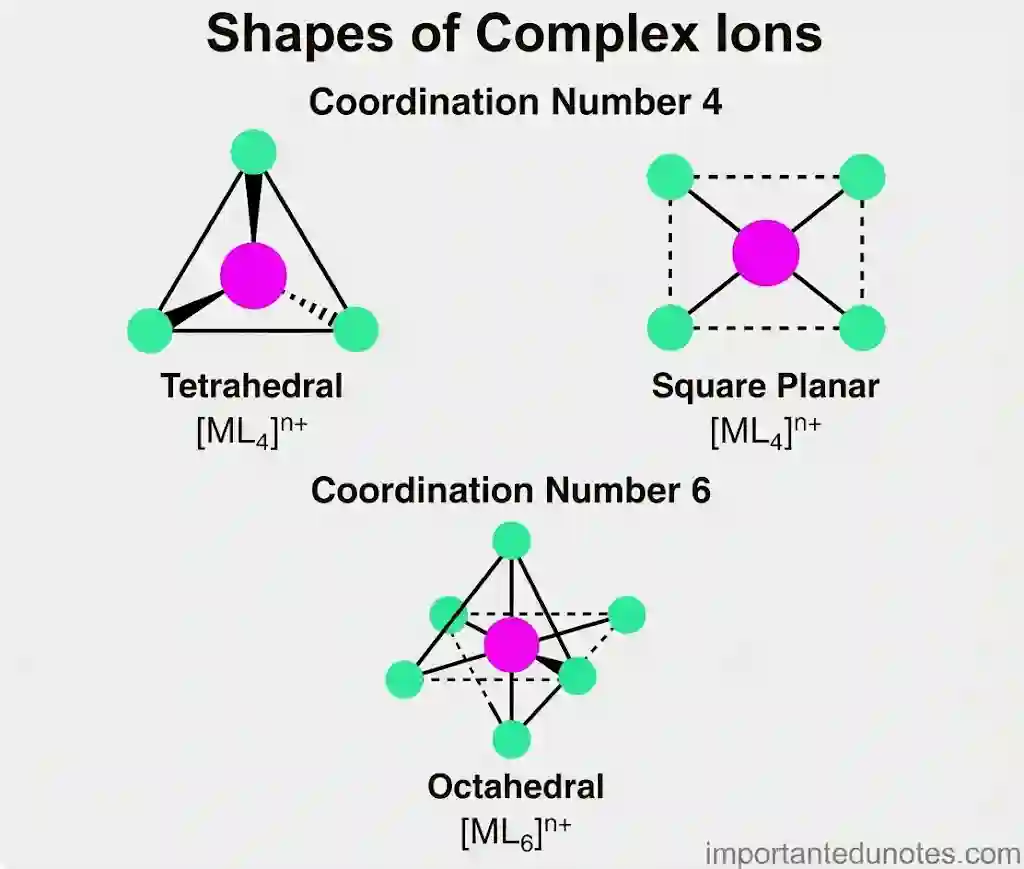
The shape of a complex ion depends on its coordination number. A coordination number of 4 gives a tetrahedral or a square planar shape, and a coordination number of 6 gives an octahedral shape. (M is the central metal ion and L is a ligand; a solid wedge points toward you and a dashed line points away from you.)
| Coordination number | Shape | Bond angle | Examples |
|---|---|---|---|
| 4 | Tetrahedral | \(109.5^\circ\) | \(\mathrm{[Zn(NH_3)_4]^{2+}}\), \(\mathrm{[CuCl_4]^{2-}}\), \(\mathrm{[Co(Cl)_4]^{2-}}\), \(\mathrm{Ni(CO)_4}\) |
| 4 | Square planar | \(90^\circ\) | \(\mathrm{[Ni(CN)_4]^{2-}}\), \(\mathrm{[Pt(Cl)_4]^{2-}}\), \(\mathrm{[Cu(NH_3)_4]^{2+}}\) |
| 6 | Octahedral | \(90^\circ\) | \(\mathrm{[Fe(H_2O)_6]^{3+}}\), \(\mathrm{[Co(NH_3)_6]^{3+}}\), \(\mathrm{[Fe(CN)_6]^{3-}}\) |
4. View PDF Notes
i. Handwritten Notes
ii. Typed PDF Notes
5. Frequently Asked Questions
What are transition metals? (Class 12 Chemistry)
What topics are included in Unit 6 Transition Metals of NEB Class 12 Chemistry?
Where can I find the transition metals list and the transition metals periodic table?
What are some transition metals examples and their uses?
What are the transition metals properties (characteristics)?
What are inner transition metals and post transition metals?
Why does transition elements show variable oxidation states?
What is a complex ion, ligand, coordination number and coordination sphere?
What are the shapes of complex ions?
What is the crystal field theory (CFT)? What is crystal field splitting energy?
Why do transition metal compounds show colour?
Why are transition metals and their compounds good catalysts?
Where can I get Class 12 Chemistry Transition Metals notes in PDF?
Where can I get Class 12 Chemistry notes of NEB (handwritten, PDF, Nepal)?
Students also search for: