
Study of Heavy Metals: Copper
Class 12 Chemistry Notes • NEB Syllabus 2083
Syllabus, 10 solved multiple choice questions, the full exercise with solutions and diagrams, handwritten and typed PDF notes and frequently asked questions on the extraction, properties, uses and compounds of copper.
1. Syllabus
Unit 7: Study of Heavy Metals: Copper
These notes follow the NEB Class 12 Chemistry syllabus (+2 Chemistry, Nepal). Practise the multiple choice questions first, then work through the solved numerical and subjective questions, and finish with the PDF notes for quick revision.
2. Multiple Choice Questions
Question 1. Which of the following is an ore of copper?
- a) Calamine
- b) Philosopher’s wool
- c) Chalcopyrite
- d) Rinmann’s green
Correct Answer: c) Chalcopyrite
Reason: Chalcopyrite (copper pyrite, \(\mathrm{CuFeS_2}\)) is the chief ore of copper. Calamine (\(\mathrm{ZnCO_3}\)) is an ore of zinc, philosopher’s wool is zinc oxide (\(\mathrm{ZnO}\)) and Rinmann’s green is a cobalt zincate.
Question 2. Which of the following metallurgical principles is applied to extract copper?
- a) Hydrometallurgy
- b) Pyrometallurgy
- c) Electrometallurgy
- d) Mond’s process
Correct Answer: b) Pyrometallurgy
Reason: Copper is extracted from its sulphide ore by heating operations at high temperature (roasting, smelting and bessemerisation), which is pyrometallurgy.
Question 3. Which of the following methods is used to purify blister copper?
- a) Zone refining
- b) Distillation
- c) Electrolytic refining
- d) Fractional crystallization
Correct Answer: c) Electrolytic refining
Reason: Blister copper (98 to 99% pure) is refined by electrolysis, using it as the anode and pure copper as the cathode in acidified \(\mathrm{CuSO_4}\). This gives 99.9% pure copper.
Question 4. In electrolytic refining, where does the pure copper deposit?
- a) Anode
- b) Anode mud
- c) Cathode mud
- d) Cathode
Correct Answer: d) Cathode
Reason: \(\mathrm{Cu^{2+}}\) ions move to the cathode, gain two electrons and deposit as pure copper: \(\mathrm{Cu^{2+}+2e^-\rightarrow Cu}\).
Question 5. What do we call the impurities that settle during the electro-refining of copper?
- a) Anode mud
- b) Cathode mud
- c) Slag
- d) Flux
Correct Answer: a) Anode mud
Reason: The insoluble impurities (silver, gold, platinum) do not dissolve. They fall to the bottom of the cell below the anode as a muddy mass called anode mud.
Question 6. Which of the following dressing methods is used for the chief ore of copper?
- a) Leaching
- b) Magnetic separation
- c) Gravity separation
- d) Froth flotation
Correct Answer: d) Froth flotation
Reason: The chief ore, chalcopyrite, is a sulphide ore. Sulphide particles are wetted by pine oil and rise with the air bubbles in the froth, while the gangue is wetted by water and settles.
Question 7. Which of the following compositions represents copper matte?
- a) \(\mathrm{CuFeS_2+SO_2}\)
- b) \(\mathrm{CuS+FeS}\)
- c) \(\mathrm{Cu_2O+CuS}\)
- d) \(\mathrm{FeS+CuO}\)
Correct Answer: b) \(\mathrm{CuS+FeS}\)
Reason: Copper matte is the molten mixture of copper sulphide and iron sulphide obtained at the bottom of the blast furnace (it contains about 50% copper). Of the given options only (b) is a mixture of copper and iron sulphides. Strictly, the copper sulphide in the matte is \(\mathrm{Cu_2S}\).
Question 8. Which of the following is not a coinage metal?
- a) Ag
- b) Cu
- c) Co
- d) Au
Correct Answer: c) Co
Reason: The coinage metals are copper, silver and gold of Group 11. Cobalt is in Group 9 and is not used for coins.
Question 9. What is the formula of malachite?
- a) \(\mathrm{CuCO_3\cdot Cu(OH)_2}\)
- b) \(\mathrm{Cu_2O}\)
- c) \(\mathrm{CuFeS_2}\)
- d) \(\mathrm{Cu_2S}\)
Correct Answer: a) \(\mathrm{CuCO_3\cdot Cu(OH)_2}\)
Reason: Malachite is the green basic carbonate of copper. \(\mathrm{Cu_2O}\) is cuprite, \(\mathrm{CuFeS_2}\) is chalcopyrite and \(\mathrm{Cu_2S}\) is chalcocite.
Question 10. What is the composition of bell metal?
- a) \(\mathrm{Cu+Zn+Sn}\)
- b) \(\mathrm{Cu+Sn}\)
- c) \(\mathrm{Zn+Sn}\)
- d) \(\mathrm{Cu+Pb+Sn}\)
Correct Answer: b) \(\mathrm{Cu+Sn}\)
Reason: Bell metal is a bronze rich in tin, about 78% copper and 22% tin. (Brass is copper and zinc.)
3. Numerical and Subjective Questions
Short Answer Questions
a. Statues of copper become green on long standing.
In moist air containing carbon dioxide, copper slowly forms a green layer of basic copper carbonate (verdigris or patina):
The layer sticks to the metal and protects it from further corrosion.
b. Copper sulphate is not recommended to be stored in a nickel vessel.
Nickel lies above copper in the electrochemical series (\(E^\circ_{\mathrm{Ni^{2+}/Ni}}=-0.25\ \mathrm{V}\) and \(E^\circ_{\mathrm{Cu^{2+}/Cu}}=+0.34\ \mathrm{V}\)). Nickel therefore displaces copper from the solution, and the vessel is eaten away:
The same reason holds for zinc and iron containers.
c. A brown gas evolves when copper is treated with conc. nitric acid.
Concentrated nitric acid is a strong oxidising agent. It oxidises copper to copper(II) nitrate and is itself reduced to nitrogen dioxide, a brown gas:
Copper does not react with dilute sulphuric acid alone, so it is dissolved in the hot acid with a current of air (or after being heated in air to CuO):
The solution is concentrated and cooled, and blue crystals of blue vitriol separate:
Use: it is used as a fungicide and insecticide, for example in Bordeaux mixture (blue vitriol, slaked lime and water) sprayed on grape vines and potato crops.
First, a bluish-white precipitate of copper(II) hydroxide forms:
With excess ammonia the precipitate dissolves and a deep blue (ink blue) solution of tetraamminecopper(II) sulphate forms:
This solution is called Schweitzer’s reagent. It dissolves cellulose and is used to make rayon (artificial silk).
a. Blue vitriol
\(\mathrm{CuSO_4\cdot5H_2O}\) (copper(II) sulphate pentahydrate).
b. Malachite
\(\mathrm{CuCO_3\cdot Cu(OH)_2}\) (green basic copper carbonate).
c. Ruby copper
\(\mathrm{Cu_2O}\) (cuprous oxide, also called cuprite).
d. Black oxide
\(\mathrm{CuO}\) (cupric oxide).
a. Black oxide
Formula: \(\mathrm{CuO}\). Use: it gives blue or green colour to glass and ceramics, and it is used as an oxidising agent (to estimate carbon and hydrogen in organic compounds).
b. Red oxide
Formula: \(\mathrm{Cu_2O}\). Use: it is used in anti-rust and antifouling paints and to make red glass.
c. Blue vitriol
Formula: \(\mathrm{CuSO_4\cdot5H_2O}\). Use: it is used as a fungicide and insecticide (Bordeaux mixture), and in electroplating.
a. Starting from metallic copper how would you prepare blue vitriol?
Dissolve copper in hot dilute sulphuric acid while air is blown through it:
Filter, concentrate the solution by heating and cool it. Blue crystals of \(\mathrm{CuSO_4\cdot5H_2O}\) separate. (With hot concentrated sulphuric acid the reaction is \(\mathrm{Cu+2H_2SO_4\longrightarrow CuSO_4+SO_2\uparrow+2H_2O}\).)
b. Write the action of heat on blue vitriol.
The blue crystals lose their water of crystallisation in steps and turn white, and the anhydrous salt decomposes at a high temperature:
c. What happens when aqueous solution of this compound treated with KI?
Copper(II) oxidises iodide to iodine and is reduced to white cuprous iodide. The solution turns brown because of the iodine that is set free:
d. Why is this compound considered as vitriol?
“Vitriol” is the old name (from Latin vitreus, glassy) for the glassy, crystalline hydrated sulphates of metals. Sulphuric acid itself was called “oil of vitriol”. Blue vitriol is the glassy blue hydrated sulphate of copper, so it is a vitriol. Other examples are green vitriol (\(\mathrm{FeSO_4\cdot7H_2O}\)) and white vitriol (\(\mathrm{ZnSO_4\cdot7H_2O}\)).
a. Roasting of copper sulphide ore.
The concentrated ore (chalcopyrite) is heated strongly in excess air in a reverberatory furnace:
Part of the sulphides is further oxidised:
The impurities of phosphorus, sulphur and arsenic leave as volatile oxides: \(\mathrm{4P+5O_2\rightarrow2P_2O_5}\), \(\mathrm{S+O_2\rightarrow SO_2}\), \(\mathrm{4As+3O_2\rightarrow2As_2O_3}\).
b. Thermal decomposition of blue vitriol.
c. Action of air on a copper coin.
In moist air containing carbon dioxide, a green coating forms:
Introduction: Blue vitriol is copper(II) sulphate pentahydrate, \(\mathrm{CuSO_4\cdot5H_2O}\). It is called nilo tutho in Nepali and is the most important compound of copper.
Preparation: by the action of dilute sulphuric acid on copper (with air), CuO, \(\mathrm{Cu(OH)_2}\) or \(\mathrm{CuCO_3}\), followed by crystallisation:
Physical properties: it is a blue crystalline solid, soluble in water and insoluble in alcohol. Its anhydrous form is white.
Chemical properties:
Uses:
The chief ore of copper is copper pyrite (chalcopyrite), \(\mathrm{CuFeS_2}\). Copper is extracted from it by pyrometallurgy in the following steps.
Figure: Flow chart of the extraction of copper from copper pyrite (chalcopyrite)
1. Crushing and pulverisation. Big lumps of the ore are broken into small pieces by a jaw crusher or hammer and then ground to a powder in a ball mill.
2. Concentration (froth flotation). The powdered ore is mixed with water and pine oil in a tank, and compressed air is blown through the mixture. The sulphide particles are wetted by the oil and rise to the surface in a froth, while the earthy impurities (gangue) settle at the bottom.
Figure: Froth flotation. Sulphide ore particles stick to the oil, rise in the froth and are skimmed off; the earthy gangue settles at the bottom
3. Roasting. The concentrated ore is strongly heated in excess air in a reverberatory furnace. Copper pyrite changes into a mixture of cuprous sulphide and ferrous sulphide, and part of the sulphides is oxidised:
Impurities of P, S and As escape as volatile oxides \(\mathrm{P_2O_5}\), \(\mathrm{SO_2}\) and \(\mathrm{As_2O_3}\).
4. Smelting. The roasted ore is mixed with coke and sand (silica) and heated to about 1000 °C in a blast furnace with hot air from the tuyères. Remaining FeS is oxidised to FeO, and cuprous oxide reacts with unreacted FeS to give cuprous sulphide again. The FeO combines with silica to form a fusible slag:
The slag floats on top and the heavier molten mass below it is matte, a mixture of copper and iron sulphides with about 50% copper. All the FeS must be removed, otherwise iron is carried into the copper.
Figure: Blast furnace used for smelting the roasted ore with coke and sand. The molten matte settles below the slag
5. Bessemerisation. The molten matte is mixed with silica and charged into a Bessemer converter, a pear-shaped furnace with a lining of basic material, and hot air is blown through the tuyères. The remaining iron is removed as slag, then cuprous sulphide is partly oxidised to cuprous oxide, which reacts with the rest of the cuprous sulphide to give copper (auto-reduction):
On cooling slowly, the dissolved \(\mathrm{SO_2}\) escapes and leaves blisters on the surface. This is blister copper, 98 to 99% pure.
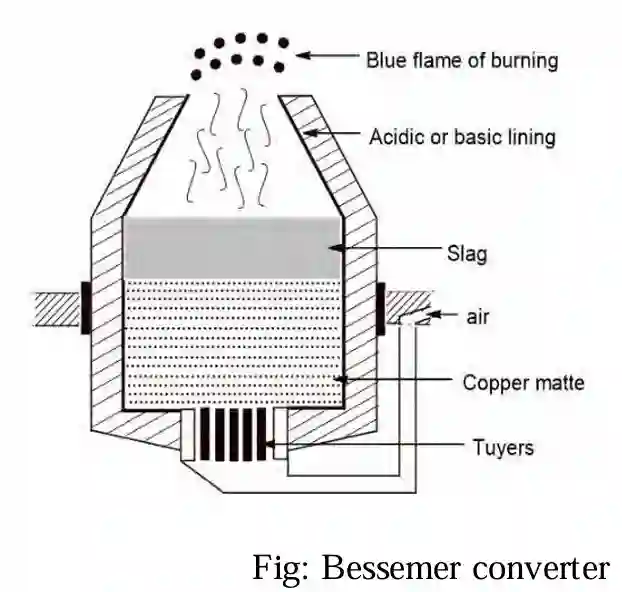
Figure: Bessemer converter. Air blown through the molten matte removes iron as slag and gives blister copper
6. Purification. Blister copper contains oxides and sulphides of copper and iron and traces of Ag, Au, Zn and Ni. It is purified by either of two methods.
(i) Poling (old method). The molten copper is stirred with a green pole of bamboo. The hydrocarbons in the pole reduce the cuprous oxide to copper, \(\mathrm{Cu_2O+C\rightarrow2Cu+CO\uparrow}\), and 99.5% pure copper is obtained.
(ii) Electrolytic refining (modern method). Impure copper is the anode and a thin sheet of pure copper is the cathode in acidified copper sulphate solution. When current passes, copper dissolves from the anode and deposits on the cathode, and a muddy mass of silver, gold and platinum falls below the anode as anode mud.
The copper obtained is 99.9% pure. An impure rod is used as the anode because it must supply the Cu²⁺ ions that deposit on the cathode. If a graphite rod were used as the anode, no copper would dissolve, the solution would lose its copper ions, and oxygen would be liberated at the anode instead.

Figure: Electrolytic refining of copper. Impure copper dissolves at the anode and pure copper deposits on the cathode; the insoluble impurities fall as anode mud
Blister copper is the impure copper (98 to 99% pure) obtained from the Bessemer converter. When the molten copper cools slowly, the dissolved sulphur dioxide gas escapes and forms blister-like bubbles on the surface, which gives it its name.
Extraction from chalcopyrite (\(\mathrm{CuFeS_2}\)):
Long Answer Questions
a. Identify the metal ‘M’.
The metal M is copper (Cu), atomic number 29, a coinage metal of Group 11.
b. Write the formula of the chief ore of ‘M’.
The chief ore is copper pyrite (chalcopyrite), \(\mathrm{CuFeS_2}\) (also written \(\mathrm{Cu_2S\cdot Fe_2S_3}\)).
c. How would you extract ‘M’ starting from its chief ore?
(The diagrams are given with Short Answer Question 9.)
d. What happens when ‘M’ is treated with dilute sulphuric acid followed by crystallization?
Copper lies below hydrogen in the electrochemical series, so it does not liberate hydrogen from dilute acid. In the presence of air (oxygen), however, it dissolves:
When the blue solution is concentrated and cooled, blue crystals of blue vitriol, \(\mathrm{CuSO_4\cdot5H_2O}\), separate.
e. What happens when ‘M’ is heated with dry air below and above \(1100^\circ\mathrm{C}\)?
Below 1100 °C copper gives black CuO, and above 1100 °C CuO loses oxygen and the red \(\mathrm{Cu_2O}\) is obtained.
f. Write any two uses of ‘M’.
a. Identify the chemical formula of ‘X’.
\(\mathrm{CuSO_4\cdot5H_2O}\), copper(II) sulphate pentahydrate.
b. Describe the preparation of ‘X’ from copper(II) oxide.
Black copper(II) oxide is dissolved in warm dilute sulphuric acid:
The blue solution is filtered to remove any unreacted CuO, concentrated by heating and cooled. Blue crystals of \(\mathrm{CuSO_4\cdot5H_2O}\) separate out.
c. Write the physical properties of ‘X’.
d. What chemical changes occur when ‘X’ is heated?
It loses its water of crystallisation step by step and turns from blue to white; the anhydrous salt decomposes at a still higher temperature:
e. What happens when excess of ammonia gas is passed through the aqueous solution of ‘X’?
A bluish-white precipitate of copper(II) hydroxide forms first. It dissolves in excess ammonia and gives a deep blue solution of tetraamminecopper(II) sulphate (Schweitzer’s reagent):
Overall: \(\mathrm{CuSO_4+4NH_3\rightarrow[Cu(NH_3)_4]SO_4}\).
f. Outline two agricultural uses of ‘X’.
4. View PDF Notes
i. Handwritten Notes
ii. Typed PDF Notes
5. Frequently Asked Questions
What is copper? What are its symbol, atomic number and atomic mass?
What topics are included in Unit 7 Study of Heavy Metals of NEB Class 12 Chemistry?
What are heavy metals? Give the heavy metals list and names.
Are there heavy metals in the body? Which are essential and which are toxic?
How do heavy metals get into water and food?
What are the ores (minerals) of copper?
How is copper extracted from copper pyrite? Write the steps.
What is blister copper and how is copper refined electrolytically?
What are the physical and chemical properties of copper?
What is blue vitriol? How is it prepared and what are its uses?
What is the copper colour? Why do copper statues turn green?
Is copper a vitamin? What does copper do in the body?
What is meant by copper hair colour?
Where can I get Class 12 Chemistry Heavy Metals notes in PDF?
Where can I get Class 12 Chemistry notes of NEB (handwritten, PDF, Nepal)?
Students also search for: