
SEE 2081 Compulsory Mathematics Lumbini Province Solution | RE-1031 ‘LP’ | अनिवार्य गणित

Welcome to the complete solution set for Compulsory Mathematics SEE 2081 Lumbini Province (RE-1031 ‘LP’). This post provides a detailed, step-by-step guide to solving the questions asked in the recent SEE examination. Both English medium and Nepali medium students can benefit from this comprehensive guide.
Practicing past papers like the SEE 2081 Compulsory Mathematics is crucial for understanding the exam pattern and marking scheme. Below, you will find the questions, their Nepali translations, and the official marking scheme. For more educational resources, you can also visit the Ministry of Education website.
Table of Contents: Compulsory Mathematics SEE 2081 Lumbini Province
Group A (समूह क) – Sets, Arithmetic & Growth
In a survey conducted on the students studying in class ten of a school to determine a suitable place for educational tours to Janakpur and Birgunj, it was found that 60 students considered Janakpur suitable, 40 students considered Birgunj suitable, and 20 students considered both places suitable, but 10 students did not consider either of the two places suitable.
एउटा विद्यालयको कक्षा दशमा अध्ययनरत विद्यार्थीहरूलाई जनकपुर र विरगञ्जमध्ये कुनै ठाउँमा शैक्षिक भ्रमणमा जान उपयुक्त हुन्छ भनी गरिएको सर्वेक्षणमा 60 जनाले जनकपुर, 40 जनाले विरगञ्ज र 20 जना विद्यार्थीहरूले दुवै ठाउँ उपयुक्त हुने बताए भने 10 जनाले यी दुईमध्ये कुनै पनि ठाउँ उपयुक्त नहुने बताए ।
-
a) If ‘J’ and ‘B’ denote the set of students who prefer Janakpur and Birgunj respectively, write the set of students who considered both places suitable in cardinality notation. [1]
$J$ र $B$ ले क्रमशः जनकपुर र विरगञ्ज उपयुक्त हुन्छ भन्ने विद्यार्थीहरूको समूहलाई जनाउँछ भने दुवै ठाउँ उपयुक्त हुन्छ भन्ने विद्यार्थीहरूको समूहलाई गणनात्मकता सङ्केतमा लेख्नुहोस् ।
-
b) Present the above information in a Venn diagram. [1]
माथिको जानकारीलाई भेनचित्रमा प्रस्तुत गर्नुहोस् ।
-
c) How many students are studying in class ten in the school? Find it. [3]
उक्त विद्यालयमा कक्षा दशमा कति जना विद्यार्थीहरू अध्ययनरत रहेछन् ? पत्ता लगाउनुहोस् ।
-
d) If the 10 students who did not consider either of the two places suitable had said Janakpur was a suitable place, what would be the ratio of students who consider only Janakpur and only Birgunj as the suitable place? Find it. [1]
यदि सर्वेक्षणमा कुनै पनि ठाउँ उपयुक्त नहुने बताएका 10 जना विद्यार्थीहरूले जनकपुर उपयुक्त स्थान हो भनेको भए जनकपुर मात्र उपयुक्त स्थान भन्ने र विरगञ्ज मात्र उपयुक्त स्थान भन्ने विद्यार्थीहरूको अनुपात कति हुने थियो ? पत्ता लगाउनुहोस् ।
Solution:
a) दुवै ठाउँ उपयुक्त हुन्छ भन्ने विद्यार्थीहरूको समूह (Set of students considering both places suitable): $$n(J \cap B)$$
b)
यहाँ (Here), $n(J) = 60$, $n(B) = 40$, $n(J \cap B) = 20$, $n(\overline{J \cup B}) = 10$
भेनचित्र (Venn Diagram):
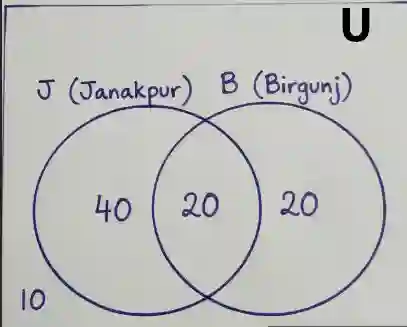
c) जम्मा विद्यार्थी संख्या $n(U)$ निकाल्न (To find total students): $$n(U) = n_o(J) + n_o(B) + n(J \cap B) + n(\overline{J \cup B})$$ $$n_o(J) = n(J) – n(J \cap B) = 60 – 20 = 40$$ $$n_o(B) = n(B) – n(J \cap B) = 40 – 20 = 20$$ $$n(U) = 40 + 20 + 20 + 10 = 90$$ अतः कक्षा दशमा 90 जना विद्यार्थीहरू अध्ययनरत रहेछन् । (Therefore, 90 students are studying in class ten.)
d)
नयाँ अवस्थामा (In the new condition):
जनकपुर रुचाउनेको संख्या (New $n(J)$) = $60 + 10 = 70$
अब, जनकपुर मात्र उपयुक्त भन्ने (New $n_o(J)$) = $70 – 20 = 50$
विरगञ्ज मात्र उपयुक्त भन्ने (Existing $n_o(B)$) = $20$
अनुपात (Ratio) = $n_o(J) : n_o(B) = 50 : 20 = 5 : 2$
Anil deposited Rs. 2,00,000 in a bank at the rate of 10% p.a. compound interest for 2 years.
अनिलले रु. 2,00,000 वार्षिक 10% चक्रीय व्याजदरले एउटा बैङ्कमा 2 वर्षको लागि जम्मा गरेछन् ।
-
a) Write the formula for finding quarterly compound interest. [1]
त्रैमासिक चक्रीय व्याज पत्ता लगाउने सुत्र लेख्नुहोस् ।
-
b) How much annual compound interest did Anil receive in 2 years? Find it. [2]
अनिलले 2 वर्षमा कति वार्षिक चक्रीय व्याज पाएछन् ? पत्ता लगाउनुहोस् ।
-
c) If the bank provides semi-annual compound interest instead of annual compound interest at the same rate of interest, how much more interest would be received by Anil? Find it. [2]
यदि बैंकले सोही व्याजदरमा वार्षिक चक्रिय व्याजको सट्टामा अर्धवार्षिक चक्रीय व्याज दिएको भए अनिलले कति बढी ब्याज पाउने थिए ? पत्ता लगाउनुहोस् ।
Solution:
a) $$C.I. (Quarterly) = P \left[ \left(1 + \frac{R}{400}\right)^{4T} – 1 \right]$$
b)
यहाँ, $P = Rs. 2,00,000$, $R = 10\%$, $T = 2$ years.
वार्षिक चक्रीय ब्याज (Annual C.I.) = $P \left[ \left(1 + \frac{R}{100}\right)^T – 1 \right]$
$= 2,00,000 \left[ \left(1 + \frac{10}{100}\right)^2 – 1 \right]$
$= 2,00,000 [ (1.1)^2 – 1 ]$
$= 2,00,000 [ 1.21 – 1 ]$
$= 2,00,000 \times 0.21$
$= Rs. 42,000$
c)
अर्धवार्षिक चक्रीय ब्याज (Semi-annual C.I.) = $P \left[ \left(1 + \frac{R}{200}\right)^{2T} – 1 \right]$
$= 2,00,000 \left[ \left(1 + \frac{10}{200}\right)^{2 \times 2} – 1 \right]$
$= 2,00,000 [ (1.05)^4 – 1 ]$
$= 2,00,000 [ 1.21550625 – 1 ]$
$= 2,00,000 \times 0.21550625$
$= Rs. 43,101.25$
बढी ब्याज (More Interest) = Semi-annual C.I. – Annual C.I.
$= 43,101.25 – 42,000$
$= Rs. 1,101.25$
The present population of a municipality is 20,000 and the annual population growth rate is 3%.
एउटा नगरपालिकाको हालको जनसङ्ख्या 20,000 छ र त्यहाँको वार्षिक जनसङ्ख्या वृद्धिदर 3% छ ।
-
a) Write the formula to find the population $P_{T}$ after $T$ years if the initial population is $P$ and the rate of annual growth is $R$. [1]
यदि सुरुको जनसङ्ख्या $P$ र वार्षिक वृद्धिदर $R$ भए $T$ वर्षपछि हुने जनसङ्ख्या $P_{T}$ पत्ता लगाउने सुत्र लेख्नुहोस् ।
-
b) What will be the population of the municipality after 2 years? Find it. [1]
2 वर्षपछि उक्त नगरपालिकाको जनसङ्ख्या कति हुन्छ ? पत्ता लगाउनुहोस् ।
-
c) Is the calculation process of population growth and compound interest the same? Give your opinion. [1]
के जनसङ्ख्या वृद्धि र चक्रीय व्याजको गणना प्रक्रिया समान हुन्छ ? आफ्नो राय दिनुहोस् ।
Solution:
a) $$P_T = P \left(1 + \frac{R}{100}\right)^T$$
b)
यहाँ, $P = 20,000$, $R = 3\%$, $T = 2$.
$P_2 = 20,000 \left(1 + \frac{3}{100}\right)^2$
$= 20,000 (1.03)^2$
$= 20,000 \times 1.0609$
$= 21,218$ जना (people).
c)
हो, जनसङ्ख्या वृद्धि र चक्रीय व्याजको गणना प्रक्रिया समान हुन्छ किनभने दुवैमा वृद्धि भएको परिणाममा थप वृद्धि जोडिदै जान्छ ।
(Yes, the calculation process is the same because in both cases, the growth is accumulated on the previously increased amount.)
Group B (समूह ख) – Currency Exchange & Geometry
According to the money exchange rate at a certain time, one American dollar ($1) was equal to NRs. 136.04.
मुद्रा विनियम दर अनुसार कुनै समयमा एक अमेरिकन डलर ($1) बराबर ने.रु. 136.04 थियो ।
-
a) How many American dollars ($) can be exchanged with NRs. 20,406? Find it. [1]
ने.रु. 20,406 सँग कति अमेरिकी डलर ($) साट्न सकिन्छ ? पत्ता लगाउनुहोस् ।
-
b) How many Nepali rupees can be exchanged with 2,500 American dollars when Nepali currency is devaluated by 2%? Find it. [2]
नेपाली मुद्रामा 2% ले अवमूल्यन हुँदा अमेरिकी डलर 2,500 सँग कति नेपाली रुपियाँ साट्न सकिन्छ ? पत्ता लगाउनुहोस् ।
-
c) If the Nepali currency was revaluated up by 2% instead of devaluation, how much less or more Nepali rupees can be obtained while exchanging 2,500 American dollars? Find it. [2]
यदि नेपाली मुद्रामा अवमूल्यनको सट्टा 2% अधिमूल्यन भएको भए अमेरिकी डलर 2500 साट्दा कति कम वा बढी नेपाली रुपियाँ प्राप्त गर्न सकिन्थ्यो ? पत्ता लगाउनुहोस् ।
Solution:
a)
$136.04 \text{ NRs} = \$1$
$20,406 \text{ NRs} = \$ \frac{20406}{136.04}$
$= \$150$
b)
नेपाली मुद्रा अवमूल्यन पछि (After devaluation):
नयाँ विनिमय दर (New Rate) = $136.04 \times (1 + \frac{2}{100})$
$= 136.04 \times 1.02 = \text{NRs. } 138.7608$
अब, $\$2,500 = 2500 \times 138.7608$
$= \text{NRs. } 3,46,902$
c)
अधिमूल्यन पछि (After revaluation):
नयाँ विनिमय दर (New Rate) = $136.04 \times (1 – \frac{2}{100})$
$= 136.04 \times 0.98 = \text{NRs. } 133.3192$
प्राप्त रकम (Amount) = $2500 \times 133.3192 = \text{NRs. } 3,33,298$
तुलना (Comparison with devaluation case in ‘b’):
फरक (Difference) = $3,46,902 – 3,33,298$
$= \text{NRs. } 13,604$
अतः, अवमूल्यनको अवस्था भन्दा अधिमूल्यन हुँदा रु. 13,604 कम प्राप्त हुन्छ ।
(Therefore, Rs. 13,604 less amount is obtained compared to the devaluation scenario.)
The vertical height of a square-based pyramid is 24 cm and the length of the base side is 14 cm.
वर्ग आधार भएको पिरामिडको ठाडो उचाइ 24 से.मि. र आधार भुजाको लम्बाइ 14 से.मि. छन् ।
-
a) Write the formula to find the area of a triangular surface of the pyramid. [1]
उक्त पिरामिडको एउटा त्रिभुजाकार सतहको क्षेत्रफल पत्ता लगाउने सुत्र लेख्नुहोस् ।
-
b) Find the volume of the pyramid. [2]
उक्त पिरामिडको आयतन पत्ता लगाउनुहोस् ।
-
c) Find the total surface area of the pyramid. [2]
उक्त पिरामिडको पूरा सतहको क्षेत्रफल पत्ता लगाउनुहोस् ।
Solution:
a)
त्रिभुजाकार सतहको क्षेत्रफल (Area of a triangular surface) = $\frac{1}{2} a l$
(जहाँ $a$ = आधार भुजा, $l$ = छड्के उचाइ)
b)
यहाँ, उचाइ $(h) = 24 \text{ cm}$, आधार $(a) = 14 \text{ cm}$.
आयतन $(V) = \frac{1}{3} a^2 h$
$= \frac{1}{3} \times (14)^2 \times 24$
$= 196 \times 8$
$= 1,568 \text{ cm}^3$
c)
छड्के उचाइ $(l) = \sqrt{h^2 + (\frac{a}{2})^2}$
$= \sqrt{24^2 + (7)^2} = \sqrt{576 + 49} = \sqrt{625} = 25 \text{ cm}$.
पूरा सतहको क्षेत्रफल (T.S.A.) = $a^2 + 2al$
$= (14)^2 + 2 \times 14 \times 25$
$= 196 + 700$
$= 896 \text{ cm}^2$
A solid object made up of a cone and a cylinder is given in the figure.
चित्रमा सोली र बेलना मिली बनेको ठोस वस्तु दिइएको छ ।
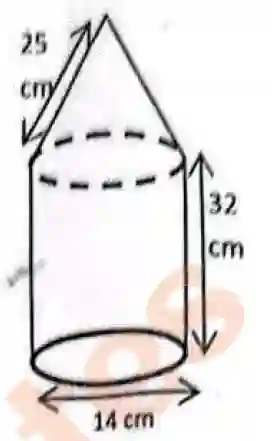
(Data: Cone slant height $l=25$ cm, Cylinder height $H=32$ cm, Diameter $d=14$ cm ⇒ Radius $r=7$ cm)
-
a) How many curved surfaces are there in the given solid object? Write it. [1]
दिइएको ठोस वस्तुमा कतिओटा बक्र सतहहरू छन् ? लेख्नुहोस् ।
-
b) Find the height of the cone. [1]
सोलीको उचाइ पत्ता लगाउनुहोस् ।
-
c) Compare the volume of the cone and the cylinder. [2]
सोली र बेलनाको आयतन तुलना गर्नुहोस् ।
Solution:
a)
2 ओटा (Two curved surfaces).
(One from cylinder, one from cone).
b)
सोलीको छड्के उचाइ $(l) = 25 \text{ cm}$, अर्धव्यास $(r) = 7 \text{ cm}$.
सोलीको उचाइ $(h) = \sqrt{l^2 – r^2}$
$= \sqrt{25^2 – 7^2} = \sqrt{625 – 49} = \sqrt{576} = 24 \text{ cm}$.
c)
बेलनाको आयतन $(V_1) = \pi r^2 H = \pi (7)^2 (32) = 1568 \pi \approx 4,928 \text{ cm}^3$
सोलीको आयतन $(V_2) = \frac{1}{3} \pi r^2 h = \frac{1}{3} \pi (7)^2 (24) = 392 \pi \approx 1,232 \text{ cm}^3$
तुलना (Comparison): $\frac{V_1}{V_2} = \frac{4928}{1232} = 4$
अतः बेलनाको आयतन सोलीको आयतनभन्दा ४ गुणा बढी छ ।
(Therefore, Volume of Cylinder = 4 $\times$ Volume of Cone).
The length, breadth, and height of a rectangular classroom are 18 ft, 14 ft, and 10 ft respectively. In the classroom, there are two windows with size 6 ft $\times$ 4 ft and two doors with size 6 ft $\times$ 3 ft.
एउटा आयताकार कक्षाकोठाको लम्बाइ, चौडाइ र उचाइ क्रमशः 18 फिट, 14 फिट र 10 फिट छन् । उक्त कक्षाकोठामा 6 फिट $\times$ 4 फिट नाप भएका दुईओटा झ्यालहरू र 6 फिट $\times$ 3 फिट का दुईओटा ढोकाहरू छन् ।
-
a) How much does it cost to paint the four walls and ceiling of the classroom excluding doors and windows at the rate of Rs. 40 per square foot? Find it. [3]
ढोका र झ्याल बाहेक उक्त कक्षाकोठाको चार भित्ता र सिलिङ्गमा प्रति वर्गफिट रु. 40 का दरले रङ लगाउन कति खर्च लाग्छ ? पत्ता लगाउनुहोस् ।
-
b) If a painter paints 202 square feet in a day, how many days will two painters take to paint the classroom? Find it. [1]
यदि एक जना पेन्टरले एक दिनमा जम्मा 202 वर्गफिटमा रङ लगाउँछ भने उक्त कक्षाकोठामा दुई जना पेन्टरलाई रङ लगाउन जम्मा कति दिन लाग्छ ? पत्ता लगाउनुहोस् ।
Solution:
a)
कोठाको जम्मा क्षेत्रफल (भित्ता + सिलिङ्ग) = $2h(l+b) + l \times b$
$= 2 \times 10 (18 + 14) + 18 \times 14$
$= 20(32) + 252 = 640 + 252 = 892 \text{ sq. ft.}$
झ्याल र ढोकाको क्षेत्रफल (Area of openings) = $2(6 \times 4) + 2(6 \times 3)$
$= 48 + 36 = 84 \text{ sq. ft.}$
रङ लगाउने भागको क्षेत्रफल (Area to be painted) = $892 – 84 = 808 \text{ sq. ft.}$
जम्मा खर्च (Total Cost) = Area $\times$ Rate $= 808 \times 40$
$= Rs. 32,320$
b)
आवश्यक दिन (Days required) = $\frac{\text{Total Area}}{\text{Painters} \times \text{Rate per painter}}$
$= \frac{808}{2 \times 202}$
$= \frac{808}{404}$
$= 2 \text{ days.}$
Group C (समूह ग) – Algebra & Series
The first and last terms of an arithmetic series are 5 and 329 respectively. The sum of all terms is 4676.
एउटा समानान्तरीय श्रेणीको पहिलो पद र अन्तिम पद क्रमशः 5 र 329 छन् । सबै पदहरूको योगफल 4676 छ ।
-
a) What is called the mean in an arithmetic series? Write it. [1]
समानान्तरीय श्रेणीमा मध्यमा भनेको के हो ? लेख्नुहोस् ।
-
b) Find the common difference of the series. [2]
उक्त श्रेणीको समान अन्तर पत्ता लगाउनुहोस् ।
-
c) How many terms should be removed from the last in the series to make the sum 51? Find it by calculation. [2]
उक्त श्रेणीको योगफल 51 बनाउनु पर्यो भने पछाडिका कतिओटा पदहरू हटाउनु पर्छ ? हिसाब गरी पत्ता लगाउनुहोस् ।
Solution:
a)
समानान्तरीय श्रेणीमा पहिलो र अन्तिम पदको बिचमा पर्ने पद वा पदहरूलाई समानान्तरीय मध्यमा भनिन्छ ।
(The terms between the first and last terms of an arithmetic series are called arithmetic means.)
b)
यहाँ, $a=5, l=329, S_n=4676$.
सुत्र अनुसार (By formula), $S_n = \frac{n}{2}(a + l)$
$4676 = \frac{n}{2}(5 + 329)$
$4676 = \frac{n}{2}(334)$
$n = \frac{4676}{167} = 28$
फेरि, $l = a + (n-1)d$
$329 = 5 + (28-1)d$
$324 = 27d$
$d = \frac{324}{27} = 12$
समान अन्तर $(d) = 12$.
c)
नयाँ योगफल $S_n = 51$
$\frac{n}{2}[2a + (n-1)d] = 51$
$\frac{n}{2}[2 \times 5 + (n-1)12] = 51$
$n[10 + 12n – 12] = 102$
$n[12n – 2] = 102$
$12n^2 – 2n – 102 = 0$
$6n^2 – n – 51 = 0$
$(n-3)(6n+17) = 0$
$\therefore n = 3$ (n cannot be negative fraction)
सुरुका 3 पद राख्दा योगफल 51 हुन्छ ।
हटाउनु पर्ने पद संख्या (Terms to be removed) = Total terms – 3
$= 28 – 3 = 25$.
In a positive number of two digits, the product of two digits is 27. When 54 is subtracted from the number, the places of the digits are interchanged.
दुई अङ्कले बनेको एउटा धनात्मक सङ्ख्यामा अङ्कहरूको गुणनफल 27 छ । उक्त सङ्ख्याबाट 54 घटाउँदा सो सङ्ख्याका अङ्कहरूको स्थान बदलिन्छन् ।
-
a) If the two-digit number be $10x + y$, then write the number obtained by interchanging its digits. [1]
यदि दुई अङ्कले बनेको सङ्ख्या $10x + y$ भए अङ्कहरूको स्थान परिवर्तन गर्दा बन्ने सङ्ख्या लेख्नुहोस् ।
-
b) Make a quadratic equation from the given verbal problem. [2]
दिइएको शाब्दिक समस्याबाट एउटा वर्ग समीकरण बनाउनुहोस् ।
-
c) Find the number. [2]
उक्त सङ्ख्या पत्ता लगाउनुहोस् ।
Solution:
a) स्थान परिवर्तन गर्दा बन्ने सङ्ख्या (Number after interchanging digits) = $10y + x$
b)
पहिलो शर्त (First condition): $xy = 27 \implies y = \frac{27}{x} … (i)$
दोस्रो शर्त (Second condition): $(10x + y) – 54 = 10y + x$
$9x – 9y = 54$
$x – y = 6 … (ii)$
समीकरण (i) बाट y को मान (ii) मा राख्दा:
$x – \frac{27}{x} = 6$
$x^2 – 27 = 6x$
$x^2 – 6x – 27 = 0$ (आवश्यक वर्ग समीकरण)
c)
$x^2 – 9x + 3x – 27 = 0$
$x(x-9) + 3(x-9) = 0$
$(x-9)(x+3) = 0$
$x = 9$ (since number is positive, ignore negative digit).
$y = \frac{27}{9} = 3$
आवश्यक सङ्ख्या (Required Number) = $10x + y = 10(9) + 3 = 93$.
(a) Simplify:
(a) सरल गर्नुहोस्:
(b) Solve:
(b) हल गर्नुहोस्:
Solution:
(a) Simplify:
$= \frac{(a+1)(a^2-a+1)}{a^2-a+1} + \frac{(a-1)(a^2+a+1)}{a^2+a+1}$
$= (a+1) + (a-1)$
$= 2a$
(b) Solve:
मानौँ (Let) $5^x = a$.
$a + \frac{1}{a} = \frac{26}{5}$
$\frac{a^2+1}{a} = \frac{26}{5}$
$5a^2 + 5 = 26a$
$5a^2 – 26a + 5 = 0$
$5a^2 – 25a – a + 5 = 0$
$5a(a-5) – 1(a-5) = 0$
$(a-5)(5a-1) = 0$
Either $a = 5 \implies 5^x = 5^1 \implies x = 1$
Or $a = \frac{1}{5} \implies 5^x = 5^{-1} \implies x = -1$
$\therefore x = \pm 1$
Group D (समूह घ) – Geometry, Trigonometry & Statistics
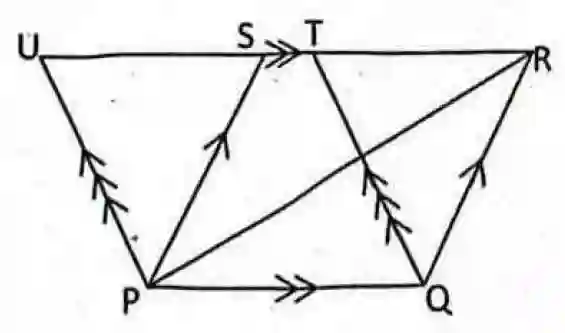
In the adjoining figure, $\triangle PQR$, parallelograms $PQRS$ and $PQTU$ are standing on the same base $PQ$ and between the same parallel lines $PQ$ and $UR$.
सँगैको चित्रमा $\triangle PQR$, समानान्तर चतुर्भुजहरू $PQRS$ र $PQTU$ एउटै आधार $PQ$ र उही समानान्तर रेखाहरू $PQ$ र $UR$ का बिचमा रहेका छन् ।
-
a) Write the relation between the area of parallelograms $PQRS$ and $PQTU$. [1]
समानान्तर चतुर्भुजहरू $PQRS$ र $PQTU$ को क्षेत्रफल बिचको सम्बन्ध लेख्नुहोस् ।
-
b) Prove that the area of $\triangle PQR$ is half of the area of parallelogram $PQTU$. [2]
त्रिभुज $PQR$ को क्षेत्रफल समानान्तर चतुर्भुज $PQTU$ को क्षेत्रफलको आधा हुन्छ भनी प्रमाणित गर्नुहोस् ।
Solution:
a)
समानान्तर चतुर्भुज $PQRS$ को क्षेत्रफल = समानान्तर चतुर्भुज $PQTU$ को क्षेत्रफल
(Area of parallelogram $PQRS$ = Area of parallelogram $PQTU$)
b)
प्रमाण (Proof):
1. $\triangle PQR$ को क्षेत्रफल = $\frac{1}{2} \times$ समानान्तर चतुर्भुज $PQRS$ को क्षेत्रफल
(एउटै आधार र उही समानान्तर रेखाहरू बिच रहेकाले / Standing on same base and between same parallels).
2. समानान्तर चतुर्भुज $PQRS$ को क्षेत्रफल = समानान्तर चतुर्भुज $PQTU$ को क्षेत्रफल
(एउटै आधार र उही समानान्तर रेखाहरू बिच रहेकाले).
3. तथ्य (1) र (2) बाट: $\triangle PQR$ को क्षेत्रफल = $\frac{1}{2} \times$ समानान्तर चतुर्भुज $PQTU$ को क्षेत्रफल ।
(प्रमाणित भयो / Proved).
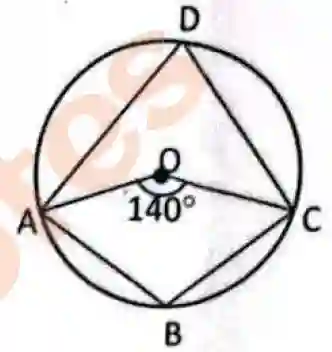
In the given figure, $O$ is the centre of the circle. Where, central angle $AOC$ is equal to $140^{\circ}$.
दिइएको चित्रमा, $O$ वृत्तको केन्द्रविन्दु हो । जहाँ, केन्द्रिय कोण $AOC$ बराबर $140^{\circ}$ छ ।
-
a) Write the relation between the inscribed angle $ADC$ and the arc $ABC$. [1]
परिधिकोण $ADC$ र चाप $ABC$ बिचको सम्बन्ध लेख्नुहोस् ।
-
b) Find the value of $\angle ADC$ from the given figure. [1]
दिइएको चित्रबाट $\angle ADC$ को मान पत्ता लगाउनुहोस् ।
-
c) Experimentally verify that the opposite angles $ABC$ and $ADC$ of cyclic quadrilateral $ABCD$ are supplementary. (Two circles with at least 3 cm radii are necessary.) [2]
चक्रिय चतुर्भुज $ABCD$ का सम्मुख कोणहरू $ABC$ र $ADC$ परिपूरक हुन्छन् भनी प्रयोगात्मक विधिबाट प्रमाणित गर्नुहोस् । (कम्तीमा 3 से.मि. अर्धव्यास भएका दुईओटा वृत्तहरू आवश्यक छन् ।)
Solution:
a)
परिधिकोण $\angle ADC$, यसको विपरित चाप $ABC$ को डिग्री नापको आधा हुन्छ ।
($\angle ADC = \frac{1}{2} \text{ degree measure of arc } ABC$)
b)
$\angle ADC = \frac{1}{2} \times \text{Reflex } \angle AOC$
Reflex $\angle AOC = 360^{\circ} – 140^{\circ} = 220^{\circ}$
$\therefore \angle ADC = \frac{1}{2} \times 220^{\circ} = 110^{\circ}$
(Alternatively, if using alternate segment: $\angle ADC = \frac{1}{2} \times \text{major arc AC}$)
c)
(विद्यार्थीले कम्पास प्रयोग गरी दुईवटा वृत्त बनाउने, चक्रीय चतुर्भुज खिच्ने, र प्रोटेक्टरले कोण नापेर $\angle ABC + \angle ADC = 180^{\circ}$ देखाउने ।)
(Student should draw two circles, draw cyclic quad, measure opposite angles and show sum is 180°).
(a) Construct a triangle $CAT$ having sides $AT = 4.4$ cm, $AC = 5.5$ cm and $\angle CAT = 60^{\circ}$. Construct another triangle $BAT$ whose area is equal to the area of the given triangle, where $AB = 6.2$ cm.
(a) भुजा $AT = 4.4$ से.मि., $AC = 5.5$ से.मि. र $\angle CAT = 60^{\circ}$ हुने त्रिभुज $CAT$ को रचना गरी उक्त त्रिभुजसँग बराबर क्षेत्रफल हुने अर्को त्रिभुज $BAT$ को रचना गर्नुहोस् । जहाँ, $AB = 6.2$ से.मि. छ ।
(b) Why are the areas of $\triangle CAT$ and $\triangle BAT$ equal? Give a reason.
(b) $\triangle CAT$ र $\triangle BAT$ को क्षेत्रफल किन बराबर भए ? कारण दिनुहोस् ।
(c) In the parallelogram $ROSE$, if $P$ and $Q$ are any points of sides $ES$ and $ER$ respectively, prove that: $\triangle ROP = \triangle SOQ$.
(c) यदि समानान्तर चतुर्भुज $ROSE$ मा भुजाहरू $ES$ र $ER$ का कुनै बिन्दुहरू क्रमशः $P$ र $Q$ छन् भने प्रमाणित गर्नुहोस्: $\triangle ROP = \triangle SOQ$।
Solution:
(a) Construction:
रचनाका चरणहरू (Construction Steps):
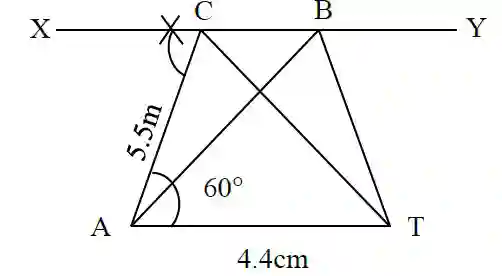
2. $A$ मा $60^{\circ}$ को कोण बनाई $5.5$ cm को चापले काटी $C$ बिन्दु पत्ता लगाउने । $\triangle CAT$ तयार भयो ।
3. $C$ बाट $AT$ सँग समानान्तर हुने रेखा $XY$ तान्ने ($XY \parallel AT$) ।
4. $A$ वा $T$ बाट $6.2$ cm को चापले समानान्तर रेखा $XY$ मा काट्ने । त्यो बिन्दु $B$ हुनेछ ।
5. $B$ र $T$ (तथा $B$ र $A$) जोड्ने । $\triangle BAT$ तयार भयो ।
(b) Reason:
किनभने दुवै त्रिभुजहरू एउटै आधार $AT$ र उही समानान्तर रेखाहरू $AT$ र $XY$ (जहाँ $B$ र $C$ पर्दछन्) को बिचमा बनेका छन् ।
(Because both triangles stand on the same base AT and lie between the same parallel lines.)
(c) Proof:
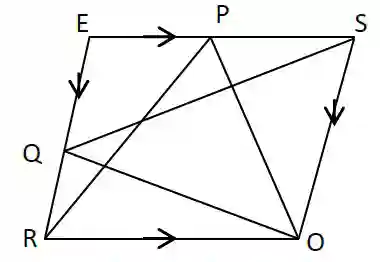
त्यस्तै, $\triangle SOQ = \frac{1}{2} \text{Area of } \square ROSE$ (एउटै आधार $SO$ मान्दा… $Q$ is on $ER$. Base $OS$ is parallel to $ER$).
दुवैको क्षेत्रफल समानान्तर चतुर्भुजको आधा भएकाले, $\triangle ROP = \triangle SOQ$ प्रमाणित भयो ।
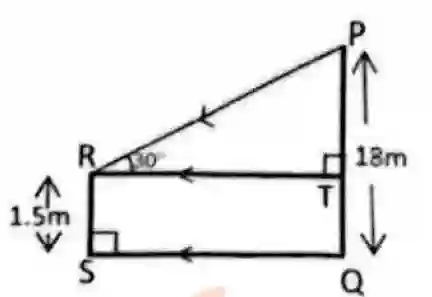
In the given figure, height of the electric pole ($PQ$) is 18 meters and height of a man ($RS$) is 1.5 meters. $SQ$ represents the distance between the electric pole and man, where $\angle PRT = 30^{\circ}$.
दिइएको चित्रमा बिजुलीको खम्बा ($PQ$) को उचाइ 18 मिटर र एउटा मानिस ($RS$) को उचाइ 1.5 मिटर छ । $SQ$ ले मानिस र बिजुलीको खम्बा बिचको दुरीलाई जनाउँछ । जहाँ, $\angle PRT = 30^{\circ}$ छ ।
-
a) Define the angle of elevation. [1]
उन्नतांश कोणलाई परिभाषित गर्नुहोस् ।
-
b) Find the value of $PT$. [1]
$PT$ को मान पत्ता लगाउनुहोस् ।
-
c) Find the distance between the electric pole and the man. [1]
बिजुलीको खम्बा र मानिस बिचको दुरी पत्ता लगाउनुहोस् ।
-
d) By how many degrees will the angle of elevation be less or more when $PT$ and $TR$ are equal? Find it. [1]
$PT$ र $TR$ बराबर भए उन्नतांश कोण कति डिग्रीले कम वा बढी हुन्छ ? पत्ता लगाउनुहोस् ।
Solution:
a)
दर्शकले आफूभन्दा माथिको वस्तुलाई हेर्दा दृष्टि रेखाले क्षितिज रेखासँग बनाएको कोणलाई उन्नतांश कोण भनिन्छ ।
(The angle made by the line of sight with the horizontal line when an observer looks at an object above them is called the angle of elevation.)
b)
यहाँ $PQ = 18$ m, $TQ = RS = 1.5$ m.
$PT = PQ – TQ = 18 – 1.5 = 16.5$ m.
c)
$\triangle PRT$ मा, $\tan 30^{\circ} = \frac{PT}{RT}$
$\frac{1}{\sqrt{3}} = \frac{16.5}{RT}$
$RT = 16.5 \times 1.732 = 28.58$ m.
खम्बा र मानिस बिचको दुरी ($SQ = RT$) = $28.58$ m.
d)
यदि $PT = TR$ भए, $\tan \theta = \frac{PT}{TR} = 1 \implies \theta = 45^{\circ}$.
पहिलेको कोण $30^{\circ}$ थियो ।
अन्तर (Difference) = $45^{\circ} – 30^{\circ} = 15^{\circ}$.
अतः उन्नतांश कोण $15^{\circ}$ ले बढी हुन्छ ।
(Increases by $15^{\circ}$).
The marks obtained by 20 students in an examination with full marks 50 are given in the following table.
50 पूर्णाङ्कको एउटा परीक्षामा 20 जना विद्यार्थीहरूले प्राप्त गरेको प्राप्ताङ्क निम्न तालिकामा दिइएको छ ।
| प्राप्ताङ्क (Marks obtained) | 0-10 | 10-20 | 20-30 | 30-40 | 40-50 |
|---|---|---|---|---|---|
| विद्यार्थी सङ्ख्या (No. of students) | 2 | 3 | 4 | 7 | 4 |
-
a) Write the modal class of the given data. [1]
दिइएको तथ्याङ्कको रीत पर्ने श्रेणी लेख्नुहोस् ।
-
b) Find the median from the given data. [2]
दिइएको तथ्याङ्कबाट मध्यिका पत्ता लगाउनुहोस् ।
-
c) Calculate the average mark from the given data. [2]
दिइएको तथ्याङ्कबाट औसत प्राप्ताङ्क गणना गर्नुहोस् ।
-
d) How many maximum number of students could be there who obtained marks less than the average mark? Find it. [1]
औसत प्राप्ताङ्कभन्दा कम अंक ल्याउने अधिकतम विद्यार्थी संख्या कति जना हुन सक्छन् । पत्ता लगाउनुहोस् ।
Solution:
a) सबैभन्दा बढी बारम्बारता (7) भएको श्रेणी: 30-40.
b)
सञ्चित बारम्बारता (cf):
0-10: 2
10-20: 5
20-30: 9
30-40: 16
40-50: 20
$N=20$.
Median position = $(N/2)^{th} = 10^{th}$ item.
cf 9 भन्दा ठुलो 16 हो, त्यसैले Median Class = 30-40.
$L=30, cf=9, f=7, i=10$.
Median = $L + \frac{N/2 – cf}{f} \times i$
$= 30 + \frac{10 – 9}{7} \times 10$
$= 30 + 1.43 = 31.43$.
c)
| Marks | f | Mid-value (m) | f×m |
|---|---|---|---|
| 0-10 | 2 | 5 | 10 |
| 10-20 | 3 | 15 | 45 |
| 20-30 | 4 | 25 | 100 |
| 30-40 | 7 | 35 | 245 |
| 40-50 | 4 | 45 | 180 |
| Total | 580 | ||
Mean $(\overline{X}) = \frac{\Sigma fm}{N} = \frac{580}{20} = 29$.
d)
औसत (Mean) = 29.
Marks less than 29:
0-10 (2 students) – All less than 29.
10-20 (3 students) – All less than 29.
20-30 (4 students) – Since the range goes up to 30, it is possible that all 4 students scored between 20 and 29.
So, Maximum students = $2 + 3 + 4 = 9$.
Two cards are drawn randomly one after another without replacement from a well-shuffled deck of 52 cards.
राम्ररी फिटिएको 52 पत्ति तासको गड्डीबाट नहेरी कुनै दुई ओटा तासहरू एक पछि अर्को गरी पुनः नराखिकन झिकिएका छन् ।
-
a) If $P(A \cap B) = P(A) \cdot P(B)$, what type of events are $A$ and $B$? Write it. [1]
यदि $P(A \cap B) = P(A) \cdot P(B)$ हुँदा $A$ र $B$ कस्ता घट्नाहरू हुन्छन्? लेख्नुहोस् ।
-
b) Show the probability of all possible outcomes of getting and not getting king cards in a tree diagram. [2]
बादशाह पर्ने र नपर्ने सबै परिणामहरूको सम्भाव्यतालाई वृक्षचित्रमा देखाउनुहोस् ।
-
c) Find the probability of getting both king cards. [1]
दुवै तासहरू बादशाह पर्ने सम्भाव्यता पत्ता लगाउनुहोस् ।
-
d) Is the probability of getting both ace of diamond possible? Give reason. [1]
के दुबै तास इटाको एक्का पर्ने सम्भाव्यता सम्भव हुन्छ ? कारण दिनुहोस् ।
Solution:
a) स्वतन्त्र घटनाहरू (Independent Events).
b)
(वृक्षचित्र बनाउने / Draw Tree Diagram):
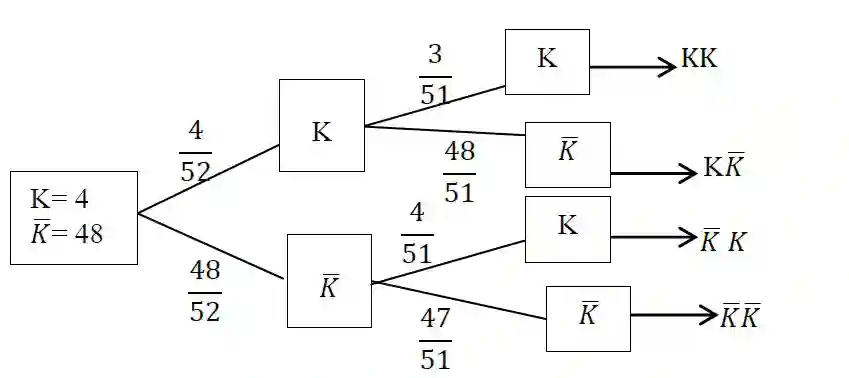
• King (K): 4/52
• Not King ($\overline{K}$): 48/52
Second Draw (Without replacement):
• From K: K: 3/51, $\overline{K}$: 48/51
• From $\overline{K}$: K: 4/51, $\overline{K}$: 47/51
c) $P(K \cap K) = \frac{4}{52} \times \frac{3}{51} = \frac{1}{13} \times \frac{1}{17} = \frac{1}{221}$.
d)
सम्भव हुँदैन (Not possible).
कारण: तासको गड्डीमा इटाको एक्का एउटा मात्र हुन्छ । पुनः नराखिकन झिक्दा दोस्रो पटक इटाको एक्का पर्ने सम्भावना हुँदैन ।
(Reason: There is only one Ace of Diamond in a deck. Without replacement, it is impossible to draw it twice.)