
Quantization of Energy
Class 12 Physics Notes • NEB Syllabus 2083
Bohr model, hydrogen spectrum, de Broglie waves, uncertainty principle, X-rays and Bragg’s law, 17 solved multiple choice questions, step-by-step numericals, handwritten and typed PDF notes and frequently asked questions.
1. Syllabus
Unit: Modern Physics
Chapter 23: Quantization of Energy (6 hours)
23.1 Bohr’s theory of hydrogen atom
23.2 Spectral series; excitation and ionization potentials
23.3 Energy level; emission and absorption spectra
23.4 De Broglie theory; duality
23.5 Uncertainty principle
23.6 X-rays: nature and production; uses
23.7 X-ray diffraction, Bragg’s law
These notes follow the NEB Class 12 Physics syllabus (+2 Physics, Nepal). Read the quick overview first, practise the multiple choice questions, then work through the numericals, and finish with the PDF notes for quick revision.
2. Quantization of Energy at a Glance
Quantization of energy means that the energy of a bound system, such as the electron in an atom, can take only certain discrete values, like the steps of a staircase, and not any value in between. The electron gains or loses energy only by jumping between these levels, absorbing or emitting a photon of energy \(hf\).
Bohr’s theory of the hydrogen atom
Postulates: (1) the electron moves only in certain stable circular stationary orbits without radiating; (2) the allowed orbits have angular momentum \(mvr=\dfrac{nh}{2\pi}\); (3) radiation is emitted or absorbed only when the electron jumps between orbits, with \(hf=E_i-E_f\).
| Quantity | Formula (hydrogen-like atom, charge \(Ze\)) |
|---|---|
| Radius of the \(n\)th orbit | \(r_n=\dfrac{\varepsilon_0n^2h^2}{\pi mZe^2}=0.529\dfrac{n^2}{Z}\ \text{\AA}\) |
| Speed in the \(n\)th orbit | \(v_n=\dfrac{Ze^2}{2\varepsilon_0nh}=2.19\times10^{6}\dfrac Zn\ \mathrm{m\,s^{-1}}\) |
| Energy of the \(n\)th level | \(E_n=-\dfrac{mZ^2e^4}{8\varepsilon_0^2h^2n^2}=-13.6\dfrac{Z^2}{n^2}\ \mathrm{eV}\) |
| Photon emitted in a jump | \(\dfrac1\lambda=R\left(\dfrac1{n_1^2}-\dfrac1{n_2^2}\right),\ R=1.097\times10^7\ \mathrm{m^{-1}}\) |
| Wave number | \(\bar\nu=\dfrac1\lambda\) |
| Photon energy and wavelength | \(E(\mathrm{eV})=\dfrac{1240}{\lambda(\mathrm{nm})}\) |
Energy levels and spectral series of hydrogen
Figure: Energy levels of hydrogen. Jumps to \(n=1\) form the Lyman series and jumps to \(n=2\) form the Balmer series.
| Series | Lower level \(n_1\) | Upper level \(n_2\) | Region |
|---|---|---|---|
| Lyman | 1 | 2, 3, 4, … | Ultraviolet |
| Balmer | 2 | 3, 4, 5, … | Visible |
| Paschen | 3 | 4, 5, 6, … | Infrared |
| Brackett | 4 | 5, 6, 7, … | Infrared |
| Pfund | 5 | 6, 7, 8, … | Far infrared |
Excitation potential is the accelerating potential that raises an atom from the ground state to an excited state (10.2 V for hydrogen, \(n=1\to2\)). Ionization potential removes the electron completely from the ground state (13.6 V for hydrogen). An emission spectrum shows bright lines on a dark background; an absorption spectrum shows dark lines on a continuous background.
De Broglie theory, duality and the uncertainty principle
| Topic | Statement or formula |
|---|---|
| De Broglie wavelength | \(\lambda=\dfrac hp=\dfrac h{mv}=\dfrac{h}{\sqrt{2mK}}\) |
| Electron accelerated through \(V\) volts | \(\lambda=\dfrac{12.27}{\sqrt V}\ \text{\AA}\) |
| Wave-particle duality | Radiation shows particle nature (photoelectric effect) and matter shows wave nature (electron diffraction) |
| Heisenberg’s uncertainty principle | \(\Delta x\,\Delta p\ge\dfrac h{4\pi}\), and \(\Delta E\,\Delta t\ge\dfrac h{4\pi}\) |
X-rays and Bragg’s law
X-rays are electromagnetic waves of wavelength about 0.01 nm to 10 nm. They are produced in a Coolidge tube when electrons from a heated filament are accelerated through a high voltage and hit a heavy metal target (tungsten) in a vacuum. The accelerating voltage controls the penetrating power and the filament current controls the intensity. The shortest wavelength is \(\lambda_{\min}=\dfrac{hc}{eV}=\dfrac{12400}{V}\ \text{\AA}\). Uses: detecting bone fractures, radiotherapy for cancer, finding flaws in metals, baggage scanning and the study of crystal structure.
3. Multiple Choice Questions
Question 1. The reciprocal of wavelength is:
- a) Frequency
- b) Wave number
- c) Amplitude
- d) Wave velocity
Correct Answer: b) Wave number
Reason: The wave number is the number of waves per unit distance, \(\bar\nu=\dfrac1\lambda\).
Question 2. The angular momentum of the electron in the second orbit of the H atom is:
- a) \(\dfrac{h}{2\pi m}\)
- b) \(\dfrac{h}{2\pi}\)
- c) \(\dfrac{2h}{\pi}\)
- d) \(\dfrac h\pi\)
Correct Answer: d) \(\dfrac h\pi\)
Reason: By Bohr’s quantization condition \(L=\dfrac{nh}{2\pi}\); for \(n=2\):
Question 3. How many fast-moving electrons strike the target per second to produce a total anode current of 0.02 A?
- a) \(1.25\times10^{17}\)
- b) \(1.25\times10^{18}\)
- c) \(1.25\times10^{19}\)
- d) \(1.25\times10^{20}\)
Correct Answer: a) \(1.25\times10^{17}\)
Question 4. The ionization energy of an atom compared to the binding energy of a nucleus is:
- a) More
- b) Less
- c) Equal
- d) Sometimes more and sometimes less
Correct Answer: b) Less
Reason: Atomic ionization energies come from electrostatic forces and are of the order of eV. Nuclear binding energies come from the strong nuclear force and are of the order of MeV, so the ionization energy is much less.
Question 5. The ionization energy of a hydrogen atom is 13.6 eV. The ionization energy of a singly ionized helium atom (He\(^+\)) would be:
- a) 13.6 eV
- b) 27.2 eV
- c) 6.8 eV
- d) 54.4 eV
Correct Answer: d) 54.4 eV
Reason: For a hydrogen-like atom \(E_1=-13.6Z^2\ \mathrm{eV}\). For He\(^+\), \(Z=2\):
Question 6. The energy of a hydrogen atom in its ground state is \(-13.6\ \mathrm{eV}\). The energy of the level corresponding to \(n=5\) is:
- a) \(-0.54\ \mathrm{eV}\)
- b) \(-5.40\ \mathrm{eV}\)
- c) \(-0.85\ \mathrm{eV}\)
- d) \(-2.72\ \mathrm{eV}\)
Correct Answer: a) \(-0.54\ \mathrm{eV}\)
Question 7. The ionization energy of hydrogen is 13.6 eV. The energy required to excite the electron in a singly ionized helium atom (He\(^+\)) from the first to the second orbit is:
- a) 13.6 eV
- b) \(2\times13.6\) eV
- c) \(3\times13.6\) eV
- d) \(4\times13.6\) eV
Correct Answer: c) \(3\times13.6\) eV
Reason: For He\(^+\), \(E_n=-\dfrac{13.6\times4}{n^2}\ \mathrm{eV}\), so \(E_1=-54.4\ \mathrm{eV}\) and \(E_2=-13.6\ \mathrm{eV}\):
Question 8. An electron in the \(n=1\) orbit of a hydrogen atom is bound by 13.6 eV. If a hydrogen atom is in the \(n=3\) state, how much energy is required to ionize it?
- a) 13.6 eV
- b) 4.53 eV
- c) 3.4 eV
- d) 1.51 eV
Correct Answer: d) 1.51 eV
Question 9. Which of the following spectral series in a hydrogen atom gives the spectral line 4860 \(\mathrm{\AA}\)?
- a) Lyman
- b) Balmer
- c) Paschen
- d) Brackett
Correct Answer: b) Balmer
Reason: 4860 \(\mathrm{\AA}\) = 486 nm lies in the visible region, and the Balmer series is the hydrogen series that lies in the visible region. The 486.1 nm line is the \(H_\beta\) line (\(n=4\to2\)).
Question 10. The velocity of an electron in the second orbit of a sodium atom (\(Z=11\)) is \(v\). The velocity of an electron in its fifth orbit will be:
- a) \(\tfrac25v\)
- b) \(\tfrac52v\)
- c) \(\tfrac4{25}v\)
- d) \(\tfrac{25}4v\)
Correct Answer: a) \(\tfrac25v\)
Reason: In Bohr’s model \(v_n\propto\dfrac Zn\), so for a given atom \(v_n\propto\dfrac1n\):
Question 11. Let the potential energy of a hydrogen atom in the ground state be regarded as zero. Then its potential energy in the first excited state will be:
- a) 3.4 eV
- b) 6.8 eV
- c) 10.2 eV
- d) 20.4 eV
Correct Answer: d) 20.4 eV
Reason: The potential energy is \(U_n=-\dfrac{27.2}{n^2}\ \mathrm{eV}\), so \(U_1=-27.2\ \mathrm{eV}\) and \(U_2=-6.8\ \mathrm{eV}\). Taking \(U_1\) as zero adds \(27.2\ \mathrm{eV}\) to every value:
Question 12. The internal structure of a crystal can be studied by:
- a) X-rays
- b) \(\gamma\)-rays
- c) IR rays
- d) UV rays
Correct Answer: a) X-rays
Reason: The wavelength of X-rays (about 0.1 nm, or 1 \(\mathrm{\AA}\)) is of the same order as the spacing between atoms in a crystal, so X-rays are diffracted by the crystal planes (Bragg’s law).
Question 13. The voltage applied to an X-ray tube is 20 kV. The corresponding minimum wavelength of the X-ray photon is:
- a) 6.2 \(\mathrm{\AA}\)
- b) 0.62 \(\mathrm{\AA}\)
- c) 0.062 \(\mathrm{\AA}\)
- d) 1 \(\mathrm{\AA}\)
Correct Answer: b) 0.62 \(\mathrm{\AA}\)
Question 14. A potential difference of 42000 V is used in an X-ray tube to accelerate electrons. The maximum frequency of X-rays produced is:
- a) \(10^{19}\ \mathrm{Hz}\)
- b) \(10^{18}\ \mathrm{Hz}\)
- c) \(10^{16}\ \mathrm{Hz}\)
- d) \(10^{29}\ \mathrm{Hz}\)
Correct Answer: a) \(10^{19}\ \mathrm{Hz}\)
Reason: The maximum frequency occurs when the whole kinetic energy of an electron goes into one photon, \(hf_{\max}=eV\):
Question 15. In radiotherapy, X-rays are used to:
- a) Detect bone fractures
- b) Treat cancer
- c) Detect skin diseases
- d) Detect faults in radio receiving circuits
Correct Answer: b) Treat cancer
Reason: Radiotherapy uses a beam of high-energy (hard) X-rays to destroy cancer cells and control the growth of tumours.
Question 16. A 10 keV electron strikes a tungsten target in a vacuum. The radiation emitted by the target is:
- a) Visible light
- b) X-rays
- c) Infrared radiation
- d) Radio waves
Correct Answer: b) X-rays
Reason: A 10 keV electron is rapidly decelerated by a high-\(Z\) target such as tungsten and emits high-energy photons in the X-ray region (bremsstrahlung).
Question 17. X-rays of wavelength 1 \(\mathrm{\AA}\) are incident on crystal planes of NaCl at a glancing angle of \(10^\circ\). The spacing between the principal planes of NaCl is:
- a) 2.8 \(\mathrm{\AA}\)
- b) 1.8 \(\mathrm{\AA}\)
- c) 0.8 \(\mathrm{\AA}\)
- d) 1.2 \(\mathrm{\AA}\)
Correct Answer: a) 2.8 \(\mathrm{\AA}\)
Reason: By Bragg’s law \(2d\sin\theta=n\lambda\) with \(n=1\):
The nearest option is 2.8 \(\mathrm{\AA}\).
4. Numerical and Subjective Questions
a) State the fundamental postulates of Bohr’s theory of the hydrogen atom, with special emphasis on Bohr’s concept of stationary orbits.
Stationary orbits: an electron revolves around the positively charged nucleus only in certain stable, non-radiating circular paths called stationary orbits. While it moves in such an orbit it does not emit electromagnetic energy.
Quantization of angular momentum: the allowed orbits are those in which the orbital angular momentum is an integral multiple of \(\dfrac h{2\pi}\):
Frequency condition: radiation is emitted or absorbed only when the electron jumps from one stationary orbit to another, and the photon frequency is given by
b) Derive the expressions for the radius of the \(n\)th orbit, the velocity of the electron in the \(n\)th orbit and the total energy of an electron in the \(n\)th orbit of the hydrogen atom.
Radius. The electrostatic attraction provides the centripetal force:
From the quantization condition \(mv_nr_n=\dfrac{nh}{2\pi}\), \(v_n=\dfrac{nh}{2\pi mr_n}\). Substituting in (1):
For hydrogen (\(Z=1\)), \(r_n=\dfrac{\varepsilon_0h^2}{\pi me^2}n^2=0.529\,n^2\ \mathrm{\AA}\).
Velocity. Substituting \(r_n\) into \(v_n=\dfrac{nh}{2\pi mr_n}\):
Total energy. The kinetic energy is \(K=\tfrac12mv_n^2=\dfrac{Ze^2}{8\pi\varepsilon_0r_n}\) and the potential energy is \(U=-\dfrac{Ze^2}{4\pi\varepsilon_0r_n}\), so
For hydrogen, \(E_n=-\dfrac{13.6}{n^2}\ \mathrm{eV}\).
The postulates are those given in Question 1(a). Bohr explained the spectrum by combining classical mechanics with quantum ideas. When hydrogen gas is excited, electrons jump to higher levels. The excited state is unstable, so the electron falls back to a lower level and emits a photon of exactly the energy difference:
Using \(E_n=-\dfrac{me^4}{8\varepsilon_0^2h^2n^2}\):
This formula accounts for all the observed series:
| Series | \(n_1\) | \(n_2\) | Region |
|---|---|---|---|
| Lyman | 1 | 2, 3, 4, … | Ultraviolet |
| Balmer | 2 | 3, 4, 5, … | Visible |
| Paschen | 3 | 4, 5, 6, … | Infrared |
| Brackett | 4 | 5, 6, 7, … | Far infrared |
| Pfund | 5 | 6, 7, 8, … | Far infrared |
The highest energy the atom can reach is \(-13.6+12.2=-1.4\ \mathrm{eV}\). The levels are \(E_2=-3.40\ \mathrm{eV}\) (needs 10.2 eV), \(E_3=-1.51\ \mathrm{eV}\) (needs 12.09 eV) and \(E_4=-0.85\ \mathrm{eV}\) (needs 12.75 eV). Since \(12.09<12.2<12.75\), the atoms are excited at most to \(n=3\).
The possible transitions on de-excitation, with \(\lambda=\dfrac{1240}{\Delta E}\ \mathrm{nm}\):
The emitted wavelengths are about 656 nm, 121.6 nm and 102.6 nm.
a) Explain the terms excitation potential and ionization potential.
Excitation potential: the minimum accelerating potential difference that gives an electron enough energy to raise an atom from its ground state to a higher bound (excited) state.
Ionization potential: the minimum accelerating potential difference needed to remove an electron completely from an atom in its ground state.
b) Show that the ionization potential for a hydrogen atom is 13.6 V.
The ground-state energy is \(E_1=-13.6\ \mathrm{eV}\), so the energy needed to ionize the atom is
Since \(E_{\text{ion}}=eV_{\text{ion}}\), the ionization potential is \(V_{\text{ion}}=13.6\ \mathrm{V}\).
c) Explain emission spectra.
An emission spectrum is produced when excited atoms or molecules fall to lower energy levels and emit photons of energy \(\Delta E=hf\). It appears as bright coloured lines on a dark background, and each element has its own characteristic set of lines.
d) When white radiation is passed through a sample of hydrogen gas at room temperature, absorption lines are observed in the Lyman series only. Explain why.
At room temperature the thermal energy is far too small to excite hydrogen atoms, so almost all of them are in the ground state (\(n=1\)). An atom in the ground state can absorb only photons whose energies match transitions \(n=1\to2,3,4,\dots\), and these transitions are the lines of the Lyman series. Absorption lines of the Balmer or other series would need atoms already in \(n\ge2\), and there are practically none.
a) What are X-rays? How are they produced?
X-rays are high-frequency, highly energetic electromagnetic waves of wavelength about 0.01 nm to 10 nm. In a Coolidge tube, electrons emitted from a heated filament are accelerated by a high voltage and strike a heavy metal target in a vacuum. The sudden stopping of the electrons produces the X-rays.
b) What is meant by the penetrating power and the intensity of X-rays? How are (i) the penetrating power and (ii) the intensity controlled in a Coolidge tube?
Penetrating power (quality): the ability of X-rays to pass through matter; it depends on the photon energy. It is controlled by the accelerating voltage between filament and target: a higher voltage gives a shorter wavelength and harder, more penetrating X-rays.
Intensity (quantity): the number of X-ray photons emitted per unit area per unit time. It is controlled by the filament current, which sets the number of electrons emitted per second.
c) Can aluminium be used as a target in an X-ray tube? Explain.
No. More than 99% of the electrons’ energy appears as heat, and aluminium has a low melting point (660 \(^\circ\)C), so it would melt. Its atomic number is also low (\(Z=13\)), and the efficiency of X-ray production increases with \(Z\). A target should be a high-\(Z\) metal with a high melting point, such as tungsten (\(Z=74\)).
a) Explain Bragg’s law of diffraction of X-rays.
X-rays reflected from parallel crystal planes a distance \(d\) apart interfere constructively when the path difference between rays from adjacent planes is a whole number of wavelengths:
where \(\theta\) is the glancing angle and \(n\) is the order of diffraction.
b) X-rays are incident on a zinc sulphide crystal whose lattice spacing is \(3.08\times10^{-8}\ \mathrm{cm}\). First-order reflection takes place at a glancing angle of \(12^\circ\). Calculate the wavelength of the incident X-rays.
a) A proton and an electron have the same kinetic energy. Which one has the longer de Broglie wavelength?
With \(\lambda=\dfrac h{\sqrt{2mK}}\) and equal \(K\), \(\lambda\propto\dfrac1{\sqrt m}\). The proton is much heavier than the electron, so the electron has the longer de Broglie wavelength.
b) Using Bohr’s theory of the hydrogen atom, calculate the circumference of the first orbit and the linear momentum of the electron in that orbit. Find the de Broglie wavelength of this electron and show how they are related.
For the first orbit \(r_1=0.529\ \mathrm{\AA}=5.29\times10^{-11}\ \mathrm{m}\), so the circumference is
From \(mvr_1=\dfrac h{2\pi}\), the momentum is
The de Broglie wavelength is
So the circumference of the first Bohr orbit equals exactly one de Broglie wavelength of the electron, \(2\pi r_1=\lambda\).
a) When a Coolidge tube is operated for an extended period, it becomes hot. Where does this heat come from?
More than 99% of the kinetic energy of the electrons hitting the target is converted into heat in inelastic collisions with the atoms of the target, so the tube becomes hot.
b) An X-ray tube operated at a DC potential difference of 10 kV produces heat at the rate of 720 W. Assuming that 0.5% of the kinetic energy of the incident electrons is converted into X-radiation, calculate the tube current and the velocity of the incident electrons. (\(e/m=1.8\times10^{11}\ \mathrm{C\,kg^{-1}}\))
The heat is 99.5% of the total power supplied:
The velocity follows from \(eV=\tfrac12mv^2\):
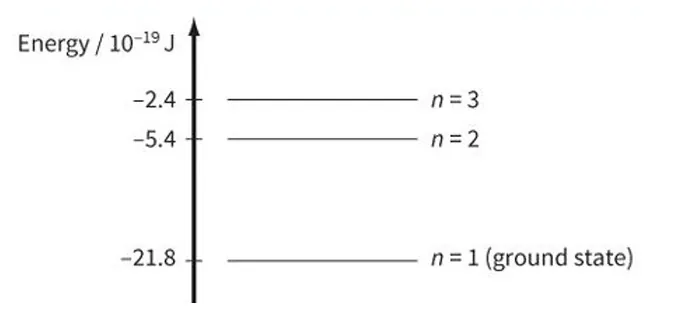
Figure: Three energy levels in an isolated hydrogen atom
a) Explain what happens to an electron in the ground state when it absorbs energy from a photon of energy \(21.8\times10^{-19}\ \mathrm{J}\).
The energy needed to remove the electron from the ground state is \(0-(-21.8\times10^{-19})=21.8\times10^{-19}\ \mathrm{J}\). A photon of exactly this energy lets the electron escape from the atom with no kinetic energy left over, so the atom is ionised.
b) (i) Explain why a photon is emitted when an electron makes a transition between the levels \(n=3\) and \(n=2\). (ii) Calculate the wavelength of the radiation emitted.
(i) The level \(n=3\) has a higher energy than \(n=2\). By conservation of energy, when the electron falls to the lower level the difference in energy is released as a photon.
(ii)
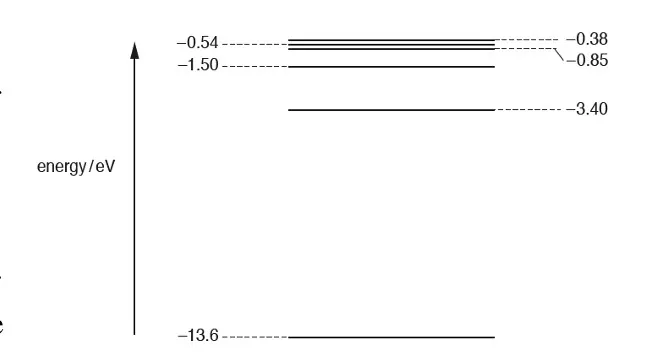
Figure: Lowest electron energy levels of a hydrogen atom (\(-0.38\), \(-0.54\), \(-0.85\), \(-1.50\), \(-3.40\) and \(-13.6\ \mathrm{eV}\))
a) State what is meant by wave number.
The wave number is the number of complete waves per unit distance, \(\bar\nu=\dfrac1\lambda\).
b) (i) An electron is initially at the energy level \(-0.85\ \mathrm{eV}\). State the total number of different wavelengths that may be emitted as the electron de-excites.
The level \(-0.85\ \mathrm{eV}\) is \(n=4\). The number of possible transitions is
namely \(4\to3,\ 4\to2,\ 4\to1,\ 3\to2,\ 3\to1\) and \(2\to1\).
(ii) Photons from this de-excitation fall on a sample of platinum of work function 5.6 eV. Determine (1) the maximum kinetic energy of a photoelectron and (2) the wavelength of the photon producing it.
(1) The most energetic photon comes from the largest jump, \(n=4\to1\):
(2)
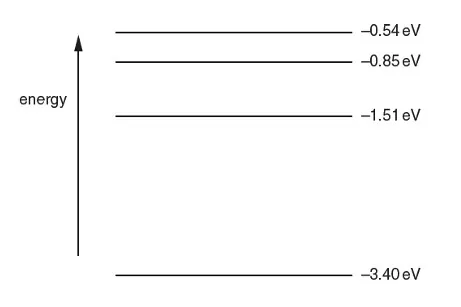
Figure: Four electron energy levels in an isolated atom (\(-0.54\), \(-0.85\), \(-1.51\) and \(-3.40\ \mathrm{eV}\))
a) State an effect, one in each case, that provides evidence for (i) the wave nature of a particle and (ii) the particle nature of electromagnetic radiation.
(i) Electron diffraction (the Davisson-Germer experiment) shows the wave nature of particles. (ii) The photoelectric effect (or the Compton effect) shows the particle nature of electromagnetic radiation.
b) (i) Identify the transition that gives rise to the shortest wavelength. (ii) Show that the wavelength of this transition is \(4.35\times10^{-7}\ \mathrm{m}\).
(i) The shortest wavelength comes from the largest energy change, from \(-0.54\ \mathrm{eV}\) down to \(-3.40\ \mathrm{eV}\).
(ii)
c) (i) State what is meant by the de Broglie wavelength. (ii) Calculate the speed of an electron having a de Broglie wavelength equal to the wavelength in (b)(ii).
(i) The de Broglie wavelength is the wavelength \(\lambda=\dfrac hp\) associated with a moving particle of momentum \(p\).
(ii)
5. View PDF Notes
i. Handwritten Notes
ii. Typed PDF Notes
6. Frequently Asked Questions
What is quantization of energy? (Class 12)
What is quantization of energy in simple words?
What is quantization of energy in quantum mechanics?
What is quantization of energy in chemistry?
What are examples of quantization of energy?
What are the formulas for quantization of energy?
What are Bohr’s postulates for the hydrogen atom?
What are the radius, velocity and energy of the nth Bohr orbit?
What are the spectral series of hydrogen?
What are excitation potential and ionization potential?
What are emission and absorption spectra?
What is the de Broglie wavelength and wave-particle duality?
What is the uncertainty principle?
What are X-rays and how are they produced?
What are the uses of X-rays?
What is the minimum wavelength of X-rays from a tube?
What is Bragg’s law?
What topics are included in Chapter 23 Quantization of Energy of NEB Class 12 Physics?
Where can I get Class 12 Physics Quantization of Energy notes in PDF?
Students also search for: