
Photons
Class 12 Physics Notes • NEB Syllabus 2083
Quantum nature of radiation, Einstein’s photoelectric equation and Planck’s constant, 10 solved multiple choice questions, step-by-step numericals, handwritten and typed PDF notes and frequently asked questions.
1. Syllabus
Unit: Modern Physics
Chapter 21: Photons (4 hours)
21.1 Quantum nature of radiation
21.2 Einstein’s photoelectric equation; stopping potential
21.3 Measurement of Planck’s constant
These notes follow the NEB Class 12 Physics syllabus (+2 Physics, Nepal). Read the quick overview first, practise the multiple choice questions, then work through the numericals, and finish with the PDF notes for quick revision.
2. Photons at a Glance
A photon is a quantum, or discrete packet, of electromagnetic radiation. According to the quantum nature of radiation (Planck 1900, Einstein 1905), radiation is emitted, travels and is absorbed in photons, not as a continuous wave of energy.
Properties and formulas of a photon
| Quantity | Formula or value |
|---|---|
| Energy of a photon | \(E=hf=\dfrac{hc}{\lambda}\) |
| Momentum of a photon | \(p=\dfrac h\lambda=\dfrac Ec\) |
| Planck’s constant | \(h=6.63\times10^{-34}\ \mathrm{J\,s}\) |
| Useful product | \(hc\approx1240\ \mathrm{eV\,nm}\), so \(E(\mathrm{eV})=\dfrac{1240}{\lambda(\mathrm{nm})}\) |
| Charge and rest mass | Both zero; speed \(c\) in vacuum |
| Intensity of a beam | \(I=\dfrac{nhf}{A}\), with \(n\) the number of photons per second |
Photoelectric effect: laws, Einstein’s equation and stopping potential
The photoelectric effect is the emission of electrons from a metal surface when light of high enough frequency falls on it. Experiment shows that (1) there is a threshold frequency \(f_0\) below which no emission occurs, (2) the maximum kinetic energy of the electrons depends on the frequency, not on the intensity, (3) the photocurrent is proportional to the intensity, and (4) emission is instantaneous. The wave theory cannot explain these facts; Einstein’s photon theory does.
Figure: Maximum kinetic energy against frequency. The slope is Planck’s constant \(h\); the intercept on the energy axis is \(-\phi\) and the intercept on the frequency axis is \(f_0\).
Measurement of Planck’s constant (Millikan)
Monochromatic light of known frequency falls on a metal cathode in a vacuum tube. The retarding voltage is increased until the photocurrent just becomes zero, which gives the stopping potential \(V_s\). From \(eV_s=hf-\phi\), a graph of \(V_s\) against \(f\) is a straight line of slope \(\dfrac he\). Planck’s constant is \(h=e\times\text{slope}\).
3. Multiple Choice Questions
Question 1. Einstein’s photoelectric equation states that \(E_k=E-W\). In this equation, \(E_k\) refers to:
- a) Kinetic energy of all the emitted electrons
- b) Mean kinetic energy of the emitted electrons
- c) Maximum kinetic energy of the emitted electrons
- d) Minimum kinetic energy of the emitted electrons
Correct Answer: c) Maximum kinetic energy of the emitted electrons
Reason: \(E\) is the photon energy and \(W\) is the work function, the minimum energy needed to eject an electron. An electron that loses no further energy on its way out leaves with the whole excess, so \(E_k\) is the maximum kinetic energy \(K_{\max}\).
Question 2. Emission of electrons from the surface of a metal by the action of light on it is:
- a) Thermionic emission
- b) Electronic emission
- c) Photoelectric emission
- d) Cold emission
Correct Answer: c) Photoelectric emission
Reason: Thermionic emission is caused by heat and cold (field) emission by a strong electric field. Emission caused by light falling on the metal is photoelectric emission.
Question 3. Which of the following radiations of the same intensity gives the maximum photocurrent?
- a) Infra-red
- b) Visible
- c) Ultra-violet
- d) All of the above
Correct Answer: a) Infra-red
Reason: Intensity is \(I=n\,hf\) per unit area, so for the same intensity the number of photons per second is \(n=\dfrac{I}{hf}\), which is largest for the lowest frequency. Infra-red has the lowest frequency, so it has the most photons. If every beam can eject electrons (frequency above the threshold) and each photon ejects one electron, infra-red gives the largest photocurrent.
Question 4. A photon is a:
- a) Quantum of light energy
- b) Quantum of matter
- c) Positively charged particle
- d) Instrument for measuring light intensity
Correct Answer: a) Quantum of light energy
Reason: By the Planck-Einstein relation \(E=hf\), electromagnetic radiation is quantised, and one packet of energy is called a photon.
Question 5. The photoelectric current can be increased by:
- a) Increasing frequency
- b) Increasing intensity
- c) Decreasing intensity
- d) Decreasing wavelength
Correct Answer: b) Increasing intensity
Reason: The photocurrent is proportional to the number of photoelectrons emitted per second. A greater intensity (with the frequency above the threshold) means more photons per second and so more emitted electrons.
Question 6. The study of the photoelectric effect is useful in understanding:
- a) Quantisation of energy
- b) Quantisation of charge
- c) Conservation of charge
- d) Conservation of kinetic energy
Correct Answer: a) Quantisation of energy
Reason: Classical wave theory could not explain the threshold frequency or the instantaneous emission. Einstein explained them by taking light energy to come in discrete packets, the photons, which establishes the quantisation of energy.
Question 7. A metal with a work function of 0.6 eV is illuminated with light of photon energy 2 eV. The stopping potential is:
- a) 4.6 V
- b) 0.8 V
- c) 1.4 V
- d) 3.6 V
Correct Answer: c) 1.4 V
Question 8. The work function of a metal is 2.51 eV. Its threshold frequency is:
- a) \(7.5\times10^{13}\ \mathrm{Hz}\)
- b) \(6.08\times10^{14}\ \mathrm{Hz}\)
- c) \(10.4\times10^{12}\ \mathrm{Hz}\)
- d) \(6.8\times10^{11}\ \mathrm{Hz}\)
Correct Answer: b) \(6.08\times10^{14}\ \mathrm{Hz}\)
Question 9. The threshold frequency of a metal is \(f_0\). When light of frequency \(4f_0\) is incident on the metal, the maximum kinetic energy of the emitted photoelectrons is:
- a) \(5hf_0\)
- b) \(hf_0/2\)
- c) \(hf_0\)
- d) \(3hf_0\)
Correct Answer: d) \(3hf_0\)
Question 10. Ultraviolet radiation of 6.2 eV falls on an aluminium surface (work function 4.2 eV). The kinetic energy in joules of the fastest electron is approximately:
- a) \(5.2\times10^{-17}\ \mathrm{J}\)
- b) \(3\times10^{-19}\ \mathrm{J}\)
- c) \(2.4\times10^{-18}\ \mathrm{J}\)
- d) \(2.65\times10^{-16}\ \mathrm{J}\)
Correct Answer: b) \(3\times10^{-19}\ \mathrm{J}\)
The nearest option is \(3\times10^{-19}\ \mathrm{J}\).
4. Numerical and Subjective Questions
a) Define threshold frequency, stopping potential and work function in photoelectric emission.
Threshold frequency \(f_0\): the minimum frequency of the incident radiation that can just eject photoelectrons from a given metal surface. Below it no emission occurs, however intense the light.
Stopping potential \(V_s\): the minimum retarding (negative) potential of the anode with respect to the cathode that stops even the most energetic photoelectrons, reducing the photocurrent to zero.
Work function \(\phi\): the minimum energy needed by an electron to just escape from the metal surface; \(\phi=hf_0\).
b) Show that the existence of a threshold frequency is evidence in favour of the quantum theory.
In the classical wave theory the energy is spread continuously over the wavefront, so a low-frequency but intense (or long-lasting) wave should eventually give an electron enough accumulated energy to escape. The wave theory therefore predicts no threshold frequency.
In the quantum theory light consists of photons of energy \(E=hf\), and one electron absorbs one photon. If \(hf<\phi\) the electron cannot escape, no matter how many photons arrive per second or for how long. The observed sharp threshold frequency fits this one-photon, one-electron interaction.
a) (i) Explain why there is no emission if the frequency is lower than a certain value.
The radiation arrives as photons of energy \(E=hf\). An electron needs at least the work function \(\phi\) to leave the metal. If \(f\) is below the threshold, \(hf<\phi\), and since an electron absorbs only one photon at a time it never gets enough energy to escape.
(ii) State two other pieces of evidence from the photoelectric effect that suggest electromagnetic radiation has particle properties.
Instantaneous emission: electrons are emitted almost at once (in less than about \(10^{-9}\ \mathrm{s}\)) when light strikes the surface, with none of the time delay for energy to build up that wave theory predicts.
Kinetic energy independent of intensity: the maximum kinetic energy of the electrons depends only on the frequency of the light, not on its intensity.
b) (i) The work function of the metal is 3.8 eV. Calculate the minimum frequency of radiation that causes photoelectric emission.
(ii) An electron at the surface of the metal is emitted with a kinetic energy of \(4.5\times10^{-19}\ \mathrm{J}\). Calculate the energy of the incident photon in eV.
c) Mention any two applications of the photoelectric effect in daily life.
Solar (photovoltaic) cells, which convert sunlight directly into electrical energy; and light meters in photography, which measure light intensity. (Automatic doors and burglar alarms also use photocells.)
a) Describe Millikan’s experiment to calculate the value of Planck’s constant.
Millikan used a vacuum tube with an alkali-metal cathode and an anode. Monochromatic light of several known frequencies \(f\) was shone on the cathode. For each frequency a variable retarding voltage was applied to the anode until the photocurrent just became zero, giving the stopping potential \(V_s\).
From Einstein’s equation, \(eV_s=hf-\phi\), so
A graph of \(V_s\) against \(f\) is a straight line of slope \(\dfrac he\). Multiplying the measured slope by the electron charge \(e\) gives Planck’s constant \(h\).
b) The photoelectric work function of potassium is \(3.8\times10^{-19}\ \mathrm{J}\). If light of wavelength 5000 \(\mathrm{\AA}\) is incident on it, find (i) the stopping potential, (ii) the kinetic energy of the most energetic electrons and (iii) the velocity of these electrons.
(ii) Kinetic energy:
(i) Stopping potential:
(iii) Velocity:
a) What is the photoelectric effect? Obtain Einstein’s photoelectric equation. State and explain the laws of photoelectric emission from this equation.
Photoelectric effect: the emission of electrons from a metal surface when electromagnetic radiation of sufficiently high frequency falls on it.
Einstein’s equation: light consists of photons of energy \(E=hf\). A photon gives its whole energy to a single electron. Part of it, the work function \(\phi\), is used to overcome the surface barrier, and the rest appears as the maximum kinetic energy of the emitted electron. By conservation of energy
Laws from the equation:
Threshold frequency: emission needs \(K_{\max}\ge0\), that is \(hf\ge\phi\), so there is a minimum frequency \(f_0=\phi/h\) below which no electrons are emitted.
Independence of intensity: \(K_{\max}\) depends only on \(f\) and \(\phi\). A greater intensity means more photons per second, hence a larger photocurrent, but not a larger \(K_{\max}\).
Dependence on frequency: \(K_{\max}\) increases linearly with the frequency of the light.
b) A sheet of silver is illuminated by monochromatic ultraviolet radiation of wavelength 1810 \(\mathrm{\AA}\). What is the maximum energy of the emitted electron? The threshold wavelength of silver is 2640 \(\mathrm{\AA}\).
Using \(hc\approx1240\ \mathrm{eV\,nm}\), with \(\lambda=181\ \mathrm{nm}\) and \(\lambda_0=264\ \mathrm{nm}\):
a) Explain Einstein’s theory of photoelectricity. Hence arrive at Einstein’s photoelectric equation.
Einstein postulated that light interacts with matter in quanta. An electron near the surface absorbs one whole photon of energy \(hf\). If \(hf>\phi\), the electron uses \(\phi\) to break free of the binding forces and keeps the excess as kinetic energy:
This is Einstein’s photoelectric equation (see Question 4a).
b) Photosynthesis starts in certain plants when they are exposed to sunlight but not if the plant is exposed only to infrared light. Explain.
Photosynthesis is a photochemical reaction, and each molecule that starts the reaction must absorb a single photon with at least a certain minimum energy. Sunlight contains visible and ultraviolet light, whose photons have a high frequency and energy \(hf\) large enough to trigger the reaction. Infrared photons have a lower frequency and so too little energy per photon. Since a molecule absorbs one photon at a time, the infrared photons cannot start the process, however intense the infrared light is.
(a) Photons per second: the power through the area is
The energy of one photon is
(b) Momentum of a photon:
(c) Force: the light is totally absorbed, so each photon loses its whole momentum \(p\) and the force is the rate of change of momentum:
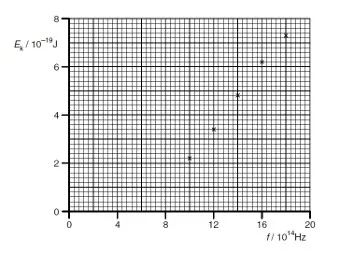
Figure: Maximum kinetic energy of the photoelectrons against frequency
a) Name the effect described above.
The photoelectric effect.
b) Use the figure to determine (i) the threshold frequency of the radiation and (ii) a value for Planck’s constant.
(i) Threshold frequency: from \(E_k=hf-\phi\), \(E_k=0\) at \(f=f_0\), so \(f_0\) is the intercept of the graph on the frequency axis. From the figure, \(f_0=6.8\times10^{14}\ \mathrm{Hz}\).
(ii) Planck’s constant: the gradient of the straight line is \(h\). Taking the gradient of the line in the figure,
c) On the figure draw a line to show the variation of \(E_k\) with \(f\) for a second metal which has a lower work function than the metal in (b).
A lower work function means a lower threshold frequency, \(f_0=\phi/h\). The gradient is still \(h\), so the new line must be a straight line parallel to the original, shifted to the left, so that it meets the frequency axis at a smaller value of \(f\).
d) The kinetic energy of the electrons is described as the maximum. Suggest why the emitted electrons are likely to have a range of kinetic energies for any one frequency.
Einstein’s equation gives the energy of electrons that come from the very surface of the metal and lose nothing on the way out. Electrons from deeper in the metal need more than \(\phi\) to reach the surface, because they lose varying amounts of energy in collisions with atoms. They therefore leave with a range of kinetic energies from zero up to the maximum value.
a) State what is meant by a photon.
A photon is a discrete packet, or quantum, of electromagnetic radiation energy.
b) For the \(\gamma\)-ray photon, calculate (i) its wavelength and (ii) its momentum.
(i) Wavelength:
(ii) Momentum:
c) For this nucleus, determine the change in mass \(\Delta m\) during the decay that gives rise to the energy of the \(\gamma\)-ray photon.
a) Explain what is meant by the photoelectric effect.
The photoelectric effect is the ejection of electrons from the surface of a material, usually a metal, when electromagnetic radiation of sufficiently high frequency falls on it.
b) One wavelength of electromagnetic radiation emitted from a mercury vapour lamp is 436 nm. Calculate the photon energy corresponding to this wavelength.
c) The light from the lamp falls, separately, on caesium (work function 1.4 eV) and tungsten (work function 4.5 eV). Calculate the threshold wavelength for photoelectric emission from (i) caesium and (ii) tungsten.
Use \(\phi=\dfrac{hc}{\lambda_0}\), so \(\lambda_0=\dfrac{hc}{\phi}\) with \(hc\approx1240\ \mathrm{eV\,nm}\):
d) Use your answers in (c) to state and explain whether the radiation of wavelength 436 nm will cause photoelectric emission from each of the metals.
Emission occurs only if the incident wavelength is less than or equal to the threshold wavelength, that is, if the photon energy is at least the work function.
Caesium: \(436\ \mathrm{nm}<886\ \mathrm{nm}\), so the photon energy (about 2.8 eV) exceeds 1.4 eV and photoelectric emission occurs.
Tungsten: \(436\ \mathrm{nm}>276\ \mathrm{nm}\), so the photon energy (about 2.8 eV) is less than 4.5 eV and there is no photoelectric emission.
5. View PDF Notes
i. Handwritten Notes
ii. Typed PDF Notes
6. Frequently Asked Questions
What is a photon in physics?
What are photons made of?
Are photons energy?
What do photons do?
What are photons of light?
What is the quantum nature of radiation?
What are the formulas for the quantum nature of radiation?
What is Planck’s quantum theory?
What is the quantum theory of electromagnetic radiation?
What is the photoelectric effect and what are its laws?
What is Einstein’s photoelectric equation?
What are stopping potential and threshold frequency?
How is Planck’s constant measured?
What are photons in photosynthesis?
How is the word photon pronounced?
What is a quantum of radiation? (crossword clue)
What topics are included in Chapter 21 Photons of NEB Class 12 Physics?
Where can I get Class 12 Physics Photons notes in PDF?
Students also search for: