
Radioactivity and Nuclear Reaction
Class 12 Physics Notes • NEB Syllabus 2083
Syllabus, 11 solved multiple choice questions, step-by-step numericals and derivations, handwritten and typed PDF notes and frequently asked questions on radioactive decay, half-life, nuclear reactions, carbon dating and the Geiger-Muller tube.
1. Syllabus
Unit: Modern Physics
Chapter 24: Radioactivity and Nuclear Reaction (4 hours)
These notes follow the NEB Class 12 Physics syllabus (+2 Physics, Nepal). Practise the multiple choice questions first, then work through the numericals, and finish with the PDF notes for quick revision.
2. Multiple Choice Questions
Question 1. An activity of \(1.85\times10^{12}\) disintegrations per second is nearly equivalent to:
- a) 40 curie
- b) 50 curie
- c) 30 curie
- d) 60 curie
Correct Answer: b) 50 curie
Reason: The curie is defined as \(1\ \mathrm{Ci}=3.7\times10^{10}\) disintegrations per second:
Question 2. The half-life of a radioactive substance is \(2\) months. The amount of substance left after \(1\) year is:
- a) \(\dfrac{M}{64}\)
- b) \(\dfrac{M}{32}\)
- c) \(\dfrac{M}{16}\)
- d) \(\dfrac{M}{8}\)
Correct Answer: a) \(\dfrac{M}{64}\)
Reason: The number of half-lives in \(12\) months is \(n=\dfrac{12}{2}=6\):
Question 3. The mass of a radioactive salt of half-life \(2\) days is \(10\ \mathrm{g}\). What amount of the salt will be left after \(10\) days?
- a) \(2.54\ \mathrm{g}\)
- b) \(5\ \mathrm{g}\)
- c) \(6.24\ \mathrm{g}\)
- d) \(0.31\ \mathrm{g}\)
Correct Answer: d) \(0.31\ \mathrm{g}\)
Reason: The number of half-lives is \(n=\dfrac{10}{2}=5\):
Question 4. If \(20\%\) of a radioactive mass decays in \(10\) days, what percentage of undecayed mass remains after \(20\) days?
- a) \(60\%\)
- b) \(75\%\)
- c) \(50\%\)
- d) \(64\%\)
Correct Answer: d) \(64\%\)
Reason: After \(10\) days, \(80\%\) remains, so \(e^{-10\lambda}=0.8\). After \(20\) days:
So \(64\%\) remains undecayed.
Question 5. Which of the following is equivalent to one rutherford?
- a) \(3.37\times10^{4}\) disintegrations per second
- b) \(3.3\times10^{4}\) disintegrations per second
- c) \(10^{6}\) disintegrations per second
- d) \(3.7\times10^{4}\) disintegrations per second
Correct Answer: c) \(10^{6}\) disintegrations per second
Reason: One rutherford (Rd) is a unit of radioactivity defined as \(10^6\) disintegrations per second, that is, \(1\ \mathrm{MBq}\).
Question 6. What determines the half-life of a radioactive element?
- a) atomic number
- b) mass number
- c) temperature
- d) none of the above
Correct Answer: d) none of the above
Reason: The half-life depends only on the internal stability of the particular nucleus and is not changed by temperature, pressure or chemical combination. Neither the atomic number alone nor the mass number alone fixes it: isotopes of the same element (same atomic number) can have very different half-lives.
Question 7. A radioactive element has a half-life of \(2.5\) hours. In \(10\) hours, \(1\ \mathrm{g}\) of the radioactive material is reduced to:
- a) \(\tfrac14\ \mathrm{g}\)
- b) \(\tfrac18\ \mathrm{g}\)
- c) \(\tfrac1{16}\ \mathrm{g}\)
- d) \(\tfrac1{32}\ \mathrm{g}\)
Correct Answer: c) \(\tfrac1{16}\ \mathrm{g}\)
Reason: The number of half-lives is \(n=\dfrac{10}{2.5}=4\):
Question 8. A source of half-life \(130\) days contains initially \(10^{20}\) radioactive atoms. The activity of the source after \(260\) days is:
- a) \(1.54\times10^{12}\ \mathrm{s^{-1}}\)
- b) \(2.54\times10^{12}\ \mathrm{s^{-1}}\)
- c) \(3.54\times10^{12}\ \mathrm{s^{-1}}\)
- d) \(4.45\times10^{12}\ \mathrm{s^{-1}}\)
Correct Answer: a) \(1.54\times10^{12}\ \mathrm{s^{-1}}\)
Reason: \(260\) days is \(n=2\) half-lives, so the number of atoms left is
The decay constant is
Question 9. The activity of radium decreases by about \(1\%\) every \(25\) years. Its half-life is:
- a) \(1224\) years
- b) \(1424\) years
- c) \(1624\) years
- d) \(1724\) years
Correct Answer: d) \(1724\) years
Reason: After \(25\) years, \(99\%\) remains: \(0.99=e^{-25\lambda}\). Taking logarithms:
Question 10. A radioactive source has decayed to \(1\%\) of its initial activity in \(100\) days. Its half-life is:
- a) \(15\) days
- b) \(20\) days
- c) \(25\) days
- d) \(30\) days
Correct Answer: a) \(15\) days
Reason: \(0.01=e^{-100\lambda}\), so
Question 11. The half-life of a radioactive substance is \(4.8\) minutes. The time required for the activity to decrease to \(5\%\) is:
- a) \(10.8\) min
- b) \(15.8\) min
- c) \(20.8\) min
- d) \(25.8\) min
Correct Answer: c) \(20.8\) min
Reason: \(\dfrac{A}{A_0}=\left(\dfrac12\right)^{t/T_{1/2}}=0.05\). Taking logarithms:
3. Numerical and Subjective Questions
a) What is radioactivity? Write down the laws of radioactive decay.
Radioactivity is the spontaneous emission of particles (alpha or beta) or radiation (gamma rays) from the unstable nucleus of an atom, as the nucleus tries to reach a more stable state.
Laws of radioactive decay (Rutherford and Soddy):
In symbols, \(-\dfrac{dN}{dt}=\lambda N\), which on integration gives
b) Define the radioactive decay constant. Find the relation between half-life and decay constant.
The decay constant \(\lambda\) is the probability of decay per unit time of a nucleus, that is, the fraction of the atoms of a sample that decay per unit time. Its reciprocal \(1/\lambda\) is the mean life, the time in which the number of active atoms falls to \(1/e\) (about \(36.8\%\)) of its initial value.
At the half-life \(t=T_{1/2}\), \(N=\dfrac{N_0}{2}\):
Figure: Exponential decay and half-life
c) The half-life of a radioactive element is \(30\) days. Calculate its decay constant and the time required for \(75\%\) of its atoms to disintegrate.
(The corresponding mean life is \(\tau=\dfrac1\lambda\approx43.3\) days.)
If \(75\%\) disintegrates, \(25\%=\dfrac14\) remains, which is \(\left(\dfrac12\right)^2\), that is, two half-lives:
a) State the law of radioactive disintegration. What do you mean by half-life and mean life of a radioactive substance? Prove that the half-life of a radioactive substance is equal to 0.693 times its mean life.
Law: the rate of disintegration \(\left(-\dfrac{dN}{dt}\right)\) of a radioactive sample at any instant is directly proportional to the number of undecayed nuclei \(N\) present at that instant: \(-\dfrac{dN}{dt}=\lambda N\).
Half-life \(T_{1/2}\): the time required for half of the initial number of radioactive nuclei to decay.
Mean life \(\tau\): the average life of the nuclei of the sample, equal to the sum of the lives of all the nuclei divided by their total number. It equals the reciprocal of the decay constant, \(\tau=\dfrac1\lambda\).
Proof: from the decay law, \(T_{1/2}=\dfrac{\ln2}{\lambda}=\dfrac{0.693}{\lambda}\). Since \(\dfrac1\lambda=\tau\):
b) What is the half-life of a radioactive substance whose activity reduces to \(\dfrac1{10}\)th of its original value in \(7.5\) years?
a) Does the neutron-proton ratio in the nucleus increase or decrease in \(\alpha\)-decay?
In \(\alpha\)-decay the nucleus loses 2 protons and 2 neutrons. If the nucleus has \(Z\) protons and \(N\) neutrons, the ratio changes from \(\dfrac NZ\) to \(\dfrac{N-2}{Z-2}\). For the heavy nuclei that emit alpha particles, \(N>Z\), and then
So the neutron-proton ratio increases in alpha decay.
b) The half-life of a radioactive substance is \(30\) days. What is the time taken for \(\dfrac34\)th of its original mass to disintegrate?
The mass remaining is \(M=M_0-\dfrac34M_0=\dfrac14M_0=\left(\dfrac12\right)^2M_0\), so \(n=2\) half-lives:
a) What percentage of a given sample of a radioactive substance will be left undecayed after five half-life periods?
b) There is a stream of neutrons with kinetic energy \(0.0327\ \mathrm{eV}\). If the half-life of a neutron is \(700\ \mathrm{s}\), what fraction of the neutrons will decay before they travel a distance of \(10\ \mathrm{m}\)? (Mass of a neutron \(=1.675\times10^{-27}\ \mathrm{kg}\).)
Kinetic energy in joules and the speed of the neutrons:
Time to travel \(10\ \mathrm{m}\) and the decay constant:
The fraction decayed is \(1-e^{-\lambda t}\). Since \(\lambda t\) is very small, \(1-e^{-\lambda t}\approx\lambda t\):
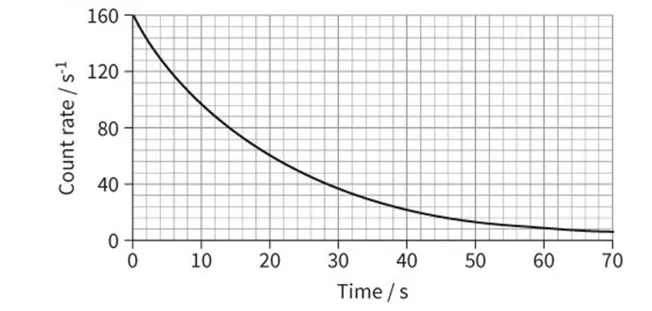
Figure for Question 5
a) Use the graph to determine the half-life of the isotope.
Read the initial count rate \(A_0\) at \(t=0\) on the vertical axis. Find the point on the vertical axis equal to \(\dfrac{A_0}{2}\), draw a horizontal line to the curve and then a vertical line down to the time axis. The time read is the half-life. For this graph it is
b) Calculate the decay constant.
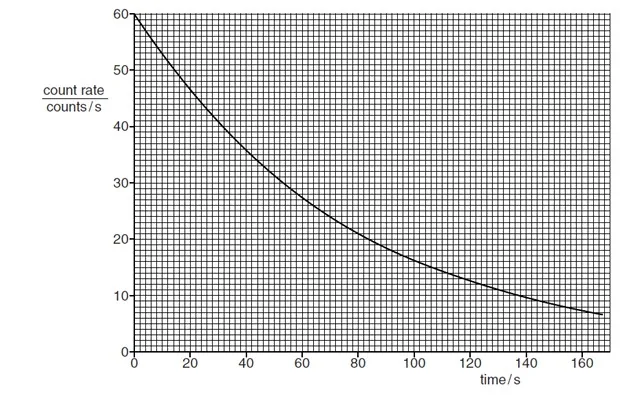
Figure for Question 6
a) Using the figure, describe how the count rate changes with time.
The count rate decreases exponentially with time. The graph is steepest at the start and becomes less steep as time goes on, so the count rate falls by the same fraction in equal intervals of time.
b) i) Using the figure, determine how many seconds it takes for the count rate to change from \(60\) counts/s to \(15\) counts/s.
Reading the times at which the count rate is \(60\) counts/s and \(15\) counts/s from the graph gives an interval of 106 s.
b) ii) State the number of half-lives in this time.
The count rate falls \(60\to30\) (one half-life) and \(30\to15\) (a second half-life), so there are 2 half-lives.
c) Calculate the half-life of the radioactive substance.
d) State the time taken for the count rate to change from \(10\) counts/s to \(5\) counts/s.
Halving the count rate takes exactly one half-life, so the time is 53 s.
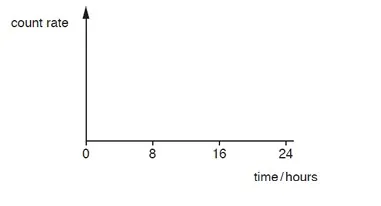
Figure for Question 7
a) Complete the table to describe the nucleus of astatine-210.
The atomic number \(Z=85\) is the number of protons and the mass number \(A=210\) is the number of protons plus neutrons, so the number of neutrons is \(210-85=125\).
| Type of particle | Number of particles | Charge on a particle |
|---|---|---|
| Neutron | 125 | neutral (0) |
| Proton | 85 | positive |
b) i) The count rate of a sample of astatine-210 is measured over \(24\) hours. On the figure, sketch a line to show how the count rate changes over the \(24\) hours.
Draw a smooth exponential decay curve starting at the initial count rate \(A_0\) at \(t=0\). It passes through \(\dfrac{A_0}{2}\) at \(8\) h, \(\dfrac{A_0}{4}\) at \(16\) h and \(\dfrac{A_0}{8}\) at \(24\) h, with a gradient that is negative and becomes less steep.
Figure: Decay curve of astatine-210
b) ii) The mass of a sample of astatine-210 is \(0.500\ \mathrm{kg}\). Calculate how long it takes for \(0.375\ \mathrm{kg}\) of the sample to decay.
Mass remaining \(=0.500-0.375=0.125\ \mathrm{kg}\):
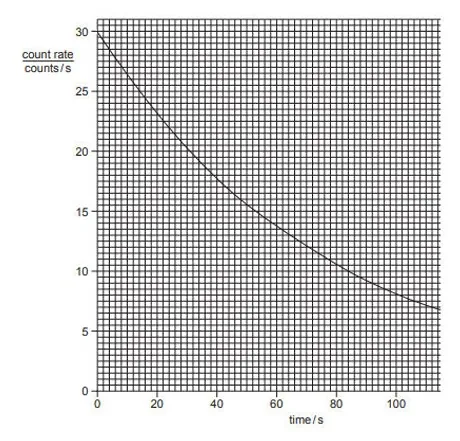
Figure for Question 8
a) Complete the following definition of radioactive half-life: the half-life of a radioactive substance is the time taken for…
…the activity of a given amount of the radioactive substance (or the number of radioactive nuclei present) to decay to half of its initial value.
b) i) Use the figure to find the half-life of the radioactive material.
Read the time taken for the count rate to fall from an initial value \(A_0\) to \(\dfrac{A_0}{2}\). From the graph, \(T_{1/2}=53\ \mathrm{s}\).
b) ii) Use the graph to find how long it takes for the count rate to decrease from \(30\) counts/s to \(10\) counts/s.
b) iii) Use your answers to (i) and (ii) to find how long it takes for the count rate to decrease from \(30\) counts/s to \(5\) counts/s.
Step 1: \(30\to10\) counts/s takes \(84\ \mathrm{s}\) (part ii). Step 2: \(10\to5\) counts/s is one half-life, \(53\ \mathrm{s}\).
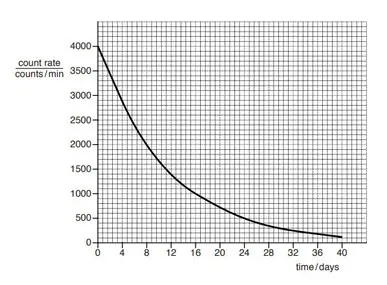
Figure for Question 9
a) State what a \(\beta\)-particle is and give its charge.
A \(\beta\)-particle is a high-speed electron emitted from the nucleus (a neutron changes into a proton). Its charge is negative, \(-e=-1.6\times10^{-19}\ \mathrm{C}\).
b) The graph in the figure shows how the count rate from a sample of a radioactive substance varies with time. Use the graph to find the half-life. Show your working on the graph.
Note the initial count rate at \(t=0\) and divide it by two. Draw a horizontal line from this value to the curve, then a vertical line down to the time axis. The time read is the half-life: 8 days.
c) i) Following an accident, the soil around a nuclear power station is contaminated by caesium-137. A sample of this soil has a count rate of \(180\) counts/min. Caesium-137 has a half-life of \(30\) years and decays by \(\beta\)-emission. Calculate the count rate from the caesium-137 in the sample after \(60\) years.
\(60\) years is \(n=\dfrac{60}{30}=2\) half-lives:
c) ii) Suggest why people do not want to live near the power station, even after it has closed.
4. View PDF Notes
i. Handwritten Notes
ii. Typed PDF Notes
5. Frequently Asked Questions
What is radioactivity? (definition in physics)
Radioactivity discovered by whom?
What topics are included in Chapter 24 Radioactivity and Nuclear Reaction of NEB Class 12 Physics?
What is radioactivity in chemistry?
What are alpha particles, beta particles and gamma rays?
What are the laws of radioactive decay?
What is the radioactivity formula for half-life, decay constant and mean life?
What is the Geiger-Muller tube?
What is carbon dating?
What is the medical use of nuclear radiation and what are the health hazards?
What is radioactivity and why is it dangerous?
What is a nuclear reaction in physics and what is the nuclear reaction formula?
What are examples of nuclear reactions and the nuclear reaction in the Sun?
What is nuclear reaction energy and which elements are involved?
What is the unit of radioactivity?
Is the Radioactivity movie related to this chapter?
Where can I get Class 12 Physics Chapter 24 Radioactivity and Nuclear Reaction notes in PDF?
Students also search for: