
Electrons
Class 12 Physics Notes • NEB Syllabus 2083
Syllabus, 10 solved multiple choice questions, step-by-step numericals and derivations, handwritten and typed PDF notes and frequently asked questions on Millikan’s oil drop experiment, electron motion in electric and magnetic fields and Thomson’s experiment.
1. Syllabus
Unit: Modern Physics
Chapter 20: Electrons (4 hours)
These notes follow the NEB Class 12 Physics syllabus (+2 Physics, Nepal). Practise the multiple choice questions first, then work through the numericals, and finish with the PDF notes for quick revision.
2. Multiple Choice Questions
Question 1. What is the kinetic energy of an electron which is accelerated through a potential difference of \(100\ \mathrm{V}\)?
- a) \(1\ \mathrm{eV}\)
- b) \(100\ \mathrm{eV}\)
- c) \(1.6\times10^{-18}\ \mathrm{J}\)
- d) \(100\times10^{-18}\ \mathrm{J}\)
Correct Answer: b) \(100\ \mathrm{eV}\)
Reason: A charge \(q\) accelerated through a potential difference \(V\) gains kinetic energy \(K=qV\). For an electron:
In joules this is \(100\times1.6\times10^{-19}=1.6\times10^{-17}\ \mathrm{J}\).
Question 2. In J.J. Thomson’s experiment, the charge-to-mass ratio \((e/m)\) of the electron was found using:
- a) only an electric field
- b) only a magnetic field
- c) crossed electric and magnetic fields
- d) both electric and magnetic fields acting parallel to each other
Correct Answer: c) crossed electric and magnetic fields
Reason: Thomson used mutually perpendicular (crossed) electric and magnetic fields. Balancing the electric force \(eE\) and the magnetic force \(evB\) gave the speed \(v=E/B\) of the electrons, which then allowed \(e/m\) to be calculated.
Question 3. Which property of the electron was established by Millikan’s oil drop experiment?
- a) mass
- b) charge
- c) speed
- d) spin
Correct Answer: b) charge
Reason: Millikan’s experiment measured the elementary charge \(e\) of the electron and showed that electric charge is quantised, \(q=ne\).
Question 4. In Thomson’s \(e/m\) experiment, if the magnetic field is doubled while the electric field and the deflection are kept constant, what must happen to the velocity of the electrons for the beam to remain undeflected?
- a) Halved
- b) Doubled
- c) Remains unchanged
- d) Reduced to one-fourth
Correct Answer: a) Halved
Reason: For an undeflected beam the electric and magnetic forces are equal:
If \(B\) is doubled with \(E\) constant, \(v’=\dfrac{E}{2B}=\dfrac v2\). The velocity must be halved.
Question 5. In Millikan’s oil drop experiment, if the strength of the electric field is increased and the drop remains suspended, what does this imply about the charge on the oil drop?
- a) Charge has increased
- b) Charge has decreased
- c) Mass has increased
- d) Drop has a higher charge than previously measured
Correct Answer: b) Charge has decreased
Reason: A suspended drop of mass \(m\) is in equilibrium when the electric force balances its weight:
For the same mass, a larger field \(E\) holding the drop stationary means a smaller charge \(q\).
Question 6. An electron enters a region with perpendicular electric and magnetic fields and continues in a straight line. If the electric field is suddenly turned off, the electron will:
- a) stop moving
- b) continue in a straight line
- c) move in a circular path
- d) oscillate back and forth
Correct Answer: c) move in a circular path
Reason: With the electric field off, only the magnetic force \(\vec F=e(\vec v\times\vec B)\) acts. It is always perpendicular to the velocity, so it provides the centripetal force and the electron moves in a circle of radius \(r=\dfrac{mv}{eB}\).
Question 7. If in a cathode ray tube the deflection on the screen is more in the electric field than in the magnetic field, what could be a valid conclusion?
- a) Magnetic field is stronger
- b) Electric field is weaker
- c) Velocity of the electrons is low
- d) Magnetic force dominates
Correct Answer: c) Velocity of the electrons is low
Reason: The electric deflection varies as \(y_e\propto\dfrac{1}{v^2}\), while the magnetic deflection varies as \(y_m\propto\dfrac1v\). Hence
At low electron speeds the electric deflection grows faster than the magnetic deflection.
Question 8. In Millikan’s oil drop experiment, an oil drop carrying a charge \(Q\) is held stationary by a potential difference of \(2400\ \mathrm{V}\) between the plates. To keep a drop of half the radius stationary, the potential difference has to be made \(600\ \mathrm{V}\). What is the charge on the second drop?
- a) \(3Q/2\)
- b) \(Q/2\)
- c) \(Q/4\)
- d) \(Q\)
Correct Answer: b) \(Q/2\)
Reason: For a stationary drop, \(q\dfrac Vd=mg=\dfrac43\pi r^3\rho g\), so \(q\propto\dfrac{r^3}{V}\):
Question 9. A Thomson’s tube operated at \(2\ \mathrm{kV}\) allows an electron beam to pass with a speed of \(6\times10^{6}\ \mathrm{m/s}\). What is the speed when it operates at \(8\ \mathrm{kV}\)?
- a) \(2.4\times10^{7}\ \mathrm{m/s}\)
- b) \(3.6\times10^{7}\ \mathrm{m/s}\)
- c) \(4.8\times10^{7}\ \mathrm{m/s}\)
- d) \(1.2\times10^{7}\ \mathrm{m/s}\)
Correct Answer: d) \(1.2\times10^{7}\ \mathrm{m/s}\)
Reason: From \(\tfrac12mv^2=eV\), \(v=\sqrt{\dfrac{2eV}{m}}\), so \(v\propto\sqrt V\):
Question 10. A horizontal beam of electrons is passed between two horizontal parallel plates, \(2.0\ \mathrm{cm}\) apart, as shown. The upper plate has an electrical potential of \(+4.0\ \mathrm{V}\) and the lower plate has an electrical potential of \(-4.0\ \mathrm{V}\). What is the force on each electron when it is between the plates?
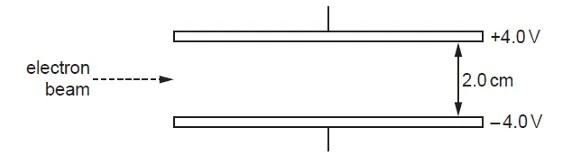
Figure for Question 10
- a) \(3.2\times10^{-17}\ \mathrm{N}\) downwards
- b) \(3.2\times10^{-17}\ \mathrm{N}\) upwards
- c) \(6.4\times10^{-17}\ \mathrm{N}\) downwards
- d) \(6.4\times10^{-17}\ \mathrm{N}\) upwards
Correct Answer: d) \(6.4\times10^{-17}\ \mathrm{N}\) upwards
Reason: The potential difference is \(V=4.0-(-4.0)=8.0\ \mathrm{V}\) and the separation is \(d=0.02\ \mathrm{m}\):
The electron is negative, so the force is opposite to the field: upwards, towards the positive plate.
3. Numerical and Subjective Questions
i) Discuss the motion of an electron in a uniform magnetic field and show that if a free electron moves at a right angle to a magnetic field, the path is a circle and the period of revolution is independent of the speed of the electron.
Let an electron of mass \(m\) and charge \(e\) enter a magnetic field \(B\) at right angles to it with speed \(v\). The magnetic force is
This force is always perpendicular to the velocity, so it changes only the direction of motion, not the speed. It acts as the centripetal force:
The radius is constant for a given speed, so the path is a circle. The period of revolution is
The speed \(v\) cancels, so \(T\) depends only on \(m\), \(e\) and \(B\): the period is independent of the speed of the electron.
Figure: Electron moving in a circle in a magnetic field
ii) Prove that the path of a horizontal beam of electrons entering midway between two oppositely charged plates is parabolic.
Let the electron enter along the \(x\)-axis with speed \(v_0\). The electric field \(E=V/d\) acts along \(y\).
Horizontal motion (no force):
Vertical motion (constant acceleration \(a=\dfrac{eE}{m}\) from rest):
Substituting \(t=x/v_0\):
Since \(e,E,m\) and \(v_0\) are constants, \(y\propto x^2\), which is the equation of a parabola.
Figure: Parabolic path of an electron between charged plates
iii) A beam of electrons moving with a velocity of \(10^{7}\ \mathrm{m/s}\) enters midway between two horizontal parallel plates, in a direction parallel to the plates. Each plate is \(5\ \mathrm{cm}\) long, the plates are \(2\ \mathrm{cm}\) apart and a potential difference of \(90\ \mathrm{V}\) is applied between them. Calculate the velocity of the electron beam with which it just grazes the edge of the positive plate. (\(e/m=1.8\times10^{11}\ \mathrm{C/kg}\))
(Check: the deflection is \(y=\tfrac12at^2\approx1.0\ \mathrm{cm}=\tfrac d2\), so the electron just grazes the edge of the plate.)
i) What is the specific charge of an electron? Describe J.J. Thomson’s experiment to determine the specific charge of an electron.
The specific charge of a particle is the ratio of its charge to its mass. For the electron, \(\dfrac em\approx1.76\times10^{11}\ \mathrm{C/kg}\).
Thomson’s method. A beam of electrons from a heated cathode is accelerated, passes through a pair of parallel plates (electric field \(E\)) and a region of magnetic field \(B\) perpendicular to \(E\) and to the beam, and falls on a fluorescent screen.
Figure: Thomson’s apparatus with crossed electric and magnetic fields
Step 1: velocity. The two fields are adjusted until the spot on the screen is undeflected. Then the electric and magnetic forces balance:
Step 2: deflection. The magnetic field is switched off. The electric field alone deflects the beam through \(y\) over the plate length \(l\):
Step 3: specific charge. Substituting \(v=E/B\):
ii) An oil drop of density \(960\ \mathrm{kg/m^3}\) and radius \(10^{-7}\ \mathrm{m}\) is driven vertically upward through air by an electric field of \(1.95\times10^{4}\ \mathrm{V/m}\) with a constant velocity of \(3.5\times10^{-4}\ \mathrm{m/s}\). If the viscosity of air is \(1.8\times10^{-5}\ \mathrm{N\,s/m^2}\), calculate the net number of electronic charges on the drop. (Neglect the upthrust due to air.)
The drop moves upward at constant velocity, so the electric force balances the weight plus the viscous drag:
The drop carries about 4 electronic charges.

Figure for Question 3
a) Draw a free body diagram to represent the motion of an oil drop when it is moving constantly in a downward direction in the absence of an electric field, as well as in the presence of an electric field, along with the forces acting on it.
No electric field (constant velocity \(v_1\) downward): the weight \(F_g\) acts downward; the viscous drag \(F_v=6\pi\eta rv_1\) and the upthrust \(F_u\) act upward.
With electric field (smaller constant velocity \(v_2\) downward): the weight \(F_g\) acts downward; the viscous drag \(F_v=6\pi\eta rv_2\), the upthrust \(F_u\) and the electric force \(F_e=qE\) act upward.
Figure: Forces on an oil drop without and with an electric field
b) Find the expression for the charge on an oil drop of radius \(r\) moving with constant velocity \(v\) in a downward direction.
With the field, the forces balance:
Without the field the drop falls at \(v_1\), so \(F_g-F_u=6\pi\eta rv_1\). Substituting:
c) Determine the magnitude of the charge on an oil drop of radius \(1.5\times10^{-6}\ \mathrm{mm}\) when its terminal velocity changes from \(0.25\ \mathrm{mm/s}\) to \(0.1\ \mathrm{mm/s}\) while moving through an electric field of \(10^{5}\ \mathrm{V/m}\). The coefficient of viscosity is \(1.8\times10^{-5}\ \mathrm{N\,s/m^2}\).
a) What is meant by the quantisation of charge?
Electric charge exists only in whole-number multiples of a fundamental unit, the charge of the electron:
b) i) In Millikan’s oil drop experiment, an oil drop of weight \(1.5\times10^{-14}\ \mathrm{N}\) is held stationary between plates \(10\ \mathrm{mm}\) apart by applying a potential difference of \(470\ \mathrm{V}\). State the condition necessary for the drop to remain stationary. Also sketch the forces acting on the oil drop.
The drop remains stationary when the upward electric force equals the downward weight: \(qE=W\).
Figure: Forces on a stationary oil drop
b) ii) Calculate the charge on the oil drop.
This is about \(2e\).
b) iii) Explain what would happen if the above oil drop is suddenly struck by a stray alpha particle.
An alpha particle carries a charge of \(+2e\). If it is captured, the charge on the drop changes by \(2e\) and the balance \(qE=W\) is destroyed. For a negatively charged drop (held up by the positive upper plate) of charge about \(-2e\), the new charge becomes about zero, so the electric force disappears and the drop falls under its weight. If the drop were positively charged, its charge would become about \(4e\), the upward electric force would double and the drop would move upward.
i) State the condition necessary for the beam to remain undeflected. Also sketch the forces acting on the electron beam.
The beam is undeflected when the electric force equals the magnetic force in size and the two act in opposite directions: \(eE=evB\).
Figure: Forces on an electron beam in crossed fields
ii) If the two fields produce no deflection in the electron beam, calculate the velocity of the electrons.
iii) Explain what would happen to the nature of motion of the electron beam if the electric field between the parallel plates is made zero.
Only the magnetic force \(evB\) is left. It is perpendicular to the velocity, so it supplies the centripetal force and the beam moves along a circular path of radius
(This treats the electron non-relativistically, as the question does.)
a) What is the use of X-rays in this experiment? Also discuss the physical principle involved in this experiment.
X-rays ionise the air molecules between the plates and produce free electrons, which attach to the oil drops and charge them.
Principle: the charge on the drop is quantised, \(q=ne\), and the drop is in equilibrium under gravity, the viscous drag and upthrust, and the electrostatic force.
b) What happens if the falling drop suddenly experiences a net zero force in the vertical path?
The drop stops accelerating and moves with a constant (terminal) velocity, because by Newton’s first law there is no change in its velocity.
c) Mention the types of forces that play an important role during the motion of the drop in the viscous medium. Also sketch the forces involved.
Figure: Forces on an oil drop in a viscous medium
d) An oil drop is falling with a terminal velocity of \(2.0\times10^{-4}\ \mathrm{m/s}\) in air. The density of the oil is \(920\ \mathrm{kg/m^3}\) and the viscosity of air is \(1.8\times10^{-5}\ \mathrm{N\,s/m^2}\). Take \(g=9.8\ \mathrm{m/s^2}\). Calculate the radius of the oil drop.
At terminal velocity \(v=\dfrac{2r^2\rho g}{9\eta}\), so
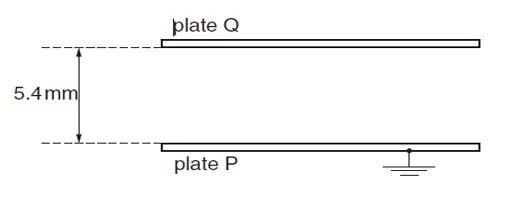
Figure for Question 7
a) State a fundamental property of charge that was suggested by this experiment.
Electric charge is quantised: it exists only as integral multiples of a basic unit, \(q=ne\).
b) i) Two parallel metal plates P and Q are situated in a vacuum, horizontal and \(5.4\ \mathrm{mm}\) apart. Suggest why plates P and Q must be parallel and horizontal.
Parallel: so that the electric field \(E=V/d\) between them is uniform. Horizontal: so that the field, and therefore the electric force, is vertical and acts directly against the weight of the drop.
b) ii) The lower plate P is earthed. An oil droplet of mass \(7.7\times10^{-15}\ \mathrm{kg}\) remains stationary when plate Q is at a potential of \(+850\ \mathrm{V}\). Calculate the charge, with its sign, on the oil droplet.
The drop is held up by attraction towards the positive upper plate Q, so its charge is negative: \(q\approx-4.8\times10^{-19}\ \mathrm{C}\).
c) The procedure was repeated for further oil droplets, and the magnitudes of the charges were found to be \(3.2\times10^{-19}\ \mathrm{C}\), \(6.4\times10^{-19}\ \mathrm{C}\) and \(3.2\times10^{-19}\ \mathrm{C}\). Explain what value these data and your answer in (b)(ii) suggest for the charge on the electron.
All the measured charges are whole-number multiples of the same smallest value:
The data suggest that the charge on the electron is \(e=1.6\times10^{-19}\ \mathrm{C}\).
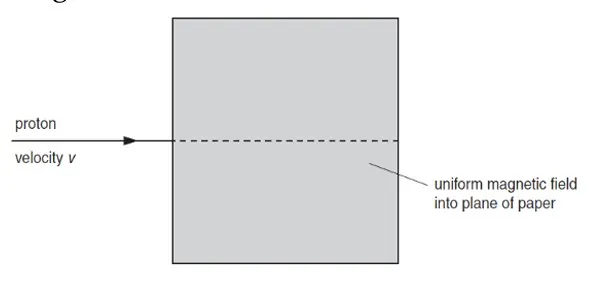
Figure for Question 8
a) On the figure, draw an arrow labelled E to show the direction of the electric field.
For the proton to pass undeviated, the electric force must be equal and opposite to the magnetic force. The magnetic force is upward in the figure, so the electric force is downward. For a positive charge the electric force is along the field, so the electric field \(\vec E\) points downward.
b) i) The proton is replaced by other particles; the electric and magnetic fields remain unchanged. State and explain the deviation, if any, of an \(\alpha\)-particle with initial velocity \(v\).
The \(\alpha\)-particle has charge \(+2e\). Then \(F_e=2eE\) and \(F_b=2evB\). Since \(v=E/B\) for the proton, \(F_e=F_b\) still holds, so the \(\alpha\)-particle passes undeviated. (The condition \(v=E/B\) does not depend on the charge or the mass.)
b) ii) An electron with initial velocity \(2v\).
The electric force is \(F_e=eE=evB\), while the magnetic force is \(F_b=e(2v)B=2evB\). The magnetic force is now twice the electric force, so the forces no longer balance. The electron is deviated, in the direction of the magnetic force on it.

Figure for Question 9
a) i) Complete the path of the electron beam.
The beam travels in a straight line up to the plates, curves (in a parabola) towards the positive plate while it is between them, and then moves in a straight line to the point P on the screen.
Figure: Path of the electron beam between the plates
a) ii) Mark the charges on both plates.
The electrons are deflected towards point P, that is, towards the plate on that side. Electrons are attracted to a positive plate, so the plate on the side of P is positive (+) and the other plate is negative (−).
a) iii) Mark with an arrow and the letter C the direction of the conventional current in the electron beam.
Conventional current is opposite to the motion of the electrons. The arrow C points from the screen back towards the electron source.
b) Two plane metal plates \(4.0\ \mathrm{cm}\) long are held horizontally \(3.0\ \mathrm{cm}\) apart in a vacuum, one vertically above the other. The upper plate is at a potential of \(300\ \mathrm{V}\) and the lower is earthed. Electrons having a velocity of \(1.0\times10^{7}\ \mathrm{m\,s^{-1}}\) are injected horizontally midway between the plates, parallel to the \(4.0\ \mathrm{cm}\) edge. Calculate the vertical deflection of the electron beam as it emerges from the plates. (\(e/m=1.8\times10^{11}\ \mathrm{C\,kg^{-1}}\))
The vertical deflection is 1.44 cm, which is less than half the plate separation (1.5 cm), so the beam emerges from between the plates.
4. View PDF Notes
i. Handwritten Notes
ii. Typed PDF Notes
5. Frequently Asked Questions
What are electrons?
What topics are included in Chapter 20 Electrons of NEB Class 12 Physics?
Who discovered the electron?
What are electrons, protons and neutrons?
Where are electrons found?
What is the electron in chemistry and in electricity?
What are examples of electrons in everyday life?
What is the specific charge of an electron?
How did Thomson determine the specific charge of the electron?
What was Millikan’s oil drop experiment?
What is the quantisation of charge?
What is the path of an electron in a uniform magnetic field and in an electric field?
What is the kinetic energy of an electron accelerated through a potential difference V?
When does an electron beam pass undeflected through electric and magnetic fields?
Where can I get Class 12 Physics Chapter 20 Electrons notes in PDF?
Students also search for: