
Class 10 Optional Mathematics Linear Programming
Exercise 3: Inequalities, Graphs, Feasible Region and Optimization
27 solved questions with English and Nepali questions, graphs, step by step solutions and frequently asked questions for the Nepal Grade 10 SEE.
1. Class 10 Optional Mathematics Linear Programming: Unit Overview and Key Formulas
Unit 3: Linear Programming (Optional Mathematics, Grade 10, SEE, Nepal)
Class 10 Optional Mathematics Linear Programming is the third unit of the Grade 10 Optional Mathematics course prescribed by the Curriculum Development Centre (CDC), Nepal. These class 10 optional math linear programming notes solve every question of Exercise 3.
Every question is written as in the textbook: the main question first (Q.1 to Q.6) with its parts (a, b, c …) listed under it and the Nepali question in brackets. Solutions are in English because the steps and symbols are the same in both languages. Graphs for Q.2, Q.3 and Q.5 are drawn as SVG, while the graphs of Q.1(E), Q.4 and Q.6 use the textbook figures.
- Words to symbols: “more than” is \(>\), “at least” is \(\ge\), “less than” is \(<\), and “at most” is \(\le\).
- Graph of an inequality: draw the boundary line (solid for \(\le,\ge\), dashed for \(<,>\)), test the origin, then shade the side that satisfies the inequality.
- Feasible region: the common region of all the inequalities. Its corner points are the vertices.
- Optimization: evaluate the objective function at every vertex. The largest value is the maximum and the smallest is the minimum.
Key formulas to remember
Figure: A feasible region (shaded). The maximum and minimum of the objective function occur at its corner points.
For more chapters, visit the complete SEE Class 10 Optional Mathematics notes. You can also read about linear programming for extra understanding.
2. Exercise 3 Linear Programming: Class 10 Optional Mathematics Linear Programming
Exercise 3 Linear Programming: Multiple Choice Questions (बहुवैकल्पिक प्रश्न)
Q.1 Tick (✓) the correct option for the given questions:
(दिइएका प्रश्नहरूको उपयुक्त विकल्पमा ठिक चिह्न (✓) लगाउनुहोस् : )
A. Hari earns more than Rs. \(600\) in a day. If Hari’s one day earning is denoted by \(x\), which one of the following inequalities is correct? (हरिले एक दिनमा रु. \(600\) भन्दा बढी कमाउँछ । हरिको एक दिनको कमाइलाई \(x\) मान्दा तलका मध्ये कुन असमानता सही छ ?)
- a) \(x>600\)
- b) \(x\ge 600\)
- c) \(x<600\)
- d) \(x\le 600\)
Correct Answer: a) \(x>600\)
Solution:
- Given: Hari’s one day earning \(=x\).
- The phrase “more than” means strictly greater than (\(>\)). Hence \(x>600\).
(“भन्दा बढी” ले कडा रूपमा ठुलो (\(>\)) जनाउँछ । त्यसैले \(x>600\) हुन्छ ।)
B. In the winter season of Kathmandu, the temperature becomes at least \(-3^\circ\text{C}\). If the winter temperature is denoted by \(x\), which one of the following inequalities represents the statement? (काठमाडौँको जाडो मौसममा तापक्रम कम्तीमा \(-3^\circ\text{C}\) हुने गर्छ । जाडो मौसमको तापक्रमलाई \(x\) मान्दा दिइएको कथनलाई तलको कुन असमानताले जनाउँछ ?)
- a) \(x>-3^\circ\text{C}\)
- b) \(x\ge -3^\circ\text{C}\)
- c) \(x<-3^\circ\text{C}\)
- d) \(x\le -3^\circ\text{C}\)
Correct Answer: b) \(x\ge -3^\circ\text{C}\)
Solution:
- Given: winter temperature \(=x\).
- The phrase “at least” means greater than or equal to (\(\ge\)). Hence \(x\ge -3^\circ\text{C}\).
(“कम्तीमा” ले ठुलो वा बराबर (\(\ge\)) जनाउँछ । त्यसैले \(x\ge -3^\circ\text{C}\) हुन्छ ।)
C. Which one of the following points satisfies the inequality \(2x-3y>5\)? (असमानता \(2x-3y>5\) मा तलका मध्ये कुन बिन्दु मान्य हुन्छ ?)
- a) \((0,0)\)
- b) \((1,1)\)
- c) \((4,3)\)
- d) \((5,1)\)
Correct Answer: d) \((5,1)\)
Solution:
- Substitute each point in \(2x-3y\) and compare with \(5\).
- \((0,0)\): \(2(0)-3(0)=0\), and \(0>5\) is false.
- \((1,1)\): \(2(1)-3(1)=-1\), and \(-1>5\) is false.
- \((4,3)\): \(2(4)-3(3)=8-9=-1\), and \(-1>5\) is false.
- \((5,1)\): \(2(5)-3(1)=10-3=7\), and \(7>5\) is true.
(प्रत्येक बिन्दुलाई \(2x-3y\) मा राख्दा केवल \((5,1)\) बाट \(7>5\) सत्य हुन्छ ।)
D. If the objective function is \(Z=3x+4y\), at which of the points \(O(0,0)\), \(A(9,0)\), \(B(7,3)\) and \(C(0,8)\) of the feasible region will the maximum value occur? (उद्देश्य फलन \(Z=3x+4y\) भए हल क्षेत्रका बिन्दुहरू \(O(0,0)\), \(A(9,0)\), \(B(7,3)\) र \(C(0,8)\) मध्ये कुन बिन्दुमा अधिकतम मान होला ?)
- a) \(O(0,0)\)
- b) \(A(9,0)\)
- c) \(B(7,3)\)
- d) \(C(0,8)\)
Correct Answer: c) \(B(7,3)\)
Solution:
- Evaluate \(Z=3x+4y\) at every vertex.
- At \(O(0,0)\): \(Z=0\).
- At \(A(9,0)\): \(Z=3(9)+4(0)=27\).
- At \(B(7,3)\): \(Z=3(7)+4(3)=21+12=33\).
- At \(C(0,8)\): \(Z=3(0)+4(8)=32\).
- The maximum value is \(33\), at \(B(7,3)\).
(प्रत्येक शीर्षबिन्दुमा \(Z\) को मान निकाल्दा \(B(7,3)\) मा सबैभन्दा ठुलो मान \(33\) आउँछ ।)
E. Which one of the following inequalities represents the given graph? (दिइएको लेखाचित्रलाई जनाउने असमानता तलका मध्ये कुन होला ?)
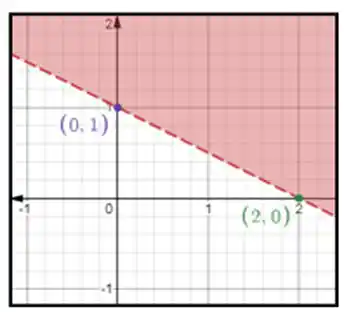
- a) \(x+y>2\)
- b) \(x+2y>2\)
- c) \(2x+y<2\)
- d) \(x+2y>2\)
Correct Answer: b) \(x+2y>2\)
Solution:
- The dashed boundary line passes through \((2,0)\) and \((0,1)\).
- The line is dashed, so the inequality is strict. The origin is unshaded: \(x+2y>2\) gives \(0>2\), which is false, so the origin is correctly left out.
Note: options b and d are printed identically in the textbook, and the answer key marks b.
(रेखा \((2,0)\) र \((0,1)\) बाट जाने भएकाले समीकरण \(x+2y=2\) हुन्छ । मूलबिन्दु छायाँ नपरेकाले असमानता \(x+2y>2\) हुन्छ ।)
Exercise 3 Linear Programming: Written Questions (लेख्ने प्रश्न)
Q.2 Draw the graphs of the following inequalities:
- a. \(x+y\ge 3\)
- b. \(x-y\ge 0\)
- c. \(2x+3y\le 6\)
- d. \(3x+4y\ge 12\)
- e. \(x-2y\ge 3\)
- f. \(3x-2y\ge 4\)
(दिइएका असमानताहरूको लेखाचित्र खिच्नुहोस् : )
Step 1: Boundary line
The corresponding equation is \(x+y=3\). For \(x=0\), \(y=3\), giving \((0,3)\). For \(y=0\), \(x=3\), giving \((3,0)\).
Step 2: Test the origin
\[0+0\ge 3 \implies 0\ge 3 \quad (\text{false})\]Step 3: Shade
The origin does not satisfy the inequality, so shade the half-plane that does not contain the origin. The boundary line is solid because of “\(\ge\)”.
Figure: Graph of x + y ≥ 3: solid boundary x + y = 3, shaded away from the origin.
Step 1: Boundary line
The corresponding equation is \(x-y=0\), that is \(y=x\). It passes through \((0,0)\), \((2,2)\) and \((-2,-2)\).
Step 2: Test a point not on the line
The origin lies on the line, so test \((2,0)\):
\[2-0\ge 0 \implies 2\ge 0 \quad (\text{true})\]Step 3: Shade
Shade the region containing \((2,0)\), which is below the line \(y=x\). The boundary line is solid.
Figure: Graph of x − y ≥ 0: solid boundary y = x, shaded below the line (the side containing (2, 0)).
Step 1: Boundary line
The corresponding equation is \(2x+3y=6\). It passes through \((0,2)\) and \((3,0)\).
Step 2: Test the origin
\[2(0)+3(0)\le 6 \implies 0\le 6 \quad (\text{true})\]Step 3: Shade
Shade the region containing the origin. The boundary line is solid.
Figure: Graph of 2x + 3y ≤ 6: solid boundary, shaded on the side containing the origin.
Step 1: Boundary line
The corresponding equation is \(3x+4y=12\). It passes through \((0,3)\) and \((4,0)\).
Step 2: Test the origin
\[3(0)+4(0)\ge 12 \implies 0\ge 12 \quad (\text{false})\]Step 3: Shade
Shade the region away from the origin. The boundary line is solid.
Figure: Graph of 3x + 4y ≥ 12: solid boundary, shaded away from the origin.
Step 1: Boundary line
The corresponding equation is \(x-2y=3\). It passes through \((3,0)\) and \((0,-1.5)\).
Step 2: Test the origin
\[0-2(0)\ge 3 \implies 0\ge 3 \quad (\text{false})\]Step 3: Shade
Shade the region away from the origin. The boundary line is solid.
Figure: Graph of x − 2y ≥ 3: solid boundary, shaded away from the origin.
Step 1: Boundary line
The corresponding equation is \(3x-2y=4\). It passes through \((0,-2)\) and \(\left(\frac{4}{3},0\right)\).
Step 2: Test the origin
\[3(0)-2(0)\ge 4 \implies 0\ge 4 \quad (\text{false})\]Step 3: Shade
Shade the region away from the origin. The boundary line is solid.
Figure: Graph of 3x − 2y ≥ 4: solid boundary, shaded away from the origin.
Q.3 Draw the graphs of the following systems of inequalities and find the common solution region (feasible region):
- a. \(x+2y\le 6,\ x\ge 0\)
- b. \(2x-y\ge 4,\ y\ge 0\)
- c. \(x+y\le 1,\ x-y\ge 1\)
- d. \(3x+4y\le 12,\ 2x-y\le 0,\ x-y\le 2,\ x\ge 0\ \text{and}\ y\ge 0\)
- e. \(2x+3y\le 6,\ 3x-y\le 0,\ x\ge 0\ \text{and}\ y\ge 0\)
- f. \(x+y\le 2,\ 2x-3y\le 6,\ x\ge 0\ \text{and}\ y\le 2\)
(दिइएका असमानता पद्धतिहरूको लेखाचित्र खिची साझा हल क्षेत्र पत्ता लगाउनुहोस् : )
Note: the question prints \(x\ge 0\). The solution also takes \(y\ge 0\) (first quadrant), as is usual in linear programming.
Step 1: Boundary lines
- \(x+2y=6\) passes through \((0,3)\) and \((6,0)\).
- \(x\ge 0\) means the right of the \(y\)-axis (first and fourth quadrants).
- \(y\ge 0\) means above the \(x\)-axis (first and second quadrants).
Step 2: Test the origin in \(x+2y\le 6\)
\[0+2(0)\le 6 \implies 0\le 6 \quad (\text{true})\]So shade the side of \(x+2y=6\) containing the origin.
Step 3: Feasible region
The common region is the triangle with corner points \((0,0)\), \((6,0)\) and \((0,3)\).
Figure: Feasible region of x + 2y ≤ 6, x ≥ 0, y ≥ 0: the triangle with corners (0, 0), (6, 0) and (0, 3).
Note: the question prints \(y\ge 0\). The solution also takes \(x\ge 0\) (first quadrant), as is usual in linear programming.
Step 1: Boundary line
\(2x-y=4\) passes through \((2,0)\) and \((0,-4)\).
Step 2: Test the origin
\[2(0)-0\ge 4 \implies 0\ge 4 \quad (\text{false})\]So the region lies on the side of the line away from the origin, that is below the line \(y=2x-4\).
Step 3: Feasible region
Together with \(x\ge 0\) and \(y\ge 0\), the common region lies in the first quadrant, below the line and above the \(x\)-axis. It is unbounded, with its only corner point at \((2,0)\), and it extends towards the positive \(x\)-axis.
Figure: Feasible region of 2x − y ≥ 4, y ≥ 0, x ≥ 0: an unbounded region with vertex (2, 0).
Note: the solution takes \(x\ge 0\) and \(y\ge 0\) (first quadrant), as is usual in linear programming.
Step 1: Boundary lines
- \(x+y=1\) passes through \((1,0)\) and \((0,1)\). Test the origin: \(0\le 1\) is true, so shade towards the origin.
- \(x-y=1\) passes through \((1,0)\) and \((0,-1)\). Test the origin: \(0\ge 1\) is false, so shade away from the origin.
- \(x\ge 0,\ y\ge 0\) gives the first quadrant.
Step 2: Common region
From \(x-y\ge 1\) we get \(x\ge 1+y\), and from \(x+y\le 1\) we get \(x\le 1-y\). Hence
\[1+y\le 1-y \implies y\le 0\]Since \(y\ge 0\), we get \(y=0\), and then \(x=1\).
Step 3: Feasible region
The feasible region is the single point \((1,0)\).
Figure: The lines x + y = 1 and x − y = 1 meet the x-axis at (1, 0), the only point satisfying all four inequalities.
Step 1: Boundary lines and shading
- \(3x+4y=12\) passes through \((4,0)\) and \((0,3)\). The origin gives \(0\le 12\) (true), so shade towards the origin.
- \(2x-y=0\) passes through \((0,0)\) and \((1,2)\). Test \((1,0)\): \(2\le 0\) is false, so shade the upper side (\(y\ge 2x\)).
- \(x-y=2\) passes through \((2,0)\) and \((0,-2)\). The origin gives \(0\le 2\) (true), so shade towards the origin.
Step 2: Corner points
The line \(x-y=2\) does not cut the common region, because \(y\ge 2x\) already gives \(x-y\le -x\le 0\). The corner points are \((0,0)\) and \((0,3)\), together with the intersection of \(3x+4y=12\) and \(2x-y=0\):
\[\begin{aligned}& y=2x \\ &\implies 3x+4(2x)=12 \\ &\implies 11x=12 \\ &\implies x=\frac{12}{11},\ y=\frac{24}{11}\end{aligned}\]Step 3: Feasible region
The feasible region is the triangle with vertices \((0,0)\), \((0,3)\) and \(\left(\frac{12}{11},\frac{24}{11}\right)\).
Figure: Feasible region of the five inequalities: the triangle with corners (0, 0), (0, 3) and (12/11, 24/11).
Step 1: Boundary lines and shading
- \(2x+3y=6\) passes through \((3,0)\) and \((0,2)\). The origin gives \(0\le 6\) (true), so shade towards the origin.
- \(3x-y=0\), that is \(y=3x\), passes through \((0,0)\) and \((1,3)\). Test \((1,0)\): \(3\le 0\) is false, so shade the upper side (\(y\ge 3x\)).
Step 2: Corner points
The corner points are \((0,0)\) and \((0,2)\), together with the intersection of the two lines:
\[\begin{aligned}& y=3x \\ &\implies 2x+3(3x)=6 \\ &\implies 11x=6 \\ &\implies x=\frac{6}{11},\ y=\frac{18}{11}\end{aligned}\]Step 3: Feasible region
The feasible region is the triangle with vertices \((0,0)\), \((0,2)\) and \(\left(\frac{6}{11},\frac{18}{11}\right)\).
Figure: Feasible region of 2x + 3y ≤ 6, 3x − y ≤ 0, x ≥ 0, y ≥ 0: the triangle with corners (0, 0), (0, 2) and (6/11, 18/11).
Step 1: Boundary lines and shading
- \(x+y=2\) passes through \((2,0)\) and \((0,2)\). The origin gives \(0\le 2\) (true), so shade towards the origin.
- \(2x-3y=6\) passes through \((3,0)\) and \((0,-2)\). The origin gives \(0\le 6\) (true), so shade towards the origin.
- \(x\ge 0\) is the right of the \(y\)-axis, and \(y\le 2\) is below the line \(y=2\).
Step 2: Corner points
- \(x+y=2\) meets the \(y\)-axis at \((0,2)\).
- \(2x-3y=6\) meets the \(y\)-axis at \((0,-2)\).
- The two lines meet where
The condition \(y\le 2\) is already satisfied, because \(y\le 2-x\le 2\) for \(x\ge 0\).
Step 3: Feasible region
The feasible region is the triangle with vertices \((0,2)\), \((0,-2)\) and \(\left(\frac{12}{5},-\frac{2}{5}\right)\).
Figure: Feasible region of x + y ≤ 2, 2x − 3y ≤ 6, x ≥ 0, y ≤ 2: the triangle with corners (0, 2), (0, −2) and (12/5, −2/5).
Q.4 Find the inequalities represented by the shaded region from the given graph:
- a. Graph (a) in the figure below
- b. Graph (b) in the figure below
- c. Graph (c) in the figure below
- d. Graph (d) in the figure below
(दिइएको लेखाचित्रबाट छाया पारिएको क्षेत्रले जनाउने असमानताहरू पत्ता लगाउनुहोस् : )
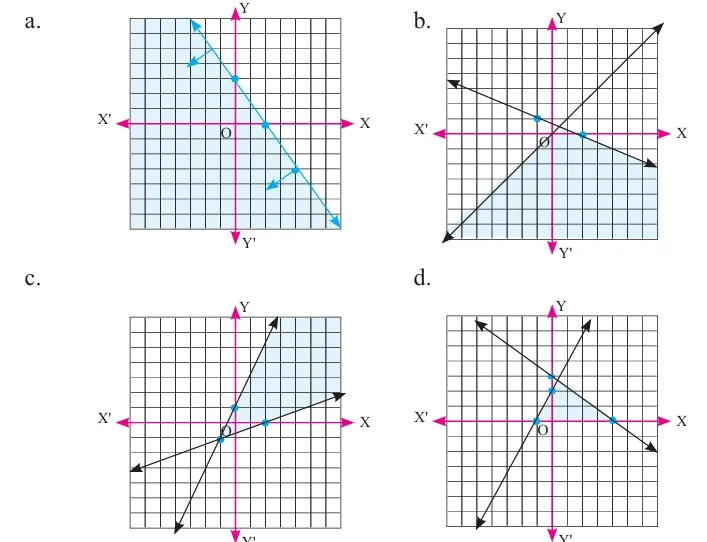
Step 1: Equation of the boundary line
The line passes through \((2,0)\) and \((0,3)\):
\[\frac{x}{2}+\frac{y}{3}=1 \implies 3x+2y=6\]Step 2: Decide the inequality
The shaded region contains the origin. Test \((0,0)\):
\[3(0)+2(0)=0\le 6\]Step 1: Line 1
The line passes through \((0,0)\) and \((-2,1)\), so its equation is \(x+2y=0\). The shaded region is below this line. Test \((0,-1)\):
\[0+2(-1)=-2\le 0 \implies x+2y\le 0\]Step 2: Line 2
The line passes through the origin with slope \(1\), so its equation is \(x-y=0\). The shaded region is below this line. Test \((1,0)\):
\[1-0=1\ge 0 \implies x-y\ge 0\]Step 1: Line 1
The intercepts are \((1,0)\) and \((0,-0.5)\):
\[\frac{x}{1}+\frac{y}{-0.5}=1 \implies x-2y=1\]Step 2: Line 2
The intercepts are \((2,0)\) and \(\left(0,-\frac{2}{3}\right)\):
\[\frac{x}{2}+\frac{y}{-2/3}=1 \implies x-3y=2\]Step 3: Decide the inequalities
The origin lies in the shaded region: \(0\le 1\) and \(0\le 2\) are both true.
Step 1: Line 1
The intercepts are \((-1,0)\) and \((0,2)\):
\[\begin{aligned}& \frac{x}{-1}+\frac{y}{2}=1 \\ &\implies -2x+y=2 \\ &\implies 2x-y=-2\end{aligned}\]Step 2: Line 2
The intercepts are \((4,0)\) and \((0,3)\):
\[\frac{x}{4}+\frac{y}{3}=1 \implies 3x+4y=12\]Step 3: Decide the inequalities
The shaded region contains the origin: \(2(0)-0=0\ge -2\) and \(3(0)+4(0)=0\le 12\). The region is bounded below by the \(x\)-axis, so \(y\ge 0\).
Q.5 Find the maximum and minimum value of the given condition:
- a. Function: \(Z=3x+2y\); \(x+y\ge 6,\ x-y\le 4,\ x\ge 0,\ y\ge 0\)
- b. Function: \(P(x,y)=3x+5y\); \(x+y\le 6,\ x-y\ge 2,\ x\ge 0,\ y\ge 0\)
- c. Function: \(Z=3x+5y\); \(x-2y\le 1,\ x+y\le 4,\ x\ge 0,\ y\ge 0\)
- d. Function: \(F=3x+2y\); \(x-2y\le 2,\ x+2y\le 8,\ x\ge 0,\ y\ge 0\)
- e. Function: \(F(x,y)=2x+y\); \(x+2y\le 10,\ x+y\ge 1,\ y\le 4\)
(निम्नलिखित अवस्थामा अधिकतम र न्यूनतम मान निकाल्नुहोस् : )
Step 1: Find the corner points
Intersect \(x+y=6\) and \(x-y=4\):
\[2x=10 \implies x=5,\ y=1\]Intersect \(x+y=6\) with \(x=0\): \((0,6)\). The region \(x+y\ge 6\) lies away from the origin, so the feasible region is unbounded with corner points \((0,6)\) and \((5,1)\).
Step 2: Evaluate \(Z=3x+2y\)
- At \((0,6)\): \(Z=3(0)+2(6)=12\).
- At \((5,1)\): \(Z=3(5)+2(1)=17\).
Step 3: Conclusion
Because the region is unbounded and the coefficients of \(Z\) are positive, \(Z\) increases without limit, so there is no maximum value. The minimum value is \(12\) at \((0,6)\).
Note on the printed condition
If the first condition is read as \(x+y\le 6\) (a likely misprint), the corner points are \((0,0)\), \((4,0)\), \((5,1)\) and \((0,6)\), giving \(Z=0,\,12,\,17,\,12\). Then the maximum is \(17\) at \((5,1)\) and the minimum is \(0\) at \((0,0)\).
Step 1: Find the corner points
- \(x-y=2\) and \(y=0\) give \((2,0)\).
- \(x+y=6\) and \(y=0\) give \((6,0)\).
- \(x+y=6\) and \(x-y=2\) give \((4,2)\).
Step 2: Evaluate \(P=3x+5y\)
- At \((2,0)\): \(P=3(2)+5(0)=6\).
- At \((6,0)\): \(P=3(6)+5(0)=18\).
- At \((4,2)\): \(P=3(4)+5(2)=12+10=22\).
Step 1: Find the corner points
- \(x-2y=1\) and \(y=0\) give \((1,0)\).
- \(x+y=4\) and \(x=0\) give \((0,4)\).
- \(x-2y=1\) and \(x+y=4\) give \(3y=3\), so \(y=1\), \(x=3\), that is \((3,1)\).
- The origin \((0,0)\) is also a corner point.
Step 2: Evaluate \(Z=3x+5y\)
- At \((0,0)\): \(Z=0\).
- At \((1,0)\): \(Z=3(1)+0=3\).
- At \((3,1)\): \(Z=3(3)+5(1)=14\).
- At \((0,4)\): \(Z=3(0)+5(4)=20\).
Step 1: Find the corner points
The intersection of \(x-2y=2\) and \(x+2y=8\) is found by adding:
\[2x=10 \implies x=5,\ y=\frac{3}{2}\]The other corner points are \((0,0)\), \((2,0)\) and \((0,4)\).
Step 2: Evaluate \(F=3x+2y\)
- At \((0,0)\): \(F=0\).
- At \((2,0)\): \(F=3(2)+0=6\).
- At \(\left(5,\frac{3}{2}\right)\): \(F=3(5)+2\left(\frac{3}{2}\right)=15+3=18\).
- At \((0,4)\): \(F=3(0)+2(4)=8\).
Note on the conditions
The conditions as printed do not include \(y\ge 0\). Without it the region is unbounded below and \(F\) has no maximum. The answer uses the \(x\)-axis as the lower boundary (the corner point \((10,0)\)), so we take \(y\ge 0\).
Step 1: Find the corner points
- \(x+y=1\) and \(y=0\) give \((1,0)\).
- \(x+2y=10\) and \(y=0\) give \((10,0)\).
- \(x+2y=10\) and \(y=4\) give \((2,4)\).
- \(x+y=1\) and \(y=4\) give \((-3,4)\).
Step 2: Evaluate \(F=2x+y\)
- At \((1,0)\): \(F=2(1)+0=2\).
- At \((10,0)\): \(F=2(10)+0=20\).
- At \((2,4)\): \(F=2(2)+4=8\).
- At \((-3,4)\): \(F=2(-3)+4=-2\).
Q.6 Find the four inequalities which are represented by the shaded part from the given graph. Find the maximum and minimum values of the objective function: \(F(x,y)=20x+30y\) from the values that satisfy those inequalities.
(सँगैको लेखाचित्रबाट छाया पारिएको भागले जनाउने चारओटा असमानताहरू पत्ता लगाउनुहोस् । ती असमानताहरूलाई मान्य हुने मानहरूबाट उद्देश्य फलन : \(F(x,y)=20x+30y\) को अधिकतम र न्यूनतम मान निकाल्नुहोस् ।)
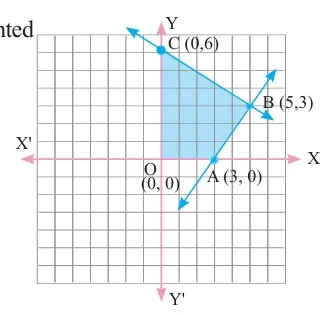
Step 1: Equation of line \(AB\) through \((3,0)\) and \((5,3)\)
\[m=\frac{3-0}{5-3}=\frac{3}{2}\]\[\begin{aligned}& y-0=\frac{3}{2}(x-3) \\ &\implies 2y=3x-9 \\ &\implies 3x-2y=9\end{aligned}\]Test the origin: \(0\le 9\), so the inequality is \(3x-2y\le 9\).
Step 2: Equation of line \(BC\) through \((5,3)\) and \((0,6)\)
\[m=\frac{6-3}{0-5}=-\frac{3}{5}\]\[\begin{aligned}& y-6=-\frac{3}{5}(x-0) \\ &\implies 5y-30=-3x \\ &\implies 3x+5y=30\end{aligned}\]Test the origin: \(0\le 30\), so the inequality is \(3x+5y\le 30\).
Step 3: Axis conditions
The region lies in the first quadrant, so \(x\ge 0\) and \(y\ge 0\).
Step 4: Evaluate \(F=20x+30y\) at the vertices
- At \(O(0,0)\): \(F=0\).
- At \(A(3,0)\): \(F=20(3)+30(0)=60\).
- At \(B(5,3)\): \(F=20(5)+30(3)=100+90=190\).
- At \(C(0,6)\): \(F=20(0)+30(6)=180\).
3. Frequently Asked Questions on Class 10 Optional Mathematics Linear Programming
What is covered in Class 10 Optional Mathematics Linear Programming (Unit 3)? (कक्षा १० ऐच्छिक गणित रेखीय प्रोग्रामिङ (एकाइ ३) मा के के समावेश छ ?)
Class 10 Optional Mathematics Linear Programming is Unit 3 of the Grade 10 Optional Mathematics book of Nepal. Its exercise covers forming inequalities, graphing single inequalities and systems of inequalities, finding the feasible region, finding inequalities from a graph, and finding the maximum and minimum value of an objective function. This page solves all 27 questions.
How do I write words like “at least” and “more than” as inequalities? (“कम्तीमा” र “भन्दा बढी” जस्ता शब्दलाई असमानतामा कसरी लेख्ने ?)
- More than: \(>\)
- At least (not less than): \(\ge\)
- Less than: \(<\)
- At most (not more than): \(\le\)
For example, “more than Rs. 600” is \(x>600\) (Exercise 3, Question 1A).
How do I draw the graph of a linear inequality? (रेखीय असमानताको लेखाचित्र कसरी खिच्ने ?)
- Change the inequality into an equation and find two points (the intercepts).
- Draw the boundary line: solid for \(\le,\ \ge\) and dashed for \(<,\ >\).
- Test a point that is not on the line, usually the origin.
- Shade the side that makes the inequality true.
How do I decide which side of the line to shade? (रेखाको कुन तर्फ छाया पार्ने भनी कसरी निर्धारण गर्ने ?)
Substitute the origin \((0,0)\) in the inequality. If it is true, shade the side containing the origin. If it is false, shade the other side. If the line passes through the origin, test another point such as \((2,0)\) (Exercise 3, Question 2b).
What is a feasible region? (हल क्षेत्र (feasible region) भनेको के हो ?)
The feasible region is the common region that satisfies all the given inequalities at the same time. Its corner points are called vertices. Exercise 3, Question 3 finds the feasible region of several systems.
What is an objective function? (उद्देश्य फलन (objective function) भनेको के हो ?)
It is the expression whose maximum or minimum value is required, for example \(Z=3x+2y\). The variables \(x\) and \(y\) must satisfy all the constraints.
How do I find the maximum and minimum value of the objective function? (उद्देश्य फलनको अधिकतम र न्यूनतम मान कसरी निकाल्ने ?)
- Draw the feasible region and find all its corner points.
- Substitute each corner point in the objective function.
- The largest value is the maximum and the smallest value is the minimum.
Example: in Exercise 3, Question 6, \(F=20x+30y\) has maximum \(190\) at \(B(5,3)\) and minimum \(0\) at \(O(0,0)\).
What if the feasible region is unbounded? (हल क्षेत्र असीमित (unbounded) भए के गर्ने ?)
An unbounded region may have only a minimum or only a maximum, or neither. If the objective function keeps increasing as \(x\) and \(y\) grow, there is no maximum. Exercise 3, Question 5a is an example: \(Z=3x+2y\) has a minimum but no maximum.
How do I find the inequalities from a given graph? (दिइएको लेखाचित्रबाट असमानताहरू कसरी पत्ता लगाउने ?)
- Find the equation of each boundary line from its intercepts, using \(\dfrac{x}{a}+\dfrac{y}{b}=1\), or from two points.
- Test a point of the shaded region in each equation to choose the symbol.
- Add \(x\ge 0\) or \(y\ge 0\) if the region is bounded by an axis.
Are these questions useful for SEE preparation in Nepal? (के यी प्रश्नहरू नेपालमा SEE को तयारीका लागि उपयोगी छन् ?)
Yes, for students who study Optional Mathematics. This set covers every question type of the exercise: forming inequalities, graphs of inequalities, feasible regions, inequalities from graphs and optimization. Practising them builds the skills needed for SEE-style questions.
Are the solutions available in Nepali? (के समाधान नेपाली भाषामा पनि उपलब्ध छन् ?)
Every question is shown in English with the Nepali question in brackets. Multiple choice solutions also have Nepali in brackets. All other solutions are in English only, because the steps and symbols of mathematics are the same in both languages.
Students also search for:
Also Read
- SEE Class 10 Optional Mathematics Notes (all chapters)
- SEE Class 10 Compulsory Mathematics Notes
- SEE Class 10 Science Notes
- Class 10 English Notes (SEE Nepal)
- Nepali Class 10 Vyakaran SEE Notes
- SEE Class 10 Social Studies Notes
- SEE Class 10 Computer Science Notes
- Class 10 Account SEE Notes
- Class 10 Education Notes
- Class 10 Economics Guide