
Volumetric Analysis
NEB Syllabus 2083 • Notes, Formulas and Solved Exercise
Equivalent weight, concentration units, standard substances, the normality equation and titrations, with all formulas, every exercise question solved, and handwritten and typed PDF notes.
1. Syllabus
Unit 1: Volumetric Analysis
1.1 Introduction to gravimetric analysis, volumetric analysis and equivalent weight
1.2 Relationship between equivalent weight, atomic weight and valency
1.3 Equivalent weight of compounds
1.4 Concentration of solution and its units
1.5 Primary and secondary standard substances
1.6 Law of equivalence and normality equation
1.7 Titration and its types
These notes follow the NEB Class 12 Chemistry syllabus (+2 Chemistry, Nepal). Revise the formulas first, practise the multiple choice questions, then work through the short and long answer questions, and finish with the PDF notes.
2. Volumetric Analysis at a Glance
Gravimetric analysis finds the amount of an analyte by converting it into a pure compound that is weighed. Volumetric analysis finds it by measuring the volume of a standard solution (the titrant) that reacts completely with the analyte in a titration.
Equivalent weight
| Substance | n-factor | Examples (equivalent weight) |
|---|---|---|
| Element | Valency | Mg = 24/2 = 12; Fe(III) = 56/3 = 18.67 |
| Acid | Basicity (replaceable H+) | HCl 36.5; H2SO4 49; H3PO4 32.67; oxalic acid dihydrate 63 |
| Base | Acidity (replaceable OH−) | NaOH 40; Ca(OH)2 37 |
| Salt | Total positive (or negative) charge | Na2CO3 53; Na2SO4 71 |
| Oxidising or reducing agent | Electrons gained or lost per formula unit | KMnO4 (acidic) 158/5 = 31.6; K2Cr2O7 294/6 = 49; FeSO4 152; Mohr’s salt 392 |
Concentration of solutions and its units
| Unit | Definition and formula |
|---|---|
| Molarity \(M\) | \(M=\dfrac{\text{moles of solute}}{V\ (\mathrm{L})}=\dfrac{w}{M_w\,V(\mathrm{L})}\) |
| Normality \(N\) | \(N=\dfrac{\text{gram equivalents}}{V\ (\mathrm{L})}=\dfrac{w}{E\,V(\mathrm{L})}=M\times n\text{-factor}\) |
| Molality \(m\) | moles of solute per kilogram of solvent (independent of temperature) |
| Mole fraction | \(X_A=\dfrac{n_A}{n_A+n_B}\) |
| Percentage w/w, w/v | g of solute per 100 g, or per 100 mL, of solution; \(\%\,(w/v)=\%\,(w/w)\times\text{density}\) |
| Molarity from % w/w | \(M=\dfrac{\%\,(w/w)\times\text{density}\times10}{M_w}\) |
| ppm and ppb | parts per \(10^6\) and per \(10^9\) parts of solution; \(1\ \mathrm{ppm}=1000\ \mathrm{ppb}\); in dilute water solutions \(1\ \mathrm{ppm}=1\ \mathrm{mg\,L^{-1}}\) |
Primary and secondary standard substances
| Basis | Primary standard | Secondary standard |
|---|---|---|
| Preparation of solution | Directly by accurate weighing | Must be standardised against a primary standard |
| Properties | Pure, stable, non-hygroscopic, high equivalent weight, soluble | Impure, hygroscopic, volatile or unstable |
| Examples | Oxalic acid, anhydrous Na2CO3, Mohr’s salt | NaOH, HCl, H2SO4, KMnO4 |
Law of equivalence and the normality equation
Substances react in the ratio of their equivalent weights, so at the end point the gram equivalents of the titrant and the analyte are equal.
Titration and its types
| Type | Reaction | Example and indicator |
|---|---|---|
| Acid-base (neutralisation) | Acid + base → salt + water | Oxalic acid with NaOH (phenolphthalein, colourless to pink); HCl with Na2CO3 (methyl orange, red to yellow) |
| Redox | Transfer of electrons | KMnO4 with oxalic acid or Fe2+ (KMnO4 is a self-indicator; end point faint permanent pink) |
| Precipitation (argentometric) | Formation of an insoluble precipitate | AgNO3 with Cl− or Br− |
| Complexometric | Formation of a complex | EDTA with metal ions |
The end point is the stage at which the indicator changes colour; it is chosen to coincide with the equivalence point, where the titrant and analyte are in exactly equivalent amounts.
3. Multiple Choice Questions
Question 1. Which of the following principles is used in gravimetric analysis?
Correct Answer: a) Mass measurement
Reason: Gravimetric analysis determines the mass of a pure compound to which the analyte is chemically related.
Question 2. Ferrosoferric oxide (magnetite) is an iron oxide with the chemical formula Fe3O4. What is the equivalent weight of iron in the oxide?
Correct Answer: c) 18.6
Reason: Fe3O4 is FeO·Fe2O3. Taking the valency of iron as 3:
Question 3. Potassium dichromate (K2Cr2O7) is an orange-red crystalline compound and a powerful oxidizing agent. What is the equivalent weight of this oxidizing agent, having molecular weight \(M\), in the following ionic equation?
Cr2O72−(aq) + SO32−(aq) → Cr3+(aq) + SO42−(aq)
Correct Answer: d) \(M/6\)
Reason: Each Cr changes from +6 to +3, a gain of 3 electrons. Two Cr atoms give 6 electrons per formula unit, so the equivalent weight is \(M/6\).
Question 4. If 1 ppm means one part per million, then what is the meaning of 1 ppb?
Correct Answer: b) One part per billion
Reason: ppb means 1 part of solute in \(10^{9}\) parts of solution.
Question 5. Which of the following is a primary standard substance used to prepare a standard solution in volumetric analysis?
Correct Answer: c) Oxalic acid (C2H2O4)
Reason: Oxalic acid is available in a pure, stable state and can be weighed accurately to make a standard solution directly. HCl, NaOH and KMnO4 are secondary standards.
Question 6. Which one of the following is NOT a characteristic of a good primary standard substance?
Correct Answer: d) High hygroscopicity
Reason: A hygroscopic substance absorbs moisture from the air, so a known mass of the pure substance cannot be weighed accurately.
Question 7. The law of equivalence is a fundamental principle in chemistry, particularly in stoichiometry and titration. The law of equivalence states that at the endpoint of a titration:
Correct Answer: b) The number of equivalents of acid equals the number of equivalents of base
Reason: Substances react in the ratio of their equivalent weights, so at complete neutralisation the gram equivalents of acid and base are equal.
Question 8. If 25 mL of a deci-molar H2SO4 solution reacts completely with 50 mL of a NaOH solution, what is the molarity of the NaOH solution?
Correct Answer: b) 0.1 M
Reason: Deci-molar H2SO4 is 0.1 M. Its basicity is 2, so \(N=0.2\ \mathrm{N}\). By \(N_1V_1=N_2V_2\):
NaOH has an acidity of 1, so its molarity is also 0.1 M.
Question 9. In a redox titration involving potassium permanganate (KMnO4) and oxalic acid (C2H2O4), which of the following statements is true regarding KMnO4?
Correct Answer: a) An oxidizing agent because it gains electrons
Reason: KMnO4 oxidises oxalic acid and is itself reduced (Mn7+ to Mn2+). Reduction is the gain of electrons.
Question 10. If 0.5 g of Na2CO3 is dissolved in 100 mL of solution, what is the molarity of the solution thus prepared? (Molecular weight of Na2CO3 = 106 g/mol)
Correct Answer: a) 0.047 M
Question 11. You are asked to prepare a 0.25 M solution of NaOH using 20 g of it. What volume of solution can be made using this amount?
Correct Answer: c) 2.0 L
Question 12. A 25 mL semi-molar solution of HCl is titrated with 0.5 N Na2CO3 solution. What volume of titrant should be added from the burette for one-fourth neutralization of the analyte in the conical flask?
Correct Answer: d) 6.25 mL
Reason: Semi-molar HCl is 0.5 M = 0.5 N. Full neutralisation needs
One-fourth neutralisation needs \(25/4=6.25\ \mathrm{mL}\).
Question 13. You are given a solution of 0.2 M sulfuric acid (H2SO4). How many grams of H2SO4 are present in 500 mL of this solution?
Correct Answer: a) 9.8 g
Question 14. A solution contains 20 g of NaOH in 500 mL of water. If the solution is diluted 2 times, what is true for the diluted solution compared to the original solution?
Correct Answer: b) Moles of NaOH remain the same
Reason: Adding solvent changes the volume and the concentration, but the amount of solute (moles) does not change.
Question 15. A 0.7 g sample of an unknown monoprotic acid requires 35 mL of 0.1 M NaOH for complete neutralization. What is the equivalent weight of the acid?
Correct Answer: c) 200
Question 16. You are tasked with preparing a solution of HCl. If you have 36.5 g of HCl and need to prepare 1 liter of a 0.5 N solution, what volume of water should be added to the HCl?
Correct Answer: c) 2 L
Reason: 36.5 g of HCl is 1 gram equivalent. For a 0.5 N solution:
The HCl is therefore diluted with water to a total volume of 2 L.
4. Short Answer Questions
a) Molarity and normality
Molarity (M) is the number of moles of solute dissolved per litre of solution, \(M=\dfrac{\text{moles}}{V\ (\mathrm{L})}\). Normality (N) is the number of gram equivalents of solute dissolved per litre of solution, \(N=\dfrac{\text{gram equivalents}}{V\ (\mathrm{L})}\). The two are related by \(N=M\times n\text{-factor}\).
b) ppm and ppb
ppm (parts per million) is the mass of solute present in \(10^{6}\) parts by mass of solution. ppb (parts per billion) is the mass of solute present in \(10^{9}\) parts by mass of solution, so \(1\ \mathrm{ppm}=1000\ \mathrm{ppb}\).
c) Molarity and molality
Molarity is moles of solute per litre of solution and changes with temperature because the volume changes. Molality is moles of solute per kilogram of solvent and does not change with temperature because it depends only on masses.
d) No. of gram moles and no. of gram equivalents
The number of gram moles is the mass of a substance divided by its molar mass. The number of gram equivalents is the mass of the substance divided by its equivalent weight, where equivalent weight \(=\dfrac{\text{molar mass}}{n\text{-factor}}\).
e) Primary and secondary standard substances
A primary standard is a pure, stable, non-hygroscopic substance whose standard solution can be prepared directly by accurate weighing, for example oxalic acid. A secondary standard cannot be weighed accurately because it is impure, hygroscopic, volatile or unstable, so its solution must be standardised against a primary standard, for example NaOH and KMnO4.
f) Acid-base and redox titrations
An acid-base titration is based on the neutralisation reaction between an acid and a base. A redox titration is based on an oxidation-reduction reaction in which electrons are transferred from a reducing agent to an oxidising agent.
a) Define volumetric analysis. How is it different from gravimetric analysis?
Volumetric analysis is a quantitative method in which the volume of a solution of known concentration needed to react completely with the analyte is measured. In gravimetric analysis the analyte is precipitated as a pure compound, filtered, dried and weighed, so the quantity measured is mass instead of volume.
b) What is the application of volumetric analysis in chemistry?
It is used to find the unknown concentration of acids, bases, oxidising agents and reducing agents, and for quality control in industry, for example to determine acetic acid in vinegar.
c) Write any one limitation of volumetric analysis.
The volume of a solution changes with temperature, so the molarity and normality change and the results depend on the temperature at which they are measured.
a) Write the balanced chemical equation for the reaction.
b) Calculate the percentage of barium chloride in the original sample.
Molar mass of BaSO4 = 137.33 + 32.06 + 4(16) = 233.39 g/mol, and of BaCl2 = 137.33 + 2(35.45) = 208.23 g/mol.
c) Explain why excess sulfuric acid is used.
The excess sulfate ions shift the equilibrium towards BaSO4 by the common-ion effect. This makes the precipitation complete and reduces the loss of barium sulfate by dissolving.
| Substance | Property |
|---|---|
| HCl | It absorbs CO2 and moisture from the air |
| I2 | It is reduced by sunlight |
| H2SO4 | It is a gas |
| NaOH | It absorbs moisture from the air |
| KMnO4 | It sublimes |
The correct matches are:
| Substance | Property |
|---|---|
| HCl | It is a gas (its solutions lose HCl and change concentration) |
| I2 | It sublimes |
| H2SO4 | It absorbs moisture from the air |
| NaOH | It absorbs CO2 and moisture from the air |
| KMnO4 | It is reduced by sunlight |
H3PO4 + KOH → K3PO4 + H2O
FeSO4 + 7H2SO4 + K2Cr2O7 → 3Fe2(SO4)3 + K2SO4 + Cr2(SO4)3 + 7H2O
a) Equivalent weight and its relation with atomic weight and valency
The equivalent weight of a substance is the mass of it that combines with or displaces 1 g of hydrogen, 8 g of oxygen or 35.5 g of chlorine.
For a compound the molecular weight is divided by the n-factor.
b) Equivalent weights of H3PO4 and K2Cr2O7
H3PO4: in this reaction all 3 H+ ions are replaced (K3PO4 is formed), so the basicity is 3:
K2Cr2O7: each Cr changes from +6 to +3, so two Cr atoms gain 6 electrons:
a) What do you mean by 68% (w/w)?
It means that 68 g of pure HNO3 is present in 100 g of the solution.
b) Convert the given concentration into w/v.
c) Calculate the mass of HNO3 dissolved in 1 liter of solution.
The mass of 1 L (1000 mL) of solution is \(1000\times1.4=1400\ \mathrm{g}\).
d) Which of the concentration units w/v or w/w depends upon temperature and why?
The w/v unit depends on temperature, because the volume of a solution expands or contracts as the temperature changes. The w/w unit uses only masses, which do not change with temperature.
a) State the “law of equivalence”. How is this law useful in titration?
The law of equivalence states that chemical substances react together in the ratio of their equivalent weights, so equal numbers of gram equivalents of the reactants take part in a reaction. In a titration, the gram equivalents of the titrant and the analyte are equal at the end point, which gives the normality equation \(N_1V_1=N_2V_2\) and makes the calculation of an unknown concentration simple.
b) Use this law to calculate the mass of magnesium metal that is enough to react completely with 250 mL of decinormal sulfuric acid.
a) What do you mean by a standard solution? Why is such a solution important in volumetric analysis?
A standard solution is a solution whose concentration is known accurately. It is important because it is the reference solution (titrant) used to find the unknown concentration of other solutions.
b) Write any three characteristics of Mohr’s salt so that it is used as a primary standard substance.
First, it is stable and is not easily oxidised by air, unlike simple FeSO4. Second, it is non-hygroscopic and can be weighed accurately. Third, it has a high equivalent weight (392), which reduces the error in weighing.
c) Why is this salt called a double salt?
It crystallises as a single substance from a solution containing two salts, (NH4)2SO4 and FeSO4, but in water it gives the ions of both salts, NH4+, Fe2+ and SO42−.
(a) % w/v: 80 mg/dL is 0.080 g in 100 mL, so the concentration is 0.080% (w/v).
(b) g/L:
(c) ppm and ppb: 1 L of blood weighs about 1000 g, so
(d) Molarity: the molar mass of glucose (C6H12O6) is 180 g/mol:
a) Calculate the number of moles present in 500 mL of a 0.100 M solution of HCl.
b) How much volume of HCl solution should the student use to prepare the desired solution?
c) What precautions should be followed during this work and why?
The concentrated acid should always be added slowly to water, with constant stirring, and never water to the acid, because the dilution is strongly exothermic and the acid can splash. Gloves, goggles and a lab coat should be worn, and the work should be done in a well-ventilated place because concentrated HCl gives off fumes.
a) Name the type of titration. Why is it called so?
It is a precipitation titration (argentometric titration). It is called so because the reaction between Ag+ and the halide ions forms insoluble precipitates of AgCl and AgBr.
b) If 25.00 mL of AgNO3 is required to reach the endpoint, what is the percentage of NaCl in the mixture?
Let the mass of NaCl be \(x\) g, so the mass of NaBr is \((0.500-x)\) g. The moles of Ag+ used equal the moles of Cl− plus Br−:
Solving for \(x\) gives the mass of NaCl, and the percentage of NaCl is \(\dfrac{x}{0.500}\times100\).
a) Write the balanced redox equation for the reaction between KMnO4 and H2C2O4.
In ionic form: \(\mathrm{2MnO_4^-+5H_2C_2O_4+6H^+\rightarrow2Mn^{2+}+10CO_2+8H_2O}\).
b) If 25 mL of 0.1 M KMnO4 is required to completely oxidize 50 mL of oxalic acid solution, calculate the molarity of the oxalic acid solution.
2 mol of KMnO4 react with 5 mol of oxalic acid:
5. Long Answer Questions
a) What do you mean by 0.5 N concentration of acid?
It means that each litre of the solution contains 0.5 gram equivalents of the acid.
b) Calculate the volume of concentrated sulfuric acid (H2SO4) required to prepare 100 liters of 0.5 N.
Molarity and normality of the concentrated acid:
c) Discuss any safety concerns and precautions that must be taken when preparing and handling such concentrated acid solutions in large quantities.
Concentrated H2SO4 is highly corrosive and dilution releases a large amount of heat. Gloves, goggles, a lab coat and an apron should be worn. The acid must be added slowly to a large volume of water, with constant stirring and cooling, never water to the acid, so that the heat is dissipated safely and the acid does not splash. The work should be done in a well-ventilated area with a safety shower and eyewash nearby, and spills should be neutralised with sodium bicarbonate.
a) What do you mean by 2% (w/v)?
It means that 2 g of NaCl is dissolved in every 100 mL of the solution.
b) Calculate the molarity and normality of this solution if its density is 1.02 g/mL.
The concentration is given as w/v, so the density is not needed. The solution contains 2 g per 100 mL, that is 20 g/L:
The n-factor of NaCl is 1, so the normality is also \(0.342\ \mathrm{N}\).
c) Why are different units needed for concentration measurement?
Different situations need different information. Molarity and normality are based on volume and are convenient in titrations, percentage units are used in everyday and medical preparations, ppm and ppb express very small amounts, and molality is used where temperature changes matter because it does not depend on volume.
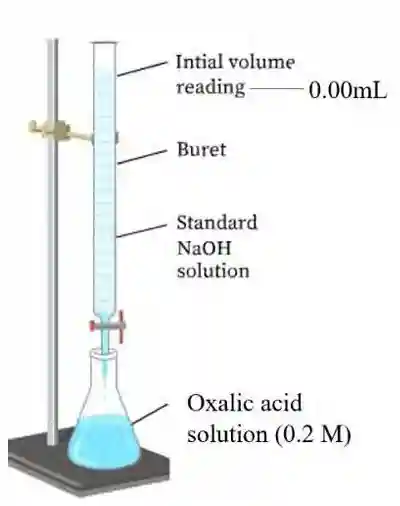
Figure: Standard NaOH solution in the burette (initial reading 0.00 mL) and oxalic acid solution (0.2 M) in the conical flask
a) Identify the type of titration, analyte and titrant in the figure.
It is an acid-base (neutralisation) titration. The analyte is the oxalic acid solution in the conical flask and the titrant is the standard NaOH solution in the burette.
b) Write the chemical reaction involved.
c) Calculate the volume of NaOH added from the burette for the complete reaction with 25 mL of oxalic acid.
Deci-molar NaOH is 0.1 M. The oxalic acid contains \(0.2\times25=5\ \mathrm{mmol}\), and each mole needs 2 mol of NaOH:
d) What is the concentration of the mixture in the conical flask when the oxalic acid is half neutralized?
Half of the oxalic acid (2.5 mmol) reacts with 5 mmol of NaOH, that is 50 mL of the titrant, and forms 2.5 mmol of Na2C2O4. The other 2.5 mmol of H2C2O4 remains. The total volume is \(25+50=75\ \mathrm{mL}\):
a) What do you mean by 0.1 M HCl?
It means that each litre of the solution contains 0.1 mole of HCl.
b) Find the volume of sulfuric acid required to prepare 200 mL of 0.2 M from the bottle containing 98% (w/v) H2SO4 and having a density of 1.8 g/L.
98% (w/v) means 98 g in 100 mL, that is 980 g/L, so the density is not needed:
c) Calculate the normality of the acid mixture in the container.
d) What happens to the concentration of the acid mixture when 700 mL of water is added? Calculate the concentration of the diluted solution.
The concentration decreases, because the same amount of acid is now present in a larger volume. The new volume is \(300+700=1000\ \mathrm{mL}\):
a) Why is it necessary to standardize a solution before using it in a titration?
KMnO4 is a secondary standard, so a solution made by weighing it does not have an exactly known concentration. It is also slowly decomposed by light and by traces of organic matter. Standardisation against a primary standard gives its exact concentration.
b) What is the end point color change in this titration keeping KMnO4 in the burette as the titrant?
The solution in the flask changes from colourless to a faint, permanent pink, because KMnO4 acts as its own indicator.
c) Why is it necessary to warm the conical flask before the titration?
The reaction between permanganate and oxalic acid is slow at room temperature. Warming to about 60–70 °C speeds it up so that the end point is sharp.
d) If 25.00 mL of KMnO4 solution is required to titrate 0.250 g of oxalic acid, what is the molarity of the KMnO4 solution?
The molar mass of H2C2O4 is 90 g/mol:
2 mol of KMnO4 react with 5 mol of oxalic acid:
a) What is the number of moles of KMnO4 required to react with 1 mole of iron sulfate?
From the equation, 1 mol of MnO4− reacts with 5 mol of Fe2+, so 1 mol of FeSO4 needs \(\dfrac15=0.2\) mol of KMnO4.
b) Calculate the equivalent weight of KMnO4 and FeSO4 in the given equation (atomic mass of Mn = 55, Fe = 56).
KMnO4 (M = 39 + 55 + 64 = 158) gains 5 electrons; FeSO4 (M = 56 + 32 + 64 = 152) loses 1 electron:
c) What is the indicator in the given titration and why?
KMnO4 itself acts as the indicator (self-indicator). Its purple colour disappears as it is reduced to colourless Mn2+, and one extra drop beyond the end point gives a permanent pink colour.
d) If a 25.0 mL sample of iron(II) sulfate requires 20.0 mL of 0.02 M KMnO4 for a complete reaction, calculate the concentration of the iron(II) sulfate solution.
a) A bottle of a tile cleanser contains 135 g of HCl and 775 g of water. What is the percent by mass of HCl in this cleanser?
b) How many grams of FeSO4 are present in a solution marked 0.35 M FeSO4?
A 0.35 M solution contains 0.35 mol of FeSO4 in every litre. With a molar mass of 151.9 g/mol:
c) Calculate the concentration in grams per liter of bench hydrochloric acid whose concentration is 12 mol/L.
d) “Concentrated” hydrochloric acid is an aqueous solution of 37.2% HCl that is commonly used as a laboratory reagent. The density of this solution is 1.19 g/mL. What mass of HCl is contained in 0.500 L of this solution?
e) What volume of 0.01 M KMnO4 solution will contain 5 g of KMnO4?
f) 1 g of caustic soda is added to 2 liters of \(X\) M sulfuric acid so that the pH of the resulting solution is 7. Find the value of \(X\).
At pH 7 the acid is exactly neutralised. The moles of NaOH (and of OH−) are \(\dfrac{1}{40}=0.025\ \mathrm{mol}\). The acid supplies \(2\times2X=4X\) mol of H+:
g) What volumes of 12 M and 2 M NaOH solution should be mixed to prepare 2 liters of a 9 M solution?
Let the volume of 12 M NaOH be \(V\) litres, so the volume of 2 M NaOH is \((2-V)\) litres. The moles of NaOH are conserved:
So 1.4 L of 12 M NaOH and 0.6 L of 2 M NaOH are mixed.
h) Calculate the volume of 1 M NaOH required to neutralize 200 mL of 2 N HCl. What mass of NaCl is produced from the neutralization reaction?
i) Two liters of molar H2SO4 are mixed with one liter of normal NaOH solution. Calculate the strength of the mixture and the mass of salt produced from the reaction.
Molar H2SO4 is 2 N, so the acid has \(2\times2=4\) eq and the base has \(1\times1=1\) eq. The acid left over is \(4-1=3\) eq in a total volume of 3 L:
The salt formed is Na2SO4 (equivalent weight 71) and 1 eq of it is produced, so its mass is 71 g.
j) 50 mL of 2 N H2SO4 is mixed with 30 mL of 3 N NaOH. Predict whether the solution is acidic, basic or neutral. Also, calculate the resulting strength of the solution.
Acid: \(50\times2=100\ \mathrm{meq}\). Base: \(30\times3=90\ \mathrm{meq}\). The acid is in excess by 10 meq, so the solution is acidic:
k) A 1.20 g sample of lye (sodium hydroxide is sold commercially as solid lye) required 45.0 mL of 0.5 M hydrochloric acid to neutralize. Calculate the percentage purity of NaOH in the sample.
l) 5.125 g of washing soda crystals are dissolved and made up to 250 mL. 25.0 mL of this solution requires 35.8 mL of 0.05 M sulfuric acid for complete neutralization. Calculate the percentage of sodium carbonate in the washing soda crystals.
0.05 M H2SO4 is 0.1 N. In 25.0 mL the Na2CO3 equals \(35.8\times0.1=3.58\ \mathrm{meq}\), so in 250 mL it is 35.8 meq = 0.0358 eq. The equivalent weight of Na2CO3 is \(106/2=53\):
m) At a blood alcohol level above 500 mg per 100 mL, a person may die. What is the molar concentration of alcohol (ethanol) at the lethal level?
500 mg per 100 mL is 5 g/L, and the molar mass of ethanol (C2H5OH) is 46 g/mol:
n) 8.492 g of salts having the formula (NH4)2SO4·nH2O were dissolved and made up to 250 mL using dilute acid and water. A 25.0 mL of this solution was titrated against a potassium permanganate solution of concentration 0.015 M, and 22.5 mL was consumed at the end point. Calculate the value of \(n\).
Only Fe2+ is oxidised by KMnO4, so the salt that reacts is the iron(II) double salt (NH4)2SO4·FeSO4·\(n\)H2O, whose anhydrous part, (NH4)2Fe(SO4)2, has a molar mass of 284 g/mol.
In the whole 250 mL there is \(1.6875\times10=16.875\ \mathrm{mmol}\), so
o) A commercial bleach solution contains 3.62% mass NaOCl in water. Calculate (a) the mole fraction and (b) the molality of NaOCl in the solution.
In 100 g of solution there are 3.62 g of NaOCl (molar mass 74.5 g/mol) and 96.38 g of water:
(a) Mole fraction:
(b) Molality:
6. View PDF Notes
i. Handwritten Notes
ii. Typed PDF Notes
7. Frequently Asked Questions
What is volumetric analysis in Class 12 Chemistry?
What is the difference between gravimetric and volumetric analysis?
What is equivalent weight and how is it calculated?
What are the equivalent weights of common acids, bases and oxidising agents?
What are molarity, normality and molality?
What are ppm and ppb?
How do you convert between percentage by mass, percentage by volume and molarity?
What is a primary standard substance?
What is a secondary standard substance and why can NaOH, HCl and KMnO₄ not be primary standards?
What is the law of equivalence and the normality equation?
What are the types of titration?
Which indicator is used for which acid-base titration?
Why is the KMnO₄ and oxalic acid titration carried out warm and in acidic medium?
What is Mohr’s salt and why is it a double salt?
What are the most important formulas of volumetric analysis?
What are the important questions from Volumetric Analysis for Class 12 NEB?
What topics are included in Unit 1 Volumetric Analysis of NEB Class 12 Chemistry?
Where can I download Volumetric Analysis Class 12 notes in PDF for free?
Students also search for: