
Ionic Equilibrium
Class 12 Chemistry Notes • NEB Syllabus 2083
Syllabus, 23 solved multiple choice questions, step-by-step numerical solutions, formulas, handwritten and typed PDF notes and frequently asked questions on acids and bases, pH, buffer solutions, solubility product and hydrolysis of salts.
1. Syllabus
Unit 2: Ionic Equilibrium
These notes follow the NEB Class 12 Chemistry syllabus (+2 Chemistry, Nepal). Practise the multiple choice questions first, then work through the solved numerical and subjective questions, and finish with the PDF notes for quick revision.
2. Multiple Choice Questions
Question 1. Which of the following is a limitation of Arrhenius’s concept of acids and bases?
- a) It cannot explain the acidic behavior of substances in non-aqueous solvents.
- b) It does not consider the ionization of bases.
- c) It fails to differentiate between weak and strong acids.
- d) It defines acids and bases only based on pH.
Correct Answer: a) It cannot explain the acidic behavior of substances in non-aqueous solvents.
Reason: The Arrhenius concept limits acids and bases to aqueous solutions (acids give \(\mathrm{H^+}\) and bases give \(\mathrm{OH^-}\) in water). It cannot explain acidity or basicity in the gas phase or in non-aqueous solvents such as liquid ammonia.
Question 2. Which of the following statements is in agreement with the Brønsted-Lowry concept?
- a) A base is an electron-pair donor.
- b) Acids and bases are proton donors and acceptors, respectively.
- c) Acids and bases are substances that increase \(\mathrm{H^+}\) and \(\mathrm{OH^-}\) in water.
- d) Acids and bases are proton acceptors and donors, respectively.
Correct Answer: b) Acids and bases are proton donors and acceptors, respectively.
Reason: According to Brønsted and Lowry, an acid is a species that donates a proton (\(\mathrm{H^+}\)) and a base is a species that accepts a proton.
Question 3. Which of the following is the conjugate acid of \(\mathrm{NH_3}\)?
- a) \(\mathrm{NH_4^+}\)
- b) \(\mathrm{NH_2^-}\)
- c) \(\mathrm{NH_3}\)
- d) \(\mathrm{OH^-}\)
Correct Answer: a) \(\mathrm{NH_4^+}\)
Reason: A conjugate acid is formed when a base accepts a proton: \(\mathrm{NH_3+H^+\rightarrow NH_4^+}\).
Question 4. The relative strength of an acid is affected by various factors. Which of the following best explains the relative strength?
- a) Its pH value.
- b) The stability of its conjugate base.
- c) The amount of water it can dissolve.
- d) Both a and b.
Correct Answer: b) The stability of its conjugate base.
Reason: The more stable the conjugate base formed after the acid donates its proton, the more easily the acid ionizes, and so the stronger the acid is.
Question 5. \(\mathrm{HCl}\) is a stronger acid than \(\mathrm{HF}\). Which of the following statements gives the correct explanation?
- a) \(\mathrm{HCl}\) has a lower bond dissociation enthalpy.
- b) \(\mathrm{HCl}\) ionizes more completely in water.
- c) \(\mathrm{HCl}\) is less electronegative.
- d) All of these.
Correct Answer: a) \(\mathrm{HCl}\) has a lower bond dissociation enthalpy.
Reason: The chlorine atom is much larger than the fluorine atom, so the \(\mathrm{H-Cl}\) bond is longer and weaker than the \(\mathrm{H-F}\) bond. The lower bond dissociation enthalpy lets \(\mathrm{HCl}\) donate its proton more easily.
Question 6. A Lewis acid is a lone pair acceptor. Which of the following is not a Lewis acid?
- a) \(\mathrm{BF_3}\)
- b) \(\mathrm{AlCl_3}\)
- c) \(\mathrm{NH_3}\)
- d) \(\mathrm{H^+}\)
Correct Answer: c) \(\mathrm{NH_3}\)
Reason: Ammonia has a lone pair of electrons on nitrogen, which it donates. It is therefore a Lewis base. \(\mathrm{BF_3}\), \(\mathrm{AlCl_3}\) and \(\mathrm{H^+}\) have vacant orbitals and accept a lone pair.
Question 7. A Lewis base must have:
- a) An unshared pair of electrons.
- b) A proton donor capability.
- c) A hydroxide group.
- d) None of these.
Correct Answer: a) An unshared pair of electrons.
Reason: A Lewis base is an electron-pair donor, so it must have at least one unshared (lone) pair of electrons to form a coordinate covalent bond.
Question 8. The reaction between a carbocation and a water molecule is shown below. What is the reason for developing a positive charge on the oxygen after the reaction?
\(\mathrm{(CH_3)_3C^{+}+:OH_2\longrightarrow(CH_3)_3C-\overset{+}{O}H_2}\)
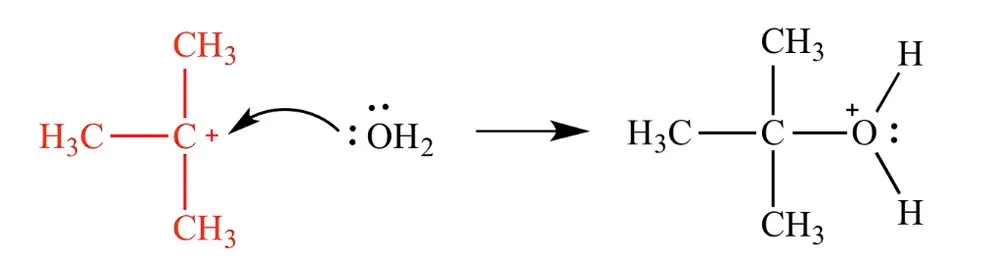
Figure: Reaction of a carbocation with a water molecule
- a) Oxygen has gained a lone pair of electrons.
- b) Oxygen has lost protons.
- c) Oxygen has gained protons.
- d) Oxygen has lost a lone pair of electrons.
Correct Answer: d) Oxygen has lost a lone pair of electrons.
Reason: Oxygen shares one of its lone pairs with the electron-deficient carbon to form a new covalent bond. Oxygen then has three bonds and one lone pair, and the formal charge on oxygen becomes +1.
Question 9. According to Ostwald’s dilution law, which of the following is true about the degree of ionization of a weak electrolyte?
- a) Inversely proportional to its concentration.
- b) Directly proportional to its concentration.
- c) Independent of its concentration.
- d) Inversely proportional to temperature.
Correct Answer: a) Inversely proportional to its concentration.
Reason: Ostwald’s dilution law gives \(K_a\approx C\alpha^2\), so \(\alpha=\sqrt{K_a/C}\). The degree of ionization increases as the concentration decreases, that is, on dilution.
Question 10. Which of the following statements explains the lower ionization of acetic acid?
- a) It has a low dissociation constant.
- b) Its equilibrium constant is high.
- c) It cannot dissociate in water.
- d) It is an organic acid.
Correct Answer: a) It has a low dissociation constant.
Reason: The dissociation constant measures the extent of ionization. Acetic acid has a low \(K_a\) (\(1.8\times10^{-5}\)), so only a small fraction of its molecules are ionized at equilibrium.
Question 11. The ionic product of water (\(K_w\)) depends upon temperature. Which of the following can increase the value of \(K_w\)?
- a) Decreasing temperature because the ionization of water decreases.
- b) Increasing temperature because the ionization of water decreases.
- c) Decreasing temperature because the ionization of water increases.
- d) Increasing temperature because the ionization of water increases.
Correct Answer: d) Increasing temperature because the ionization of water increases.
Reason: The ionization of water, \(\mathrm{H_2O\rightleftharpoons H^++OH^-}\), is endothermic. By Le Chatelier’s principle, raising the temperature shifts the equilibrium forward, giving more ions and a larger \(K_w\).
Question 12. Which acid has the highest \(pK_a\) value?
- a) \(\mathrm{HCl}\)
- b) \(\mathrm{HF}\)
- c) \(\mathrm{HNO_2}\)
- d) \(\mathrm{CH_3COOH}\)
Correct Answer: d) \(\mathrm{CH_3COOH}\)
Reason: \(pK_a=-\log K_a\), so the weakest acid has the highest \(pK_a\). Among the given acids, acetic acid is the weakest (\(pK_a\approx4.76\)).
Question 13. Which solution has the highest pH value?
- a) \(10^{-2}\ \mathrm{M\ HCl}\)
- b) \(10^{-3}\ \mathrm{M\ NaOH}\)
- c) Pure water
- d) \(10^{-2}\ \mathrm{M\ NH_4OH}\)
Correct Answer: b) \(10^{-3}\ \mathrm{M\ NaOH}\)
Reason: \(\mathrm{NaOH}\) is a strong base: \([\mathrm{OH^-}]=10^{-3}\), pOH = 3, pH = 11. \(\mathrm{NH_4OH}\) is a weak base and is only partly ionized, so \(10^{-2}\ \mathrm{M}\) \(\mathrm{NH_4OH}\) has a pH of about 10.6, lower than 11.
Question 14. Which of the following statements best describes the solubility product (\(K_{sp}\)) of a salt?
- a) The product of the molar solubility of its ions.
- b) The equilibrium constant for the dissolution reaction.
- c) The maximum concentration of solute in a solution.
- d) Both a and b.
Correct Answer: d) Both a and b.
Reason: \(K_{sp}\) is the equilibrium constant for the dissolution of a sparingly soluble salt. It is calculated as the product of the equilibrium concentrations of its ions, each raised to the power of its coefficient.
Question 15. Which of the following salts is least soluble in water at \(25^\circ\mathrm{C}\)?
- a) \(\mathrm{AgCl}\) (\(K_{sp}=1.8\times10^{-10}\))
- b) \(\mathrm{PbCl_2}\) (\(K_{sp}=1.6\times10^{-5}\))
- c) \(\mathrm{BaSO_4}\) (\(K_{sp}=1.1\times10^{-10}\))
- d) \(\mathrm{CaCO_3}\) (\(K_{sp}=4.9\times10^{-9}\))
Correct Answer: c) \(\mathrm{BaSO_4}\) (\(K_{sp}=1.1\times10^{-10}\))
Reason: For the binary salts, \(s=\sqrt{K_{sp}}\): \(\mathrm{AgCl}\) \(1.34\times10^{-5}\) M, \(\mathrm{BaSO_4}\) \(1.05\times10^{-5}\) M, \(\mathrm{CaCO_3}\) \(7.0\times10^{-5}\) M. For \(\mathrm{PbCl_2}\), \(s=\sqrt[3]{K_{sp}/4}=1.59\times10^{-2}\) M. \(\mathrm{BaSO_4}\) has the smallest solubility.
Question 16. Which of the following pairs can resist the change in pH even after the addition of 2 drops of \(\mathrm{NaOH}\)?
- a) \(\mathrm{HCl}\) and \(\mathrm{NaOH}\)
- b) \(\mathrm{CH_3COOH}\) and \(\mathrm{CH_3COONa}\)
- c) \(\mathrm{NaCl}\) and \(\mathrm{NaOH}\)
- d) \(\mathrm{HNO_3}\) and \(\mathrm{NH_4OH}\)
Correct Answer: b) \(\mathrm{CH_3COOH}\) and \(\mathrm{CH_3COONa}\)
Reason: A weak acid with its salt of a strong base forms an acidic buffer. The \(\mathrm{CH_3COO^-}\) ion removes added \(\mathrm{H^+}\) and the \(\mathrm{CH_3COOH}\) removes added \(\mathrm{OH^-}\), so the pH remains almost constant.
Question 17. The pH of a buffer solution is determined by:
- a) The concentration of acid and base.
- b) The \(pK_a\) of the weak acid used.
- c) The volume of the solution.
- d) Both a and b.
Correct Answer: d) Both a and b.
Reason: By the Henderson-Hasselbalch equation, \(\mathrm{pH}=pK_a+\log\dfrac{[\text{salt}]}{[\text{acid}]}\), the pH depends on the \(pK_a\) of the weak acid and on the ratio of the concentrations of salt and acid.
Question 18. Phenolphthalein is suitable for titrations involving:
- a) Strong acid and strong base.
- b) Weak acid and weak base.
- c) Weak acid and strong base.
- d) Both a and c.
Correct Answer: d) Both a and c.
Reason: Phenolphthalein changes colour in the pH range 8.2 to 10.0. In a strong acid-strong base titration the pH changes sharply from about 4 to 10 around the equivalence point, which includes this range. In a weak acid-strong base titration the equivalence point is above pH 7, which matches this range.
Question 19. Hydrolysis of salt can result in an acidic, basic, or neutral solution. Which of the following solutions will be acidic due to hydrolysis?
- a) \(\mathrm{NaCl}\)
- b) \(\mathrm{NH_4Cl}\)
- c) \(\mathrm{KNO_3}\)
- d) \(\mathrm{Na_2SO_4}\)
Correct Answer: b) \(\mathrm{NH_4Cl}\)
Reason: \(\mathrm{NH_4Cl}\) is the salt of a weak base (\(\mathrm{NH_4OH}\)) and a strong acid (\(\mathrm{HCl}\)). The \(\mathrm{NH_4^+}\) ion hydrolyzes: \(\mathrm{NH_4^++H_2O\rightleftharpoons NH_3+H_3O^+}\), so the solution is acidic.
Question 20. Which of the following is an acidic salt and why is it called so?
- a) \(\mathrm{Na_2SO_4}\) because of cationic hydrolysis.
- b) \(\mathrm{NH_4Cl}\) because of cationic hydrolysis.
- c) \(\mathrm{KCl}\) because of cationic hydrolysis.
- d) \(\mathrm{NH_4NO_3}\) because of cationic hydrolysis.
Correct Answer: b) \(\mathrm{NH_4Cl}\) because of cationic hydrolysis.
Reason: The \(\mathrm{NH_4^+}\) cation reacts with water (cationic hydrolysis) and produces \(\mathrm{H_3O^+}\) ions, so the solution of \(\mathrm{NH_4Cl}\) is acidic.
Question 21. A solution of \(\mathrm{NaCl}\) does not undergo hydrolysis. What is the correct reason behind it?
- a) It is a salt of a weak acid and a strong base.
- b) Both \(\mathrm{Na^+}\) and \(\mathrm{Cl^-}\) are spectator ions.
- c) The ionic product of water (\(K_w\)) is too low.
- d) None of these.
Correct Answer: b) Both \(\mathrm{Na^+}\) and \(\mathrm{Cl^-}\) are spectator ions.
Reason: \(\mathrm{NaCl}\) is the salt of a strong acid (\(\mathrm{HCl}\)) and a strong base (\(\mathrm{NaOH}\)). Both ions are very weak conjugates and do not combine with \(\mathrm{H^+}\) or \(\mathrm{OH^-}\) of water, so they remain as spectator ions and the solution is neutral.
Question 22. A complex salt is one that contains:
- a) Two cations or two anions.
- b) A metal atom surrounded by ligands.
- c) Simple ions only.
- d) Both a and b.
Correct Answer: b) A metal atom surrounded by ligands.
Reason: A complex salt contains a complex ion, in which a central metal atom or ion is bonded to surrounding ligands by coordinate covalent bonds. Such an ion does not break into simple ions in solution.
Question 23. In the hydrolysis of a salt derived from a weak acid and a strong base, the expression for the pH is:
- a) \(\mathrm{pH}=7+0.5(pK_a-\log C)\)
- b) \(\mathrm{pH}=7+0.5(pK_b-\log C)\)
- c) \(\mathrm{pH}=7+0.5(pK_a+\log C)\)
- d) \(\mathrm{pH}=7-0.5(pK_b+\log C)\)
Correct Answer: c) \(\mathrm{pH}=7+0.5(pK_a+\log C)\)
Reason: The anion of the weak acid hydrolyzes and makes the solution basic: \([\mathrm{OH^-}]=\sqrt{K_wC/K_a}\). Taking logarithms gives \(\mathrm{pH}=7+\tfrac12pK_a+\tfrac12\log C\).
3. Numerical and Subjective Questions
Short Answer Questions
a. Brønsted acid
A substance (molecule or ion) that can donate a proton to another substance. Example: \(\mathrm{HCl}\) (\(\mathrm{HCl\rightarrow H^++Cl^-}\)).
b. Brønsted base
A substance that can accept a proton from another substance. Example: \(\mathrm{NH_3}\) (\(\mathrm{NH_3+H^+\rightarrow NH_4^+}\)).
c. Lewis acid
A substance that can accept a pair of electrons to form a coordinate covalent bond. Example: \(\mathrm{BF_3}\).
d. Lewis base
A substance that can donate a pair of electrons to form a coordinate covalent bond. Example: \(\mathrm{NH_3}\) (or \(\mathrm{H_2O}\)), which has a lone pair.
e. Conjugate acid
The species formed when a Brønsted base accepts a proton. Example: \(\mathrm{NH_4^+}\) is the conjugate acid of the base \(\mathrm{NH_3}\).
a. Conjugate acid and conjugate base
| Conjugate acid | Conjugate base |
|---|---|
| Formed when a base gains a proton | Formed when an acid loses a proton |
| Has one more \(\mathrm{H^+}\) and a charge one unit higher than its base | Has one less \(\mathrm{H^+}\) and a charge one unit lower than its acid |
b. \(K_a\) and \(K_b\)
| \(K_a\) | \(K_b\) |
|---|---|
| Dissociation constant of an acid; measures acid strength | Dissociation constant of a base; measures base strength |
| Larger \(K_a\) means a stronger acid | Larger \(K_b\) means a stronger base. For a conjugate pair, \(K_a\times K_b=K_w\) |
c. Hydrolysis of sodium acetate and hydrolysis of ammonium chloride
| Sodium acetate | Ammonium chloride |
|---|---|
| Anionic hydrolysis (the acetate ion reacts with water) | Cationic hydrolysis (the ammonium ion reacts with water) |
| Solution is basic, pH above 7 | Solution is acidic, pH below 7 |
d. Solubility and solubility product
| Solubility | Solubility product |
|---|---|
| Maximum amount of solute that dissolves in a given volume of solvent at a given temperature | Equilibrium constant for the dissolution of a sparingly soluble salt, the product of the ion concentrations |
| Changes in the presence of a common ion | Remains constant at a fixed temperature, whatever ions are added |
e. Acidic salt and basic salt
| Acidic salt | Basic salt |
|---|---|
| Formed from a strong acid and a weak base (for example \(\mathrm{NH_4Cl}\)), or contains replaceable hydrogen (for example \(\mathrm{NaHSO_4}\)) | Formed from a strong base and a weak acid (for example \(\mathrm{CH_3COONa}\)), or contains replaceable hydroxide (for example \(\mathrm{Pb(OH)Cl}\)) |
| Aqueous solution has pH below 7 | Aqueous solution has pH above 7 |
a. Water is an amphoteric substance.
Water can donate a proton and act as an acid (\(\mathrm{H_2O\rightarrow H^++OH^-}\)), and it can accept a proton and act as a base (\(\mathrm{H_2O+H^+\rightarrow H_3O^+}\)). A substance that behaves both as an acid and as a base is amphoteric.
b. Phosphine (\(\mathrm{PH_3}\)) is a Lewis base.
The phosphorus atom in \(\mathrm{PH_3}\) has a lone pair of electrons, which it can donate to an electron-deficient species to form a coordinate covalent bond. A lone pair donor is a Lewis base.
c. The pH of \(10^{-7}\ \mathrm{M\ HCl}\) is not 7.
At such a low concentration the \(\mathrm{H^+}\) ions from the ionization of water (\(10^{-7}\) M) cannot be ignored. Let the total be \(x\): \(x(x-10^{-7})=10^{-14}\), so
d. Ostwald’s dilution law is not applicable to strong electrolytes.
The law is based on an equilibrium between unionized molecules and ions. Strong electrolytes are almost completely ionized at all concentrations, so there is no such equilibrium and the value of \(K_a\) calculated from the law is not constant.
e. \(\mathrm{HCl}\) is added before passing \(\mathrm{H_2S}\) gas in the salt analysis of group II metal ions.
\(\mathrm{HCl}\) gives \(\mathrm{H^+}\) ions, the common ion in \(\mathrm{H_2S\rightleftharpoons2H^++S^{2-}}\). This shifts the equilibrium to the left and lowers the concentration of \(\mathrm{S^{2-}}\). The ionic product exceeds \(K_{sp}\) only for the very insoluble sulphides of group II, so only these precipitate, and the sulphides of group IV (higher \(K_{sp}\)) do not.
a. Give reasons why \(\mathrm{NH_3}\) acts as a Lewis base.
The nitrogen atom of \(\mathrm{NH_3}\) has an unshared pair of electrons that it can donate to an electron-deficient species (a Lewis acid) to form a coordinate covalent bond.
b. Write an equation to show that ammonia is a Brønsted base and show the conjugate acid as well.
Ammonia accepts a proton, so it is a Brønsted base, and \(\mathrm{NH_4^+}\) is its conjugate acid.
c. With the help of a suitable chemical equation, explain the reaction of ammonia with water where water acts as a Brønsted acid.
Water donates a proton to \(\mathrm{NH_3}\), so water is the Brønsted acid and ammonia is the base. \(\mathrm{NH_4^+}\) is the conjugate acid and \(\mathrm{OH^-}\) is the conjugate base of water.
a. What do you mean by a concentrated acid?
A concentrated acid is an acid that contains a large amount of acid in a small amount of water (solvent), so its concentration (molarity) is high.
b. What is the concentration of the given acid in grams per liter and molarity?
c. Calculate the pH of this acid.
\(\mathrm{H_2SO_4}\) is a strong dibasic acid, and each mole gives 2 mol of \(\mathrm{H^+}\).
a. Derive the relationship between the dissociation constant (\(K_a\)) and the degree of ionization (\(\alpha\)) for a weak acid.
Let \(C\) mol/L of a weak acid HA ionize to the degree \(\alpha\).
| \(\mathrm{HA}\) | \(\mathrm{H^+}\) | \(\mathrm{A^-}\) | |
|---|---|---|---|
| Initial | \(C\) | 0 | 0 |
| At equilibrium | \(C(1-\alpha)\) | \(C\alpha\) | \(C\alpha\) |
For a weak acid \(\alpha\) is very small, so \(1-\alpha\approx1\):
b. How does dilution affect the ionization of the acid?
Since \(\alpha=\sqrt{K_a/C}\), decreasing the concentration (diluting the solution) increases the degree of ionization. On dilution a weak acid ionizes more.
c. What is the limitation of this law?
The law is valid only for weak electrolytes. It cannot be applied to strong electrolytes, which are almost completely ionized at all concentrations.
a. Why is acetic acid considered a weak acid?
Acetic acid ionizes only partly in water, so most of its molecules remain as \(\mathrm{CH_3COOH}\). Its \(K_a\) is small (\(1.8\times10^{-5}\)).
b. What do you mean by the dissociation constant (\(K_a\)) of the acid?
It is the equilibrium constant for the ionization of the acid in water, \(K_a=\dfrac{[\mathrm{H^+}][\mathrm{CH_3COO^-}]}{[\mathrm{CH_3COOH}]}\). It measures the strength of the acid at a given temperature.
c. Calculate the pH of the given acid.
The ionic product of water is the product of the molar concentrations of \(\mathrm{H^+}\) and \(\mathrm{OH^-}\) ions in water:
Effect of temperature: the ionization of water is endothermic, so by Le Chatelier’s principle \(K_w\) increases as the temperature rises, because more water molecules ionize.
| Temperature | \(K_w\) | pH of neutral water |
|---|---|---|
| \(0^\circ\mathrm{C}\) | \(1.1\times10^{-15}\) | 7.47 |
| \(25^\circ\mathrm{C}\) | \(1.0\times10^{-14}\) | 7.00 |
| \(50^\circ\mathrm{C}\) | \(5.5\times10^{-14}\) | 6.63 |
| \(100^\circ\mathrm{C}\) | \(5.1\times10^{-13}\) | 6.14 |
Significance: in neutral water \([\mathrm{H^+}]=[\mathrm{OH^-}]=\sqrt{K_w}\). Since \(K_w\) changes with temperature, the pH of neutral water is 7 only at 25 degrees Celsius. At higher temperatures it is below 7 (6.14 at 100 degrees Celsius), but the water is still neutral because \([\mathrm{H^+}]=[\mathrm{OH^-}]\).
a. Define the term solubility product constant and write the \(K_{sp}\) equation for a binary salt like \(\mathrm{AgCl}\).
The solubility product constant is the equilibrium constant for the dissolution of a sparingly soluble salt; it is the product of the molar concentrations of its ions in a saturated solution, each raised to the power of its coefficient.
b. Calculate the solubility of \(\mathrm{AgCl}\) in water if \(K_{sp}=1.8\times10^{-10}\) at \(25^\circ\mathrm{C}\).
Let the solubility be \(s\), so \([\mathrm{Ag^+}]=[\mathrm{Cl^-}]=s\).
c. Why is temperature mentioned while expressing the solubility product value?
The solubility of a salt changes with temperature, which changes the position of the equilibrium. So \(K_{sp}\) depends on temperature and is quoted for a fixed temperature.
a. Write the equation of dissociation for this salt.
b. Write the \(K_{sp}\) equation for this salt.
If the solubility is \(s\), then \([\mathrm{Al^{3+}}]=2s\) and \([\mathrm{SO_4^{2-}}]=3s\).
c. Calculate the solubility of \(\mathrm{Al_2(SO_4)_3}\) if its \(K_{sp}=2\times10^{-8}\) at room temperature.
\(\mathrm{H_2S\rightleftharpoons2H^++S^{2-}}\)
\(\mathrm{HCl\longrightarrow H^++Cl^-}\)
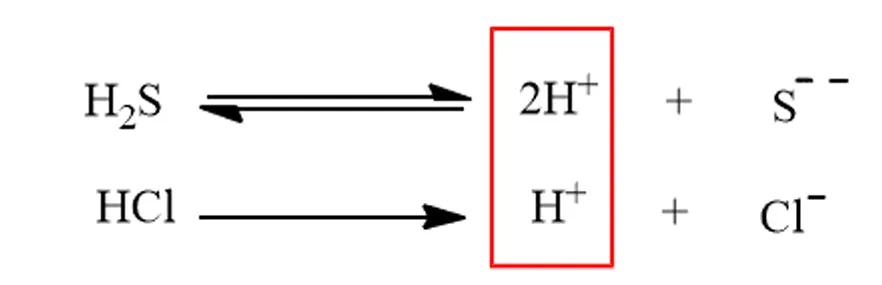
Figure: Common ion effect on the ionization of hydrogen sulfide
a. Define the term common ion effect. Explain how this effect affects the ionization of \(\mathrm{H_2S}\) in the example above.
The common ion effect is the decrease in the ionization of a weak electrolyte when a strong electrolyte having an ion in common with it is added to the solution.
\(\mathrm{HCl}\) is a strong acid and gives a large concentration of \(\mathrm{H^+}\), which is also produced by \(\mathrm{H_2S}\). By Le Chatelier’s principle the equilibrium of \(\mathrm{H_2S}\) shifts to the left, so the ionization of \(\mathrm{H_2S}\) decreases and the concentration of \(\mathrm{S^{2-}}\) becomes very small.
b. How is this effect applicable in salt analysis?
\(\mathrm{CH_3COONa+H_2O\rightleftharpoons CH_3COOH+NaOH}\)
a. Define the term hydrolysis.
Hydrolysis is the reaction of the cation, the anion or both ions of a salt with water, which changes the concentration of \(\mathrm{H^+}\) or \(\mathrm{OH^-}\) and so makes the solution acidic or basic.
b. What type of solution is produced in the example given above and why?
A basic solution (pH above 7). Sodium acetate is the salt of a weak acid and a strong base. The acetate ion takes a proton from water, \(\mathrm{CH_3COO^-+H_2O\rightleftharpoons CH_3COOH+OH^-}\), and the excess \(\mathrm{OH^-}\) makes the solution basic. \(\mathrm{Na^+}\) does not react.
c. What is the application of salt hydrolysis?
a. A strong acid and a strong base.
Example: \(\mathrm{NaCl}\). Neither \(\mathrm{Na^+}\) nor \(\mathrm{Cl^-}\) reacts with water, so there is no hydrolysis and the solution is neutral (pH = 7).
b. A weak acid and a strong base.
Example: \(\mathrm{CH_3COONa}\). The anion hydrolyzes: \(\mathrm{CH_3COO^-+H_2O\rightleftharpoons CH_3COOH+OH^-}\). Excess \(\mathrm{OH^-}\) is produced and the pH is above 7.
c. A weak base and a strong acid.
Example: \(\mathrm{NH_4Cl}\). The cation hydrolyzes: \(\mathrm{NH_4^++H_2O\rightleftharpoons NH_3+H_3O^+}\). Excess \(\mathrm{H_3O^+}\) is produced and the pH is below 7.
Effect on pH: a salt of a strong acid and a strong base leaves the pH at 7, a salt of a weak acid and a strong base raises it above 7, and a salt of a strong acid and a weak base lowers it below 7.
a. What is the meaning of an acid-base indicator? Give two examples of such indicators.
An acid-base indicator is a weak organic acid or base whose ionized and unionized forms have different colours, so its colour changes with the pH of the solution. It shows the end point of a titration. Examples: phenolphthalein and methyl orange.
b. Name the indicator suitable for the above titration and explain why it is suitable.
Phenolphthalein. Oxalic acid is a weak acid and sodium hydroxide is a strong base, so the solution at the equivalence point contains sodium oxalate, which is basic by hydrolysis (pH above 7). Phenolphthalein changes colour in the pH range 8.2 to 10.0, which includes the equivalence point.
c. What happens to the accuracy of the titration if another indicator is used?
With an indicator that changes colour in an unsuitable range, such as methyl orange (pH 3.1 to 4.4), the colour changes before the equivalence point is reached. The volume of the base read is then too small and the titration is inaccurate.
An indicator shows the end point of the titration by a sharp colour change, at or very near the equivalence point where equal gram equivalents of acid and base have reacted. The indicator must change colour in the pH range of the steep part of the titration curve.
| Indicator | pH range | Colour change (acid to base) |
|---|---|---|
| Methyl orange | 3.1 to 4.4 | Red to yellow |
| Methyl red | 4.4 to 6.2 | Red to yellow |
| Bromothymol blue | 6.0 to 7.6 | Yellow to blue |
| Phenolphthalein | 8.2 to 10.0 | Colourless to pink |
a) A strong acid-strong base titration?
The equivalence point is at pH 7 and the pH changes sharply from about 4 to 10 for a drop of titrant. Methyl orange, methyl red, bromothymol blue and phenolphthalein all change colour within this range, so any of them can be used.
b) A weak acid-strong base titration?
The salt formed is basic by hydrolysis, so the equivalence point is above 7 (about 8 to 9) and the steep part of the curve is about pH 7 to 10. Phenolphthalein is used, and methyl orange is not suitable.
| Type | Formed from | Examples | Solution |
|---|---|---|---|
| Neutral salt | Strong acid and strong base | \(\mathrm{NaCl}\), \(\mathrm{KNO_3}\) | pH = 7 (no hydrolysis) |
| Acidic salt | Strong acid and weak base; or a salt containing replaceable hydrogen | \(\mathrm{NH_4Cl}\), \(\mathrm{NaHSO_4}\) | pH below 7 (cationic hydrolysis) |
| Basic salt | Strong base and weak acid; or a salt containing replaceable hydroxide | \(\mathrm{CH_3COONa}\), \(\mathrm{Pb(OH)Cl}\) | pH above 7 (anionic hydrolysis) |
The ion of the weak parent (the weak acid or the weak base) is the one that reacts with water. So the stronger parent decides the nature of the solution: a strong base with a weak acid gives a basic solution, a strong acid with a weak base gives an acidic solution, and when both parents are strong the solution is neutral.
Long Answer Questions
a. What do you mean by an acidic buffer? Give another example of such a buffer system.
An acidic buffer is a solution of a weak acid and its salt with a strong base. It keeps the pH below 7 almost constant when a small amount of acid or base is added. Another example: carbonic acid and sodium bicarbonate (\(\mathrm{H_2CO_3}\) and \(\mathrm{NaHCO_3}\)).
b. What is the application of buffers in the human body?
Buffers keep the pH of body fluids almost constant. The carbonic acid-bicarbonate buffer keeps the pH of blood between 7.35 and 7.45, and the phosphate buffer works inside cells. Enzymes work only within a narrow pH range.
c. What is the mechanism of the buffer action for the given buffer?
The solution has a large reserve of \(\mathrm{CH_3COOH}\) and of \(\mathrm{CH_3COO^-}\).
d. Calculate the pH of this buffer using the Henderson-Hasselbalch equation (\(K_a=1.8\times10^{-5}\)).
For the usual mixture with equal concentrations of acid and salt, \(\log1=0\), so
| Solute | Solubility Equilibrium | \(K_{sp}\) |
|---|---|---|
| Aluminum hydroxide | \(\mathrm{Al(OH)_3(s)\rightleftharpoons Al^{3+}(aq)+3OH^-(aq)}\) | \(1.3\times10^{-33}\) |
| Barium carbonate | \(\mathrm{BaCO_3(s)\rightleftharpoons Ba^{2+}(aq)+CO_3^{2-}(aq)}\) | \(5.1\times10^{-9}\) |
| Barium sulfate | \(\mathrm{BaSO_4(s)\rightleftharpoons Ba^{2+}(aq)+SO_4^{2-}(aq)}\) | \(1.1\times10^{-10}\) |
| Calcium carbonate | \(\mathrm{CaCO_3(s)\rightleftharpoons Ca^{2+}(aq)+CO_3^{2-}(aq)}\) | \(2.8\times10^{-9}\) |
| Calcium fluoride | \(\mathrm{CaF_2(s)\rightleftharpoons Ca^{2+}(aq)+2F^-(aq)}\) | \(5.3\times10^{-9}\) |
| Calcium sulfate | \(\mathrm{CaSO_4(s)\rightleftharpoons Ca^{2+}(aq)+SO_4^{2-}(aq)}\) | \(9.1\times10^{-6}\) |
| Calcium oxalate | \(\mathrm{CaC_2O_4(s)\rightleftharpoons Ca^{2+}(aq)+C_2O_4^{2-}(aq)}\) | \(2.7\times10^{-4}\) |
| Chromium(III) hydroxide | \(\mathrm{Cr(OH)_3(s)\rightleftharpoons Cr^{3+}(aq)+3OH^-(aq)}\) | \(6.3\times10^{-31}\) |
| Copper(II) sulfide | \(\mathrm{CuS(s)\rightleftharpoons Cu^{2+}(aq)+S^{2-}(aq)}\) | \(8.7\times10^{-36}\) |
| Iron(III) hydroxide | \(\mathrm{Fe(OH)_3(s)\rightleftharpoons Fe^{3+}(aq)+3OH^-(aq)}\) | \(4.0\times10^{-38}\) |
| Lead(II) chloride | \(\mathrm{PbCl_2(s)\rightleftharpoons Pb^{2+}(aq)+2Cl^-(aq)}\) | \(1.6\times10^{-5}\) |
| Lead(II) chromate | \(\mathrm{PbCrO_4(s)\rightleftharpoons Pb^{2+}(aq)+CrO_4^{2-}(aq)}\) | \(2.8\times10^{-13}\) |
a. Define the terms solubility product and sparingly soluble salt.
The solubility product is the equilibrium constant for the dissolution of a salt in water, the product of the molar concentrations of its ions in the saturated solution raised to the power of their coefficients. A sparingly soluble salt is a salt that dissolves in water only to a very small extent.
b. Calculate the solubility of \(\mathrm{CaSO_4}\) and \(\mathrm{Fe(OH)_3}\) in moles per liter and grams per liter.
\(\mathrm{CaSO_4}\) (molar mass 136.14 g/mol): \(K_{sp}=s^2\).
\(\mathrm{Fe(OH)_3}\) (molar mass 106.85 g/mol): \([\mathrm{Fe^{3+}}]=s,\ [\mathrm{OH^-}]=3s\).
c. Using the information given, compare the solubility of \(\mathrm{CaCO_3}\) with \(\mathrm{BaSO_4}\).
Both are binary salts, so the one with the larger \(K_{sp}\) is more soluble. \(\mathrm{CaCO_3}\) is about 5 times more soluble than \(\mathrm{BaSO_4}\).
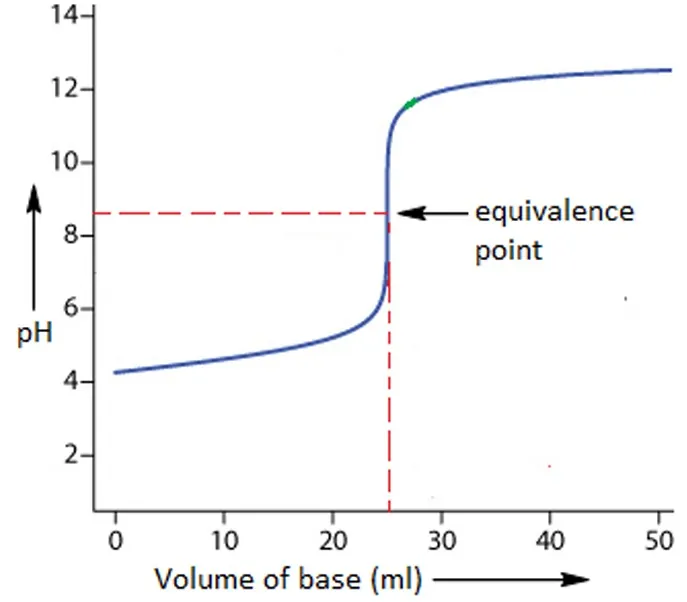
Figure: Change in pH of an acid on adding a base from the burette
a. What is the trend of change in pH with the addition of a base, and why is this trend observed with the addition of a base?
The pH increases: slowly at first, then very sharply around the equivalence point, and then slowly again as excess base is added. The added \(\mathrm{OH^-}\) ions neutralize the \(\mathrm{H^+}\) ions of the acid, so \([\mathrm{H^+}]\) decreases and the pH rises. Near the equivalence point very little acid is left, so a single drop of base changes the pH by several units.
b. What is the starting pH of the solution and what does this indicate about the nature of the acid?
The starting pH is the pH read from the graph where no base has been added. A very low starting pH (about 1 for a 0.1 M solution) shows that the acid is completely ionized, a strong acid. A starting pH of about 3 or more for the same concentration shows that the acid is only partly ionized, a weak acid.
c. Name the indicator suitable for this titration and give the reason behind it.
The indicator must change colour on the steep part of the curve. For a strong acid with a strong base (steep part from pH 4 to 10, equivalence point at 7) methyl orange or phenolphthalein can be used. For a weak acid with a strong base (steep part about pH 7 to 10, equivalence point above 7) phenolphthalein is used, because its range (8.2 to 10.0) lies on the steep part.
d. Draw the graph for the same solution keeping the acid in the burette instead of the titration flask.
If the base is in the flask and the acid is added from the burette, the pH starts high (about 13 for 0.1 M strong base), falls slowly, drops steeply at the equivalence point, and then flattens at a low pH (about 1 to 2) as excess acid is added. The curve is the mirror image of the first graph.
Figure: pH curve when the acid is kept in the burette and the strong base in the flask
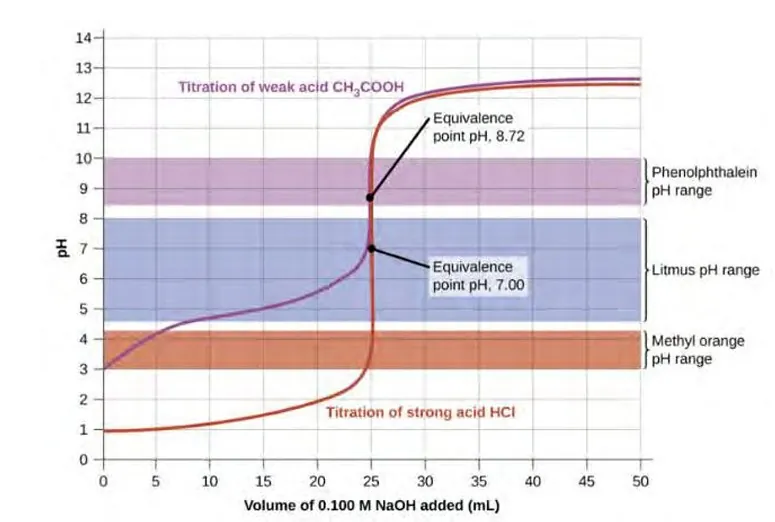
Figure: pH versus volume of alkali added for different titrations
a. What is the starting pH of \(\mathrm{HCl}\) and why does the pH increase with the addition of \(\mathrm{NaOH}\)?
The starting pH of 0.1 M \(\mathrm{HCl}\) is about 1, because \(\mathrm{HCl}\) is a strong acid and is completely ionized (\([\mathrm{H^+}]=0.1\), pH = 1). As \(\mathrm{NaOH}\) is added, its \(\mathrm{OH^-}\) ions neutralize \(\mathrm{H^+}\) ions to form water, so \([\mathrm{H^+}]\) decreases and the pH increases.
b. Find out the pH at which there is a sharp change in pH for the titration of \(\mathrm{HCl}\) with \(\mathrm{NaOH}\).
The pH changes sharply, almost vertically, from about 3 to about 10 (pH 4 to 10 for 0.1 M solutions) around the equivalence point, which is at pH 7.
c. Name the indicator that is suitable for the titration of acetic acid with \(\mathrm{NaOH}\) and explain why.
Phenolphthalein. Acetic acid is a weak acid and \(\mathrm{NaOH}\) is a strong base, so the sodium acetate formed is basic by hydrolysis and the equivalence point is at pH of about 8.7. Phenolphthalein changes colour in the pH range 8.2 to 10.0, which includes this pH. Methyl orange would change colour too early.
\(\mathrm{H_2N-\underset{R}{\underset{|}{C}}H-COOH}\)
a. What is the meaning of an amphoteric substance?
A substance that can act as an acid as well as a base is called amphoteric.
b. What could be the reason that amino acid molecules are amphoteric?
An amino acid has a basic amino group (\(\mathrm{-NH_2}\)), which can accept a proton, and an acidic carboxyl group (\(\mathrm{-COOH}\)), which can donate a proton.
c. Write the reaction of this acid with a hydrogen ion and a hydroxide ion showing its amphoteric nature.
With \(\mathrm{H^+}\) (acts as a base):
With \(\mathrm{OH^-}\) (acts as an acid):
a. What do you mean by a buffer solution, and what is the role of buffers in the human body?
A buffer solution is a solution that resists a change in its pH when a small amount of a strong acid or base is added. In the human body the bicarbonate and phosphate buffers keep the pH of blood and cells constant, so that enzymes can work.
b. Calculate the pH of the given buffer.
(using \(K_a=1.8\times10^{-5}\) for acetic acid)
c. Calculate the change in pH when 0.001 mole of hydrochloric acid is added to one liter of the solution, assuming the volume increase upon adding the \(\mathrm{HCl}\) is negligible.
The added \(\mathrm{H^+}\) converts acetate into acetic acid:
d. Compare this pH if the same amount of \(\mathrm{HCl}\) is added to a liter of pure water.
The pH of pure water falls from 7 to 3 (a change of 4 units), whereas the pH of the buffer changes by only about 0.017 unit. This shows the buffer action.
a. What is an acidic buffer, and how does the formic acid-sodium formate system qualify as one? Provide another example of an acidic buffer.
An acidic buffer is a mixture of a weak acid and its salt with a strong base. Formic acid is a weak acid and sodium formate (its salt with the strong base \(\mathrm{NaOH}\)) supplies the common ion \(\mathrm{HCOO^-}\), so the mixture resists a change in pH. Another example: acetic acid and sodium acetate.
b. Explain the role of buffers in maintaining pH stability in biological systems, such as blood.
Metabolism continuously produces acids such as carbonic acid and lactic acid. The bicarbonate buffer (\(\mathrm{H_2CO_3}\)/\(\mathrm{HCO_3^-}\)) neutralizes added \(\mathrm{H^+}\) or \(\mathrm{OH^-}\) and keeps the pH of blood at 7.35 to 7.45. A larger change in pH would stop the action of enzymes and be dangerous.
c. Calculate the pH of this buffer using the Henderson-Hasselbalch equation, given that the \(K_a\) of formic acid is \(1.77\times10^{-4}\).
a. What do you mean by solubility product and sparingly soluble salt?
The solubility product is the equilibrium constant for the dissolution of a salt, the product of the concentrations of its ions in the saturated solution (each raised to the power of its coefficient). A sparingly soluble salt is one that dissolves in water to a very small extent.
b. Write down the expression for the solubility product of \(\mathrm{BaSO_4}\) and \(\mathrm{Ag_2SO_4}\).
c. Calculate the solubility of \(\mathrm{BaSO_4}\) and \(\mathrm{Ag_2SO_4}\) in moles per liter and grams per liter in pure water.
\(\mathrm{BaSO_4}\) (molar mass 233.4 g/mol):
\(\mathrm{Ag_2SO_4}\) (molar mass 311.8 g/mol): \(K_{sp}=(2s)^2s=4s^3\).
d. Based on your calculations, determine which of the salts will precipitate first in their solution and why.
\(\mathrm{BaSO_4}\) precipitates first. Its solubility (\(1.05\times10^{-5}\) M) is much smaller than that of \(\mathrm{Ag_2SO_4}\) (\(1.44\times10^{-2}\) M), so the ionic product of \(\mathrm{BaSO_4}\) exceeds its \(K_{sp}\) at a much lower concentration of the ions.
a. Define the terms pH and pOH and write their relationship.
pH is the negative logarithm (base 10) of the molar concentration of hydrogen ions, and pOH is the negative logarithm of the molar concentration of hydroxide ions.
b. Complete the table given below:
| S.N. | \([\mathrm{H^+}]\) | pH | \([\mathrm{OH^-}]\) | pOH | Acid or Base |
|---|---|---|---|---|---|
| 1 | \(1\times10^{-6}\) | 6 | \(1\times10^{-8}\) | 8 | Acid |
| 2 | \(1\times10^{-9}\) | 9 | \(1\times10^{-5}\) | 5 | Base |
| 3 | \(2.5\times10^{-9}\) | 8.6 | 5.4 | Base | |
| 4 | \(4.0\times10^{-12}\) | 11.4 | \(2.5\times10^{-3}\) | 2.6 | |
| 5 | \(2.5\times10^{-8}\) | 6.4 | Base | ||
| 6 | \(1.6\times10^{-5}\) | 4.8 | 9.2 | Acid | |
| 7 | \(3.15\times10^{-12}\) | 11.50 | Acid | ||
| 8 | \(1.6\times10^{-6}\) | 5.8 | 8.2 | Acid | |
| 9 | 12.7 | ||||
| 10 | \(1.3\times10^{-10}\) | ||||
| 11 | 6.48 | \(3.00\times10^{-8}\) | 7.52 | Acid |
Use \([\mathrm{H^+}]=10^{-\mathrm{pH}}\), \([\mathrm{OH^-}]=10^{-\mathrm{pOH}}\), \(\mathrm{pH}+\mathrm{pOH}=14\) and \([\mathrm{H^+}][\mathrm{OH^-}]=10^{-14}\). A solution with pH below 7 is acidic and one with pH above 7 is basic.
Completed table:
| S.N. | \([\mathrm{H^+}]\) | pH | \([\mathrm{OH^-}]\) | pOH | Acid or Base |
|---|---|---|---|---|---|
| 1 | \(1.0\times10^{-6}\) | 6.00 | \(1.0\times10^{-8}\) | 8.00 | Acid |
| 2 | \(1.0\times10^{-9}\) | 9.00 | \(1.0\times10^{-5}\) | 5.00 | Base |
| 3 | \(2.5\times10^{-9}\) | 8.60 | \(4.0\times10^{-6}\) | 5.40 | Base |
| 4 | \(4.0\times10^{-12}\) | 11.40 | \(2.5\times10^{-3}\) | 2.60 | Base |
| 5 | \(2.5\times10^{-8}\) | 7.60 | \(4.0\times10^{-7}\) | 6.40 | Base |
| 6 | \(1.6\times10^{-5}\) | 4.80 | \(6.3\times10^{-10}\) | 9.20 | Acid |
| 7 | \(3.2\times10^{-3}\) | 2.50 | \(3.15\times10^{-12}\) | 11.50 | Acid |
| 8 | \(1.6\times10^{-6}\) | 5.80 | \(6.3\times10^{-9}\) | 8.20 | Acid |
| 9 | \(5.0\times10^{-2}\) | 1.30 | \(2.0\times10^{-13}\) | 12.70 | Acid |
| 10 | \(1.3\times10^{-10}\) | 9.89 | \(7.7\times10^{-5}\) | 4.11 | Base |
| 11 | \(3.3\times10^{-7}\) | 6.48 | \(3.00\times10^{-8}\) | 7.52 | Acid |
\(\mathrm{F_3B+:NH_3\longrightarrow F_3B-NH_3}\)
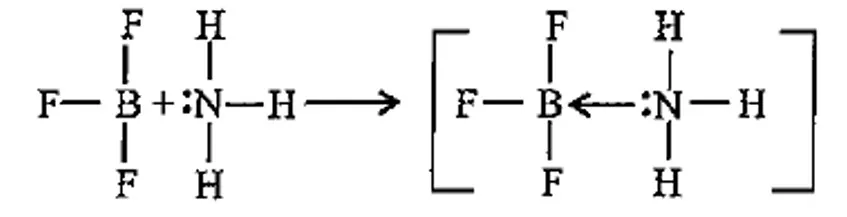
Figure: Reaction of boron trifluoride with ammonia
a. Identify the acid and base in the reaction given and state the reason why they are called so.
\(\mathrm{BF_3}\) is the acid: the boron atom has only six electrons (incomplete octet) and accepts a lone pair. \(\mathrm{NH_3}\) is the base: the nitrogen atom has a lone pair that it donates to boron, forming a coordinate covalent bond.
b. Name the concept that explains the above reaction.
The Lewis concept of acids and bases (acid = electron pair acceptor, base = electron pair donor).
c. Write similar reactions with \(\mathrm{NH_3}\) and water, and \(\mathrm{BF_3}\) and water.
\(\mathrm{NH_3}\) and water: \(\mathrm{NH_3}\) donates its lone pair to a hydrogen of water (the proton is accepted by \(\mathrm{NH_3}\)):
\(\mathrm{BF_3}\) and water: water donates a lone pair of oxygen to boron:
d. What are the limitations of this concept?
a. Calculate the solubility product constant for \(\mathrm{PbCl_2}\) (MW = 278.1), if 50.0 mL of a saturated solution of \(\mathrm{PbCl_2}\) was found to contain 0.2207 g of \(\mathrm{PbCl_2}\) dissolved in it.
\(\mathrm{PbCl_2}\)\(\rightleftharpoons\)\(\mathrm{Pb^{2+}+2Cl^-}\): \([\mathrm{Pb^{2+}}]=s,\ [\mathrm{Cl^-}]=2s\).
b. A solution is 0.010 M in barium chloride and 0.020 M in strontium chloride. Can either \(\mathrm{Ba^{2+}}\) or \(\mathrm{Sr^{2+}}\) be precipitated selectively with a concentrated sodium sulfate solution? Which ion will precipitate first?
Concentration of \(\mathrm{SO_4^{2-}}\) needed to start precipitation (\(K_{sp}=[\mathrm{M^{2+}}][\mathrm{SO_4^{2-}}]\)):
\(\mathrm{Ba^{2+}}\) precipitates first, because it needs a much smaller sulfate concentration. \(\mathrm{SrSO_4}\) starts to precipitate only when \([\mathrm{SO_4^{2-}}]\) reaches \(1.6\times10^{-5}\) M. At that point
which is only 0.07% of the original barium. So \(\mathrm{Ba^{2+}}\) can be precipitated almost completely and selectively, before any \(\mathrm{Sr^{2+}}\) precipitates.
c. Estimate the molar solubility of \(\mathrm{Ag_2CrO_4}\) in pure water if the solubility product constant for silver chromate is \(1.1\times10^{-12}\).
4. View PDF Notes
i. Handwritten Notes
ii. Typed PDF Notes
5. Frequently Asked Questions
What is ionic equilibrium? (Class 12 Chemistry)
What topics are included in Unit 2 Ionic Equilibrium of NEB Class 12 Chemistry?
What are the ionic equilibrium formulas of Class 12 Chemistry?
What are the Arrhenius, Bronsted-Lowry and Lewis concepts of acids and bases?
What is Ostwald’s dilution law?
What is the ionic product of water (Kw) and how does temperature affect it?
What is the difference between Ka, Kb, pKa and pKb?
How is pH calculated? Give examples.
What is the solubility product principle? How is solubility calculated from Ksp?
What is the common ion effect? Where is it applied?
What is a buffer solution? What is the Henderson-Hasselbalch equation?
How do I select an indicator for an acid-base titration?
What are the types of salts and the hydrolysis of salts?
Where can I find Ionic Equilibrium Class 12 numericals with solutions?
Where can I get Class 12 Chemistry Ionic Equilibrium notes in PDF?
Where can I get Class 12 Chemistry notes of NEB (handwritten, PDF, Nepal)?
Students also search for: