
Class 10 Optional Mathematics Function
Exercise 1.1 Composite Function and Exercise 1.2 Inverse Function
35 solved questions with function diagrams, English and Nepali questions, step by step solutions and frequently asked questions for the Nepal Grade 10 SEE.
1. Class 10 Optional Mathematics Function: Unit Overview and Key Formulas
Unit 1: Function (Optional Mathematics, Grade 10, SEE, Nepal)
Class 10 Optional Mathematics Function is the first unit of the Grade 10 Optional Mathematics course prescribed by the Curriculum Development Centre (CDC), Nepal. These class 10 optional math function notes solve every question of Exercise 1.1 and Exercise 1.2.
Each question is written in English with the Nepali question in brackets. Definitions and theory answers also have Nepali in brackets, and the other solutions are in English because the steps and symbols are the same in both languages.
- Exercise 1.1 Composite Function: ordered pairs, mapping diagrams, algebraic and rational functions, identity function and unknown constants.
- Exercise 1.2 Inverse Function: one-to-one and onto test, finding the inverse, inverse equations and composite of inverse functions.
Key formulas to remember
For more chapters, visit the complete SEE Class 10 Optional Mathematics notes. You can also read about function composition and inverse functions for extra understanding.
2. Exercise 1.1 Composite Function: Class 10 Optional Mathematics Function
Exercise 1.1 Composite Function: Multiple Choice Questions (बहुवैकल्पिक प्रश्न)
Question 1(A). Which of the following statements is incorrect regarding composite functions? (संयुक्त फलनको सन्दर्भमा तलको कुन भनाइ गलत छ ?)
- a) If functions \(f: A \to B\) and \(g: B \to C\) exist, and the relation \(A \to C\) is also defined as a function, it is a composite function. (फलनहरू \(f: A \to B\) र \(g: B \to C\) छन् र सम्बन्ध \(A \to C\) पनि फलन परिभाषित भएमा संयुक्त फलन हुन्छ ।)
- b) If functions \(g: A \to B\) and \(f: B \to C\) are one to one and onto, then the function \(A \to C\) is a composite function. (फलनहरू \(g: A \to B\) र \(f: B \to C\) एक एक सम्पूर्ण फलन भएमा फलन \(A \to C\) संयुक्त फलन हुन्छ ।)
- c) If functions \(g: A \to B\) and \(f: B \to C\) are defined, the function \(A \to C\) is denoted by \(g \circ f\). (फलनहरू \(g: A \to B\) र \(f: B \to C\) परिभाषित भएमा फलन \(A \to C\) लाई \(g \circ f\) ले जनाइन्छ ।)
- d) If functions \(f: A \to B\) and \(g: B \to C\) are defined, the relation \(C \to A\) cannot be a composite function of \(f\) and \(g\). (फलनहरू \(f: A \to B\) र \(g: B \to C\) परिभाषित भएमा सम्बन्ध \(C \to A\), \(f\) र \(g\) को संयुक्त फलन हुँदैन ।)
Correct Answer: c) If functions \(g: A \to B\) and \(f: B \to C\) are defined, the function \(A \to C\) is denoted by \(g \circ f\). (फलनहरू \(g: A \to B\) र \(f: B \to C\) परिभाषित भएमा फलन \(A \to C\) लाई \(g \circ f\) ले जनाइन्छ ।)
Solution:
- When \(g: A \to B\) and \(f: B \to C\), the mapping from \(A\) to \(C\) applies \(g\) first and then \(f\).
- This is written \(f \circ g\) or \(fg(x)\).
- The notation \(g \circ f\) means apply \(f\) first and then \(g\), which is a different composition.
So statement (c) is incorrect.
(जब \(g: A \to B\) र \(f: B \to C\) हुन्छन्, तब \(A\) बाट \(C\) सम्मको फलनमा पहिले \(g\) र त्यसपछि \(f\) लागू हुन्छ । यसलाई \(f \circ g\) वा \(fg(x)\) ले जनाइन्छ । \(g \circ f\) को अर्थ पहिले \(f\) र पछि \(g\) लगाउनु हो, जुन फरक संयुक्त फलन हो । त्यसैले कथन (c) गलत छ ।)
Question 1(B). In the given mapping diagram, how is the function defined from \(A\) to \(C\) denoted? (तलको मिलानचित्रमा \(A\) बाट \(C\) सम्मको परिभाषित फलनलाई केले जनाइन्छ ?)
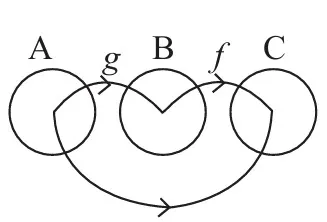
Figure: Given mapping diagram from the textbook
- a) \(fg(x)\)
- b) \(gf(x)\)
- c) \(ff(x)\)
- d) \(gg(x)\)
Correct Answer: a) \(fg(x)\)
Solution:
- The diagram shows \(g\) mapping \(A \to B\) and \(f\) mapping \(B \to C\).
- The direct map from \(A\) to \(C\) evaluates \(g(x)\) first and then applies \(f\).
Figure: Function diagram of the composite function fg = f ∘ g
Question 1(C). If \(f(x) = \{(3,-1),(2,0),(1,1)\}\) and \(g(x) = \{(-1,4),(0,5),(1,6)\}\), what is \(gf(x)\)? (यदि \(f(x) = \{(3,-1),(2,0),(1,1)\}\) र \(g(x) = \{(-1,4),(0,5),(1,6)\}\) भए, \(gf(x)\) कति होला ?)
- a) \(\{(4,3),(2,5),(1,6)\}\)
- b) \(\{(3,4),(2,5),(2,6)\}\)
- c) \(\{(3,4),(1,5),(2,6)\}\)
- d) \(\{(3,4),(2,5),(1,6)\}\)
Correct Answer: d) \(\{(3,4),(2,5),(1,6)\}\)
Solution:
Use \(gf(x) = g(f(x))\) for each \(x\) in the domain of \(f\).
- \(x=3\): \(f(3)=-1\), then \(g(-1)=4\), giving \((3,4)\).
- \(x=2\): \(f(2)=0\), then \(g(0)=5\), giving \((2,5)\).
- \(x=1\): \(f(1)=1\), then \(g(1)=6\), giving \((1,6)\).
Question 1(D). If \(f(x) = 3x – 1\) and \(g(x) = x + 1\), what is \(fg(x)\)? (यदि \(f(x) = 3x – 1\) र \(g(x) = x + 1\) भए, \(fg(x)\) कति हुन्छ ?)
- a) \(3x-1\)
- b) \(3x+1\)
- c) \(3x-2\)
- d) \(3x+2\)
Correct Answer: d) \(3x+2\)
Solution:
- Write \(fg(x) = f(g(x)) = f(x+1)\).
- Substitute \(x+1\) into \(f\):
Question 1(E). If \(f(x) = 1 – 3x\) and \(g(x) = 2x + 1\), what is \(gf\left(\frac{1}{2}\right)\)? (यदि \(f(x) = 1 – 3x\) र \(g(x) = 2x + 1\) भए, \(gf\left(\frac{1}{2}\right)\) कति हुन्छ ?)
- a) \(3\)
- b) \(1\)
- c) \(2\)
- d) \(0\)
Correct Answer: d) \(0\)
Solution:
- Find \(f\left(\frac12\right) = 1 – 3\left(\frac12\right) = 1 – \frac32 = -\frac12\).
- Find \(g\left(-\frac12\right) = 2\left(-\frac12\right) + 1 = -1 + 1 = 0\).
Exercise 1.1 Composite Function: Written Questions (लेख्ने प्रश्न)
Definition
Let \(f: A \to B\) and \(g: B \to C\) be two functions. The composite function from \(A\) to \(C\), written \(g \circ f\) or \(gf(x)\), assigns each \(x \in A\) to the unique element \(g(f(x)) \in C\).
(मानौँ \(f: A \to B\) र \(g: B \to C\) दुई फलनहरू हुन् । \(A\) बाट \(C\) सम्मको संयुक्त फलनलाई \(g \circ f\) वा \(gf(x)\) ले जनाइन्छ, जसले प्रत्येक \(x \in A\) लाई \(C\) को एक मात्र अवयव \(g(f(x))\) सँग जोड्छ ।)
Mapping diagram (मिलानचित्र)
Figure: Function diagram of the composite function gf = g ∘ f
The direct arrow from \(x\) to \(g(f(x))\) (green dashed arrow) is the composite function \(gf\).
(\(x\) बाट \(g(f(x))\) सम्मको सिधा तीर (हरियो धर्सा भएको तीर) नै संयुक्त फलन \(gf\) हो ।)
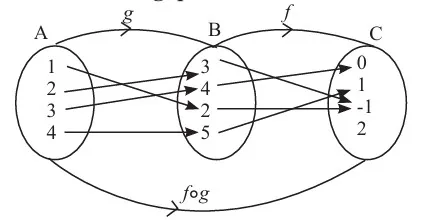
Figure: Given mapping diagram from the textbook
Read the diagram
- \(A=\{1,2,3,4\}\), \(B=\{3,4,2,5\}\), \(C=\{0,1,-1,2\}\)
- \(g\): \(1\to4\), \(2\to3\), \(3\to2\), \(4\to5\)
- \(f\): \(3\to0\), \(4\to1\), \(2\to-1\), \(5\to2\)
Figure: Mapping diagram of g, f and the composite function fog
(a)
\[g=\{(1,4),(2,3),(3,2),(4,5)\}\](b)
\[f=\{(3,0),(4,1),(2,-1),(5,2)\}\](c)
- \(fog(1)=f(g(1))=f(4)=1\)
- \(fog(2)=f(g(2))=f(3)=0\)
- \(fog(3)=f(g(3))=f(2)=-1\)
- \(fog(4)=f(g(4))=f(5)=2\)
(d)
Steps
Compute \(gf(x)=g(f(x))\) for each \(x\) in the domain of \(f\).
- \(x=1\): \(f(1)=2\), \(g(2)=4\), giving \((1,4)\).
- \(x=2\): \(f(2)=3\), \(g(3)=5\), giving \((2,5)\).
- \(x=3\): \(f(3)=4\), \(g(4)=6\), giving \((3,6)\).
Mapping diagram
Figure: Mapping diagram of the composite function gf
(a) \(gf(x)\)
\[g(f(x)) = 5-3(3x+2) = 5-9x-6 = -1-9x\](b) \(fg(x)\)
\[f(g(x)) = 3(5-3x)+2 = 15-9x+2 = 17-9x\](c) \(ff(x)\)
\[f(f(x)) = 3(3x+2)+2 = 9x+6+2 = 9x+8\](d) \(ff(3)\)
\[ff(3) = 9(3)+8 = 27+8 = 35\]Step 1: Substitute
\[\begin{aligned}fg(x) &= f(g(x)) \\ &= \frac{2\left(\frac{3x+2}{x-4}\right)-1}{\left(\frac{3x+2}{x-4}\right)+3}\end{aligned}\]Step 2: Common denominator \((x-4)\)
Numerator:
\[\begin{aligned}\frac{2(3x+2)-(x-4)}{x-4} &= \frac{6x+4-x+4}{x-4} \\ &= \frac{5x+8}{x-4}\end{aligned}\]Denominator:
\[\begin{aligned}\frac{(3x+2)+3(x-4)}{x-4} &= \frac{3x+2+3x-12}{x-4} \\ &= \frac{6x-10}{x-4}\end{aligned}\]Step 3: Cancel \((x-4)\)
Definition
A function \(I\) is an identity function if \(I(x)=x\) for all \(x\).
Proof
\[\begin{aligned}fg(x) &= f\left(\frac{x-5}{2}\right) \\ &= 2\left(\frac{x-5}{2}\right)+5 \\ &= (x-5)+5 \\ &= x\end{aligned}\]- By definition, \(f(g(x))=x\).
- Substitute into \(f\): \(\dfrac{g(x)-3}{2}=x\).
- Multiply by \(2\): \(g(x)-3=2x\).
- Add \(3\): \(g(x)=2x+3\).
- By definition, \(g(h(x))=11-2x\).
- Substitute into \(g\): \(4-h(x)=11-2x\).
- Rearrange: \(-h(x)=11-2x-4=7-2x\).
- Multiply by \(-1\): \(h(x)=2x-7\).
- \(f(5)=\dfrac{6}{5-2}=2\).
- \(gf(5)=g(2)=7\).
- \(a(2)^2-1=7\), so \(4a-1=7\).
- \(4a=8\), so \(a=2\).
- \(f(5)=5a+5\).
- \(g(5a+5)=93\), so \(8(5a+5)+13=93\).
- \(40a+40+13=93\), so \(40a+53=93\).
- \(40a=40\), so \(a=1\).
- \(f(1)=k+1\).
- \(g(k+1)=2\), so \(3(k+1)-7=2\).
- \(3k+3-7=2\), so \(3k-4=2\).
- \(3k=6\), so \(k=2\).
Step 1: Find \(g(x)\)
\(f(g(x))=6x-2\) gives \(3g(x)-2=6x-2\), so \(3g(x)=6x\) and \(g(x)=2x\).
Step 2: Solve \(gf(x)=8\)
\(g(3x-2)=8\), so \(2(3x-2)=8\).
\(6x-4=8\), so \(6x=12\).
3. Exercise 1.2 Inverse Function: Class 10 Optional Mathematics Function
Exercise 1.2 Inverse Function: Multiple Choice Questions (बहुवैकल्पिक प्रश्न)
Question 1(A). Which statement about the inverse function is correct? (विपरीत फलनको सन्दर्भमा तलका भनाइ कुन सही छ ?)
- a) If the function \(f: A \to B\) is defined in any case, the inverse function is also defined. (फलन \(f: A \to B\) भएमा सबै अवस्थामा विपरीत फलन परिभाषित हुन्छ ।)
- b) If the function \(f: A \to B\) is defined in all cases, the inverse function \(B \to A\) is also defined. (फलन \(f: A \to B\) भएमा सबै अवस्थामा विपरीत फलन \(B \to A\) पनि परिभाषित हुन्छ ।)
- c) If the function \(f: A \to B\) is a one to one and onto function, the inverse function \(A \to B\) is defined. (फलन \(f: A \to B\) एक एक सम्पूर्ण फलन भएमा विपरीत फलन \(A \to B\) पनि फलन हुन्छ ।)
- d) If the function \(f: A \to B\) is a one to one and onto function, the inverse function \(B \to A\) is defined. (फलन \(f: A \to B\) एक एक सम्पूर्ण फलन भएमा विपरीत फलन \(B \to A\) पनि फलन हुन्छ ।)
Correct Answer: d) If the function \(f: A \to B\) is a one to one and onto function, the inverse function \(B \to A\) is defined. (फलन \(f: A \to B\) एक एक सम्पूर्ण फलन भएमा विपरीत फलन \(B \to A\) पनि फलन हुन्छ ।)
Solution:
- An inverse function exists if and only if \(f: A \to B\) is one-to-one and onto (bijective).
- When this holds, the domain and codomain swap, so the inverse is defined from \(B\) to \(A\), that is \(f^{-1}: B \to A\).
(फलन \(f: A \to B\) एक एक सम्पूर्ण (one-to-one र onto) भएमा मात्र विपरीत फलन अस्तित्वमा हुन्छ । त्यस अवस्थामा प्रान्त र सहप्रान्त साटिन्छन्, त्यसैले विपरीत फलन \(f^{-1}: B \to A\) मा परिभाषित हुन्छ ।)
Question 1(B). If \(f(x)=\{(1,1),(2,4),(3,9),(4,16)\}\) is a one to one and onto function, what is \(f^{-1}(x)\)? (यदि \(f(x)=\{(1,1),(2,4),(3,9),(4,16)\}\) एक एक सम्पूर्ण फलन भए, \(f^{-1}(x)\) कति होला ?)
- a) \(\{(1,1),(4,2),(3,9),(16,4)\}\)
- b) \(\{(1,1),(4,2),(9,3),(16,4)\}\)
- c) \(\{(1,1),(4,2),(3,9),(4,16)\}\)
- d) \(\{(1,1),(2,4),(3,9),(16,4)\}\)
Correct Answer: b) \(\{(1,1),(4,2),(9,3),(16,4)\}\)
Solution:
Reverse the components of each ordered pair \((x,y)\) to get \((y,x)\).
- \((1,1)\to(1,1)\)
- \((2,4)\to(4,2)\)
- \((3,9)\to(9,3)\)
- \((4,16)\to(16,4)\)
Question 1(C). If \(f(x)=4x+5\) is a one to one and onto function, what is the value of \(f^{-1}(x)\)? (यदि \(f(x)=4x+5\) एक एक सम्पूर्ण फलन भए, \(f^{-1}(x)\) को मान कति हुन्छ ?)
- a) \(5-4x\)
- b) \(\frac{x-4}{5}\)
- c) \(\frac{x+5}{4}\)
- d) \(\frac{x-5}{4}\)
Correct Answer: d) \(\frac{x-5}{4}\)
Solution:
- Let \(y=4x+5\).
- Interchange \(x\) and \(y\): \(x=4y+5\).
- Solve: \(x-5=4y\), so \(y=\dfrac{x-5}{4}\).
Question 1(D). If \(g(x)=\dfrac{1-3x}{5}\) is a one to one and onto function, what is the value of \(g^{-1}(x)\)? (यदि \(g(x)=\dfrac{1-3x}{5}\) एक एक सम्पूर्ण फलन भए, \(g^{-1}(x)\) को मान कति होला ?)
- a) \(\frac{1+3x}{5}\)
- b) \(\frac{1-5x}{5}\)
- c) \(\frac{1-5x}{3}\)
- d) \(\frac{1+5x}{3}\)
Correct Answer: c) \(\frac{1-5x}{3}\)
Solution:
- Let \(y=\dfrac{1-3x}{5}\) and interchange \(x\) and \(y\): \(x=\dfrac{1-3y}{5}\).
- Multiply by \(5\): \(5x=1-3y\).
- Rearrange: \(3y=1-5x\).
Question 1(E). If \(h(x)=\dfrac{1+2x}{3}\) is a one to one and onto function, what is the value of \(h^{-1}(-1)\)? (यदि \(h(x)=\dfrac{1+2x}{3}\) एक एक सम्पूर्ण फलन भए, \(h^{-1}(-1)\) को मान कति हुन्छ ?)
- a) \(-2\)
- b) \(-1\)
- c) \(1\)
- d) \(2\)
Correct Answer: a) \(-2\)
Solution:
- Let \(y=\dfrac{1+2x}{3}\) and interchange: \(x=\dfrac{1+2y}{3}\).
- Then \(3x=1+2y\), so \(h^{-1}(x)=\dfrac{3x-1}{2}\).
- Evaluate: \(h^{-1}(-1)=\dfrac{3(-1)-1}{2}=\dfrac{-4}{2}=-2\).
Exercise 1.2 Inverse Function: Written Questions (लेख्ने प्रश्न)
Definition
Let \(f: A \to B\) be a one-to-one and onto function. The function \(f^{-1}: B \to A\) that associates each \(y \in B\) with the unique \(x \in A\) such that \(f(x)=y\) is called the inverse function of \(f\).
(मानौँ \(f: A \to B\) एक एक सम्पूर्ण फलन हो । प्रत्येक \(y \in B\) लाई \(f(x)=y\) हुने एक मात्र \(x \in A\) सँग जोड्ने फलन \(f^{-1}: B \to A\) लाई \(f\) को विपरीत फलन भनिन्छ ।)
Mapping diagram (मिलानचित्र)
Figure: The function f (red arrow) and its inverse f⁻¹ (green dashed arrow)
The inverse function reverses every arrow of \(f\).
(विपरीत फलनले \(f\) का प्रत्येक तीरलाई उल्टो बनाउँछ ।)
Step 1: Interchange the components
The inverse of each pair \((a,b)\) is \((b,a)\).
- \((1,2)\to(2,1)\)
- \((2,4)\to(4,2)\)
- \((3,6)\to(6,3)\)
Step 2: Mapping diagram of \(f^{-1}\)
Figure: Mapping diagram of the inverse function f⁻¹
Step 1: One-to-one test
Let \(f(x_1)=f(x_2)\). Then \(2x_1-3=2x_2-3\), so \(2x_1=2x_2\) and \(x_1=x_2\). Hence \(f\) is one-to-one.
Step 2: Onto test
Let \(y=2x-3\). Then \(x=\dfrac{y+3}{2}\), which is a real number for every real \(y\). So every element of the codomain has a pre-image, and \(f\) is onto.
Step 3: Find \(f^{-1}(x)\)
Since \(f\) is one-to-one and onto, the inverse exists. Interchange \(x\) and \(y\) in \(y=2x-3\):
\[\begin{aligned}& x=2y-3 \\ &\implies 2y=x+3 \\ &\implies y=\frac{x+3}{2}\end{aligned}\]Step 1: Find \(f^{-1}(x)\)
Let \(y=5x-2\) and interchange: \(x=5y-2\), so \(y=\dfrac{x+2}{5}\).
Step 2: Solve \(f^{-1}(x)=2\)
\[\frac{x+2}{5}=2 \implies x+2=10 \implies x=8\]Check
\(f^{-1}(8)=\dfrac{8+2}{5}=2\) ✓
Step 1: Find \(g^{-1}(x)\)
Let \(y=\dfrac{3x-7}{4}\) and interchange: \(x=\dfrac{3y-7}{4}\).
Then \(4x=3y-7\), so \(3y=4x+7\) and \(g^{-1}(x)=\dfrac{4x+7}{3}\).
Step 2: Solve \(g^{-1}(x)=5\)
\[\begin{aligned}& \frac{4x+7}{3}=5 \\ &\implies 4x+7=15 \\ &\implies 4x=8 \\ &\implies x=2\end{aligned}\]Check
\(g^{-1}(2)=\dfrac{8+7}{3}=5\) ✓
Step 1: Find \(h^{-1}(x)\)
Let \(y=\dfrac{2x-3}{3x-5}\) and interchange: \(x=\dfrac{2y-3}{3y-5}\).
- \(x(3y-5)=2y-3\)
- \(3xy-5x=2y-3\)
- \(3xy-2y=5x-3\)
- \(y(3x-2)=5x-3\)
Step 2: Solve \(h^{-1}(x)=2\)
\[5x-3=2(3x-2) \implies 5x-3=6x-4 \implies x=1\]Check
\(h^{-1}(1)=\dfrac{5-3}{3-2}=2\) ✓
Step 1: Find \(f^{-1}(x)\)
Let \(y=\dfrac{x}{3+2x}\) and interchange: \(x=\dfrac{y}{3+2y}\).
- \(x(3+2y)=y\)
- \(3x+2xy=y\)
- \(3x=y(1-2x)\)
Step 2: Solve \(f^{-1}(x)=f(x)\)
\[\begin{aligned}& \frac{3x}{1-2x}=\frac{x}{3+2x} \\ &\implies 3x(3+2x)=x(1-2x)\end{aligned}\]\[\begin{aligned}& 9x+6x^2=x-2x^2 \\ &\implies 8x^2+8x=0 \\ &\implies 8x(x+1)=0\end{aligned}\]Step 1: Find \(g^{-1}(x)\)
Let \(y=\dfrac{2x-3}{5}\) and interchange: \(x=\dfrac{2y-3}{5}\), so \(5x=2y-3\) and \(g^{-1}(x)=\dfrac{5x+3}{2}\).
Step 2: Compose
\[\begin{aligned}g^{-1}f(x) &= g^{-1}(7x-1) \\ &= \frac{5(7x-1)+3}{2} \\ &= \frac{35x-5+3}{2} \\ &= \frac{35x-2}{2}\end{aligned}\]Step 1: Find the inverses
- \(y=4x-3\) gives \(x=4y-3\), so \(f^{-1}(x)=\dfrac{x+3}{4}\).
- \(y=\dfrac{x+2}{5}\) gives \(x=\dfrac{y+2}{5}\), so \(g^{-1}(x)=5x-2\).
Step 2: Evaluate
- \(g^{-1}(2)=5(2)-2=8\).
- \(f^{-1}(8)=\dfrac{8+3}{4}=\dfrac{11}{4}\).
Part 1: \((gh)^{-1}(x)\)
First find \(gh(x)=g(h(x))\):
\[gh(x)=\frac{3\left(\frac{2x-1}{x-3}\right)-1}{\left(\frac{2x-1}{x-3}\right)-1}\]Numerator: \(\dfrac{3(2x-1)-(x-3)}{x-3}=\dfrac{5x}{x-3}\). Denominator: \(\dfrac{(2x-1)-(x-3)}{x-3}=\dfrac{x+2}{x-3}\).
\[gh(x)=\frac{5x}{x+2}\]Let \(y=\dfrac{5x}{x+2}\) and interchange: \(x=\dfrac{5y}{y+2}\), so \(xy+2x=5y\) and \(2x=y(5-x)\).
\[(gh)^{-1}(x)=\frac{2x}{5-x}\]Part 2: \((hg)^{-1}(x)\)
First find \(hg(x)=h(g(x))\):
\[hg(x)=\frac{2\left(\frac{3x-1}{x-1}\right)-1}{\left(\frac{3x-1}{x-1}\right)-3}\]Numerator: \(\dfrac{2(3x-1)-(x-1)}{x-1}=\dfrac{5x-1}{x-1}\). Denominator: \(\dfrac{(3x-1)-3(x-1)}{x-1}=\dfrac{2}{x-1}\).
\[hg(x)=\frac{5x-1}{2}\]Let \(y=\dfrac{5x-1}{2}\) and interchange: \(x=\dfrac{5y-1}{2}\), so \(5y=2x+1\).
\[(hg)^{-1}(x)=\frac{2x+1}{5}\]Step 1: Find \(ff(x)\)
\[ff(x)=f(2x-3)=2(2x-3)-3=4x-9\]Step 2: Find \(g^{-1}(x)\)
Let \(y=\dfrac{2x-7}{3}\) and interchange: \(x=\dfrac{2y-7}{3}\), so \(3x=2y-7\) and \(g^{-1}(x)=\dfrac{3x+7}{2}\).
Step 3: Solve \(ff(x)=g^{-1}(x)\)
\[\begin{aligned}& 4x-9=\frac{3x+7}{2} \\ &\implies 8x-18=3x+7 \\ &\implies 5x=25\end{aligned}\]Step 1: Find \(ff(x)\)
\[ff(x)=f(2x-5)=2(2x-5)-5=4x-15\]Step 2: Find \(g^{-1}(x)\)
Let \(y=\dfrac{3x+5}{2}\) and interchange: \(x=\dfrac{3y+5}{2}\), so \(2x=3y+5\) and \(g^{-1}(x)=\dfrac{2x-5}{3}\).
Step 3: Solve \(ff(x)=g^{-1}(x)\)
\[\begin{aligned}& 4x-15=\frac{2x-5}{3} \\ &\implies 12x-45=2x-5 \\ &\implies 10x=40\end{aligned}\]Step 1: Find \(g^{-1}(x)\)
Let \(y=\dfrac{x-5}{2}\) and interchange: \(x=\dfrac{y-5}{2}\), so \(g^{-1}(x)=2x+5\).
Step 2: Find \(fg^{-1}(x)\)
\[fg^{-1}(x)=f(2x+5)=\frac{(2x+5)+1}{2}=x+3\]Step 3: Solve \(fg^{-1}(x)=6\)
\(x+3=6\), so \(x=3\).
Frequently Asked Questions on Class 10 Optional Mathematics Function
What is covered in Class 10 Optional Mathematics Function (Unit 1)? (कक्षा १० ऐच्छिक गणित फलन (एकाइ १) मा के के समावेश छ ?)
Class 10 Optional Mathematics Function is Unit 1 of the Grade 10 Optional Mathematics book of Nepal. It has two exercises: Exercise 1.1 Composite Function and Exercise 1.2 Inverse Function. This page solves all 35 questions with mapping diagrams.
What is a composite function in Grade 10 Optional Mathematics? (कक्षा १० ऐच्छिक गणितमा संयुक्त फलन भनेको के हो ?)
A composite function joins two functions so that the output of the first becomes the input of the second. If \(f: A \to B\) and \(g: B \to C\), then \(gf(x)=g(f(x))\) maps each \(x \in A\) to an element of \(C\). In the Nepal Grade 10 course it is written \(gf(x)\) or \(g \circ f\).
Which exercises cover composite and inverse functions in the Nepal Grade 10 Optional Mathematics book? (नेपालको कक्षा १० ऐच्छिक गणितमा संयुक्त र विपरीत फलन कुन अभ्यासमा छन् ?)
They are in Chapter 1, Function, of the Grade 10 Optional Mathematics textbook published by the Curriculum Development Centre (CDC), Sanothimi, Bhaktapur, Government of Nepal.
- Exercise 1.1: Composite Function
- Exercise 1.2: Inverse Function
Is \(fg(x)\) always equal to \(gf(x)\)? (के \(fg(x)\) र \(gf(x)\) सधैँ बराबर हुन्छन् ?)
No. Composition is generally not commutative. For \(f(x)=3x+2\) and \(g(x)=5-3x\), \(gf(x)=-1-9x\) but \(fg(x)=17-9x\) (Exercise 1.1, Question 5).
Which function is applied first in \(fg(x)\)? (\(fg(x)\) मा कुन फलन पहिले प्रयोग गरिन्छ ?)
The function \(g\) is applied first, because \(fg(x)=f(g(x))\). Work from the inside out: substitute \(g(x)\) into \(f\).
When does an inverse function exist? (विपरीत फलन कहिले अस्तित्वमा हुन्छ ?)
A function \(f: A \to B\) has an inverse \(f^{-1}: B \to A\) only when it is one-to-one and onto.
- One-to-one: \(f(x_1)=f(x_2)\) implies \(x_1=x_2\).
- Onto: every \(y \in B\) equals \(f(x)\) for some \(x \in A\).
How do I find \(f^{-1}(x)\) from a formula? (सूत्रबाट \(f^{-1}(x)\) कसरी निकाल्ने ?)
Interchange \(x\) and \(y\) in \(y=f(x)\), then solve for \(y\).
- Write \(y=f(x)\).
- Interchange \(x\) and \(y\).
- Solve the new equation for \(y\).
- Write \(f^{-1}(x)=y\).
Example: for \(f(x)=4x+5\), interchanging gives \(x=4y+5\), so \(f^{-1}(x)=\dfrac{x-5}{4}\).
How do I find the inverse from ordered pairs? (क्रमजोडाबाट विपरीत फलन कसरी निकाल्ने ?)
Reverse the components of every pair \((a,b)\) to get \((b,a)\). For example, \(\{(1,2),(2,4),(3,6)\}\) becomes \(\{(2,1),(4,2),(6,3)\}\).
Is \(f^{-1}(x)\) the same as \(\dfrac{1}{f(x)}\)? (के \(f^{-1}(x)\) र \(\dfrac{1}{f(x)}\) एउटै हुन् ?)
No. \(f^{-1}\) is the inverse function, while \(\dfrac{1}{f(x)}\) is the reciprocal. For \(f(x)=2x-3\), \(f^{-1}(x)=\dfrac{x+3}{2}\) but \(\dfrac{1}{f(x)}=\dfrac{1}{2x-3}\).
How can I check that my inverse is correct? (आफ्नो विपरीत फलन सही छ कि छैन कसरी जाँच्ने ?)
Check that \(f(f^{-1}(x))=x\) and \(f^{-1}(f(x))=x\). For an equation such as \(f^{-1}(x)=2\), substitute your answer back, as in Exercise 1.2, Question 5a, where \(f^{-1}(8)=2\).
How do I find \((fg)^{-1}(x)\)? (\((fg)^{-1}(x)\) कसरी निकाल्ने ?)
Either invert \(fg(x)\) directly or use \((fg)^{-1}=g^{-1}f^{-1}\), where the order reverses. Exercise 1.2, Question 6c shows the first method.
Are these questions useful for SEE preparation in Nepal? (के यी प्रश्नहरू नेपालमा SEE को तयारीका लागि उपयोगी छन् ?)
Yes, for students who study Optional Mathematics. Functions is the first chapter of the Grade 10 Optional Mathematics book, and this set covers every question type in Exercises 1.1 and 1.2: definitions, ordered pairs, algebraic functions, unknown constants and equations. Practising them builds the skills needed for SEE-style questions.
Are the solutions available in Nepali? (के समाधान नेपाली भाषामा पनि उपलब्ध छन् ?)
Every question is shown in English with the Nepali question in brackets. Definitions and theory answers are written in English with Nepali in brackets. All other solutions are in English only, because the steps and symbols of mathematics are the same in both languages.
Students also search for: