
Mercury
Class 12 Chemistry Notes • NEB Syllabus 2083
Syllabus, 10 solved multiple choice questions, 11 short and 2 long answer questions, handwritten and typed PDF notes and frequently asked questions on the extraction, properties, uses and compounds of mercury.
1. Syllabus
Unit 7: Studies of Heavy Metals
These notes follow the NEB Class 12 Chemistry syllabus (+2 Chemistry, Nepal). This page covers 7.3 Mercury. Practise the multiple choice questions first, then work through the solved short and long answer questions, and finish with the PDF notes for quick revision.
2. Multiple Choice Questions
- a) Calomel
- b) Corrosive sublimate
- c) Cinnabar
- d) Livingstonite
Correct Answer: c) Cinnabar
Reason: The chief ore of mercury is cinnabar, mercuric sulphide \(HgS\). In Nepal it is found at places like Khimti river and Tirche pani. Calomel (\(Hg_2Cl_2\)) and corrosive sublimate (\(HgCl_2\)) are compounds of mercury, not the chief ore, and livingstonite (\(HgS\cdot2Sb_2S_3\)) is a minor ore.
- a) \(HgCl_2\)
- b) \(Hg_2Cl_2\)
- c) \(HgI_2\)
- d) \(Hg(NH_2)Cl\)
Correct Answer: a) \(HgCl_2\)
Reason: Corrosive sublimate is mercury(II) chloride, \(HgCl_2\). It is corrosive (poisonous) and it sublimes on heating. \(Hg_2Cl_2\) is calomel, \(HgI_2\) is mercuric iodide and \(Hg(NH_2)Cl\) is the white precipitate (mercuric amino chloride).
- a) \(HgS\)
- b) \(HgCl_2\)
- c) \(Hg(NH_2)Cl\)
- d) \(Hg_2Cl_2\)
Correct Answer: d) \(Hg_2Cl_2\)
Reason: Calomel is mercury(I) chloride. Mercury(I) exists as the diatomic ion \(Hg_2^{2+}\) (\(Hg-Hg\) bond), which combines with two chloride ions to give \(Hg_2Cl_2\), not \(HgCl\).
- a) It dissolves in other metals
- b) It forms stable alloy with other metals
- c) It does not react with metals
- d) It forms volatile compounds with other metals
Correct Answer: b) It forms stable alloy with other metals
Reason: Mercury forms alloys called amalgams with many metals such as gold, silver, copper, zinc and sodium (\(Na+Hg\rightarrow NaHg\)). Iron is the exception: it neither dissolves in mercury nor reacts with it, so iron flasks are used to store mercury.
- a) Potassium nitrate
- b) Sodium hydroxide
- c) Egg white
- d) Sodium carbonate
Correct Answer: c) Egg white
Reason: Egg white (and milk) contains protein. The \(Hg^{2+}\) ions of corrosive sublimate bind to the protein and are precipitated, so they are not absorbed into the body. It is a first-aid measure, and the patient must be taken to a doctor at once. Potassium nitrate, sodium hydroxide and sodium carbonate are of no use or are harmful.
- a) \(CO_2\)
- b) \(SO_2\)
- c) \(NO_2\)
- d) \(O_2\)
Correct Answer: b) \(SO_2\)
Reason: On roasting in excess air the sulphur of cinnabar is oxidised to sulphur dioxide: \(2HgS+3O_2\rightarrow2HgO+2SO_2\uparrow\). The oxide then decomposes, \(2HgO\rightarrow2Hg+O_2\), so the overall change is \(HgS+O_2\rightarrow Hg+SO_2\).
- a) Cinnabar
- b) Livingstone
- c) Calamine
- d) Calomel
Correct Answer: a) Cinnabar
Reason: Cinnabar, \(HgS\), is the ore of mercury. Calamine (\(ZnCO_3\)) is an ore of zinc. Calomel is a compound of mercury, and livingstonite is only a rare mercury and antimony sulphide mineral, so cinnabar is the best answer.
- a) \(Ag\)
- b) \(Zn\)
- c) \(Na\)
- d) \(Hg\)
Correct Answer: d) \(Hg\)
Reason: Mercury is a silvery-white metal which is liquid at room temperature and flows rapidly, so it is called quicksilver (in Nepali, paro). The symbol \(Hg\) comes from the Greek name hydrargyrum, which means liquid silver.
- a) \(CuSO_4\cdot5H_2O\)
- b) \(HgCl_2\)
- c) \(NaHg\)
- d) \(FeSO_4\cdot7H_2O\)
Correct Answer: b) \(HgCl_2\)
Reason: Mercuric chloride is a covalent solid with weak forces between its molecules, so on heating it changes directly to vapour without melting. This is why it is called corrosive sublimate. Hydrated copper and iron sulphates lose their water of crystallisation, and \(NaHg\) is an amalgam.
- a) \(K_2HgI_4+Hg\)
- b) \(K_2HgI_2\)
- c) \(K_2HgI_4\)
- d) \(HgI_4\)
Correct Answer: c) \(K_2HgI_4\)
Reason: \(HgCl_2\) first gives a scarlet precipitate of mercuric iodide, \(HgCl_2+2KI\rightarrow HgI_2\downarrow+2KCl\). In excess of \(KI\) the precipitate dissolves to form the complex potassium tetraiodomercurate(II), \(HgI_2+2KI\rightarrow K_2[HgI_4]\) (Nessler’s reagent in alkaline solution). So the product that the question asks for is \(K_2HgI_4\), which is option c (with exactly 2 mol of \(KI\) the product is only \(HgI_2\)).
3. Numerical and Subjective Questions
Short Answer Questions
a. Mercury (II) chloride is called corrosive sublimate.
It is called corrosive because it is very poisonous and attacks (corrodes) living tissue, and sublimate because on heating the solid changes directly to vapour without melting, and the vapour condenses back to the solid on a cold surface. It is a covalent compound with weak forces between its molecules, so it sublimes easily: \(HgCl_{2(s)}\rightleftharpoons HgCl_{2(g)}\).
b. Mercury (II) chloride is more toxic than mercury (I) chloride.
Mercuric chloride is soluble in water (sparingly in cold and readily in hot water), so it is easily absorbed into the blood and gives \(Hg^{2+}\) ions which bind to the proteins and enzymes of the body. Calomel, \(Hg_2Cl_2\), is insoluble in water, so very little of it is absorbed and it passes out of the body, which is why it is tasteless and almost non-toxic.
c. Most common and efficient method of purification of mercury is distillation.
Mercury has a low boiling point (357 degrees Celsius) and is volatile, whereas the impurities (\(Pb, Cu, Cd, Zn\)) have much higher boiling points and are left behind in the flask. The distillation under reduced pressure (vacuum distillation) gives mercury which is about 99.9% pure.
The chief ore of mercury is cinnabar, \(HgS\) (mercuric sulphide).
Extraction (pyrometallurgy): the ore is crushed and powdered, concentrated by froth flotation, and then roasted with charcoal in excess of air in a shaft furnace. The sulphide is converted to the oxide, and the oxide, which is unstable to heat, decomposes into mercury vapour:
The mercury vapour is passed through water-cooled condensing tubes and collects as liquid mercury, which is then purified by filtration, washing with 5% nitric acid and vacuum distillation. No coke is needed as a reducing agent, because mercury is a very unreactive metal and its oxide decomposes on heating.
Nessler’s reagent is an alkaline solution of potassium tetraiodomercurate(II), \(K_2[HgI_4]\) (potassium mercuric iodide), made alkaline with \(KOH\).
Preparation: mercuric chloride solution is treated with potassium iodide. A scarlet precipitate of mercuric iodide forms, and it dissolves in excess of \(KI\) to give the complex. The solution is then made alkaline with \(KOH\).
Application: it is used to detect and estimate ammonia or ammonium ions in water. A trace of \(NH_3\) gives a brown colour or precipitate (iodide of Millon’s base), a larger amount a brown precipitate:
a. Cinnabar
\(HgS\) (mercuric sulphide).
b. Nessler’s reagent
\(K_2[HgI_4]\) (potassium tetraiodomercurate(II), in alkaline solution).
c. Corrosive sublimate
\(HgCl_2\) (mercury(II) chloride).
d. Calomel
\(Hg_2Cl_2\) (mercury(I) chloride).
Observation: a white precipitate forms at once.
Explanation: ammonia replaces one chlorine of mercuric chloride by the amino group, giving mercuric amino chloride, \(Hg(NH_2)Cl\) (also called infusible white precipitate), which is insoluble. The other chlorine goes to ammonium chloride.
(Equivalent to \(HgCl_2+2NH_3\rightarrow Hg(NH_2)Cl\downarrow+NH_4Cl\).) In contrast, calomel with ammonia turns grey-black, since it forms finely divided mercury together with \(Hg(NH_2)Cl\); this test distinguishes the two chlorides.
a. Starting from metallic mercury how would you prepare corrosive sublimate?
By heating mercury in an excess of chlorine gas (the chlorine must be in excess, otherwise calomel forms):
b. Write the action of heat on corrosive sublimate.
On heating, mercuric chloride sublimes (the solid changes into vapour without melting), and the vapour condenses on a cold surface: \(HgCl_{2(s)}\rightleftharpoons HgCl_{2(g)}\). The notes of the textbook give the reaction on strong heating as the decomposition into the elements, \(HgCl_2\xrightarrow{\Delta}Hg+Cl_2\uparrow\).
c. What happens when aqueous solution of this compound treated with excess of KI?
A scarlet precipitate of mercuric iodide is formed first, and it dissolves in excess of \(KI\) to give a clear solution of potassium tetraiodomercurate(II), which is the Nessler’s reagent (when made alkaline):
d. Write any two uses of corrosive sublimate.
1. It is used as a pesticide, especially as a fungicide, and as a preservative of timber and leather.
2. Its 5% solution is used as a disinfectant. It is also used to prepare calomel and Nessler’s reagent.
a. Roasting of cinnabar.
Overall: \(HgS+O_2\xrightarrow{\Delta}Hg+SO_2\uparrow\).
b. Action of aqua regia on mercury.
Aqua regia is a mixture of 1 part concentrated \(HNO_3\) and 3 parts concentrated \(HCl\). It gives nascent chlorine, \(HNO_3+3HCl\rightarrow NOCl+2H_2O+2[Cl]\), and \(Hg+2[Cl]\rightarrow HgCl_2\). Overall:
c. Action of ozone on mercury.
The mercurous oxide formed makes mercury stick to glass and lose its meniscus, a change called the tailing of mercury.
Calomel is mercury(I) chloride, \(Hg_2Cl_2\). The formula is \(Hg_2Cl_2\) and not \(HgCl\) because mercury(I) exists as the \(Hg_2^{2+}\) ion, in which two mercury atoms are joined by a covalent bond.
Preparation: (i) \(Hg_2(NO_3)_2+2HCl\rightarrow Hg_2Cl_2+2HNO_3\) (laboratory method, a mercurous nitrate solution and a soluble chloride); (ii) \(Hg+HgCl_2\xrightarrow{\Delta}Hg_2Cl_2\); (iii) \(2HgCl_2+SnCl_2\rightarrow Hg_2Cl_2+SnCl_4\); (iv) \(Hg+HgSO_4+2NaCl\xrightarrow{\Delta}Hg_2Cl_2+Na_2SO_4\).
Physical properties: white amorphous solid, tasteless, insoluble in water and non-toxic, soluble in aqua regia.
Chemical properties:
Uses: as a laxative (purgative, the old bed pill) in medicine, as an antiseptic (now outdated), and to make the calomel electrode, a secondary reference electrode in electrochemistry.
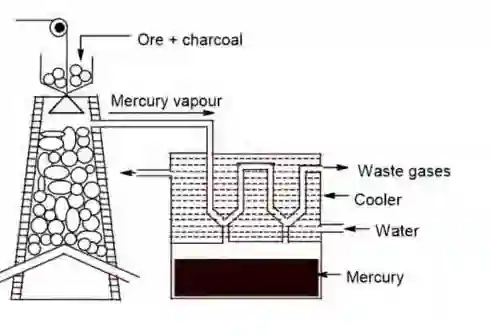
Figure: Shaft furnace for roasting and distillation of cinnabar
1. Crushing and pulverisation: big lumps of cinnabar are broken by a jaw crusher and powdered in a ball mill.
2. Concentration: the powder is mixed with water and pine oil in a tank and agitated with compressed air (froth flotation). The sulphide ore particles stick to the froth and float, and the earthy impurities (gangue) settle.
3. Roasting and distillation: the concentrated ore, mixed with charcoal, is heated in excess of air in a shaft furnace (a reverberatory furnace is not suitable because the volatile mercury vapour would escape). The sulphide changes to the oxide, which decomposes at once into mercury vapour:
Impurities such as \(P\), \(S\), \(As\) and \(Sb\) go out as volatile oxides (\(4P+5O_2\rightarrow2P_2O_5\), \(S+O_2\rightarrow SO_2\), \(4As+3O_2\rightarrow2As_2O_3\)). The mercury vapour passes through Y-shaped iron tubes cooled by water, where it condenses to liquid mercury and collects in a receiver; the waste gases escape.
4. Purification: the liquid mercury is filtered through chamois leather, washed with 5% nitric acid, and finally distilled under reduced pressure (see Question 11).
Corrosive sublimate is mercury(II) chloride, \(HgCl_2\), a poisonous white crystalline solid.
Preparation:
(\(MnO_2\) prevents the formation of calomel.)
Physical properties: white crystalline solid, sparingly soluble in cold water and readily soluble in hot water, soluble in aqua regia, toxic, and it sublimes on heating.
Chemical properties:
Mercuric thiocyanate, when dried and ignited, swells into a snake-like tube called pharaoh’s serpent. With stannous chloride it is reduced stepwise, first to calomel and then to mercury:
Uses: pesticide and fungicide, 5% solution as disinfectant, preparation of calomel and Nessler’s reagent, and preservative of timber and leather. Traditionally egg white or milk is given as the antidote for poisoning.
The liquid mercury obtained from the condenser contains impurities such as copper, lead, zinc, bismuth and suspended particles (soot, \(HgO\)). It is purified in three steps:
(i) Filtration: the impure mercury is filtered through chamois leather or thick canvas, which removes the suspended particles and oxides.
(ii) Chemical washing: the filtrate is passed in fine drops through a long tube containing 5% dilute nitric acid. The mercury is oxidised a little to mercurous nitrate, and the more reactive metals (\(Zn, Pb, Fe\)) displace mercury from it and dissolve as nitrates:
(iii) Vacuum distillation: the mercury is distilled under reduced pressure. It boils at 357 degrees Celsius and distils over, leaving \(Pb\), \(Cu\), \(Cd\) etc., which have higher boiling points, behind. The mercury obtained is about 99.9% pure.
Iron impurity is removed in the same way, since iron is more reactive than mercury and dissolves in the dilute nitric acid.
Long Answer Questions
a. Identify the metal ‘M’.
\(M\) is mercury (\(Hg\)): atomic number 80, period 6, group 12, electronic configuration \([Xe]\,4f^{14}5d^{10}6s^2\), and the only metal that is liquid at room temperature (m.p. \(-38.8\) degrees Celsius, b.p. 357 degrees Celsius, density 13.6 g/cc).
b. Write the formula of the chief ore of ‘M’.
The chief ore is cinnabar, \(HgS\).
c. How would you extract ‘M’ starting from its chief ore?
The cinnabar ore is crushed and powdered, and concentrated by froth flotation. The concentrated ore is mixed with charcoal and roasted in excess of air in a shaft furnace, where the oxide formed decomposes to mercury vapour, which is condensed in water-cooled Y-shaped iron tubes:
The liquid mercury is purified by filtration through chamois leather, washing with 5% \(HNO_3\) and vacuum distillation (99.9% pure).
d. What happens when ‘M’ is treated with aqua regia?
Mercury dissolves in aqua regia (3 parts conc. \(HCl\) and 1 part conc. \(HNO_3\)) to form mercuric chloride:
e. What happens when ‘M’ is heated with air at 350 \(^\circ\)C?
Mercury is not affected by air at ordinary temperature, but at about 350 degrees Celsius it forms red mercuric oxide: \(2Hg+O_2\xrightarrow{350^\circ C}2HgO\). Above 350 degrees Celsius the oxide decomposes back into mercury and oxygen, \(2HgO\rightarrow2Hg+O_2\).
f. Write any two uses of ‘M’.
1. As a thermometric and barometric liquid (thermometers, barometers) and in electrical switches and mercury vapour lamps.
2. In the extraction of gold and silver by amalgamation, in dental fillings (amalgam), and in the production of chlorine and caustic soda.
a. Identify the element and write its chief ore.
The element is mercury, \(Hg\), and its chief ore is cinnabar, \(HgS\).
b. Describe the steps required to extract this element from its chief ore with necessary diagram.
Figure: Shaft furnace for roasting and distillation of cinnabar
1. Crushing and pulverisation of the ore (jaw crusher, ball mill).
2. Concentration by froth flotation: the powdered ore, water and pine oil are agitated with compressed air, and the sulphide particles rise in the froth while the gangue settles.
3. Roasting and distillation: the concentrated ore mixed with charcoal is heated in excess of air in a shaft furnace: \(2HgS+3O_2\rightarrow2HgO+2SO_2\), \(2HgO\rightarrow2Hg+O_2\). The mercury vapour is condensed in water-cooled Y-shaped iron tubes and collected as liquid.
4. Purification: filtration through chamois leather, washing with 5% nitric acid, and vacuum distillation.
c. Write the formula of two important compounds of this element showing oxidation state +1 and +2.
| Oxidation state | Compound | Formula |
|---|---|---|
| +1 | Calomel (mercurous chloride) | \(Hg_2Cl_2\) |
| +2 | Corrosive sublimate (mercuric chloride) | \(HgCl_2\) |
Other compounds are \(Hg_2O\) and \(Hg_2(NO_3)_2\) (+1) and \(HgO\), \(HgS\) and \(HgI_2\) (+2).
d. Write any two uses of this element.
1. In the extraction of gold and silver by the amalgamation process, and in the preparation of amalgams including dental fillings.
2. In thermometers and barometers, in fluorescent and mercury vapour lamps, and in electrical switches.
4. View PDF Notes
i. Handwritten Notes
ii. Typed PDF Notes
5. Frequently Asked Questions
What is mercury? (Class 12 Chemistry)
What topics are included in Unit 7 Studies of Heavy Metals of NEB Class 12 Chemistry?
Which are the heavy metals and where do they come in the periodic table?
What is the chief ore of mercury and where is it found in Nepal?
How is mercury extracted from cinnabar?
How is mercury purified?
What are the physical properties of mercury?
What are the chemical properties of mercury?
What is tailing of mercury?
What is an amalgam and why does iron not form one?
What are the uses of mercury?
What is calomel and how is it prepared?
What is corrosive sublimate and what are its properties and uses?
What is Nessler’s reagent and what is it used for?
How can you distinguish calomel from corrosive sublimate?
What is the antidote for mercury poisoning and why is mercury dangerous?
Why is the symbol of mercury Hg and why is it named after a god?
Where can I get Class 12 Chemistry Mercury notes in PDF (Heavy metals PDF)?
Where can I get Class 12 Chemistry notes of NEB (handwritten, PDF, Nepal)?
Students also search for: