
Recent Trends in Technology
AI, Cloud Computing, Big Data, VR, E-Commerce & IoT
Complete NEB Class 12 Computer Science notes on Recent Trends in Technology — Artificial Intelligence, Robotics, Cloud Computing, Big Data, Virtual Reality, E-Commerce, E-Government, Mobile Computing, and IoT — with fully solved MCQs and subjective questions.
Multiple Choice Questions (MCQs)
Select an option to view the correct answer and justification.
Justification: The core goal of AI is to build systems that can solve real-world problems the way humans would, rather than purely artificial or academic ones.
Justification: Learning is one of the core components of AI (alongside reasoning, cognitive computing, machine learning, and neural networks), allowing systems to improve from experience.
Justification: LISP and PROLOG were specifically designed for AI research, and Java is widely used for AI development too, but Perl is not a commonly used AI programming language.
Justification: Face recognition, chatbots, and LIDAR (used in AI-driven perception systems like self-driving cars) are all AI applications, while ADBMS (a distributed database management system) is a database technology, not an AI application.
Justification: An agent perceives its environment through inputs (often supplied or configured by humans) and interprets the resulting output itself to decide on an action.
Justification: Perceiving, learning, and diagnosis all contribute to how well an AI agent can sense its environment, improve over time, and identify problems, together improving overall performance.
Justification: Private, public, and dedicated cloud servers are recognized cloud deployment types; “merged cloud servers” is not a standard classification (the standard hybrid category is “hybrid cloud,” not “merged”).
Justification: Security, availability, and large network access are all recognized core features of cloud computing.
Justification: Adobe Creative Cloud, PayPal’s cloud-based payment infrastructure, and Google G Suite (Workspace) are all real-world applications built on cloud computing.
Subjective Questions
A branch of science which deals with helping machines to find solutions to complex problems in a more human-like fashion is called AI.
The applications of AI are:
The main components of Artificial Intelligence are as follows:
The features of AI are as follows:
Robotics is the branch of mechanical engineering, electrical engineering, and computer science that deals with the design, construction, operation, and application of robots, as well as computer systems for their control, sensory feedback, and information processing.
Applications of Robotics:
Cloud computing architecture consists of two components: “the front end” and “the back end”. The term “Cloud computing” is based on cloud drawings used in the past to represent telephone networks and later to depict the internet.
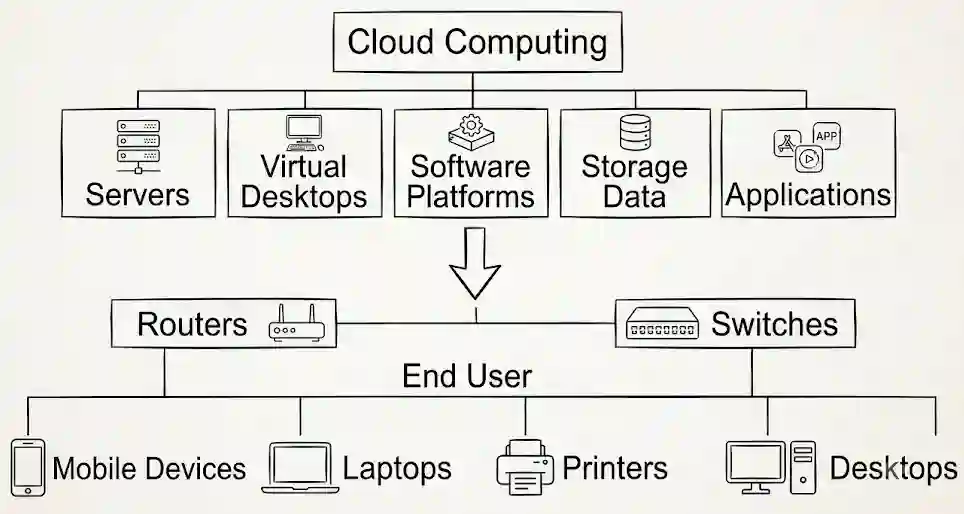
Fig: Cloud Computing Models
Cloud Computing Models:
Deployment Models:
Advantages:
Disadvantages:
Big data refers to the large, diverse sets of information that grow at ever-increasing rates. Big data refers to data that is so large, fast, or complex that it’s difficult or impossible to process using traditional methods.
Types of Big Data:
The characteristics of big data are as follows:
The word “Virtual” means near and “Reality” means what we experience as human beings. So the term “Virtual Reality” basically means “near reality”.
Virtual Reality is the term used to describe a computer-generated environment which can be explored and interacted with by a person. Virtual Reality for learning is best used to give students experiences of things that they cannot experience in the real world.
The types of virtual reality are as follows:
Virtual Reality Applications:
E-Commerce means doing business over an interconnected network. It helps in doing business electronically, by bringing buyers and sellers together. The main platforms of e-commerce are the internet, email, fax, and telephone orders.
Types of E-Commerce:
Advantages:
Disadvantages:
Electronic Government is the application of information and communication technologies (ICT) for delivering government services through integration of various systems between government and citizens.
Types of E-government:
Mobile computing is the ability to use computing capability without a pre-defined location and connection to a network to publish and subscribe to information.
The characteristics of mobile computing are as follows:
Advantages:
Disadvantages:
The IoT refers to the billions of physical devices around the world that are now connected to the internet, all collecting and sharing data.
Features of Internet of Things (IoT):
Advantages:
Disadvantages:
📄 View / Download Full PDF Notes
If the PDF doesn’t load, click here to open it in Google Drive.
 Physics (भौतिक विज्ञान)
 Chemistry (रसायन विज्ञान)
 Biology (जीव विज्ञान)
 Mathematics (गणित)
 English (अंग्रेजी)
 Nepali (नेपाली)
 Computer Science (कम्प्युटर विज्ञान)
 Account (लेखाशास्त्र)
 Economics (अर्थशास्त्र)
 Business Studies (व्यवसाय अध्ययन)
 Social (सामाजिक)