
Magnetic Field
Class 12 Physics Notes • NEB Syllabus 2083
Syllabus, 15 solved multiple choice questions, step-by-step numericals and derivations, handwritten and typed PDF notes and frequently asked questions on magnetic force, the Hall effect, the Biot-Savart law, Ampere’s law and parallel conductors.
1. Syllabus
Unit: Electricity and Magnetism
Chapter 16: Magnetic Field (12 hours)
These notes follow the NEB Class 12 Physics syllabus (+2 Physics, Nepal). Practise the multiple choice questions first, then work through the numericals, and finish with the PDF notes for quick revision.
2. Multiple Choice Questions
Question 1. The work done in deflecting a small magnet of magnetic moment \(10\ \mathrm{A\,m^2}\) through \(180^\circ\) from a uniform magnetic field of strength \(0.4\times10^{-4}\ \mathrm{T}\) (starting from the position parallel to the field) is:
- a) \(8\times10^{-4}\ \mathrm{J}\)
- b) zero
- c) \(4\times10^{-4}\ \mathrm{J}\)
- d) None of these
Correct Answer: a) \(8\times10^{-4}\ \mathrm{J}\)
Reason: The work done in rotating a magnetic dipole from \(\theta_1\) to \(\theta_2\) is \(W=MB(\cos\theta_1-\cos\theta_2)\). From \(0^\circ\) to \(180^\circ\):
Question 2. Points A and B are situated along the extended axis of a \(2\ \mathrm{cm}\) long bar magnet at distances \(x\) and \(2x\ \mathrm{cm}\) respectively from the pole nearer to the points. The ratio of the magnetic field at A and B will be:
- a) 4 : 1 exactly
- b) 8 : 1 exactly
- c) 4 : 1 approximately
- d) 8 : 1 approximately
Correct Answer: d) 8 : 1 approximately
Reason: At points on the axis that are far compared with the length of the magnet, the magnet behaves like a magnetic dipole whose axial field is \(B\propto\dfrac{1}{r^3}\), where \(r\) is measured from the centre of the magnet. The distances of A and B from the centre are \(x+1\) and \(2x+1\) (in cm), so for \(x\gg1\):
Question 3. A toroidal solenoid has \(300\) turns and a mean radius of \(10\ \mathrm{cm}\). It has a soft iron core of relative permeability \(2000\). What is the magnitude of the magnetic field in the core when a current of \(1\ \mathrm{A}\) is passed through the solenoid?
- a) \(0.12\ \mathrm{T}\)
- b) \(0.24\ \mathrm{T}\)
- c) \(1.2\ \mathrm{T}\)
- d) \(12\ \mathrm{T}\)
Correct Answer: c) \(1.2\ \mathrm{T}\)
Reason: Inside a toroid \(B=\mu_0\mu_r nI\) with \(n=\dfrac{N}{2\pi r}\):
Question 4. Two particles, each of mass \(m\) and charge \(q\), are attached to the two ends of a light rod of length \(2l\). The rod is rotated at a constant angular speed about a perpendicular axis through its centre. The ratio of the magnitudes of the magnetic moment of the system to its angular momentum is:
- a) \(\dfrac qm\)
- b) \(\dfrac{q}{2m}\)
- c) \(\dfrac{2q}{m}\)
- d) \(\dfrac{q}{\pi m}\)
Correct Answer: b) \(\dfrac{q}{2m}\)
Reason: Each charge moves in a circle of radius \(l\) with frequency \(\dfrac{\omega}{2\pi}\), giving a current \(\dfrac{q\omega}{2\pi}\). So
Question 5. What is the force per unit length between two straight conductors carrying the same current \(I\) and separated by a distance \(b\)?
- a) \(\dfrac{\mu_0I}{2\pi b^2}\)
- b) \(\dfrac{\mu_0I^2}{2\pi b}\)
- c) \(\dfrac{\mu_0I}{2\pi b}\)
- d) \(\dfrac{\mu_0I^2}{2b}\)
Correct Answer: b) \(\dfrac{\mu_0I^2}{2\pi b}\)
Reason: The force per unit length between two parallel conductors is \(\dfrac Fl=\dfrac{\mu_0I_1I_2}{2\pi d}\). With \(I_1=I_2=I\) and \(d=b\):
Question 6. A coil having \(N\) turns and plane area \(A\) carries a current \(I\). The quantity \(NIA\) is:
- a) magnetic flux
- b) magnetising field
- c) magnetic susceptibility
- d) magnetic moment
Correct Answer: d) magnetic moment
Reason: The magnetic dipole moment of a current-carrying coil is the product of the number of turns, the current and the area of the coil: \(M=NIA\).
Question 7. A long wire carrying a current \(I\) is bent at a right angle so that it has two semi-infinite arms meeting at the corner O. The magnetic field at a point P on the extension of one arm, at a distance \(a\) from O, is:
- a) \(\dfrac{\mu_0I}{4\pi a}\)
- b) \(\dfrac{\mu_0I}{2a}\)
- c) \(\dfrac{\mu_0I}{2\sqrt2\,\pi a}\)
- d) \(\dfrac{\mu_0I}{2(a+\sqrt2a)}\)
Correct Answer: a) \(\dfrac{\mu_0I}{4\pi a}\)
Reason: The point P lies on the line of the first arm, so that arm gives no field (\(\sin\theta=0\)). For the second arm, a semi-infinite wire, P is at a perpendicular distance \(a\) from its end O, so
Question 8. A coil having \(N\) turns and area \(A\) is rotated in a uniform magnetic field \(B\) with angular velocity \(\omega\). The maximum e.m.f. induced in the coil is:
- a) \(NAB\omega\)
- b) \(\tfrac12NAB\omega\)
- c) \(\dfrac{NA\omega}{B}\)
- d) \(\dfrac{B\omega}{NA}\)
Correct Answer: a) \(NAB\omega\)
Reason: The flux linked is \(\Phi=NAB\cos\omega t\). By Faraday’s law
Question 9. A coil of area \(A_0\) is placed in a magnetic field whose strength changes from \(B_0\) to \(4B_0\) in \(t\) seconds. The induced e.m.f. in the coil is:
- a) \(\dfrac{4B_0A_0}{t}\)
- b) \(\dfrac{3B_0}{A_0t}\)
- c) \(\dfrac{3B_0A_0}{t}\)
- d) \(\dfrac{4B_0}{A_0t}\)
Correct Answer: c) \(\dfrac{3B_0A_0}{t}\)
Reason: The change of flux is \(\Delta\Phi=A_0(4B_0)-A_0B_0=3A_0B_0\), so
Question 10. Magnetic lines of force:
- a) cannot intersect at all
- b) intersect at infinity
- c) intersect within the magnet
- d) intersect at the neutral point
Correct Answer: a) cannot intersect at all
Reason: The tangent to a line of force gives the direction of the magnetic field at that point. If two lines intersected, the field would have two directions at the point of intersection, which is impossible.
Question 11. Two identical coils carrying equal currents have a common centre, and their planes are at right angles to each other. What is the ratio of the magnitude of the resultant magnetic field at the centre to the field due to one coil alone?
- a) 1
- b) \(\sqrt2\)
- c) \(\dfrac{1}{\sqrt2}\)
- d) 2
Correct Answer: b) \(\sqrt2\)
Reason: The field of each coil at the centre is \(B\), along the axis of the coil. The axes are perpendicular, so
Question 12. The magnetic field at the centre O of the circular portion of the current-carrying wire of radius \(3\ \mathrm{cm}\) shown in the figure is:
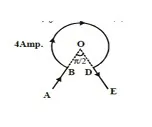
Figure: Current-carrying circular portion of wire of radius 3 cm
- a) \(\dfrac{8\pi}{3}\times10^{-5}\ \mathrm{T}\)
- b) \(\dfrac{8\pi}{3}\times10^{4}\ \mathrm{T}\)
- c) \(2\pi\times10^{-5}\ \mathrm{T}\)
- d) \(2\pi\times10^{-4}\ \mathrm{T}\)
Correct Answer: c) \(2\pi\times10^{-5}\ \mathrm{T}\)
Reason: The field at the centre of a circular arc of radius \(r\) that carries a current \(I\) and subtends an angle \(\varphi\) at the centre is
For a complete circle (\(\varphi=2\pi\)) this is \(B=\dfrac{\mu_0I}{2r}\). Using the current and the angle given in the figure with \(r=3\ \mathrm{cm}\), the field is \(2\pi\times10^{-5}\ \mathrm{T}\).
Question 13. In a moving coil galvanometer, the deflection \(\theta\) on the scale by a pointer attached to the spring is:
- a) \(\left(\dfrac{NA}{kB}\right)I\)
- b) \(\left(\dfrac{N}{kAB}\right)I\)
- c) \(\left(\dfrac{NAB}{k}\right)I\)
- d) \(\dfrac{NAB}{kI}\)
Correct Answer: c) \(\left(\dfrac{NAB}{k}\right)I\)
Reason: At equilibrium the magnetic deflecting torque equals the restoring torque of the spring:
Question 14. Which one of the following is a correct statement about magnetic forces?
- a) Magnetic forces always obey Newton’s third law.
- b) Magnetic forces do not obey Newton’s third law.
- c) For very high current, magnetic forces obey Newton’s third law.
- d) Inside a low magnetic field, magnetic forces obey Newton’s third law.
Correct Answer: b) Magnetic forces do not obey Newton’s third law.
Reason: The magnetic force between two moving point charges (or two current elements) is not in general equal and opposite or directed along the line joining them, so Newton’s third law in its simple form does not hold. Momentum is conserved only when the momentum of the electromagnetic field is included.
Question 15. A rectangular loop carrying a current \(I\) is situated near a long straight wire so that the wire is parallel to one of the sides of the loop and in the plane of the loop. If a steady current \(I\) is established in the wire as shown in the figure, the loop will:
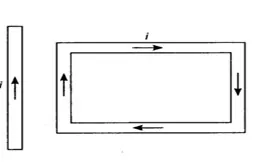
Figure: Rectangular loop near a long straight current-carrying wire
- a) rotate about an axis parallel to the wire.
- b) move away from the wire or towards the right.
- c) move towards the wire.
- d) remain stationary.
Correct Answer: c) move towards the wire.
Reason: The magnetic field of the long wire is stronger near the wire. The side of the loop nearest to the wire carries a current in the same direction as the wire, so it is attracted with a larger force. The far side carries a current in the opposite direction and is repelled with a smaller force. The net force is attractive, so the loop moves towards the wire.
3. Numerical and Subjective Questions
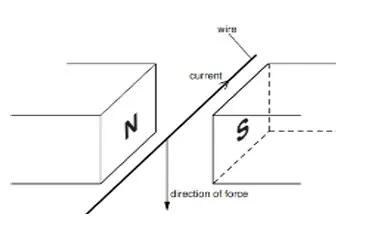
Figure: Current in a wire and the force on it in a magnetic field
a) On the figure, draw arrows to indicate the direction of the magnetic field.
Use Fleming’s left-hand rule: stretch the forefinger, the middle finger and the thumb of the left hand mutually perpendicular. The middle finger points in the direction of the current and the thumb in the direction of the force. The forefinger then gives the direction of the magnetic field, which, for the figure, is from the North pole to the South pole of the magnets.
b) The magnetic field is reversed. State what happens, if anything, to the direction of the force on the wire.
The direction of the force is also reversed, because \(\vec F=I\,\vec l\times\vec B\) changes sign when \(\vec B\) changes sign.
c) A wire carrying a current of \(10\ \mathrm{A}\) and \(2\ \mathrm{m}\) long is placed in a field of flux density \(0.34\ \mathrm{T}\). What is the force on the wire if it is placed at \(60^\circ\) to the field?
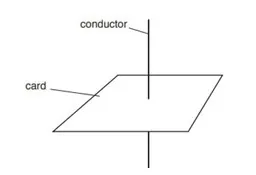
Figure: Vertical conductor passing through a horizontal card
a) i) On the figure, draw a cell and a switch in series with the conductor to form a complete circuit. Use the correct circuit symbols.
Join a cell (drawn as a long thin line for the positive terminal and a short thick line for the negative terminal) and a switch (drawn as a gap with a movable contact) in series with the vertical conductor, so that the two ends of the conductor are connected through them and form a closed circuit.
a) ii) A student sprinkles iron filings onto the card and closes the switch. There is a current in the conductor. Describe the pattern of the magnetic field seen.
The iron filings arrange themselves in a pattern of concentric circles around the conductor. The circles are closer together near the conductor, where the field is stronger.
a) iii) The student reverses the direction of the current in the conductor. State the effect, if any, on the pattern he sees.
The pattern of the filings (concentric circles) is unchanged, but the direction of the magnetic field is reversed. A small compass placed on the card would point the opposite way.
b) A straight horizontal rod X of mass \(50\ \mathrm{g}\) and length \(0.5\ \mathrm{m}\) is placed in a uniform magnetic field of \(0.2\ \mathrm{T}\) perpendicular to X. Calculate the current in X if the force acting on it just balances its weight. (Take \(g=10\ \mathrm{N\,kg^{-1}}\).)
a) Explain what is meant by magnetic flux density.
The magnetic flux density \(B\) is a measure of the strength of a magnetic field. It is defined as the force acting per unit length on a straight conductor that carries unit current and is placed perpendicular to the field:
Its unit is the tesla (T).
b) A particle has mass \(m\), charge \(+q\) and speed \(v\). It enters a uniform magnetic field of flux density \(B\), moving normal to the field, as shown in the figure. The field is perpendicular to, and into, the plane of the paper.
b) i) On the figure, draw the path of the particle through, and beyond, the region of the magnetic field.
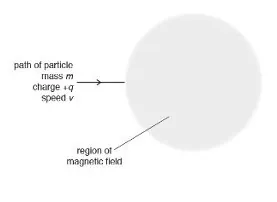
Figure: Charged particle entering a uniform magnetic field normally
Inside the field the path is a circular arc, curving in the direction of the force \(q\vec v\times\vec B\). After leaving the field the particle moves in a straight line along the tangent to the arc at the point of exit.
b) ii) There is a force acting on the particle, causing it to accelerate. Explain why the speed of the particle on leaving the magnetic field is \(v\).
The magnetic force \(\vec F=q\vec v\times\vec B\) is always perpendicular to the velocity. A force perpendicular to the motion does no work (\(W=\vec F\cdot\vec d=0\)), so the kinetic energy and hence the speed of the particle stay constant. Only the direction of the velocity changes.
c) The particle loses an electron so that its charge becomes \(+2q\). Its change in mass is negligible. Determine, in terms of \(v\), the initial speed of the particle such that its path through the magnetic field is unchanged. Explain your working.
The radius of the circular path is \(r=\dfrac{mv}{qB}\). For the path to be unchanged, \(r\) must stay the same. If \(v_{new}\) is the new speed and the charge is \(2q\):
The initial speed must be doubled, \(2v\).
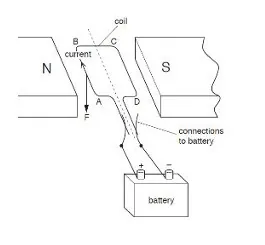
Figure: Current-carrying coil in a magnetic field
a) On the figure, draw an arrow labelled X on side CD to show the direction of the current in this side, and an arrow labelled P to show the direction of the force on CD.
The current goes round the loop, so in side CD it flows in the direction opposite to that in AB (arrow X). Since the current is reversed while the field is the same, the force on CD is opposite to \(F\) (arrow P). The two forces form a couple that turns the coil.
b) Give two ways of increasing the forces F and P on the sides of the coil.
c) i) Name the particles that flow in the metal wire of the coil.
Free electrons.
c) ii) The wire of the coil is replaced by a thinner wire of the same length and the same metal. State and explain how this changes the current in the coil.
A thinner wire has a smaller cross-sectional area, so its resistance increases:
For the same applied voltage, \(I=\dfrac VR\), so the current in the coil decreases.
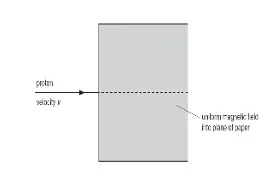
Figure: Proton entering crossed electric and magnetic fields
a) On the figure, draw an arrow labelled E to show the direction of the electric field.
By Fleming’s left-hand rule the magnetic force on the proton is upward in the figure. To pass undeviated, the electric force must be downward and equal in magnitude. The proton is positive, so the electric field points downward (in the direction of the electric force).
b) The proton is replaced by other particles. The electric and magnetic fields remain unchanged. State and explain the deviation, if any, of the following particles in the region of the fields.
b) i) An \(\alpha\)-particle with initial velocity \(v\).
It passes undeviated. The condition for no deviation is
which does not depend on the charge or the mass of the particle. Any particle that enters with speed \(v=E/B\) is therefore not deviated.
b) ii) An electron with initial velocity \(2v\).
The electron is deviated. The magnetic force is \(F_m=e(2v)B=2evB\), twice the electric force \(F_e=eE=evB\). The electron is negative, so the magnetic force is downward and the electric force is upward. The net force is \(2evB-evB=evB\) downward, so the electron is deflected downward.
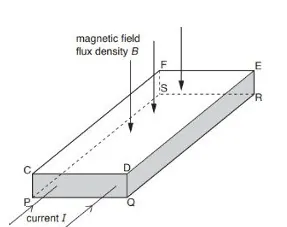
Figure: Thin conducting slice in a magnetic field for the Hall effect
i) State the faces between which the Hall voltage \(V_H\) is developed.
The Hall voltage appears across the pair of faces that are parallel to both the current and the magnetic field. These are the two faces that are neither the pair normal to the field (CDEF and PQRS) nor the pair normal to the current (CDQP and FERS), that is, the remaining two side faces of the slice. The Hall electric field is perpendicular to both \(\vec B\) and the current.
ii) The current \(I\) is produced by charge carriers, each of charge \(+q\), moving at speed \(v\) in the direction of the current. The number density of the charge carriers is \(n\). Derive an expression relating the Hall voltage \(V_H\) to \(I,B,n,q\) and \(t\), where \(t\) is the thickness of the slice.
In the steady state the electric force due to the Hall voltage balances the magnetic force on the carriers:
If \(d\) is the distance between the Hall faces, \(E=\dfrac{V_H}{d}\), so \(v=\dfrac{V_H}{Bd}\). The cross-section of the slice normal to the current is \(A=dt\), and the current is \(I=nAqv\):
iii) Suggest why the Hall voltage is difficult to detect in a thin slice of copper.
Copper has a very large number density \(n\) of free electrons. Since \(V_H=\dfrac{BI}{nqt}\) is inversely proportional to \(n\), the Hall voltage is extremely small (of the order of microvolts or less) and is difficult to detect.
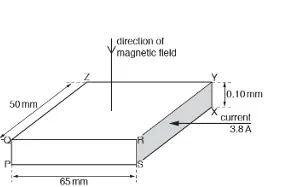
Figure: Thin rectangular slice of aluminium used to find the Hall voltage
a) State the Hall effect.
When a current-carrying conductor is placed in a magnetic field perpendicular to the current, a potential difference (the Hall voltage) is produced across the conductor in the direction perpendicular to both the current and the magnetic field.
b) Use the figure to state the magnitude of the distance \(t\).
\(t\) is the thickness of the slice in the direction of the magnetic field. From the figure,
c) Calculate the magnitude of the Hall voltage \(V_H\).
a) State and explain the Biot-Savart law.
The Biot-Savart law gives the magnetic field \(d\vec B\) at a point due to a small element \(d\vec l\) of a conductor carrying a current \(I\). The magnitude of \(dB\) is directly proportional to the current \(I\), to the length \(dl\) of the element and to the sine of the angle \(\theta\) between \(d\vec l\) and the line joining the element to the point, and is inversely proportional to the square of the distance \(r\) of the point from the element:
b) Use this law to find the magnetic field at the centre of a current-carrying circular coil.
Let the coil have radius \(r\). Every element \(dl\) is perpendicular to the radius vector, so \(\theta=90^\circ\) and
All the elements give a field in the same direction at the centre, so we add them over the whole circumference \(l=2\pi r\):
c) A circular coil of \(100\) turns has a radius of \(10\ \mathrm{cm}\) and carries a current of \(5\ \mathrm{A}\). Determine the magnetic field at a point on the axis of the coil at a distance of \(5\ \mathrm{cm}\) from the centre of the coil.
The field on the axis of a coil is
a) What is the vector representation of the Lorentz force?
The magnetic force on a charge \(q\) moving with velocity \(\vec v\) in a magnetic field \(\vec B\) is
b) State Fleming’s left-hand rule.
Stretch the thumb, the forefinger and the middle finger of the left hand so that they are mutually perpendicular. If the forefinger points in the direction of the magnetic field and the middle finger in the direction of the current (the motion of positive charge), then the thumb points in the direction of the force.
c) A horizontal straight wire \(5\ \mathrm{cm}\) long weighing \(1.2\ \mathrm{g\,m^{-1}}\) is placed perpendicular to a uniform horizontal magnetic field of flux density \(0.6\ \mathrm{T}\). If the resistance of the wire is \(3.8\ \Omega\ \mathrm{m^{-1}}\), calculate the potential difference that has to be applied between the ends of the wire to make it just self-supporting. (Take \(g=10\ \mathrm{m\,s^{-2}}\).)
For the wire to be self-supporting, \(BIl=W\):
a) What path does the electron follow in an electric field when the electron is projected normally into the field?
A parabolic path, because the electric force is constant and perpendicular to the initial velocity.
b) An electron passes through a space without deviation. Does it mean there is no field?
No. The electron may be passing through crossed electric and magnetic fields whose forces balance (\(qE=qvB\)), or it may be moving parallel (or anti-parallel) to a magnetic field, which exerts no force on it.
c) Is there any condition under which an electron does not experience any force inside a magnetic field?
Yes. The magnetic force \(F=qvB\sin\theta\) is zero if the electron is at rest (\(v=0\)) or if it moves along the field (\(\theta=0^\circ\) or \(180^\circ\)).
a) Mathematically state the Biot-Savart law.
b) Find an expression for the magnetic field intensity at the centre of a circular current-carrying coil containing \(N\) turns. Also show the direction of the magnetic field with a suitable figure.
Figure: Magnetic field at the centre of a circular current-carrying coil
For one circular loop of radius \(R\), \(d\vec l\) and \(\vec r\) are perpendicular at every point, so \(|d\vec l\times\hat r|=dl\):
For \(N\) closely wound turns the fields add up:
Direction: by the right-hand grip rule, curl the fingers of the right hand in the direction of the current in the loop. The thumb then points in the direction of the magnetic field at the centre, along the axis of the coil.
a) Two parallel conductors carrying current in the same direction are attracted to each other. Why? Explain by calculating the force per unit length between such current-carrying conductors with a suitable figure.
Figure: Two parallel conductors carrying currents in the same direction attract each other
The current \(I_1\) in wire 1 produces a magnetic field around it. By the right-hand grip rule, at the position of wire 2 this field is perpendicular to the plane of the wires (into the page in the figure) and has the magnitude
Wire 2, carrying the current \(I_2\), lies in this field and experiences a force. By Fleming’s left-hand rule, with the current upward and the field into the page, the force on wire 2 is directed towards wire 1. For a length \(l\) of wire 2:
In the same way, wire 1 experiences an equal force towards wire 2. The conductors therefore attract each other. If the currents are in opposite directions, they repel.
b) Define one ampere on the basis of the force between two parallel conductors.
One ampere is that constant current which, flowing in two straight parallel conductors of infinite length and negligible circular cross-section, placed \(1\ \mathrm{m}\) apart in vacuum, produces between them a force of \(2\times10^{-7}\ \mathrm{N}\) per metre of length.
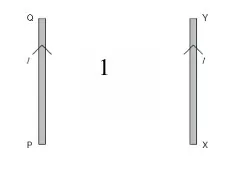
Figure 1: Two long parallel current-carrying conductors PQ and XY
a) On figure 2 draw arrows, one in each case, to show the direction of:
a) i) The magnetic field at Q due to the current in wire XY (label this arrow B).
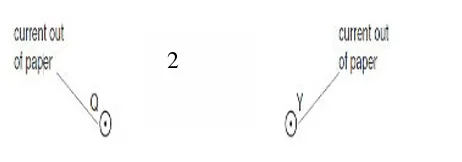
Figure 2: Plan view of the two conductors from above
By the right-hand grip rule applied to the current in XY, the magnetic field at Q is perpendicular to the plane of the figure. For the currents shown it points into the page (arrow B).
a) ii) The force at Q as a result of the magnetic field due to the current in wire XY (label this arrow F).
By Fleming’s left-hand rule the force on PQ is directed towards wire XY (arrow F), because currents in the same direction attract.
b) i) State Newton’s third law of motion.
If a body A exerts a force on a body B, then B exerts an equal and opposite force on A. (For every action there is an equal and opposite reaction.)
b) ii) Use this law and your answer in (a)(ii) to state the direction of the force on wire XY.
The force on XY is equal in magnitude and opposite in direction to the force on PQ, so it is directed towards wire PQ.
c) The magnetic flux density \(B\) at a distance \(d\) from a long straight wire carrying a current \(I\) is given by \(B=2.0\times10^{-7}\dfrac Id\). Use this expression to explain why, under normal circumstances, wires carrying alternating current are not seen to vibrate. Make reasonable estimates of the magnitudes of the quantities involved.
Estimate, for household cables, \(I\approx10\ \mathrm{A}\) and \(d\approx5\ \mathrm{mm}=0.005\ \mathrm{m}\):
This force is very small compared with the weight and the stiffness of the cable. The current also alternates (50 Hz), so the force changes direction 100 times a second, and the wire, because of its inertia, cannot respond to such rapid, tiny oscillations. No vibration is seen.
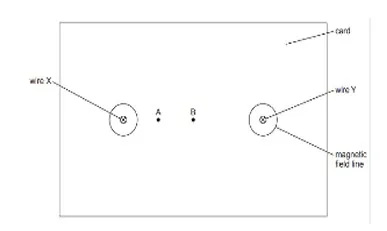
Figure: Two wires carrying equal currents downward through a card
a) On the figure, draw the complete magnetic field line due to the current in wire X that passes through point A. Mark the direction of this field line.
The field line through A is a closed circle (or loop) centred on wire X. The current is vertically downwards, into the card when seen from above, so by the right-hand grip rule the direction of the field line is clockwise.
b) Point B is midway between the two wires. Explain why the magnetic field at B is zero.
At B the clockwise field of wire X points in one direction along the line between the wires (down the page in the figure), and the clockwise field of wire Y points in the opposite direction (up the page). The currents are equal and B is midway, so the two fields are equal in magnitude and opposite in direction and cancel. The resultant field at B is zero.
c) There is a force on wire Y due to the current in wire X.
c) i) State the direction of the force on wire Y.
The force on Y is directed towards wire X (an attractive force).
c) ii) Explain why there is a force on wire Y.
Wire Y carries a current and lies in the magnetic field produced by the current in wire X. A current-carrying conductor in a magnetic field experiences a force (\(F=BIl\)). Because the currents are in the same direction, the force is attractive.
4. View PDF Notes
i. Handwritten Notes
ii. Typed PDF Notes
5. Frequently Asked Questions
What is a magnetic field? (definition for Class 10 and Class 12)
What topics are included in Chapter 16 Magnetic Field of NEB Class 12 Physics?
What are the formulas for the magnetic field?
What is the unit of the magnetic field?
What is magnetic field intensity?
What is the magnetic field of the Earth?
What are magnetic field lines and what are their properties?
What was Oersted’s experiment?
What is the Lorentz force and Fleming’s left-hand rule?
What is the principle of a moving coil galvanometer?
What is the Hall effect and the Hall voltage?
What is the Biot-Savart law?
What is Ampere’s law and what are its applications?
How is the ampere defined?
Is the Magnetic Fields festival related to this chapter?
Where can I get Class 12 Physics Chapter 16 Magnetic Field notes in PDF?
Students also search for: