
First Law of Thermodynamics
Class 12 Physics Notes • NEB Syllabus 2083
Definition, formula, 11 solved multiple choice questions, step-by-step numericals, handwritten and typed PDF notes and frequently asked questions on thermodynamic processes, heat capacities and Meyer’s relation.
1. Syllabus
Unit: Heat and Thermodynamics (16 hours)
Chapter 4: First Law of Thermodynamics (8 hours)
4.1 Thermodynamic systems
4.2 Work done during volume change
4.3 Heat and work; internal energy and first law of thermodynamics
4.4 Thermodynamic processes: adiabatic, isochoric, isothermal and isobaric
4.5 Heat capacities of an ideal gas at constant pressure and volume and relation between them
4.6 Isothermal and adiabatic processes for an ideal gas
These notes follow the NEB Class 12 Physics syllabus (+2 Physics, Nepal). Practise the multiple choice questions first, then work through the numericals, and finish with the PDF notes for quick revision.
2. Multiple Choice Questions
Question 1. Which of the following is NOT a thermodynamic system?
- a) Open system
- b) Closed system
- c) Isolated system
- d) Static system
Correct Answer: d) Static system
Reason: Thermodynamic systems are classified by their ability to exchange mass and energy with the surroundings: open (both), closed (energy only) and isolated (neither). “Static system” is not a thermodynamic classification.
Question 2. The first law of thermodynamics is a statement of the conservation of:
- a) Mass
- b) Momentum
- c) Energy
- d) Entropy
Correct Answer: c) Energy
Reason: The first law, \(\Delta Q=\Delta U+\Delta W\), says the heat supplied to a system equals the change in its internal energy plus the work done by it. Energy is neither created nor destroyed, only transferred or transformed.
Question 3. If a gas expands adiabatically, which of the following statements is true?
- a) The internal energy of the gas remains constant
- b) The gas absorbs heat
- c) The work done by the gas is equal to the decrease in internal energy
- d) The temperature of the gas remains unchanged
Correct Answer: c) The work done by the gas is equal to the decrease in internal energy
Reason: In an adiabatic process \(\Delta Q=0\), so
During expansion the gas does positive work (\(\Delta W>0\)), so its internal energy decreases (\(\Delta U<0\)) and it cools.
Question 4. In an isothermal process, which of the following remains constant?
- a) Pressure
- b) Temperature
- c) Volume
- d) Internal energy
Correct Answer: b) Temperature
Reason: “Iso-thermal” means constant temperature: the system exchanges heat slowly with a reservoir so that \(T\) stays fixed. For an ideal gas the internal energy depends only on temperature and therefore also stays constant, but constant temperature is the defining feature of the process.
Question 5. Which of the following correctly describes the relation between heat capacity at constant pressure and constant volume?
- a) \(C_p=C_v\)
- b) \(C_p<C_v\)
- c) \(C_p-C_v=R\)
- d) \(C_p-C_v=\gamma\)
Correct Answer: c) \(C_p-C_v=R\)
Reason: This is Meyer’s relation for an ideal gas. Heating at constant pressure lets the gas expand and do work against the surroundings, so \(C_p\) exceeds \(C_v\) by the universal gas constant \(R\).
Question 6. A gas undergoes an isochoric (constant volume) process. What is the work done during this process?
- a) Positive
- b) Negative
- c) Zero
- d) Cannot be determined
Correct Answer: c) Zero
Reason: \(W=\int P\,dV\). At constant volume \(dV=0\), so the work done is zero.
Question 7. A gas expands isothermally at a temperature of 300 K from an initial volume of 2 L to a final volume of 6 L. If the gas follows \(W=nRT\ln\!\left(\dfrac{V_f}{V_i}\right)\), the work done is:
- a) Positive
- b) Negative
- c) Zero
- d) Infinite
Correct Answer: a) Positive
Reason: The gas expands, so \(\dfrac{V_f}{V_i}=\dfrac62=3>1\) and \(\ln 3>0\). Hence \(W>0\): the gas does work on its surroundings.
Question 8. A gas undergoes an adiabatic compression. What happens to its temperature?
- a) Increases
- b) Decreases
- c) Remains constant
- d) Becomes zero
Correct Answer: a) Increases
Reason: With \(\Delta Q=0\), \(\Delta U=-\Delta W\). In compression work is done on the gas, so \(\Delta W<0\) and \(\Delta U>0\). The internal energy, and therefore the temperature, rises.
Question 9. 0.5 mol of an ideal gas expands isothermally and reversibly at \(27^\circ\mathrm{C}\) from 1 L to 4 L. The work done (in J) is closest to:
- a) 1384 J
- b) 1725 J
- c) 1845 J
- d) 2100 J
Correct Answer: b) 1725 J
Reason: \(T=27+273=300\ \mathrm{K}\).
The closest option is 1725 J.
Question 10. A sample of 2 moles of an ideal gas (\(\gamma=1.4\)) is compressed adiabatically from a volume of 10 L to 1 L. If the initial temperature is 300 K, what is the final temperature?
- a) 750 K
- b) 820 K
- c) 900 K
- d) 1050 K
Correct Answer: a) 750 K
Reason: For an adiabatic process \(T_1V_1^{\gamma-1}=T_2V_2^{\gamma-1}\).
Question 11. A gas expands according to the relation \(PV^{1.4}=\text{constant}\). If the initial pressure and volume are 2 atm and 3 L respectively, find the final pressure when the volume becomes 6 L.
- a) 0.57 atm
- b) 0.63 atm
- c) 0.76 atm
- d) 1.2 atm
Correct Answer: c) 0.76 atm
Reason: Using \(P_1V_1^{1.4}=P_2V_2^{1.4}\):
3. Numerical and Subjective Questions
a) Define a thermodynamic system. Write one example of each type of thermodynamic system. Differentiate between open, closed and isolated systems with examples.
A thermodynamic system is a specific, macroscopic region of space or quantity of matter chosen for thermodynamic study, separated from its surroundings by a real or imaginary boundary.
Open system: exchanges both mass and energy (heat or work) with its surroundings. Example: boiling water in an open pan, where steam escapes and heat is transferred.
Closed system: exchanges energy but not mass. Example: gas sealed in a cylinder with a movable piston; energy is transferred as heat or by piston movement but the gas does not escape.
Isolated system: exchanges neither mass nor energy. Example: hot coffee in a perfectly insulated, sealed thermos flask.
b) How does work done on the system differ from work done by the system?
Work done by the system (expansion): the system pushes on the surroundings, for example a gas pushing a piston outward. \(dV\) is positive, so the work is taken as positive (\(+W\)) and the system loses internal energy to perform it.
Work done on the system (compression): the surroundings push on the system, for example a piston pushed inward to compress a gas. \(dV\) is negative, so the work is taken as negative (\(-W\)) and the internal energy of the system increases.
c) A gas at pressure \(2\times10^5\ \mathrm{Pa}\) and volume \(0.01\ \mathrm{m^3}\) expands isobarically to \(0.03\ \mathrm{m^3}\). Find the work done.
For a constant-pressure process:
d) Define an indicator diagram and explain how work done by an expanding gas can be calculated from it.
An indicator diagram (P-V diagram) is a graph of the pressure \(P\) of a thermodynamic system on the y-axis against its volume \(V\) on the x-axis.
The work done by an expanding gas is
which is equal to the area under the P-V curve between the initial volume \(V_1\) and the final volume \(V_2\). When the volume increases (left to right) the work is positive.
a) Explain the concept of internal energy and its relation with heat and work. What does the equation \(dU=-dW\) signify? How does the internal energy of a real gas differ from that of an ideal gas?
Internal energy: internal energy \(U\) is the sum of the microscopic kinetic energies (translational, rotational, vibrational) and potential energies (due to intermolecular forces) of all the molecules of a system. It is a state function.
Relation with heat and work: the first law, \(dQ=dU+dW\), connects them. Heat added to a system raises its internal energy and does external work.
Meaning of \(dU=-dW\): it follows when \(dQ=0\), that is, in an adiabatic process. If the gas expands and does work (\(dW>0\)), the work is done at the expense of the internal energy, so \(dU\) is negative and the gas cools.
Ideal and real gas: an ideal gas has no intermolecular forces, so its internal energy is purely kinetic and depends only on temperature. A real gas has intermolecular forces, so its internal energy has both kinetic and potential parts and depends on temperature and volume.
b) Calculate the change in internal energy of 2 moles of a monoatomic ideal gas which undergoes a temperature change from 300 K to 500 K. (\(C_v=3R/2\))
a) State and explain the first law of thermodynamics. Discuss its significance.
Statement: if an amount of heat \(dQ\) is supplied to a system, it is used in two ways: to increase the internal energy of the system (\(dU\)) and to do external work (\(dW\)) by the system.
Significance: it establishes the equivalence of heat and mechanical work, shows that heat is a form of energy, and states that every thermodynamic process obeys conservation of energy.
b) Does it follow the law of conservation of energy?
Yes. The first law is the principle of conservation of energy applied to thermodynamic systems. Energy can neither be created nor destroyed; it only changes from heat into internal energy and mechanical work.
c) A gas absorbs 600 J of heat and does 150 J of work. Find the change in internal energy.
d) List out the limitations of the first law of thermodynamics.
Direction of heat flow: it does not tell in which direction heat flows, for example why heat flows from hot to cold and not the other way.
Spontaneity: it gives no information on whether a given process is possible or spontaneous.
Extent of conversion: it does not say how much heat can be converted into work; the second law is needed to show that complete conversion in a cycle is impossible.
a) Why do gases have two specific heat capacities?
Solids and liquids change very little in volume on heating, so one specific heat is enough. A gas, however, can change greatly in volume or pressure. Heated at constant volume, all the heat goes into internal energy. Heated at constant pressure, the gas also expands and does external work. Different amounts of heat are needed for the same temperature rise in the two cases, so a gas has two principal specific heats: \(C_v\) (constant volume) and \(C_p\) (constant pressure).
b) Derive Meyer’s relation, \(C_p-C_v=R\).
Consider 1 mole of an ideal gas.
At constant volume: \(dQ_v=C_v\,dT\). Since \(dW=P\,dV=0\), the first law gives \(dU=C_v\,dT\).
At constant pressure: \(dQ_p=C_p\,dT\), and the gas does work \(dW=P\,dV\). The first law gives
The internal energy of an ideal gas depends only on temperature, so \(dU=C_v\,dT\) is the same in both cases:
From \(PV=RT\) at constant pressure, \(P\,dV=R\,dT\). Therefore
c) Why is \(C_p\) always greater than \(C_v\)?
At constant volume all the heat supplied raises the internal energy (temperature). At constant pressure the gas also expands and does external work, so extra heat must be supplied for this work in addition to the heat that raises the internal energy. Hence \(C_p>C_v\).
d) If \(C_p=29.1\ \mathrm{J\,mol^{-1}K^{-1}}\) and \(C_v=20.8\ \mathrm{J\,mol^{-1}K^{-1}}\), find the gas constant \(R\) and \(\gamma\).
a) Explain the processes: isothermal, adiabatic, isobaric and isochoric with the help of P-V diagrams.
Isothermal: temperature remains constant (\(\Delta T=0\)). It occurs slowly in a highly conducting vessel, and \(PV=\text{constant}\).
Adiabatic: no heat is exchanged with the surroundings (\(\Delta Q=0\)). It occurs rapidly or in a well-insulated vessel, and \(PV^{\gamma}=\text{constant}\).
Isobaric: pressure remains constant (\(\Delta P=0\)), for example heating a gas in a cylinder with a freely moving, weight-loaded piston.
Isochoric: volume remains constant (\(\Delta V=0\)), for example heating a gas in a rigid sealed container.
b) Differentiate between the different types of thermodynamic processes. Compare their P-V diagrams.
Starting from the same initial state \((P_1,V_1)\):
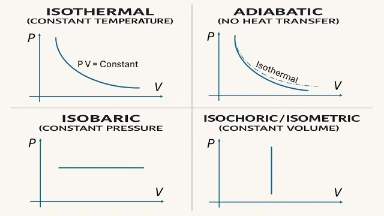
Figure: P-V diagrams of the four thermodynamic processes from the same initial state
Isobaric is a horizontal straight line (slope \(=0\)). Isochoric is a vertical straight line (slope \(=\infty\)). Isothermal is a rectangular hyperbola sloping downward with slope \(\dfrac{dP}{dV}=-\dfrac PV\). Adiabatic is also a downward curve but with slope \(\dfrac{dP}{dV}=-\gamma\dfrac PV\); since \(\gamma>1\), it is steeper than the isothermal curve.
| Process | Condition | Work done \(W\) | \(\Delta U\) | Heat \(Q\) |
|---|---|---|---|---|
| Isothermal | \(T\) constant | \(nRT\ln\dfrac{V_2}{V_1}\) | 0 | \(Q=W\) |
| Adiabatic | \(Q=0\) | \(\dfrac{nR(T_1-T_2)}{\gamma-1}\) | \(-W\) | 0 |
| Isobaric | \(P\) constant | \(P(V_2-V_1)\) | \(nC_v\Delta T\) | \(nC_p\Delta T\) |
| Isochoric | \(V\) constant | 0 | \(nC_v\Delta T\) | \(Q=\Delta U\) |
a) Define an adiabatic process. Derive the equation \(PV^\gamma=\text{constant}\).
An adiabatic process is a thermodynamic change in which no heat enters or leaves the system (\(dQ=0\)).
For \(n\) moles, the first law with \(dQ=0\) gives
Differentiating \(PV=nRT\):
Substituting in (1) and using \(R=C_p-C_v\):
Since \(\dfrac{C_v}{C_p-C_v}=\dfrac1{\gamma-1}\), multiplying through by \((\gamma-1)\) gives
Dividing by \(PV\) and integrating:
b) In an adiabatic expansion, a gas does 1200 J of work. Find the change in internal energy.
Adiabatic, so \(Q=0\), and the work done by the gas is \(W=+1200\ \mathrm{J}\):
c) Find the final temperature and the work done during an adiabatic expansion of 1 mole of ideal gas from 1 L to 5 L. Take \(\gamma=1.4\), \(T_1=300\ \mathrm{K}\), \(R=8.314\ \mathrm{J\,mol^{-1}K^{-1}}\).
Final temperature:
Work done:
a) Derive the expression for the work done during an isothermal and an adiabatic process.
Isothermal work. \(W=\displaystyle\int_{V_1}^{V_2}P\,dV\) with \(P=\dfrac{nRT}{V}\) and constant \(T\):
Adiabatic work. For an adiabatic process \(PV^\gamma=K\), so \(P=KV^{-\gamma}\):
Using \(K=P_1V_1^\gamma=P_2V_2^\gamma\):
b) A gas expands isothermally from 2 L to 8 L at 300 K. Calculate the work done. (\(R=8.314\ \mathrm{J\,mol^{-1}K^{-1}}\), \(n=1\ \mathrm{mol}\))
a) Define the heat capacity ratio (\(\gamma\)).
The heat capacity ratio is the ratio of the molar heat capacity of a gas at constant pressure to that at constant volume:
b) How does \(\gamma\) vary with the atomicity of a gas? Explain using degrees of freedom.
For a gas with \(f\) degrees of freedom, \(\gamma=1+\dfrac2f\).
| Type of gas | Motion | \(f\) | \(\gamma\) |
|---|---|---|---|
| Monoatomic (He, Ar) | Translational only | 3 | \(\dfrac53\approx1.67\) |
| Diatomic (O₂, N₂) | Translational and rotational | 5 | \(\dfrac75=1.4\) |
| Polyatomic (CO₂, NH₃) | Complex rotation | 6 (typically) | \(\dfrac43\approx1.33\) |
As atomicity, and with it the degrees of freedom, increases, \(\gamma\) decreases.
c) Differentiate between a reversible and an irreversible process.
Reversible process: an idealised process that occurs infinitely slowly so that the system is in thermal and mechanical equilibrium with its surroundings at every stage. It can be retraced along the same path, leaving no net change in the system or the universe.
Irreversible process: a real process occurring at a finite rate, usually involving friction or rapid heat transfer. The system is not in equilibrium at each step and cannot be restored to its original state without a permanent change in the surroundings (an increase in entropy). All natural processes are irreversible.
4. View PDF Notes
i. Handwritten Notes
ii. Typed PDF Notes
5. Frequently Asked Questions
What is the first law of thermodynamics? (definition)
What is the formula of the first law of thermodynamics?
What is the first law of thermodynamics in Physics?
What is the first law of thermodynamics in chemistry?
What is the first law of thermodynamics in biology?
What is the second law of thermodynamics?
What topics are included in Chapter 4 First Law of Thermodynamics of NEB Class 12 Physics?
What are open, closed and isolated thermodynamic systems?
How is work done during volume change calculated?
What does the first law say for isothermal, adiabatic, isobaric and isochoric processes?
What is Meyer’s relation and why is Cp greater than Cv?
What are the equations for isothermal and adiabatic processes of an ideal gas?
What are the limitations of the first law of thermodynamics?
Where can I get Class 12 Physics First Law of Thermodynamics notes in PDF?
Students also search for: