
Compulsory Mathematics SEE 2081 Madhesh Province Solution | अनिवार्य गणित

Welcome to the complete solution set for Compulsory Mathematics SEE 2081 Madhesh Province. This post provides a detailed, step-by-step guide to solving the questions asked in the recent SEE examination. Both English medium and Nepali medium students can benefit from this comprehensive guide.
Practicing past papers like the SEE 2081 Compulsory Mathematics is crucial for understanding the exam pattern and marking scheme. Below, you will find the questions, their Nepali translations, and the official marking scheme. For more educational resources, you can also visit the Ministry of Education website.
Table of Contents: Compulsory Mathematics SEE 2081 Madhesh Province
- Question 1: Sets & Venn Diagram
- Question 2: Compound Interest
- Question 3: Depreciation
- Question 4: Exchange Rate
- Question 5: Pyramid
- Question 6: Cylinder & Hemisphere Tank
- Question 7: Room Area & Cost
- Question 8: Arithmetic Series
- Question 9: Quadratic Equation
- Question 10: Algebra
- Question 11: Geometry
- Question 12: Circle Geometry
- Question 13: Construction
- Question 14: Trigonometry
- Question 15: Statistics
- Question 16: Probability
Question 1: Sets & Venn Diagram
160 जना मानिसहरूको समूहमा गरिएको सर्वेक्षणमा स्याउ मात्र र सुन्तला मात्र मन पराउने मानिसहरूको सङ्ख्या क्रमशः 75 र 45 छन् । जसमध्ये 23 जनाले दुईमध्ये कुनै पनि मन पराउदैनन् ।
In a survey conducted among 160 people, it was found that the number of people who like only apple and only orange are 75 and 45 respectively. Among them, 23 people do not like any of these two fruits.
-
(a) स्याउ मन पराउने मानिसको समूहलाई A र सुन्तला मन पराउने मानिसको समूहलाई O ले जनाउँदा कुनै पनि फलफुल मन नपराउने मानिसको सङ्ख्यालाई गणनात्मकता संकेतमा लेख्नुहोस् । [1]
If ‘A’ represents the set of people who like apple and ‘O’ represents the set of people who like orange, then write the cardinality notation of the number of people who don’t like any of these fruits.
-
(b) माथिको जानकारीलाई भेन चित्रमा प्रस्तुत गर्नुहोस् । [1]
Present the above information in a Venn diagram.
-
(c) स्याउ मन पराउने मानिसको सङ्ख्या पत्ता लगाउनुहोस् । [3]
Find the number of people who like apple.
-
(d) स्याउ मन पराउने र सुन्तला मन पराउने मानिसहरूको सङ्ख्याबिच तुलना गर्नुहोस् । [1]
Compare the number of people who like apple and who like orange.
Solution:
(a)
Here / यहाँ:
$n(U) = 160$
Only Apple / स्याउ मात्र: $n_o(A) = 75$
Only Orange / सुन्तला मात्र: $n_o(O) = 45$
Neither / दुवै मन नपराउने: $23$
Cardinality Notation / गणनात्मकता संकेत:
$$n(\overline{A \cup O}) \text{ or } n(A \cup O)’ = 23$$
(b) Venn diagram representation:
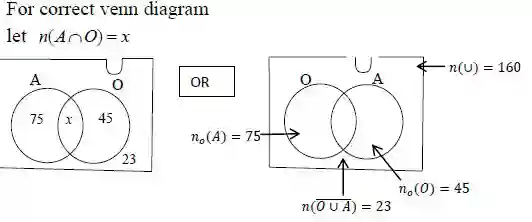
(c)
Let $n(A \cap O) = x$ / मानौँ दुवै मन पराउनेको सङ्ख्या $x$ छ ।
From Venn diagram / भेन चित्रबाट:
$$n(U) = n_o(A) + n_o(O) + n(A \cap O) + n(\overline{A \cup O})$$$$160 = 75 + 45 + x + 23$$$$160 = 143 + x$$$$x = 160 – 143$$$$\therefore x = 17$$
Number of people liking apple / स्याउ मन पराउने मानिसको सङ्ख्या:
$$n(A) = n_o(A) + n(A \cap O)$$$$n(A) = 75 + 17$$$$n(A) = 92$$
(d)
Number of people liking orange / सुन्तला मन पराउने सङ्ख्या:
$$n(O) = 45 + 17 = 62$$
Ratio / अनुपात of $n(A)$ and $n(O)$:
$$n(A) : n(O) = 92 : 62 = 46 : 31$$
Question 2: Compound Interest
निरजले वार्षिक 10% चक्रीय व्याजदरमा एउटा बैङ्कबाट 2 वर्षका लागि रु. 4,00,000 ऋण लिएछ । उनले पहिलो वर्षको अन्तमा रु. 2,40,000 तिरेछन् ।
Neeraj took a loan of Rs. 4,00,000 for 2 years at the rate of 10% annual compound interest. He paid Rs. 2,40,000 at the end of the first year.
-
(a) सावाँ $P$, वार्षिक चक्रीय व्याज दर $R$, समय $T$ र चक्रीय व्याज $CI$ बिचको सम्बन्ध लेख्नुहोस् । [1]
Write the relation among principal $P$, annual compound interest rate $R$, time $T$, and compound interest $CI$.
-
(b) पहिलो वर्षको चक्रीय व्याज पत्ता लगाउनुहोस् । [2]
Find the compound interest of the first year.
-
(c) निरजले दुई वर्षमा जम्मा कति व्याज तिरेको रहेछ ? पत्ता लगाउनुहोस् । [2]
How much total interest was paid by Neeraj in two years? Find it.
Solution:
(a)
Relation / सम्बन्ध:
$$CI = P\left[\left(1+\frac{R}{100}\right)^{T}-1\right]$$
(b)
For 1st year / पहिलो वर्षको लागि:
$P = Rs. 4,00,000$, $R = 10\%$, $T = 1$
$$CI_1 = \frac{P \times T \times R}{100}$$$$=
\frac{400000 \times 1 \times 10}{100}$$$$= Rs. 40,000$$
(c)
Amount after 1st year / पहिलो वर्षको अन्त्यमा मिश्रधन:
$$= 4,00,000 + 40,000 = Rs. 4,40,000$$
Paid amount / तिरेको रकम: $Rs. 2,40,000$
Principal for 2nd year / दोस्रो वर्षको लागि बाँकी सावाँ:
$$= 4,40,000 – 2,40,000 = Rs. 2,00,000$$
Interest for 2nd year / दोस्रो वर्षको ब्याज:
$$CI_2 = \frac{200000 \times 1 \times 10}{100} = Rs. 20,000$$
Total Interest Paid / जम्मा तिरेको ब्याज:
$$= CI_1 + CI_2 = 40,000 + 20,000 = Rs. 60,000$$
Question 3: Depreciation
निलमले एउटा मेसिन रु. 40,000 मा किनिछिन् । मेसिनको मूल्यमा वार्षिक 5% का दरले मिश्रहास हुन्छ । केही वर्षको प्रयोगपछि उक्त मेसिन रु. 36,100 मा बेचियो ।
Neelam bought a machine for Rs. 40,000. The price of the machine depreciates at the rate of 5% annually. The machine is sold for Rs. 36,100 after being used for some years.
-
(a) पहिलो वर्ष मेसिनको मूल्य कतिले घट्छ ? पत्ता लगाउनुहोस् । [1]
By how much does the price of the machine depreciate in the first year? Find it.
-
(b) कति वर्षपछि सो मेसिन विक्री गरिएको थियो ? पत्ता लगाउनुहोस् । [1]
After how many years was the machine sold? Find it.
-
(c) यदि उनले उक्त मेसिन भाडामा दिई भाडा बापत रु. 4,900 कमाउछिन् भने मेसिनको विक्रीमा उनलाई कति प्रतिशत नाफा वा नोक्सान हुन्छ ? पत्ता लगाउनुहोस् । [2]
Find the profit or loss percentage from selling the machine if she earns Rs. 4,900 from the rent of the machine.
Solution:
(a)
Depreciation amount (D) / ह्रास रकम:
$$D = P \times R\% = 40,000 \times \frac{5}{100} = Rs. 2,000$$
(b)
Using depreciation formula / ह्रास सूत्र प्रयोग गर्दा:
$$SP = P(1 – \frac{R}{100})^T$$$$36,100 = 40,000(1 – \frac{5}{100})^T$$$$\frac{36100}{40000} = (0.95)^T$$$$0.9025 = (0.95)^T$$$$(0.95)^2 = (0.95)^T$$$$\therefore T = 2 \text{ years (वर्ष)}$$
(c)
Cost Price (C.P.) / क्रय मूल्य: $Rs. 40,000$
Total amount received / जम्मा प्राप्त रकम:
$$= Selling Price + Rent = 36,100 + 4,900 = Rs. 41,000$$
Profit / नाफा:
$$= 41,000 – 40,000 = Rs. 1,000$$
Profit % / नाफा प्रतिशत:
$$= \frac{\text{Profit}}{C.P.} \times 100\% = \frac{1000}{40000} \times 100\% = 2.5\%$$
Question 4: Exchange Rate
रमेशसँग ने.रु. 2,07,345 थियो । उनी अमेरिकी डलर साट्न बैङ्क गएको दिन विनियम दर निम्न अनुसार थियो । $1 को बिक्री दर (Selling rate of $1) = Rs. 138.83, $1 को खरिद दर (Buying rate of $1) = Rs. 138.23
Ramesh had NRs. 2,07,345. When he went to the bank, the exchange rate was as follows: Selling rate of $1 = Rs. 138.83, Buying rate of $1 = Rs. 138.23
-
(a) रमेशले नेपाली रुपियासँग अमेरिकी डलर साट्दा कुन विनिमय दर प्रयोग गरिन्छ ? लेख्नुहोस् । [1]
Which exchange rate is used when Ramesh exchanges Nepali rupees for American dollars? Write it.
-
(b) ने.रु. 2,07,345 बाट प्राप्त हुने अमेरिकी डलर पत्ता लगाउनुहोस् । [2]
Find the amount of American dollars obtained from NRs. 2,07,345.
-
(c) नेपाली मुद्रामा कति प्रतिशत अवमूल्यन हुँदा अमेरिकी डलरको बिक्री दर रु. 140.2183 हुन्छ ? पत्ता लगाउनुहोस् । [1]
By what percent is the Nepali currency devaluated when the selling rate of 1 US dollar becomes Rs. 140.2183? Find it.
Solution:
(a) Selling rate / बिक्री दर प्रयोग गरिन्छ (because bank sells dollars / किनकि बैंकले डलर बेच्छ)।
(b)
Amount ($) / डलर रकम:
$$= \frac{\text{NRs. } 2,07,345}{\text{Selling Rate}} = \frac{2,07,345}{138.83}$$$$= \$ 1,493.52$$
(c)
Difference / फरक:
$$= 140.2183 – 138.83 = Rs. 1.3883$$
Devaluation % / अवमूल्यन प्रतिशत:
$$= \frac{\text{Diff}}{\text{Original Rate}} \times 100\% = \frac{1.3883}{138.83} \times 100\% = 1\%$$
Question 5: Pyramid
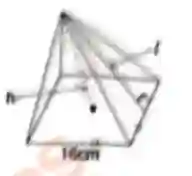
चित्रमा दिइएको वर्गाकार आधार भएको पिरामिडको आयतन 512 घन से.मि र आधारको भुजाको लम्बाइ 16 से.मि छन् ।
The volume of the square-based pyramid given in the figure is $512 \text{ cm}^3$ and the length of the side of the base is $16 \text{ cm}$.
-
(a) वर्गाकार आधार भएको पिरामिडको पूरा सतहको क्षेत्रफल गणना गर्न, जम्मा कति ओटा समतल सतहको क्षेत्रफल गणना गरिन्छ ? लेख्नुहोस् । [1]
How many plane surface areas are counted to find the total surface area of a square-based pyramid? Write it.
-
(b) उक्त पिरामिडको ठाडो उचाइ पत्ता लगाउनुहोस् । [1]
Find the vertical height of the pyramid.
-
(c) उक्त पिरामिडको पूरा सतहको क्षेत्रफल पत्ता लगाउनुहोस् । [3]
Find the total surface area of the pyramid.
Solution:
(a) 5 surfaces (५ वटा सतहहरू)
(b)
Volume formula / आयतन सूत्र:
$$V = \frac{1}{3} a^2 h$$$$512 = \frac{1}{3} \times (16)^2 \times h$$$$512 \times 3 = 256 \times h$$$$1536 = 256h$$$$\therefore h = 6 \text{ cm}$$
(c)
Slant height / छड्के उचाइ:
$$l = \sqrt{h^2 + (a/2)^2} = \sqrt{6^2 + (16/2)^2} = \sqrt{36 + 64} = \sqrt{100} = 10 \text{ cm}$$
Total Surface Area (T.S.A.) / पूरा सतहको क्षेत्रफल:
$$= a^2 + 2al = (16)^2 + 2 \times 16 \times 10$$$$= 256 + 320 = 576 \text{ cm}^2$$
Question 6: Cylinder & Hemisphere Tank
ज्योतिले स्थानीय बजारबाट बेलना र अर्धगोला मिलि बनेको एउटा ट्याङ्की किनेर ल्याइन । सो ट्याङ्कीको पूरा उचाइ 3.5 मिटर र आधारको अर्धव्यास 1.05 मिटर छन् ।
Jyoti bought a tank made up of a cylinder and a hemisphere from the local market. The total height of the tank is $3.5 \text{ meters}$ and the radius of the base is $1.05 \text{ meters}$.
-
(a) बेलना र अर्धगोला मिलि बनेको संयुक्त ठोस वस्तुमा कतिओटा बक्र सतहहरू हुन्छन् ? लेख्नुहोस् । [1]
How many curved surfaces are there in a combined solid made of a cylinder and a hemisphere? Write it.
-
(b) उक्त ट्याङ्कीको आयतन पत्ता लगाउनुहोस् । [2]
Find the volume of the tank.
-
(c) उक्त ट्याङ्कीमा बढीमा कति लिटर पानी अटाउँछ ? पत्ता लगाउनुहोस् । [1]
How much maximum liters of water is contained in the tank? Find it.
Solution:
(a) 2 curved surfaces (२ वटा बक्र सतहहरू)
(b)
Height of cylinder / बेलनाको उचाइ:
$$h_{cyl} = \text{Total Height} – \text{Radius} = 3.5 – 1.05 = 2.45 \text{ m}$$
Volume / आयतन:
$$V = \text{Vol of Cylinder} + \text{Vol of Hemisphere}$$$$= \pi r^2 h_{cyl} + \frac{2}{3} \pi r^3$$$$= \pi r^2 (h_{cyl} + \frac{2r}{3})$$$$= \frac{22}{7} \times 1.05 \times 1.05 \left(2.45 + \frac{2 \times 1.05}{3}\right)$$$$= 3.465 \times (2.45 + 0.7)$$$$= 3.465 \times 3.15$$$$= 10.91475 \text{ m}^3$$
(c)
Conversion / रूपान्तरण: $1 \text{ m}^3 = 1000 \text{ Liters}$
Capacity / क्षमता:
$$= 10.91475 \times 1000 = 10,914.75 \text{ Liters}$$
Or / अथवा: $10,914 \text{ Liters and } 750 \text{ ml}$
Question 7: Room Area & Cost
एउटा आयताकार कोठाको लम्बाइ, चौडाइ र उचाइ क्रमशः 16 फिट, 12 फिट र 9 फिट छन् । उक्त कोठामा 4 फिट किनारा भएका दुईओटा वर्गाकार भयालहरू र एउटा 6 फिट × 2 फिटको ढोका छन् ।
The length, breadth, and height of a rectangular room are $16 \text{ ft}$, $12 \text{ ft}$, and $9 \text{ ft}$ respectively. There are two square windows of dimension $4 \text{ ft}$ and one door of dimension $6 \text{ ft} \times 2 \text{ ft}$.
-
(a) उक्त कोठामा प्रतिवर्ग फिट रु. 300 का दरले कार्पेट विछ्याउँदा कति खर्च लाग्छ ? पत्ता लगाउनुहोस् । [2]
How much does it cost for carpeting the room at the rate of Rs. 300 per sq. ft.? Find it.
-
(b) यदि झ्याल ढोका बाहेक उक्त कोठाको चारभित्ता र सिलिङ्गमा रङ लगाउँदा रु. 19,560 खर्च लाग्छ भने प्रति वर्ग फिट रङ लगाउने दर पत्ता लगाउनुहोस् । [2]
If the cost of coloring four walls and ceiling excluding doors and windows of the room is Rs. 19,560, find the rate of coloring per square feet.
Solution:
(a)
Area of floor / भुइँको क्षेत्रफल:
$$A = l \times b = 16 \times 12 = 192 \text{ sq. ft.}$$
Cost / खर्च:
$$= \text{Area} \times \text{Rate} = 192 \times 300 = Rs. 57,600$$
(b)
Gross Area (Walls + Ceiling) / (भित्ता + छाना) को जम्मा क्षेत्रफल:
$$= 2h(l+b) + lb = 2 \times 9(16+12) + 192$$$$= 18(28) + 192 = 504 + 192 = 696 \text{ sq. ft.}$$
Area of Openings (Windows + Door) / (झ्याल + ढोका) को क्षेत्रफल:
$$= 2 \times (4^2) + (6 \times 2) = 2 \times 16 + 12 = 32 + 12 = 44 \text{ sq. ft.}$$
Net Area for painting / रङ लगाउने शुद्ध क्षेत्रफल:
$$= 696 – 44 = 652 \text{ sq. ft.}$$
Rate / दर:
$$= \frac{\text{Total Cost}}{\text{Area}} = \frac{19,560}{652} = Rs. 30 \text{ per sq. ft.}$$
Question 8: Arithmetic Series
हरिले आफ्नो छोरा आशिषको पहिलो जन्मदिनमा रु. 1,000, दोस्रो जन्मदिनमा रु. 2,000, तेस्रो जन्मदिनमा रु. 3,000 का दरले एउटा बैङ्कमा रकम जम्मा गरेछन् । यसरी हरेक जन्मदिनमा रु. 1,000 का दरले बढाउँदै लगेछन् ।
Hari deposited Rs. 1,000, Rs. 2,000, and Rs. 3,000 in a bank on his son Aashish’s first, second, and third birthday respectively. In this way, he increases the deposit by Rs. 1,000 on every birthday.
-
(a) समानान्तरीय श्रेणीमा मध्यमालाई परिभाषित गर्नुहोस् । [1]
Define mean in an arithmetic series.
-
(b) दशौं जन्मदिनसम्ममा कति रकम जम्मा हुन्छ ? पत्ता लगाउनुहोस् । [2]
How much total money is deposited up to the $10^{th}$ birthday? Find it.
-
(c) के एघारौं जन्मदिनसम्ममा आशिषको खातामा रु. 66,000 जम्मा हुन्छ ? कारण दिनुहोस् । [1]
Is Rs. 66,000 deposited in Aashish’s account by the $11^{th}$ birthday? Give reasons.
-
(d) आशिषको खातामा कति वर्षसम्ममा रु. 1,05,000 जम्मा होला ? पत्ता लगाउनुहोस् । [2]
In how many years, will Rs. 1,05,000 be deposited in the account of Aashish? Find it.
Solution:
(a)
दुई राशिहरू बिच पर्ने राशि वा पदलाई समानान्तरीय मध्यमा भनिन्छ ।
(The term lying between two terms in an arithmetic progression is called arithmetic mean.)
(b)
This is an Arithmetic Progression with:
First term / पहिलो पद ($a$) = $1000$
Common difference / साधारण अन्तर ($d$) = $1000$
Number of terms / पद सङ्ख्या ($n$) = $10$
Sum of first 10 terms / पहिलो 10 पदहरूको योगफल:
$$S_{10} = \frac{n}{2}[2a + (n-1)d]$$$$= \frac{10}{2}[2(1000) + (10-1)1000]$$$$= 5[2000 + 9000] = 5 \times 11000 = Rs. 55,000$$
(c)
Sum up to 11th birthday / 11 औं जन्मदिनसम्मको योगफल:
$$S_{11} = \frac{11}{2}[2(1000) + 10(1000)] = 5.5[12000] = 66,000$$
Yes, it is deposited / हो, जम्मा हुन्छ ।
(d)
We need to find $n$ when $S_n = 1,05,000$:
$$105000 = \frac{n}{2}[2000 + (n-1)1000]$$$$210000 = n[2000 + 1000n – 1000]$$$$210000 = 1000n^2 + 1000n$$$$n^2 + n – 210 = 0$$$$n^2 + 15n – 14n – 210 = 0$$$$(n+15)(n-14) = 0$$
Since $n$ cannot be negative / $n$ ऋणात्मक हुन सक्दैन:
$$\therefore n = 14 \text{ years (वर्ष)}$$
Question 9: Quadratic Equation
कृतिले चौडाइको दोब्बर लम्बाइ भएको आफ्नो खेतको वरिपरि तारको बार लगाउन चाहन्छिन् । उक्त खेतको क्षेत्रफल 800 वर्गफिट छ ।
Kriti wants to fence her field having length twice of breadth. The area of the field is 800 square feet.
-
(a) वर्ग समीकरणको स्तरीय स्वरूप लेख्नुहोस् । [1]
Write down the standard form of quadratic equation.
-
(b) खेतको वरिपरि एक पटक तारबारले घेरा हाल्न कति लामो तार चाहिएला ? पत्ता लगाउनुहोस् । [3]
How much length of wire is required to fence the field once with wire? Find it.
Solution:
(a)
Standard form / स्तरीय स्वरूप:
$$ax^2 + bx + c = 0, \text{ where } a \neq 0$$
(b)
Let breadth / चौडाइ ($b$) = $x$ ft
Then length / लम्बाइ ($l$) = $2x$ ft
Area / क्षेत्रफल:
$$l \times b = 800$$$$2x \times x = 800$$$$2x^2 = 800$$$$x^2 = 400$$$$\therefore x = 20 \text{ ft}$$
Length / लम्बाइ: $l = 2 \times 20 = 40 \text{ ft}$
Perimeter (Wire length) / परिमिति (तारको लम्बाइ):
$$= 2(l+b) = 2(40+20) = 120 \text{ ft}$$
Question 10: Algebra
(a) सरल गर्नुहोस् (Simplify): $$\frac{x}{xy-y^{2}} + \frac{y}{xy-x^{2}}$$
(Simplify)
(b) हल गर्नुहोस् (Solve): $$2^{x} + \frac{16}{2^{x}} = 10$$
(Solve)
Solution:
(a) $$\frac{x}{xy-y^{2}} + \frac{y}{xy-x^{2}}$$$$= \frac{x}{y(x-y)} + \frac{y}{x(y-x)}$$$$= \frac{x}{y(x-y)} – \frac{y}{x(x-y)}$$$$= \frac{x^2 – y^2}{xy(x-y)}$$$$= \frac{(x-y)(x+y)}{xy(x-y)} = \frac{x+y}{xy}$$
(b)
Let $2^x = a$
Then / त्यसपछि:
$$a + \frac{16}{a} = 10$$$$a^2 + 16 = 10a$$$$a^2 – 10a + 16 = 0$$$$(a-8)(a-2) = 0$$
Either / या त:
$a=8 \implies 2^x = 2^3 \implies x=3$
Or / अथवा:
$a=2 \implies 2^x = 2^1 \implies x=1$
$$\therefore x = 1, 3$$
Question 11: Geometry
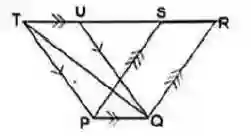
दिइएको चित्रमा APQT, समानान्तर चर्तुभुजहरू PQRS र PQUT एउटै आधार PQ र उही समानान्तर रेखाहरू PQ र TR विच बनेका छन् ।
In the given figure, APQT, parallelograms PQRS and PQUT are standing on the same base PQ and between the same parallel lines PQ and TR.
-
(a) समानान्तर चर्तुभुजहरू PQRS र PQUT का क्षेत्रफलविचको सम्बन्ध लेख्नुहोस् । [1]
Write the relation between the areas of parallelograms PQRS and PQUT.
-
(b) $\triangle PQT$ को क्षेत्रफल समानान्तर चर्तुभुज PQRS को क्षेत्रफलको आधा हुन्छ भनि प्रमाणित गर्नुहोस् । [2]
Prove that area of $\triangle PQT$ is half of the area of parallelogram PQRS.
-
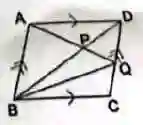
(c) के दिइएको चित्रमा $\triangle APD$ र $\triangle BPQ$ को क्षेत्रफल बराबर हुन्छन् ? कारण सहित लेख्नुहोस् । [2]
Are the areas of $\triangle APD$ and $\triangle BPQ$ equal in the given figure? Write with reason.
Solution:
(a)
Area of $\Box PQRS$ = Area of $\Box PQUT$
(Standing on same base PQ and between same parallel lines / एउटै आधार PQ र उही समानान्तर रेखाहरूबिच बनेका)
(b)
Area of $\triangle PQT = \frac{1}{2} \times \text{base} \times \text{height}$
Area of $\Box PQRS = \text{base} \times \text{height}$
$\therefore$ Area of $\triangle PQT = \frac{1}{2}$ Area of $\Box PQRS$
(c)
Yes / हो, Area($\triangle APD$) = Area($\triangle BPQ$)
Reason / कारण:
$\Delta ABD$ and $\Delta ABQ$ stand on same base AB and between same parallels.
So / त्यसैले, Area($\Delta ABD$) = Area($\Delta ABQ$).
Subtracting common Area($\Delta ABP$) from both sides / दुबै तिरबाट समान क्षेत्रफल $\Delta ABP$ घटाउँदा:
Area($\Delta APD$) = Area($\Delta BPQ$)
Question 12: Circle Geometry
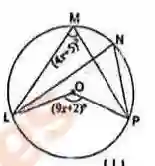
दिइएको चित्रमा O वृत्तको केन्द्रविन्दु हो । विन्दुहरू M, N, P र L वृत्तको परिधिमा छन् ।
In the given figure, O is the centre of the circle. The points M, N, P and L are on the circumference of the circle.
-
(a) परिधि कोणलाई परिभाषित गर्नुहोस् । [1]
Define the inscribed angle.
-
(b) यदि केन्द्रीय कोण $\angle LOP = (9x+2)^{\circ}$ र परिधि कोण $\angle LMP = (4x + 5)^{\circ}$ भए x को मान पत्ता लगाउनुहोस् । [1]
If the central angle $\angle LOP = (9x+2)^{\circ}$ and inscribed angle $\angle LMP = (4x + 5)^{\circ}$, find the value of x.
-
(c) परिधि कोणहरू $\angle LMP$ र $\angle LNP$ बराबर हुन्छन् भनी प्रयोगात्मक विधिवाट प्रमाणित गर्नुहोस् । (कम्तीमा 3 से.मि. अर्धव्यास भएका दुई वृत्तहरू आवश्यक छन् ।) [2]
Verify experimentally that inscribed angles $\angle LMP$ and $\angle LNP$ are equal. (Two circles having at least 3cm radii are necessary.)
Solution:
(a)
वृत्तको दुई जीवाहरू परिधिमा मिलि बन्ने कोणलाई परिधि कोण भनिन्छ ।
(The angle formed by the intersection of two chords at the circumference of a circle is called an inscribed angle.)
(b)
Central Angle = $2 \times$ Inscribed Angle / केन्द्रीय कोण = $2 \times$ परिधि कोण
$$9x + 2 = 2(4x + 5)$$$$9x + 2 = 8x + 10$$$$9x – 8x = 10 – 2$$$$\therefore x = 8$$
(c)
Experimental Verification / प्रयोगात्मक प्रमाण:
1. Construct two circles with radii $\ge 3$ cm / 3 से.मि. भन्दा बढी अर्धव्यास भएका दुई वृत्तहरू बनाउनुहोस् ।
2. Draw points L, M, N, P on circumference / परिधिमा L, M, N, P बिन्दुहरू खिच्नुहोस् ।
3. Measure $\angle LMP$ and $\angle LNP$ / $\angle LMP$ र $\angle LNP$ को मापन गर्नुहोस् ।
4. Both angles will be equal / दुबै कोण बराबर हुनेछन् ।
Question 13: Construction
(a) चर्तुभुज PQRS को रचना गर्नुहोस् जहाँ $PQ=5.4$ से.मि., $QR = 5.6$ से.मि., $RS=5.4$ से.मि., $SP = 6.8$ से.मि. र $\angle PQR=75^{\circ}$ । चतुर्भुज PQRS को क्षेत्रफलसंग बराबर हुने गरी त्रिभुज PSM को रचना गर्नुहोस् ।
Construct a quadrilateral PQRS in which $PQ=5.4$ cm, $QR=5.6$ cm, $RS=5.4$ cm, $SP=6.8$ cm and $\angle PQR=75^{\circ}$. Then construct a triangle PSM equal in area to the quadrilateral PQRS.
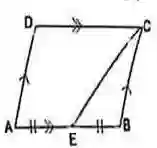
(b) संगै दिइएको समानान्तर चतुर्भुज ABCD मा $AE = BE$ छ भने त्रिभुज BEC ले समानान्तर चर्तुभुज ABCD को कति प्रतिशत क्षेत्रफल ओगटेको छ ? पत्ता लगाउनुहोस् ।
In the given adjoining parallelogram ABCD, $AE = BE$. What percentage of area of parallelogram ABCD is occupied by the triangle BEC? Find it.
Solution:
(a) Construction steps / रचना चरणहरू:

- Draw $PQ = 5.4$ cm
- Construct $\angle PQR = 75^{\circ}$ at Q
- Cut off $QR = 5.6$ cm
- With center R, draw an arc of radius 5.4 cm
- With center P, draw an arc of radius 6.8 cm
- Intersection gives point S
- Join PS and RS to complete quadrilateral PQRS
- For equal area triangle, draw diagonal PR
- Construct triangle PSM with same base and between same parallels
(b)
Since $AE = BE$, E is the midpoint of AB / $AE = BE$ भएकोले E ले AB लाई दुई भागमा बराबर बाँड्छ ।
Area of $\triangle BEC$ / $\triangle BEC$ को क्षेत्रफल:
$$= \frac{1}{2} \times EB \times h = \frac{1}{2} \times (\frac{1}{2} AB) \times h = \frac{1}{4} (AB \times h)$$
Area of Parallelogram ABCD / समानान्तर चतुर्भुज ABCD को क्षेत्रफल:
$$= AB \times h$$
Percentage / प्रतिशत:
$$= \frac{\frac{1}{4} (AB \times h)}{AB \times h} \times 100\% = 25\%$$
Question 14: Trigonometry
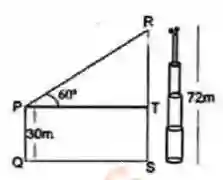
सँगै दिइएको चित्रमा PQ ले घरको उचाइ, RS ले टावरको उचाइ र QS ले घरदेखि टावरसम्मको दूरीलाई जनाउँछ । (Visual Data: $\angle RPT = 60^{\circ}$, $PQ = 30m$, $RS = 72m$)
In the given figure alongside, PQ represents the height of house, RS represents the height of tower and QS represents the distance from the house to the tower.
-
(a) घरको छतबाट टावरको टुप्पोमा अवलोकन गर्दा बन्ने उन्नतांश कोणको नाम लेख्नुहोस् । [1]
Write the name of angle of elevation of top of tower as observed from the roof of the house.
-
(b) TR को मान पत्ता लगाउनुहोस् । [1]
Find the value of TR.
-
(c) घर र टावर विचको दुरी पत्ता लगाउनुहोस् । [1]
Find the distance between the house and the tower.
-
(d) के टावरको टुप्पोबाट 28 मिटर तलको विन्दुबाट घरको छत हेर्दा $30^{\circ}$ को अवनति कोण बन्छ ? कारण लेख्नुहोस् । [1]
Is the angle of depression of $30^{\circ}$ formed when the roof of the house is observed from a point 28 meter below the top of the tower? Give reason.
Solution:
(a) $\angle RPT$
(b) $$TR = RS – TS = RS – PQ = 72 – 30 = 42 \text{ m}$$
(c)
In right triangle $\Delta PTR$:
$$\tan 60^{\circ} = \frac{TR}{PT}$$$$\sqrt{3} = \frac{42}{PT}$$$$PT = \frac{42}{\sqrt{3}} = 14\sqrt{3} \text{ m}$$$$\approx 24.24 \text{ m}$$
(d)
Height of observer from top / टुप्पोबाट दर्शकको उचाइ: $28m$
Height of observer from ground / जमिनबाट दर्शकको उचाइ: $72-28 = 44m$
Height relative to house roof / घरको छतको सापेक्ष उचाइ: $44 – 30 = 14m$
$$\tan \theta = \frac{\text{Perpendicular}}{\text{Base}} = \frac{14}{14\sqrt{3}} = \frac{1}{\sqrt{3}}$$$$\therefore \theta = 30^{\circ}$$
Yes, the statement is correct / हो, भनिएको कुरा सही छ ।
Question 15: Statistics
दिइएको तथ्याङ्कले गणित विषयको 50 पूर्णाङ्कको एउटा आन्तरिक परीक्षामा विद्यार्थीहरूले प्राप्त गरेको प्राप्ताङ्कलाई प्रतिनिधित्व गर्दछ । उक्त तथ्याङ्कको मध्यिका 29 छ ।
The given data represents the marks obtained by the students in an internal examination of Mathematics with full marks 50. The median of the data is 29.
| प्राप्ताङ्क (Obtained Marks) | 0-10 | 10-20 | 20-30 | 30-40 | 40-50 |
|---|---|---|---|---|---|
| विद्यार्थी सङ्ख्या (Number of students) | 3 | 7 | 10 | x | 10 |
-
(a) मध्यिका श्रेणी लेख्नुहोस् । [1]
Write the median class.
-
(b) x को मान पत्ता लगाउनुहोस् । [2]
Find the value of x.
-
(c) दिइएको तथ्याङ्कको मध्यक प्राप्ताङ्क पत्ता लगाउनुहोस् । [2]
Find the mean mark of the given data.
-
(d) 20 अङ्क भन्दा कम र 20 वा सोभन्दा बढी अङ्क प्राप्त गर्ने विद्यार्थीहरूको अनुपात निकाल्नुहोस् । [1]
Find the ratio of students obtaining marks less than 20 and 20 or more than 20.
Solution:
(a)
Since Median = 29, which lies in 20-30 class / मध्यिका 29 भएकोले 20-30 श्रेणीमा पर्छ ।
Median class / मध्यिका श्रेणी: $20-30$
(b)
Total frequency / जम्मा बारम्बारता:
$$N = 3 + 7 + 10 + x + 10 = 30 + x$$
Using median formula / मध्यिका सूत्र प्रयोग गर्दा:
$$Md = L + \frac{\frac{N}{2} – c.f.}{f} \times i$$$$29 = 20 + \frac{\frac{30+x}{2} – 10}{10} \times 10$$$$9 = \frac{30+x-20}{2}$$$$18 = 10 + x$$$$\therefore x = 8$$
(c)
With $x=8$:
$N = 30 + 8 = 38$
Calculation table / गणना तालिका:
| Class | f | Mid-value (x) | fx |
|---|---|---|---|
| 0-10 | 3 | 5 | 15 |
| 10-20 | 7 | 15 | 105 |
| 20-30 | 10 | 25 | 250 |
| 30-40 | 8 | 35 | 280 |
| 40-50 | 10 | 45 | 450 |
| Total / जम्मा | 38 | – | 1100 |
$$\overline{X} = \frac{\sum fx}{N} = \frac{1100}{38} = 28.94$$
(d)
Marks $<20$: $3+7=10$
Marks $\ge 20$: $10+8+10=28$
Ratio / अनुपात: $10:28 = 5:14$
Question 16: Probability
एउटा झोलामा 7 ओटा काला र 4 ओटा राता उस्तै र उत्रै बलहरू छन् । दुईओटा बलहरू एक पछि अर्को गरी पुनः नराखी झिकिएका छन् ।
A bag contains 7 black and 4 red balls of same shape and size. Two balls are drawn randomly one after another without replacement.
-
(a) यदि B र R दुई ओटा अनाश्रित घटना भए $P(B \cap R)$ को सूत्र लेख्नुहोस् । [1]
If B and R be two independent events then write the formula of $P(B \cap R)$.
-
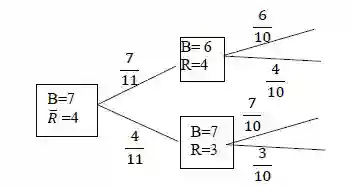
(b) सबै सम्भावित परिणामहरूको सम्भाव्यतालाई वृक्ष चित्रमा देखाउनुहोस् । [2]
Show the probabilities of all the possible outcomes in a tree diagram.
-
(c) दुवै बल कालो नै पर्ने सम्भाव्यता पत्ता लगाउनुहोस् । [1]
Find the probability of getting both black balls.
-
(d) दुवै बल रातो पर्ने सम्भाव्यता, दुवै बल कालो पर्ने सम्भाव्यताभन्दा कति बढी वा घटी छ ? पत्ता लगाउनुहोस् । [1]
By how much the probability of getting both red balls is more or less than the probability of getting both black balls? Find it.
Solution:
(a)
For independent events / अनाश्रित घटनाहरूको लागि:
$$P(B \cap R) = P(B) \times P(R)$$
(b) Tree diagram:
(c)
Probability of both black / दुवै बल कालो नै पर्ने सम्भाव्यता:
$$P(BB) = \frac{7}{11} \times \frac{6}{10} = \frac{42}{110} = \frac{21}{55}$$
(d)
Probability of both red / दुवै बल रातो नै पर्ने सम्भाव्यता:
$$P(RR) = \frac{4}{11} \times \frac{3}{10} = \frac{12}{110} = \frac{6}{55}$$
Difference / फरक:
$$\frac{21}{55} – \frac{6}{55} = \frac{15}{55} = \frac{3}{11}$$
$P(RR)$ is less than $P(BB)$ by $\frac{3}{11}$ / $P(RR)$ ले $P(BB)$ भन्दा $\frac{3}{11}$ ले कम छ ।