

Unit 5: Price Determination of Factor of Production
This chapter provides complete notes on Price Determination of Factor of Production. It covers key concepts like Rent, Wages, Interest, and Profit, along with theories like the Ricardian Theory of Rent and the Classical Theory of Interest.
Table of Contents
Very Short Answer Questions [1 Mark]
Gross interest is the total amount paid by a borrower to the lender in return for the capital borrowed for a period of time.
Gross profit is the difference between total revenue and total explicit cost.
Gross profit = TR – Explicit cost
Contract rent is the total payment made to the factor owner by the renter for the use of a factor or its services for a period of time as per their agreement. Economic rent is the surplus of current earning over transfer earning of the factor of production.
Marginal land is a type of land whose produce value just covers its cost of production. Marginal land is also called ‘No Rent Land’.
Gross profit is the difference between total revenue and total explicit cost. On the other hand, net profit is the difference between total revenue and total cost including both explicit and implicit costs.
Rent is defined as the payment made to the landlord by the tenant for the use of original and indestructible powers of the soil.
Economic rent is that part of the payment made by a tenant to the landlord only for the use of land.
Interest can be defined as the price paid for the use of borrowed funds to spend on the purchase of capital assets used in production.
Gross interest is the total amount paid by a borrower to the lender in return for the capital borrowed for a period of time.
Net interest is the price paid to the lender by the borrower only for the use of borrowed capital or money.
Profit can be defined as the reward that an entrepreneur gets in return for his or her functions of risk-taking and uncertainty-bearing.
Contract rent is the total payment made to the factor owner by the renter for the use of a factor (or its services) for a period of time.
Wage is the price paid to the labour for the use of its mental or physical (or both) services in production by the producer according to the contract.
Net profit can be defined as the difference between total revenue and total cost including both explicit and implicit costs.
Net profit = TR – Economic cost
The Classical theory of interest is also known as the Demand and Supply Theory of Interest. According to this theory, the rate of interest is determined by the demand and supply of capital.
The land which has higher productivity than marginal land is called ‘Intra-marginal Land’.
Net interest is the price paid to the lender by the borrower only for the use of borrowed capital or money for a period of time. It does not include other payments.
Money wage is the wage received by a labourer in the form of money for his or her services per unit of time. Real wage is the sum of goods and services that the money wage of labour can buy and extra benefits that the labour receives in his or her occupation per unit of time.
Situation rent is a type of rent which arises due to the difference in the situation or the location of land.
Real wage is the sum of goods and services that the money wage of labour can buy and extra benefits that the labour receives in his or her occupation per unit of time.
Short Answer Questions [5 Marks]
The Subsistence Theory of Wages was developed by David Ricardo and other classical economists. The ‘Subsistence Theory of Wages’ is also known as the ‘Iron Law’ of wages. According to this theory, wages are determined by the cost of production of labour or subsistence level. The wage so determined will remain fixed. In other words, wages tend to remain at the subsistence level in the long run. Wages paid to workers are just sufficient to fulfill their basic needs. Workers don’t have surplus income.
Assumptions:
- Population increases at a faster rate.
- Food production is subject to the law of diminishing returns.
- There is no existence of trade unions.
- The cost of production of labour is equal to the subsistence wage.
- This theory is based on the long-run concept.
If wages rise above the subsistence level, the prosperity of workers increases, which will encourage the workers to marry sooner and to have large families, and thus population increases. This will increase labour supply. The increased competition among workers for employment causes wages to fall again to the subsistence level.
Similarly, if wages fall below the subsistence level, there will be a lower wage and no prosperity. People will have less interest in marriage and birth. They will suffer from malnutrition, diseases, starvation, etc., and that may lead to deaths. And that leads to a decrease in the size of the population and thereby the supply of labour. The competition among the labourers for employment reduces, i.e., demand for labour exceeds its supply, and wages tend to rise to the subsistence level. In this way, the wages above or below the subsistence level lead to being maintained, ultimately, at the subsistence level, in the long run.
Here, the subsistence level of wages refers to the lowest or minimum wage upon which a worker and his or her family can survive. In other words, it refers to the minimum wage required to fulfill the basic needs, i.e., food (nutrition), clothing, and shelter (housing) of a worker and his or her family.
The Classical theory of interest is also known as the Demand and Supply Theory of Interest. According to this theory, the rate of interest is determined by the demand and supply of capital. Demand for capital arises from investment. Investment is inversely related to the rate of interest.
On the other hand, the supply of capital comes out of people’s savings. Saving is positively related to the rate of interest. The rate of interest is determined at the point where demand for capital (investment) equals the supply of capital (saving) as shown in the following table and diagram.
| Rate of Interest (in %) | Demand for Capital (in Rs.) | Supply of Capital (in Rs.) |
|---|---|---|
| 2% | 30,000 | 10,000 |
| 3% | 20,000 | 20,000 |
| 4% | 10,000 | 30,000 |
It is clear from the above table that as the rate of interest increases from 2% to 4%, the demand for capital declines from Rs. 30,000 to Rs. 10,000, while the supply of capital increases from Rs. 10,000 to Rs. 30,000. When the rate of interest is 3%, the demand for capital is just equal to the supply of capital, i.e., Rs. 20,000. Hence, 3% is the equilibrium rate of interest.
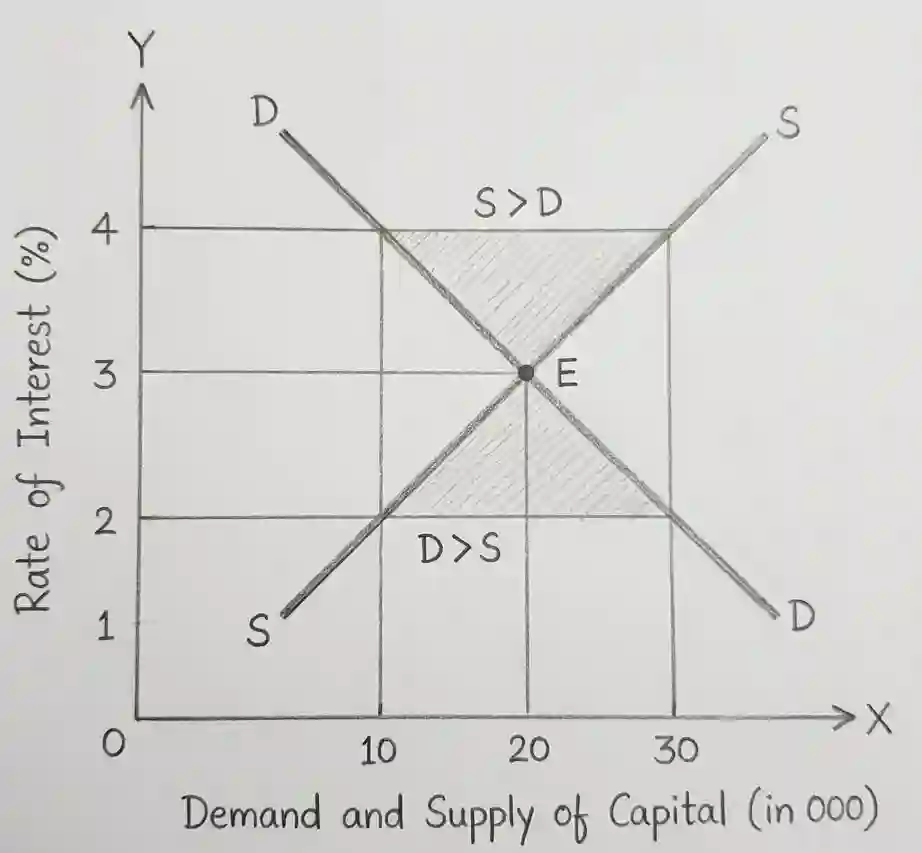
In the given figure, the X-axis represents the demand for and supply of capital, and the Y-axis represents the rate of interest. DD is the demand curve for capital and SS is the supply curve of capital. These two curves intersect at point E. Thus, 3% is the equilibrium rate of interest. At a 4% rate of interest, supply is greater than demand (S > D). This leads to a decrease in the rate of interest. Similarly, at a 2% rate of interest, demand is greater than supply (D > S); this leads to an increase in the rate of interest. Hence, 3% is the equilibrium rate of interest which will come to stay in the market.
The reward of the entrepreneur is called profit. It is defined as the reward that an entrepreneur gets in return for his or her function of taking risk or bearing uncertainty in business.
| Gross Profit | Net Profit |
|---|---|
| Gross profit is the difference between total revenue and explicit costs including both explicit and implicit costs. It is also known as business profit. | Net profit is the difference between total revenue and total costs. It is also known as the economic profit. |
| Its constituents are rent, interest and wages on entrepreneur’s own land, capital, and labour respectively and depreciation charges, insurance charges, and net profit. | Its constituents are reward for bearing risk and uncertainty, ability and innovations, and monopoly and windfall gains. |
| It does not exist under perfect competition. | It does not exist under perfect competition. |
| A part of it exists under certain conditions in the long-run. | It does not exist under certain conditions in the long-run. |
| Real loss cannot be estimated on the basis of gross profit. | Real loss can be estimated on the basis of net profit. |
The theory of rent propounded by David Ricardo is called the Ricardian Theory of Rent. He propounded a systematic theory of rent in his book, ‘Principles of Political Economy and Taxation’, published in 1817. He restricted rent to land alone. According to him, “Rent is that portion of the produce of the earth, which is paid to the landlord for the use of the original and indestructible power of the soil.”
Assumptions:
- Rent is earned only from the land.
- Land is a free gift of nature.
- There is an existence of no-rent land or marginal land.
- Various pieces of lands are cultivated in the declining order of their fertility.
- The law of diminishing returns applies to agriculture.
- The cause for the emergence of rent is the difference in the fertility of land.
In the view of David Ricardo, rent originates due to the difference in fertility. The excess of production on superior land in comparison to inferior land is differential surplus, and it is the rent of the superior land. This can be explained with the help of the following table.
| Types of Land | Total Production (In Quintals) | Rent (In Quintals) |
|---|---|---|
| Intra marginal land (A) | 40 | 40 – 10 = 30 |
| Intra marginal land (B) | 30 | 30 – 10 = 20 |
| Intra marginal land (C) | 20 | 20 – 10 = 10 |
| Marginal land (D) | 10 | 10 – 10 = 0 |
In the above table, four grades of land: A, B, C, and D are in order of their productive powers. D grade has the least productive power, and it is called marginal or no-rent land. Other grades of land (A, B, and C) are then intra-marginal land. The excess of production over this marginal land on other grades of land have 30, 20, and 10 quintals of food grain as rent respectively.
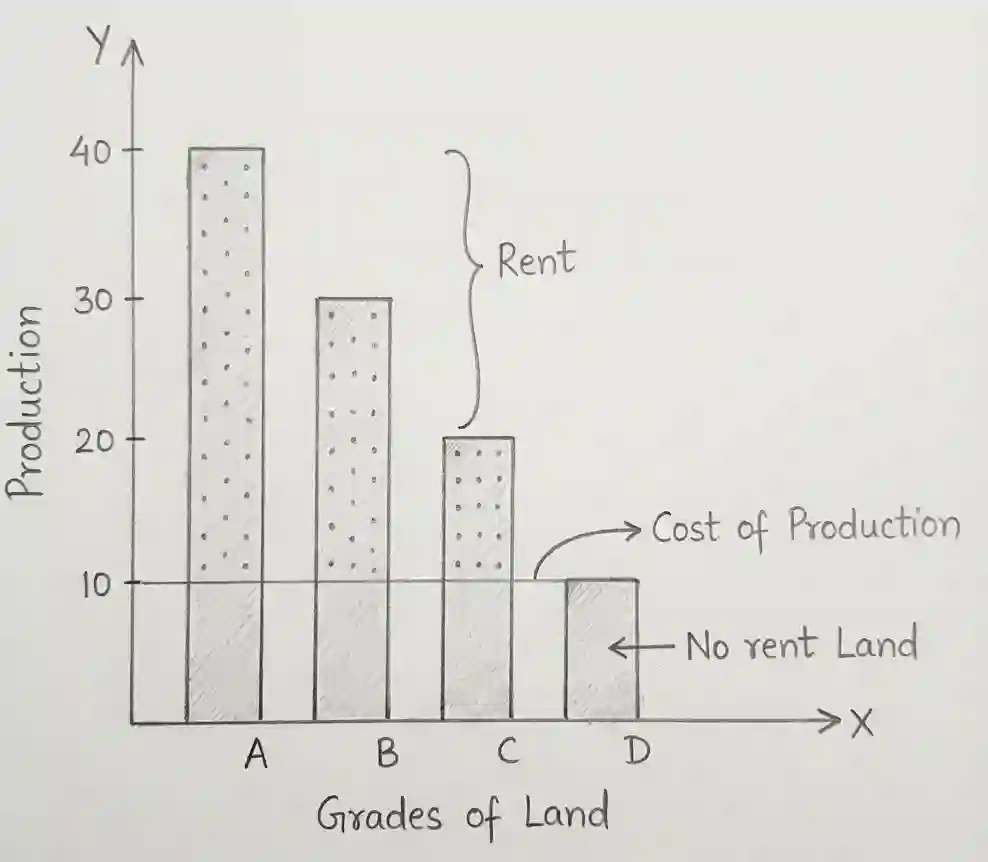
In the given figure, the X-axis represents grades of land and the Y-axis represents production. D grade land is no-rent land. The shaded area shows the amount of rent on different grades of land. A grade land earns 30 quintals, B grade earns 20 quintals, and C grade earns 10 quintals of rent as shown in the figure. Thus, according to Ricardo, rent arises because of different productive powers of different grades of land.
| Gross Interest | Net Interest |
|---|---|
| Gross interest is the total amount paid by a borrower to the lender in return of the capital borrowed for a period of time. | Net interest is the price paid by a borrower to the lender only for the use or service of the capital. |
| It is a broad concept as it includes net interest and other charges. | It is a narrow concept as it is a part of gross interest. |
| The rate of gross interest differs in the market. | The rate of net interest remains almost the same in the market. |
| It is a practical concept which is applicable in the real life. | It is purely a theoretical concept which has no practical application. |
| It is determined by several factors beside demand for and supply of the capital. | It is determined by the demand for the capital and supply of the capital. |
The Wage Fund Theory was formulated by J.S. Mill in his book ‘Principles of Political Economy’. According to this theory, wages depend upon the relationship that exists between the supply of population and the capital available to employ workers.
Here, the population refers to the number only of the labouring classes or those people who offer their services for hire, and the capital refers to the amount of capital to be used for the payment of wages and any amounts incidental to the hire of labours. Thus, the available funds for wages are fixed at any given time, which is called the wage fund, and the only way to increase wages is to reduce the number of workers to be paid. The level of wage at any moment of time is equal to the ratio of the wage fund and the number of labourers to be paid, i.e.,
Level of Wage = Wage Fund / Number of Workers
Assumptions:
- Capital stock or wage fund is fixed, and it is built from the saving of the previous period.
- Wage fund is raised before the employment of workers.
- The level of wage is fixed after the employment of workers.
- The units of labour are homogeneous.
- Workers are paid wages equally out of the predetermined wage fund.
- The wage level is flexible to the change in the number of workers employed.
- Money works only as a medium of exchange.
- There exists a direct relationship between the level of wage and wage fund and an inverse relationship between the level of wage and the number of workers.
| Wage Fund (In Rs.) | Number of Workers | Level of wage = Wage Fund / Number of Workers |
|---|---|---|
| 10,000 | 50 | 200 |
| 10,000 | 100 | 100 |
| 10,000 | 200 | 50 |
| 10,000 | 250 | 40 |
The above table shows the inverse relationship between the number of workers employed and the level of wage under the Wage Fund Theory of Wages. On the basis of the above table, we can draw the following figure.
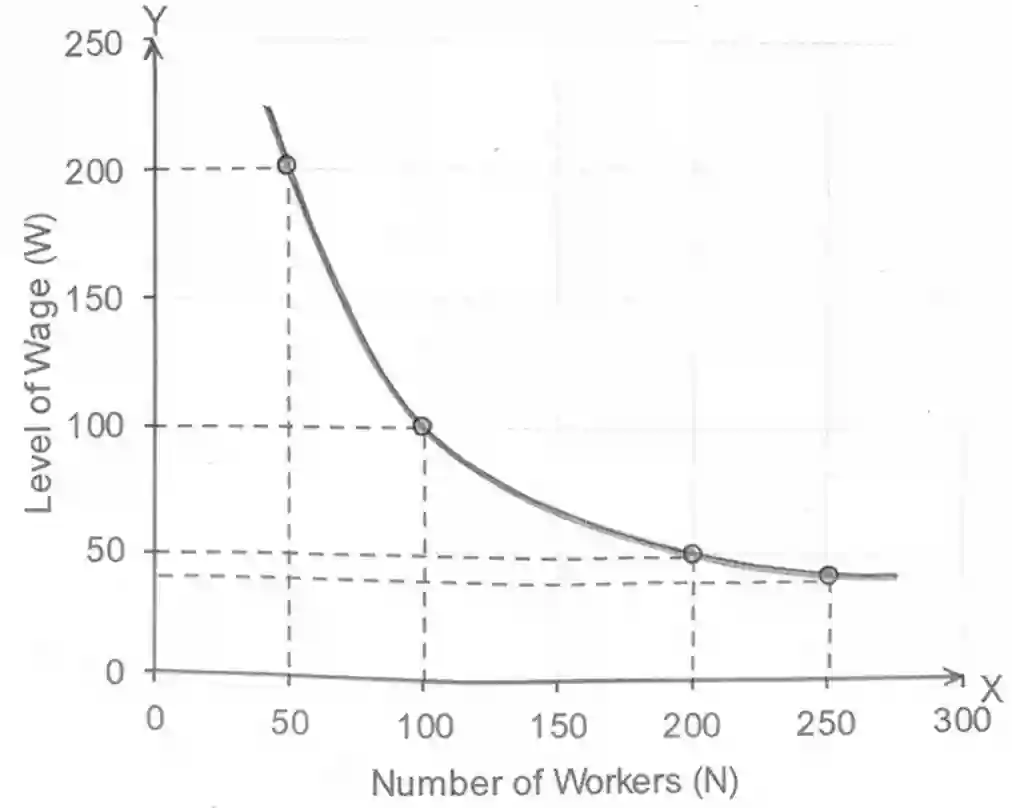
In the figure, the number of workers and the level of wage are measured along the horizontal axis and vertical axis respectively. Here, the wage fund is assumed to be fixed in the short run. The downward-sloping convex curve shows the inverse relationship between the number of workers employed and the level of wage i.e. the higher the number of workers, the lower the level of wage and vice versa.
The Risk Theory of Profit was developed by the American economist, Prof. Hawley in 1907. According to this theory, the entrepreneur earns profit because he undertakes ‘risks’. Hawley points out that the most essential function of the entrepreneur is risk taking.
Risks are inherent in all types of production. Risks are assumed to be unpleasant and irksome. Therefore, no one would like to bear the risk unless he expects a reward for it. Hence, profit is the reward of risk. The higher the risk, the greater will be the expected reward and vice-versa.
In simple words, Hawley has cleared that it is the risk taking function of the entrepreneur which is the basis of profit. The real producer of the output is the entrepreneur and not the other factors of production; as the other factors – land, labour and capital – are paid the fixed remuneration. They are mere ‘means of production’. In the absence of the entrepreneur, they remain unutilized. Thus, a reward must be given to the entrepreneur for his taking risks. The reward is called profit.
The Uncertainty Bearing Theory of Profit was first developed by the American economist Prof. F.H. Knight in 1921 AD. It is an improvement on Hawley’s theory of profit. According to Prof. Knight, profit arises on account of uncertainty-bearing rather than the risk-taking function of the entrepreneur.
He says that there are certain risks which can be foreseen or forecasted. Thus, they are not risk proper. Knight divides the risks into two kinds:
- Insurable risks: Risks about which certain predictions and estimates are possible can be insured; they are called known risks or insurable risks. For example, predictions regarding fire, accidents, theft, etc., are easily possible. Therefore, these risks are insured. Actually, after insurance, they do not remain risks at all.
- Non-insurable risks: Some risks cannot be predicted, so they cannot be insured. This is why they are called unknown or non-insurable risks. These risks create uncertainties, and the entrepreneur bears these uncertainties or unknown risks. These risks are competition risks, technological risks, risk of government intervention, business cycle risks, etc.
Weakness/Criticisms:
- No profit despite uncertainty-bearing: According to this theory, profit is the reward for uncertainty-bearing. But critics point out that sometimes an entrepreneur earns no profit despite uncertainty-bearing.
- Incomplete theory: Profit is not a reward only for bearing uncertainty. According to critics, there are also other causes of profit in addition to uncertainty-bearing, such as initiating, coordinating, bargaining, etc. Thus, it is an incomplete theory of profit.
- Uncertainty is not a separate factor of production: Knight assumes that like land, labour, capital, etc., uncertainty is also a separate factor of production, which is not correct.
- Unable to explain monopoly gain: The theory does not suit well to expose the phenomenon of monopoly profit when there is the least uncertainty involved in a monopoly business.
| Contract Rent | Economic Rent |
|---|---|
| Contract rent refers to the total payment made to the landlord by the tenant for the use of land according to their mutual agreement. | Economic rent is a part of contract rent which is paid only for the use of land. |
| It consists of economic rent, interest on capital invested in the land by the owner in the form of buildings, fences, drainage, well, etc. | It does not consist of any other payments. It is obtained by deducting all the expenses incurred in the process of production from the total revenue of land. |
| It can be obtained from all the grades or types of land. | It cannot be obtained from the marginal land. |
| The change in the price of the product does not affect the contract rent. | The change in the price of the product influences the economic rent. |
| It depends on the demand and the supply of the land. | It depends on the total production of the land and the cost of production. |
Wage: Wage is the remuneration or price paid to the labour for the use of his or her service in the production. In other words, the reward paid to the worker for his or her mental or physical work is called wage in economics.
| Money Wage | Real Wage |
|---|---|
| Money wage is the wage received by a labour in the form of money. It is also known as the nominal wages. | Real wage is the wage measured in terms of purchasing power. |
| It is expressed in terms of money. | It is expressed in terms of goods and services. |
| It excludes extra facilities of labour’s occupation. | It includes extra facilities of labour’s occupation. |
| It is a narrow concept. | It is a broad concept. |
| Money wage alone cannot indicate the economic position or living standard of the labour of a particular country. | Real wage determines the economic position or living standard of the labour of a particular country. |
Long Answer Questions [8/10 Marks]
Profit: The reward of the entrepreneur is called profit. In other words, it is defined as the reward that an entrepreneur gets in return for his or her function of taking risk or bearing uncertainty in business.
Risk Theory of Profit:
The Risk Theory of Profit was developed by the American economist, Prof. Hawley, in 1907. According to this theory, the entrepreneur earns profit because he undertakes ‘risks’. Hawley points out that the most essential function of the entrepreneur is risk-taking. Risks are inherent in all types of production. Risks are assumed to be unpleasant and irksome. Therefore, no one would like to bear the risk unless he expects a reward for it. Hence, profit is the reward of risk. The higher the risk, the greater will be the expected reward and vice-versa. In the words of Hawley, “Risk bearing is the special function of an entrepreneur. None would be prepared to undertake the hazard of production unless he expects to earn a profit. Profit is thus the price of risk bearing.”
In simple words, Hawley has cleared that it is the risk-taking function of the entrepreneur which is the basis of profit. The real producer of the output is the entrepreneur and not the other factors of production, as the other factors—land, labour, and capital—are paid fixed remuneration. They are mere ‘means of production’. In the absence of the entrepreneur, they remain unutilized. Thus, a reward must be given to the entrepreneur for taking risks. The reward is called profit.
Criticisms:
- Not a reward for all types of risks: This theory does not make the distinction between insurable risks and non-insurable risks. Insurable risks cannot be the reason for the emergence of profit.
- Reward for reducing risk: According to Prof. Carver, an entrepreneur does not receive profit because he bears the risk, but he avoids the risk by his intelligence and ability.
- No direct relation between risk and profit: There is no direct relationship between the amount of risk and profit. It is not necessary that occupations having higher risk should give more profits.
- Narrow theory: Critics point out that risk-bearing is not the only function of an entrepreneur. He has to perform several decision-making functions regarding the management and output in the industry.
Ricardian Theory of Rent:
The repeated content can be found Ricardian theory of rent.
Criticisms:
The criticisms of Ricardian theory of rent are as follows:
- No original and indestructible power of the soil: The main criticism of this theory is that the power of the soil is neither original nor indestructible as pointed out by Ricardo. By constant cultivation, even the most fertile pieces of land lose their fertility.
- Historically wrong order of cultivation: Ricardo assumes that land is cultivated in order of fertility, i.e., from the most fertile to the least fertile. But land is generally cultivated according to the situation. Thus, the order of cultivation laid down by Ricardo is not always followed in practical life.
- Rent arises for all factors of production: Ricardo believed that rent is paid for the use of original and indestructible power of the soil. Therefore, rent is paid for land only. But modern economists are of the view that rent is paid for any factor of production which has perfectly inelastic supply.
- Rent enters into price: According to Ricardo, rent does not enter into price. However, modern economists are of the view that an individual producer has to pay for the services of land he has used. Therefore, it is included in the cost of production, hence it affects the price and rent enters into price.
- Marginal land: Ricardo’s concept of no rent land or marginal land is not necessarily found in any country of the world. It is just an imaginary concept.
Theory: Classical theory of interest is also known as Demand and Supply Theory of Interest. This theory was originally developed by the old classical economists. Later, it was refined and popularized by neo-classical economists like Marshall, Pigou, Walras, Taussing, and Knight. According to this theory, interest is the price paid for the use of capital. Like prices of other commodities, the price of capital, i.e., the rate of interest, is determined by the demand and supply of capital.
Demand for Capital: Demand for capital arises from investment. Investment is inversely related to the rate of interest. Thus, the demand curve for capital slopes downward to the right, which indicates that the higher the rate of interest, the lower will be the demand for capital and vice-versa.
Supply of Capital: The supply of capital comes out of people’s savings. Saving is positively related to the rate of interest. Thus, the supply curve for capital slopes upward to the right, which indicates that the higher the rate of interest, the greater will be the supply of capital and vice-versa.
Determination of Rate of Interest: The rate of interest is determined at the point where demand for capital (investment) equals the supply of capital (saving) as shown in the following table and diagram.
| Rate of Interest (in %) | Demand for Capital (in Rs.) | Supply of Capital (in Rs.) |
|---|---|---|
| 2% | 30,000 | 10,000 |
| 3% | 20,000 | 20,000 |
| 4% | 10,000 | 30,000 |
It is clear from the above table that as the rate of interest increases from 2% to 4%, the demand for capital declines from Rs. 30,000 to Rs. 10,000, while the supply of capital increases from Rs. 10,000 to Rs. 30,000. When the rate of interest is 3%, the demand for capital is just equal to the supply of capital, i.e., Rs. 20,000. Hence 3% is the equilibrium rate of interest.
Figure:
In the given figure, X-axis represents demand for and supply of capital and Y-axis represents the rate of interest. DD is the demand curve for capital and SS is the supply curve of capital. These two curves intersect at point E. Thus, 3% is the equilibrium rate of interest. At 4% of rate of interest, supply is greater than demand; this leads to a decrease in the rate of interest. Similarly, at 2% rate of interest, demand is greater than supply; this leads to an increase in the rate of interest. Hence, 3% is the equilibrium rate of interest which will come to stay in the market. If any change in the demand for capital and/or supply of capital comes out, the curve will shift accordingly and the equilibrium rate of interest will also change.
Criticisms:
The main criticisms of the classical theory of interest are as follows:
- Saving and investment equality: The rate of interest does not bring about the equilibrium between saving and investment. Keynes says that the equality between saving and investment is brought about by the changes in the level of income.
- Unrealistic assumption of full employment: The classical theory assumes the prevalence of full employment which is unrealistic in the real world. Keynes firmly believed that in the actual world resources are not fully employed and there is less than full employment.
- Indeterminate theory: The classical theory is indeterminate. It says that the rate of interest is determined by the demand and supply of capital. But the supply of capital varies with the general level of income. The classical explanation is thus confusing.
- Saving is not the only source of capital: The classical theory does not take into account the past hoardings and bank credit in the determination of the rate of interest. Its explanation of the supply of saving is, therefore, inadequate.
- Monetary factors ignored: The theory neglects the monetary influences in the determination of the rate of interest. Keynes says that the rate of interest is a monetary phenomenon. It is determined by the demand for and supply of money. The classical theory is, therefore, a partial explanation of the determination of the rate of interest.
Wages Fund Theory:
The Wage Fund Theory was propounded by Adam Smith. Later, it was developed and popularized by J.S. Mill. According to him, wages are determined by the ratio of the labour force to capital stock. He said that a certain fixed proportion of the capital of a country was set apart for payment as wages of labour. According to this theory, at any time, a fixed proportion of capital is allotted for the payment of wages to labour. This proportion is called the wages fund.
Labour force means the number of workers willing to work at the existing wage rate, i.e., the labour supply. Wages at any time are determined by the ratio between the number of workers and the capital that forms the wages fund. Therefore, the level of wages depends on two quantities:
- The wages fund; and
- The number of workers willing to work.
Hence, the level of wages can be obtained simply by dividing the wages fund by the number of workers. That is,
$$ \text{Level of wage} = \frac{\text{Wage Fund}}{\text{Number of Workers}} $$
This relation shows that wages vary directly with the size of the wage fund and inversely with the number of workers. It means the general rate of wages will increase only if the wages fund increases or the supply of labour diminishes. Since the increase in the wages fund is a slow process, because savings increase slowly, if the workers want to increase the rate of wages, they must restrict the number of their children.
Criticisms:
The main criticisms of the Wage Fund theory are as follows:
- Unable to explain the origin of wage fund: This theory does not explain how the wage fund arises and why it remains fixed. Given the wages fund and number of workers, it only explains the process of determination of wages.
- One-sided theory: According to this theory, wages can be increased by decreasing the supply of labour. But wages can also be increased by increasing the wage fund. Therefore, this theory is one-sided.
- Unscientific concept: According to this theory, the wage of the labour is given from the wage fund only. But wages can also be given from the national income. Thus, this theory is unscientific.
- Wrong concept of permanent wage fund: This theory takes the wage fund to be permanent. But this concept is wrong. With increases in the price level, the wage rate should also be increased. So, to increase the wage rate, the wage fund should also be increased.
- Wage rate is not determined by capital: Actually, wages do not correspond to the total amount of capital available. In some countries, wages are high even though capital is scarce.
Profit: The reward of the entrepreneur is called profit. In other words, it is defined as the reward that an entrepreneur gets in return for his or her function of taking risk or bearing uncertainty in business.
Uncertainty Bearing Theory of Profit:
Uncertainty Bearing Theory of Profit was first developed by the American economist Prof. F.H. Knight in 1921 AD. It is an improvement on Hawley’s theory of profit. According to Prof. Knight, profit arises on account of uncertainty-bearing rather than the risk-taking function of the entrepreneur. He says that there are certain risks which can be foreseen or forecasted. Thus, they are not risk proper. Knight divides the risks into two kinds:
- Insurable risks: Risks about which certain predictions and estimates are possible can be insured; they are called known risks or insurable risks. For example, predictions regarding fire, accidents, theft, etc., are easily possible. Therefore, these risks are insured. Actually, after insurance, they do not remain risks at all.
- Non-insurable risks: Some risks cannot be predicted, so they cannot be insured. This is why they are called unknown or non-insurable risks. These risks create uncertainties, and the entrepreneur bears these uncertainties or unknown risks. These risks are the following:
- Competition risks: Arise from the possibility of new firms entering the industry.
- Technological risks: Arise from the possibility of newly-installed machinery becoming obsolete (outdated) due to the discovery of some new process.
- Risk of government intervention: Such as price control, tax policy, import and export restrictions, etc., which may result in profit or losses.
- Business cycle risks: Arise because of the occurrence of business depressions when prices fall much more than costs.
These risks create uncertainties in the occupation, and an entrepreneur gets profit only because of bearing these uncertainties. Profit of the entrepreneur depends on the level of such unknown risks or uncertainties.
Criticisms:
Uncertainty Bearing Theory of Profit is criticized as follows:
- No profit despite uncertainty-bearing: According to this theory, profit is the reward for uncertainty-bearing. But critics point out that sometimes an entrepreneur earns no profit despite uncertainty-bearing.
- Incomplete theory: Profit is not a reward only for bearing uncertainty. According to critics, there are also other causes of profit in addition to uncertainty-bearing, such as initiating, coordinating, bargaining, etc. Thus, it is an incomplete theory of profit.
- Uncertainty is not a separate factor of production: Knight assumes that like land, labour, capital, etc., uncertainty is also a separate factor of production, which is not correct.
- Unable to explain monopoly gain: The theory does not suit well to expose the phenomenon of monopoly profit, where there is the least uncertainty involved in a monopoly business.
Subsistence Theory of Wages:
Subsistence Theory of Wages was propounded by Quesnay, a French economist, and later it was developed by David Ricardo. This theory of wages is also called the ‘Iron Law’ of wages. This theory is associated with the Malthusian Theory of Population. According to this theory, workers should be paid at minimum subsistence level – the level which will be just sufficient to maintain their minimum standard of living. If they are given higher wages than the minimum subsistence level, they will become well off. They are encouraged to marry more wives and to have a large family. Supply of labour, thus, increases and it exceeds the available demand. When supply exceeds the demand for labour at the prevailing wage rate, the wage tends to reduce to the minimum subsistence level.
In the same way, if workers are paid below the minimum subsistence level, they would be unable to join their hand to mouth. Starvation, disease, malnutrition, death etc. will be the result. This will reduce the labour supply, and demand for labour exceeds the available supply at the prevailing wage rate. Wage, thus, tends to increase to the minimum subsistence level.
In this way, wages over the long-run will be equal to the minimum subsistence level. If workers are paid above or below the minimum subsistence level, market mechanism would automatically bring it to the minimum subsistence level in the long-run.
Criticisms:
The subsistence theory of wages is criticized as follows:
- Basis of exploitation: This theory ignores the productivity aspect and argues that workers should be paid at minimum subsistence level whatever be the production and productivity.
- Fails to explain wages variation: This theory has failed to explain the wage variation of workers. A professor and a doctor cannot be paid the same wages as a farm worker, although the subsistence requirement is basically the same. Similarly, workers with high efficiency and high productivity will certainly get more wages than unskilled ones.
- Unrealistic: This theory is based on unrealistic assumptions that the supply of labour increases with an increase in the wages of the workers. But critics point out that increased wages can improve the standard of living of the workers and not their supply alone.
- Ignores the demand side: This theory is one-sided. It has ignored the demand side. Only the supply side has been overemphasized.
- Subsistence level not specific: Subsistence level depends on several factors such as physical condition, nature of work, habit and custom, etc. of the workers. That’s why it may differ from worker to worker.
- Ignores the role of trade union: This theory ignores the influence of Trade Unions on wages. Trade unions play an important role in the determination of wages. Sometimes, it can increase wages much beyond the level of subsistence.
Numerical Questions
Solution:
Given:
Wage fund (W) = Rs. 30,000
Number of workers (N) = 50 + 10 = 60
We know that:
Wage rate = W / N
= 30,000 / 60
= Rs. 500
Solution:
Given:
Produce of landlord’s land = 80 quintals maize
Produce of marginal land = 60 quintals maize
We know that:
Rent = Produce of higher graded land – Produce of marginal land
= 80 – 60
= 20 quintals maize
| Rate of interest (%) | Investment (Rs. in crores) | Saving (Rs. in crores) |
|---|---|---|
| 8 | 40 | 90 |
| 7 | 50 | 70 |
| 6 | 60 | 60 |
| 4 | 80 | 40 |
Solution:
Here, Investment and saving are equal at 6% interest rate.
Therefore, equilibrium rate of interest is 6%.
Solution:
Given:
Produce of landlord’s land = 40 quintals maize
Produce of marginal land = 40 quintals maize
Rent = Produce of higher graded land – Produce of marginal land
= 40 – 40 = 0
Therefore, the landlord’s land is no rent land.
Solution:
Given:
Wage fund (W) = Rs. 40,000
Number of workers (N) = 80
We know that:
Wage rate = W / N
= 40,000 / 80
= Rs. 500